Free Printable Difference Quotient Worksheets for Year 12
Year 12 difference quotient worksheets from Wayground provide comprehensive printables and practice problems that help students master this fundamental calculus concept through step-by-step exercises with complete answer keys.
Explore printable Difference Quotient worksheets for Year 12
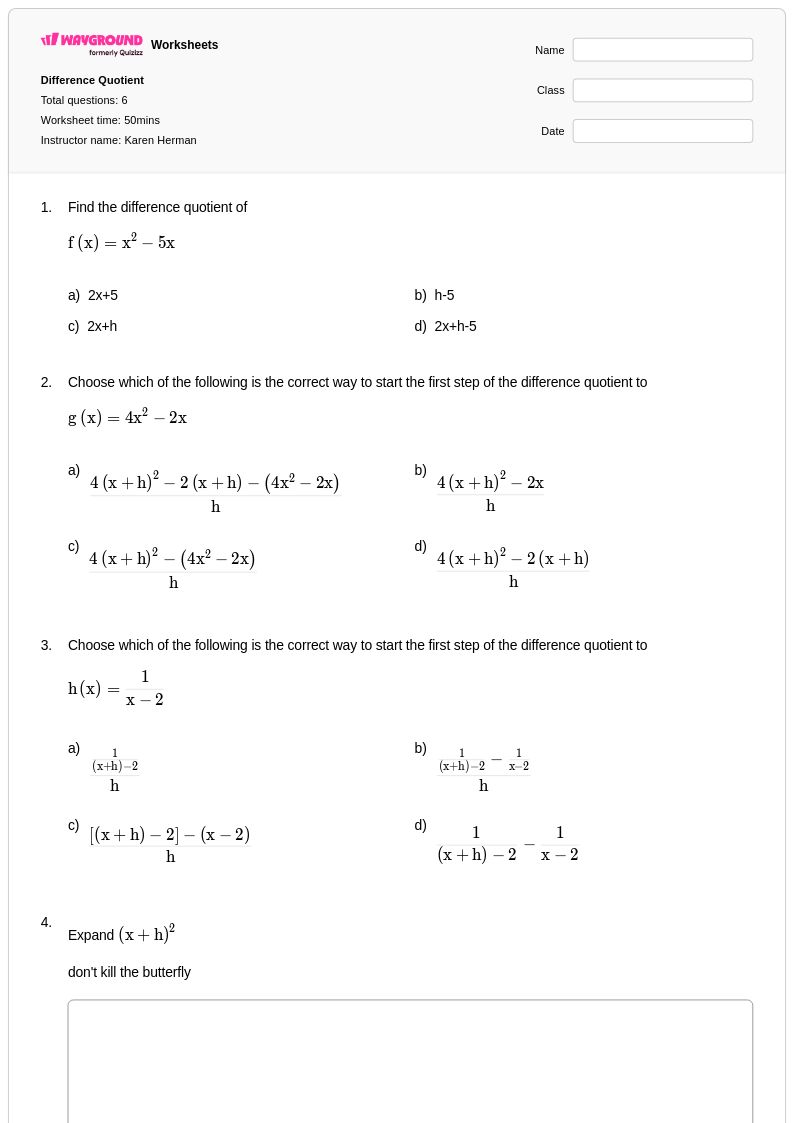
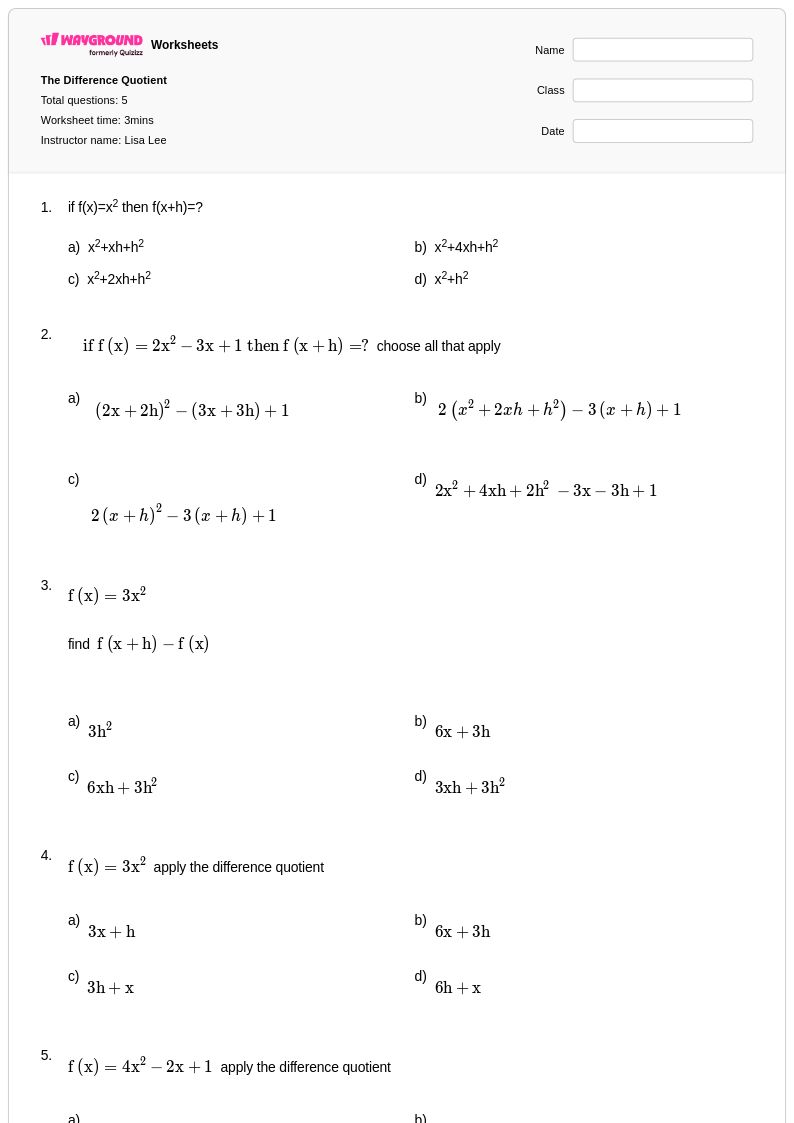
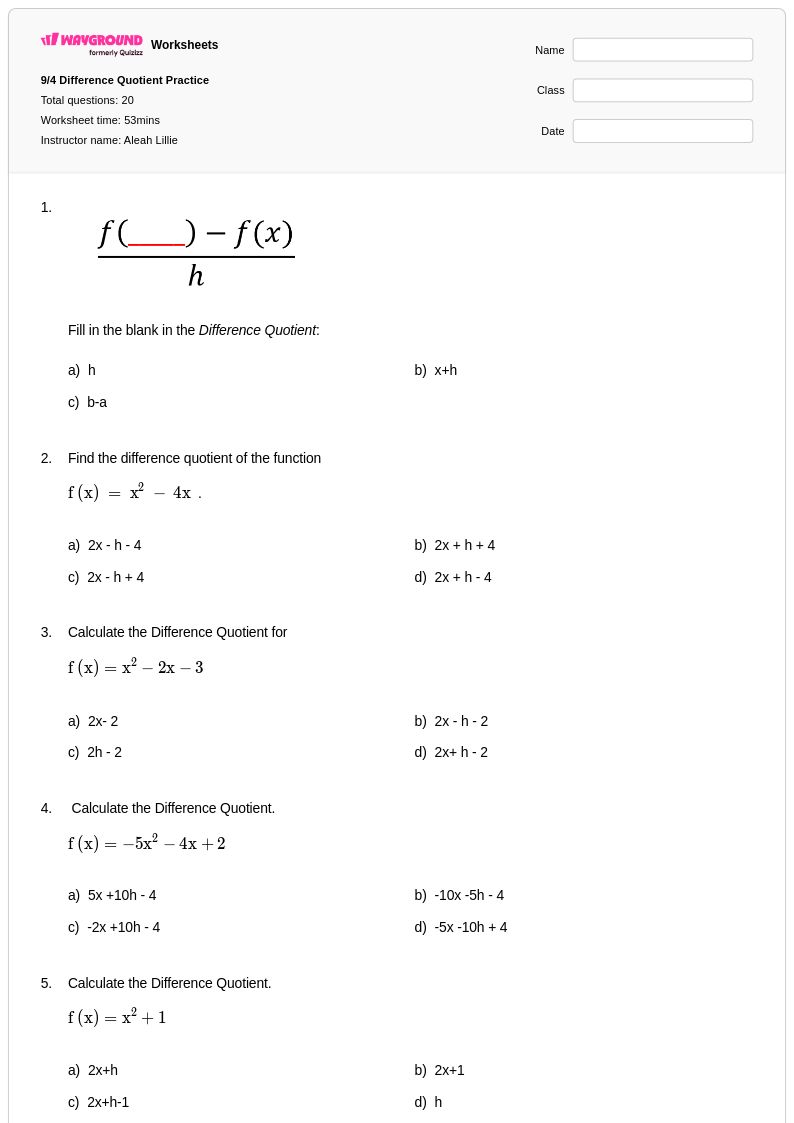
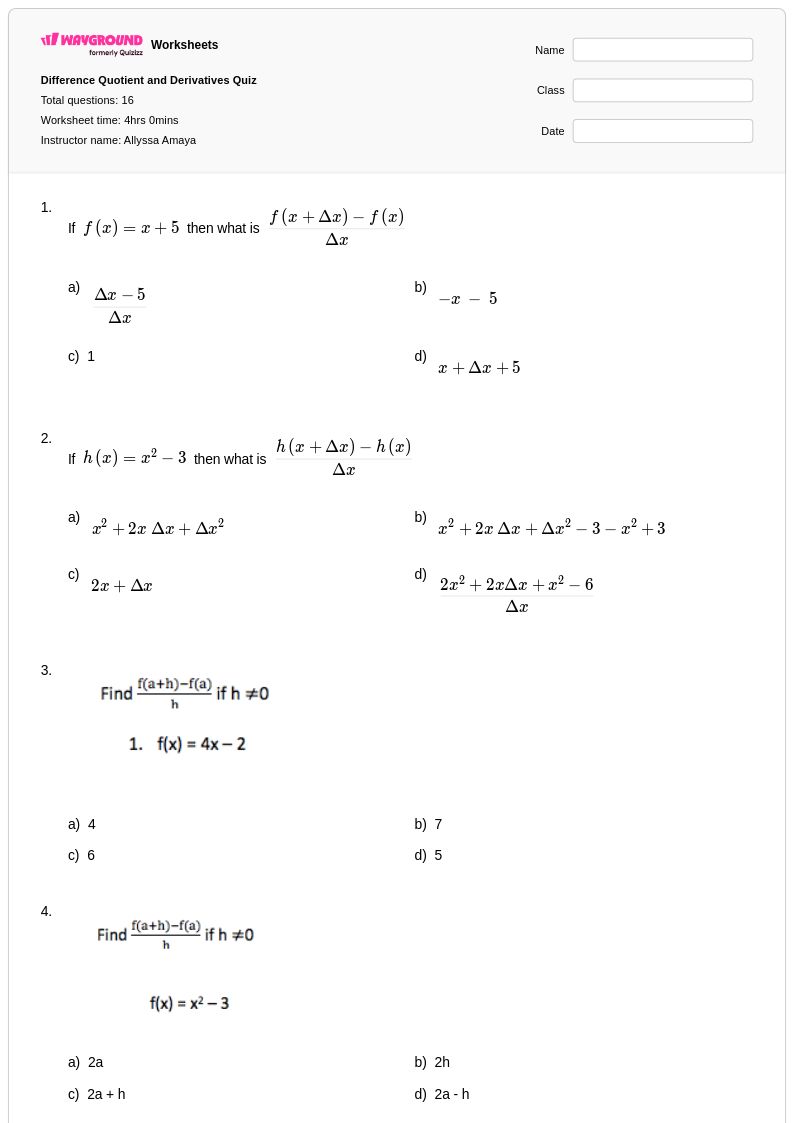
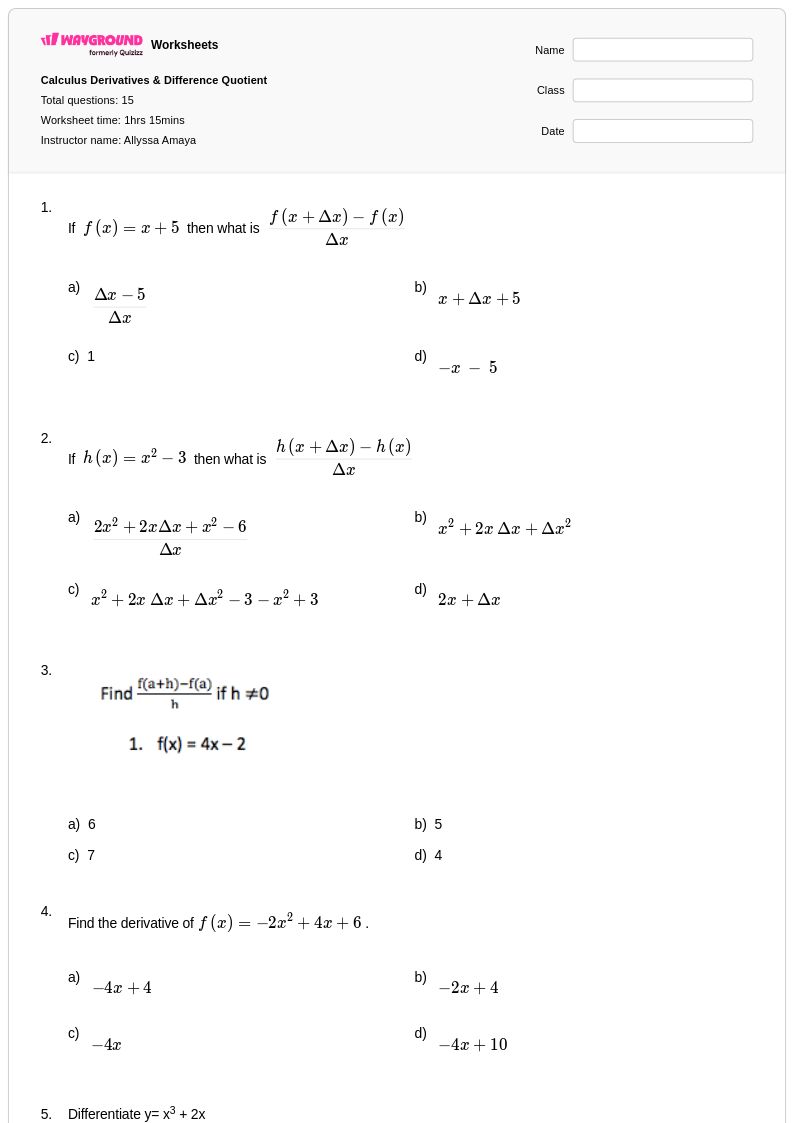
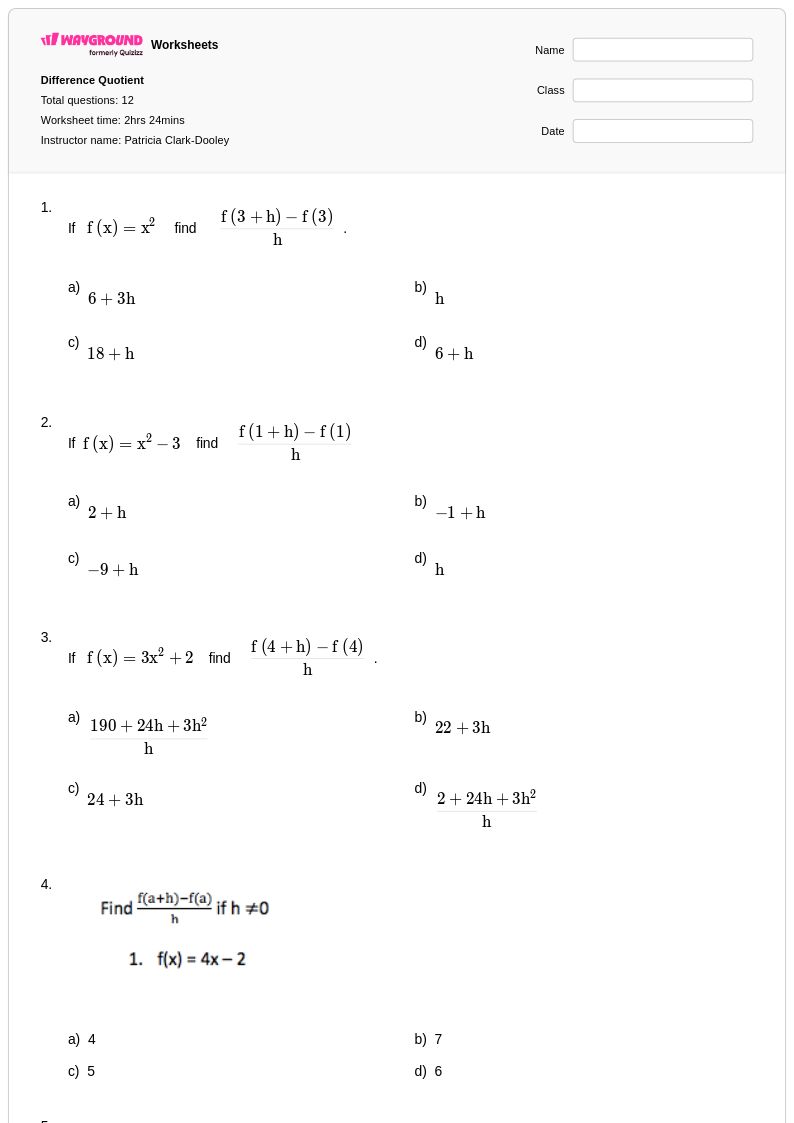
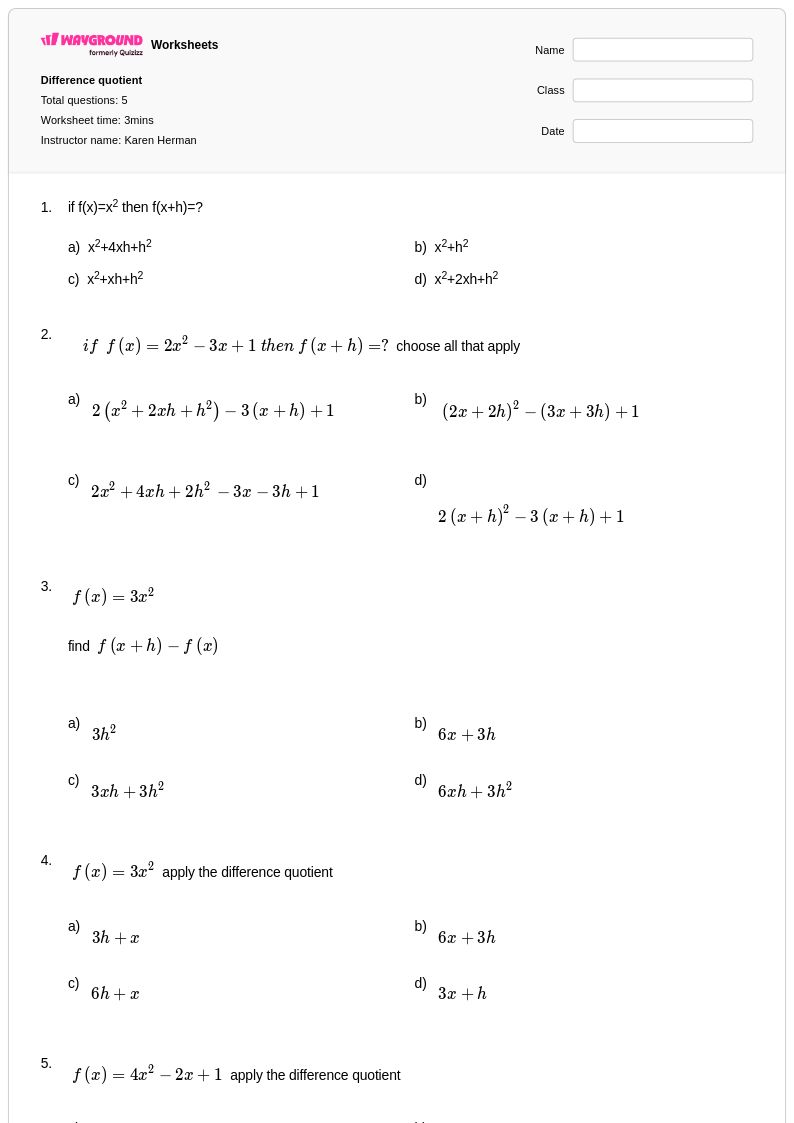
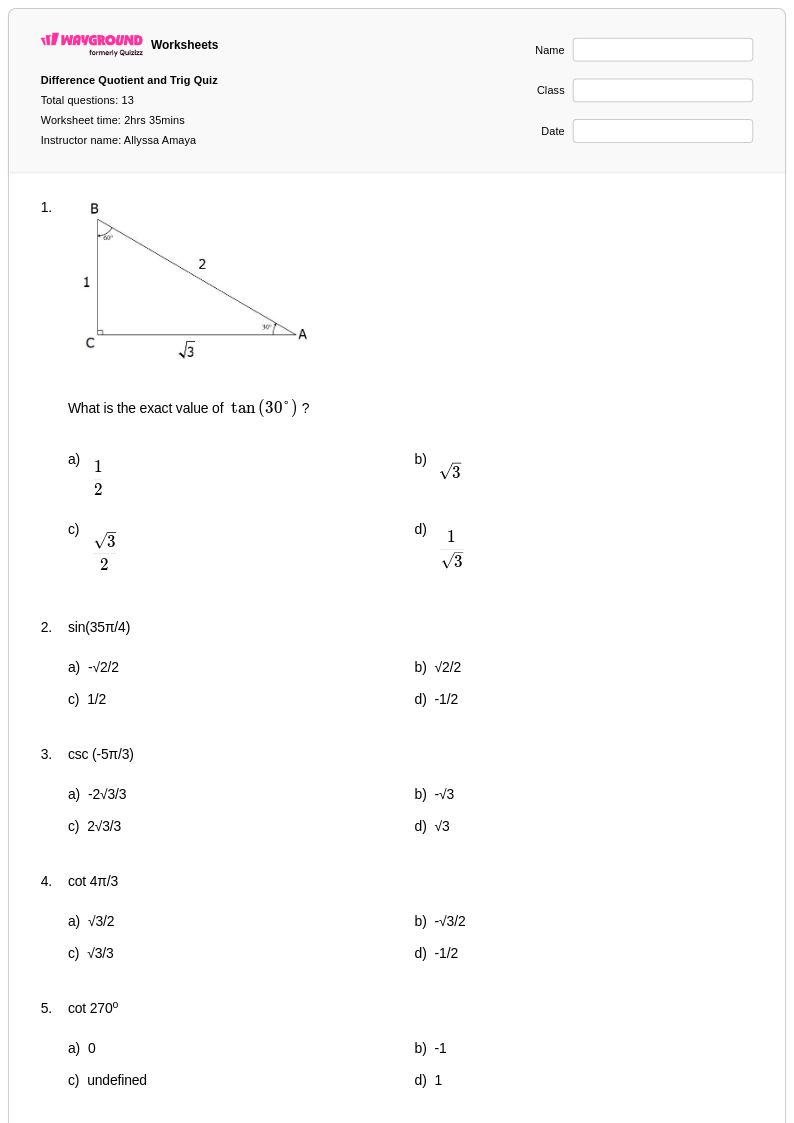
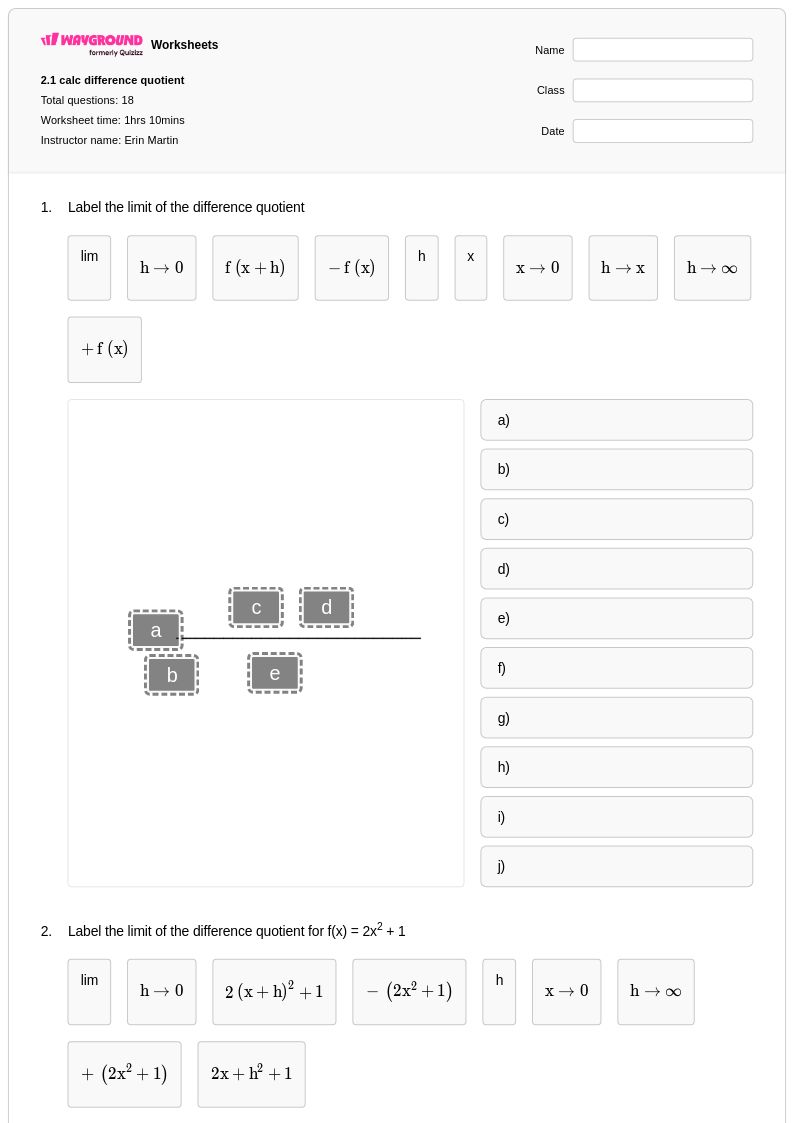
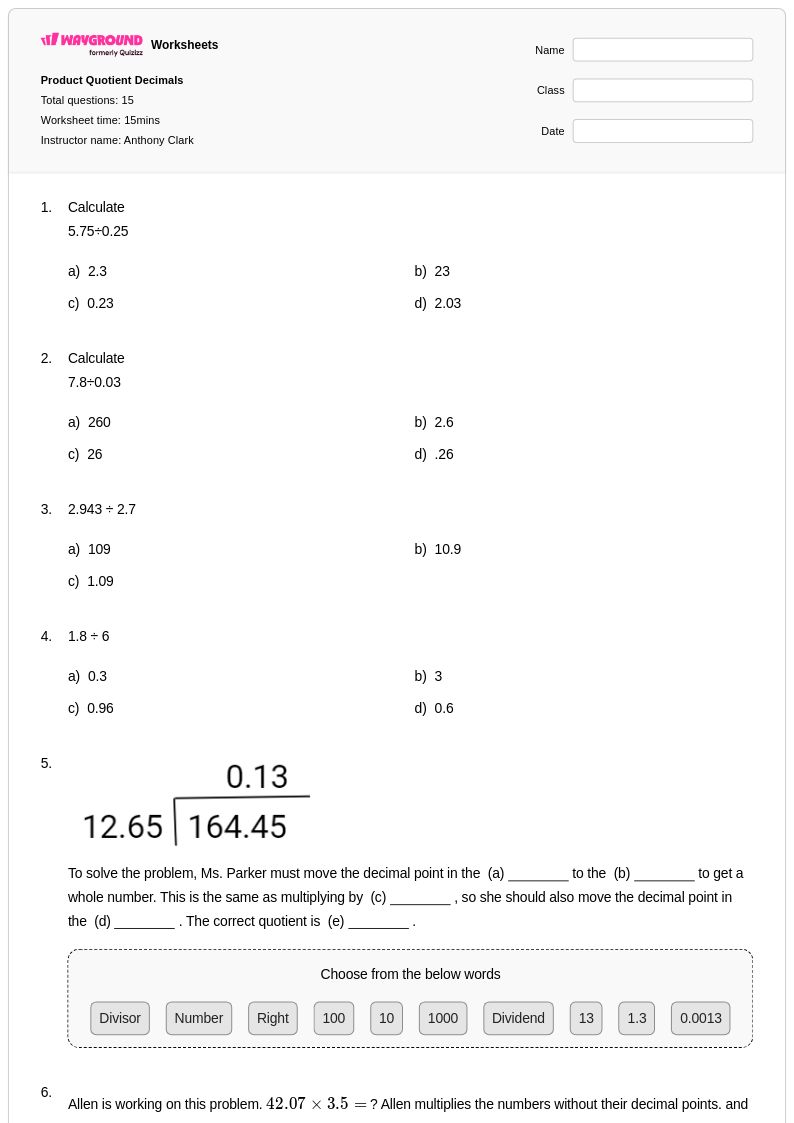
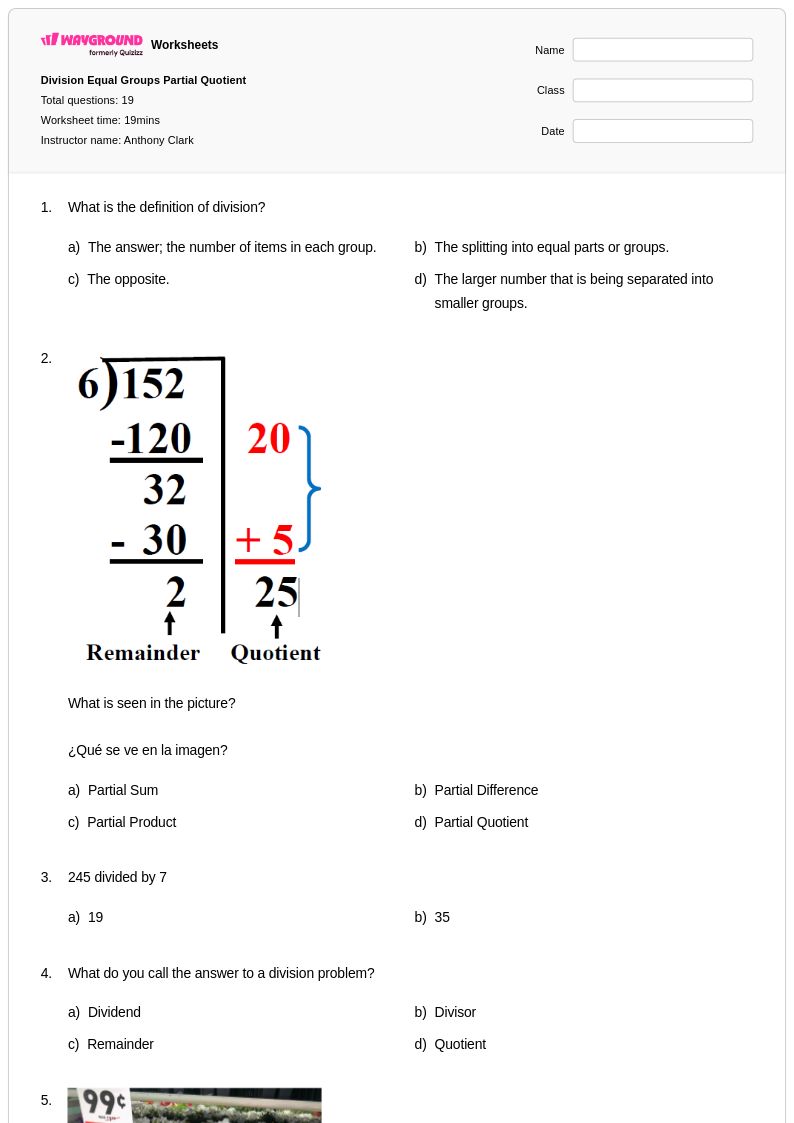
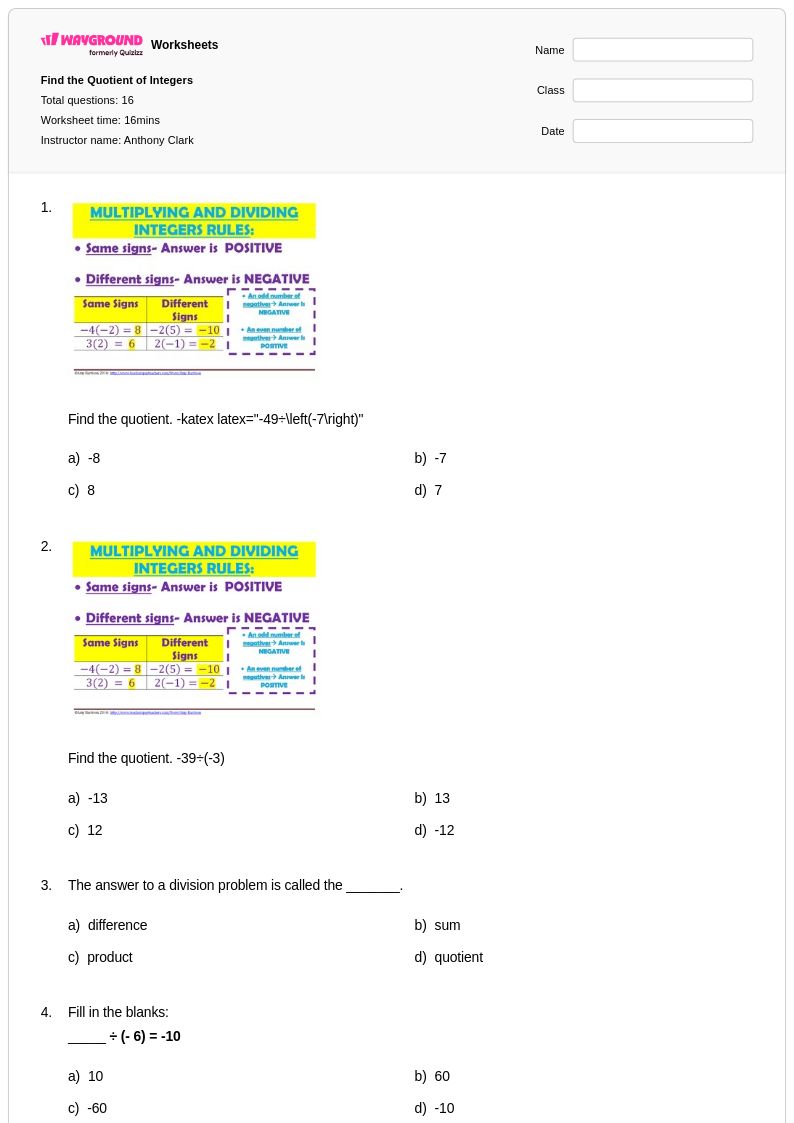
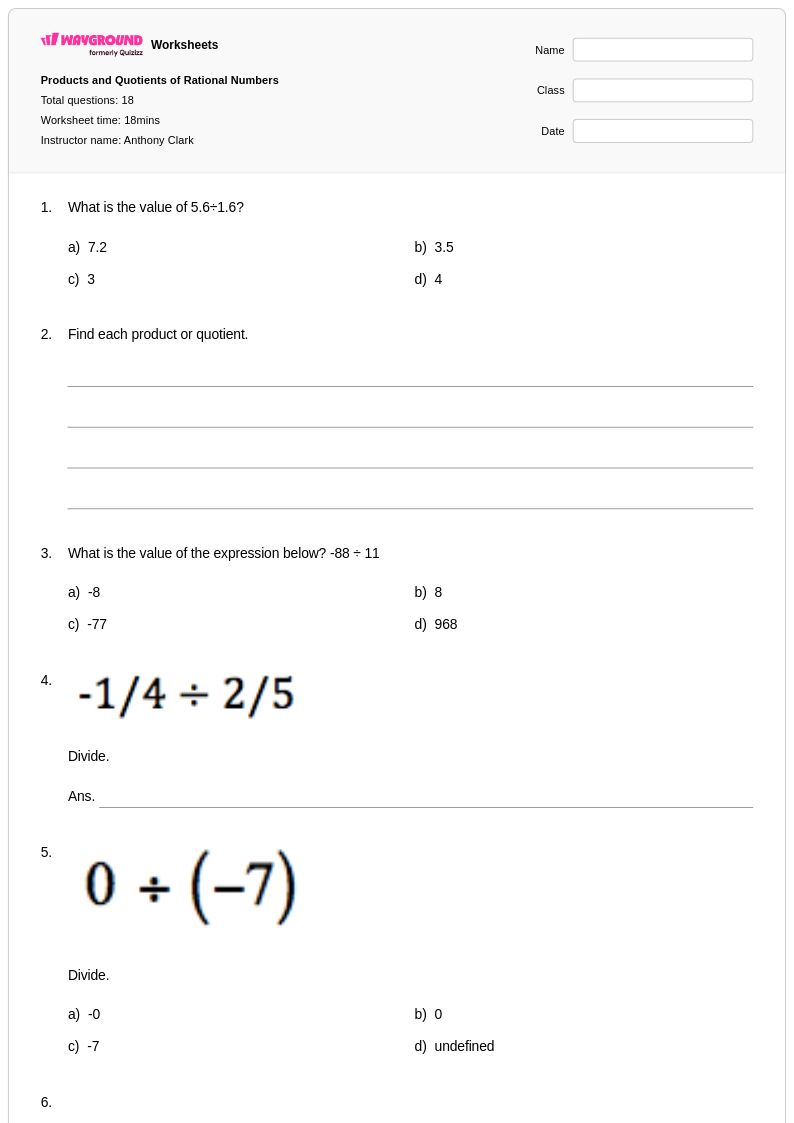
Difference quotient worksheets for Year 12 students available through Wayground (formerly Quizizz) provide comprehensive practice in understanding and calculating this fundamental calculus concept that serves as the foundation for derivatives. These carefully designed worksheets guide students through the process of evaluating the difference quotient formula (f(x+h) - f(x))/h for various polynomial, rational, and radical functions, strengthening their algebraic manipulation skills and conceptual understanding of instantaneous rate of change. Students work through systematic practice problems that progress from basic polynomial functions to more complex scenarios involving trigonometric and exponential functions, with each worksheet including detailed answer keys and step-by-step solutions. These free printable resources in convenient pdf format help students master the algebraic techniques required for simplifying complex expressions while building intuition about limits and derivative concepts that are essential for advanced calculus success.
Wayground (formerly Quizizz) empowers mathematics teachers with access to millions of educator-created difference quotient worksheet collections that feature robust search and filtering capabilities aligned to common calculus standards. Teachers can easily locate materials that match their specific instructional needs, whether focusing on polynomial functions, rational expressions, or mixed practice sets, and customize worksheets to accommodate different learning levels through built-in differentiation tools. The platform's flexible format options allow educators to seamlessly integrate these resources into both traditional classroom settings and digital learning environments, providing printable pdf versions for homework assignments alongside interactive digital formats for immediate feedback. These comprehensive worksheet collections support effective lesson planning by offering varied problem types for initial instruction, targeted remediation for struggling students, and enrichment opportunities for advanced learners, enabling teachers to provide systematic skill practice that builds student confidence in manipulating algebraic expressions and understanding the conceptual foundations of differential calculus.
FAQs
How do I teach the difference quotient in 12th grade?
By grade 12, most students are in Calculus or AP Calculus, so the difference quotient should be taught as the formal definition of the derivative — not just a formula to simplify. Work through the full limit: simplify (f(x+h) - f(x))/h algebraically, then evaluate as h → 0. Use a concrete example like f(x) = x² to show that the process yields 2x, which students can verify matches the power rule. That connection between the definition and the shortcut rules they'll use all year is worth making explicit.
What exercises help 12th graders practice the difference quotient?
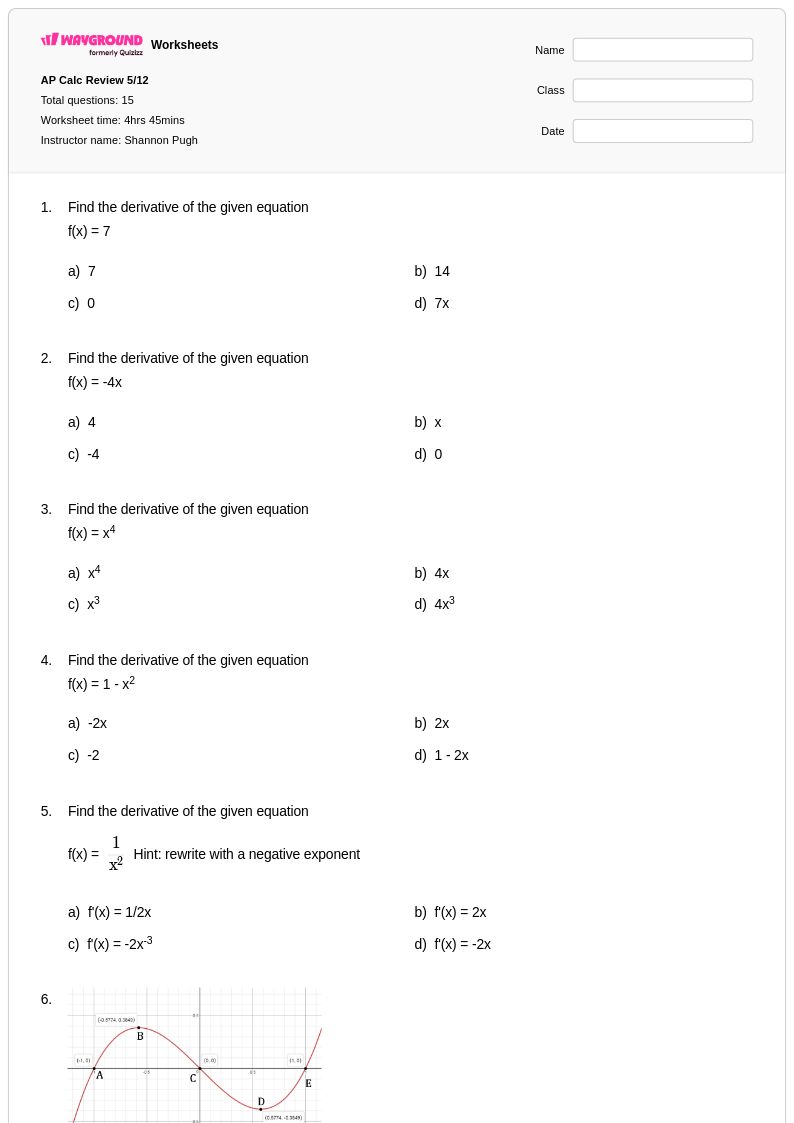
At grade 12, practice should span the full range of function types: polynomials, rational expressions, radicals, and, for calculus courses, trigonometric and exponential functions. Problems that ask students to find the derivative using the limit definition (rather than just simplify the expression) are the most valuable, because they reinforce why the formula matters. Mixed sets without labeled function types are also useful: they force students to recognize the algebraic structure and choose their approach.
What mistakes do 12th graders make with the difference quotient?
With trigonometric functions, students often don't know how to expand sin(x+h) or cos(x+h) and stall immediately — reviewing the sum identities before assigning those problems saves a lot of frustration. With exponential functions, the common error is treating e^(x+h) as e^x + e^h instead of e^x · e^h. Both are prerequisite knowledge gaps, not difference quotient misunderstandings, so a quick diagnostic on those identities before the worksheet is worth the five minutes.
How do I use Wayground's Grade 12 difference quotient worksheets?
Each worksheet includes a complete answer key and step-by-step solutions, which makes them well-suited for self-paced review or test prep. Host the worksheet as a digital quiz on Wayground for immediate feedback, or print the PDF for in-class work — the Wayground for Teachers app lets you scan paper submissions for grading, which is practical when you want students working through multi-step derivations by hand. The step-by-step solutions are especially useful here: when a student's final answer is wrong, the solution shows exactly where the algebra diverged.
How does the difference quotient connect to what 12th graders are learning in calculus?
The difference quotient is the formal definition of the derivative, so at grade 12 it's not a standalone topic — it's the foundation everything else rests on. Differentiation rules like the power rule, product rule, and chain rule are all shortcuts derived from this definition. Students who understand the limit process behind the formula are better equipped to handle edge cases, like differentiating piecewise functions or verifying whether a derivative exists at a point, where the rules alone don't tell the whole story.
How can I differentiate difference quotient practice for my 12th-grade class?
Route students by function complexity: polynomial and rational problems for students consolidating their algebra, trigonometric and exponential problems for students ready for the full calculus treatment. For students who need accessibility support, Wayground lets you adjust font size and spacing or apply a dyslexia-friendly font to the same worksheet — useful when the density of algebraic notation is itself a barrier. Extended time settings on digital assignments can be configured per student without any visible difference to the rest of the class.