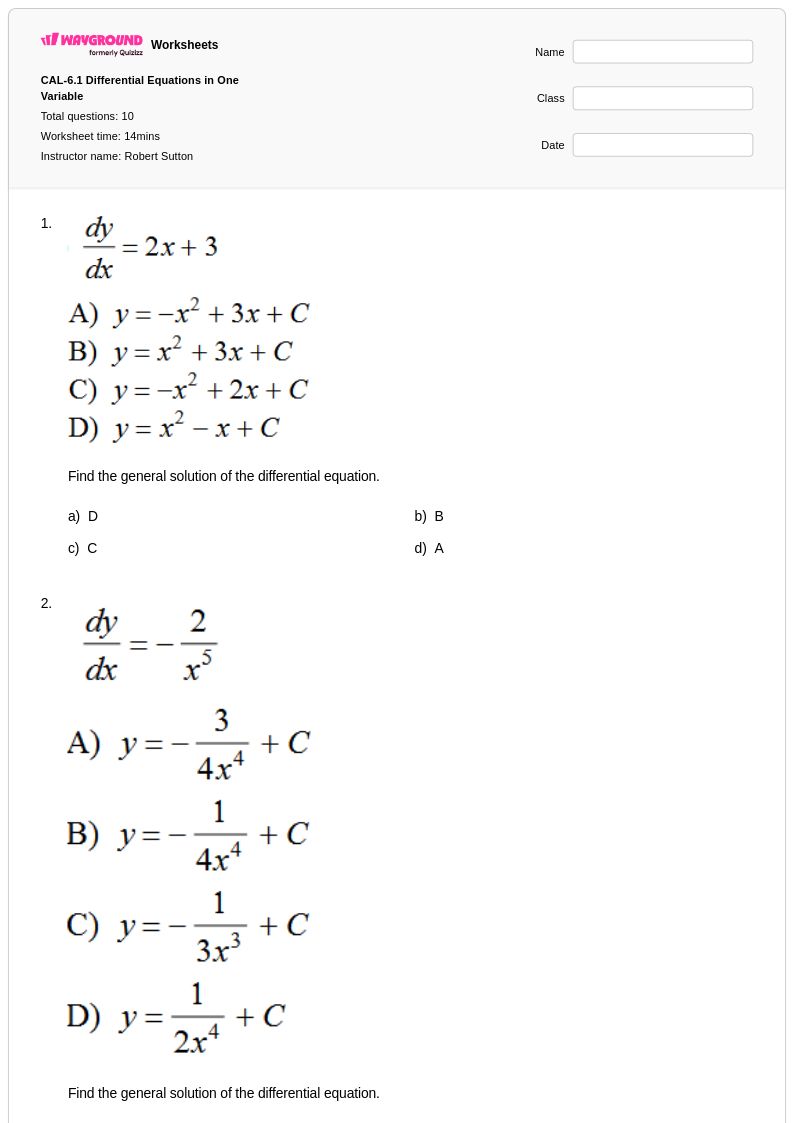
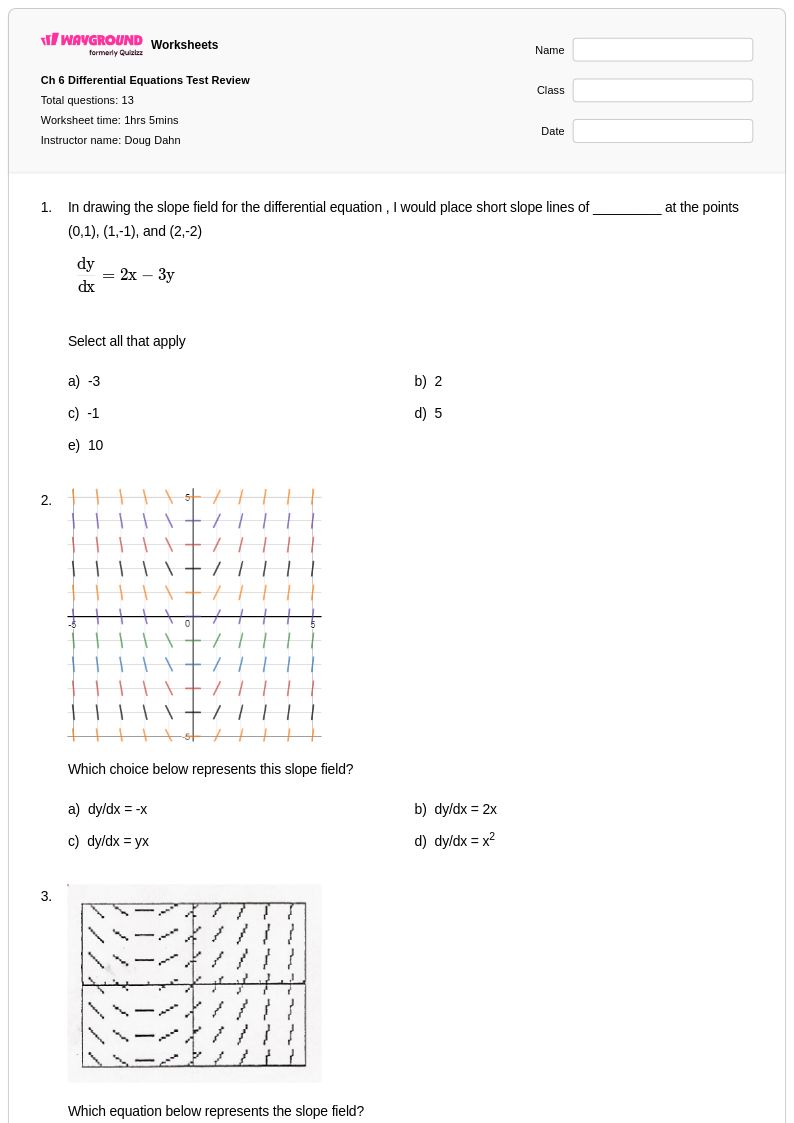
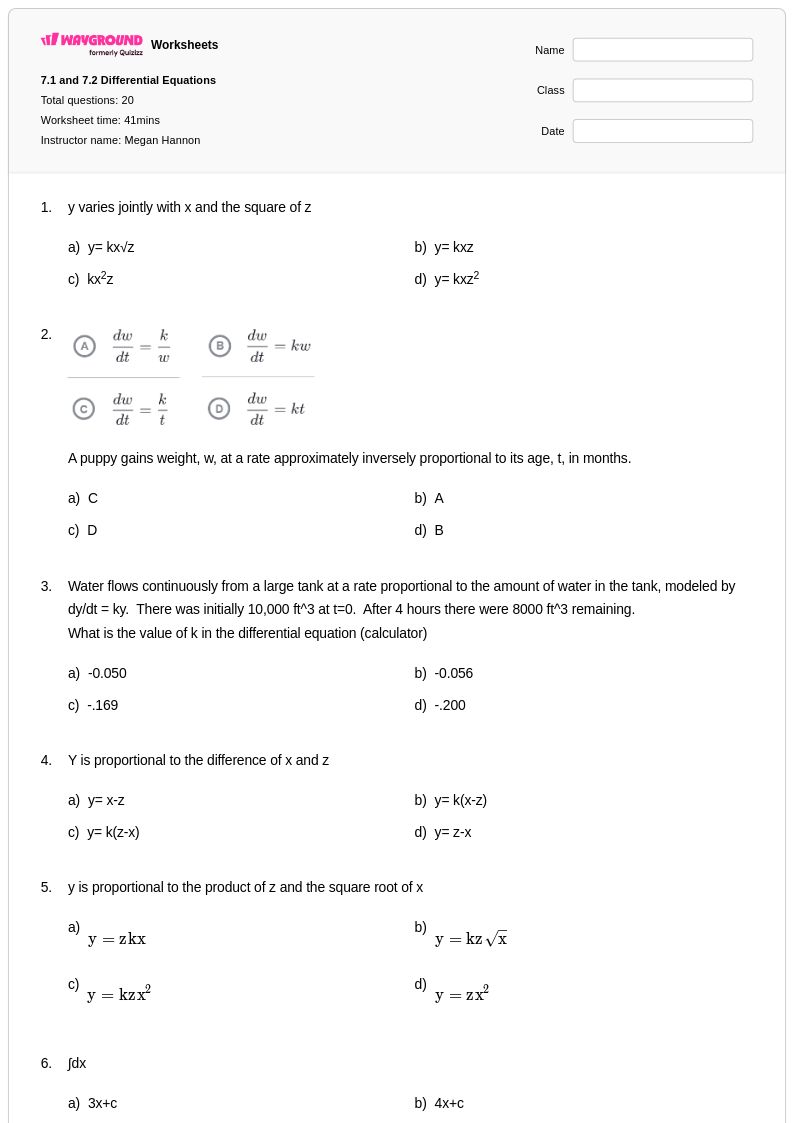
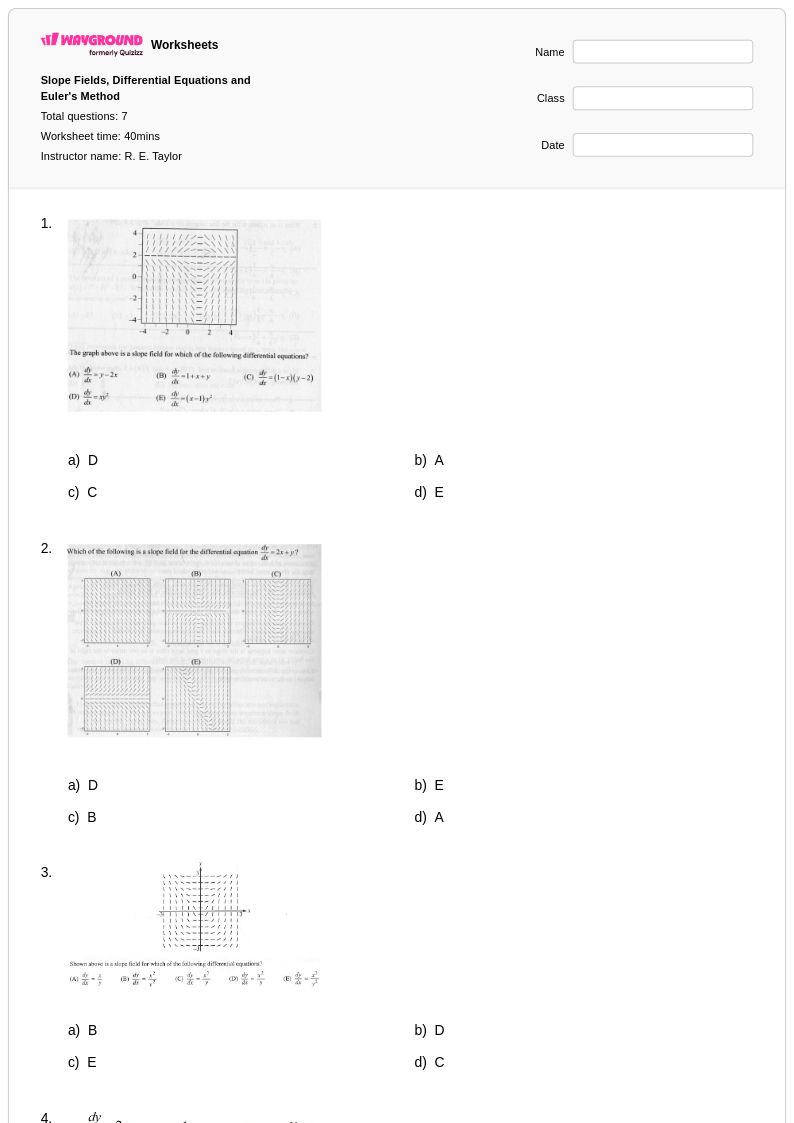
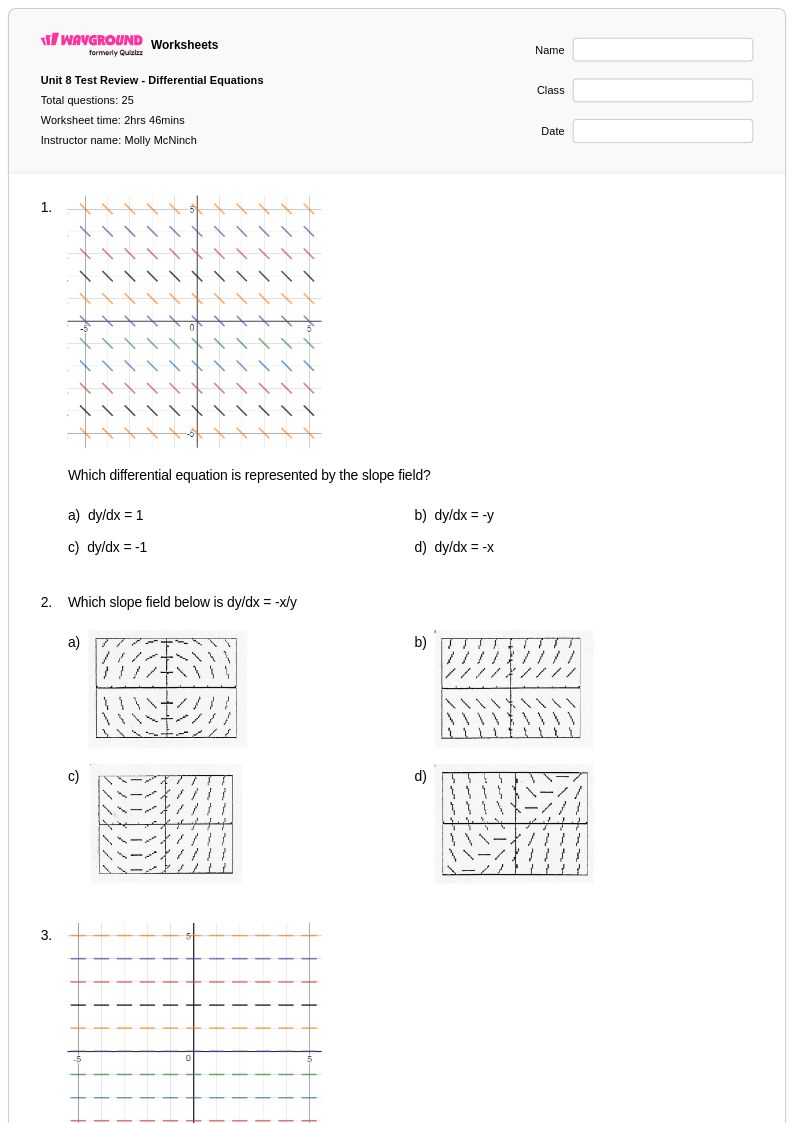
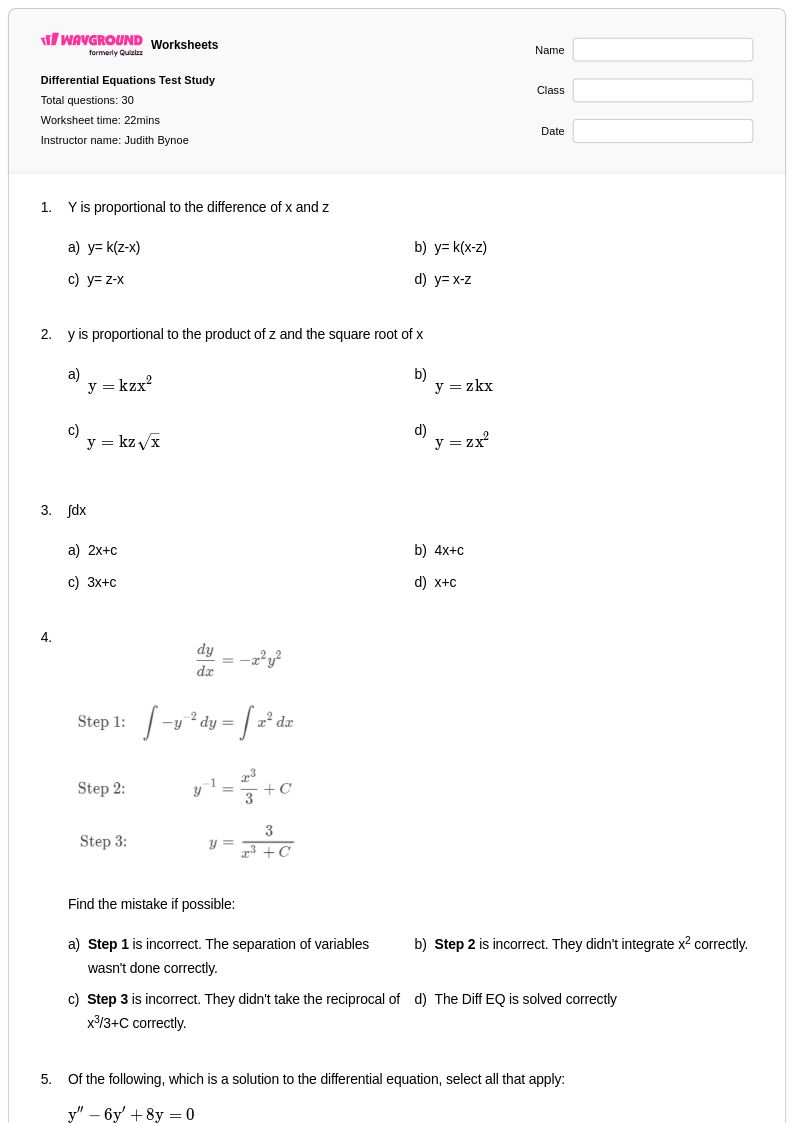
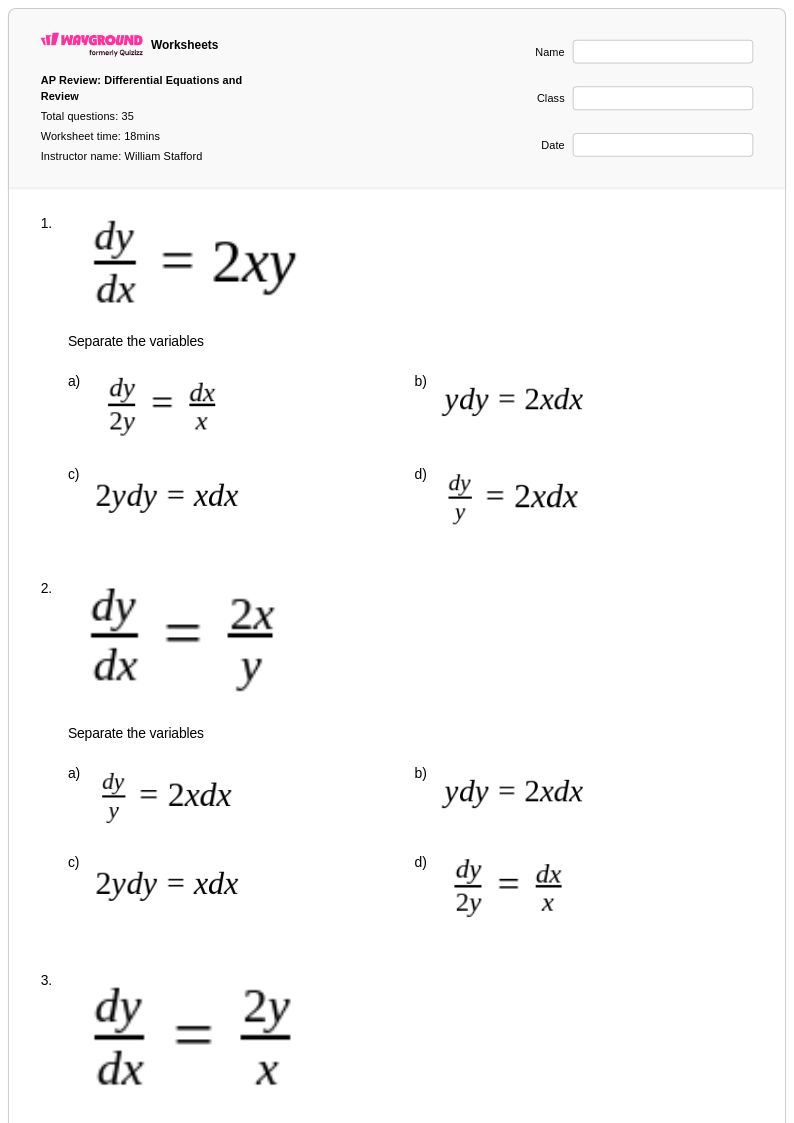
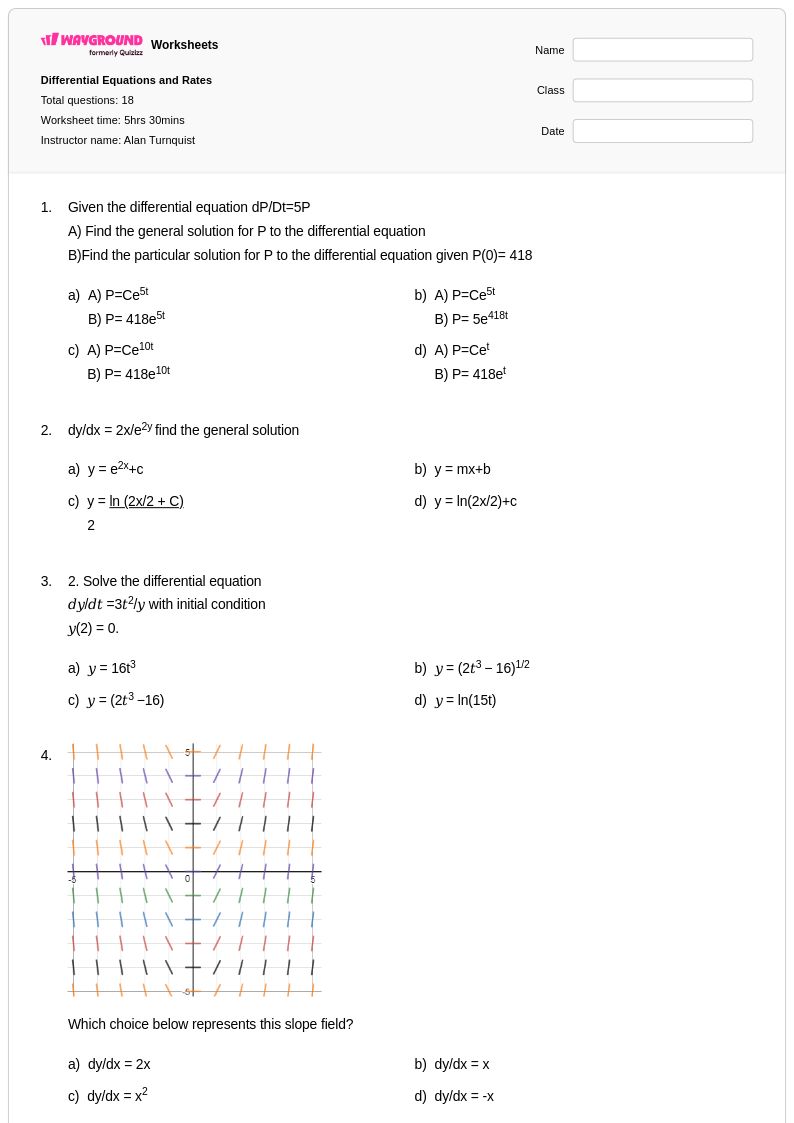
Free Printable Differential Equations Worksheets for Year 9
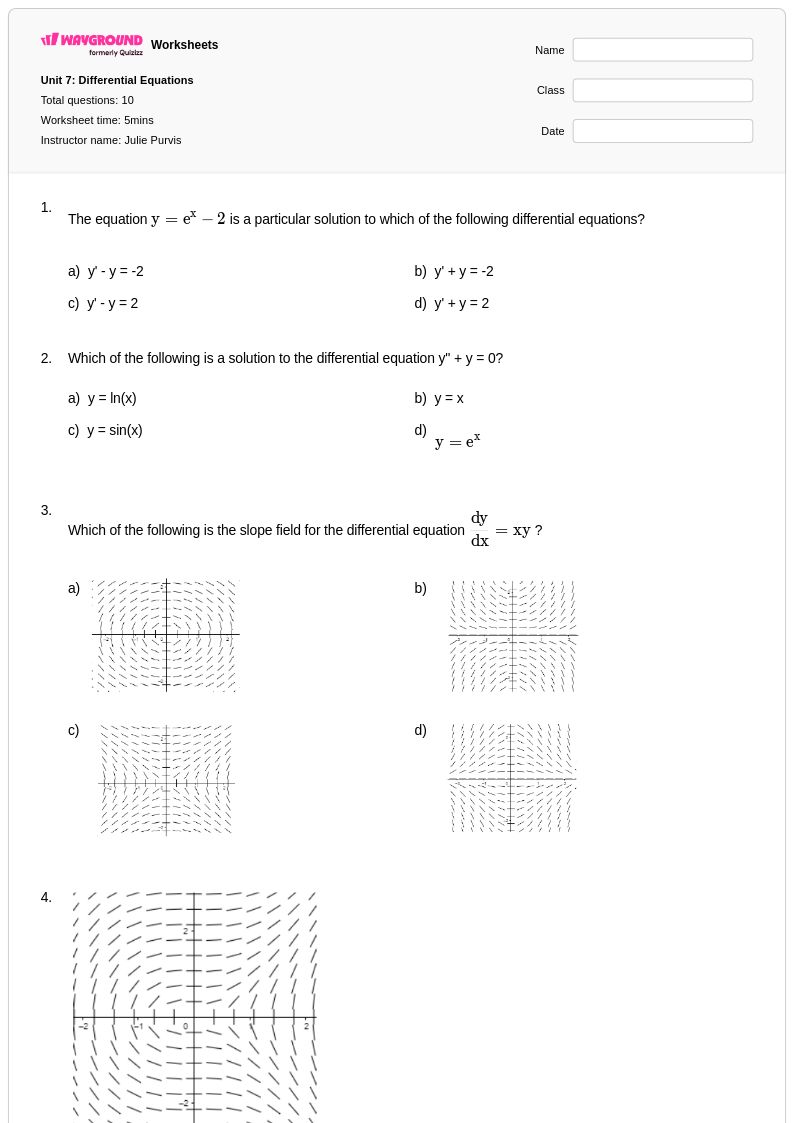
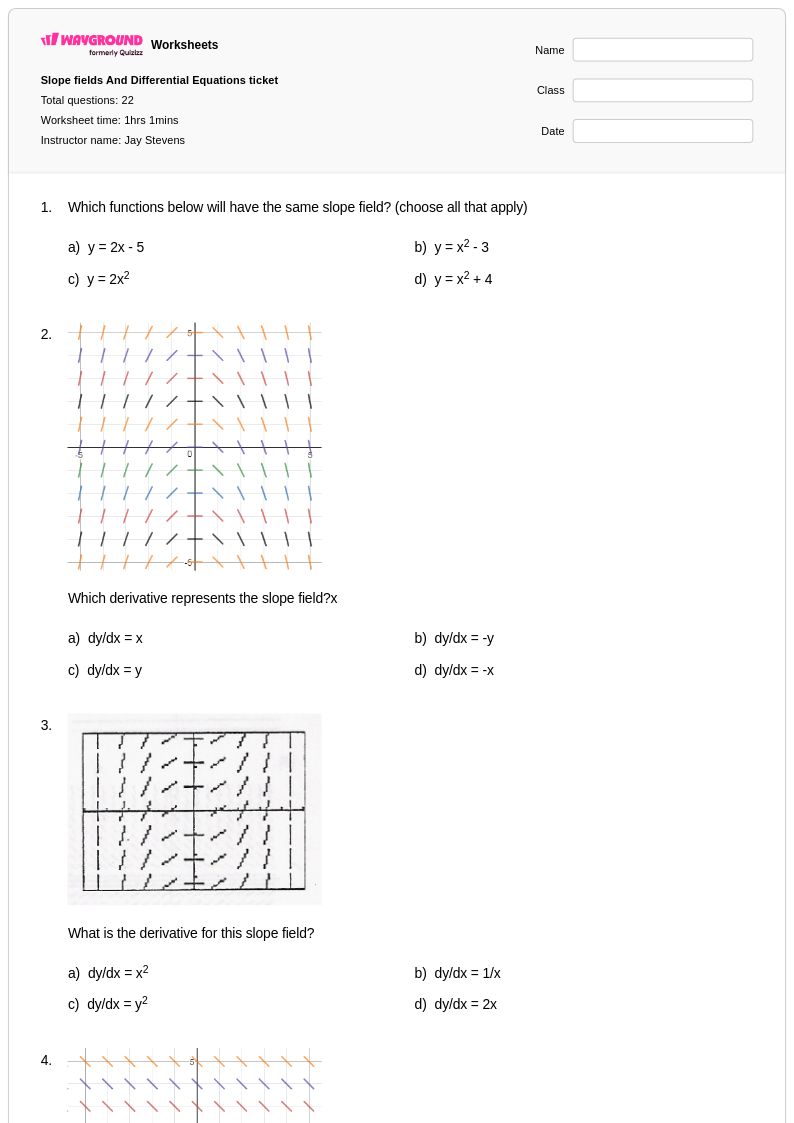
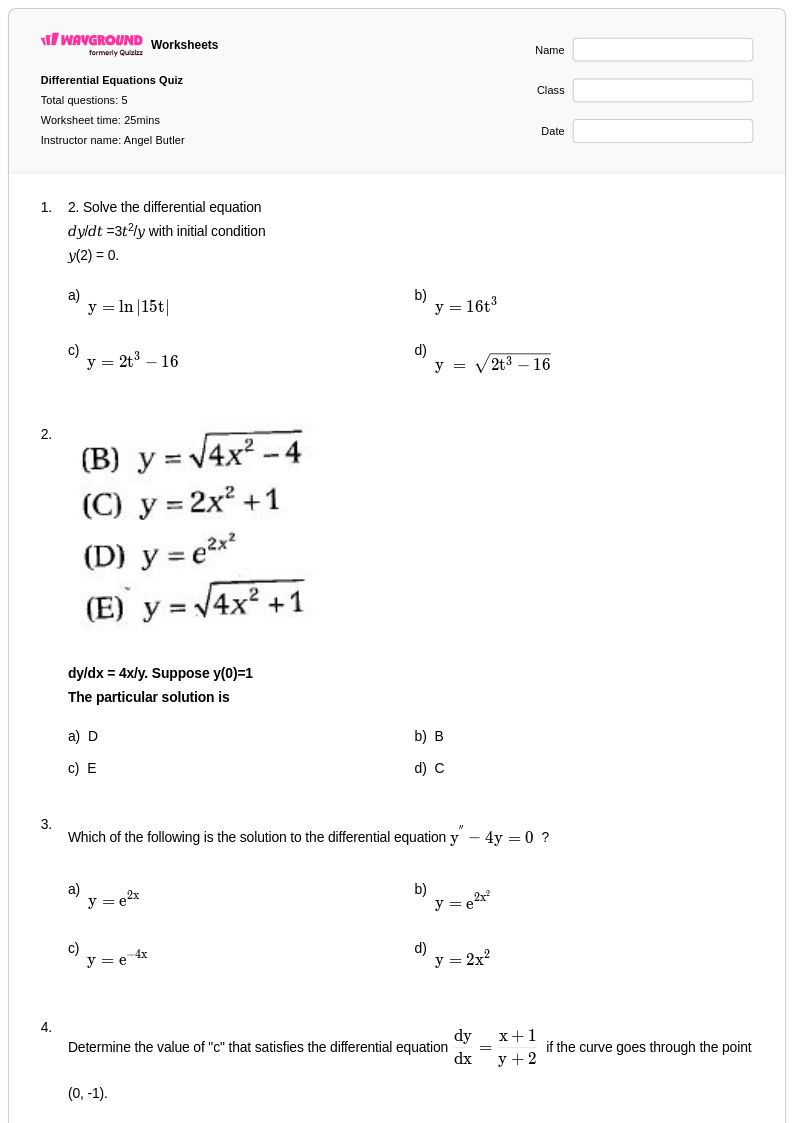
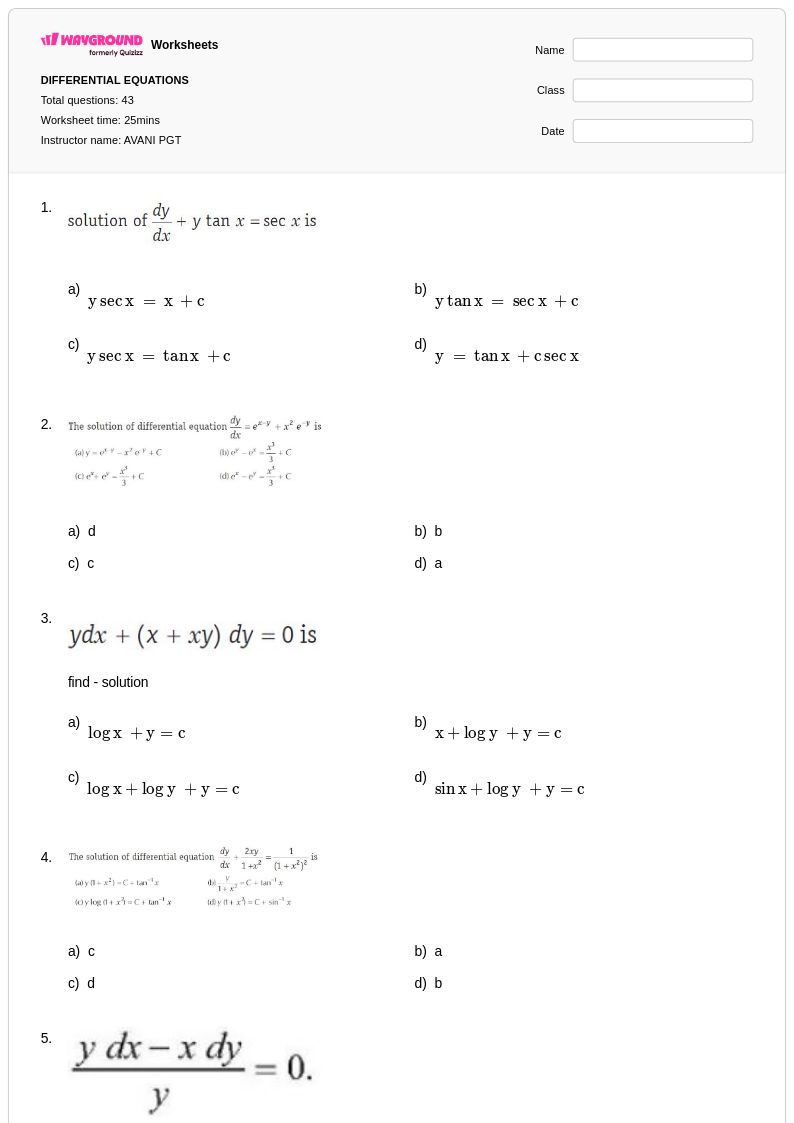
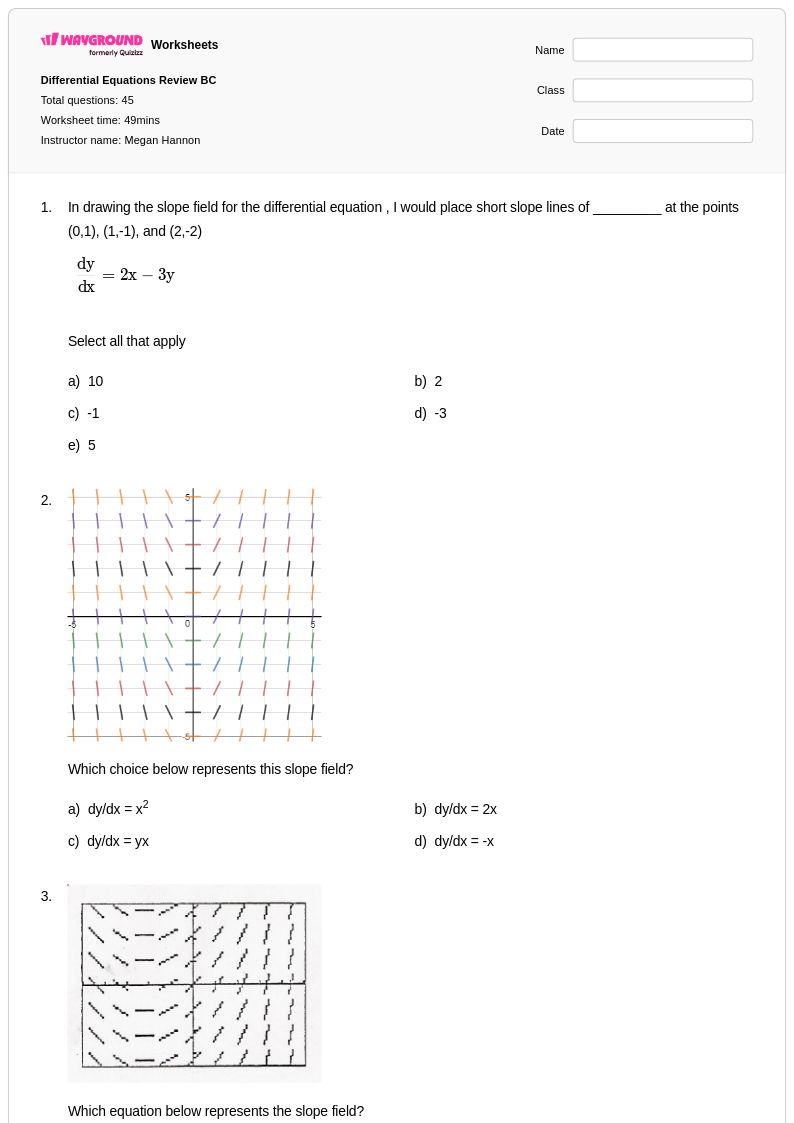
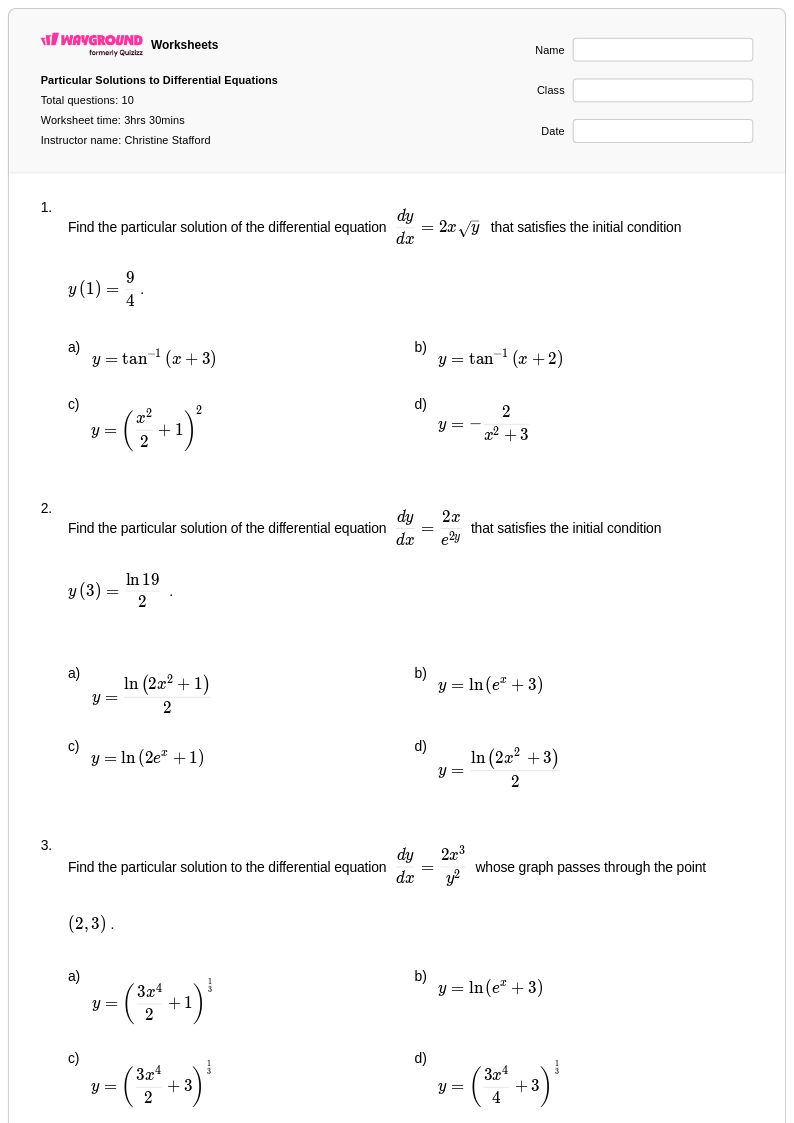
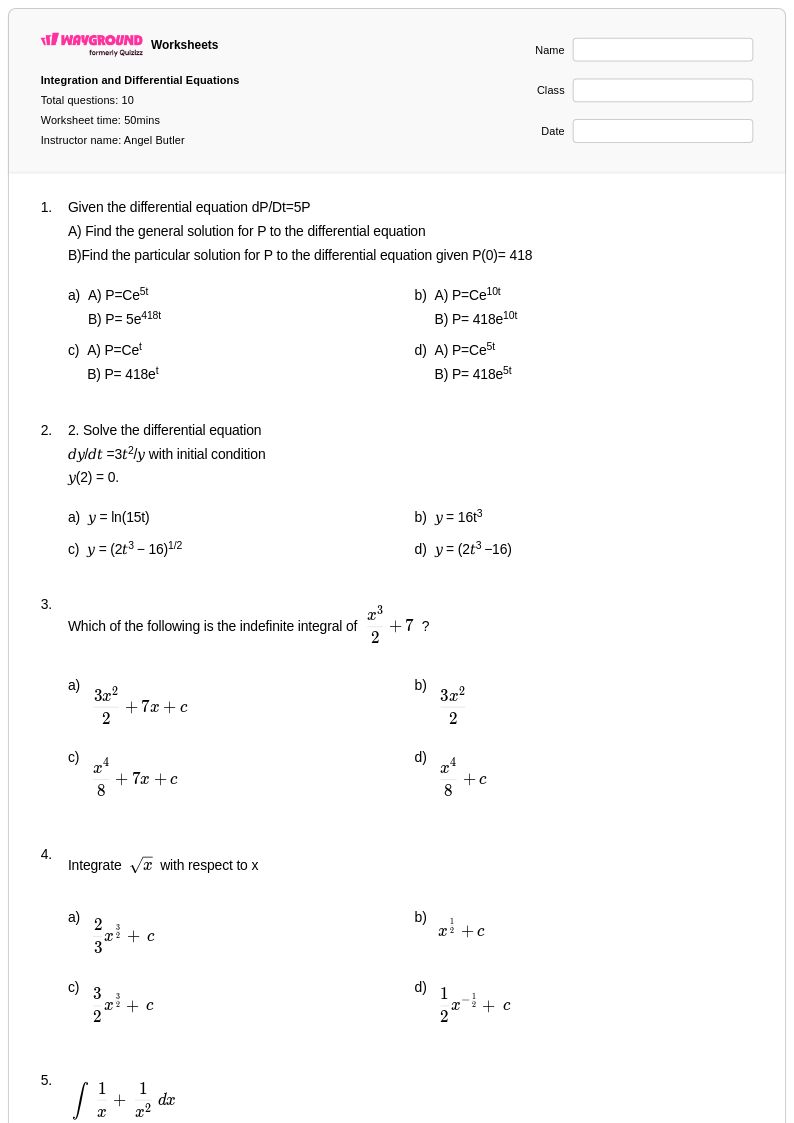
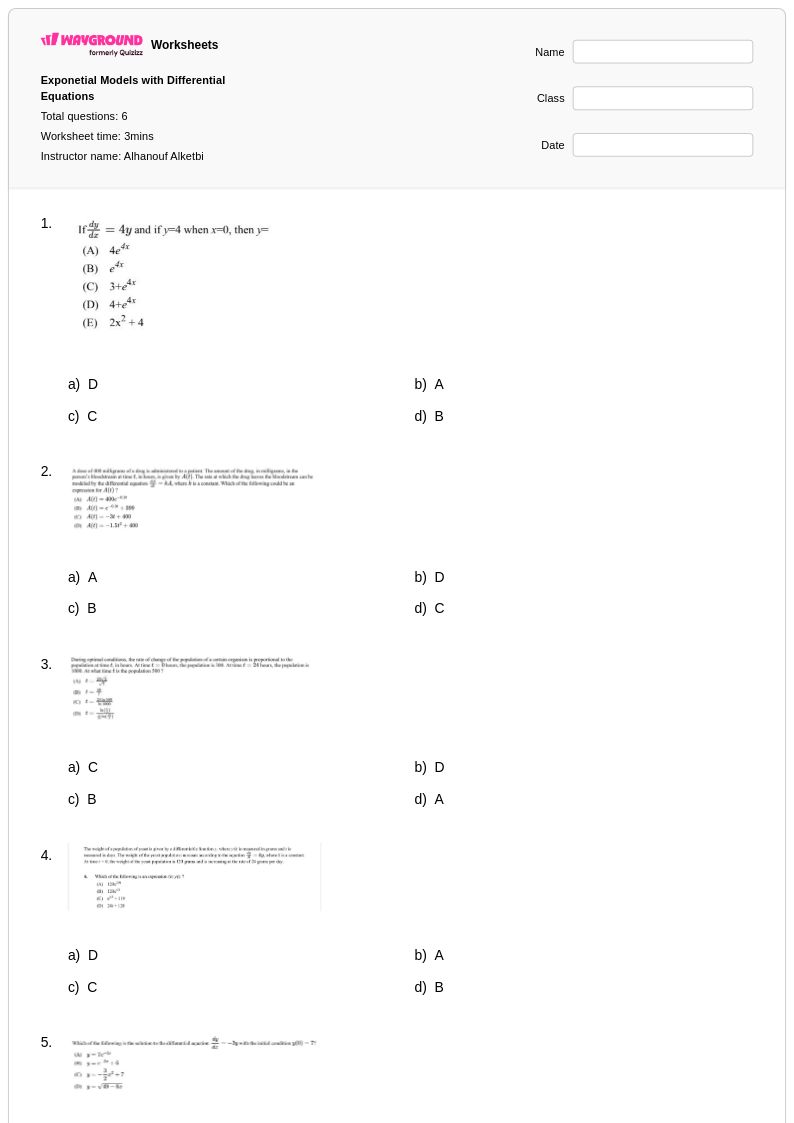
Free Year 9 differential equations worksheets and printables help students master solving first-order equations, separation of variables, and initial value problems through comprehensive practice problems with detailed answer keys.
Explore printable Differential Equations worksheets for Year 9
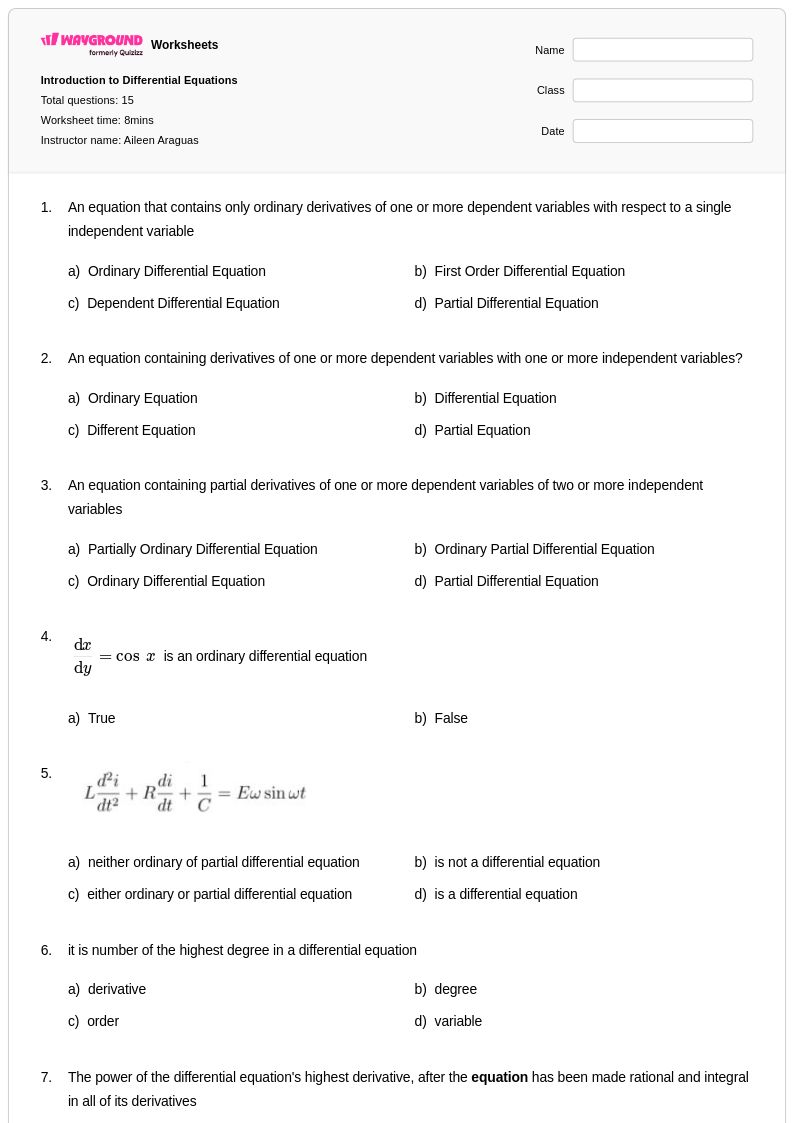
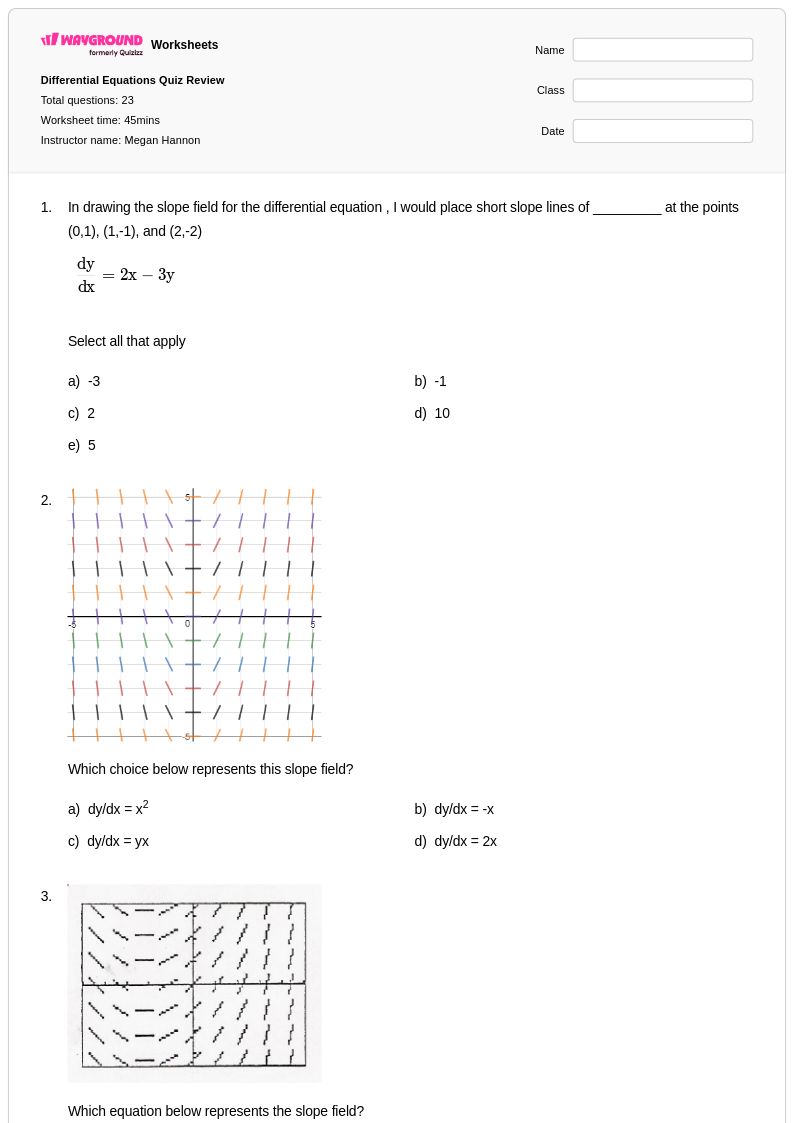
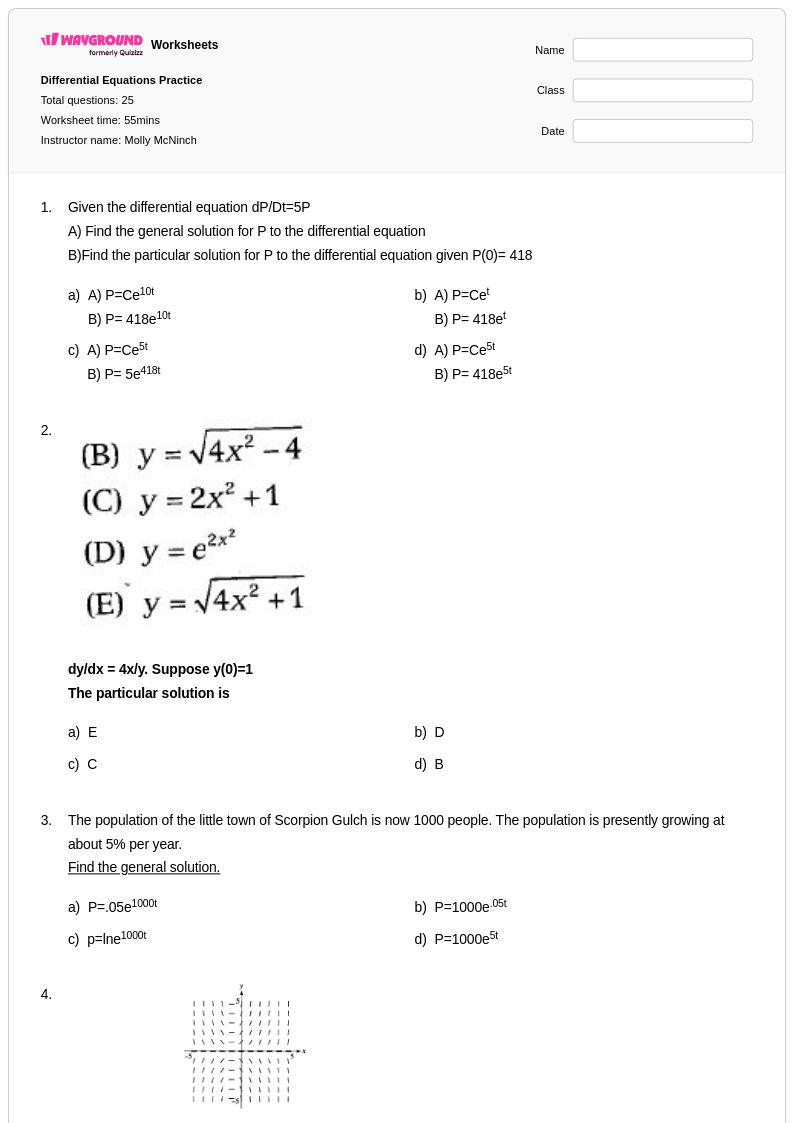
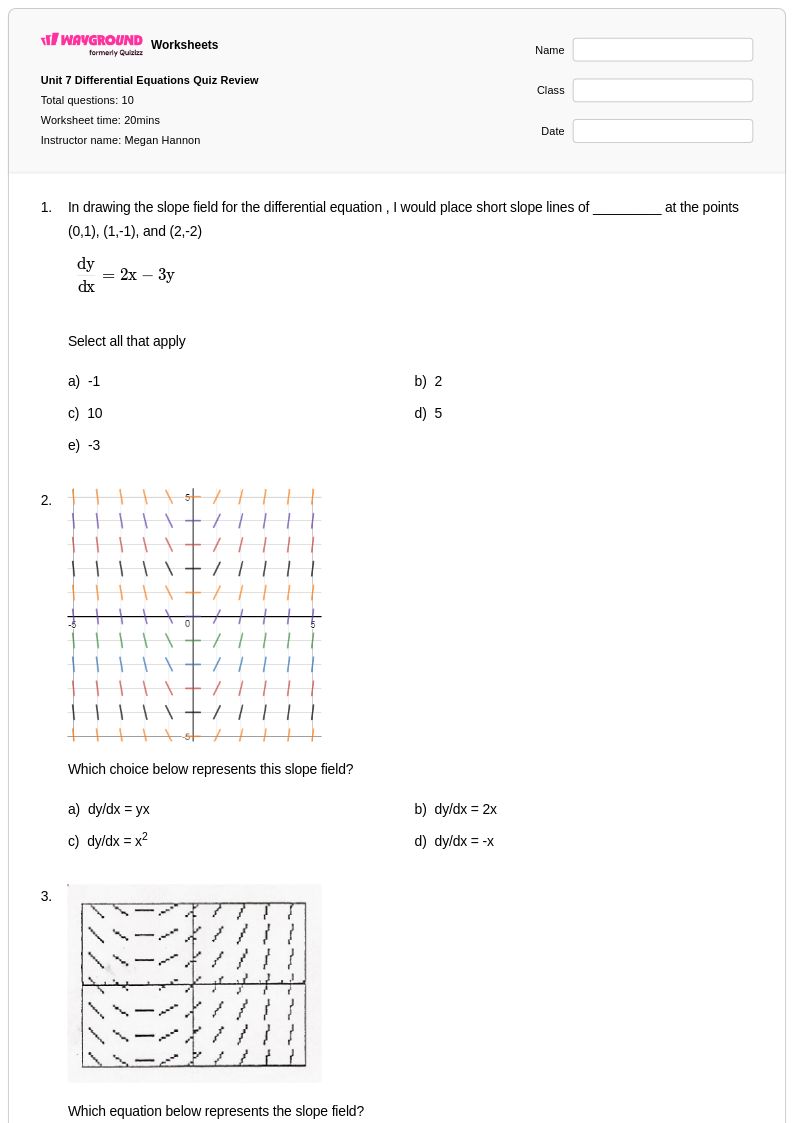
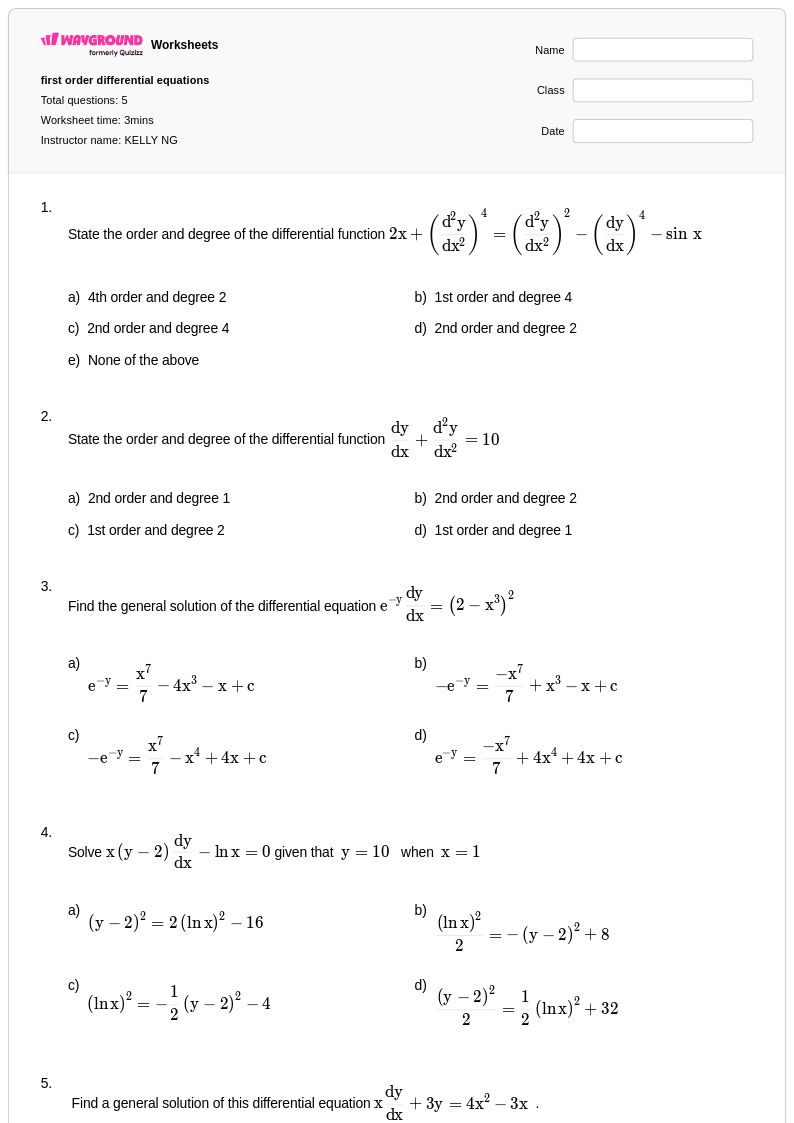
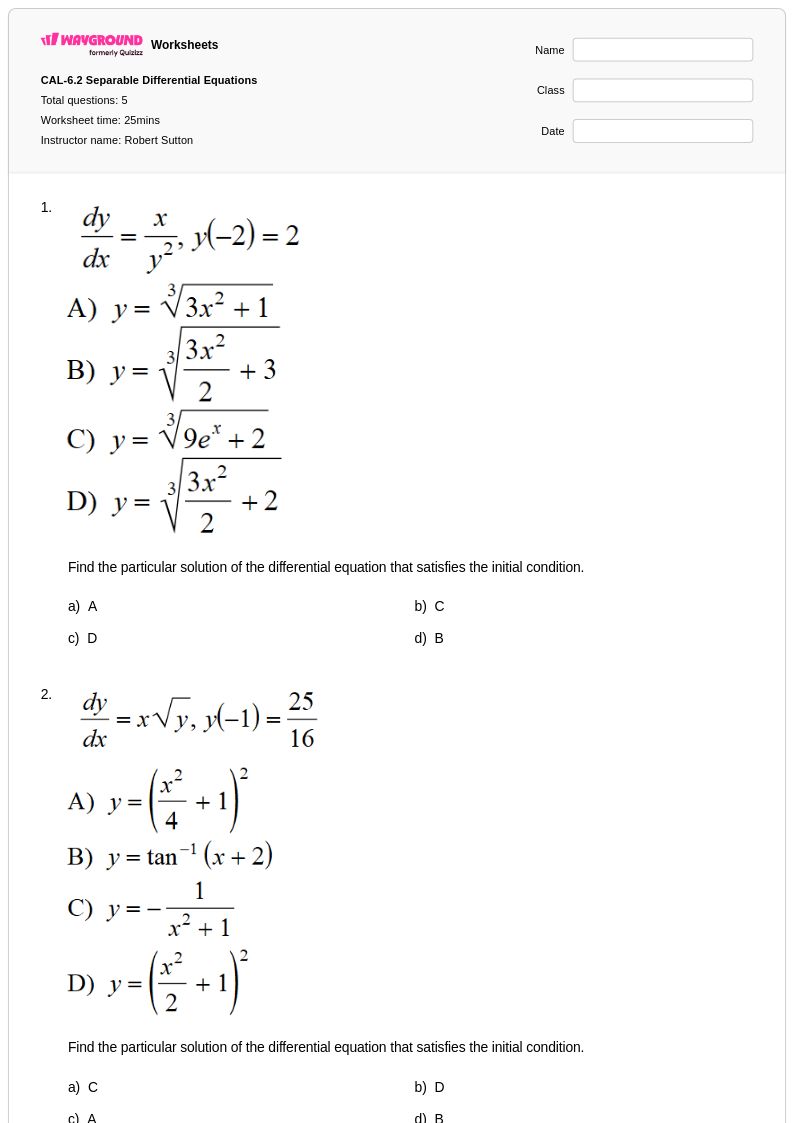
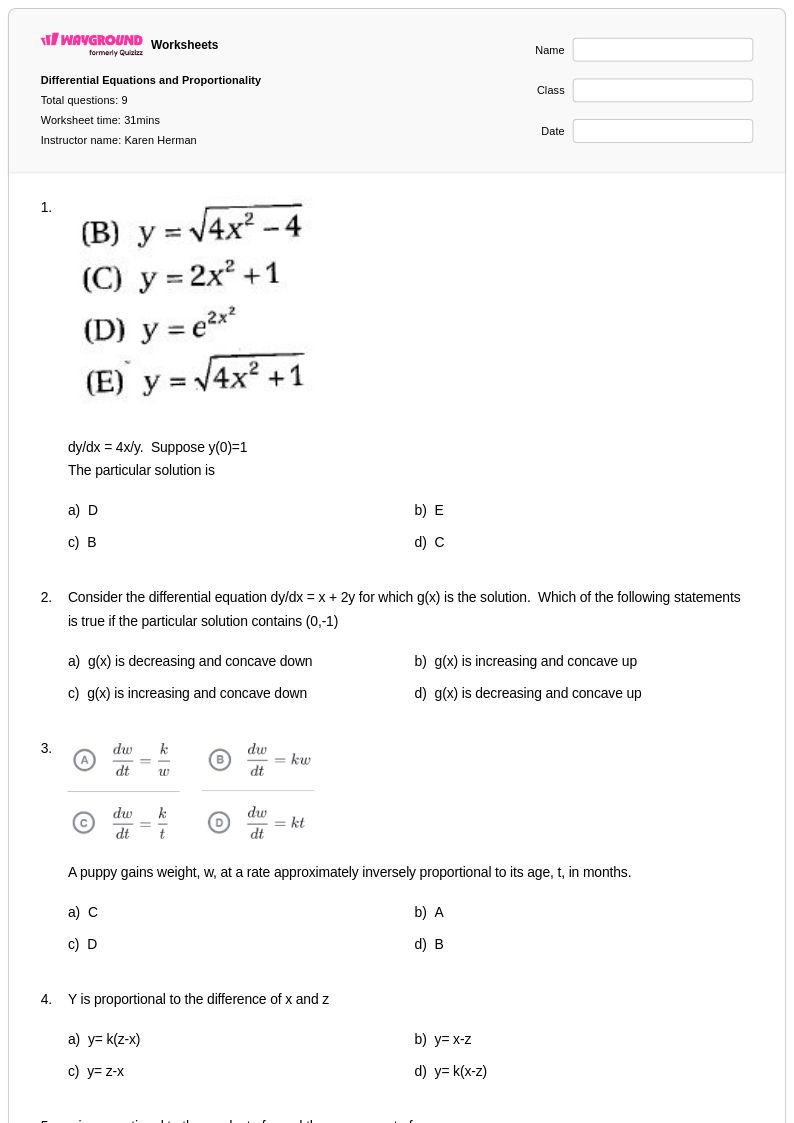
Differential equations worksheets for Year 9 students available through Wayground (formerly Quizizz) provide essential practice in understanding the fundamental concepts of rates of change and mathematical modeling. These comprehensive worksheets introduce students to basic differential equations, helping them develop critical thinking skills as they learn to set up, solve, and interpret equations that describe dynamic relationships between variables and their derivatives. Each worksheet collection includes detailed answer keys and step-by-step solutions, allowing students to verify their work and understand the underlying mathematical reasoning. Available as free printables and downloadable pdf resources, these practice problems systematically build student confidence in recognizing differential equation types, applying separation of variables, and connecting mathematical solutions to real-world phenomena.
Wayground (formerly Quizizz) empowers educators with millions of teacher-created differential equations resources specifically designed for Year 9 mathematics instruction. The platform's advanced search and filtering capabilities enable teachers to quickly locate worksheets that align with curriculum standards and match their students' specific learning needs. Differentiation tools allow instructors to modify existing worksheets or create customized versions that address varying skill levels within the classroom, supporting both remediation for struggling learners and enrichment opportunities for advanced students. Available in both printable pdf format and interactive digital versions, these resources streamline lesson planning while providing flexible options for homework assignments, classroom practice, assessment preparation, and targeted skill development in this foundational area of calculus.
FAQs
Should Grade 9 students be learning differential equations?
Formal differential equations, solving dy/dx = f(x) analytically, are not a standard Grade 9 topic in most US curricula. What Grade 9 students can meaningfully engage with is the foundational idea: that some equations describe how a quantity changes rather than what it equals. Introductory exposure through rate-of-change language, slope interpretation, and simple modeling scenarios (like a population doubling) builds the intuition that makes differential equations accessible when students reach calculus. If your Grade 9 course is accelerated or pre-calculus-track, light conceptual introduction is appropriate; full analytic methods are not.
How do I introduce the concept of differential equations to Grade 9 students?
Skip the notation at first. Ask students to describe in words how a quantity is changing, 'the population grows by 5% each year', and then show how that description translates into a mathematical relationship between a quantity and its rate of change. Connecting the idea to slope (which Grade 9 students know from linear functions) makes the concept far less abstract. Once students can articulate what a differential equation is saying in plain language, introducing dy/dx notation lands much more naturally.
What common misconceptions do Grade 9 students have about rates of change?
The most persistent one is conflating the value of a quantity with its rate of change — students will say 'the population is 5%' when they mean 'the population is growing at 5%.' A second issue is assuming that a constant rate of change always produces a linear relationship; students are often surprised that a rate proportional to the current value produces exponential behavior instead. Worksheets that ask students to sketch or interpret a graph of the quantity alongside a description of its rate of change are effective at surfacing and correcting both misconceptions.
How do I use these Grade 9 differential equations worksheets in my classroom?
The worksheets include complete answer keys, which makes them well-suited for guided practice or homework where students self-check as they go. For in-class use, hosting the worksheet as a digital quiz on Wayground lets you see where students are getting stuck in real time. If your school is managing screen time, the printable PDF works just as well for paper-based practice, and you can grade submitted work using the Wayground for Teachers app by scanning student pages directly.
How can I support Grade 9 students who struggle with the language in word problems about rates of change?
Applied rate-of-change problems are language-heavy, and that's often where Grade 9 students lose the thread before they even attempt the math. Wayground's Read Aloud accommodation reads problem text aloud for students who need it, and you can generate a translated version of the worksheet for students whose first language isn't English. For students who find dense text overwhelming, the reduced answer choices setting can help them focus on the mathematical relationship rather than getting lost in the setup.