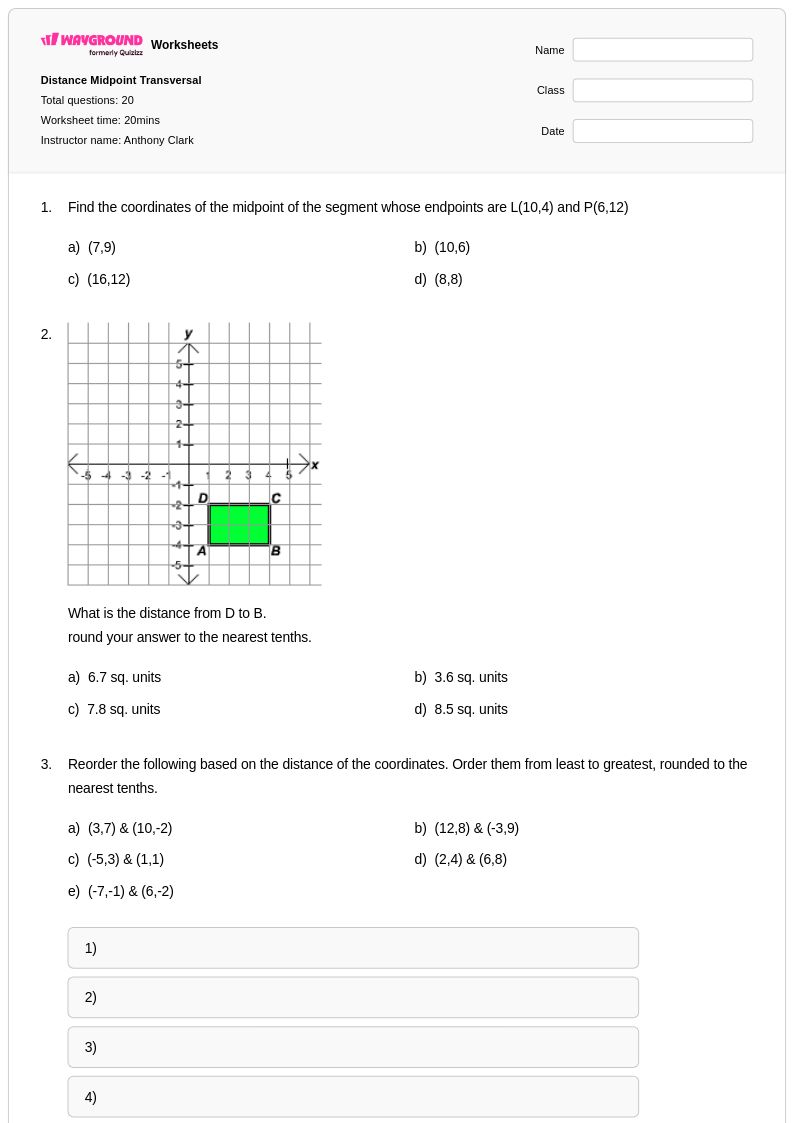
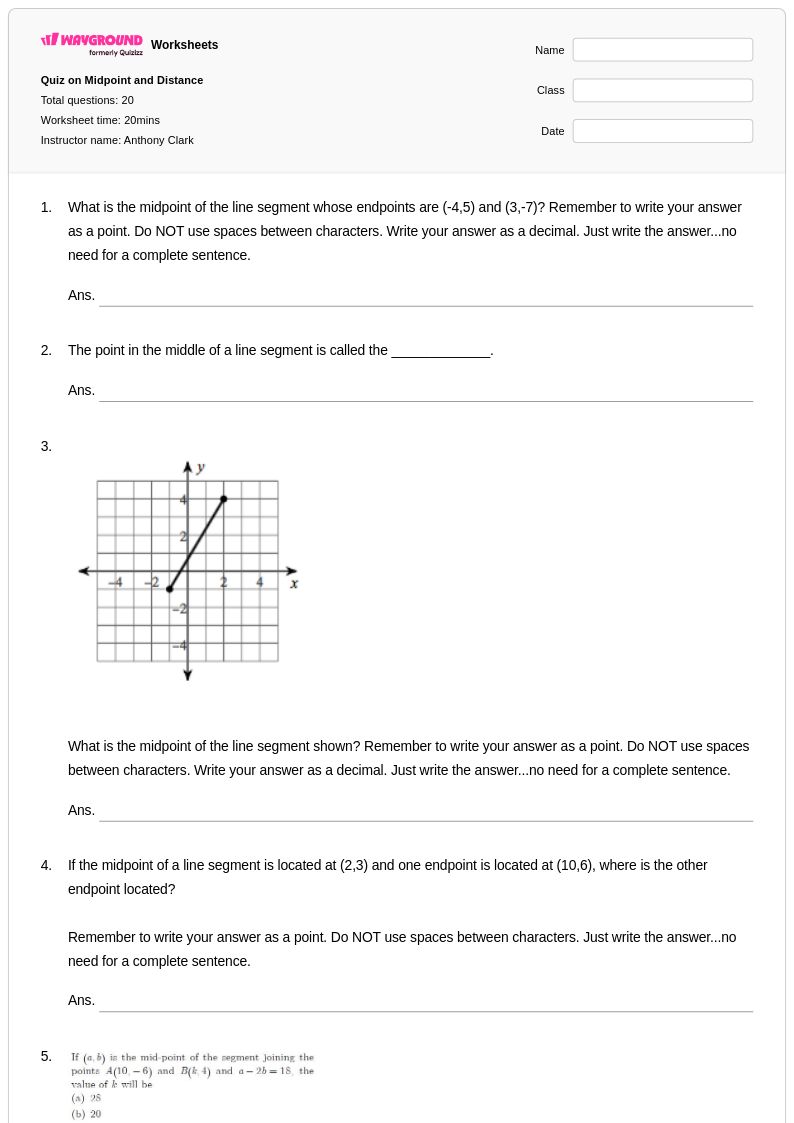
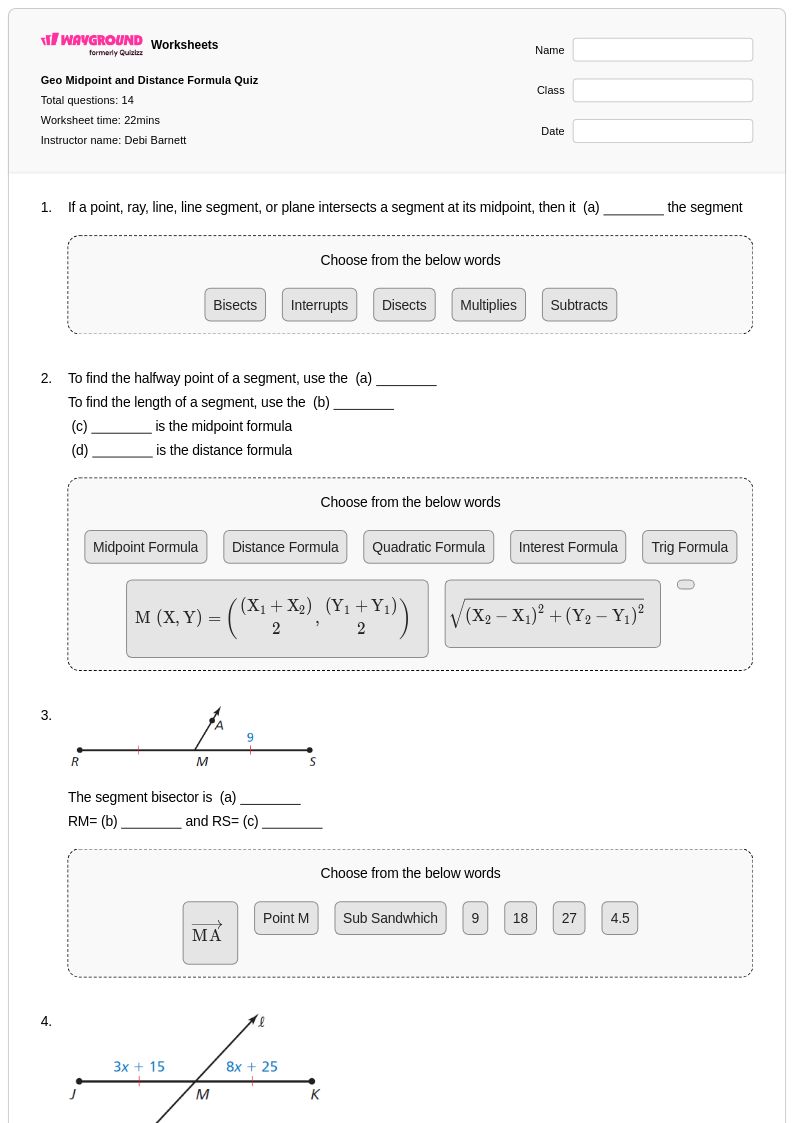
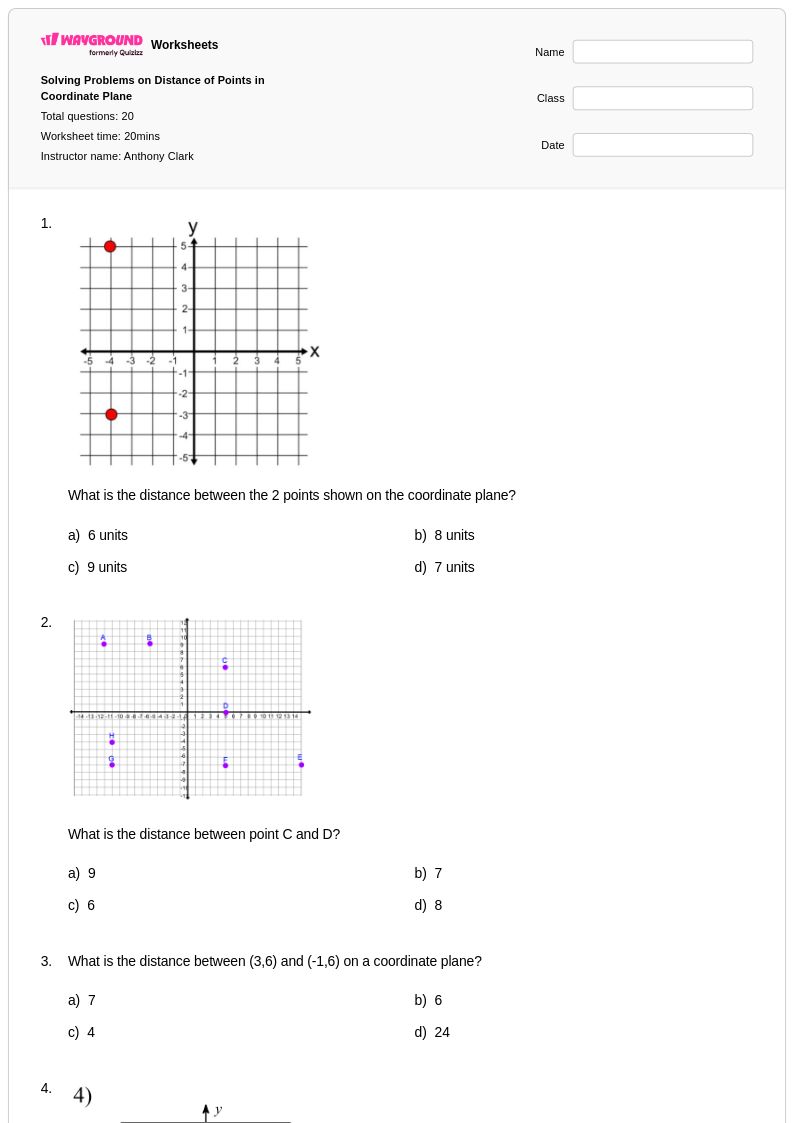
Free Printable Distance Between a Point and a Line Worksheets for Year 12
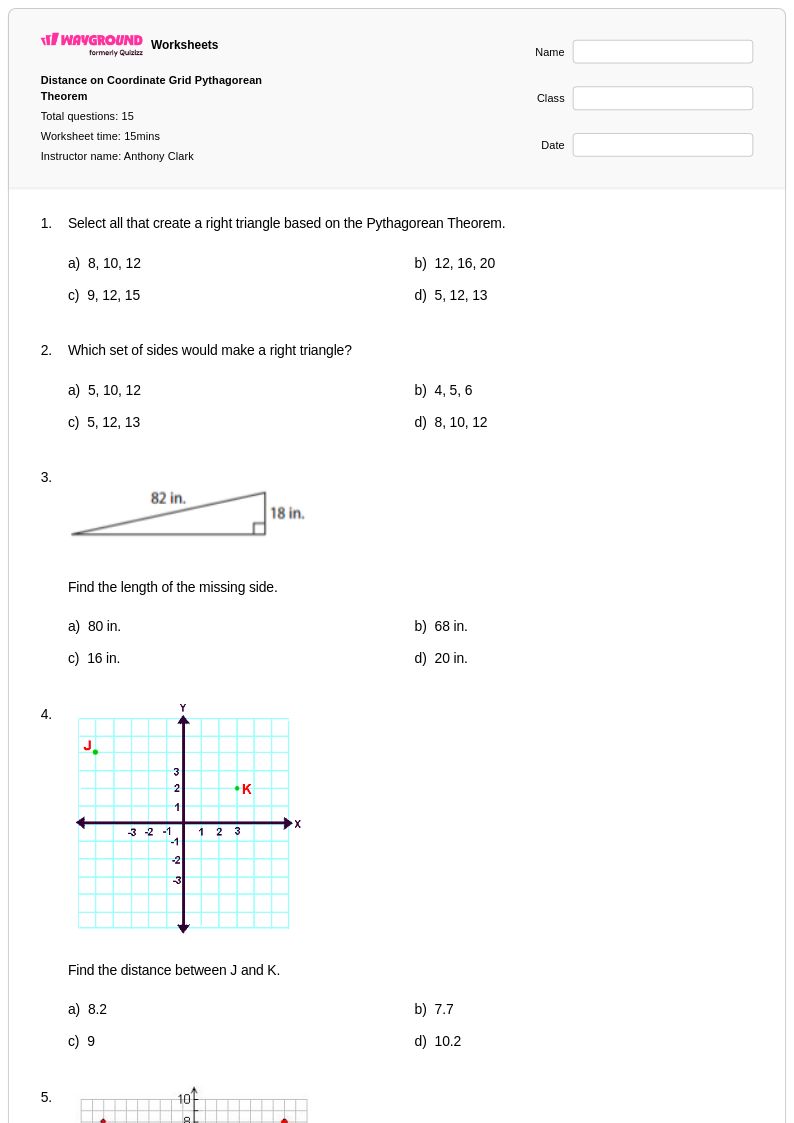
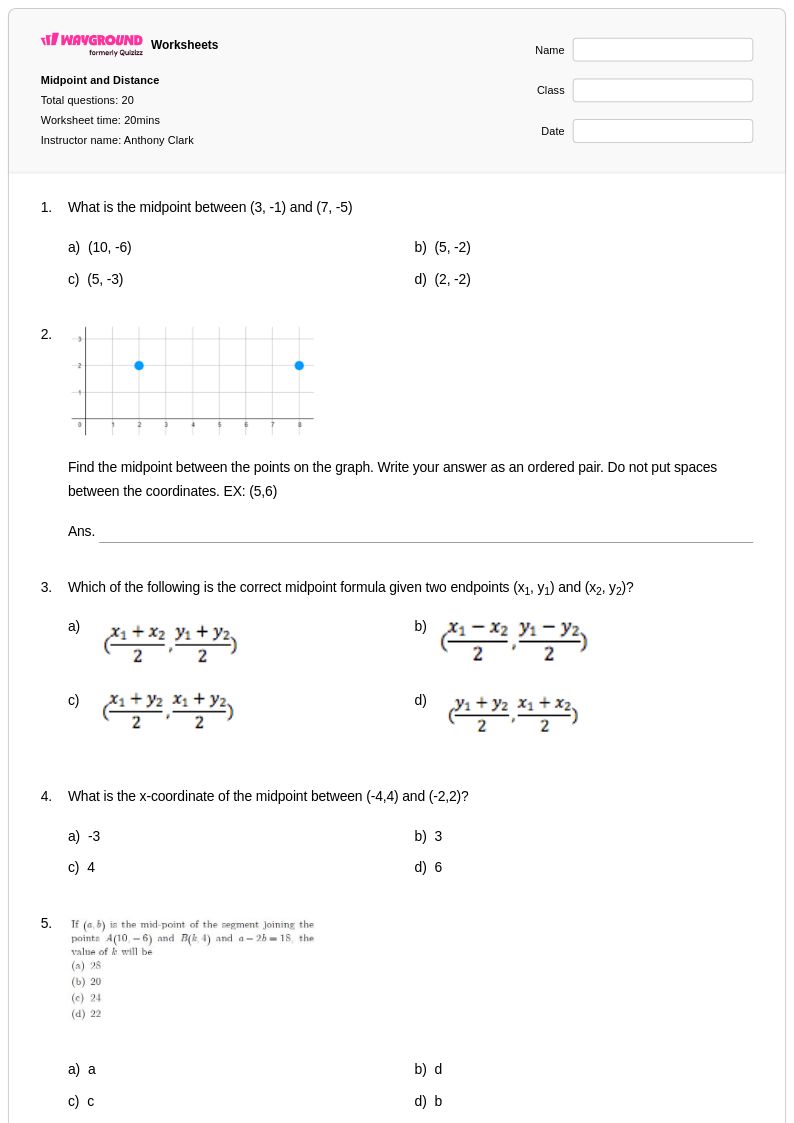
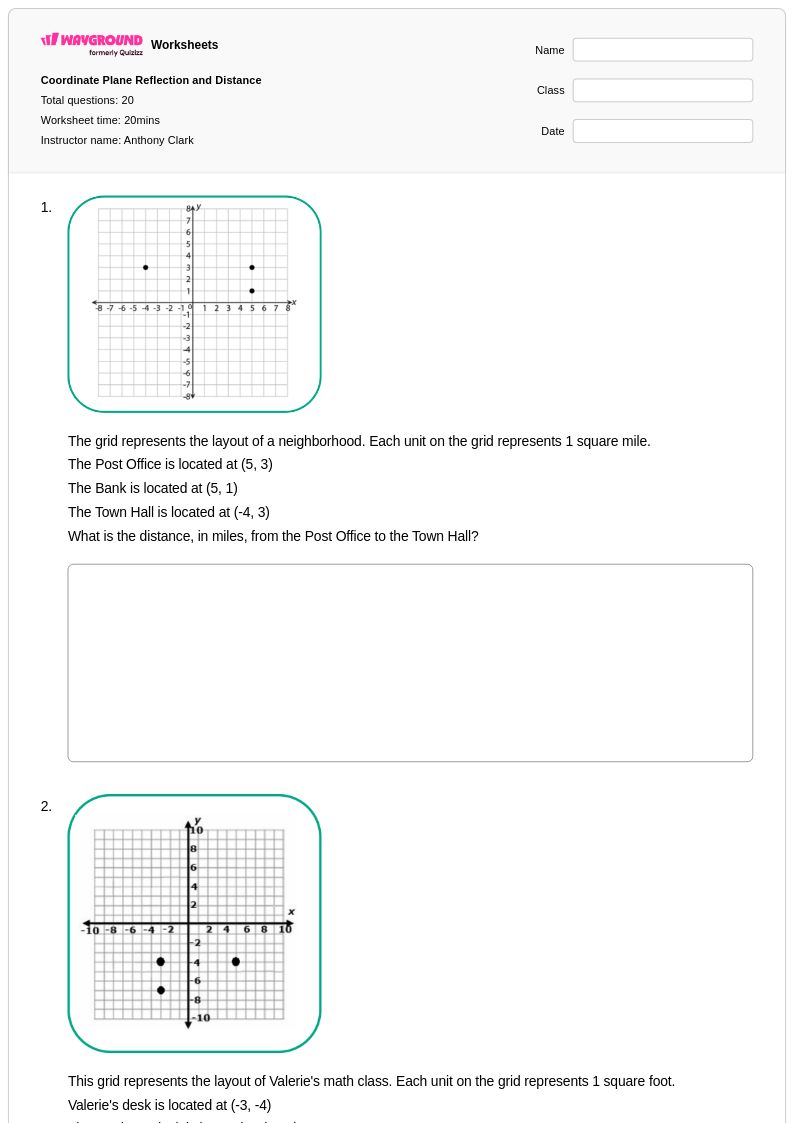
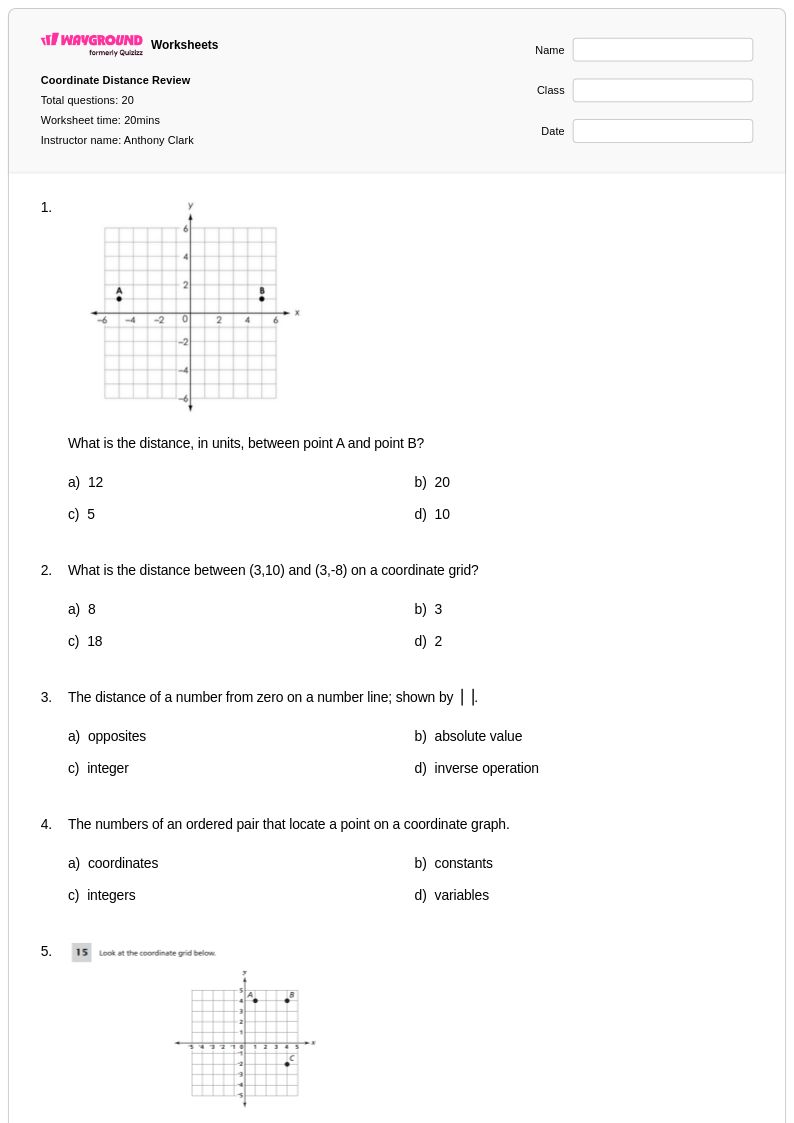
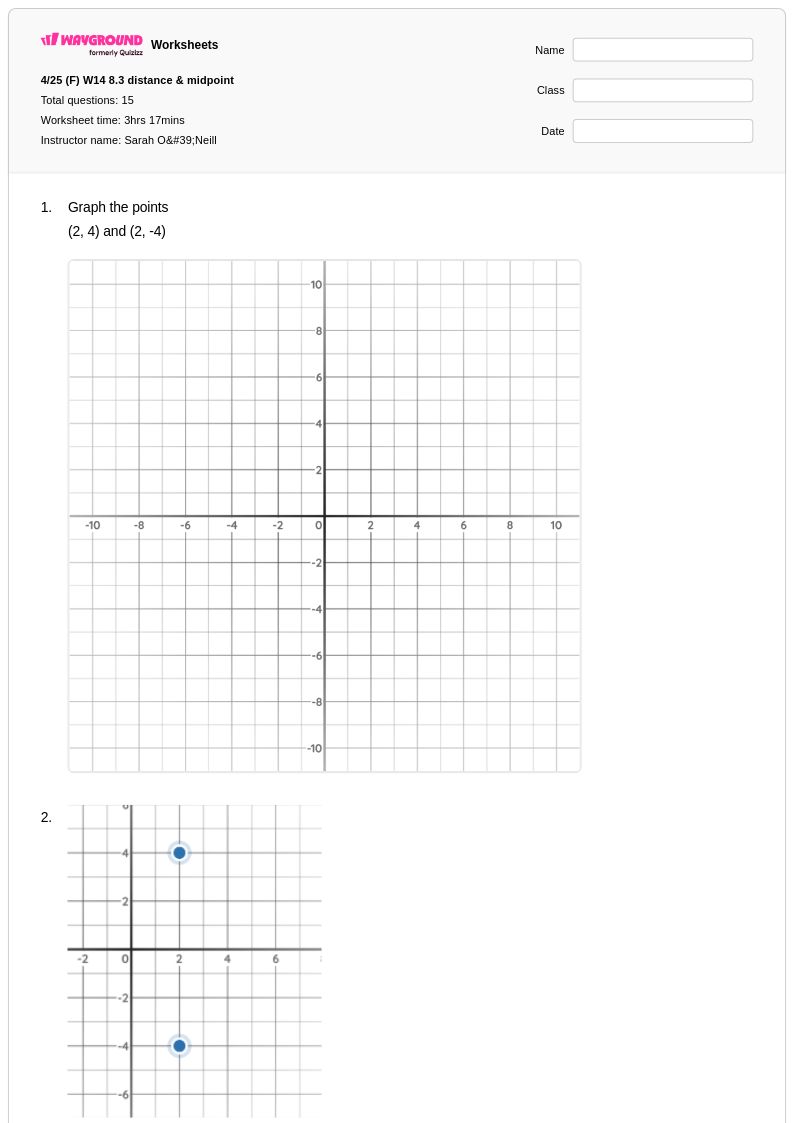
Year 12 students can master calculating the distance between a point and a line with Wayground's comprehensive collection of free geometry worksheets, featuring step-by-step practice problems, printable PDFs, and detailed answer keys.
Explore printable Distance Between a Point and a Line worksheets for Year 12
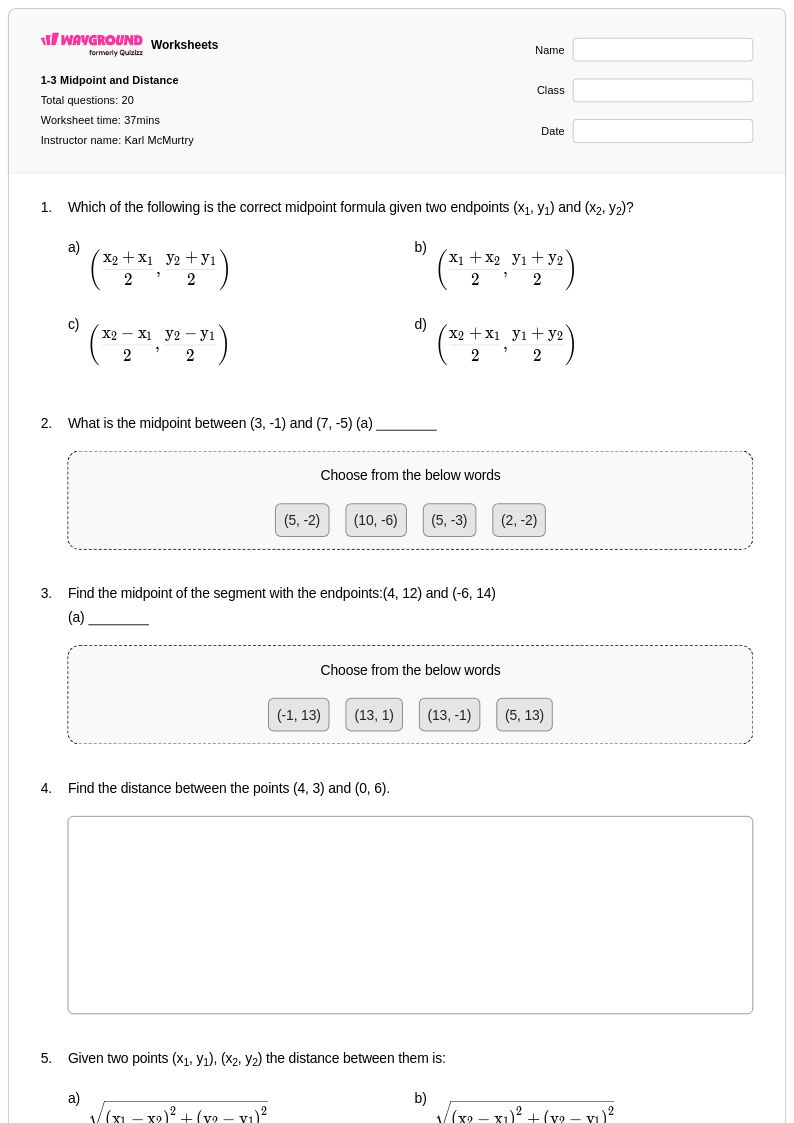
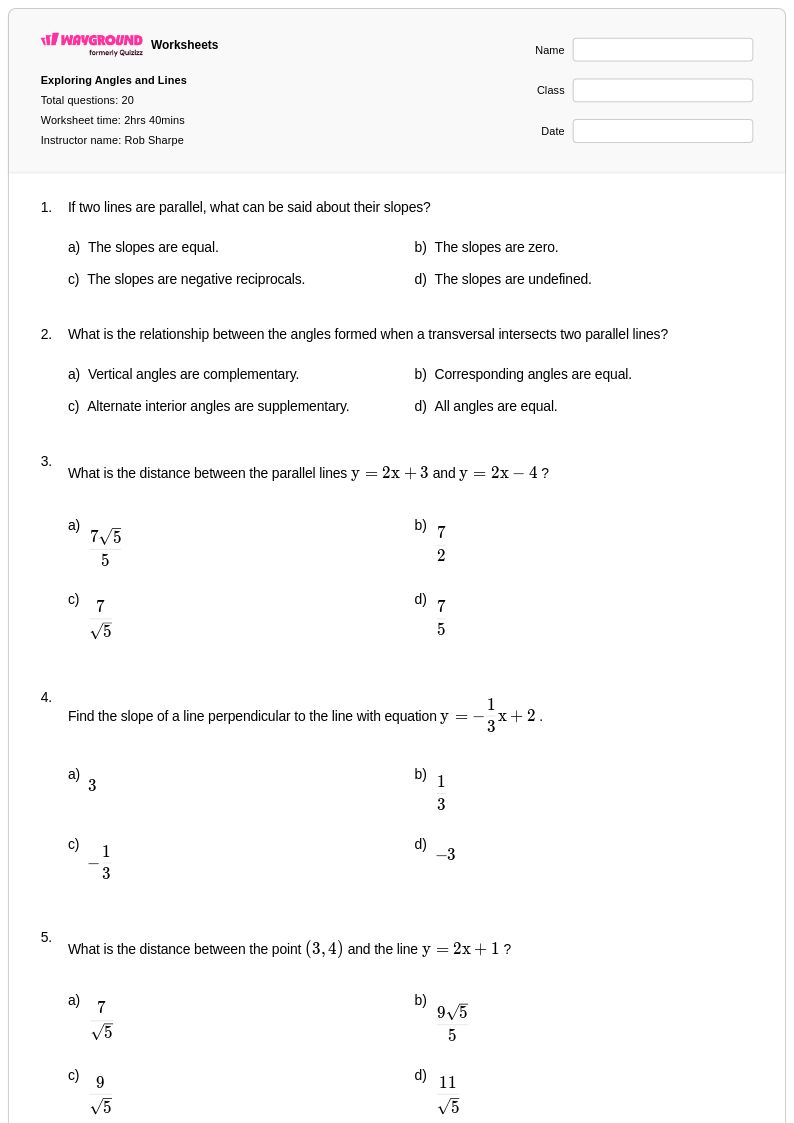
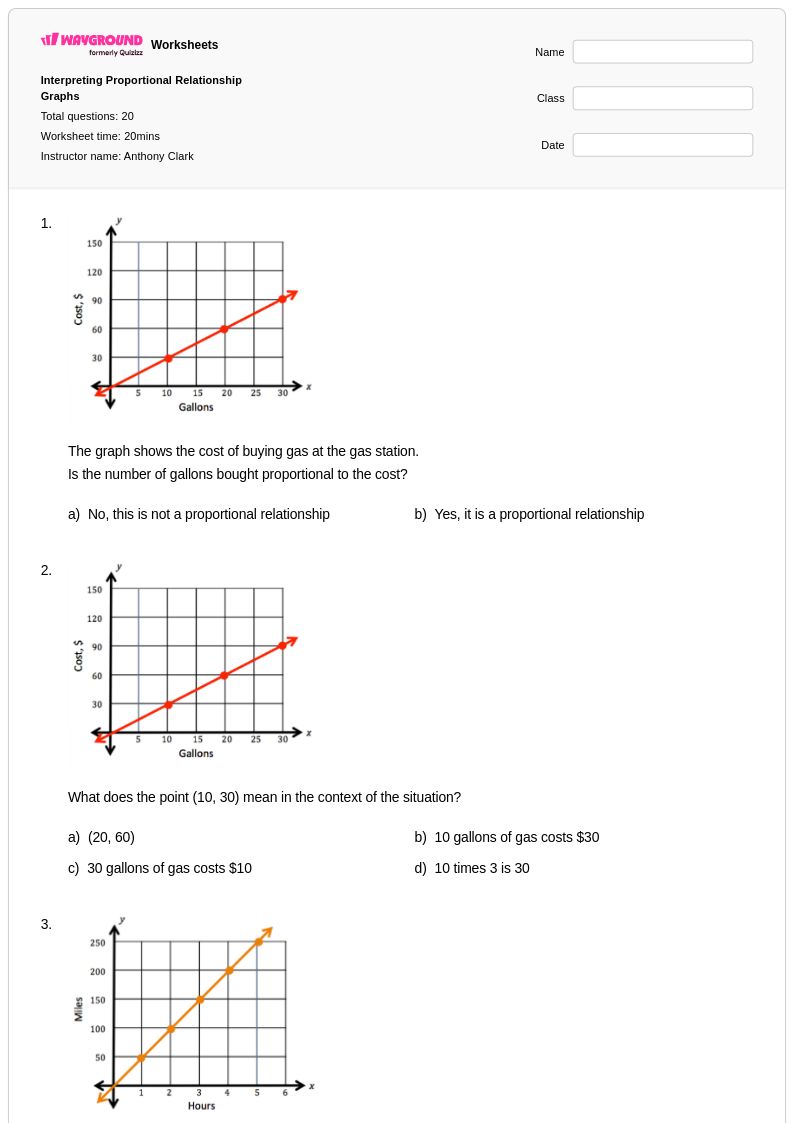
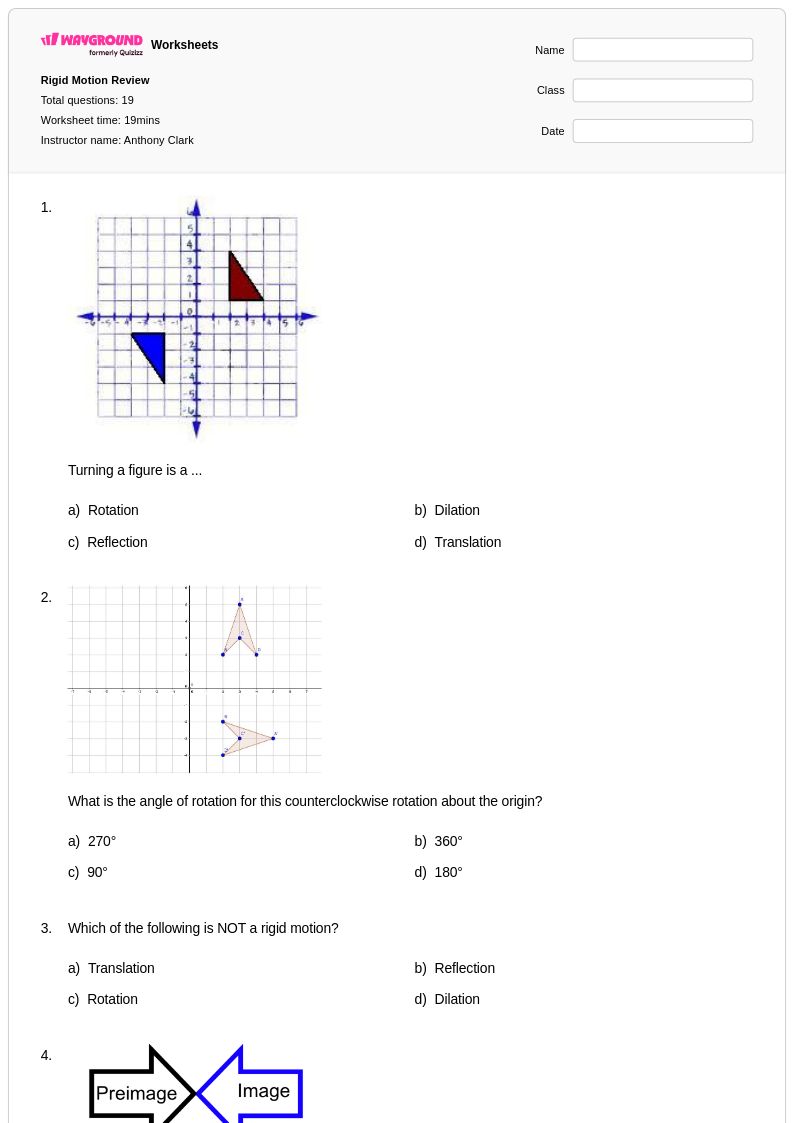
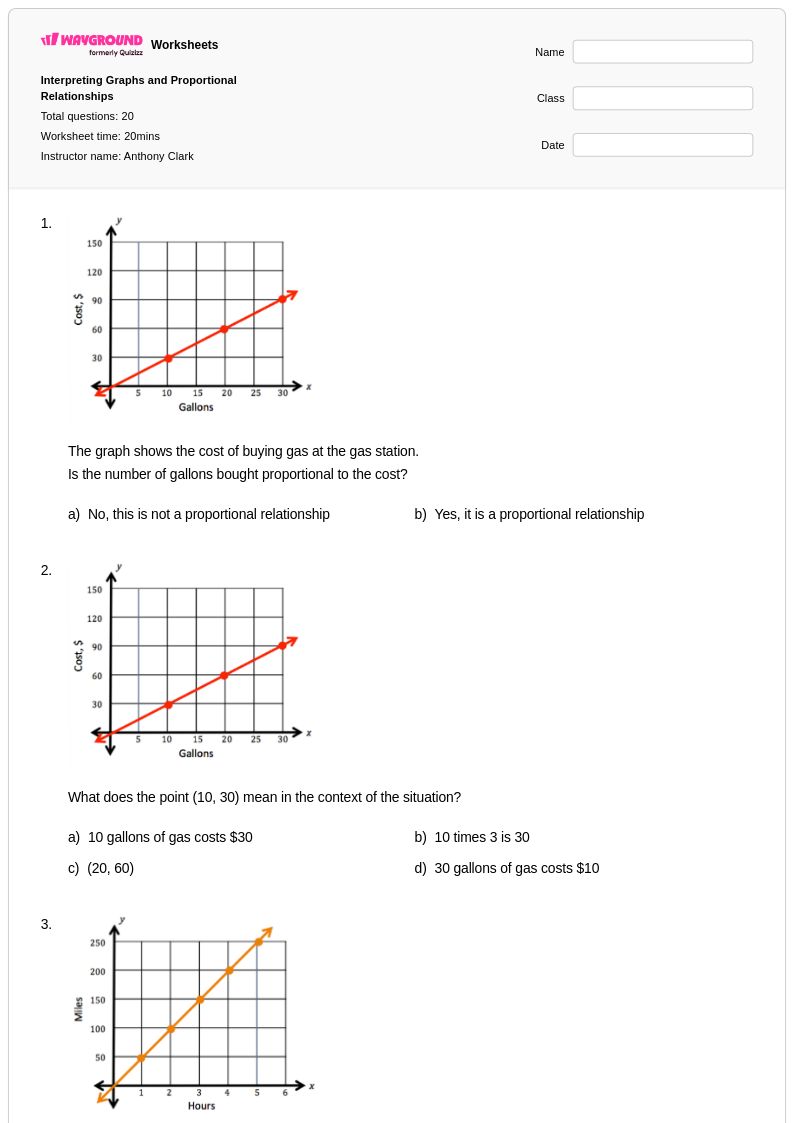
Distance between a point and a line worksheets for Year 12 students provide essential practice with one of the most fundamental concepts in coordinate geometry and analytical mathematics. These comprehensive resources available through Wayground (formerly Quizizz) strengthen students' abilities to apply the point-to-line distance formula, work with perpendicular distances, and solve complex geometric problems involving linear equations and coordinate systems. The worksheets feature carefully structured practice problems that progress from basic applications of the distance formula to more sophisticated scenarios involving parallel lines, optimization problems, and real-world applications. Each worksheet includes detailed answer keys and step-by-step solutions, making them valuable free printables for both classroom instruction and independent study, while the pdf format ensures easy distribution and accessibility for all students.
Wayground (formerly Quizizz) supports mathematics educators with an extensive collection of millions of teacher-created resources specifically designed for advanced geometry instruction at the Year 12 level. The platform's robust search and filtering capabilities allow teachers to quickly locate worksheets that align with specific curriculum standards and learning objectives related to distance calculations and coordinate geometry. Teachers can customize these materials to meet diverse student needs, creating differentiated assignments for remediation or enrichment while maintaining focus on essential skills like formula application, algebraic manipulation, and geometric reasoning. The availability of both printable and digital formats, including downloadable pdf versions, provides maximum flexibility for lesson planning and ensures that educators can seamlessly integrate these resources into their existing instructional frameworks whether for in-class practice, homework assignments, or assessment preparation.
FAQs
How should I approach teaching point-to-line distance to 12th graders?
At Grade 12, this topic is rarely taught from scratch — it's revisited in the context of analytic geometry, conic sections, or calculus preparation. The instructional focus should be on fluency and application: students should be able to set up and solve a distance problem as one step inside a larger problem, not as the whole problem. If students are still slow on the formula mechanics, a targeted review session with structured practice is more efficient than re-teaching the concept from the beginning.
What practice problems are appropriate for 12th grade point-to-line distance work?
The most relevant problems at this level involve parallel line distances, tangent line distances in circle problems, and optimization scenarios where minimizing distance is the goal. Problems that require students to derive the line equation from a graph or verbal description — rather than receiving it pre-formatted — are especially useful for calculus readiness. Pure substitution problems are appropriate only as a warm-up or diagnostic.
What errors do 12th graders still make with this formula?
The most common issue at this level isn't the formula itself — it's setup. Students who can execute d = |ax₁ + by₁ + c| / √(a² + b²) correctly on a clean problem will still make errors when the line is defined implicitly, when coordinates involve variables rather than numbers, or when the distance calculation is embedded in a multi-step problem. The error is usually in identifying what a, b, c, and the point coordinates actually are in a given context, not in the arithmetic.
How do I use these Grade 12 worksheets in my classroom?
The worksheets come with detailed answer keys and step-by-step solutions, which makes them particularly useful for exam review and independent study — students can work through problems and check their reasoning without waiting for teacher feedback. You can assign them as a digital quiz on Wayground or print the PDF for paper-based practice. For paper submissions, the Wayground for Teachers app lets you scan and grade student work from your phone, which is practical when you're reviewing multi-step solutions.
How does point-to-line distance connect to what 12th graders are doing in the broader curriculum?
In Common Core-aligned 12th grade math, point-to-line distance appears most prominently within analytic geometry and as a supporting skill in conic sections — the definition of a parabola, for instance, is built on the relationship between a point's distance to a focus and its distance to a directrix (a line). Students heading into calculus also encounter it in optimization problems. By Grade 12, the concept should feel like a reliable tool students reach for, not a topic they're still learning.
How can I support diverse learners with these worksheets at the 12th grade level?
For students who process complex notation slowly, Wayground's Read Aloud feature reads question text aloud, which helps when problems involve dense algebraic expressions. Extended time per question can be configured individually for students who need it on digital assignments. For printed versions, worksheet-level formatting options — larger font size, wider spacing, or a dyslexia-friendly font — let you tailor the same problem set to different learners without creating separate materials from scratch.