Free Printable Distance Between a Point and a Line Worksheets for Year 10
Year 10 geometry students can master distance between a point and a line concepts with Wayground's free printable worksheets featuring comprehensive practice problems and detailed answer keys in convenient PDF format.
Explore printable Distance Between a Point and a Line worksheets for Year 10
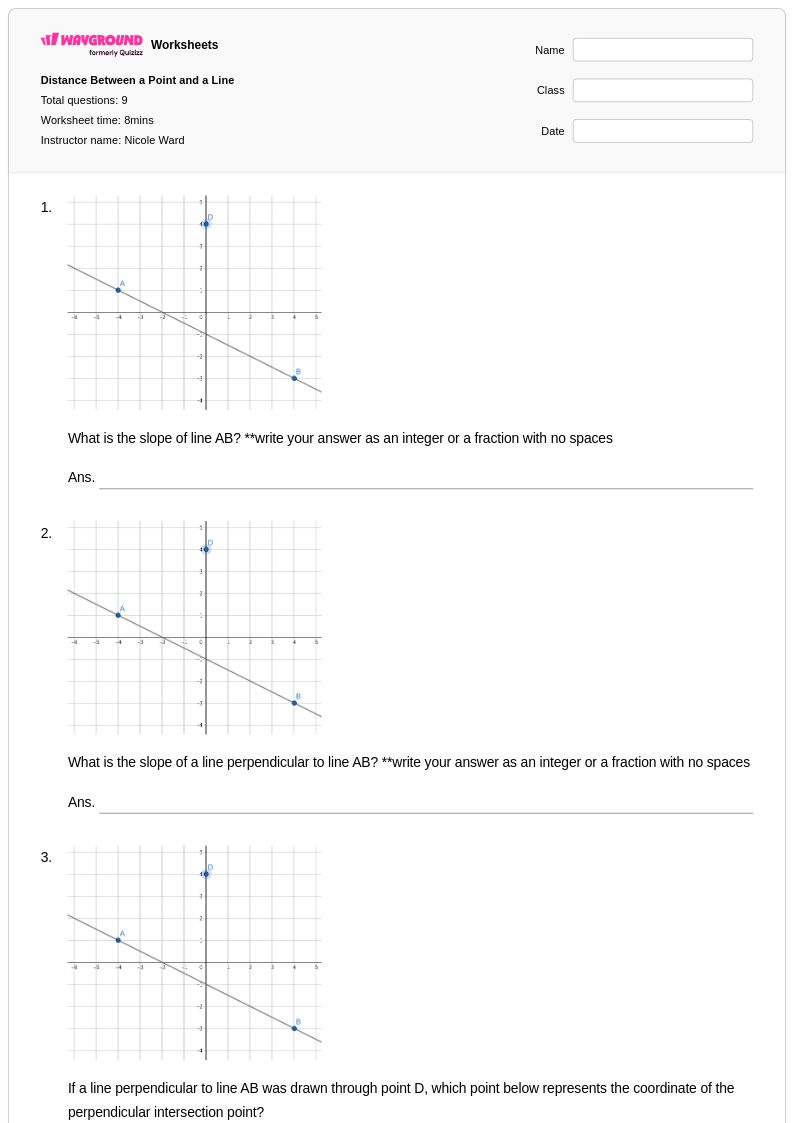
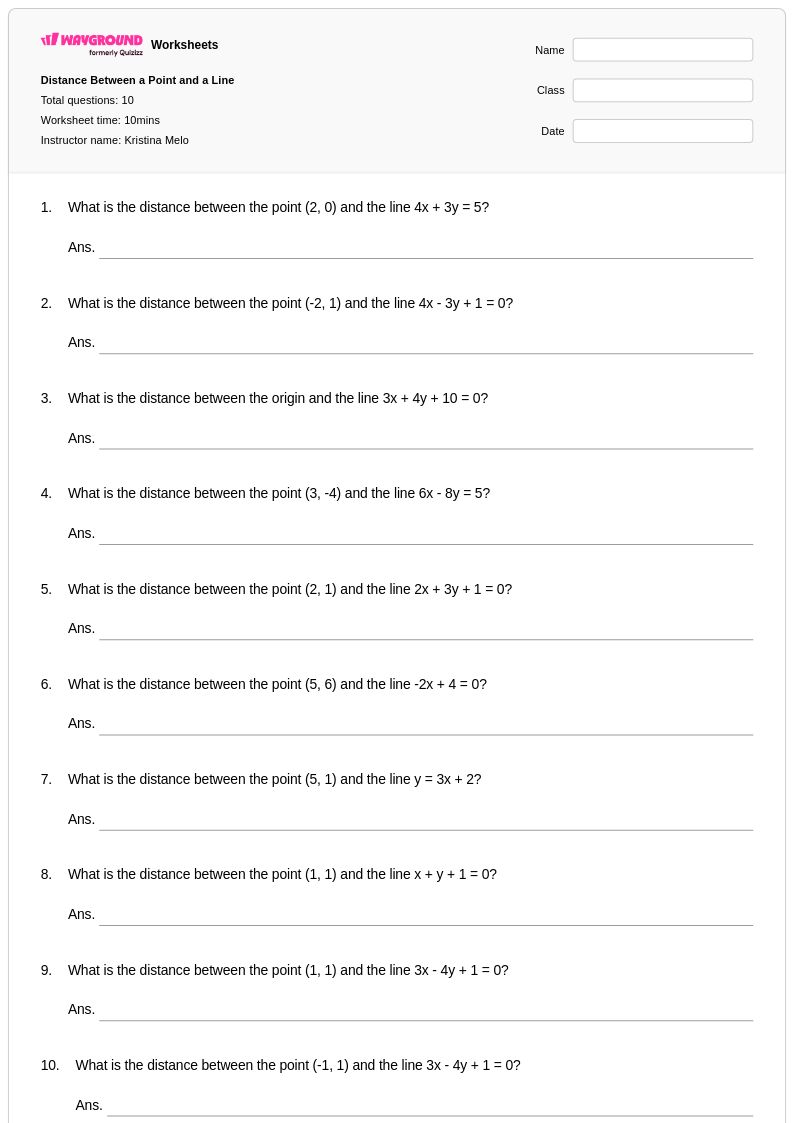
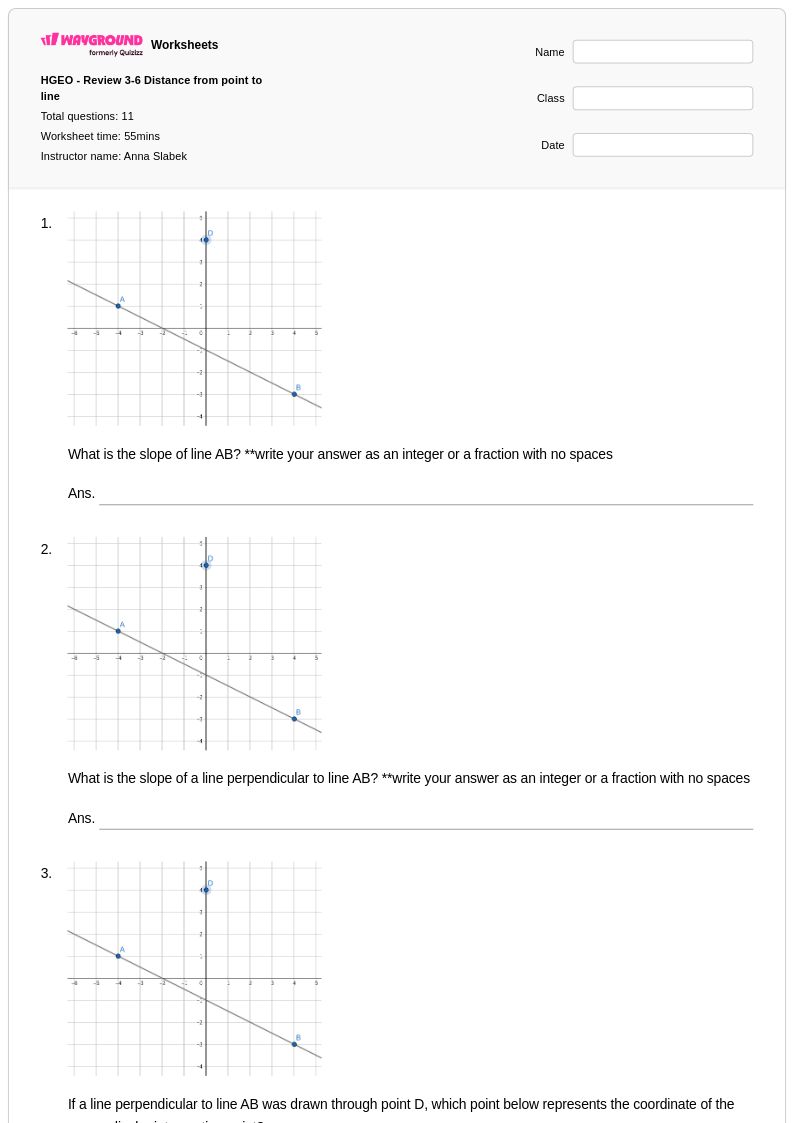
Distance between a point and a line worksheets for Year 10 students available through Wayground (formerly Quizizz) provide comprehensive practice with this fundamental coordinate geometry concept. These expertly designed resources help students master the perpendicular distance formula and develop proficiency in calculating the shortest distance from any given point to a straight line in the coordinate plane. The worksheets systematically build understanding through varied practice problems that require students to apply the standard formula d = |ax₀ + by₀ + c|/√(a² + b²), work with different line representations including standard form and slope-intercept form, and interpret geometric relationships. Each worksheet collection includes detailed answer keys and step-by-step solutions, making them valuable as both classroom assignments and independent study materials. These free printables reinforce essential skills in algebraic manipulation, coordinate geometry, and spatial reasoning that form the foundation for advanced mathematics courses.
Wayground (formerly Quizizz) empowers educators with millions of teacher-created worksheet resources specifically designed for Year 10 geometry instruction, including extensive collections focused on distance between a point and a line calculations. The platform's robust search and filtering capabilities allow teachers to quickly locate worksheets that align with specific curriculum standards and match their students' skill levels. Advanced differentiation tools enable educators to customize practice problems by adjusting complexity, providing multiple solution methods, and incorporating real-world applications that make abstract concepts more accessible. These versatile resources are available in both printable pdf formats for traditional classroom use and interactive digital versions for online learning environments. Teachers can seamlessly integrate these worksheets into lesson planning for initial instruction, targeted remediation sessions, enrichment activities for advanced learners, and regular skill practice that ensures students maintain proficiency with coordinate geometry fundamentals throughout the academic year.
FAQs
How do I teach point-to-line distance to 10th graders?
By 10th grade, students should be comfortable with linear equations in multiple forms, so the teaching emphasis shifts from setup to fluency and flexibility. Focus on problems where the line isn't handed to them in standard form — they need to convert first. It's also worth connecting the formula explicitly to the idea of perpendicularity: the distance is always measured along the perpendicular, and students who understand why are far less likely to misapply the formula in unfamiliar contexts.
What kinds of practice problems work best for 10th grade point-to-line distance?
At this level, straightforward substitution problems are a warm-up, not the main event. More useful are problems involving fractional or decimal coefficients, lines defined by two points (requiring students to derive the equation first), and problems that ask for the distance between two parallel lines — which reduces to finding the distance from any point on one line to the other. Real-world contexts like finding the shortest distance from a location to a road add motivation without adding much complexity.
What errors do 10th graders still make with the point-to-line distance formula?
Even students who know the formula well stumble when the line equation needs rearranging before they can use it. A line given as 3x = 2y + 5, for instance, trips up students who mechanically match coefficients without rewriting to standard form. Another persistent error: when the denominator involves a sum of squares under a radical, students sometimes simplify √(a² + b²) as a + b. Targeted practice on the denominator step alone — separate from the full problem — fixes this faster than repeated full-problem practice.
How do I use these Grade 10 worksheets effectively?
These worksheets include complete answer keys, so they're well-suited for independent practice, homework, or in-class review without extra prep. Assign them as a digital quiz on Wayground for instant feedback, or download the PDF and print — the Wayground for Teachers app lets you scan paper submissions and grade them from your phone. Both routes work; the digital version is faster to assign, the printed version works well when devices aren't available.
How does point-to-line distance fit into the 10th grade geometry progression?
In Common Core-aligned 10th grade geometry, this topic extends students' coordinate geometry work from 9th grade — specifically their ability to write and manipulate linear equations — toward more sophisticated geometric reasoning. Mastering it here is a prerequisite for working with circles (finding tangent lengths, distances from center to chord) and for the analytic geometry that appears in precalculus. Students who leave 10th grade shaky on this formula tend to struggle with those later topics in ways that aren't immediately obvious.
How can I differentiate point-to-line distance practice for my 10th grade class?
Wayground lets you create alternate versions of the same worksheet with larger font sizes or wider line spacing for students who need it, and you can apply a dyslexia-friendly font without changing the math content. For students who need more processing time on multi-step problems, extended time per question can be set individually so the rest of the class works at the default pace. These settings carry over to future sessions automatically once configured.