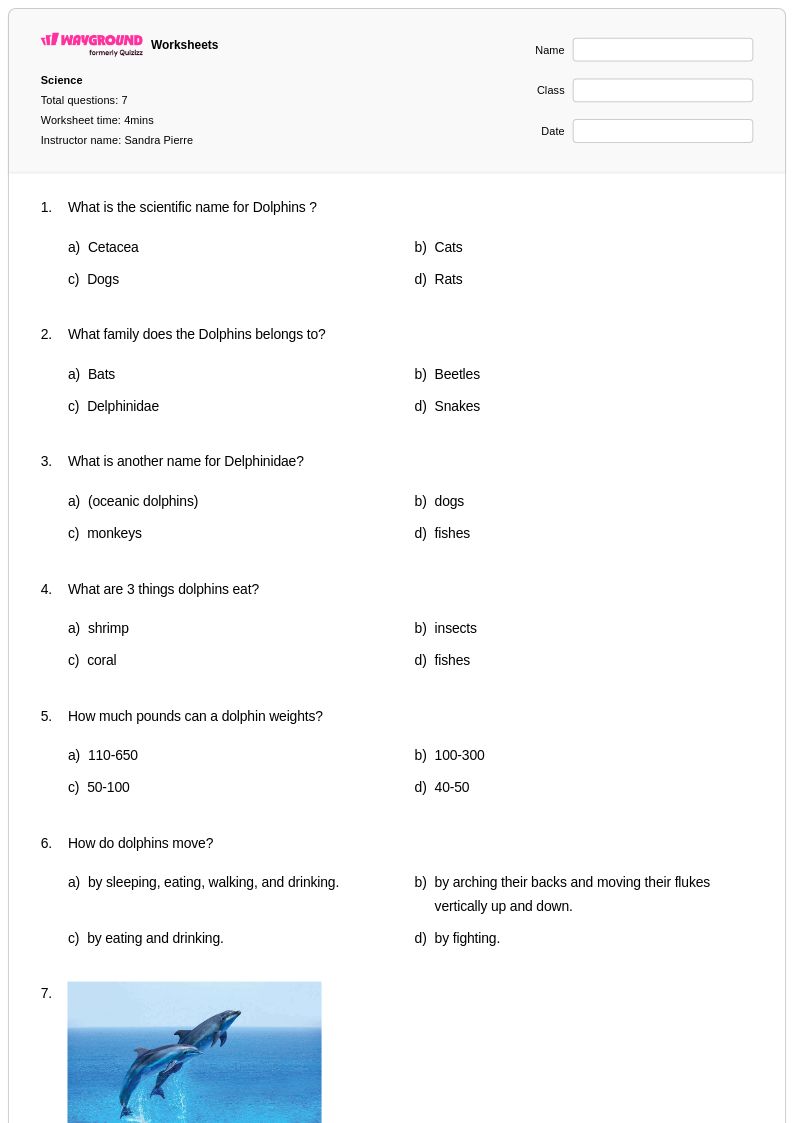
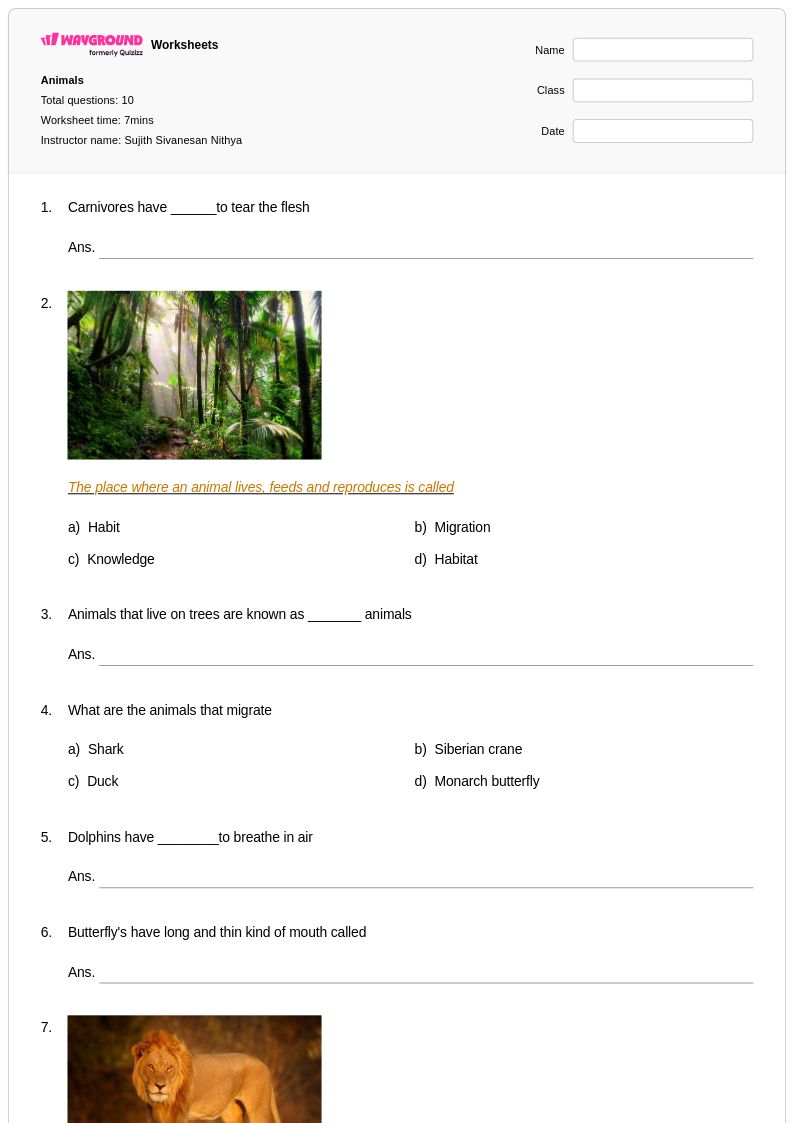
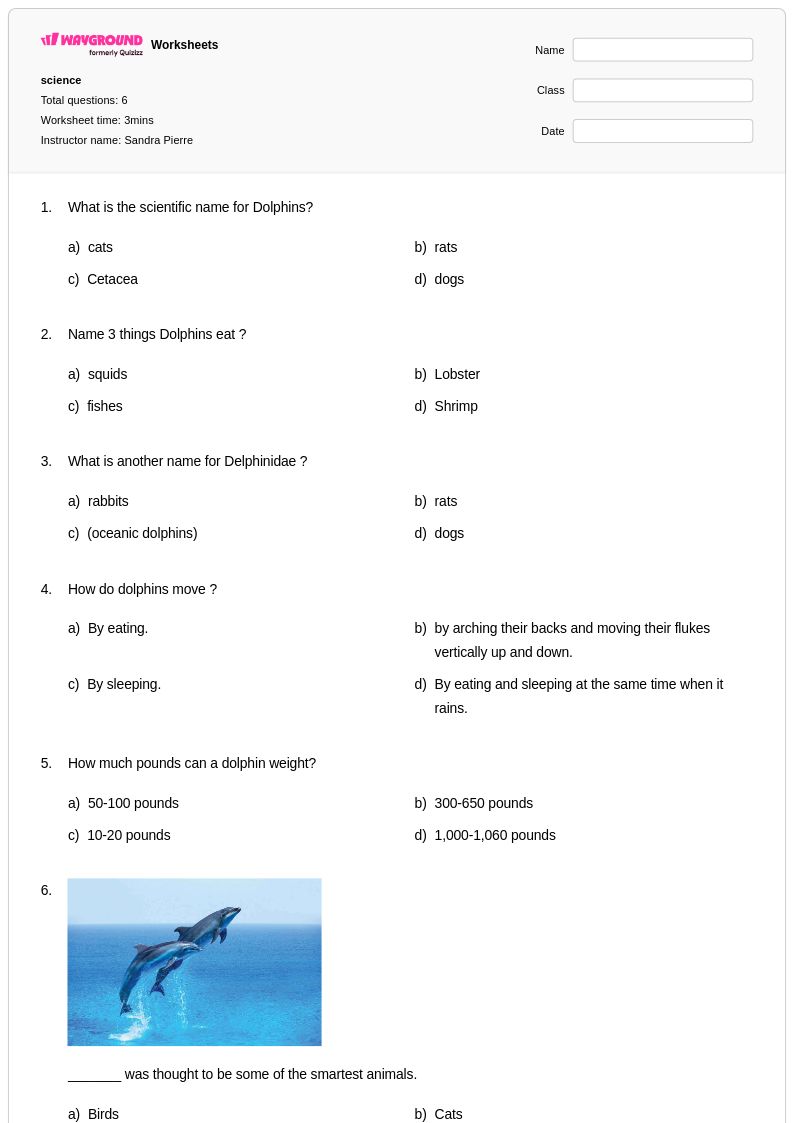
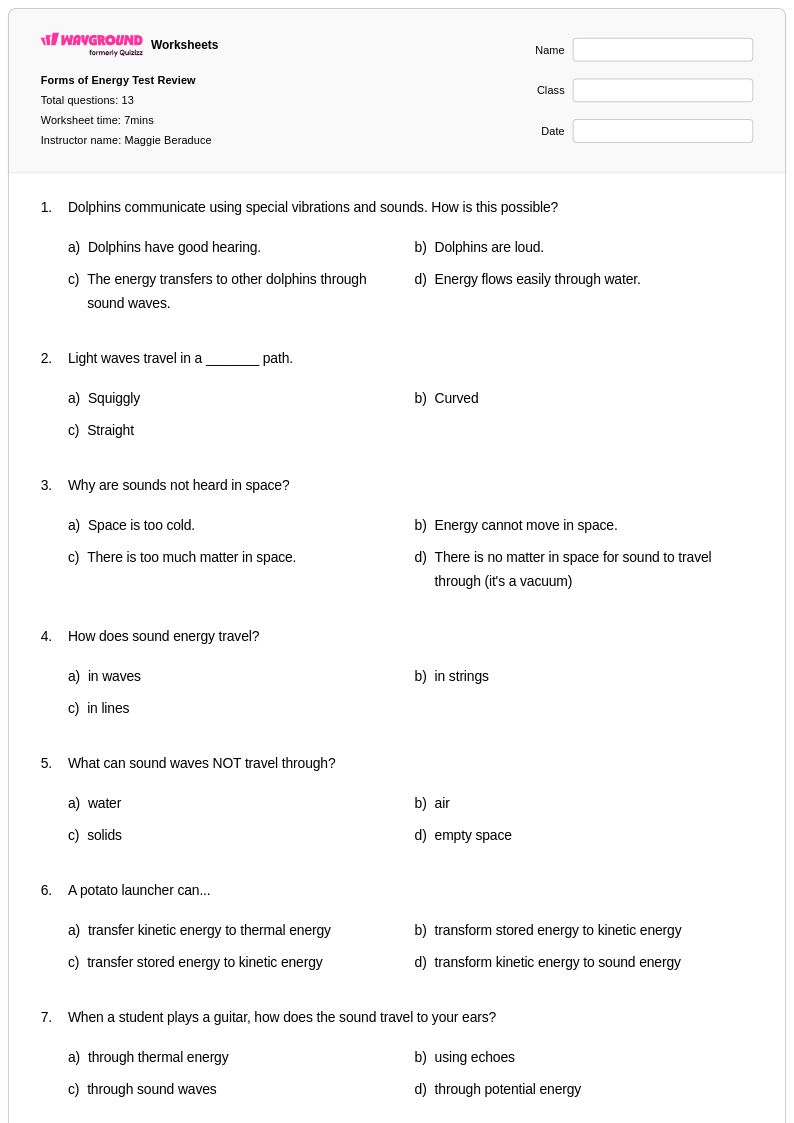
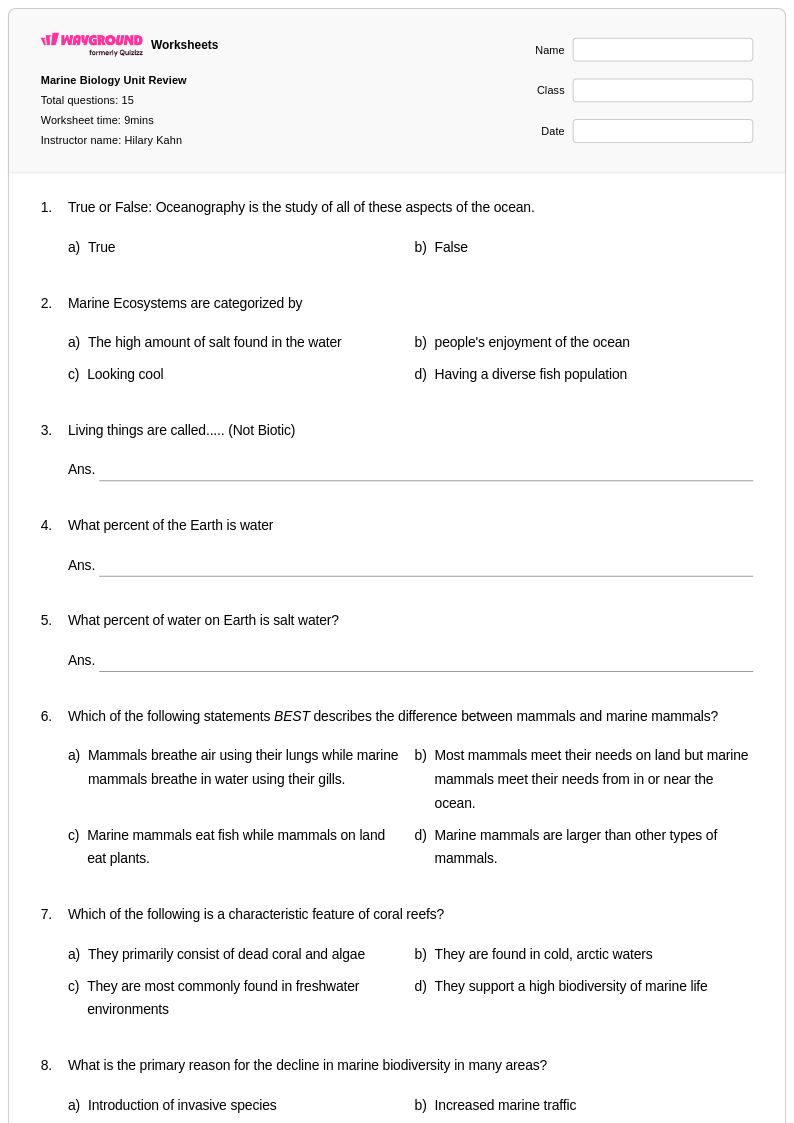
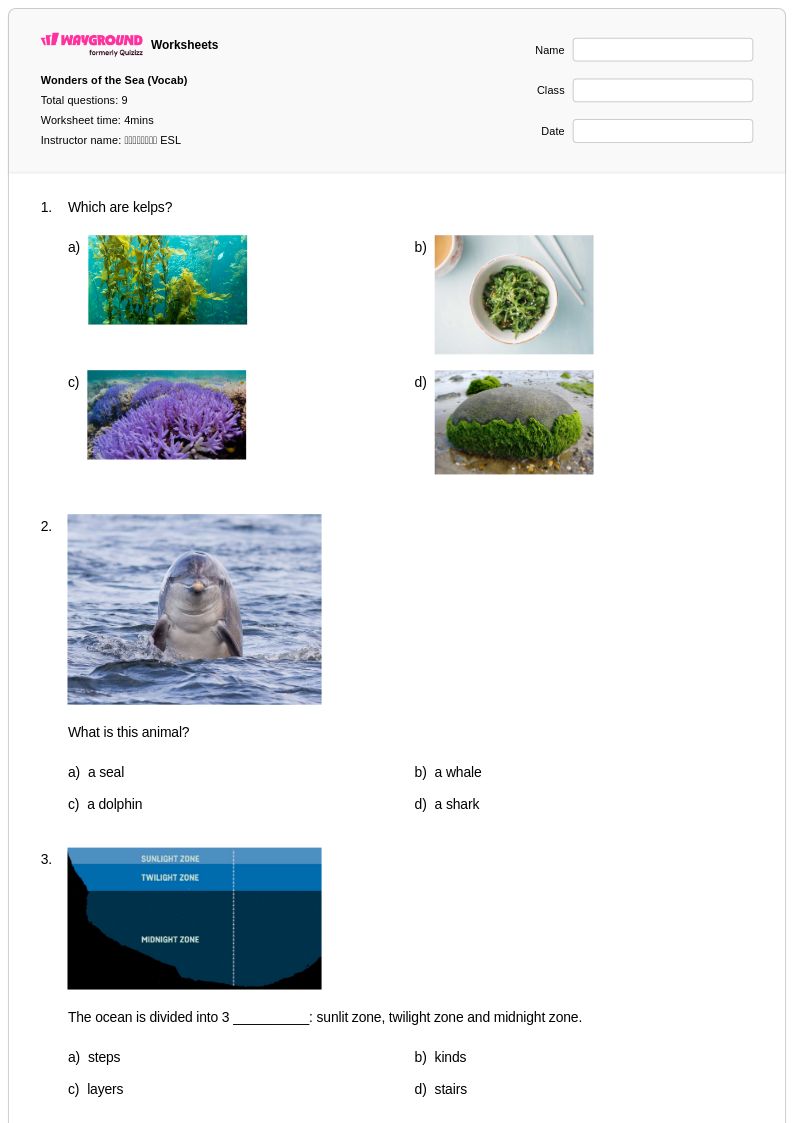
Explore Wayground's comprehensive collection of Year 5 dolphins worksheets and printables that help students discover marine mammal biology through engaging practice problems, free PDF resources, and detailed answer keys.
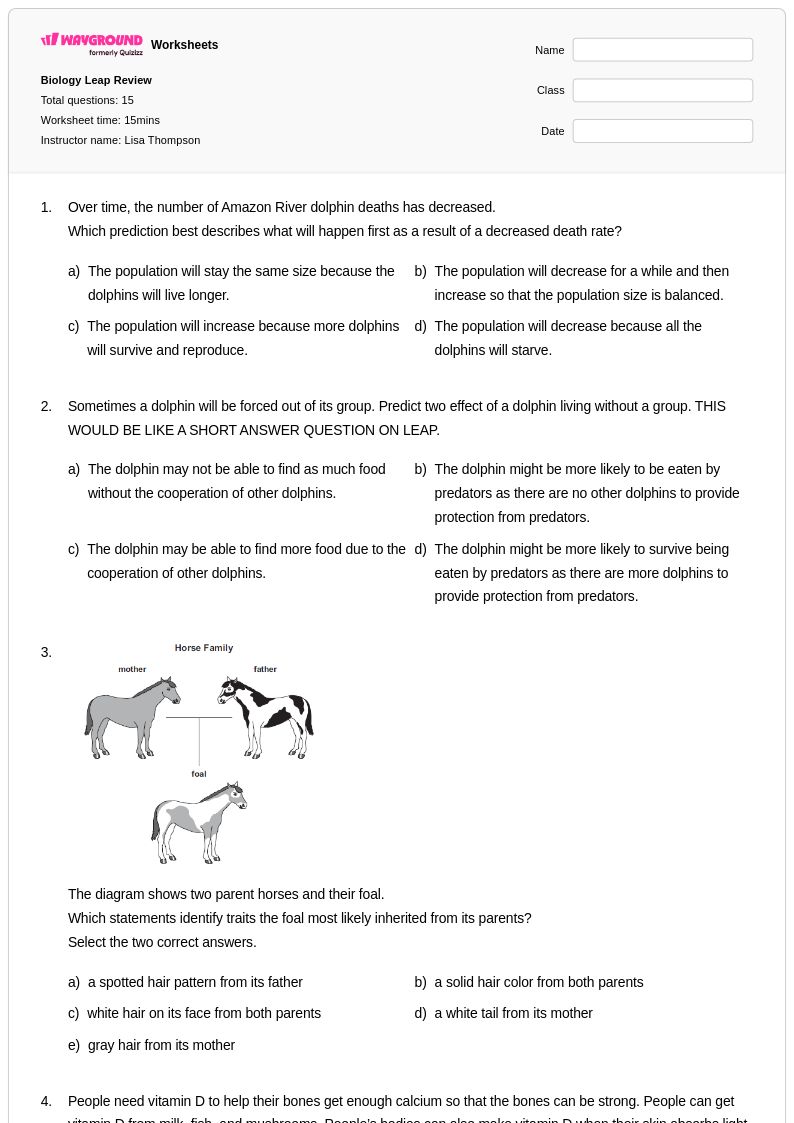
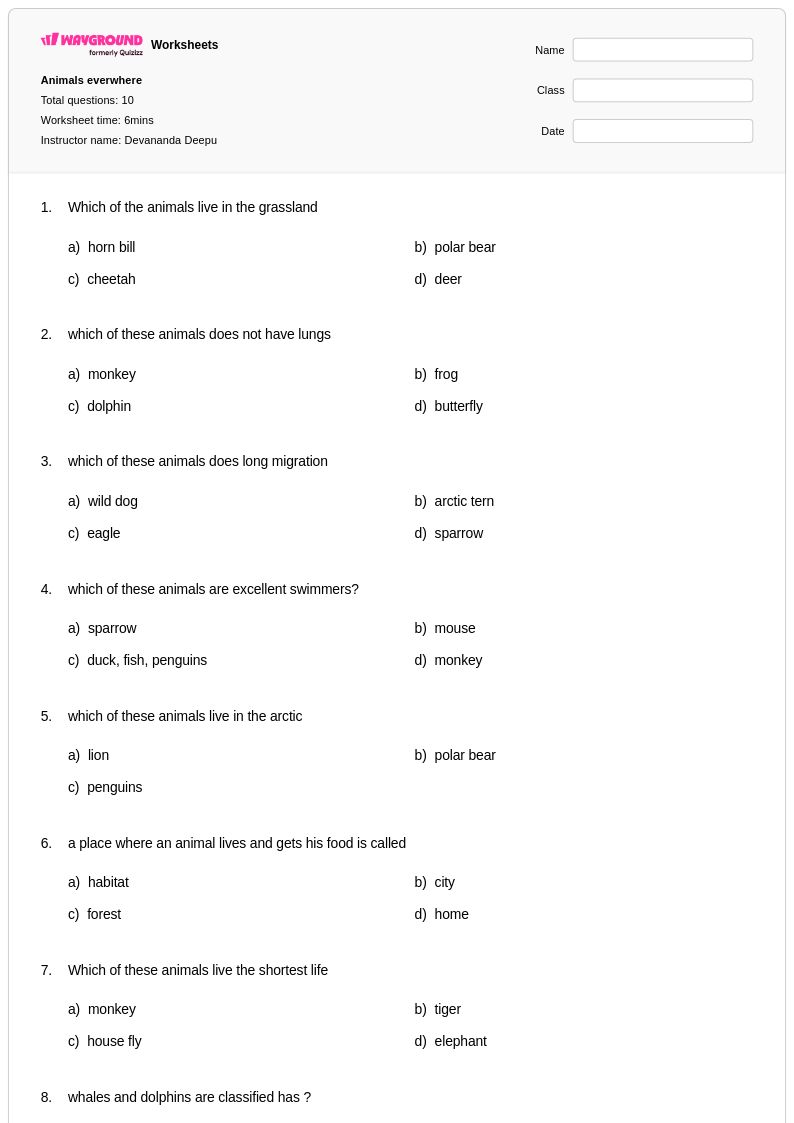
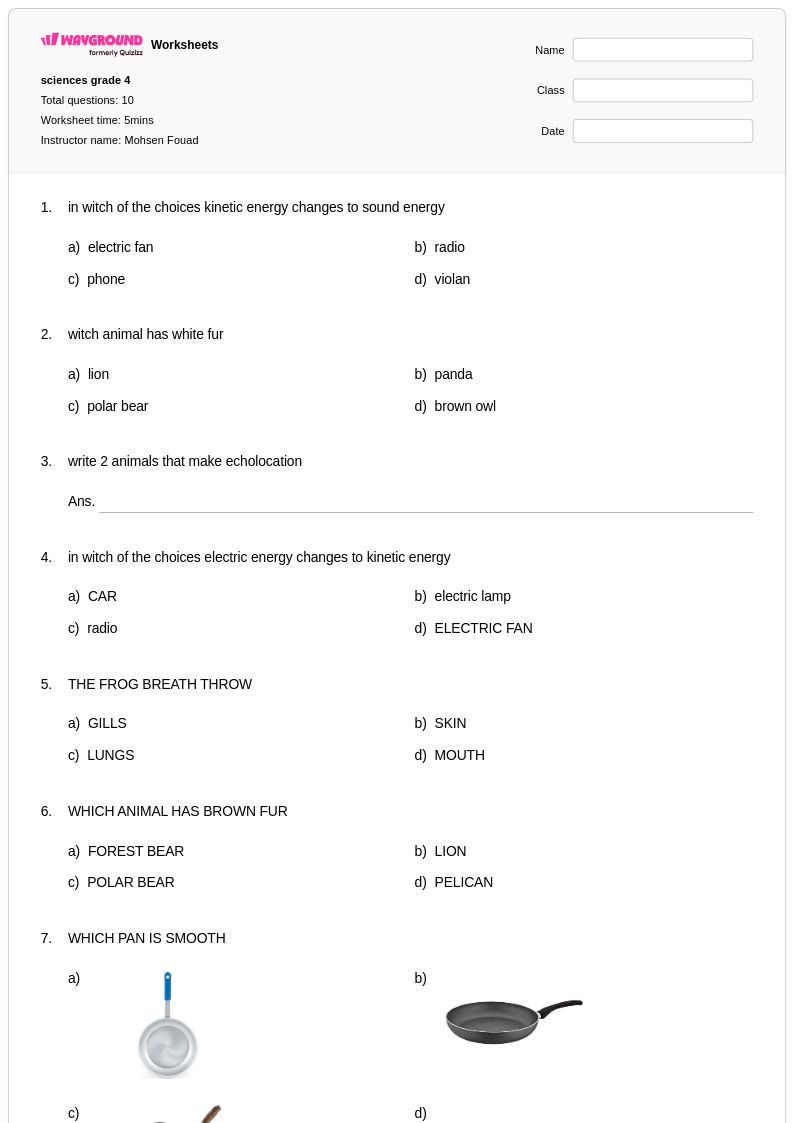
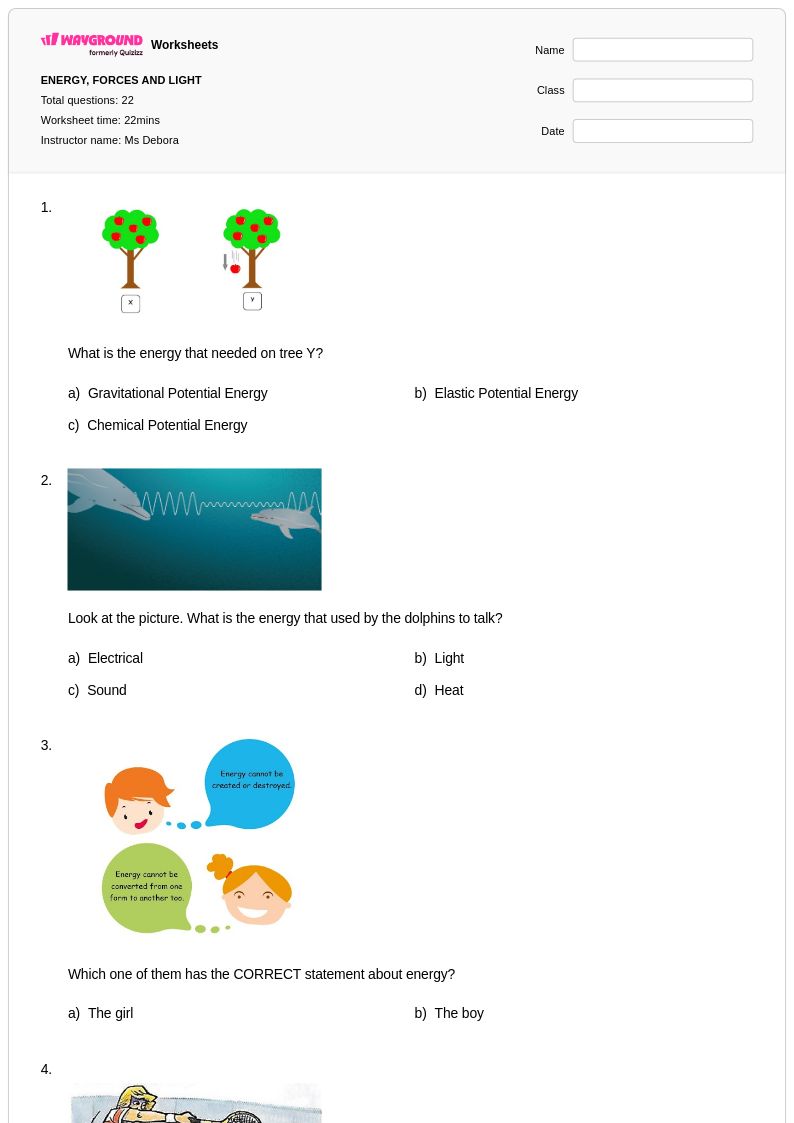
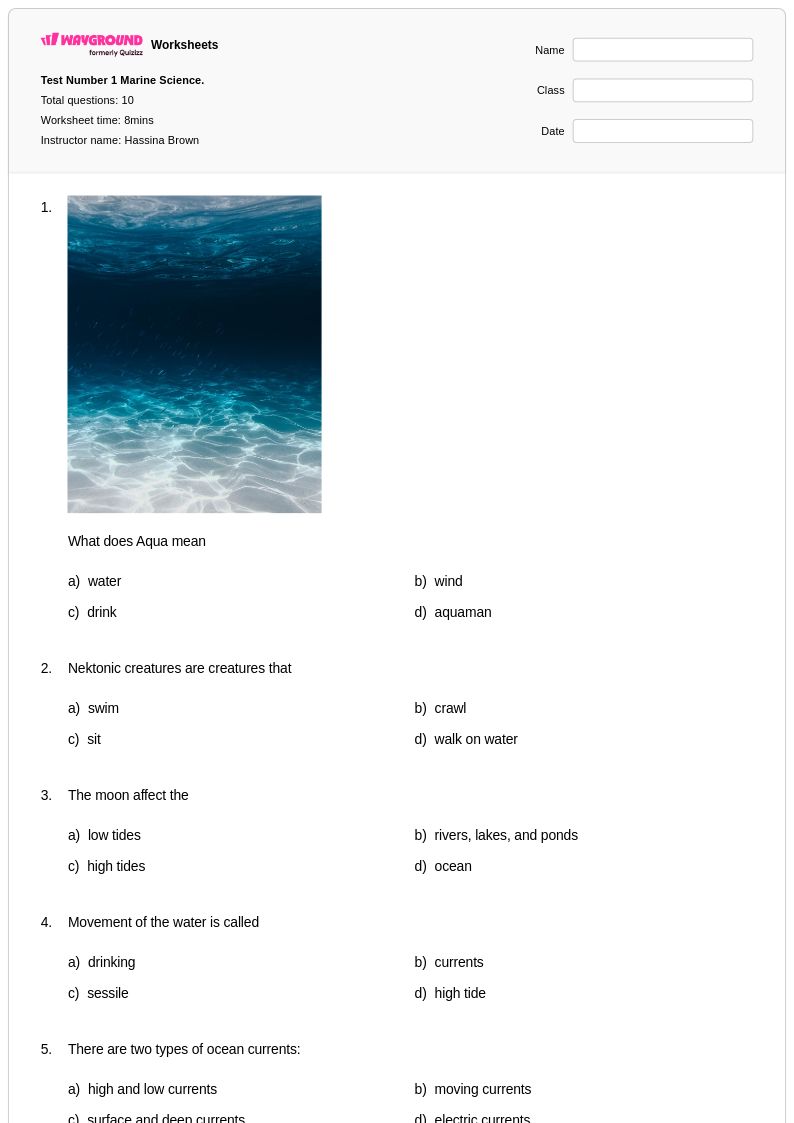
Dolphins worksheets for Year 5 students available through Wayground (formerly Quizizz) provide comprehensive learning opportunities that explore the fascinating world of these intelligent marine mammals. These educational resources strengthen critical thinking skills as students investigate dolphin anatomy, behavior, communication methods, and habitat requirements while developing scientific observation and analysis abilities. The worksheet collections include detailed answer keys that support both independent learning and classroom instruction, with free printable formats that make distribution effortless for educators. Students engage with practice problems covering dolphin echolocation, social structures, feeding patterns, and conservation challenges, building foundational knowledge in marine biology while enhancing reading comprehension and scientific reasoning skills through age-appropriate content designed specifically for fifth-grade learners.
Wayground (formerly Quizizz) empowers teachers with access to millions of educator-created dolphin resources that streamline lesson planning and support diverse learning needs in Year 5 science instruction. The platform's robust search and filtering capabilities enable teachers to quickly locate materials aligned with specific learning standards, while differentiation tools allow seamless customization of content difficulty and complexity to meet individual student requirements. These versatile worksheet collections are available in both printable pdf formats and interactive digital versions, providing flexibility for various classroom environments and teaching approaches. Teachers utilize these comprehensive resources for targeted skill practice, remediation support for struggling learners, and enrichment opportunities for advanced students, ensuring that every fifth-grader can successfully explore dolphin biology concepts at their appropriate instructional level while building confidence in scientific inquiry and marine science understanding.
FAQs
How do I teach dolphin biology to students?
Teaching dolphin biology is most effective when you anchor lessons in concrete systems: start with anatomy and how physical structures like the blowhole, dorsal fin, and melon support survival, then connect those structures to behaviors like echolocation and pod communication. From there, zoom out to ecological role, covering how dolphins interact with food chains and ocean ecosystems. Using labeled diagrams alongside reading passages helps students build vocabulary while reinforcing conceptual understanding.
What topics are typically covered in dolphin worksheets?
Dolphin worksheets typically cover anatomy and body structure, echolocation mechanics, social behavior and pod dynamics, dolphin communication methods, adaptation strategies for marine life, and conservation challenges facing dolphin populations. Strong worksheets also connect dolphin biology to broader concepts in mammalian evolution and ocean ecosystems, helping students see how these topics fit into the larger science curriculum.
What mistakes do students commonly make when learning about dolphins?
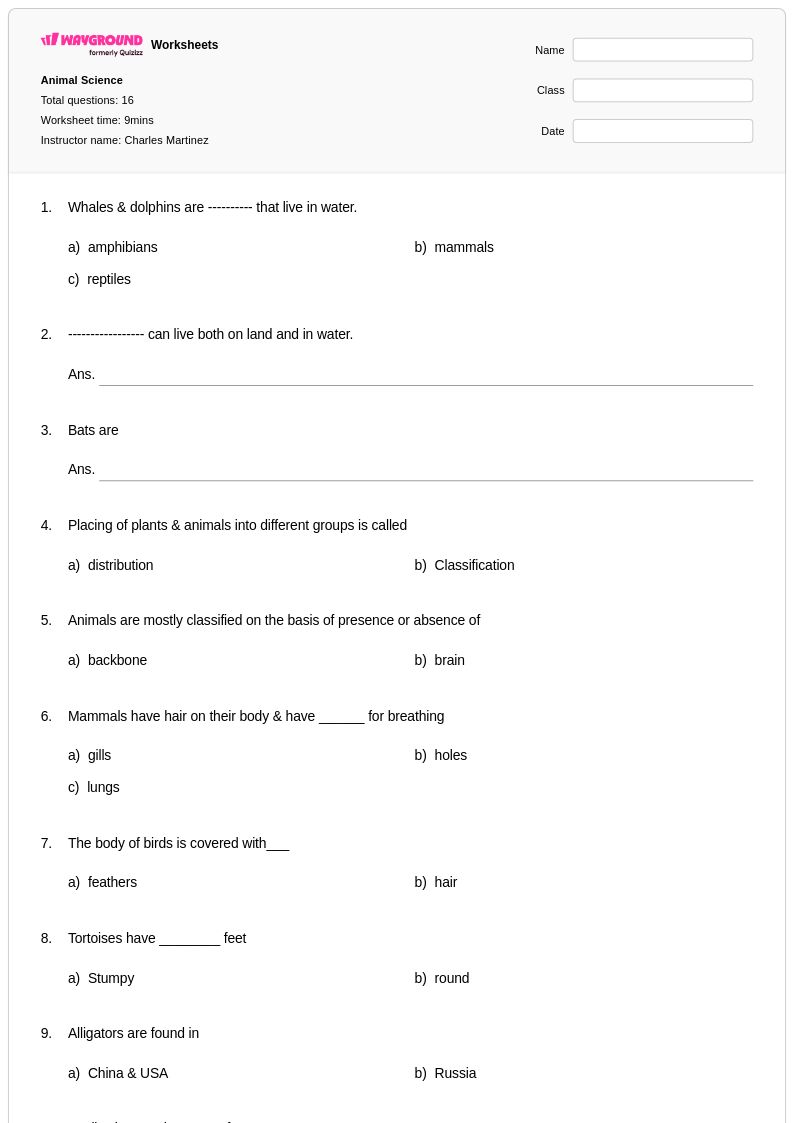
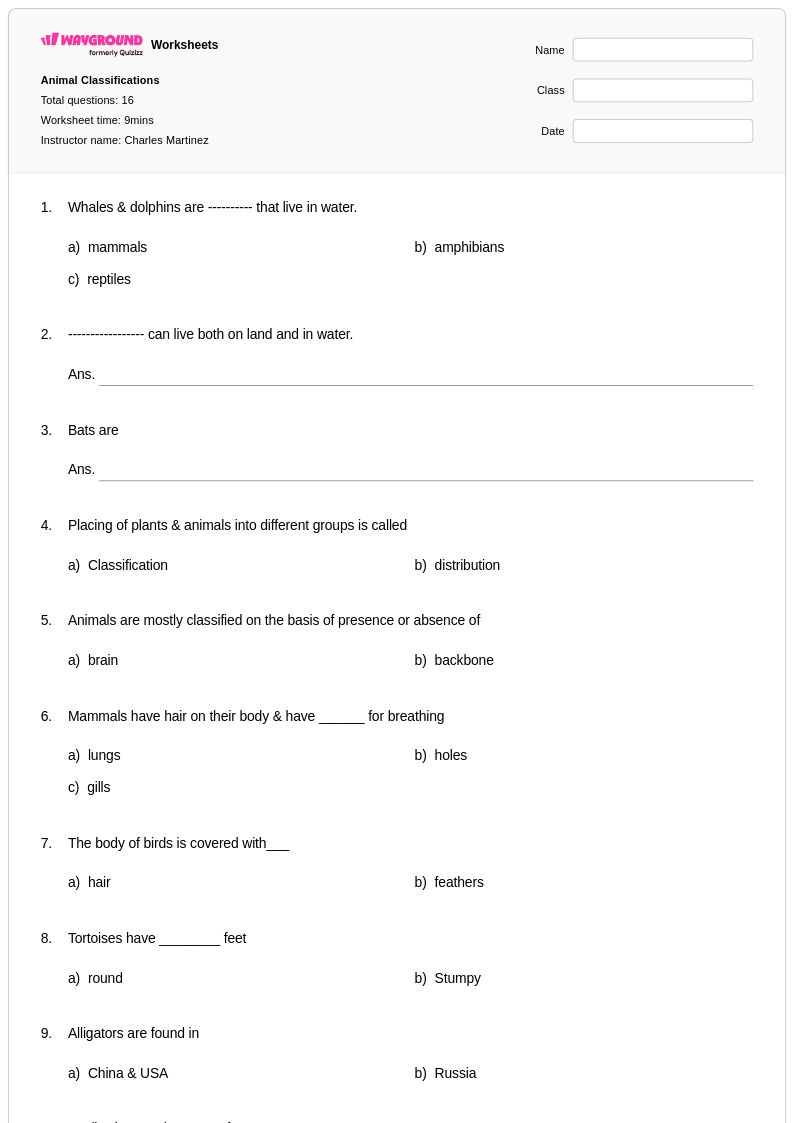
The most common misconception is that dolphins are fish. Students need explicit instruction that dolphins are mammals that breathe air, give live birth, and nurse their young, despite living entirely in water. A second frequent error is confusing echolocation with hearing, when in fact echolocation is an active biological sonar system dolphins use to navigate and hunt. Addressing these misconceptions directly in worksheets, with labeled diagrams and comparison tasks, tends to correct them more reliably than explanation alone.
How can I use dolphin worksheets to support different learners in my class?
Dolphin worksheets can be differentiated by adjusting the complexity of reading passages, the number of answer choices on identification tasks, or the depth of analysis required in open-response questions. On Wayground, teachers can apply individual accommodations such as read aloud for audio support, reduced answer choices to lower cognitive load, and extended time for students who need it. These settings can be assigned to specific students without affecting the rest of the class, making it practical to support diverse learners within a single activity.
How do I use Wayground's dolphin worksheets in my classroom?
Wayground's dolphin worksheets are available as printable PDFs for traditional classroom use and in digital formats for technology-integrated instruction. Teachers can assign them as independent practice, guided group work, or review activities, and can also host them as a quiz directly on Wayground for real-time student responses. Complete answer keys are included with each worksheet, which supports both teacher-led correction and independent student self-assessment.
How does dolphin biology connect to broader science curriculum standards?
Dolphin biology naturally connects to life science standards covering mammalian characteristics, animal adaptation, food webs, and marine ecosystems. Echolocation ties into physical science concepts around sound waves, while dolphin conservation topics link to environmental science and human impact on ecosystems. Because dolphin content spans multiple science domains, it is well suited for cross-curricular reinforcement and can serve as an engaging anchor topic during marine biology or ecology units.