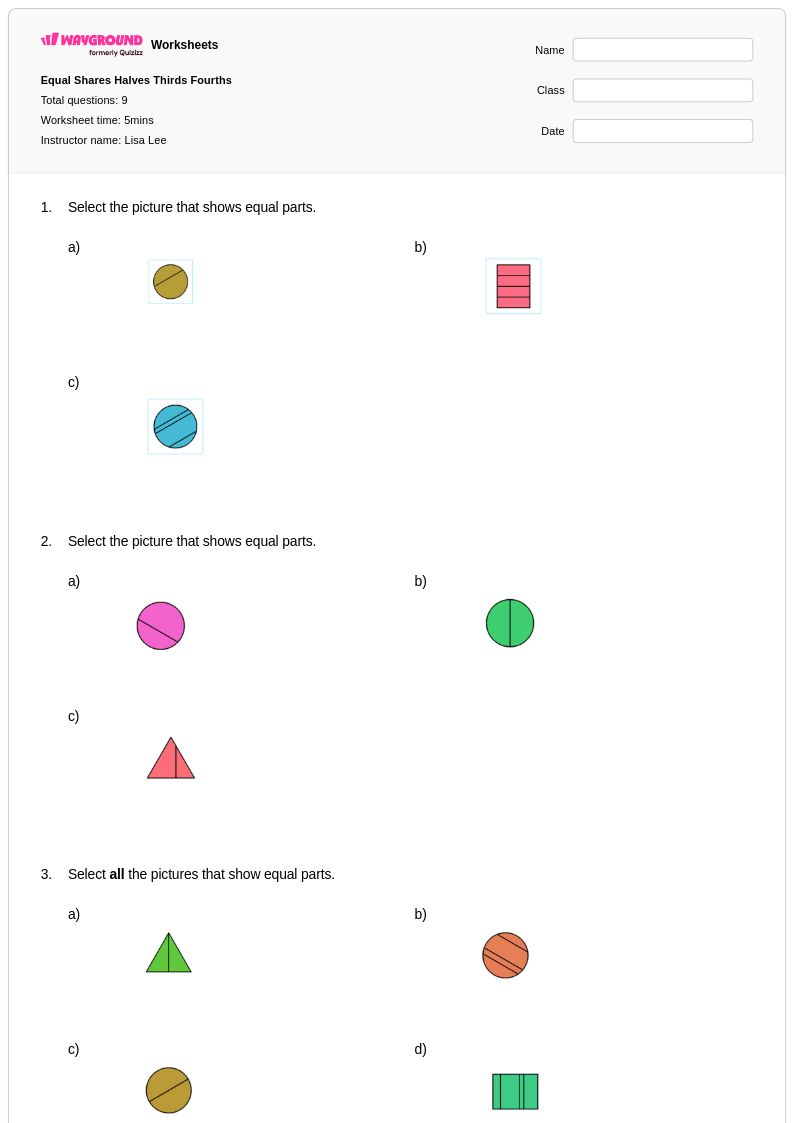
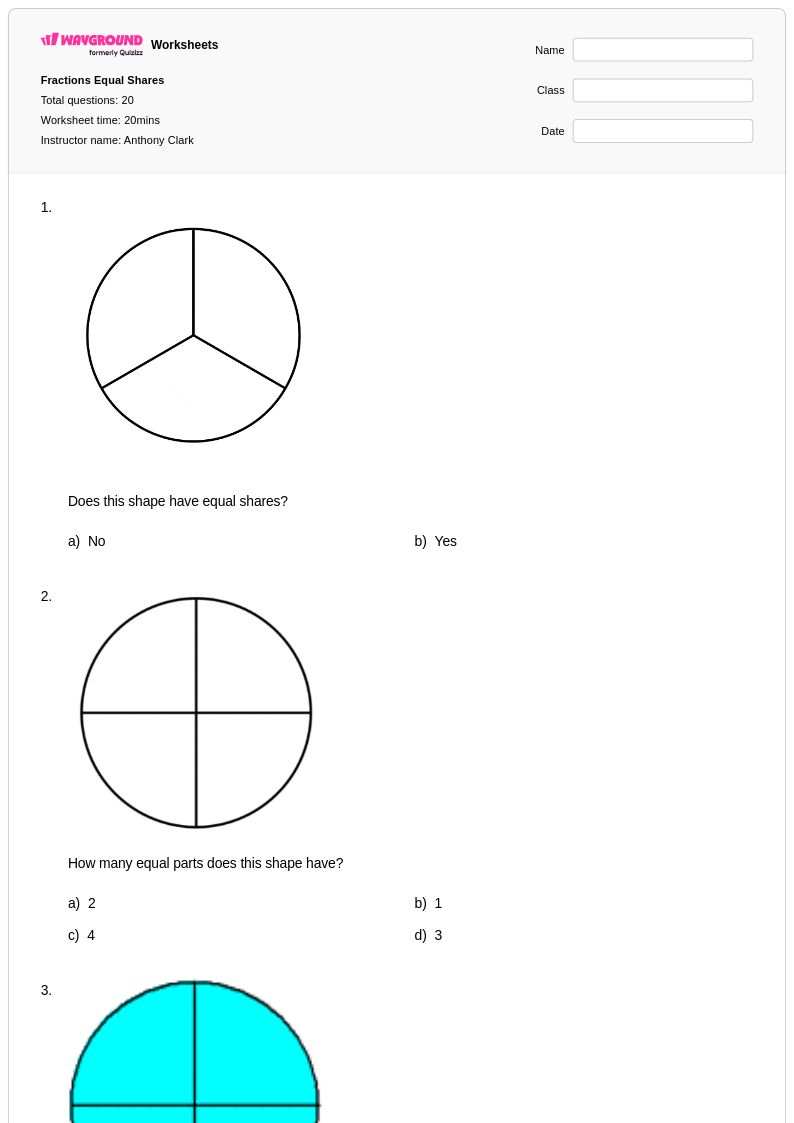
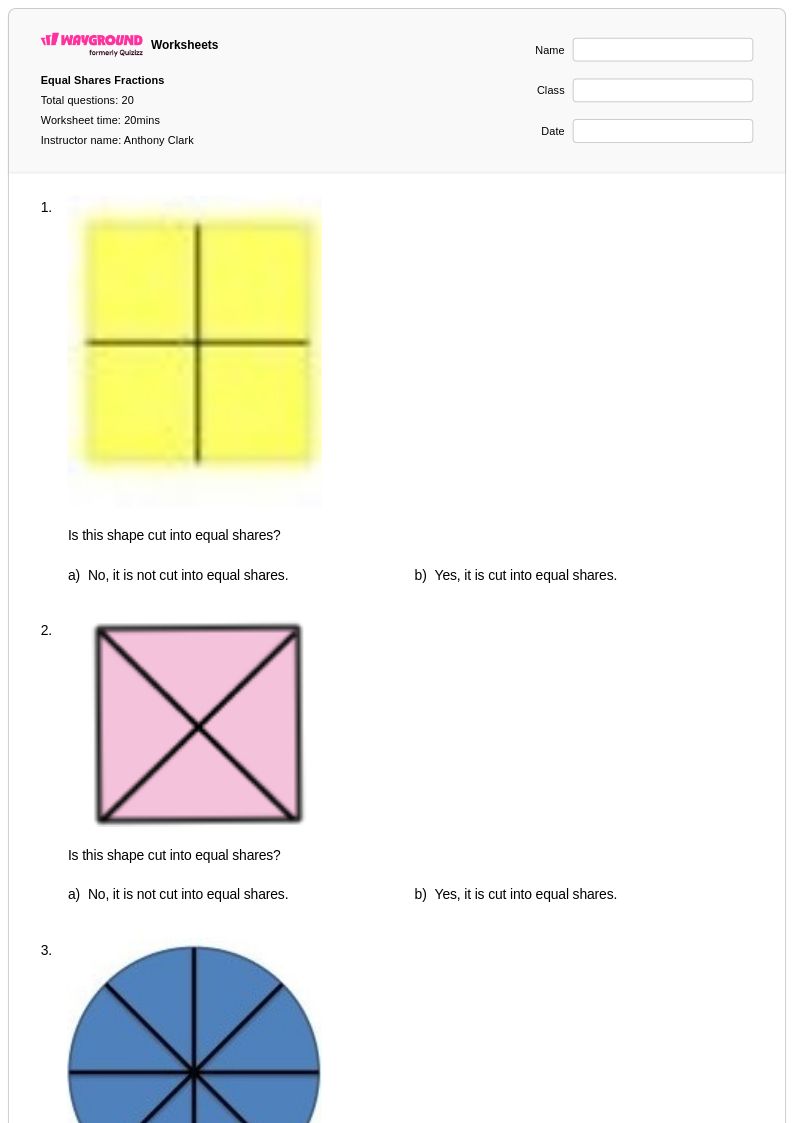
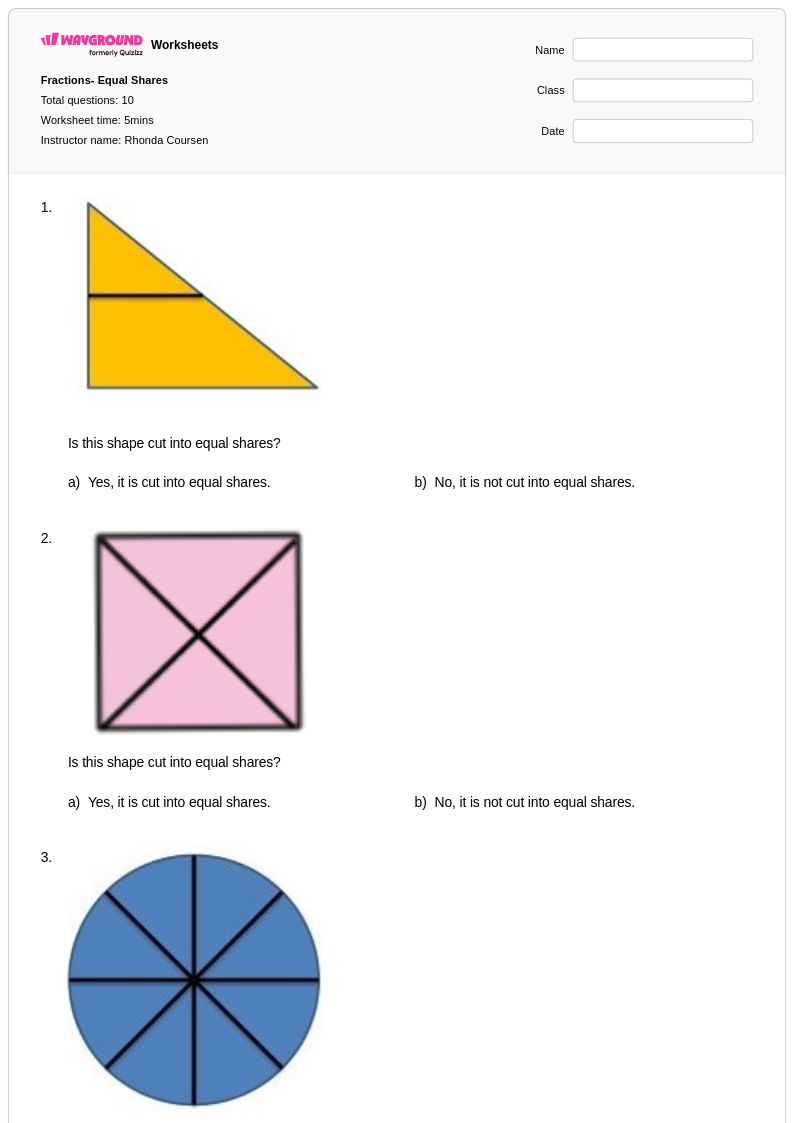
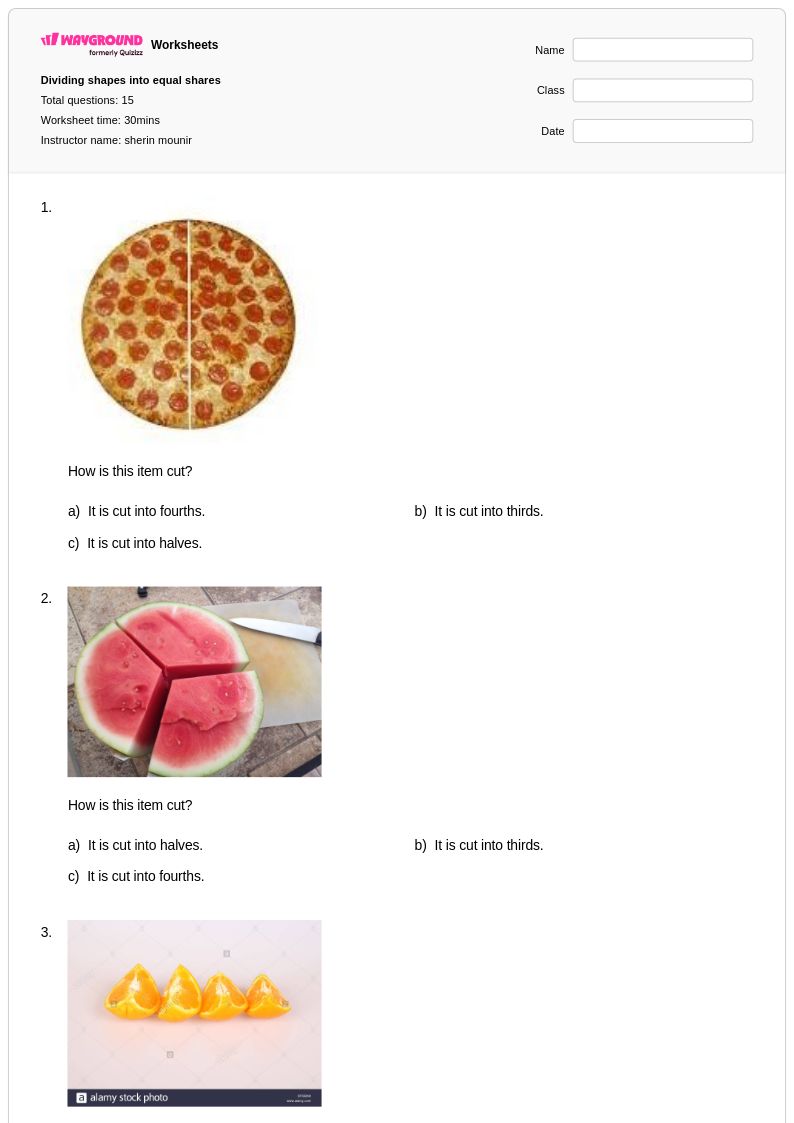
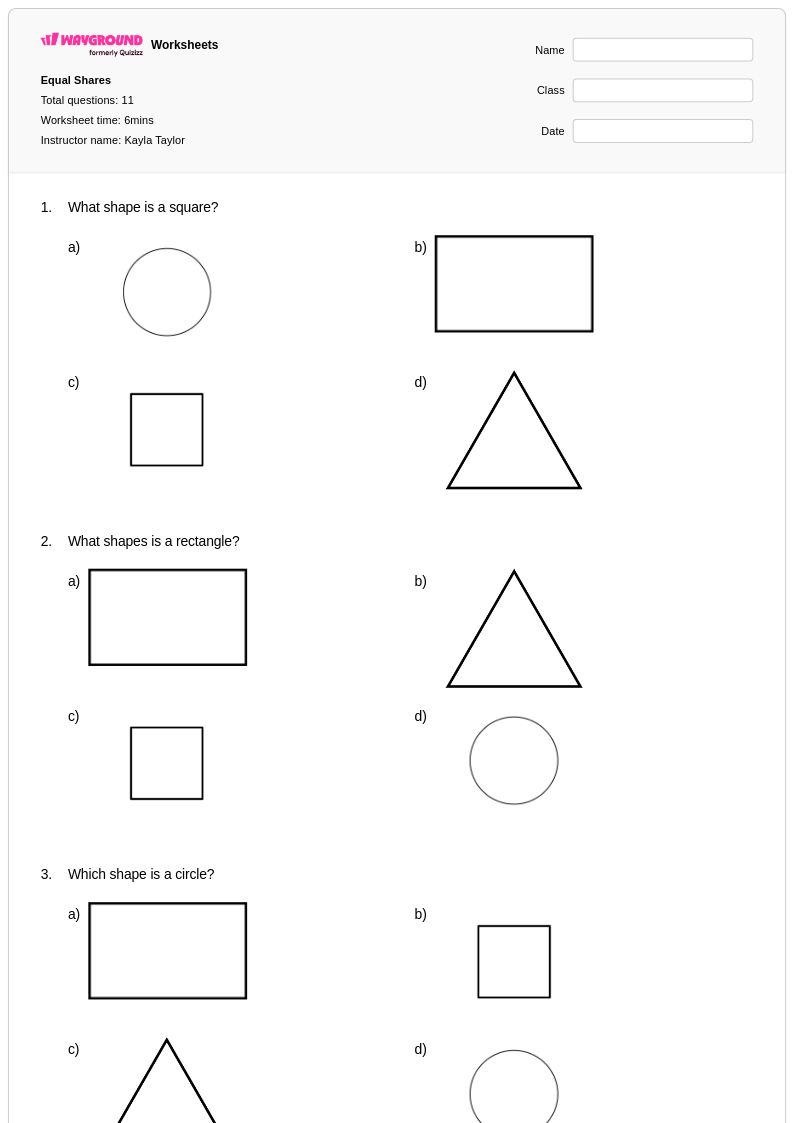
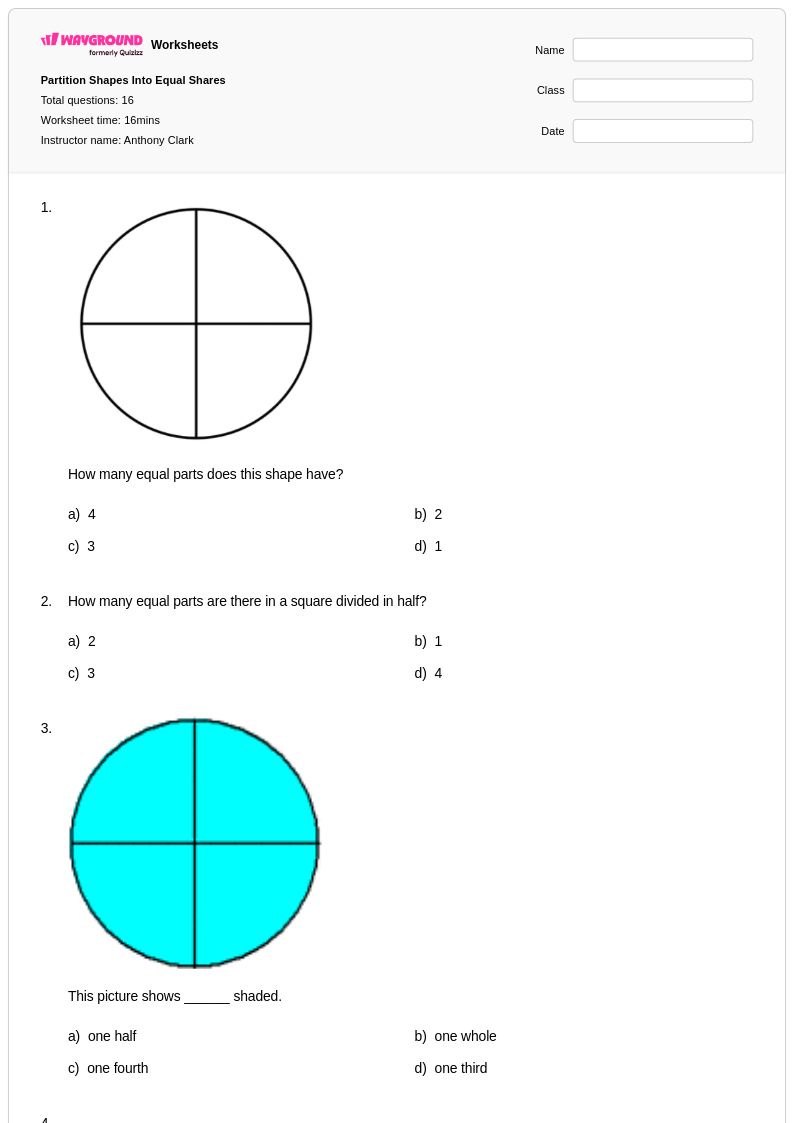
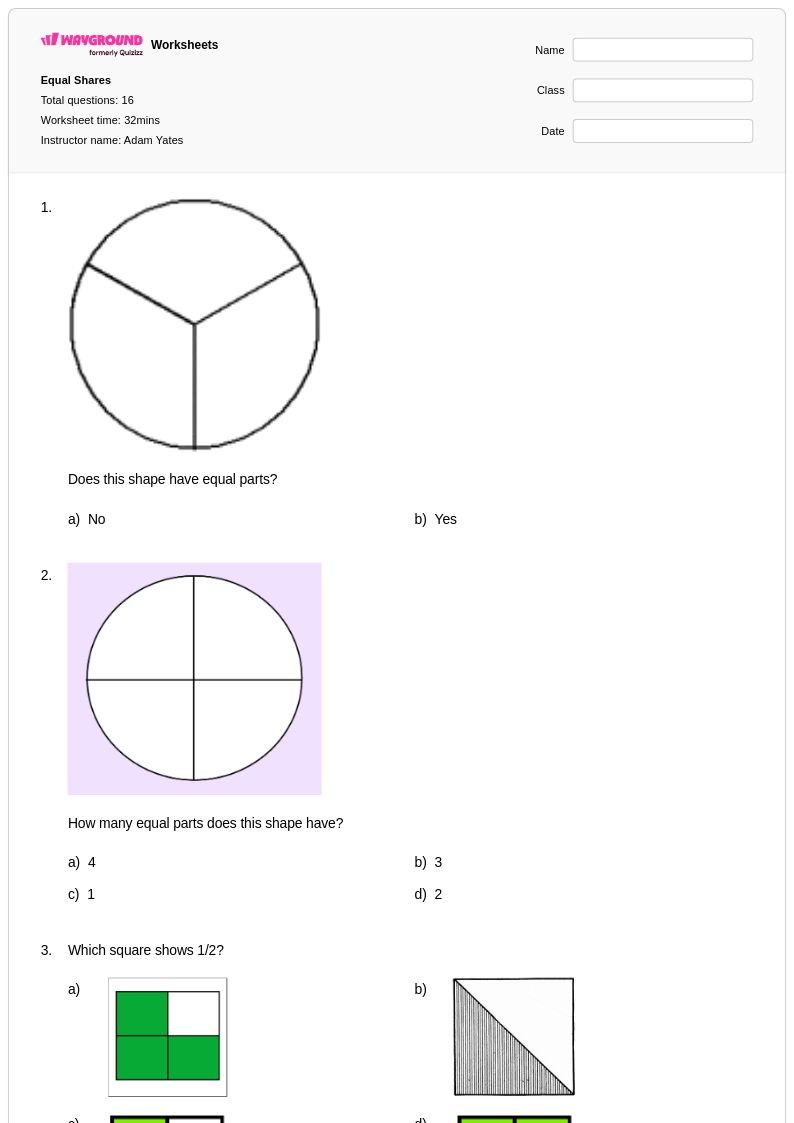
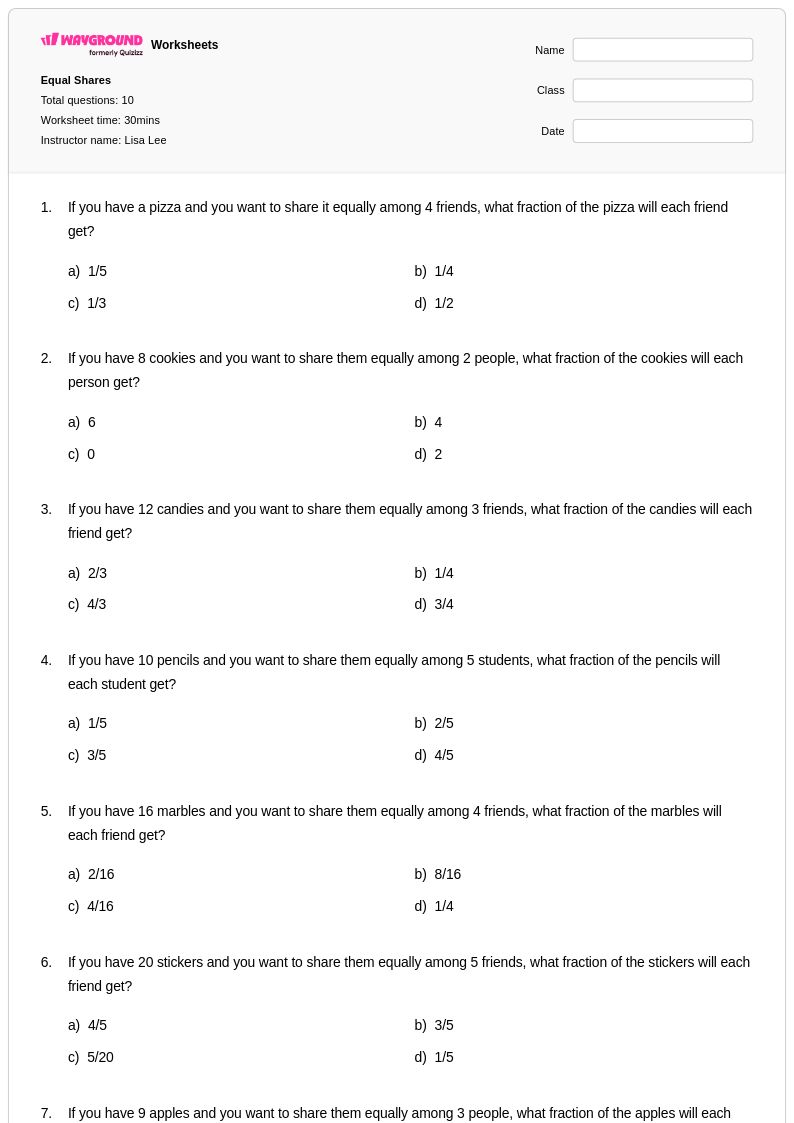
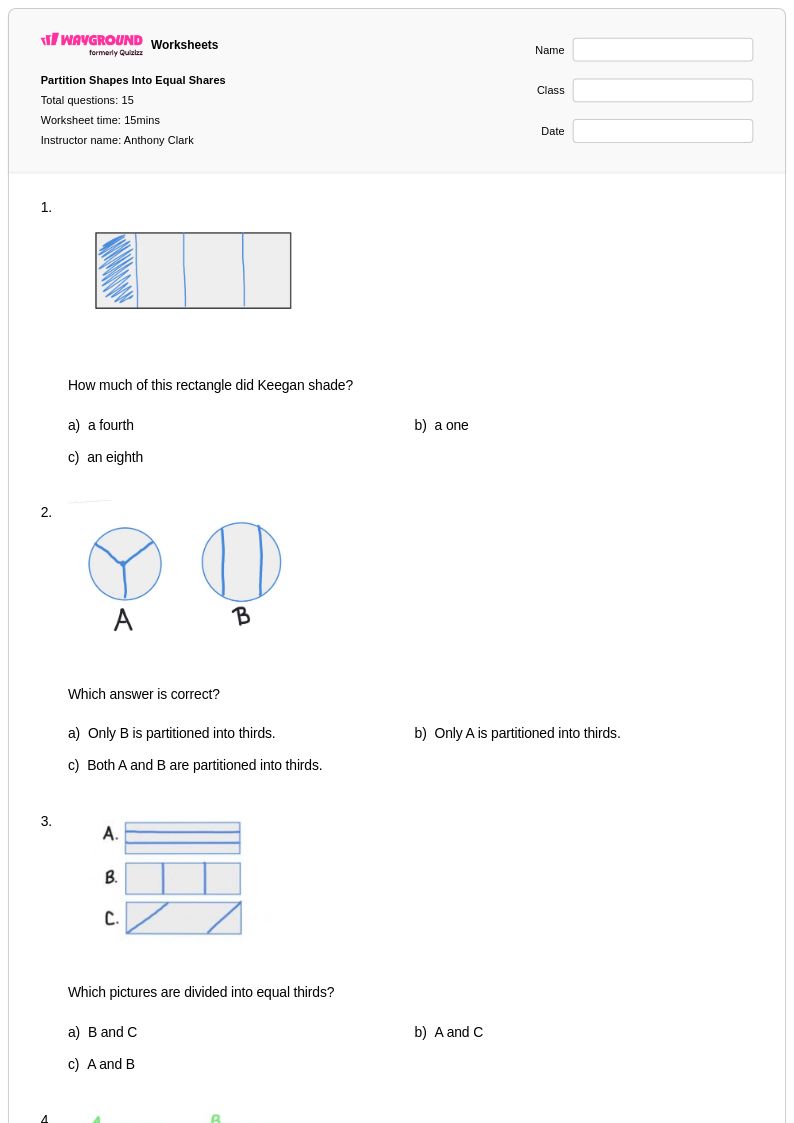
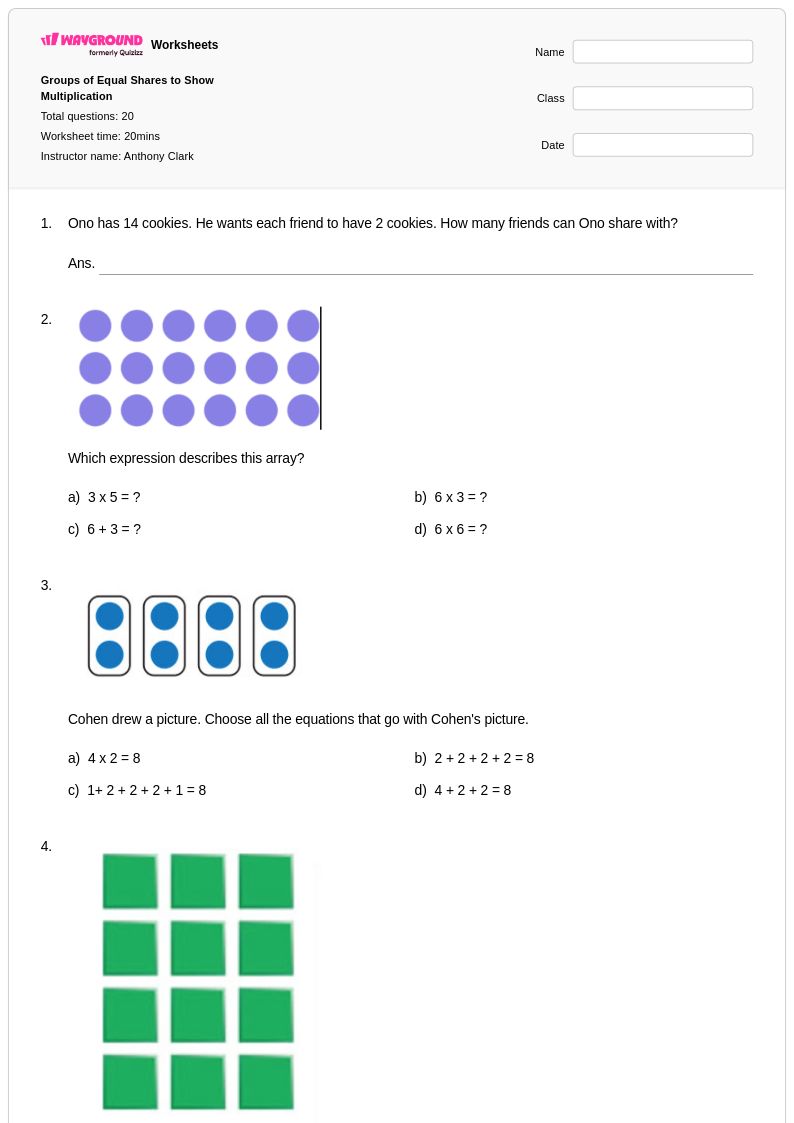
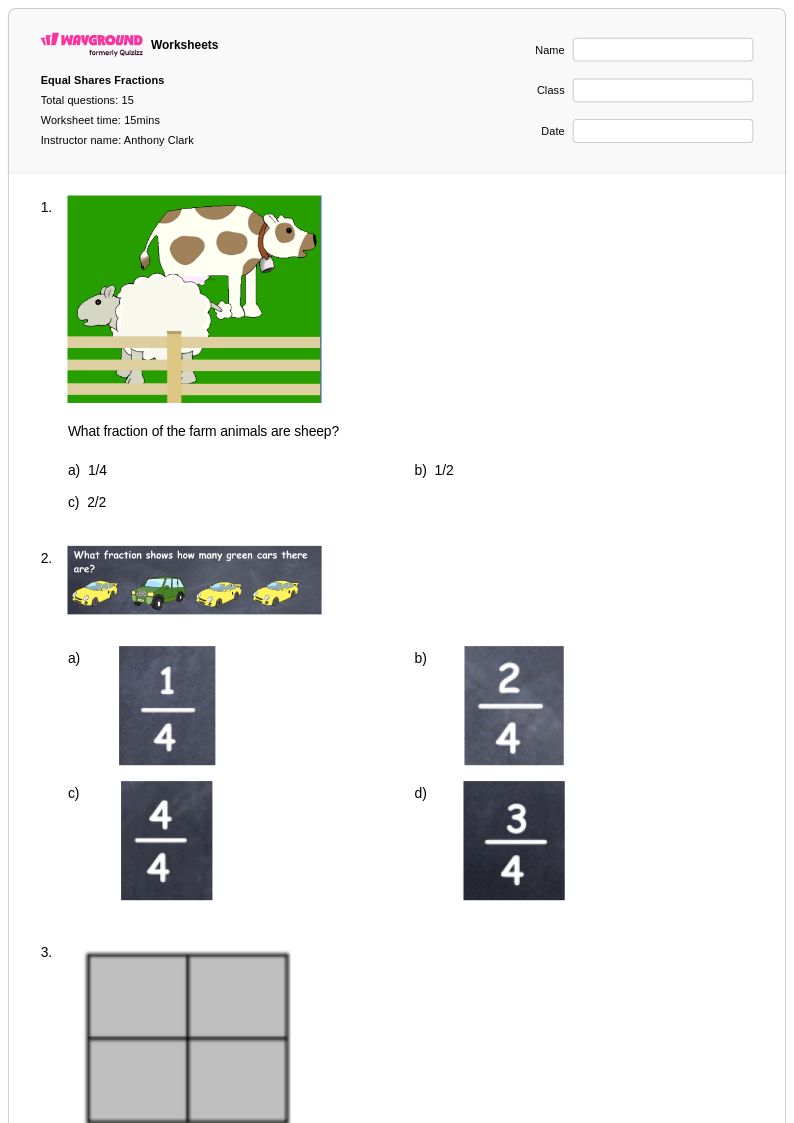
Free equal shares worksheets and printables help students master dividing shapes and objects into fair, equivalent parts through engaging practice problems with complete answer keys.
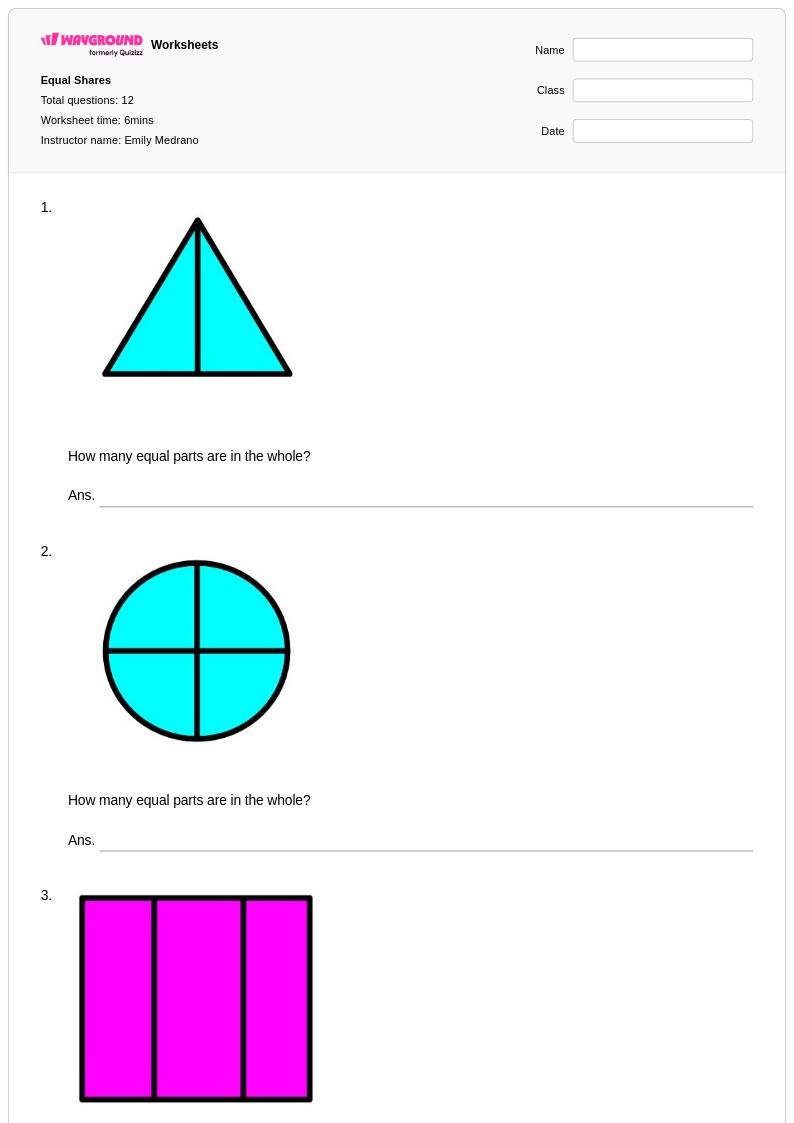
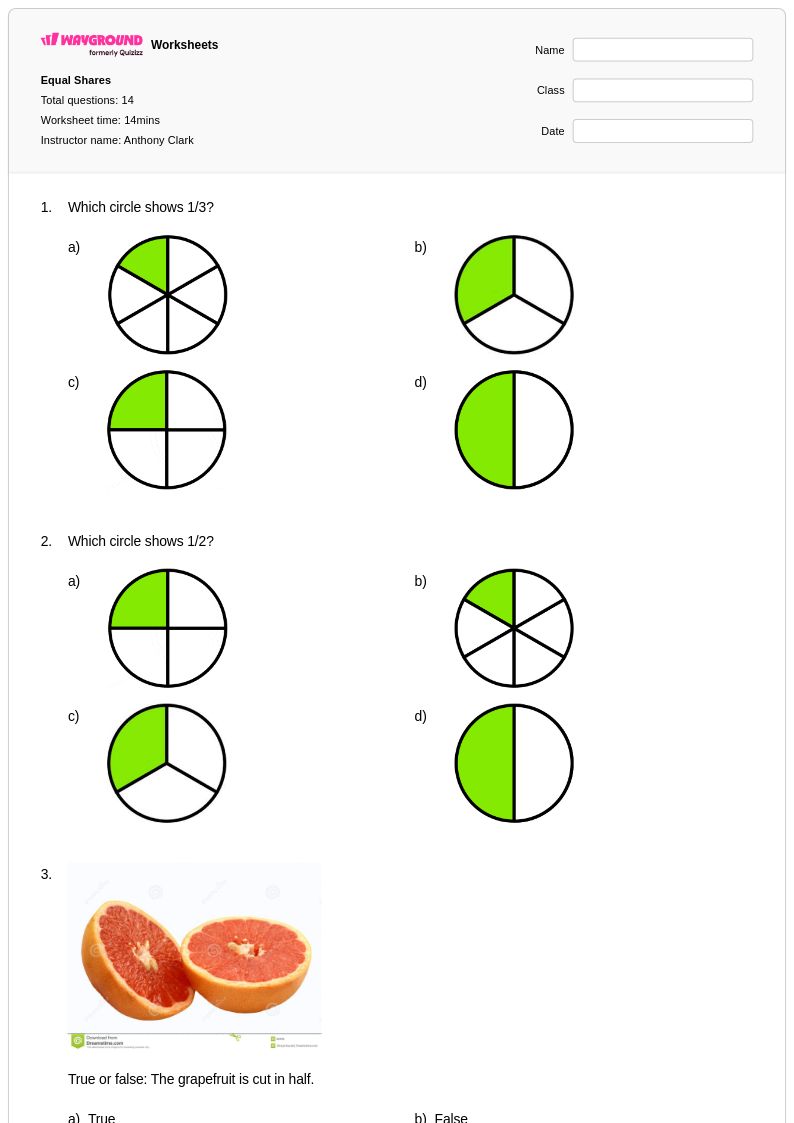
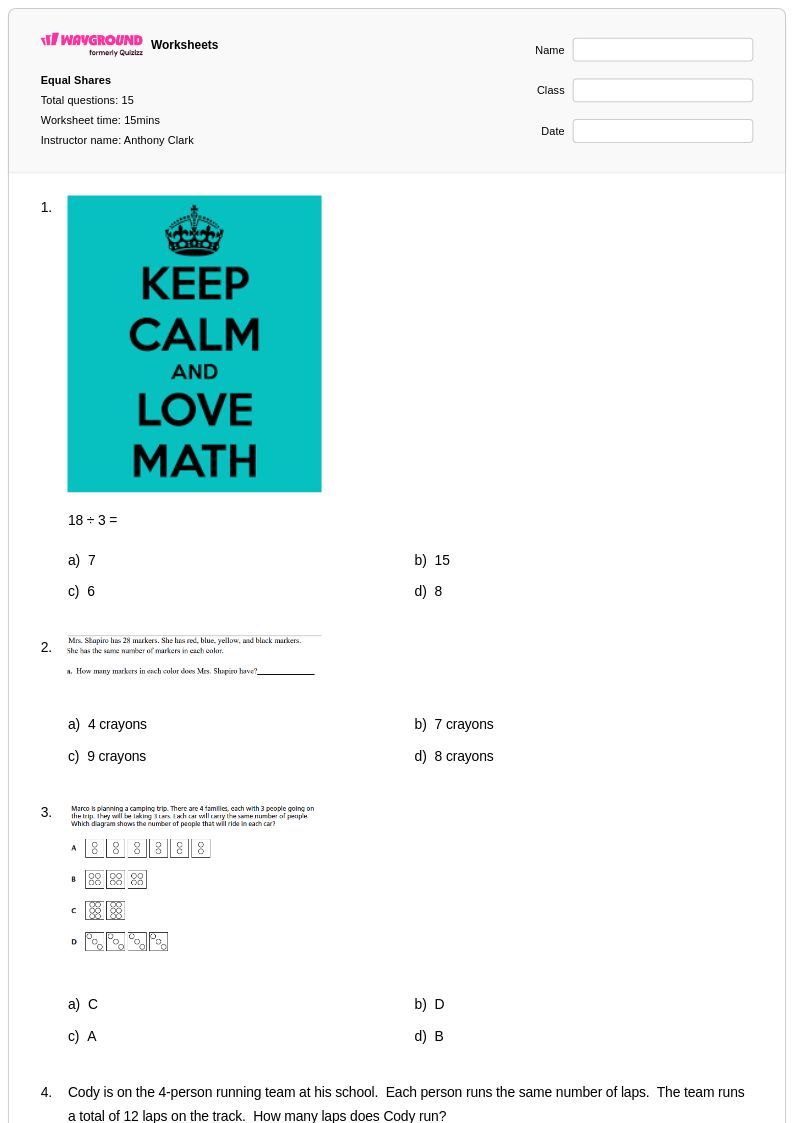
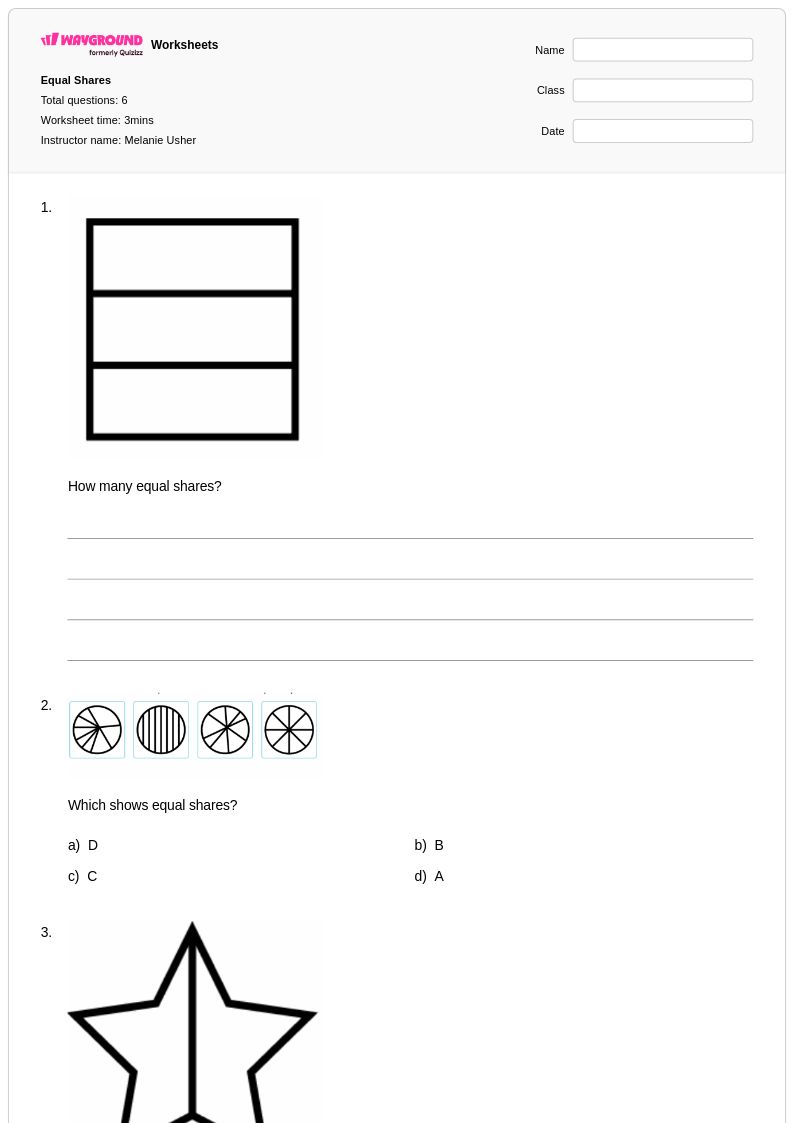
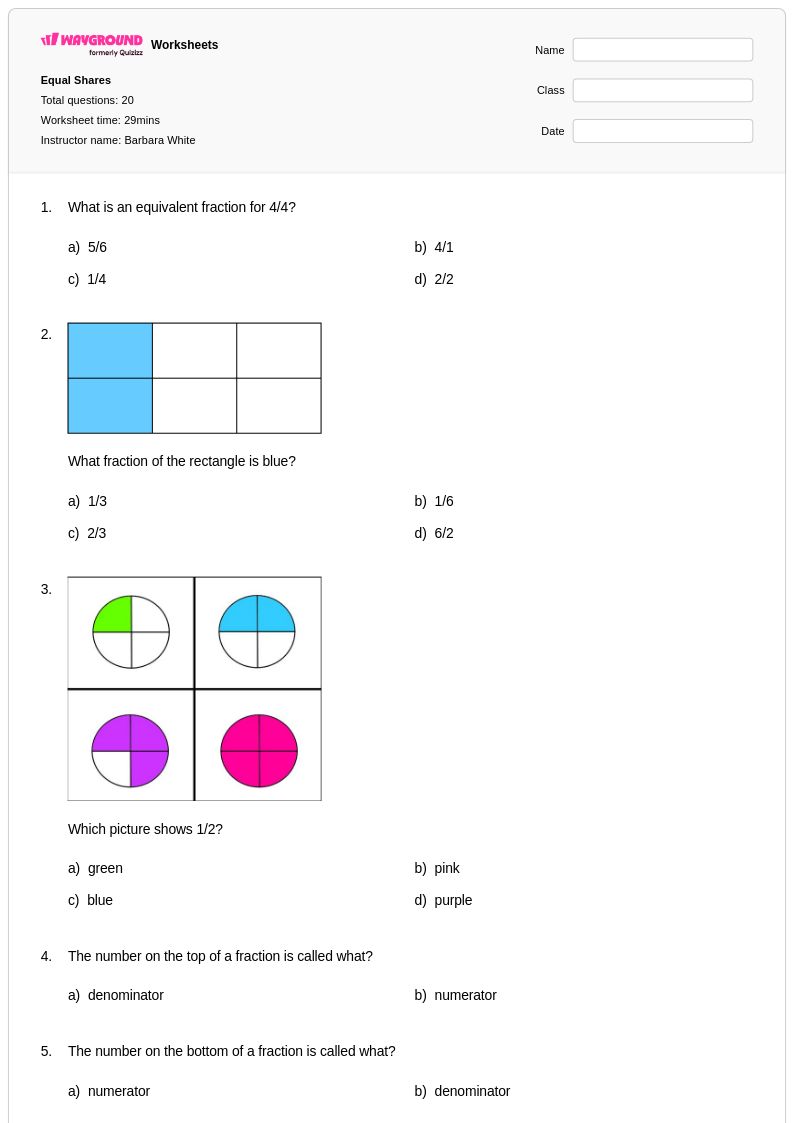
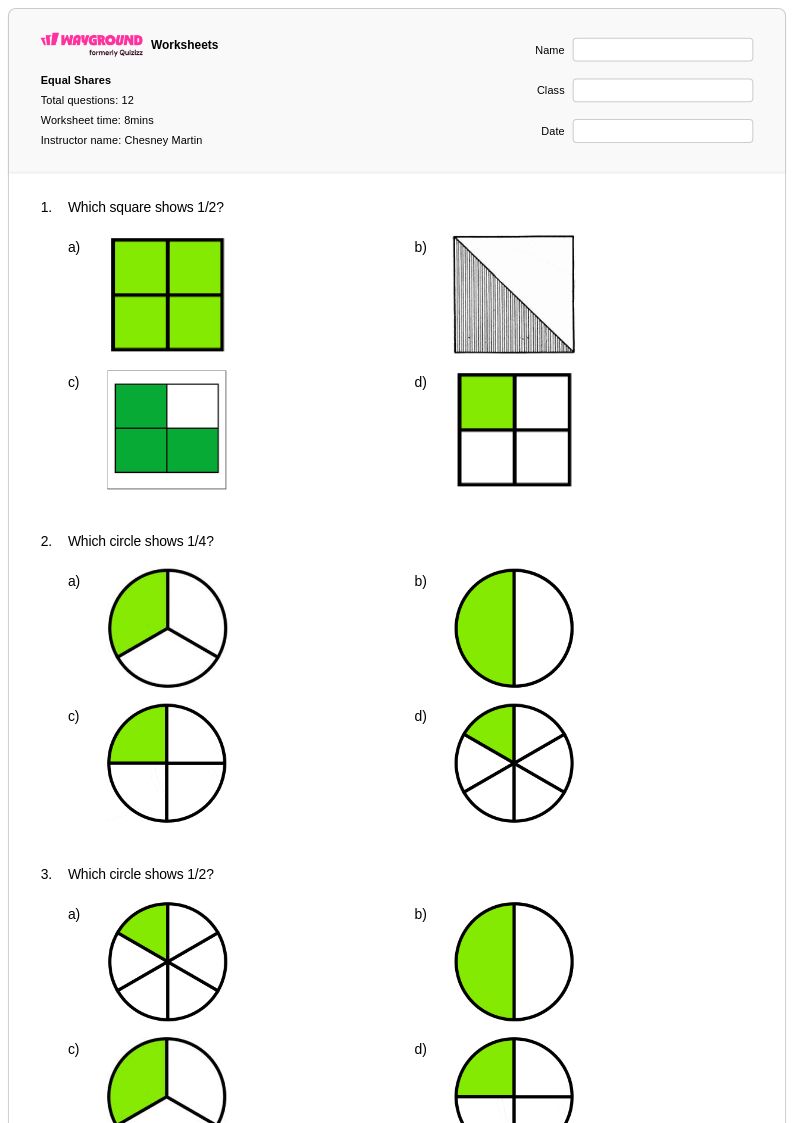
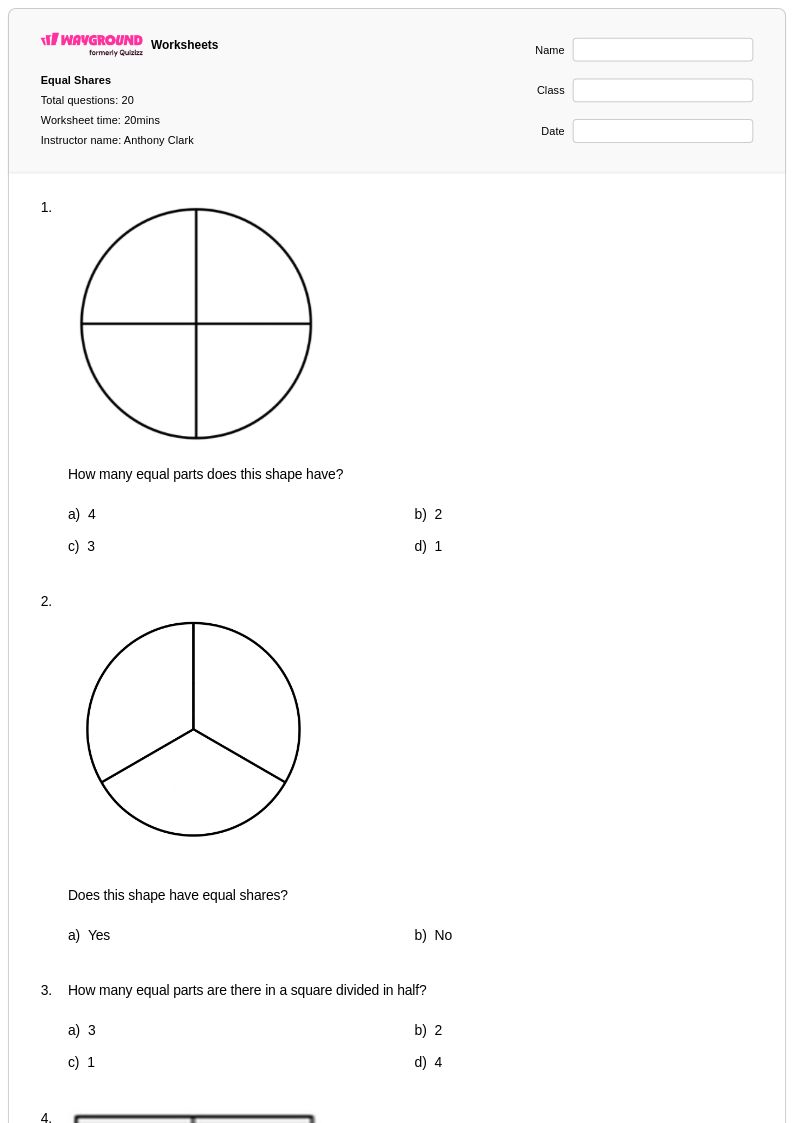
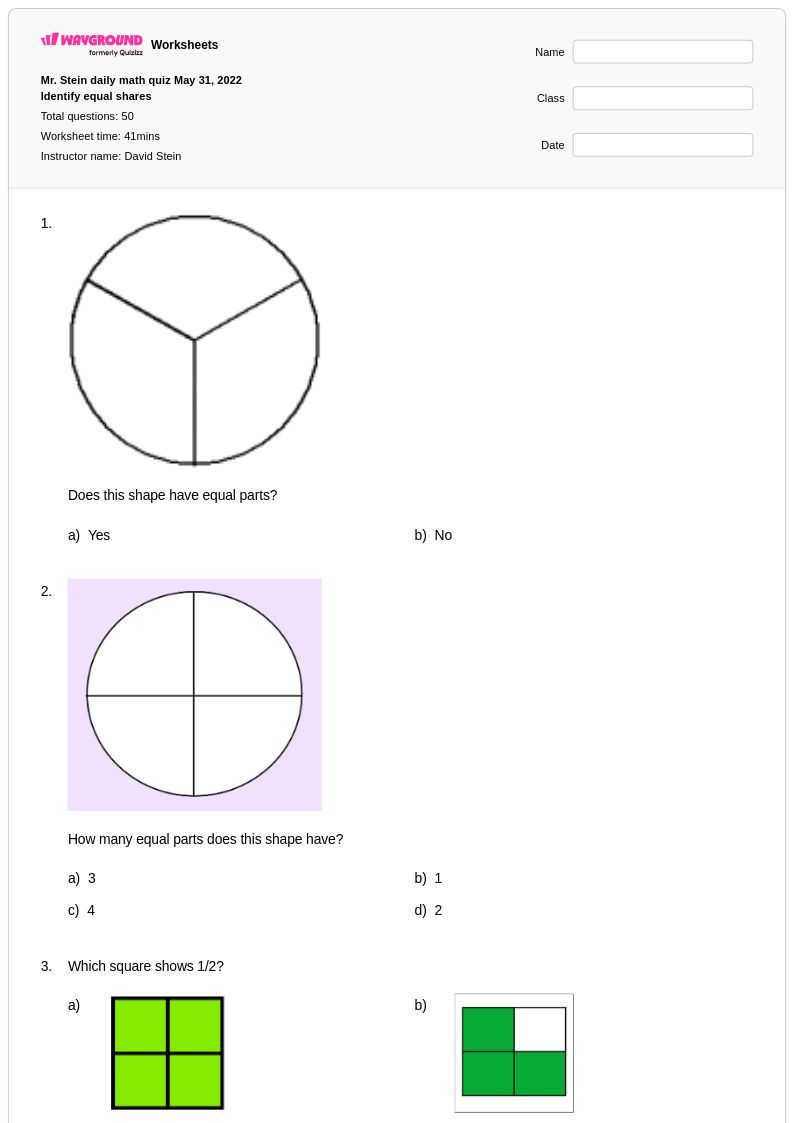
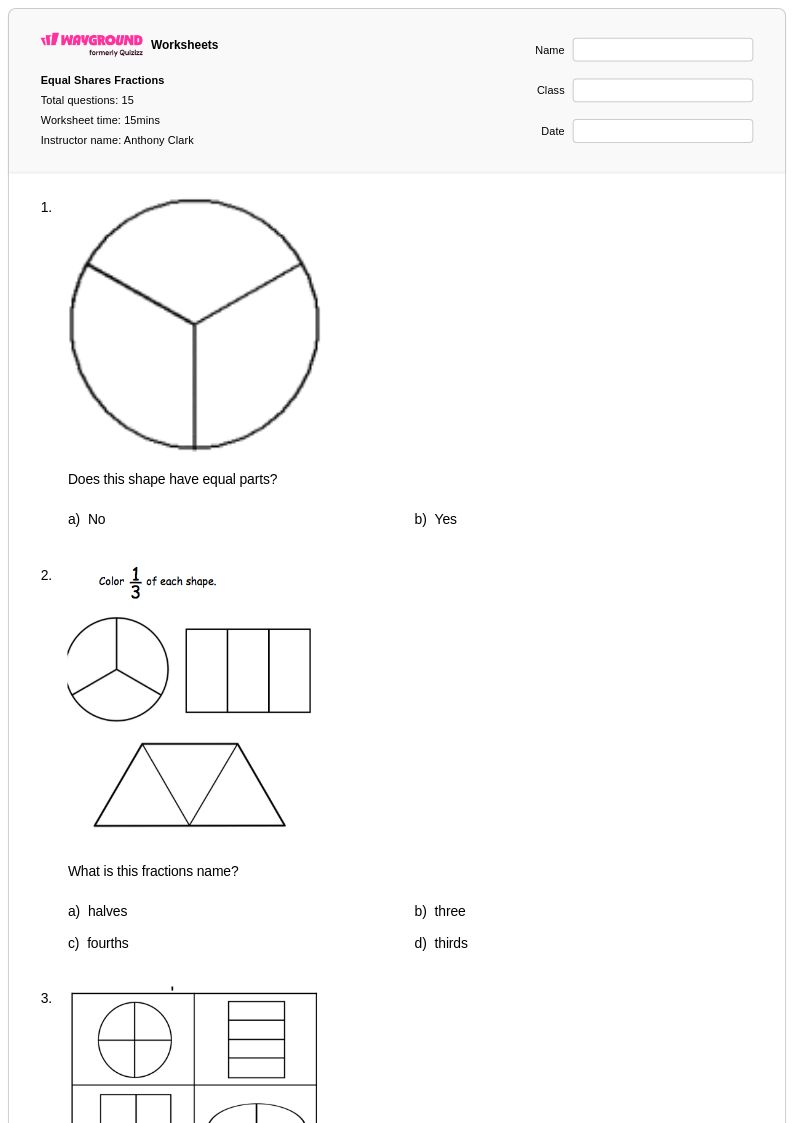
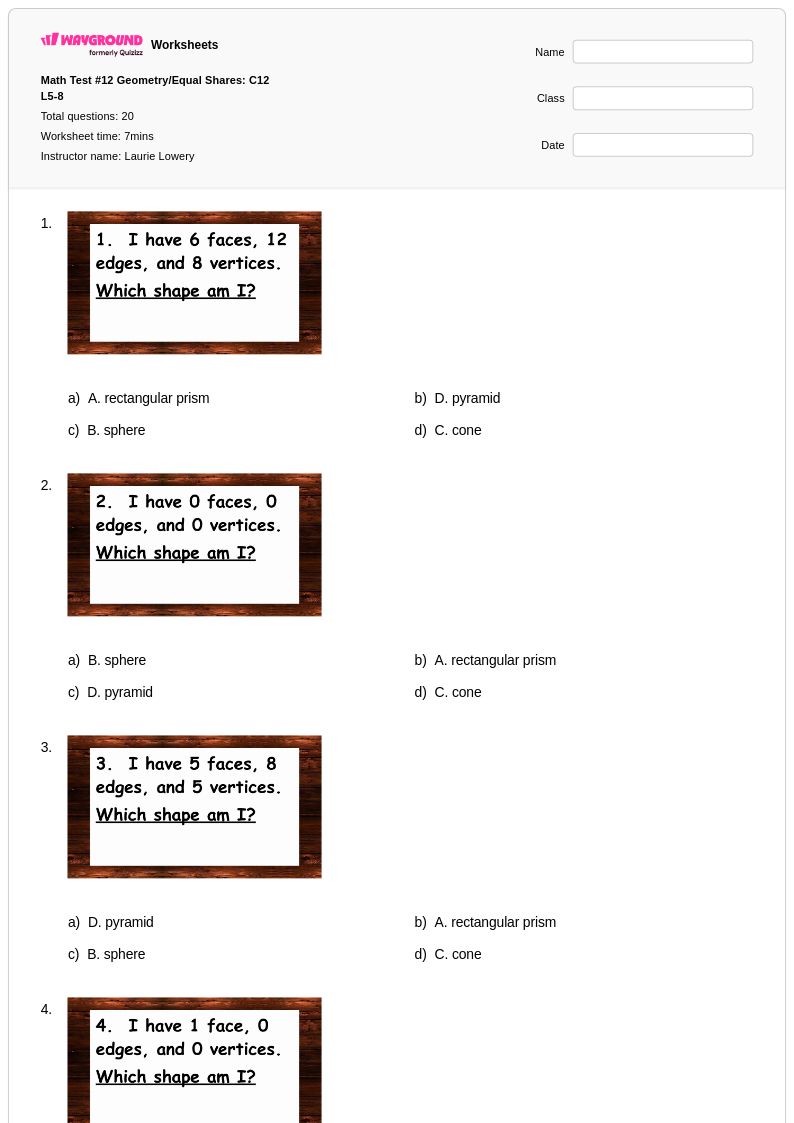
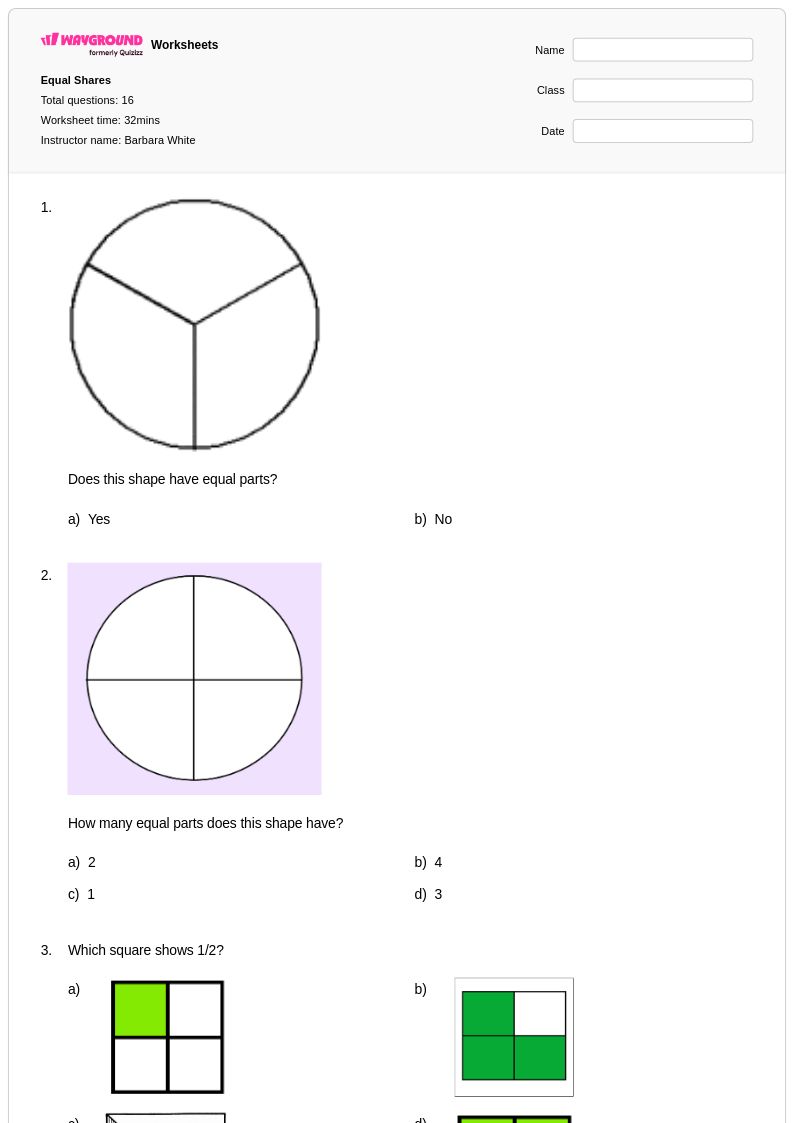
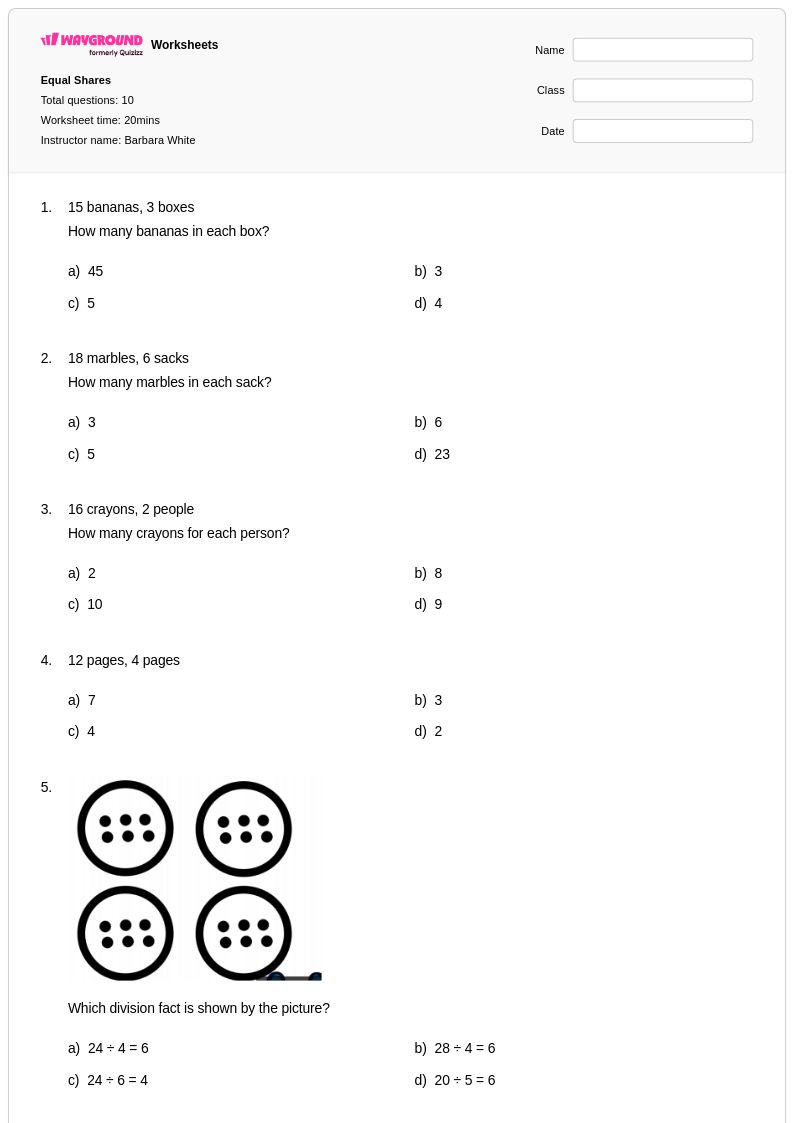
Equal shares worksheets available through Wayground (formerly Quizizz) provide students with essential foundational practice in understanding how wholes can be divided into equivalent parts, forming the cornerstone of fraction comprehension in mathematics. These carefully designed printables strengthen critical mathematical reasoning skills by engaging learners in visual and conceptual exercises that demonstrate how objects, shapes, and sets can be partitioned into equal groups or sections. Students develop spatial awareness and logical thinking as they work through practice problems that require them to identify, create, and compare equal shares using various models including circles, rectangles, arrays, and real-world scenarios. Each worksheet collection includes comprehensive answer keys and is available as free pdf downloads, ensuring educators have immediate access to both student materials and solution guides for effective instruction and assessment.
Wayground (formerly Quizizz) empowers teachers with an extensive library of millions of educator-created equal shares resources that seamlessly integrate into diverse classroom settings and instructional approaches. The platform's robust search and filtering capabilities allow educators to quickly locate worksheets that align with specific learning standards and accommodate varying student needs through built-in differentiation tools and flexible customization options. Teachers can access materials in both printable and digital formats, including downloadable pdfs, making it simple to adapt resources for in-person instruction, remote learning, or hybrid educational environments. These comprehensive worksheet collections support strategic lesson planning while providing targeted resources for remediation, enrichment, and ongoing skill practice, enabling educators to address individual learning gaps and strengthen conceptual understanding of equal shares across diverse mathematical contexts.
FAQs
How do I teach equal shares to elementary students?
Start with physical objects before moving to paper. Have students split a set of counters into two equal groups, or fold a paper rectangle in half, so they can see and feel what "equal" means. Once the concept clicks with hands-on materials, visual models on worksheets — circles, rectangles, arrays — give students a way to practice the same reasoning independently. The key misconception to address early: students often think any partition counts as sharing, so explicitly comparing equal and unequal divisions side by side helps them internalize the difference.
What exercises help students practice equal shares?
The most effective practice moves through three levels: identifying (is this divided equally?), creating (draw a line to make equal shares), and comparing (which shape shows halves vs. fourths?). Wayground's equal shares worksheets cover all three using circles, rectangles, arrays, and real-world contexts like pizza slices and cookies, so students aren't just memorizing one model — they're building a flexible understanding they can apply to fractions later.
What mistakes do students commonly make with equal shares?
The most common error is confusing the number of parts with whether the parts are equal — a shape cut into two pieces looks like "halves" even when one piece is clearly larger. Students also struggle with non-standard shapes: they can identify equal shares in a circle or rectangle but get confused when the same shape is oriented differently or when a set of objects (rather than a single shape) needs to be partitioned. Worksheets that include both correct and incorrect examples, and ask students to explain why a partition is or isn't equal, address both errors directly.
How do I use Wayground's equal shares worksheets in my classroom?
You can run these as a digital quiz hosted on Wayground — students work through the problems on a device and results come back to you automatically. If you'd rather go paper, download the printable PDF, assign it in class or as homework, and grade submissions using the Wayground for Teachers app, which lets you scan or capture student work for quick grading. Every worksheet includes a complete answer key either way, so you're never left hunting for solutions.
How does equal shares fit into the Common Core math progression?
Common Core introduces equal shares in the earliest primary grades, where students partition circles and rectangles into two and four equal parts and describe those parts using words like halves and fourths. This work is explicitly pre-fraction: students build the visual and conceptual understanding that a whole can be divided into equal pieces before they ever see fraction notation. By Grade 3, that foundation supports the formal introduction of fractions as numbers on a number line, so gaps in equal-shares understanding tend to surface as confusion about why 1/4 is smaller than 1/2.
How can I differentiate equal shares practice for mixed-ability learners?
For students who need more support, Wayground's reduced answer choices accommodation limits the number of options displayed, which helps when the cognitive load of comparing multiple partitions becomes a barrier. The dyslexia-friendly font and adjustable font size options are worth enabling for students who struggle to read word problems alongside visual models. For the worksheet itself, the font spacing and size controls let you create a less visually cluttered version for students who get overwhelmed by dense layouts — all from the same base worksheet, so you're not building separate materials from scratch.