Free Printable Exponential Decay Worksheets for Year 12
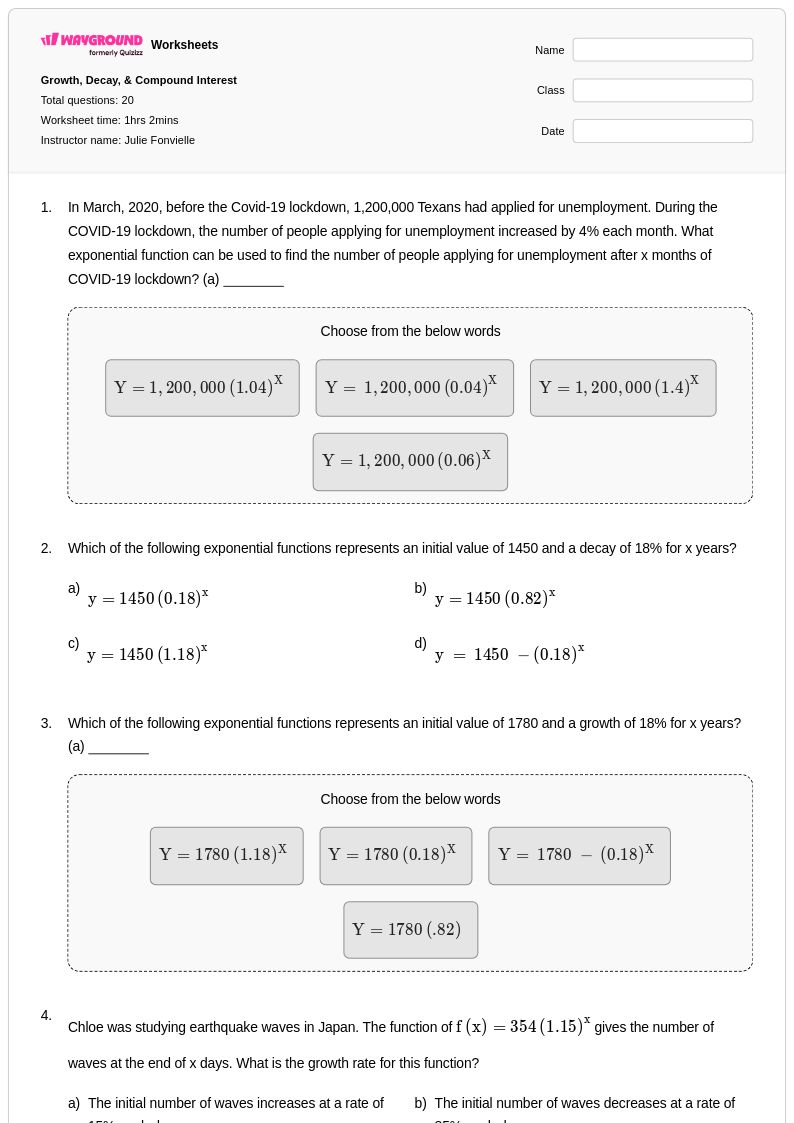
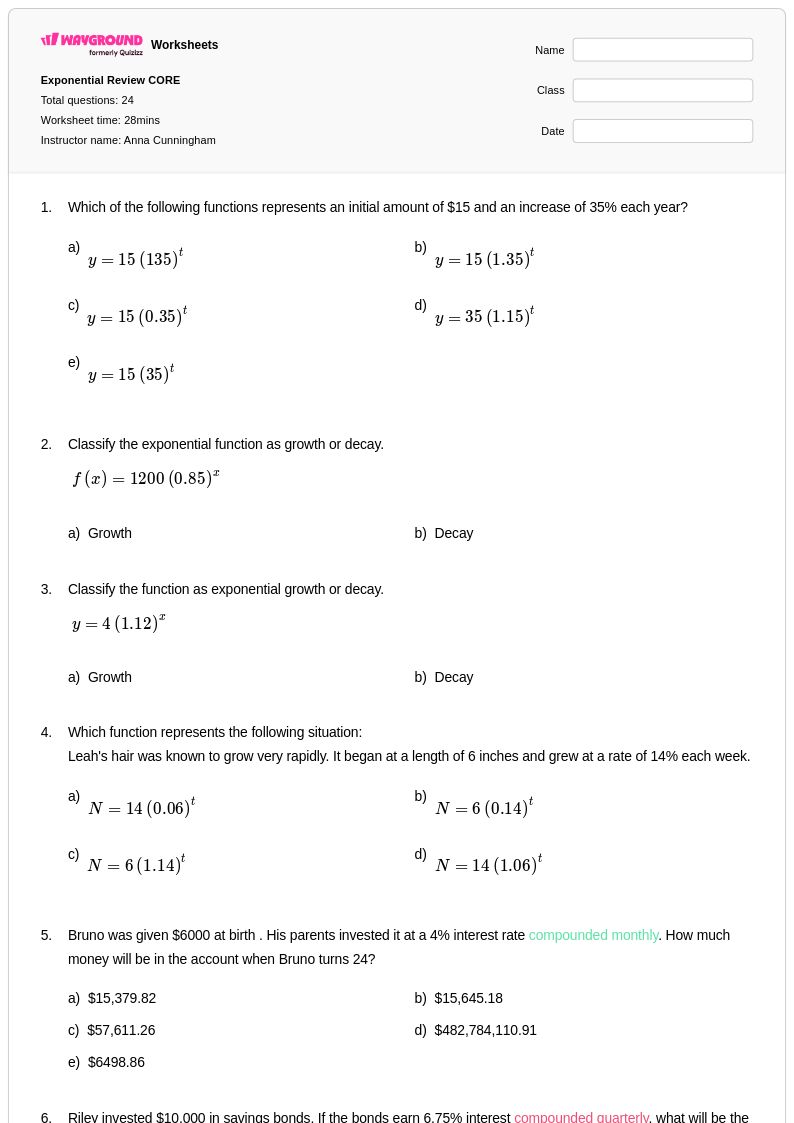
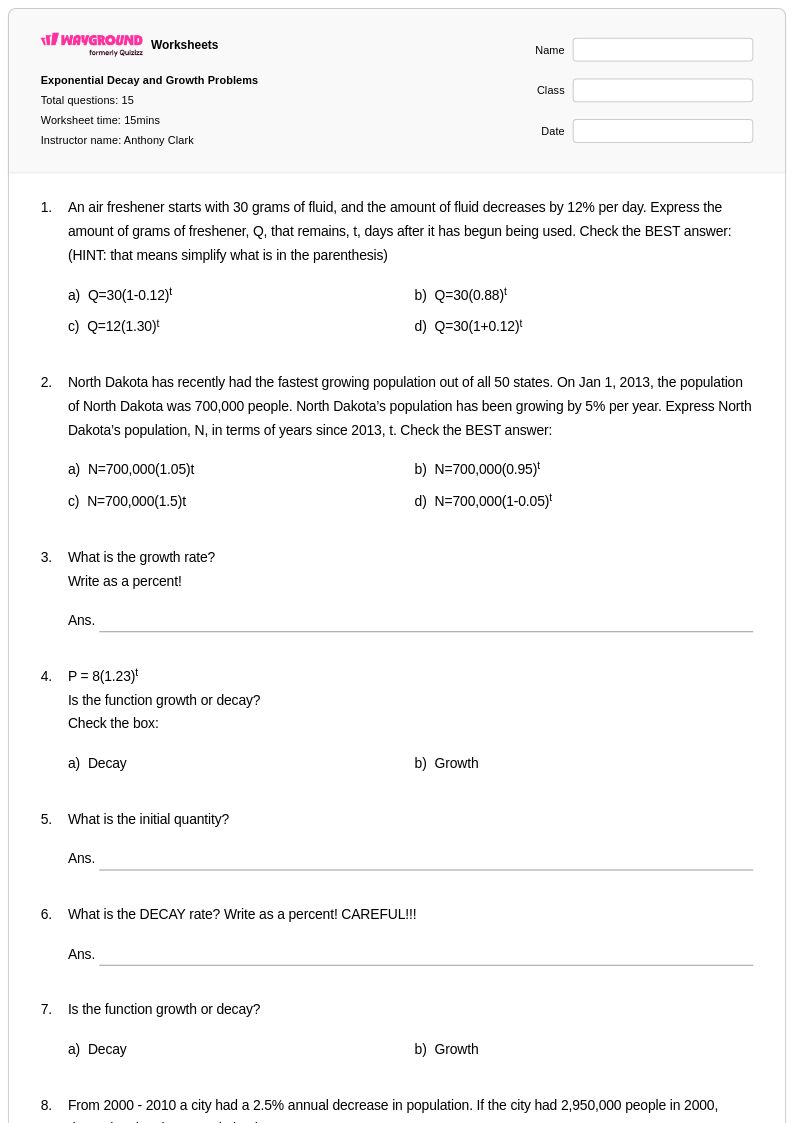
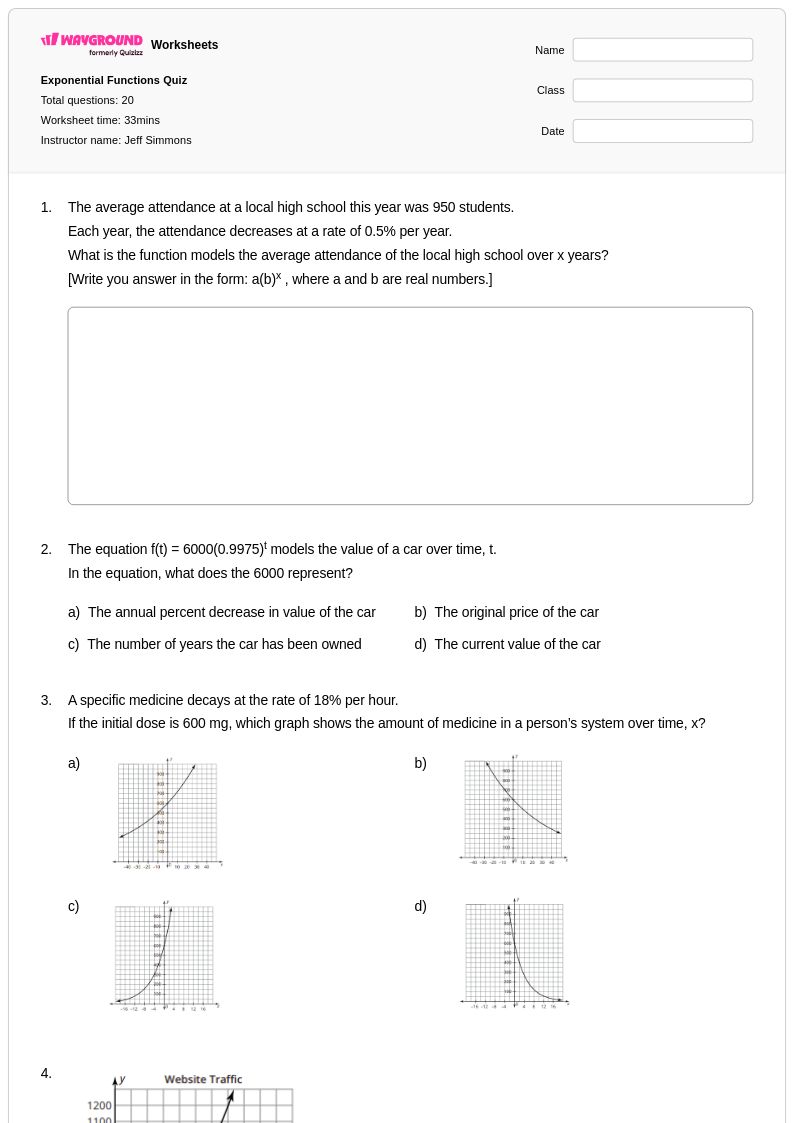
Year 12 exponential decay worksheets from Wayground provide comprehensive practice problems and printables with answer keys to help students master decay functions, half-life calculations, and real-world applications through free PDF exercises.
Explore printable Exponential Decay worksheets for Year 12
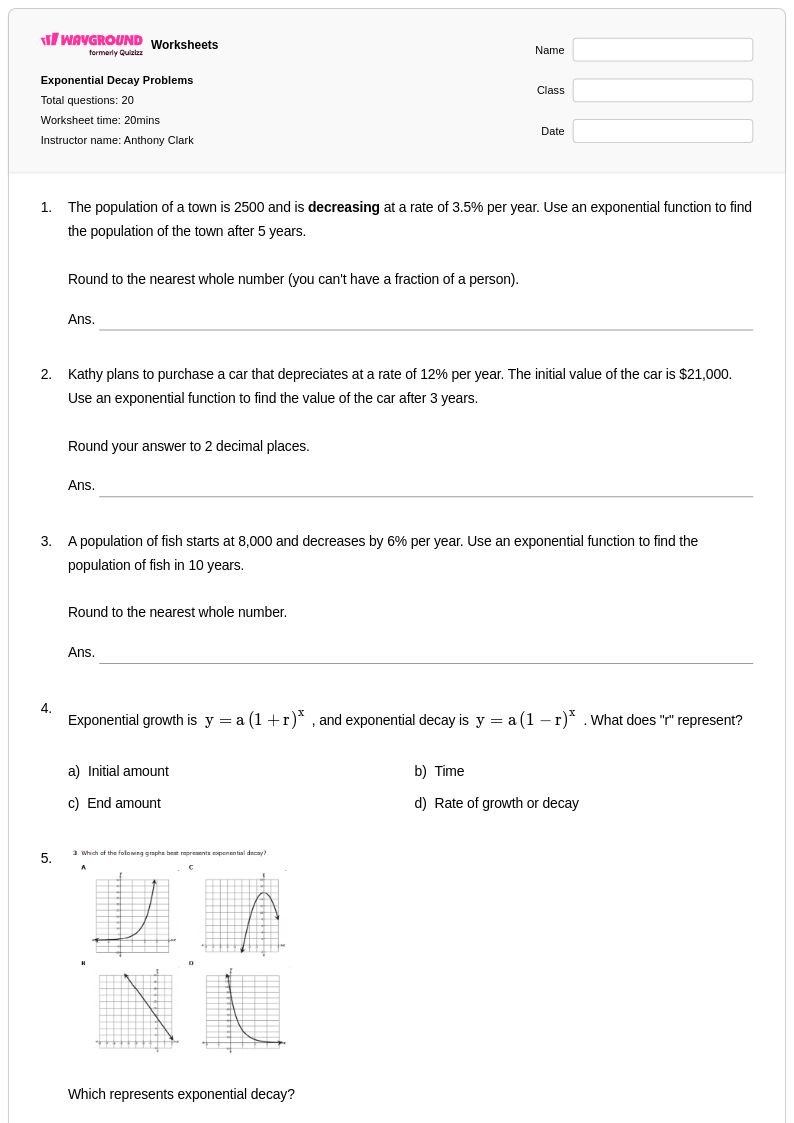
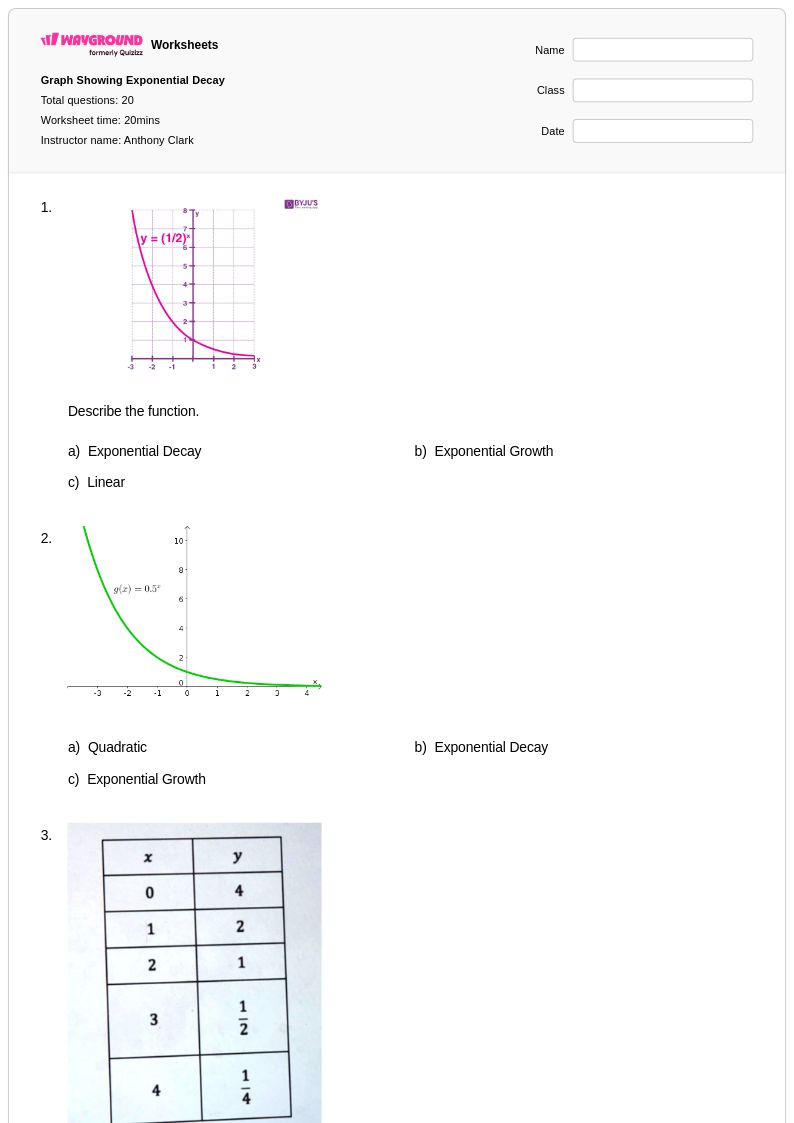
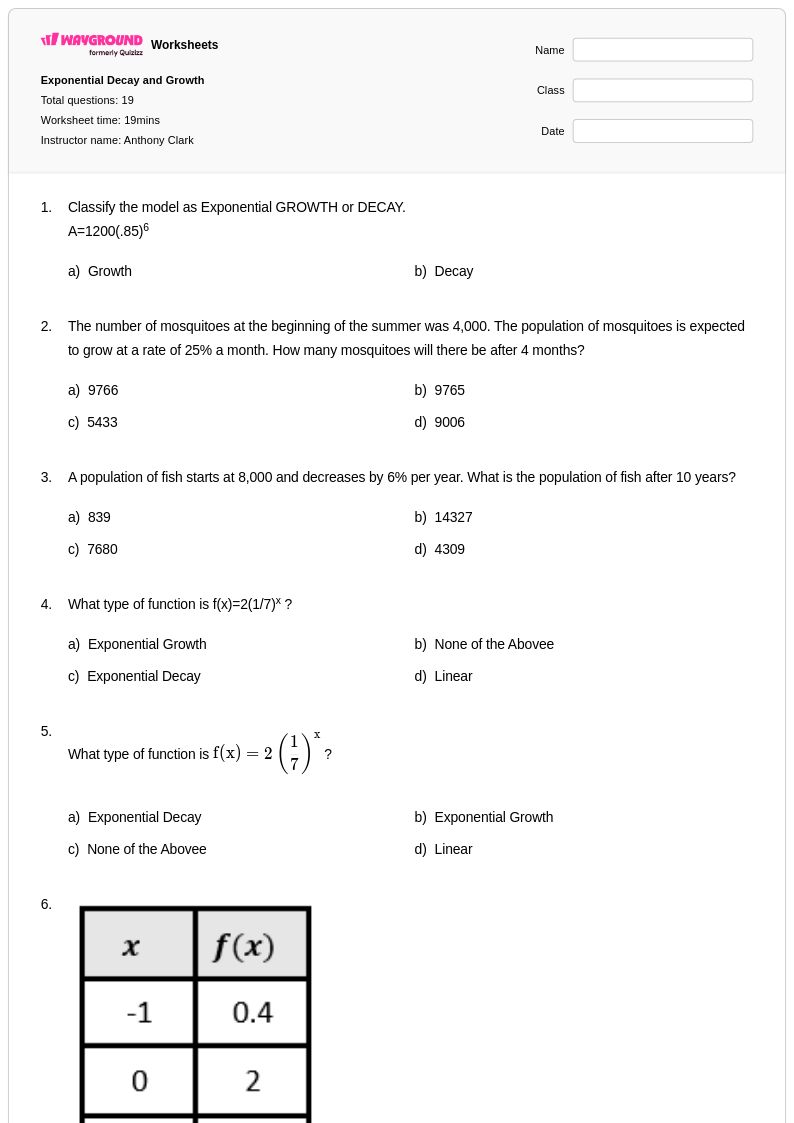
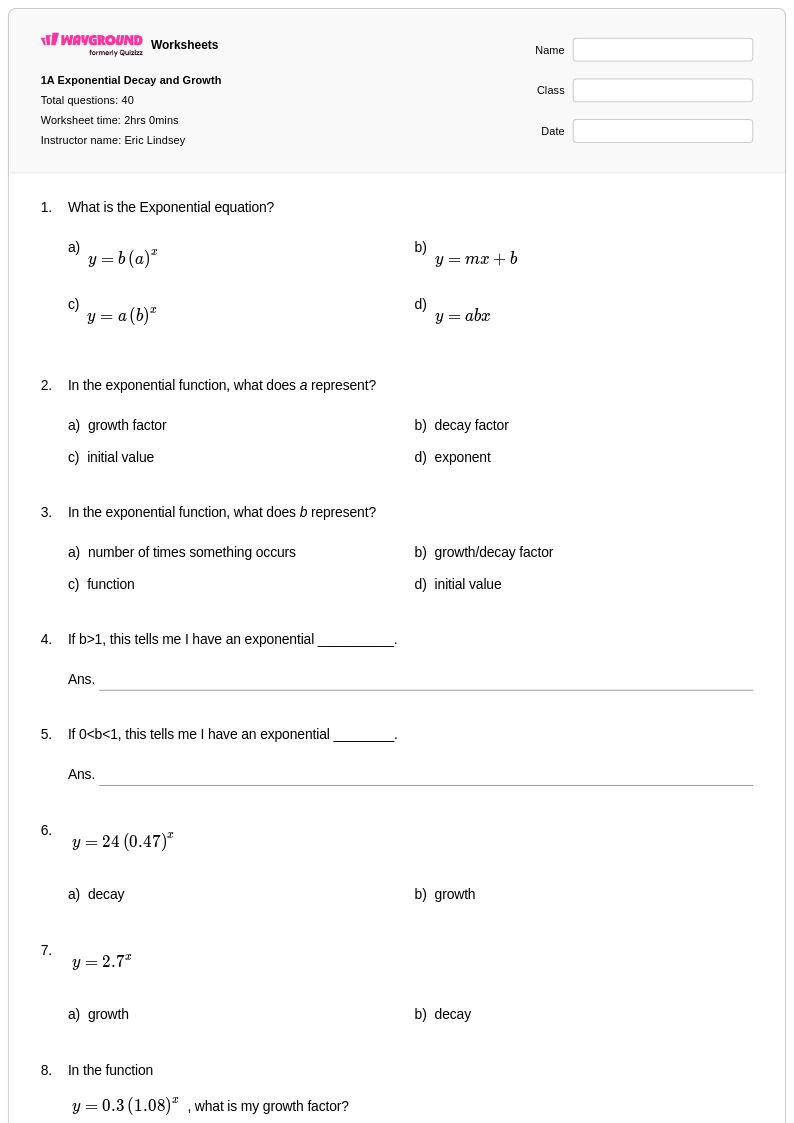
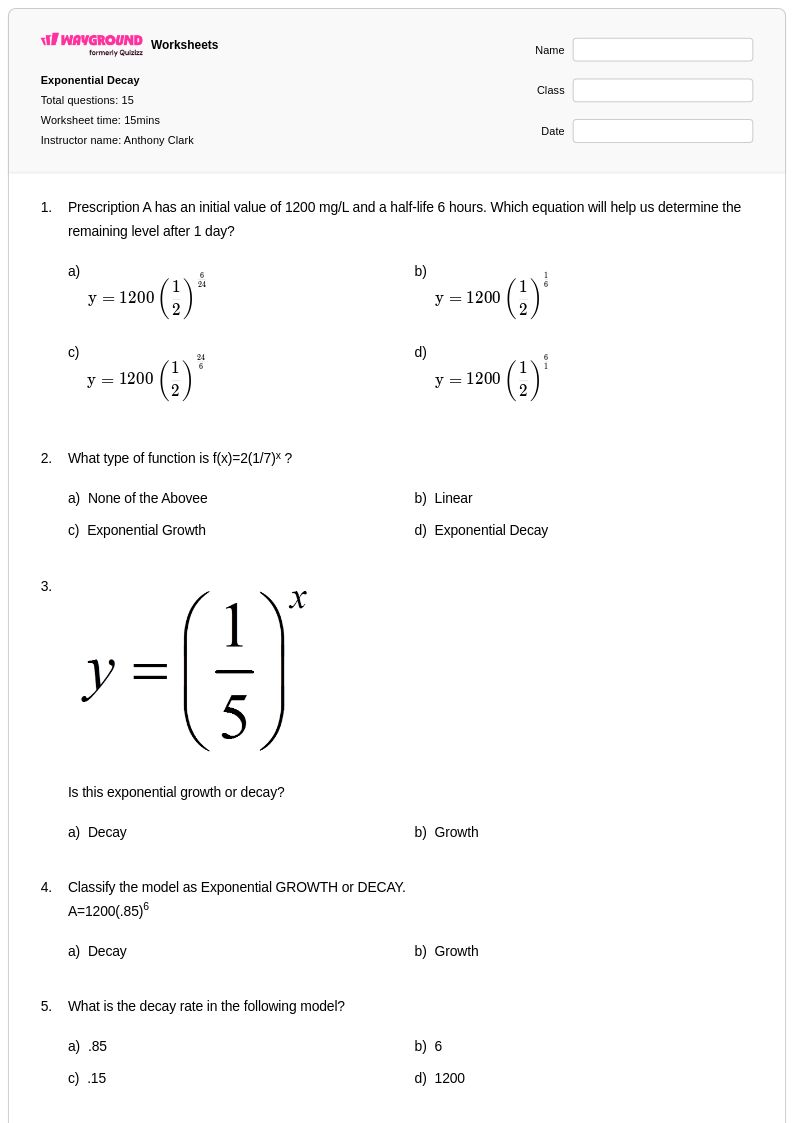
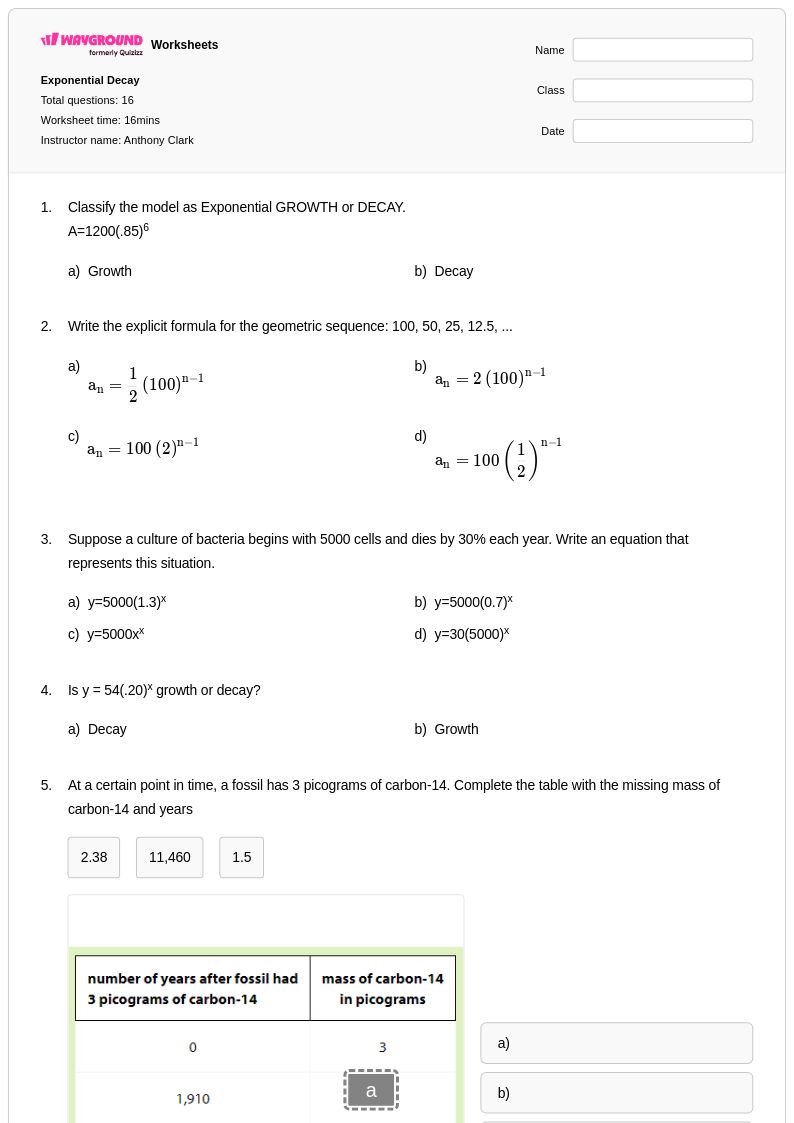
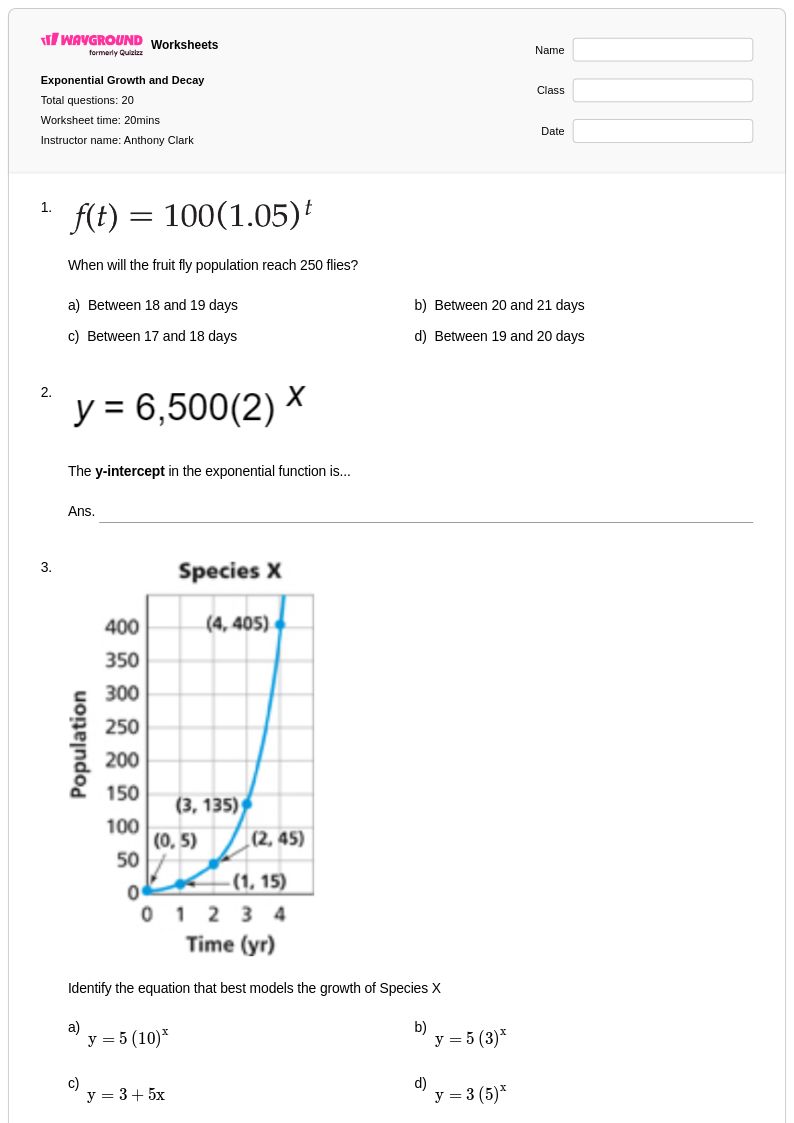
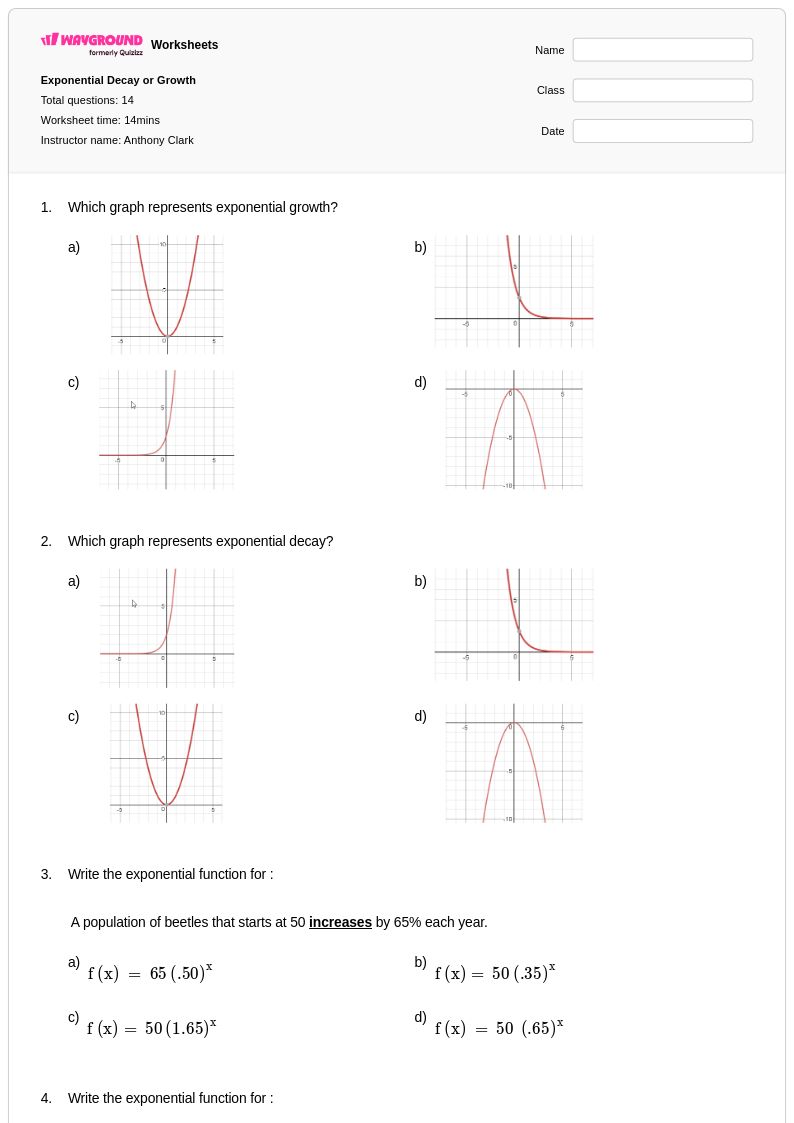
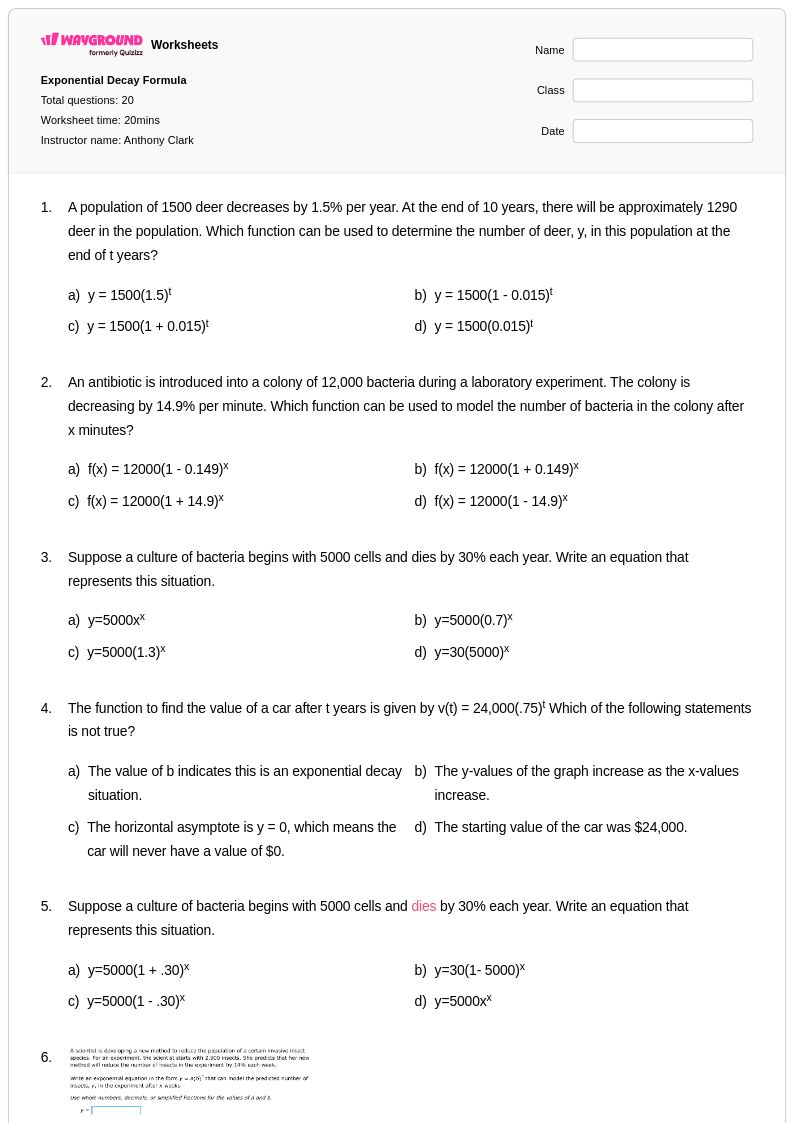
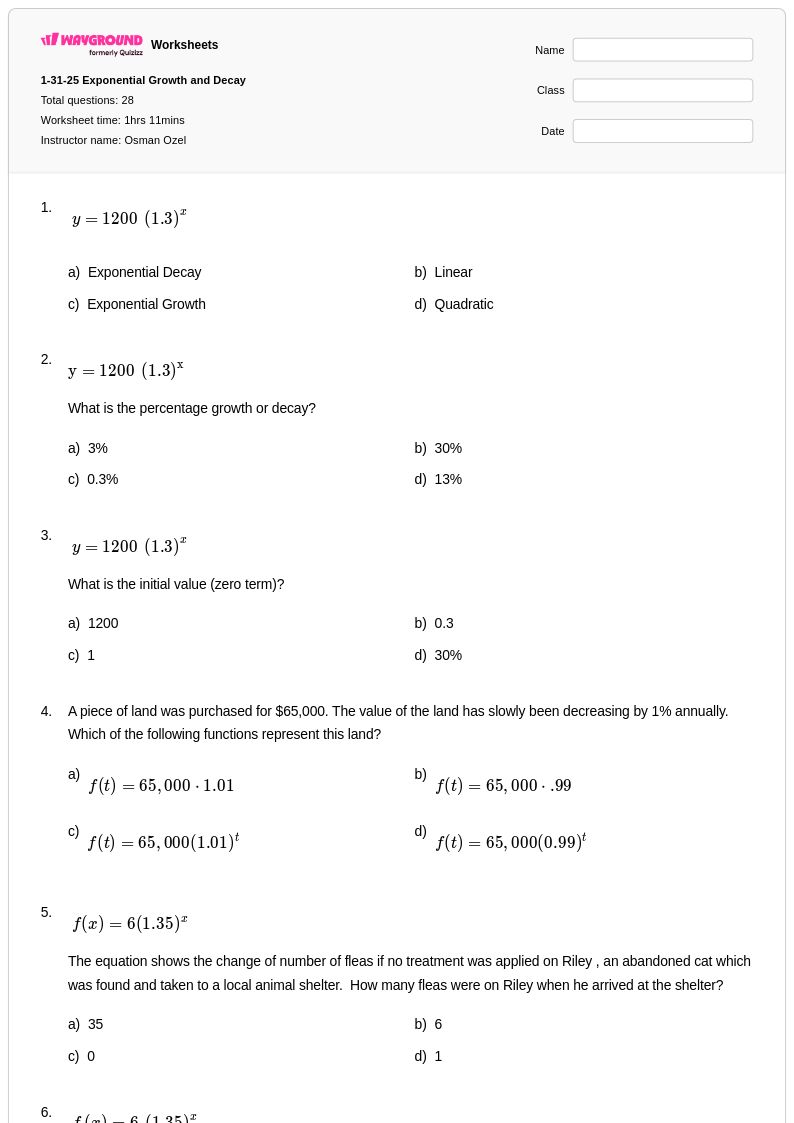
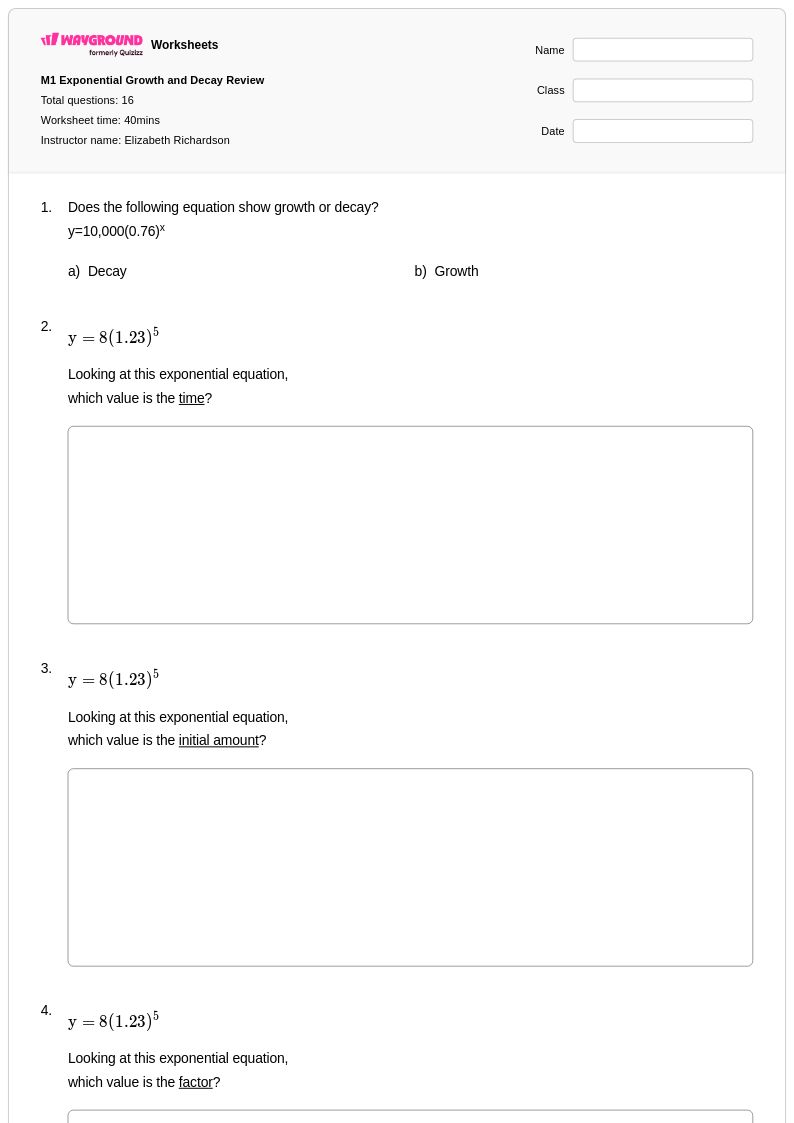
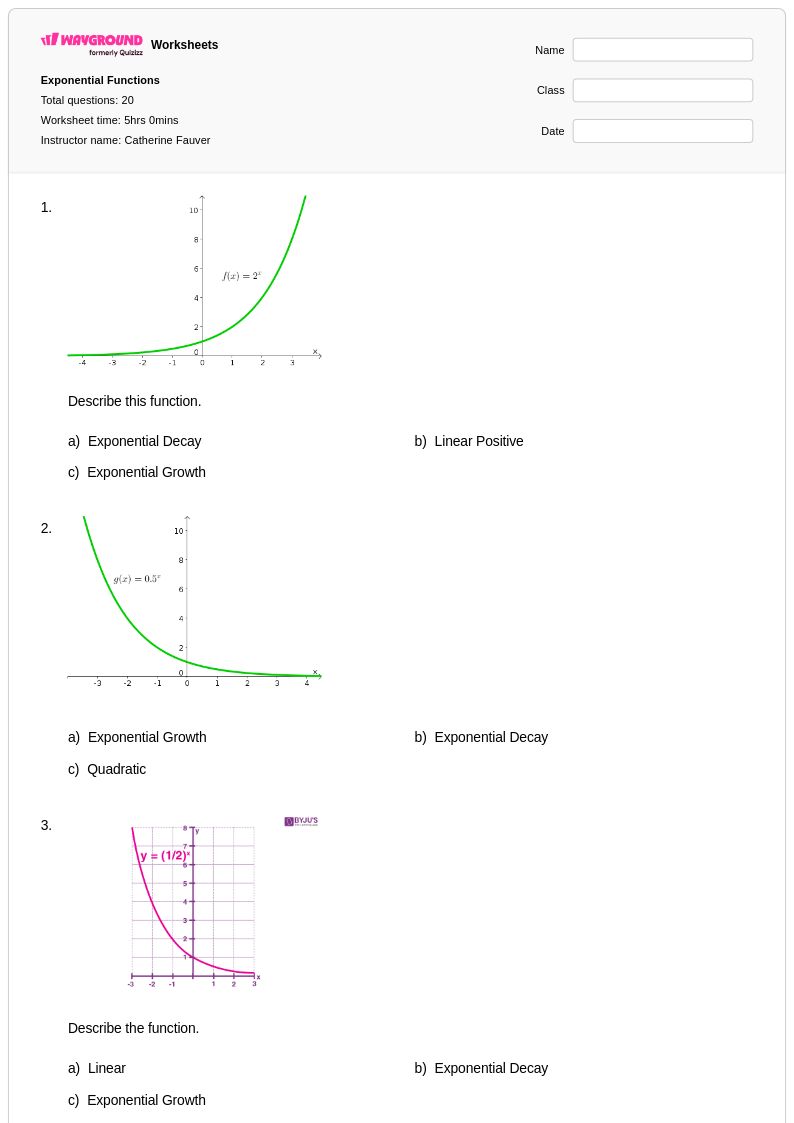
Exponential decay worksheets for Year 12 mathematics provide students with essential practice in understanding how quantities decrease at rates proportional to their current values. These comprehensive worksheets available through Wayground (formerly Quizizz) focus on developing critical skills in modeling real-world scenarios such as radioactive decay, population decline, depreciation, and cooling processes using exponential functions. Students work through practice problems that require them to identify decay factors, calculate half-lives, interpret graphs of exponential decay functions, and solve application problems involving compound interest and depreciation. Each worksheet collection includes detailed answer keys and is available as free printables in PDF format, allowing students to master the algebraic manipulation of exponential equations while building conceptual understanding of how exponential decay differs from linear decrease patterns.
Wayground (formerly Quizizz) empowers educators with millions of teacher-created exponential decay worksheet resources that can be easily searched, filtered, and customized to meet diverse classroom needs. The platform's robust collection supports standards alignment across different curricula while providing differentiation tools that allow teachers to modify complexity levels for individual student requirements. These worksheets are available in both printable PDF formats and interactive digital versions, giving educators the flexibility to implement them during in-class instruction, homework assignments, or assessment preparation. Teachers can efficiently plan remediation activities for students struggling with exponential concepts, create enrichment materials for advanced learners, and design targeted skill practice sessions that address specific learning gaps in exponential decay applications, making it an invaluable resource for comprehensive Year 12 algebra instruction.
FAQs
How do I teach exponential decay in 12th grade?
At Grade 12, exponential decay should be treated as a modeling tool, not a procedure to execute. Students at this level should be building models from raw data — fitting an exponential function to a table of values, interpreting the decay constant in context, and evaluating whether an exponential model is appropriate for a given dataset. Continuous decay using the form y = ae^(kt) is the natural focus, and connecting it to the discrete model students learned earlier helps consolidate both. Newton's Law of Cooling is a strong capstone application because it introduces a non-zero asymptote and requires students to adapt the standard model.
What exercises help 12th graders practice exponential decay?
Data-driven problems are the right challenge at this level: give students a table of values and ask them to determine whether the relationship is exponential, find the decay rate, and write the model. Problems that require interpreting the meaning of the decay constant k in a continuous model — not just computing with it — build the conceptual depth that distinguishes Grade 12 work from earlier grades. Comparing an exponential decay model to a linear approximation over a short interval is also worth including; it sharpens students' understanding of when each model is appropriate.
What mistakes do 12th graders make with exponential decay?
The most common error at this level is conflating the discrete decay rate r with the continuous decay constant k — students apply the formula for one when the problem calls for the other. A second persistent mistake is mishandling the asymptote in shifted models: when the function approaches a non-zero value (as in Newton's Law of Cooling), students forget to subtract the asymptote before applying logarithms. Both errors suggest students have memorized forms without fully understanding the structure behind them.
How do I use Wayground's Grade 12 exponential decay worksheets?
The PDF format works well for extended modeling problems where students need to show multi-step work — print it, assign it, and use the Wayground for Teachers app to scan and grade submissions without re-entering anything manually. For shorter practice sets or pre-assessment checks, the digital quiz format gives you instant class-level data. Every worksheet includes a complete answer key, which is especially useful for self-directed review before AP exams or end-of-year assessments.
How does exponential decay fit into the Grade 12 Common Core progression?
Common Core's capstone expectations for exponential functions ask students to analyze and build models from data, interpret parameters in context, and connect exponential and logarithmic representations fluently. At Grade 12, decay work should reflect all three: students aren't just solving given equations but constructing and critiquing models. The progression from Grade 9 pattern recognition through Grade 11 logarithmic solving arrives here at genuine mathematical modeling — using decay functions to make predictions and evaluate their reasonableness against real data.
How can I differentiate exponential decay worksheets for my Grade 12 class?
For students who are still consolidating logarithm mechanics, Wayground's scaffolded worksheet options — wider spacing and larger font — reduce visual clutter on equation-heavy problems and make multi-step work easier to track. Students preparing for AP Calculus or Statistics benefit from problems that connect decay to rate-of-change language, which the worksheet library covers at the advanced end. For students with language barriers, Wayground's worksheet translation feature lets you assign the same problems in a student's home language without creating a separate resource.
What real-world applications of exponential decay are most relevant for 12th graders?
Newton's Law of Cooling and radioactive dating are the two strongest contexts at this level — both require the continuous model, involve non-trivial solving, and appear in science courses students are likely taking simultaneously. Financial depreciation with continuous compounding connects to economics and personal finance. For students heading into STEM, framing decay as a differential equation (the quantity decreases at a rate proportional to itself) previews calculus without requiring it, and it's a connection worth making explicitly.