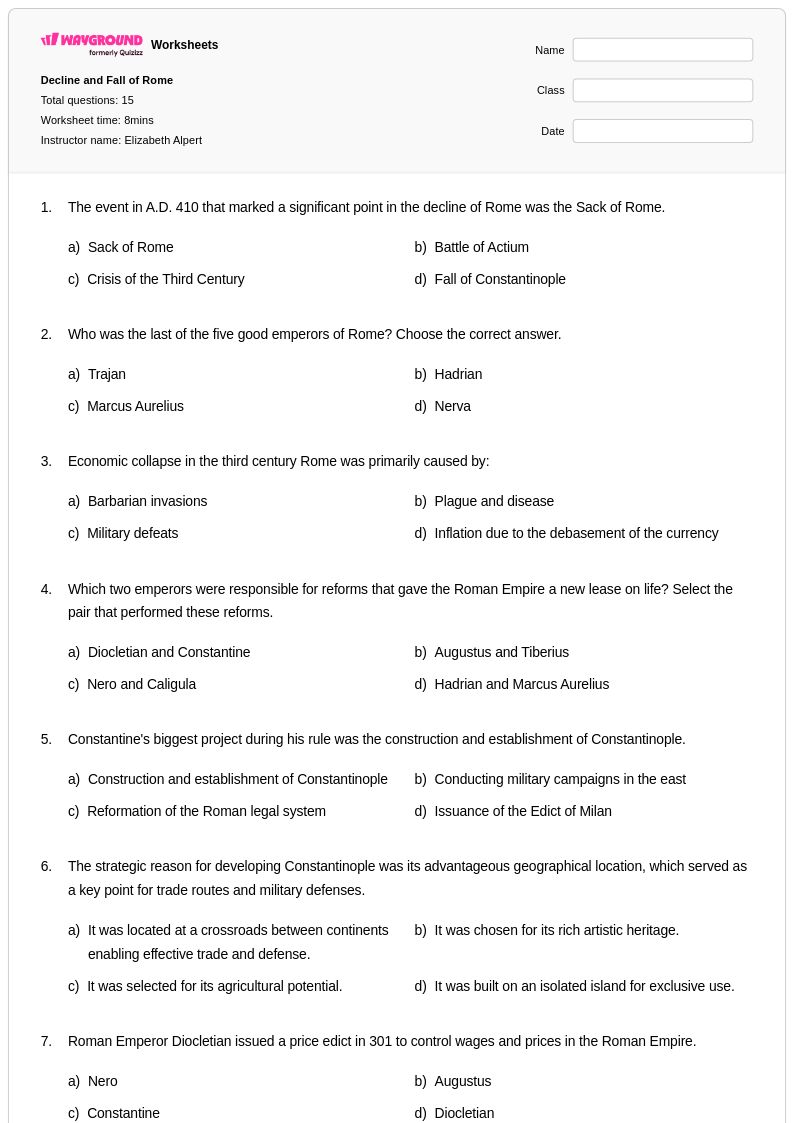
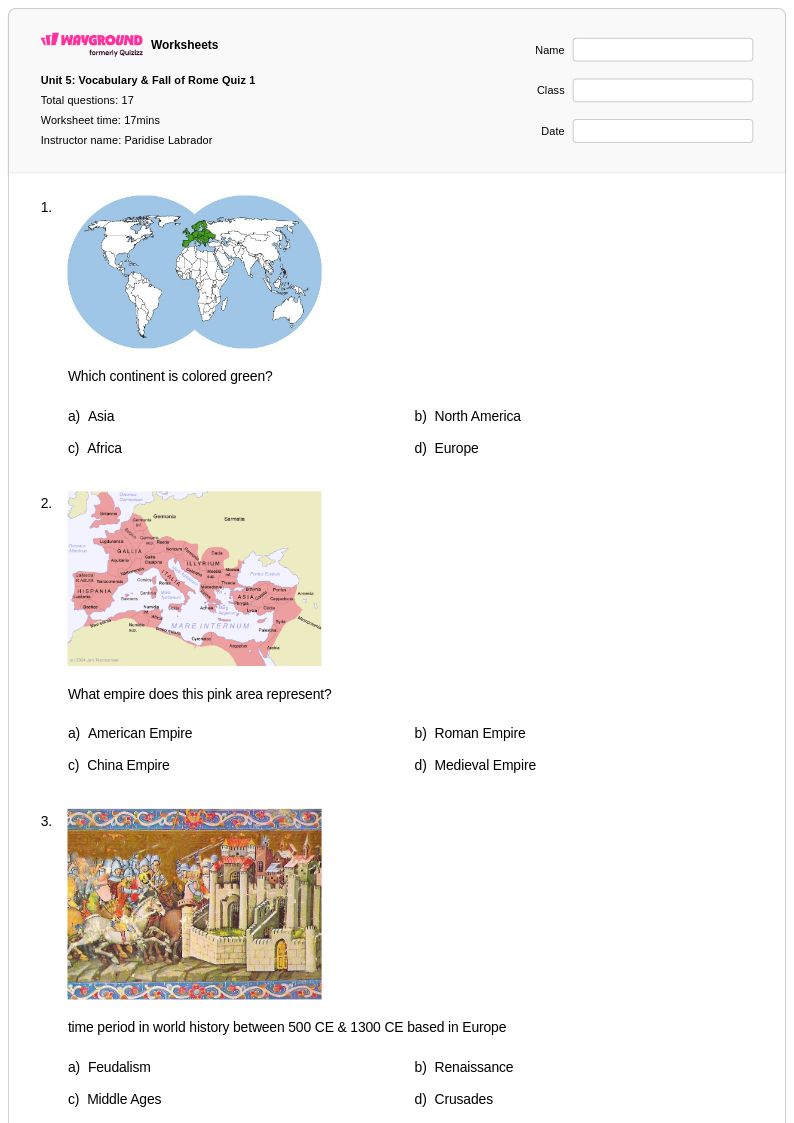
Year 9 students can explore the Fall of Rome through our comprehensive collection of free worksheets and printables, featuring practice problems and answer keys that help analyze the political, economic, and social factors behind this pivotal historical collapse.
Explore printable Fall of Rome worksheets for Year 9
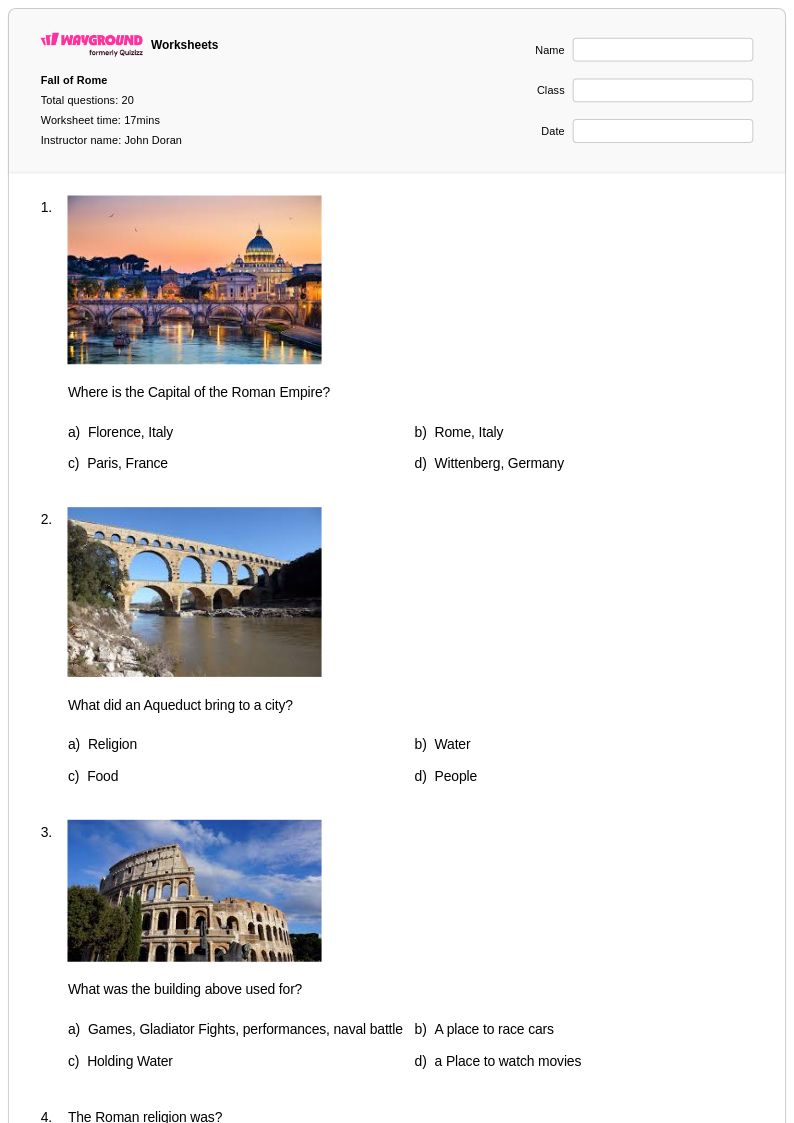
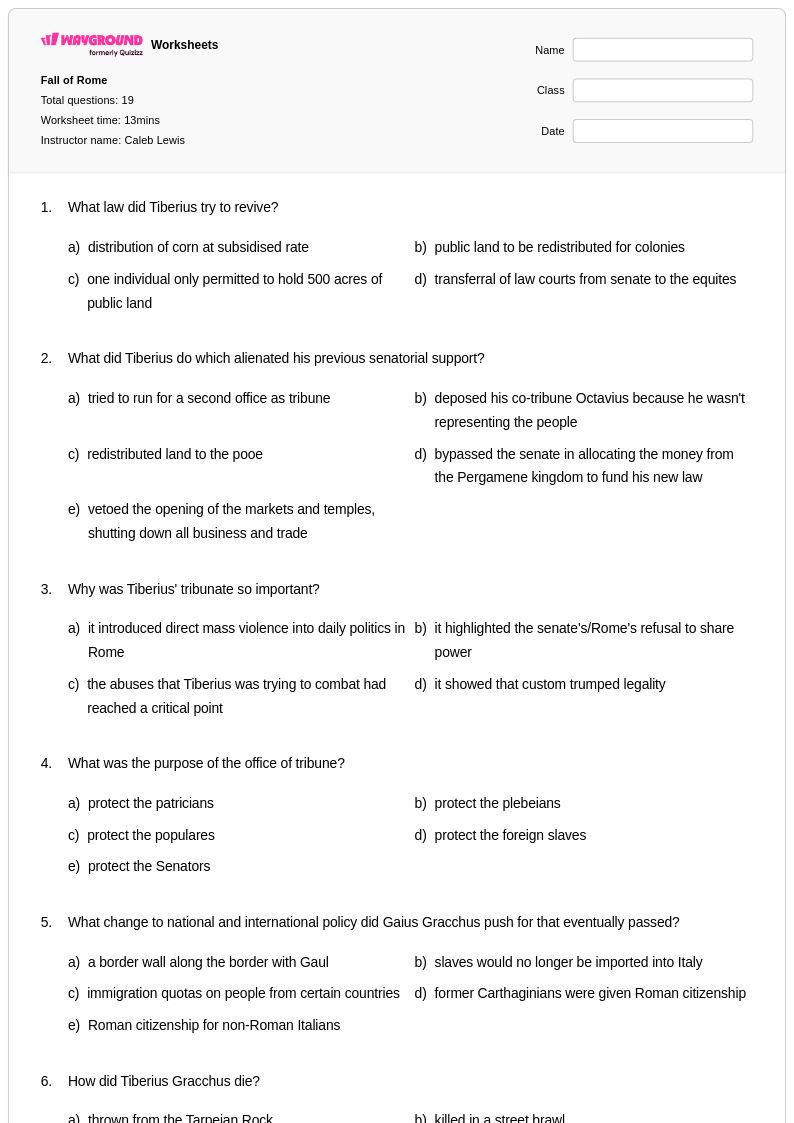
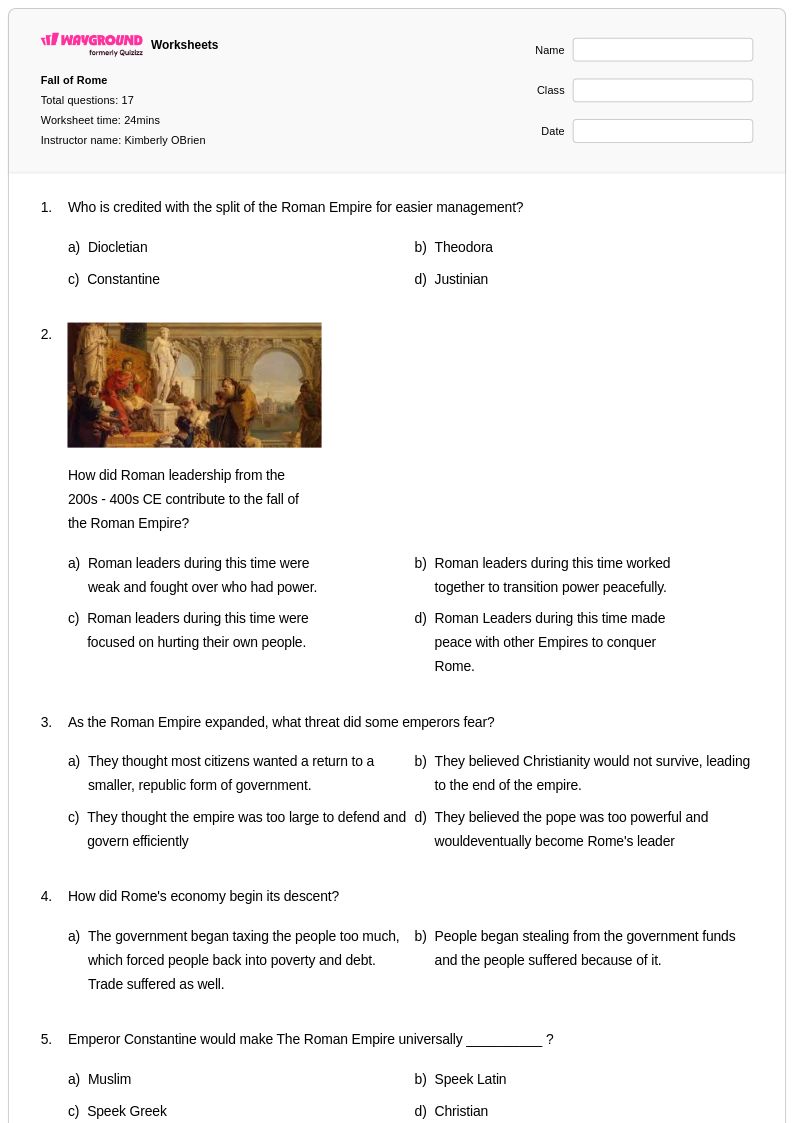
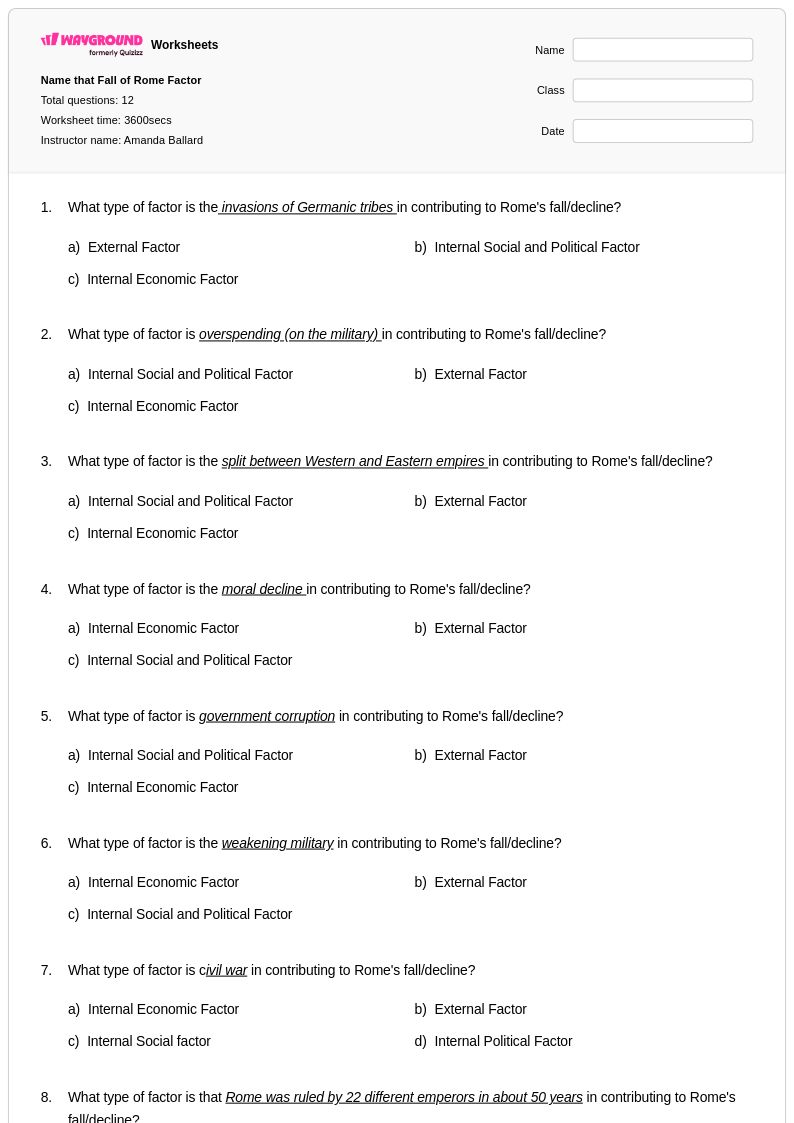
Fall of Rome worksheets for Year 9 students through Wayground (formerly Quizizz) provide comprehensive exploration of the complex factors that led to the collapse of one of history's most influential empires. These educational materials strengthen critical thinking skills by examining political instability, economic decline, military pressures, and social upheaval that characterized Rome's final centuries. Students engage with primary source analysis, cause-and-effect relationships, and historical interpretation through carefully structured practice problems that challenge them to synthesize multiple perspectives on this pivotal historical transition. The collection includes detailed answer key materials and free printables that support both independent study and classroom instruction, enabling students to master essential concepts about imperial decline, barbarian invasions, and the transformation of the ancient world into the medieval period.
Wayground (formerly Quizizz) empowers educators with millions of teacher-created resources specifically designed to enhance instruction on complex historical topics like the Fall of Rome. The platform's robust search and filtering capabilities allow teachers to locate worksheets that align with curriculum standards while offering differentiation tools to meet diverse learning needs within Year 9 classrooms. Teachers can customize existing materials or create new assessments using flexible formatting options, with resources available in both printable pdf formats and interactive digital versions. These comprehensive worksheet collections support strategic lesson planning by providing varied approaches to skill practice, targeted remediation for struggling learners, and enrichment opportunities for advanced students, ensuring that all ninth-grade learners can successfully analyze the multifaceted causes and consequences of Rome's decline and fall.
FAQs
How do I teach the Fall of Rome to middle or high school students?
Teaching the Fall of Rome effectively requires framing it as a multi-causal event rather than a single dramatic collapse. Start by introducing the third century crisis as a turning point, then guide students through the interconnected political, military, economic, and social pressures that accumulated over roughly two centuries. Using primary source analysis and causation mapping helps students see how factors like currency debasement, barbarian incursions, and administrative fragmentation reinforced one another rather than acting in isolation.
What are the most important causes of the Fall of Rome students need to understand?
Students should be able to identify and connect at least four categories of causation: military overextension and reliance on Germanic foederati, economic instability including inflation and currency debasement, political corruption and the erosion of central authority, and social transformations including the role of Christianity and shifting civic identity. Understanding how these factors compounded one another across the third through fifth centuries is more important than memorizing 476 CE as a single end date.
What mistakes do students commonly make when analyzing the Fall of Rome?
The most common error is treating the Fall of Rome as a sudden event caused by a single factor, typically barbarian invasion, rather than a prolonged decline driven by overlapping pressures. Students also frequently conflate the fall of the Western Empire in 476 CE with the end of Roman civilization entirely, ignoring the continuation of the Eastern Empire for nearly another thousand years. Encouraging students to evaluate multiple causation theories and distinguish between the Eastern and Western Empires directly addresses both misconceptions.
How can I help students practice analyzing historical causation using the Fall of Rome?
Structured practice with primary source excerpts, cause-and-effect graphic organizers, and multi-causation analysis questions are all effective formats for building historical thinking skills around this topic. Asking students to rank or weigh contributing factors, then defend their reasoning in writing, pushes them beyond recall toward genuine analytical thinking. Worksheets that present competing historical interpretations of Rome's decline are particularly effective for developing the kind of evaluative reading required in AP and IB history courses.
How do I use Fall of Rome worksheets from Wayground in my classroom?
Fall of Rome worksheets on Wayground are available as printable PDFs for traditional classroom use and in digital formats for technology-integrated environments, giving teachers flexibility depending on their setup. Digital versions can be hosted directly as a quiz on Wayground, making them easy to assign for in-class work, homework, or assessment. All worksheets include complete answer keys, so they work equally well for independent student practice, guided instruction, or teacher-led review sessions.
How can I differentiate Fall of Rome instruction for students who struggle with complex historical analysis?
For students who find multi-causal historical analysis challenging, reducing the scope of causation to two or three concrete factors before building toward complexity is a practical starting point. On Wayground, teachers can apply built-in accommodations such as Read Aloud for students who struggle with dense historical text, reduced answer choices to lower cognitive load on assessment items, and extended time settings configurable per student. These accommodations can be assigned individually while the rest of the class receives standard settings, and they carry over automatically to future sessions.