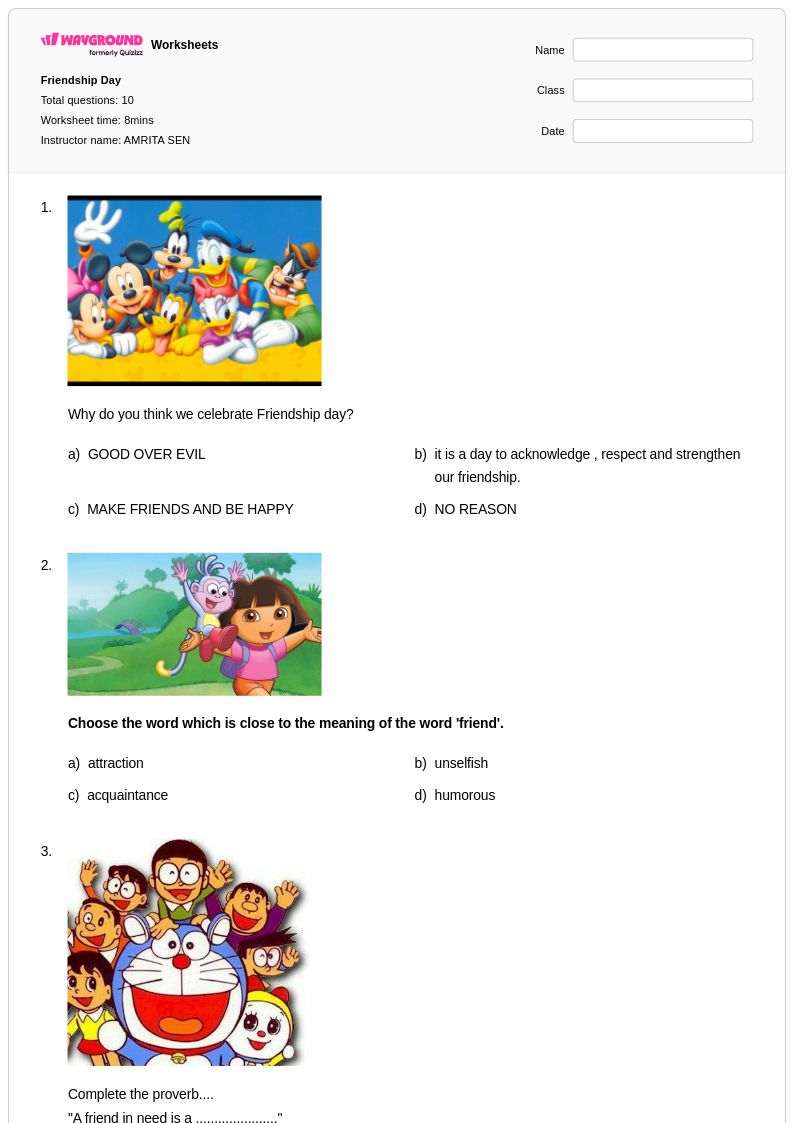
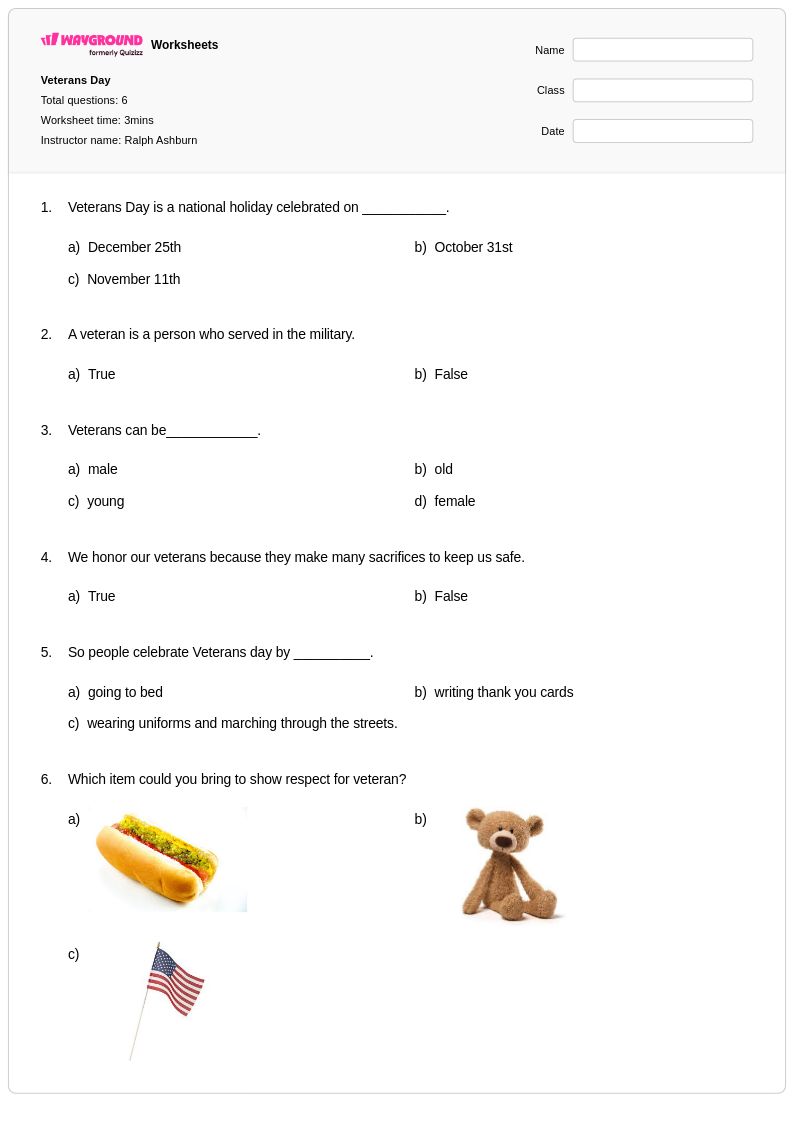
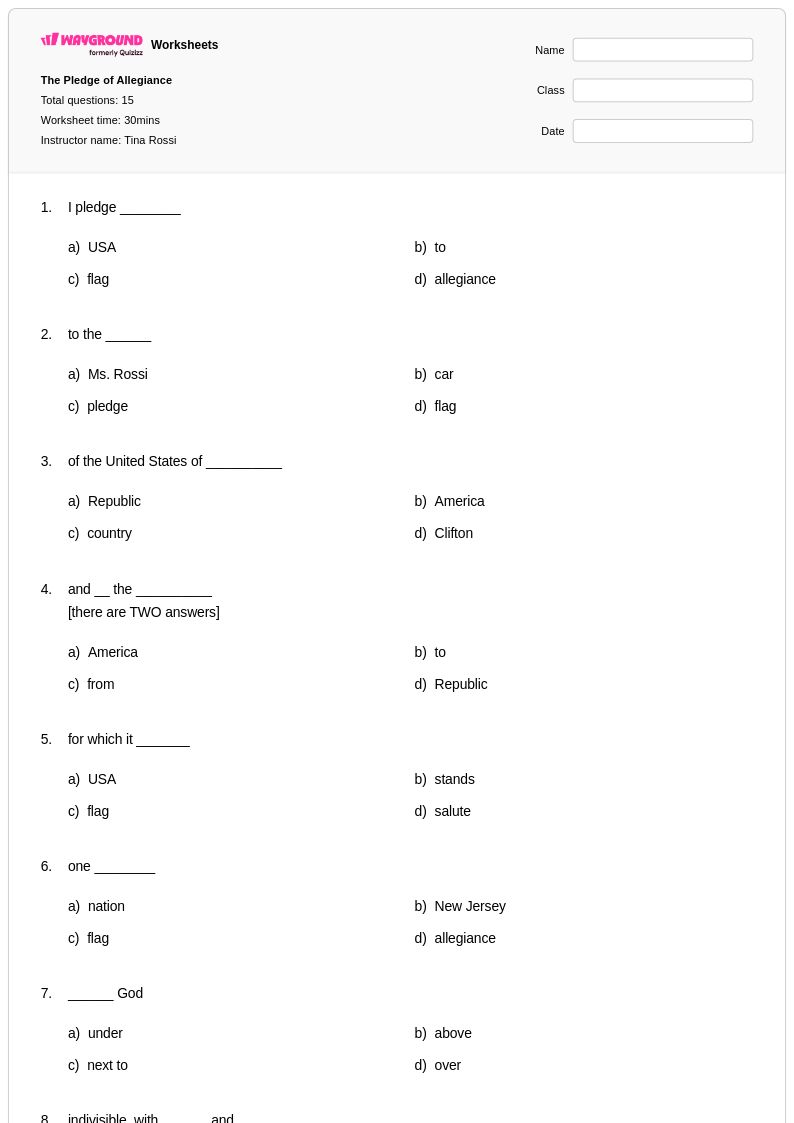
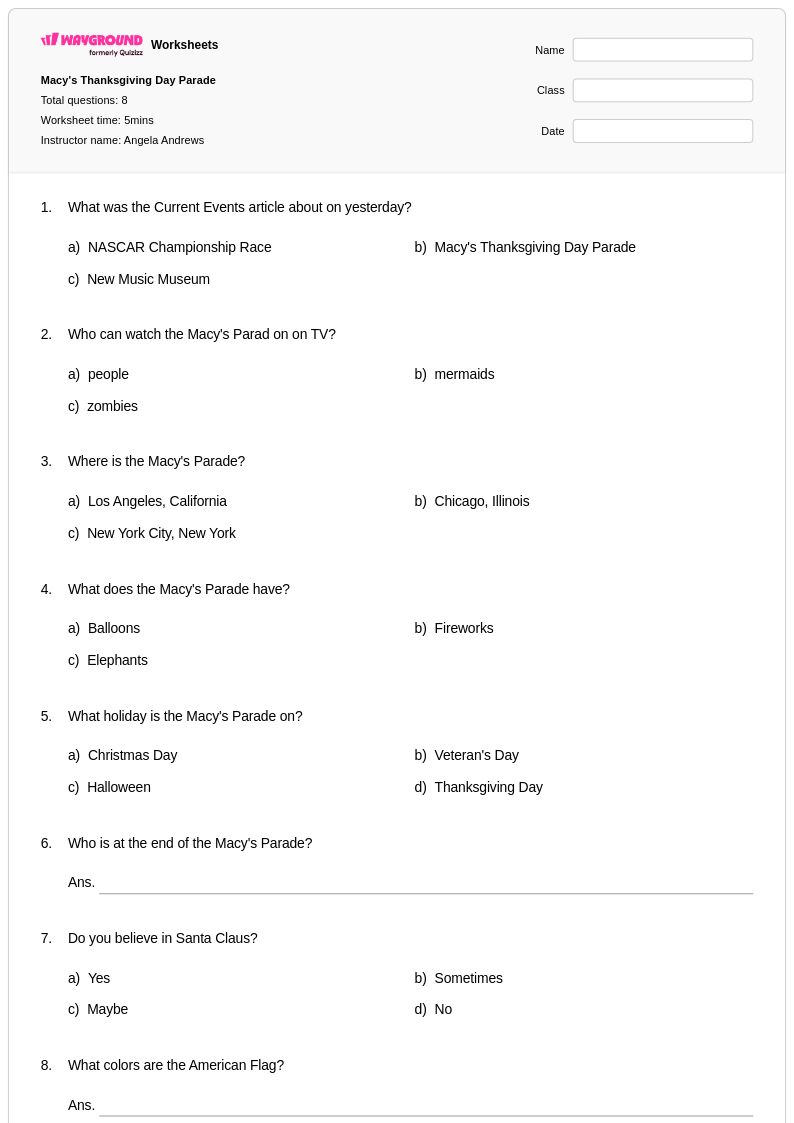
Year 2 Flag Day worksheets and printables help students explore the history and significance of America's flag through engaging practice problems, free PDF activities, and comprehensive answer keys.
Flag Day worksheets for Year 2 students through Wayground (formerly Quizizz) provide young learners with engaging activities that explore the history, symbolism, and significance of the American flag. These educational resources strengthen foundational social studies skills by helping second graders understand patriotic symbols, develop basic historical thinking, and connect national traditions to their own communities and cultures. The comprehensive collection includes practice problems that guide students through flag etiquette, the meaning behind the stars and stripes, and the evolution of our nation's banner throughout history. Teachers can access free printables with accompanying answer keys, ensuring that instruction remains focused and assessment stays streamlined. Each pdf worksheet incorporates age-appropriate vocabulary and visual elements that make complex civic concepts accessible to developing readers while building essential knowledge about American symbols and traditions.
Wayground (formerly Quizizz) empowers educators with millions of teacher-created Flag Day resources specifically designed for elementary social studies instruction. The platform's robust search and filtering capabilities allow teachers to quickly locate materials that align with state standards for community and cultures curriculum, while differentiation tools enable customization for diverse learning needs within Year 2 classrooms. These worksheets are available in both printable and digital formats, including downloadable pdf options that support flexible lesson planning whether instruction occurs in-person or remotely. Teachers utilize these comprehensive collections for skill practice during Flag Day celebrations, remediation for students needing additional support with civic concepts, and enrichment activities that extend learning beyond basic flag recognition to deeper cultural understanding of American symbols and their role in community identity.
FAQs
How do I teach Flag Day to elementary and middle school students?
Teaching Flag Day effectively means connecting the holiday's history to broader civic themes students can relate to. Start with the origins of Flag Day on June 14, 1777, when the Continental Congress officially adopted the Stars and Stripes, then trace how the flag's design evolved as new states joined the Union. Incorporating primary source documents, historical imagery, and flag etiquette activities helps students move beyond memorization toward genuine civic understanding.
What kinds of activities help students practice Flag Day and American flag history?
Effective practice activities for Flag Day include analyzing how the American flag's design changed over time, matching flag symbols to their civic meanings, and sequencing key dates in the flag's history on a timeline. Activities that ask students to interpret primary source documents or connect Flag Day observances to concepts like national identity and civic responsibility deepen comprehension beyond surface-level facts. Worksheets that combine reading passages with structured questions work especially well for building historical analysis skills alongside content knowledge.
What common mistakes do students make when learning about Flag Day?
A frequent misconception is that Flag Day celebrates the creation of the American flag itself rather than the date Congress formally adopted it in 1777. Students also commonly confuse Flag Day with Independence Day or Veterans Day, conflating overlapping themes of patriotism without understanding each holiday's distinct purpose. Another error is treating flag etiquette rules as trivial rather than recognizing them as codified civic practice governed by the U.S. Flag Code.
How can I use Flag Day to build students' civic literacy and historical thinking skills?
Flag Day is a natural entry point for teaching civic literacy because it connects a concrete national symbol to abstract concepts like national identity, shared values, and civic responsibility. Teachers can use it to introduce primary source analysis by having students examine historical images of early American flags or read excerpts from the original Flag Resolution. Extending the lesson to flag etiquette and the reasons behind display rules helps students understand that civic traditions carry intentional meaning, not just ceremony.
How do I use Wayground's Flag Day worksheets in my classroom?
Wayground's Flag Day worksheets are available as free printable PDFs for traditional classroom use and in digital formats for technology-integrated environments, including the option to host them as a quiz directly on the Wayground platform. Each worksheet includes a complete answer key, making them straightforward to assign for independent practice, small group work, or homework without additional preparation. The digital format also allows teachers to apply student-level accommodations such as read aloud, extended time, or reduced answer choices for students who need additional support.
How do I differentiate Flag Day instruction for students at different reading and skill levels?
Differentiation for Flag Day content can include modifying the complexity of reading passages, adjusting whether students respond in open-ended or multiple-choice formats, and varying how much scaffolding is provided for timeline or document analysis tasks. On Wayground, teachers can apply individual accommodations such as read aloud support, reduced answer choices, or extended time to specific students without affecting the experience of the rest of the class. These settings are saved per student and carry over to future assignments, reducing the setup time for repeated accommodations.