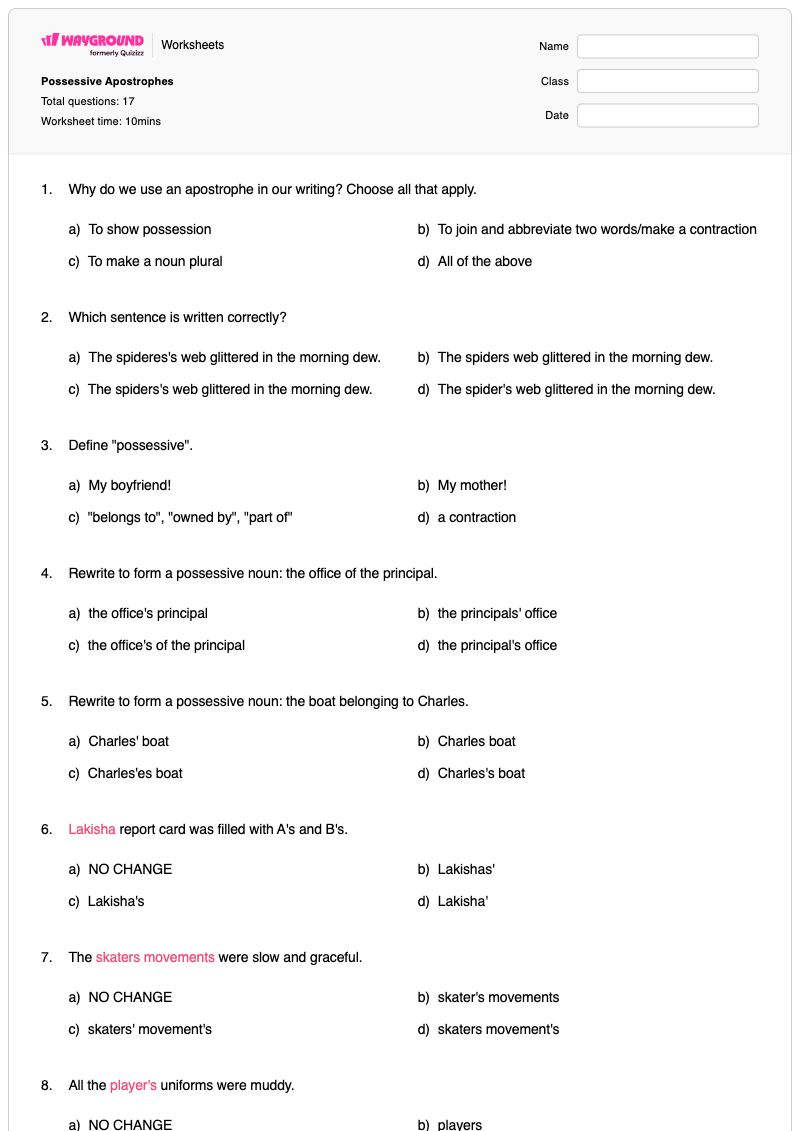
Free Printable Grammar and Mechanics Worksheets for Year 8
Enhance Year 8 students' writing skills with Wayground's free grammar and mechanics worksheets, featuring printable PDF practice problems and comprehensive answer keys for mastering punctuation, capitalization, and sentence structure.
Explore printable Grammar and Mechanics worksheets for Year 8
Grammar and mechanics worksheets for Year 8 students through Wayground (formerly Quizizz) provide comprehensive practice in the fundamental language skills that form the backbone of effective written communication. These expertly designed resources target essential areas including sentence structure, punctuation rules, capitalization conventions, subject-verb agreement, and proper usage of various parts of speech. Each worksheet collection includes detailed answer keys that enable both independent student practice and efficient teacher assessment, while the free printable format ensures accessibility for diverse classroom settings. The practice problems progress systematically from basic concept reinforcement to more complex applications, helping eighth-grade students master the sophisticated grammar and mechanics skills required for high school readiness and advanced academic writing.
Wayground (formerly Quizizz) empowers educators with an extensive library of millions of teacher-created grammar and mechanics resources specifically curated for Year 8 instruction. The platform's robust search and filtering capabilities allow teachers to quickly locate worksheets aligned with state and national language arts standards, while built-in differentiation tools enable seamless adaptation of materials for varied student ability levels. These comprehensive worksheet collections are available in both printable pdf format and interactive digital versions, providing maximum flexibility for classroom implementation, homework assignments, and remote learning scenarios. Teachers can efficiently customize existing resources or combine multiple worksheets to create targeted practice sets for remediation, skill reinforcement, or enrichment activities that address specific grammar and mechanics concepts their students need to master.
Frequently asked questions
Effective grammar and mechanics instruction works best when concepts are taught in context rather than in isolation. Start with explicit instruction on a single concept, such as comma rules or sentence structure, then move students toward applying that concept in their own writing. Scaffolded practice that progresses from recognition tasks to open-ended application helps students internalize rules rather than simply memorize them. Connecting grammar lessons to texts students are already reading strengthens transfer and retention.
Targeted exercises that isolate specific mechanics, such as punctuation correction, sentence diagramming, parallel structure identification, or verb conjugation practice, are most effective for building discrete skills. Sentence correction tasks work particularly well because they require students to identify an error and explain the rule being violated, reinforcing both recognition and application. Mixing exercise types, such as multiple choice for recognition and short-answer for application, ensures students engage with concepts at different cognitive levels.
The most frequent grammar and mechanics errors include comma splices, incorrect apostrophe use in possessives versus plurals, pronoun-verb agreement failures, and inconsistent verb tense. Students also commonly struggle with parallel structure, particularly in lists and compound sentences, and misuse dependent clauses by treating them as complete sentences. Identifying these patterns early through targeted practice allows teachers to address root misunderstandings before they become entrenched writing habits.
Differentiation in grammar instruction means adjusting both the complexity of the concept and the scaffolding provided. For struggling students, reduce the number of answer choices or focus on a single rule before introducing exceptions. Advanced students benefit from tasks that require them to generate original sentences applying the rule, rather than identifying or correcting errors. On Wayground, teachers can apply individual accommodations, such as reduced answer choices or read-aloud support, to specific students while the rest of the class works with standard settings.
Wayground's Grammar and Mechanics worksheets are available as printable PDFs for traditional classroom use and in digital formats for technology-integrated instruction, including the option to host them as a live quiz on Wayground. Teachers can use them for direct instruction, independent practice, or formative assessment, and each worksheet includes a complete answer key to support efficient grading and feedback. The range of subtopics, from apostrophes and capitalization to sentence diagramming and parallel structure, makes it straightforward to match a worksheet to a specific lesson objective.
Effective assessment of grammar and mechanics goes beyond error-counting on a worksheet. Look for whether students can explain why a correction is needed, not just identify that something is wrong, which reveals conceptual understanding rather than surface pattern-matching. Exit tickets targeting one specific rule, such as semicolon usage or possessive apostrophes, give teachers actionable data on which concepts need reteaching before moving forward. Comparing performance on recognition tasks versus application tasks also helps distinguish students who understand the concept from those who have only memorized examples.