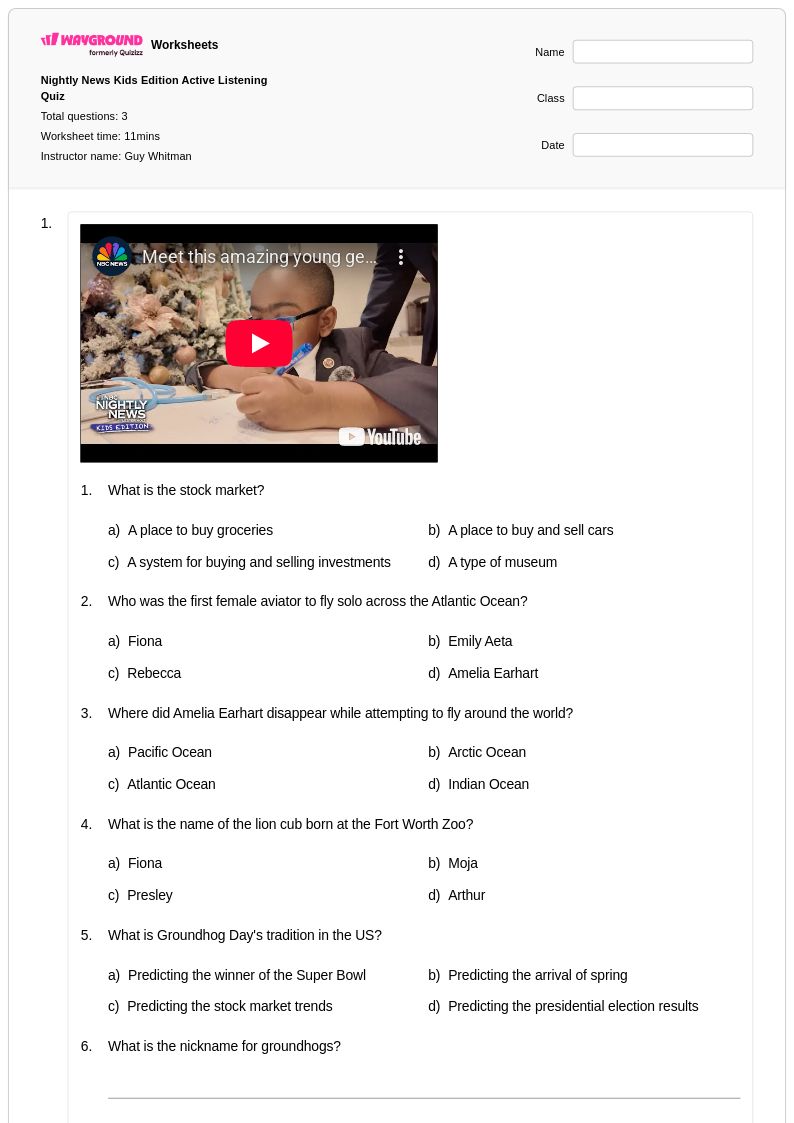
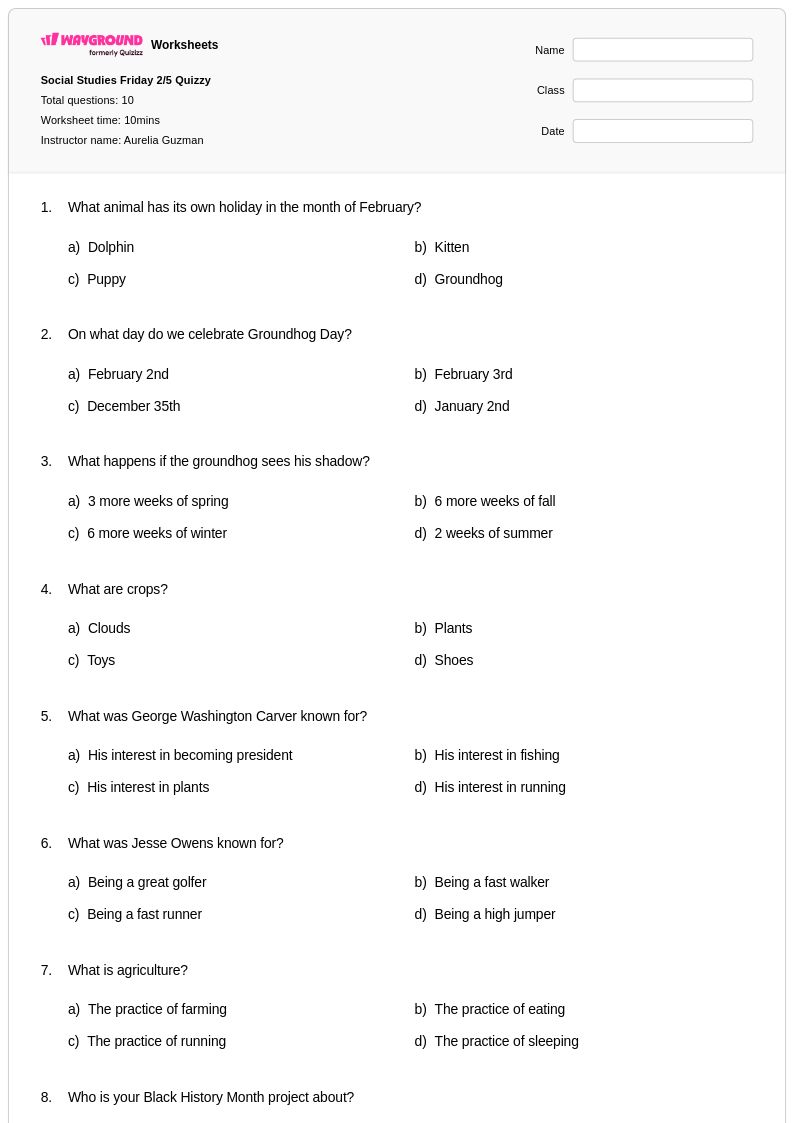
Explore Wayground's free Groundhog Day worksheets and printables that help students discover this beloved American tradition through engaging social studies activities, practice problems, and comprehensive answer keys in downloadable PDF format.
Groundhog Day worksheets available through Wayground (formerly Quizizz) provide educators with comprehensive social studies resources that explore this beloved American tradition within the broader context of community celebrations and cultural practices. These educational materials strengthen students' understanding of seasonal customs, folklore origins, and regional traditions while developing critical thinking skills about how communities create and maintain shared cultural experiences. The worksheet collection includes engaging practice problems that examine the historical roots of Groundhog Day, weather prediction folklore, and the role of media in perpetuating cultural traditions, with each resource featuring detailed answer keys and available as free printable pdf downloads to support classroom instruction and independent learning.
Wayground (formerly Quizizz) empowers teachers with millions of educator-created Groundhog Day resources that can be seamlessly integrated into community and cultures curriculum planning. The platform's robust search and filtering capabilities allow instructors to quickly locate age-appropriate materials that align with social studies standards, while built-in differentiation tools enable customization for diverse learning needs and skill levels. Teachers can access these resources in both printable and digital formats, including downloadable pdfs, making them ideal for remediation activities, enrichment projects, and targeted skill practice that helps students connect seasonal celebrations to broader concepts of community identity and cultural continuity.
FAQs
How do I teach Groundhog Day as a social studies topic?
Teaching Groundhog Day as a social studies topic works best when framed around the broader concepts of cultural traditions, community celebrations, and folklore. Start by grounding students in the holiday's historical roots, including its European origins and how it became an American tradition, then connect it to how communities create and maintain shared cultural practices. Discussion questions about weather prediction folklore and the role of media in sustaining traditions help students think critically rather than just recite facts.
What kinds of activities help students practice Groundhog Day concepts?
Effective practice activities for Groundhog Day focus on reading comprehension passages about its history and folklore, sequencing the origins and evolution of the tradition, and short-response questions that ask students to analyze why communities celebrate seasonal events. Connecting the holiday to broader social studies themes, such as regional identity and cultural continuity, gives the practice work curriculum-level depth rather than treating it as a novelty exercise.
What misconceptions do students commonly have about Groundhog Day?
A common misconception is that Groundhog Day is purely a modern media event rather than a tradition with documented folkloric and European roots. Students often don't realize the holiday connects to older weather-prediction customs tied to seasonal change. Another frequent error is treating the groundhog's prediction as a fixed scientific claim rather than understanding it as cultural folklore, which presents a strong opportunity to discuss the difference between tradition and evidence-based reasoning.
How do I use Groundhog Day worksheets in my classroom?
Groundhog Day worksheets on Wayground are available as both printable PDFs and in digital formats, making them easy to deploy whether you are running a traditional classroom or a technology-integrated environment. You can print them for independent seat work, assign them digitally for remote or hybrid settings, or host them as a quiz directly on Wayground. Each worksheet includes a complete answer key, which reduces grading time and supports consistent feedback for students.
How can I differentiate Groundhog Day worksheets for students with different learning needs?
On Wayground, teachers can apply student-level accommodations to any digital worksheet, including Read Aloud for students who need questions read to them, reduced answer choices to lower cognitive load, and extended time configured per student. These settings can be assigned individually so that students who need accommodations receive them while the rest of the class works under default settings without being singled out. This makes it straightforward to support diverse learners during a whole-class Groundhog Day activity.