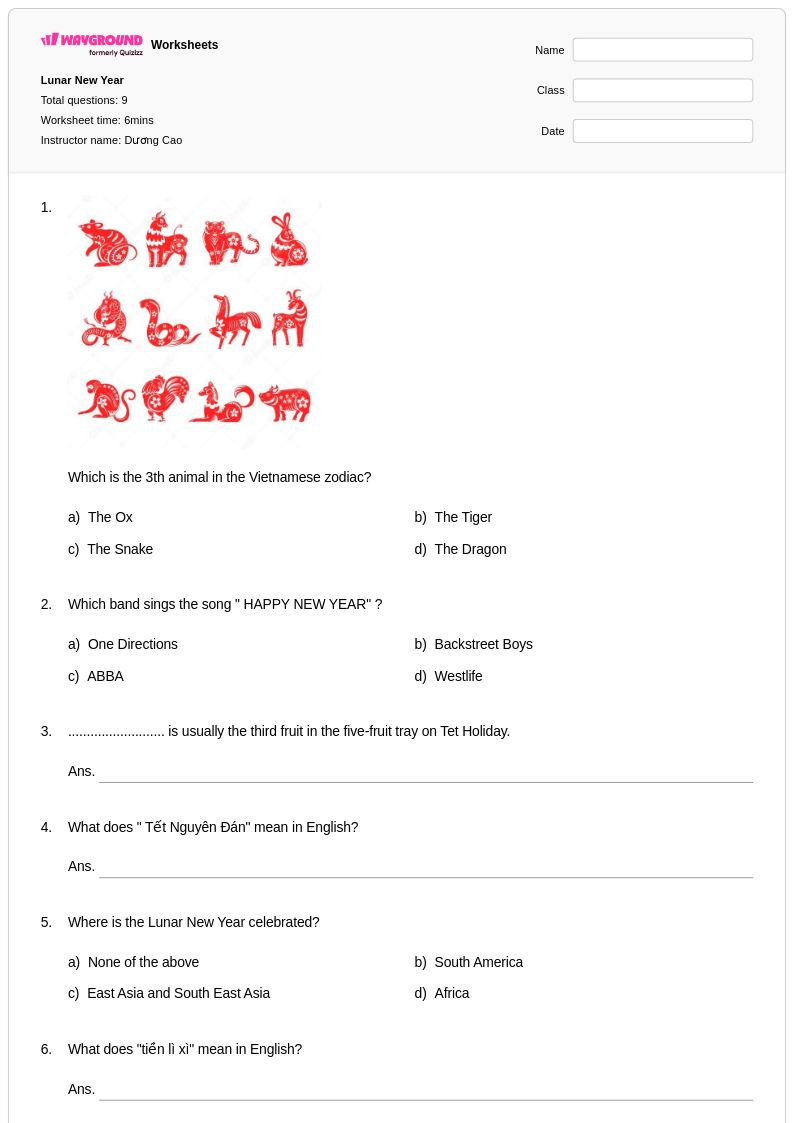
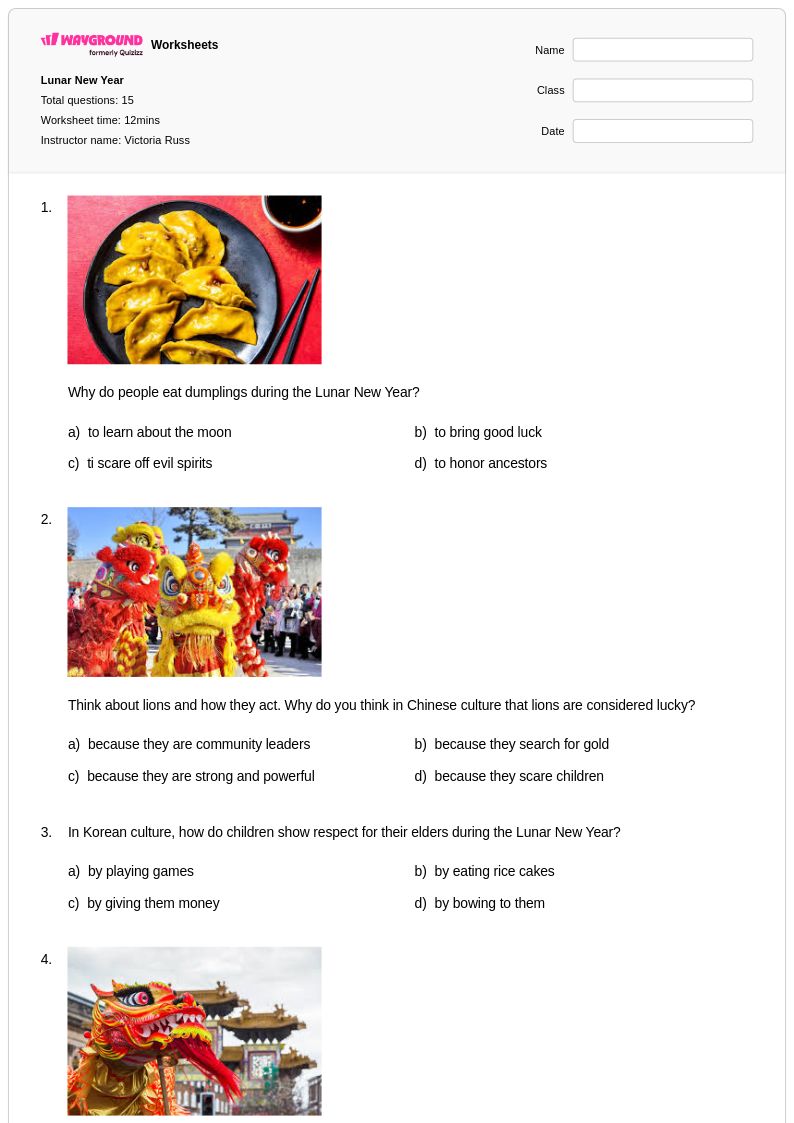
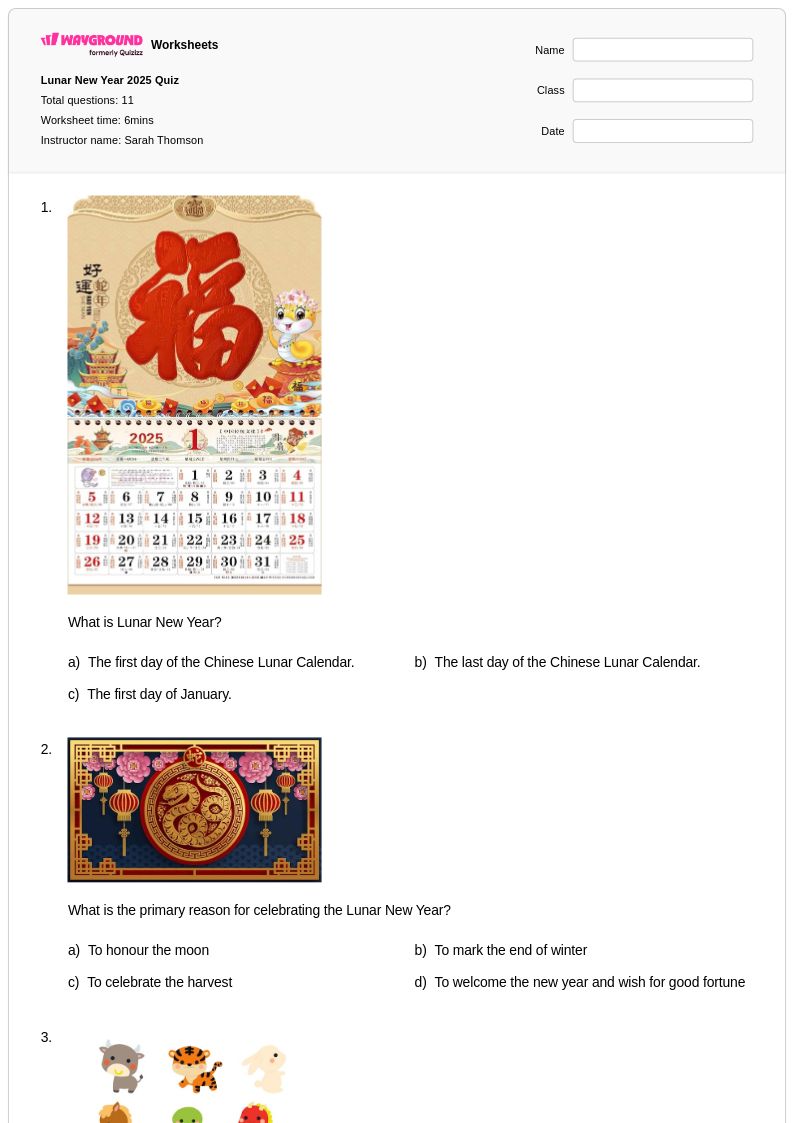
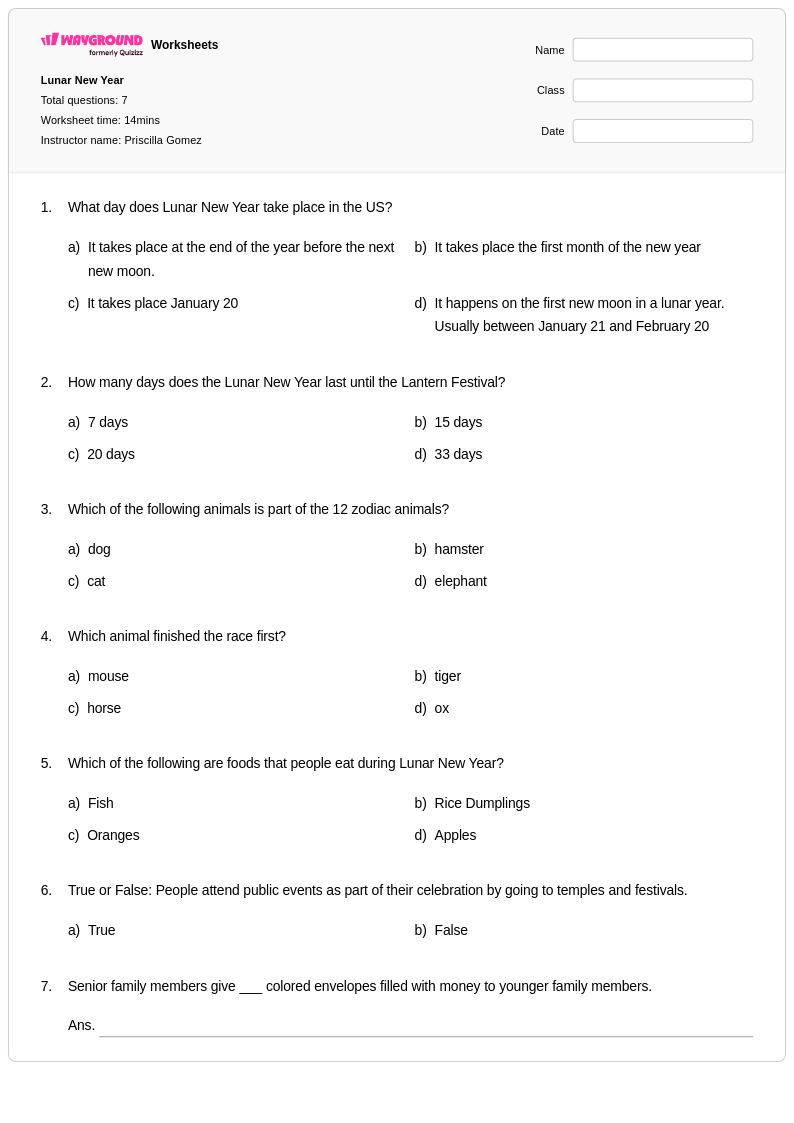
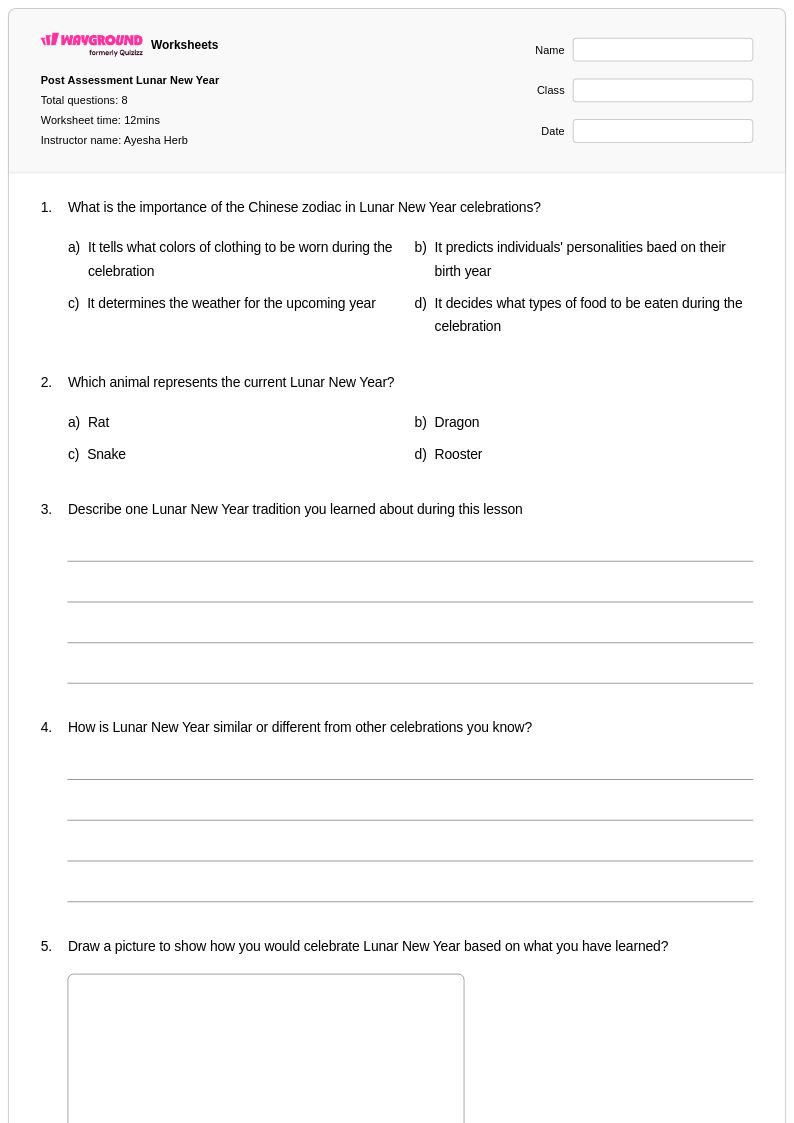
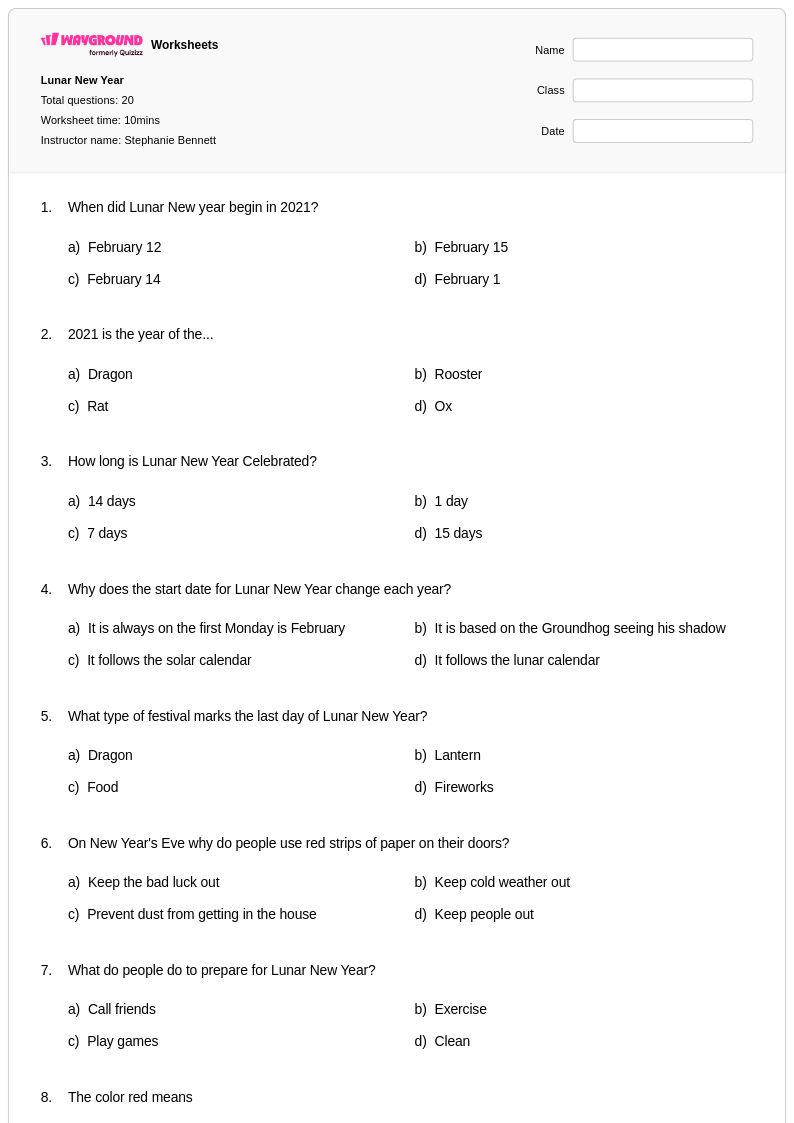
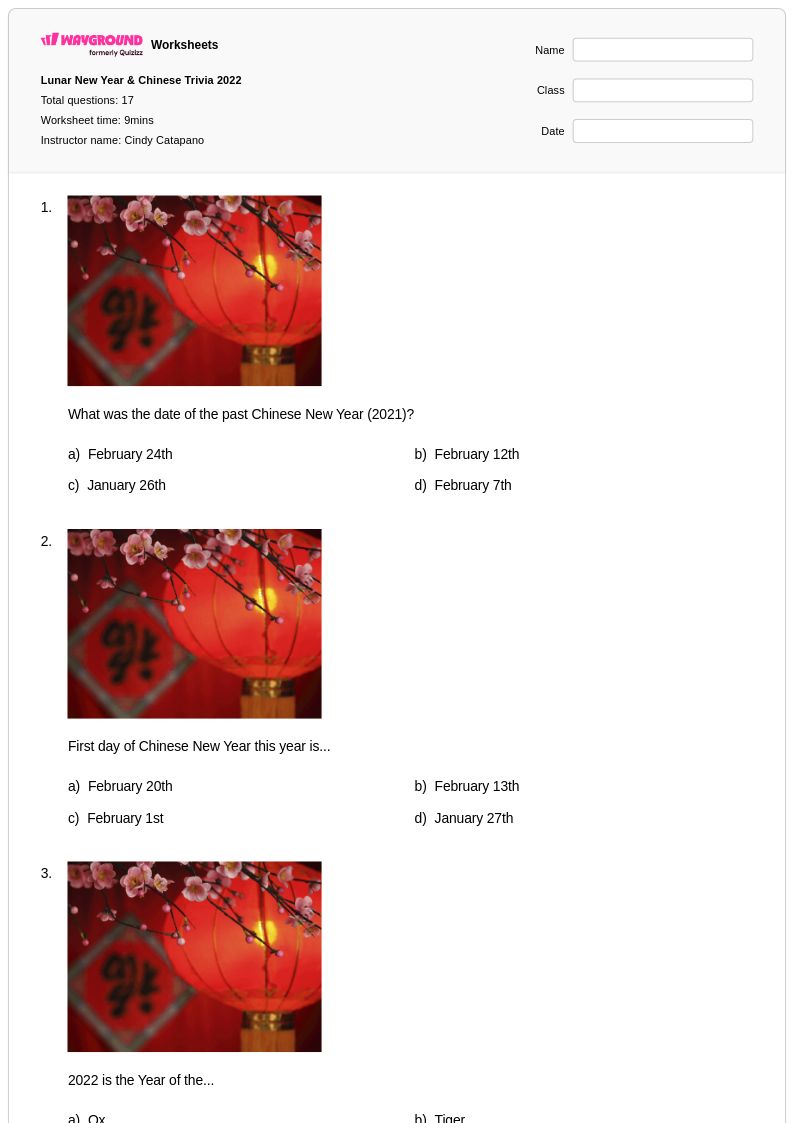
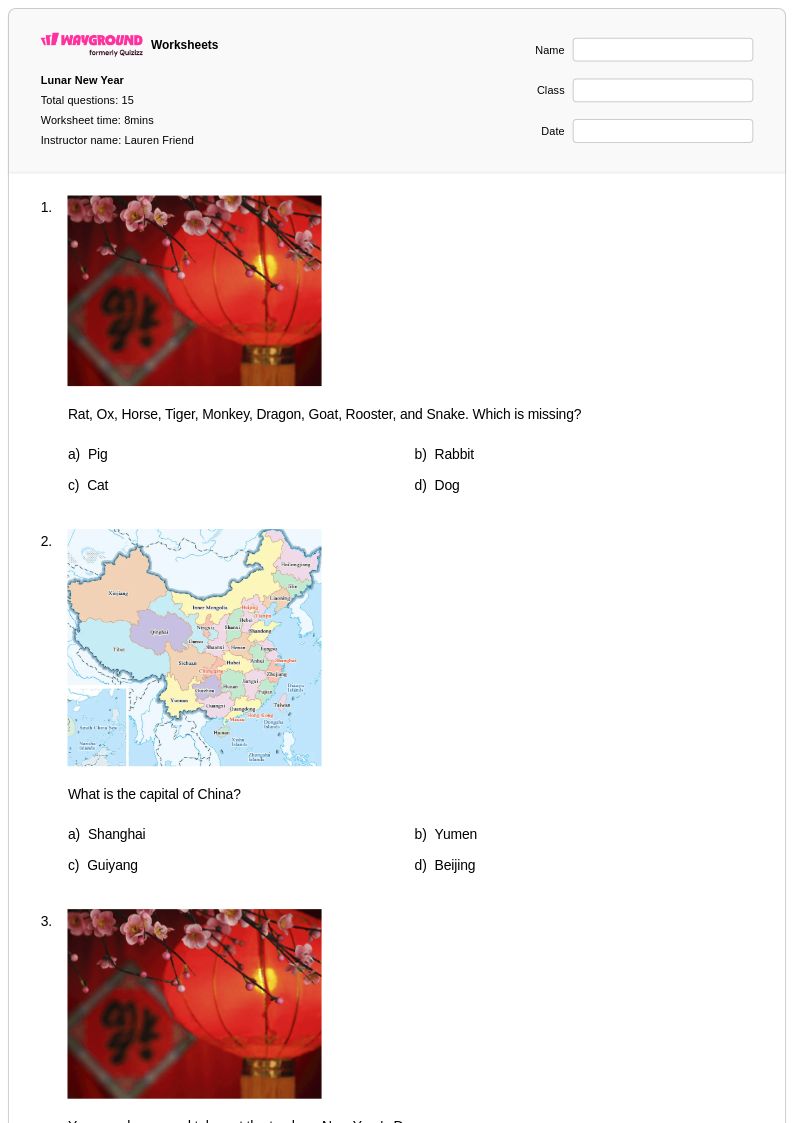
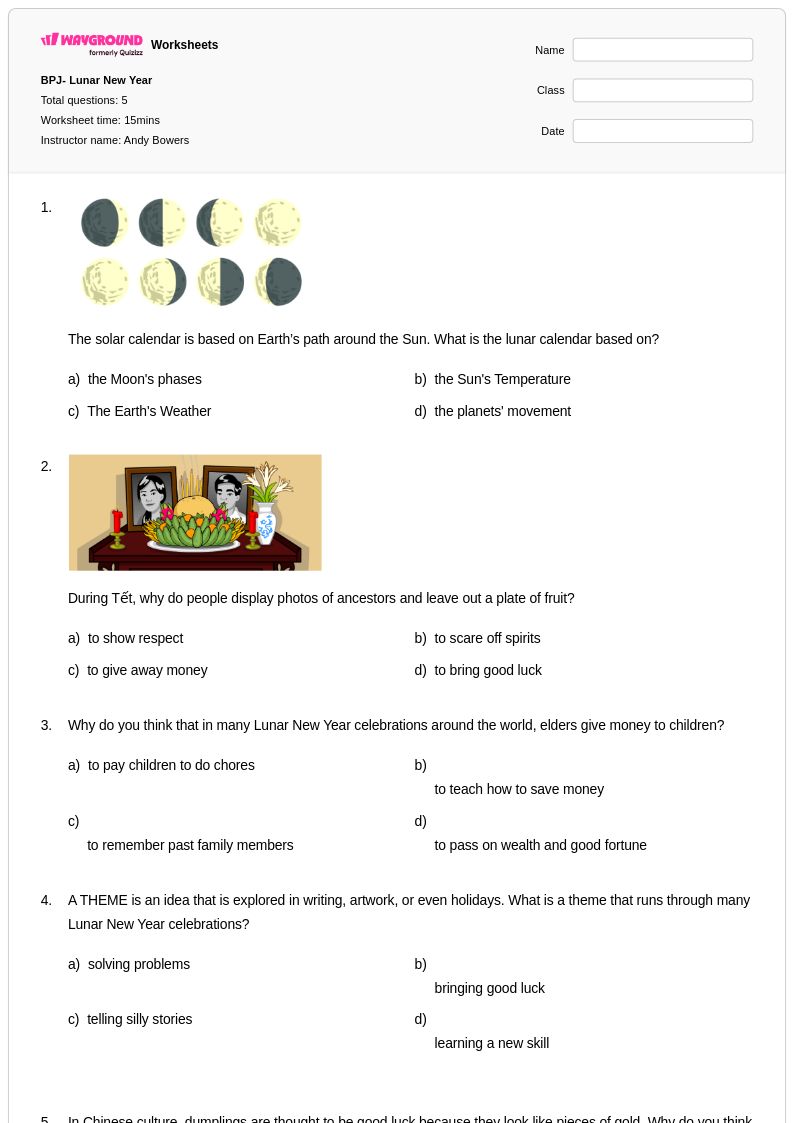
Explore free Lunar New Year worksheets and printables that help students discover the rich traditions, customs, and cultural significance of this important celebration through engaging practice problems and comprehensive answer keys.
Lunar New Year worksheets available through Wayground (formerly Quizizz) provide students with comprehensive educational materials that explore this significant cultural celebration and its global impact on communities. These expertly crafted resources help students develop critical thinking skills about cultural traditions, understand the historical significance of lunar calendar celebrations, and analyze how different Asian cultures observe this important holiday through varying customs and practices. The collection includes engaging practice problems that challenge students to compare and contrast New Year traditions across cultures, examine the symbolism behind traditional foods and decorations, and investigate how immigrant communities maintain their cultural heritage while adapting to new environments. Teachers can access complete answer keys and free printables that support diverse learning objectives, from basic cultural awareness activities to more complex analytical exercises that examine the economic and social impacts of Lunar New Year celebrations worldwide.
Wayground (formerly Quizizz) empowers educators with millions of teacher-created resources specifically designed to bring cultural studies into the classroom through well-organized, searchable content that aligns with social studies standards. The platform's robust filtering system allows teachers to quickly locate age-appropriate materials that match their specific curriculum needs, while differentiation tools enable customization for diverse learning abilities and cultural backgrounds. These flexible resources are available in both printable pdf format and interactive digital versions, making them ideal for traditional classroom instruction, remote learning environments, or hybrid teaching approaches. Teachers can seamlessly integrate these materials into their lesson planning for cultural awareness units, use them for targeted remediation when students need additional support understanding cultural concepts, or deploy them for enrichment activities that deepen student appreciation for global traditions and community celebrations.
FAQs
How do I teach Lunar New Year in the classroom?
Teaching Lunar New Year effectively means grounding students in the cultural and historical context of lunar calendar systems before exploring the specific customs of Chinese, Vietnamese, Korean, and other Asian communities that observe the holiday. Start by comparing the lunar calendar to the Gregorian calendar so students understand why the date shifts each year, then move into traditions like symbolic foods, lantern festivals, and gift-giving practices. Using primary source images, cultural texts, and structured comparison activities helps students engage critically rather than superficially with the material.
What activities help students practice comparing Lunar New Year traditions across cultures?
Comparison charts and Venn diagrams are effective tools for helping students distinguish how Chinese New Year, Tet (Vietnamese), and Seollal (Korean) share common roots in lunar calendar observance while differing in foods, rituals, and duration. Writing prompts that ask students to analyze the symbolism behind specific traditions, such as the significance of red envelopes, certain foods, or animal zodiac cycles, push students toward deeper cultural analysis. Practice problems that ask students to examine how immigrant communities adapt these celebrations in new countries add a valuable layer of sociological thinking.
What misconceptions do students commonly have about Lunar New Year?
The most common misconception is that Lunar New Year is exclusively a Chinese holiday, when in fact it is observed across many Asian cultures including Vietnamese, Korean, Tibetan, and others, each with distinct customs. Students also frequently conflate the lunar calendar with the Islamic calendar, not recognizing that multiple cultures use lunar or lunisolar systems independently. Another common error is treating Lunar New Year traditions as monolithic, when practices vary significantly by region, generation, and diaspora community.
How can I use Lunar New Year worksheets to support diverse learners in my classroom?
Lunar New Year worksheets on Wayground are available in both printable PDF and digital formats, making them accessible across in-person, hybrid, and remote learning environments, and teachers can host them as a quiz directly on Wayground. For students who need additional support, Wayground's built-in accommodation tools allow teachers to enable Read Aloud for audio delivery of questions, reduce answer choices to lower cognitive load, or grant extended time on a per-student basis. These settings can be applied individually so that differentiated support is seamless and does not single out any student.
How do Lunar New Year worksheets connect to social studies standards?
Lunar New Year worksheets align naturally with social studies standards related to cultural awareness, global communities, and historical traditions, particularly in units covering world cultures, immigration, or community identity. They support standards that require students to analyze how traditions are transmitted across generations and how cultural practices reflect historical and geographic contexts. Teachers can use these materials to address both content knowledge and analytical skills within the same lesson.
What are good discussion questions to pair with Lunar New Year worksheets?
Strong discussion questions push students beyond surface-level cultural facts and into analysis, such as asking why certain symbols like the color red, fireworks, or specific animals carry meaning across multiple Asian New Year traditions. Questions like 'How do immigrant communities balance preserving cultural traditions with adapting to a new country?' connect Lunar New Year content to broader social studies concepts around identity and community. Pairing these discussions with structured written responses or worksheet prompts reinforces both comprehension and critical thinking.