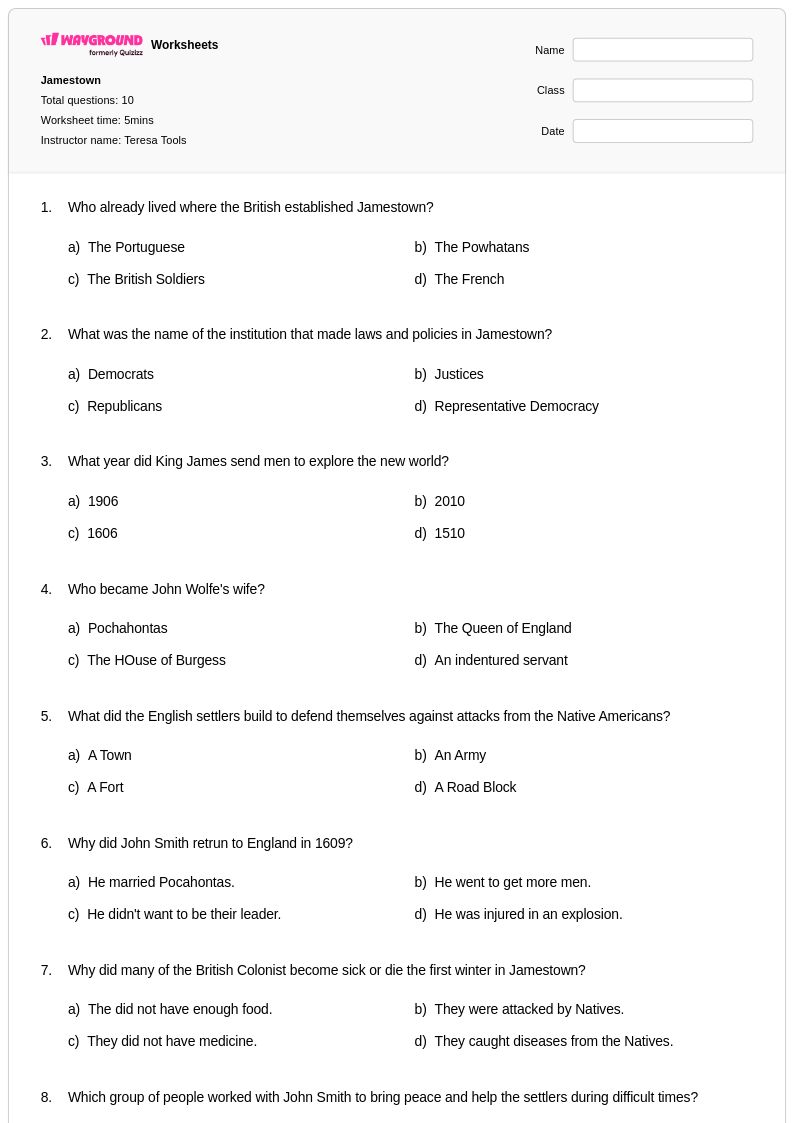
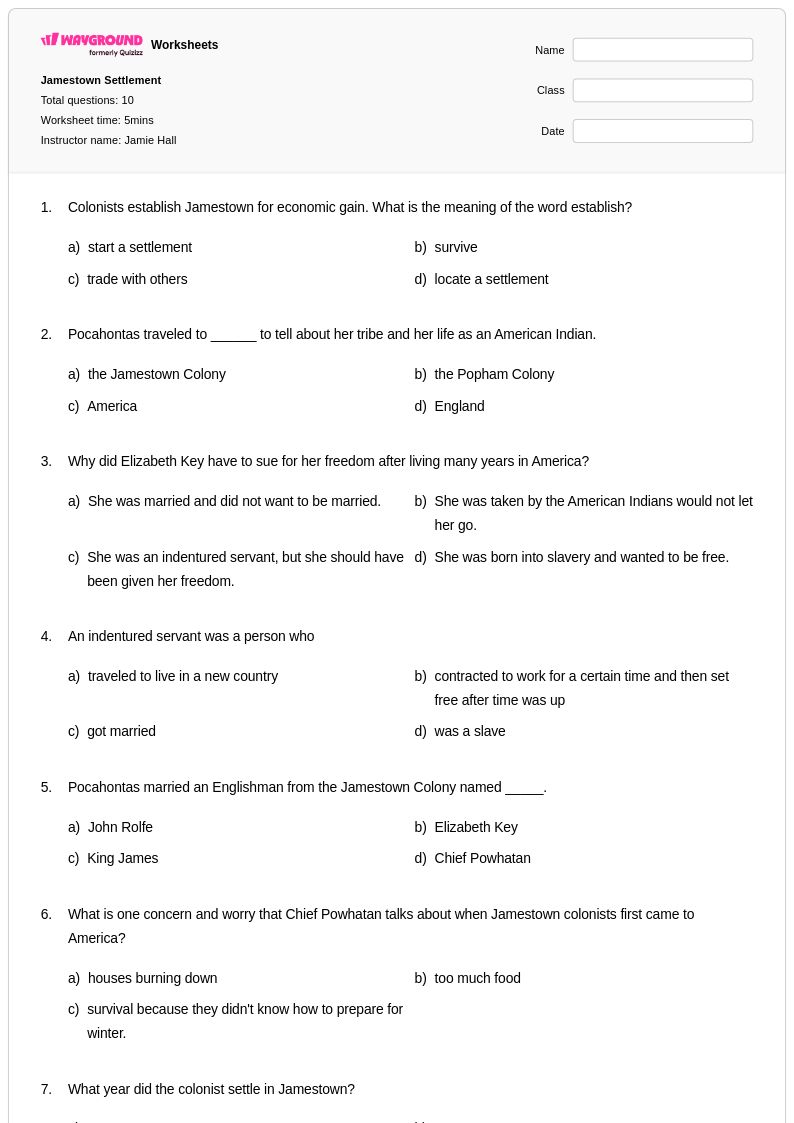
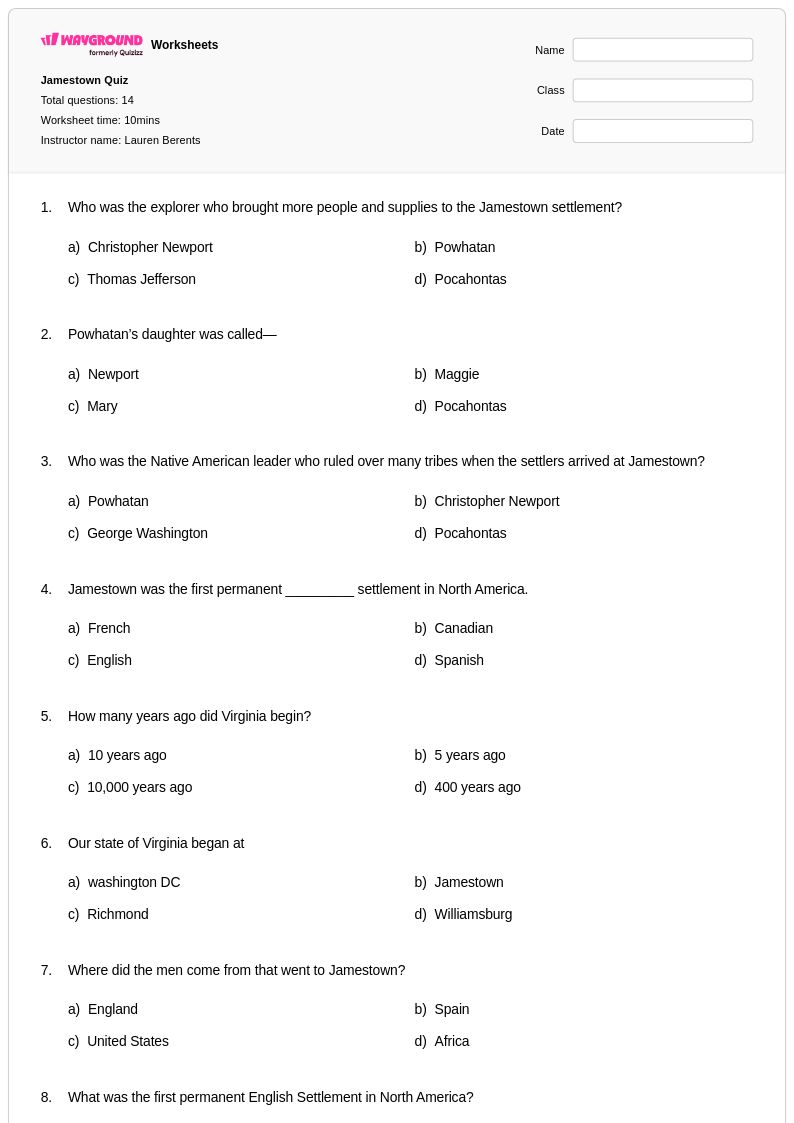
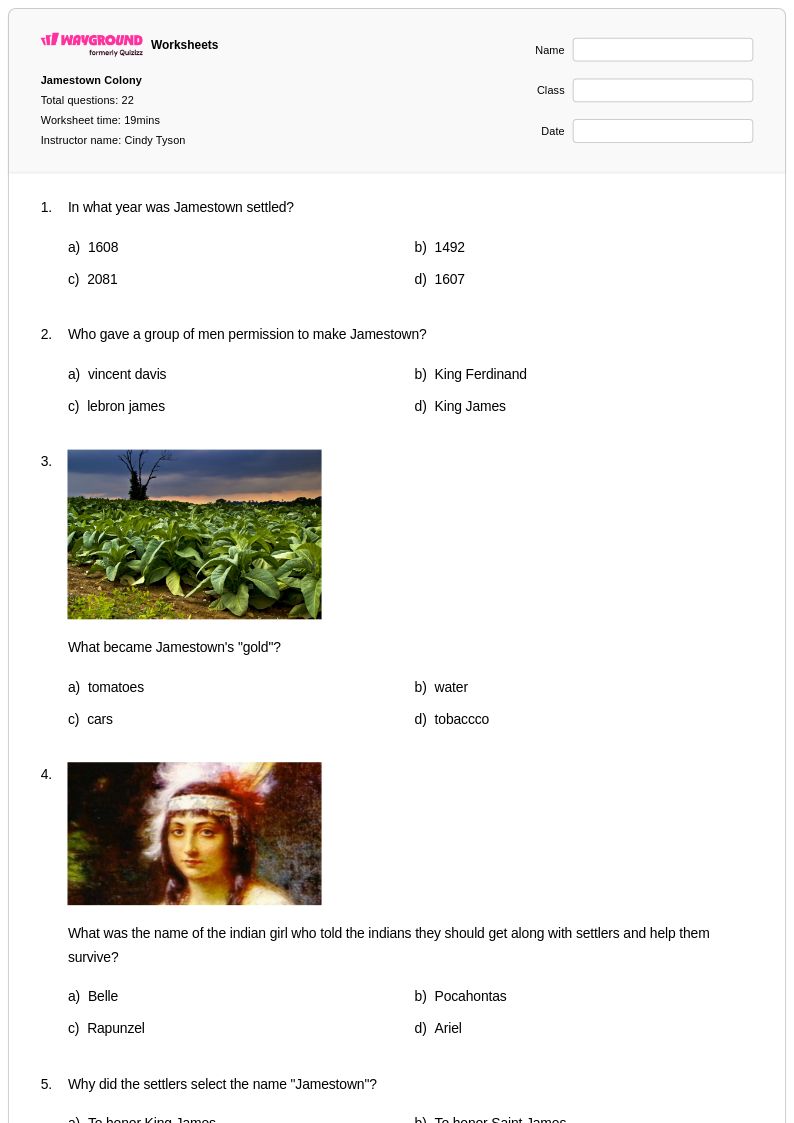
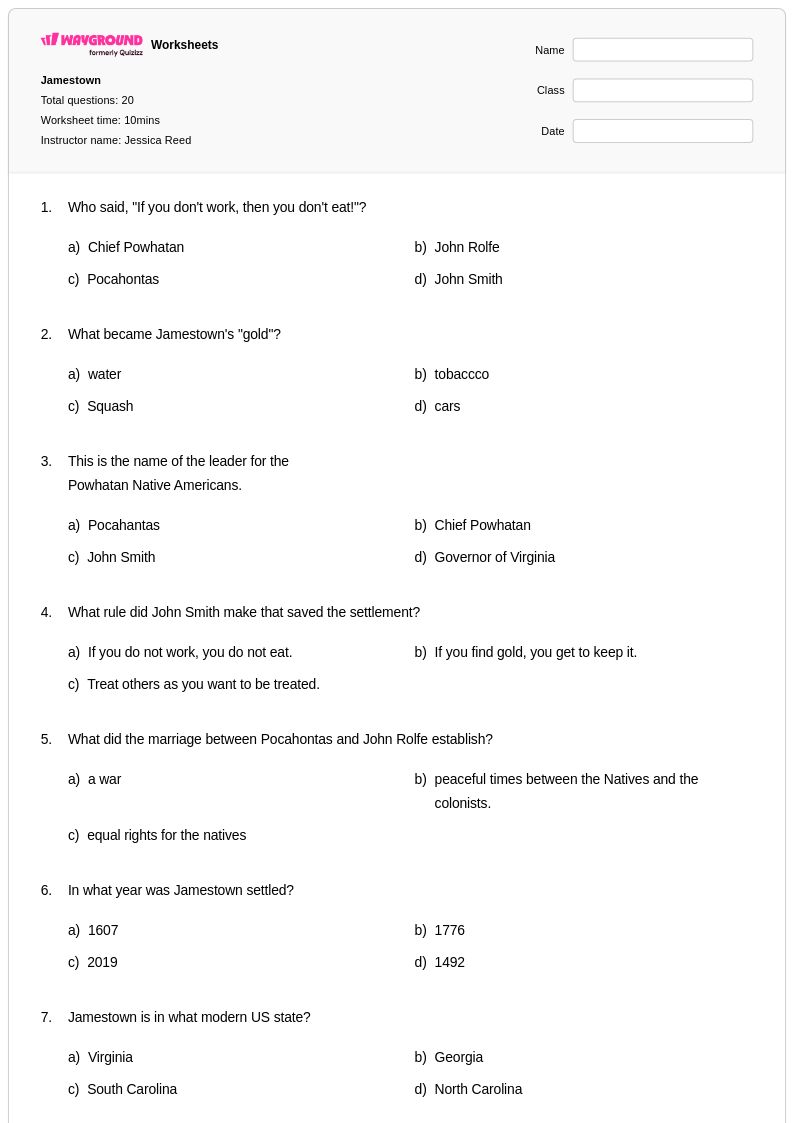
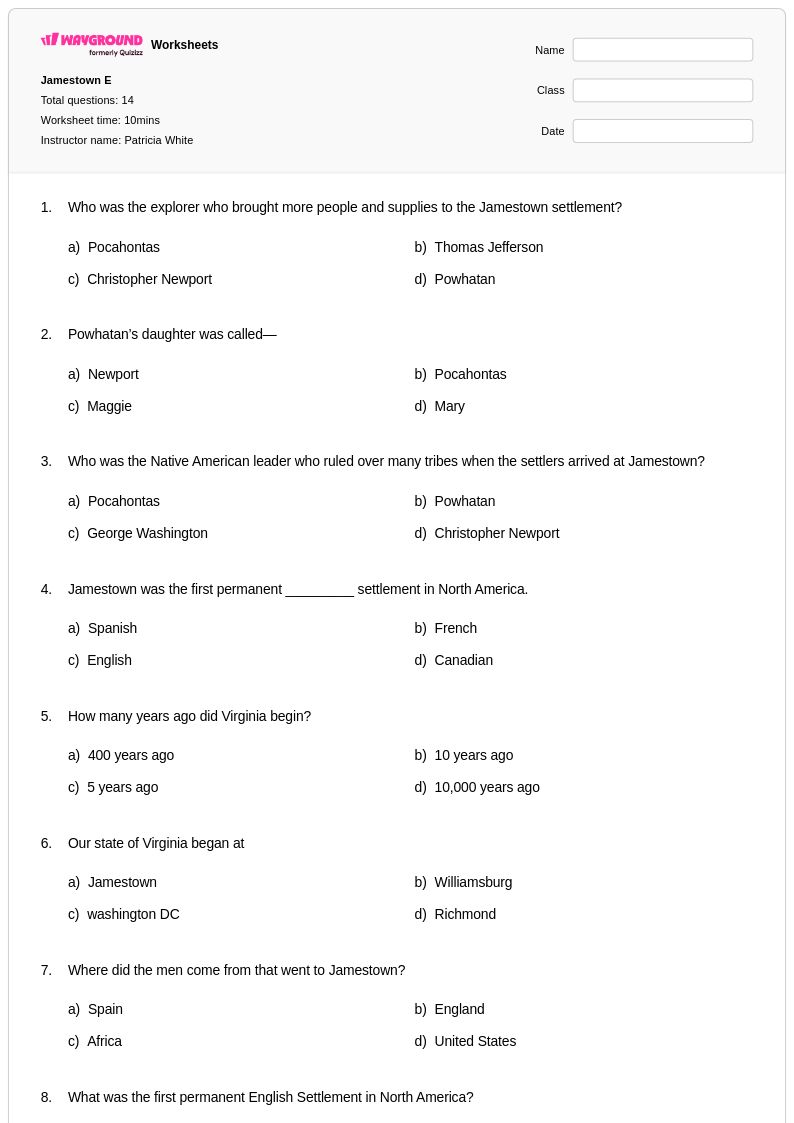
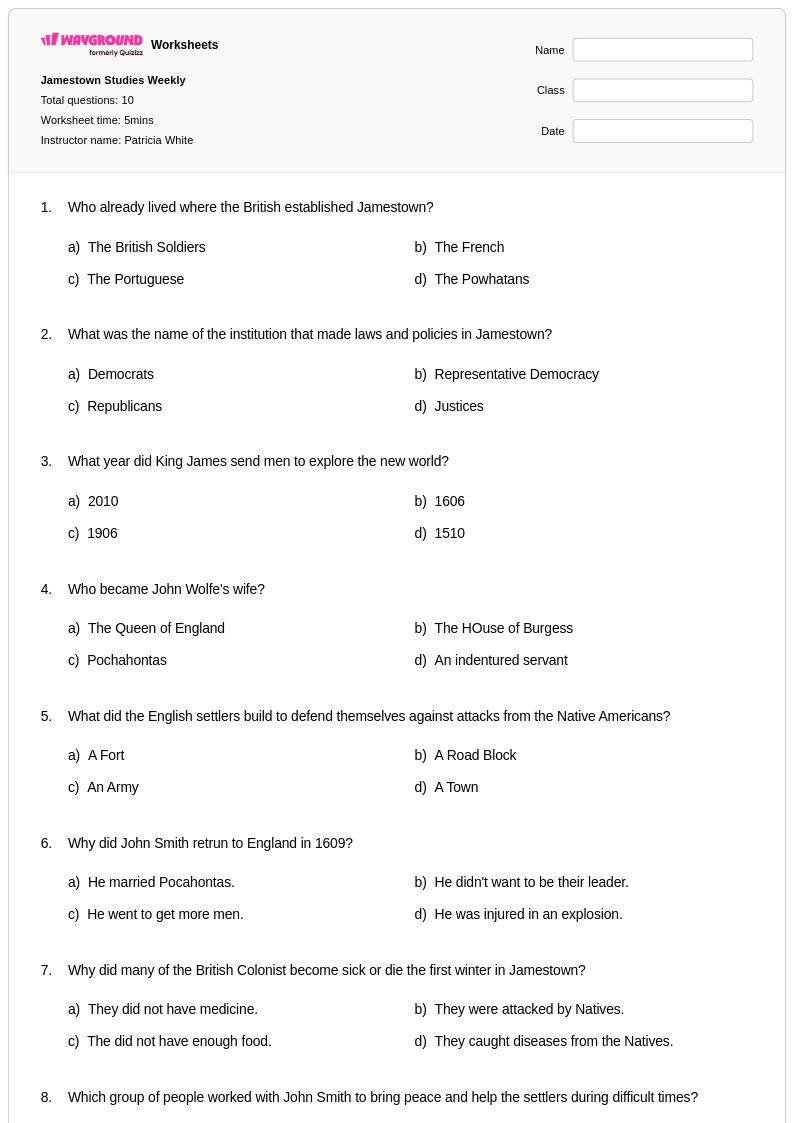
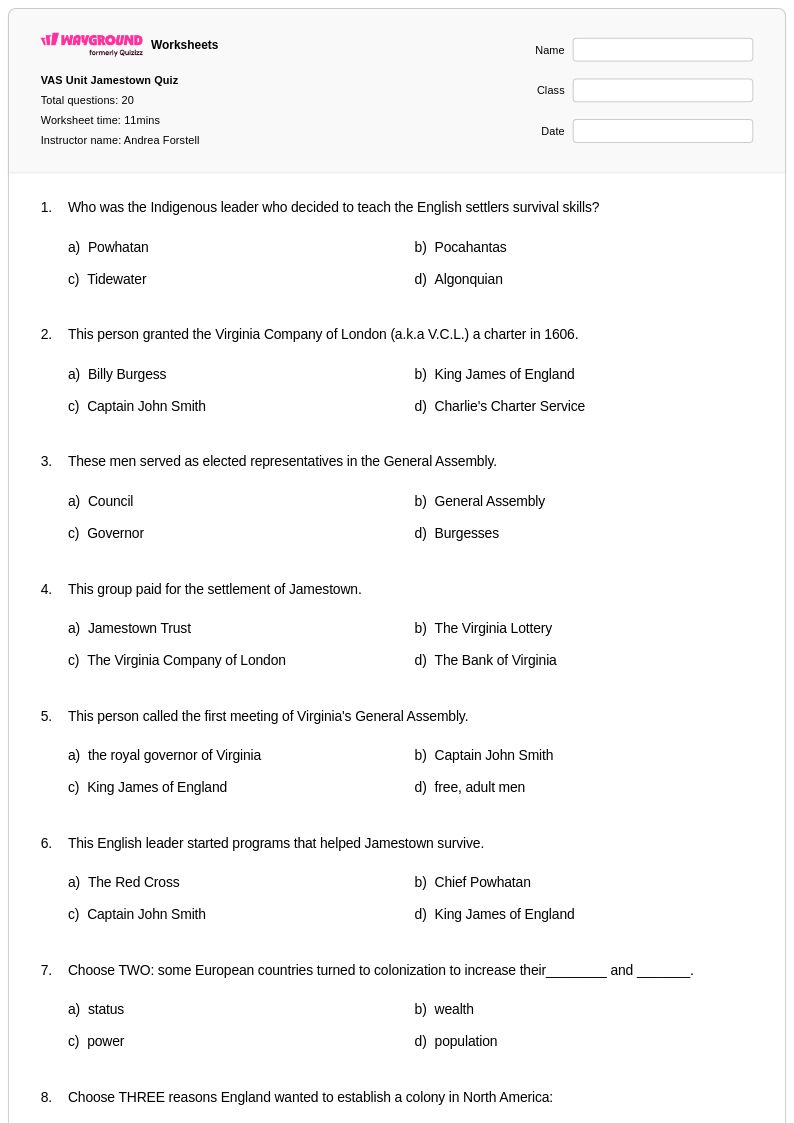
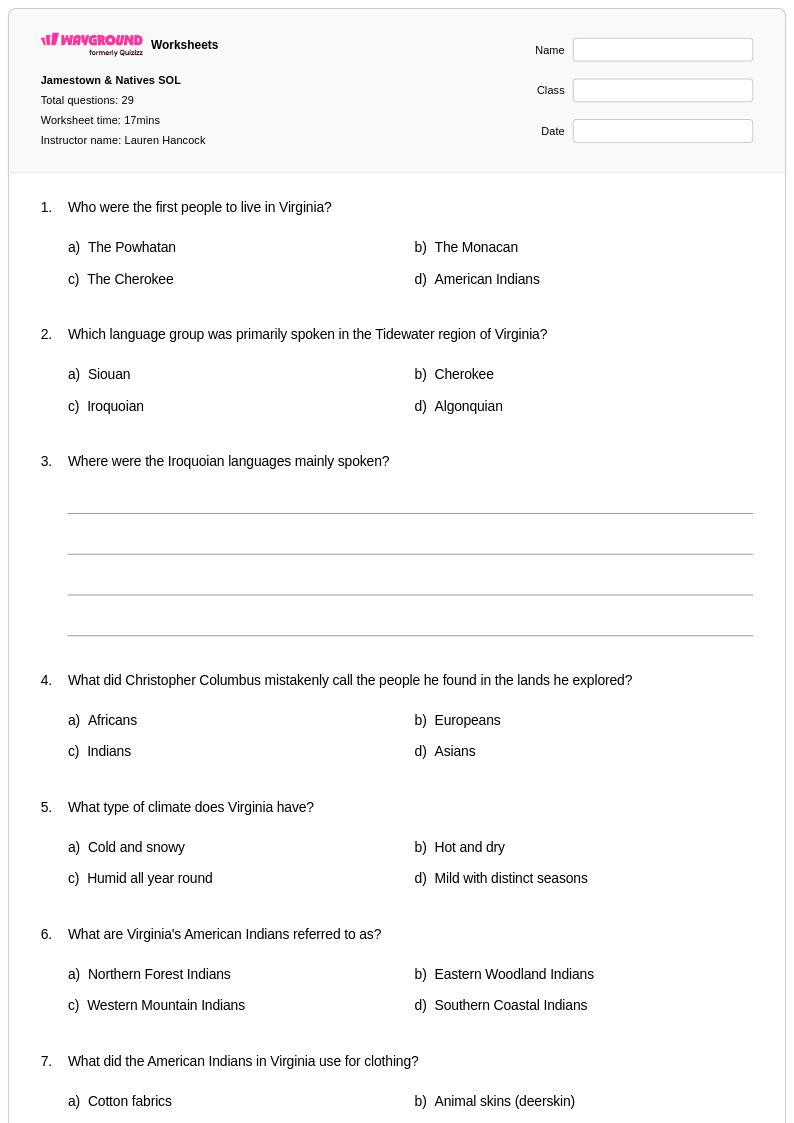
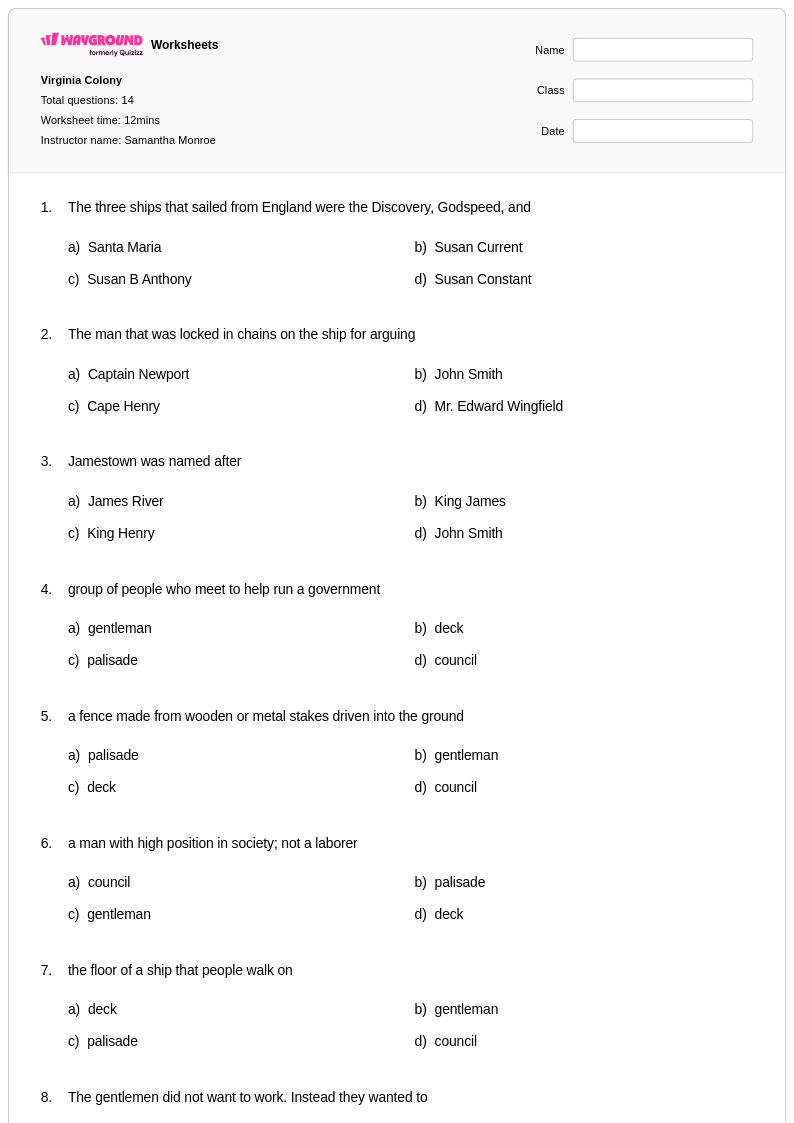
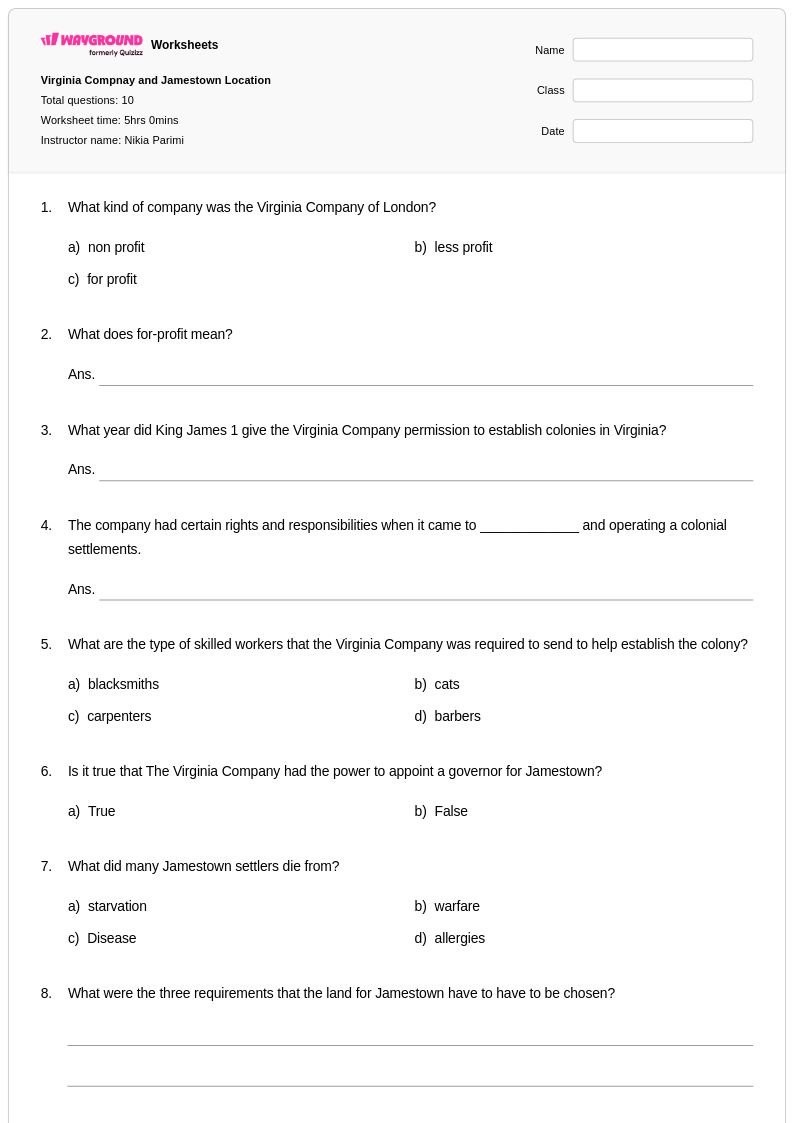
Explore Year 3 Jamestown worksheets and printables that help students discover America's first permanent English settlement through engaging practice problems, free PDF resources, and comprehensive answer keys.
Jamestown worksheets for Year 3 through Wayground (formerly Quizizz) provide young learners with engaging opportunities to explore America's first permanent English settlement through age-appropriate activities and comprehensive practice problems. These educational resources strengthen essential social studies skills including reading comprehension, historical thinking, and chronological reasoning while introducing students to key figures like John Smith and Pocahontas, the challenges of early colonial life, and the significance of tobacco cultivation. Each worksheet collection includes detailed answer keys to support accurate assessment and features content designed specifically for third-grade reading levels, making complex historical concepts accessible through visual aids, simple timelines, and interactive exercises available as free printables in convenient pdf format.
Wayground (formerly Quizizz) empowers educators with access to millions of teacher-created Jamestown resources that align with state social studies standards and support diverse classroom needs. The platform's advanced search and filtering capabilities enable teachers to quickly locate materials targeting specific learning objectives, from basic settlement facts to more complex cause-and-effect relationships in early American history. Flexible customization tools allow instructors to modify existing worksheets for differentiation purposes, supporting both remediation for struggling learners and enrichment opportunities for advanced students, while the availability of both printable and digital formats ensures seamless integration into any lesson planning approach. These comprehensive worksheet collections facilitate effective skill practice and assessment preparation while reducing teacher preparation time through ready-to-use materials that maintain academic rigor appropriate for elementary learners.
FAQs
How do I teach the founding of Jamestown to middle school students?
Start by grounding students in the Virginia Company's economic motivations before introducing the hardships colonists faced on arrival. Use primary source excerpts from John Smith's accounts alongside structured questions that ask students to distinguish between what colonists expected and what they encountered. Connecting the 'Starving Time' to specific decisions made by the Virginia Company helps students practice cause-and-effect thinking rather than memorizing isolated facts.
What are the most important concepts students need to understand about Jamestown?
Students should understand four interconnected concepts: the Virginia Company's profit-driven motives for settlement, the colonists' survival challenges including the 'Starving Time,' the role of tobacco as an economic lifeline, and the complex relationships between English settlers and the Powhatan Confederacy. Without understanding how these factors interact, students tend to view Jamestown as a story of individual heroism rather than a collision of economic, political, and cultural forces.
What exercises help students practice analyzing Jamestown's historical significance?
Primary source analysis tasks work particularly well for Jamestown because they require students to read documents with purpose rather than passively absorb timelines. Cause-and-effect charts tracing the tobacco economy's growth, comparison activities examining English and Powhatan perspectives, and document-based questions about the 'Starving Time' all build the historical thinking skills that social studies standards require. Worksheets that combine these exercise types within a single assignment help students see Jamestown as a system of interrelated causes rather than a sequence of isolated events.
What misconceptions do students commonly have about Jamestown?
The most common misconception is that John Smith single-handedly saved the colony, which oversimplifies the role of Powhatan food diplomacy and the Virginia Company's organizational failures. Students also frequently confuse Jamestown with Plymouth Colony, conflating Pilgrim narratives with early Virginia history. A third persistent error is treating the arrival of African peoples in 1619 as a minor footnote rather than a foundational moment in the development of American slavery and labor systems.
How do I use Jamestown worksheets effectively in my classroom?
Jamestown worksheets on Wayground are available as printable PDFs for traditional classroom use and in digital formats for technology-integrated environments, including the option to host them as a quiz on Wayground. For print use, the included answer keys allow for efficient grading and support structured class discussions after students complete their work. In digital mode, teachers can assign worksheets individually and apply accommodations such as read aloud or extended time for students who need additional support, without disrupting the experience for the rest of the class.
How do I differentiate Jamestown instruction for students at different reading levels?
Differentiation for Jamestown works best when the historical content stays consistent but the complexity of source texts and questioning varies. For struggling readers, pairing scaffolded documents with sentence starters helps students engage with primary sources without being blocked by vocabulary. On Wayground, teachers can apply individual accommodations such as read aloud and reduced answer choices to specific students, so the same digital worksheet can serve the full range of learners in one classroom without requiring separate lesson plans.