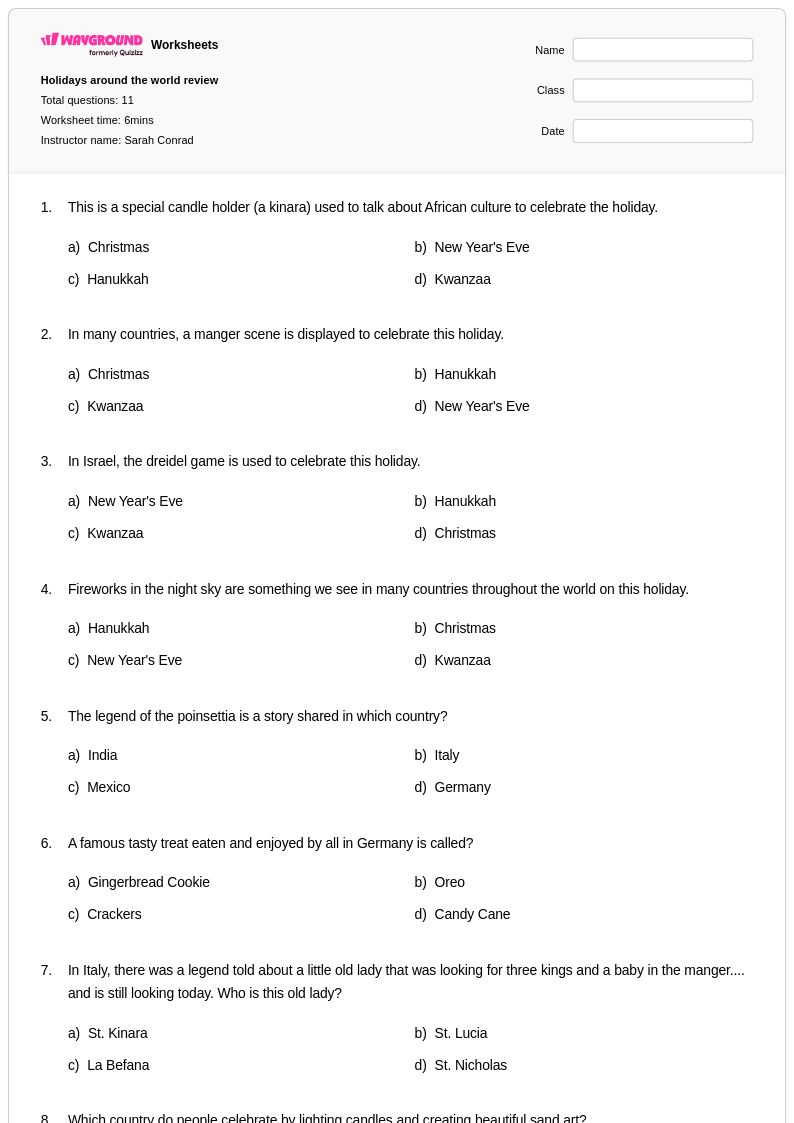
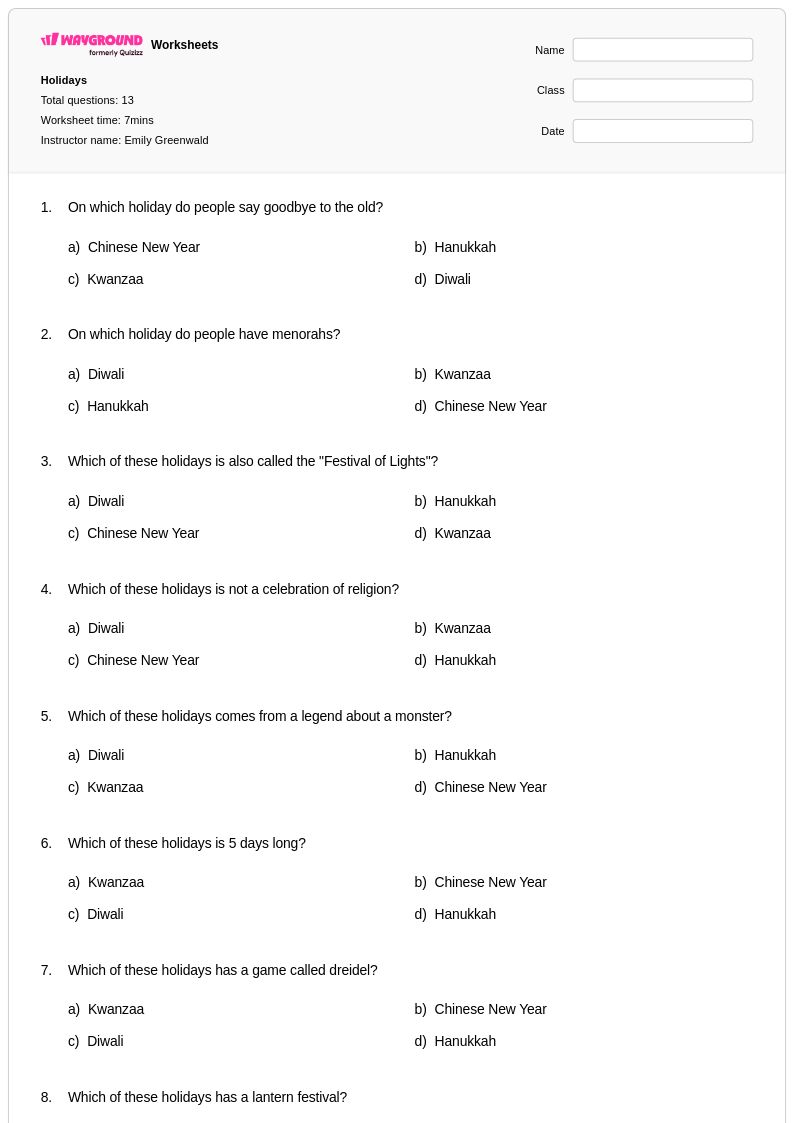
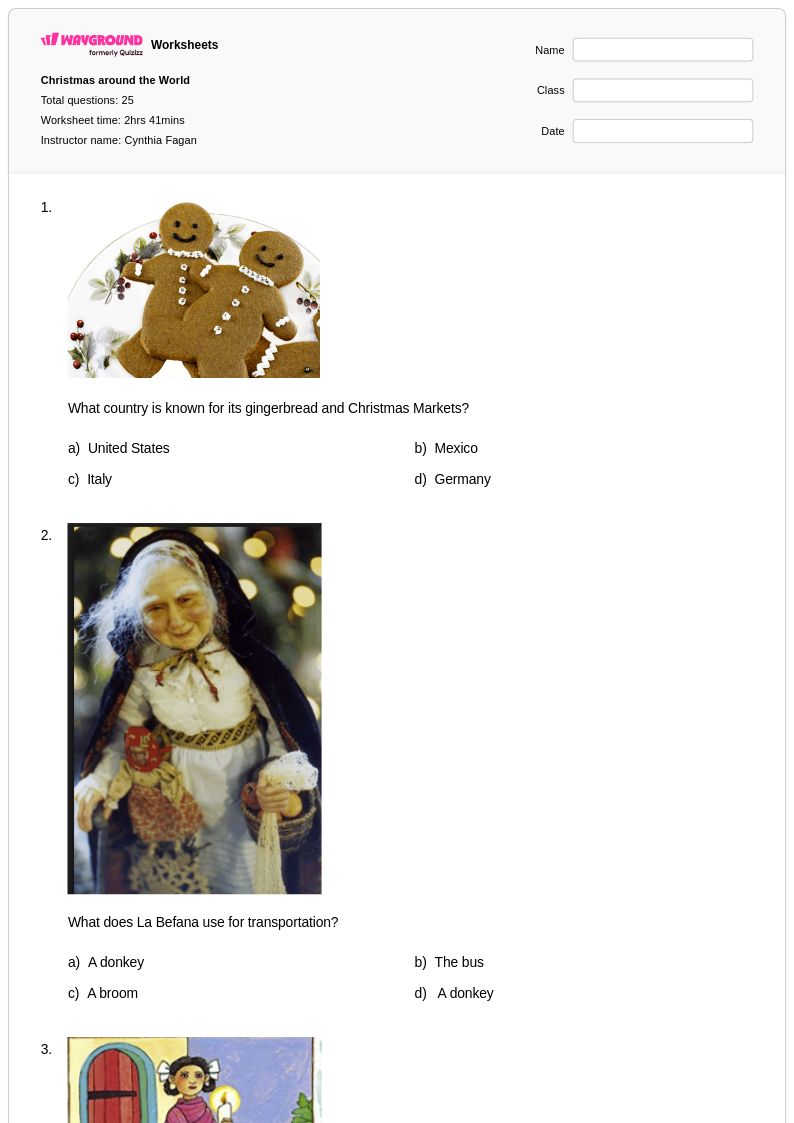
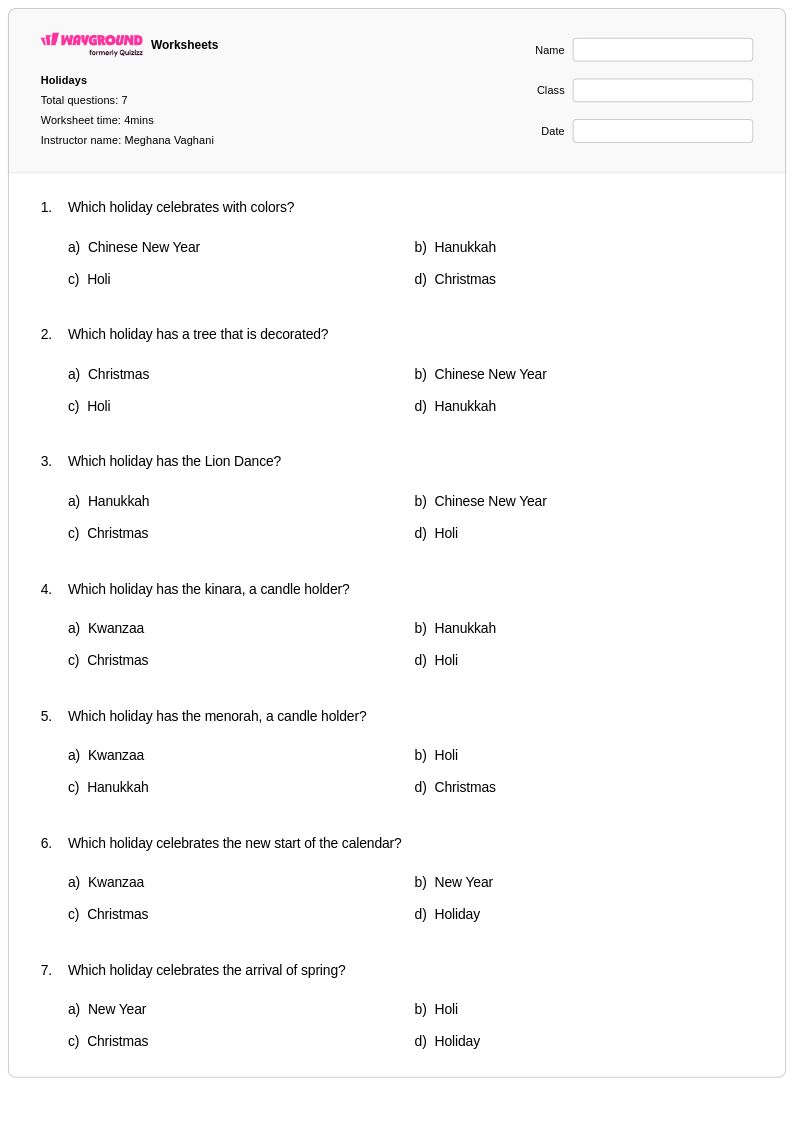
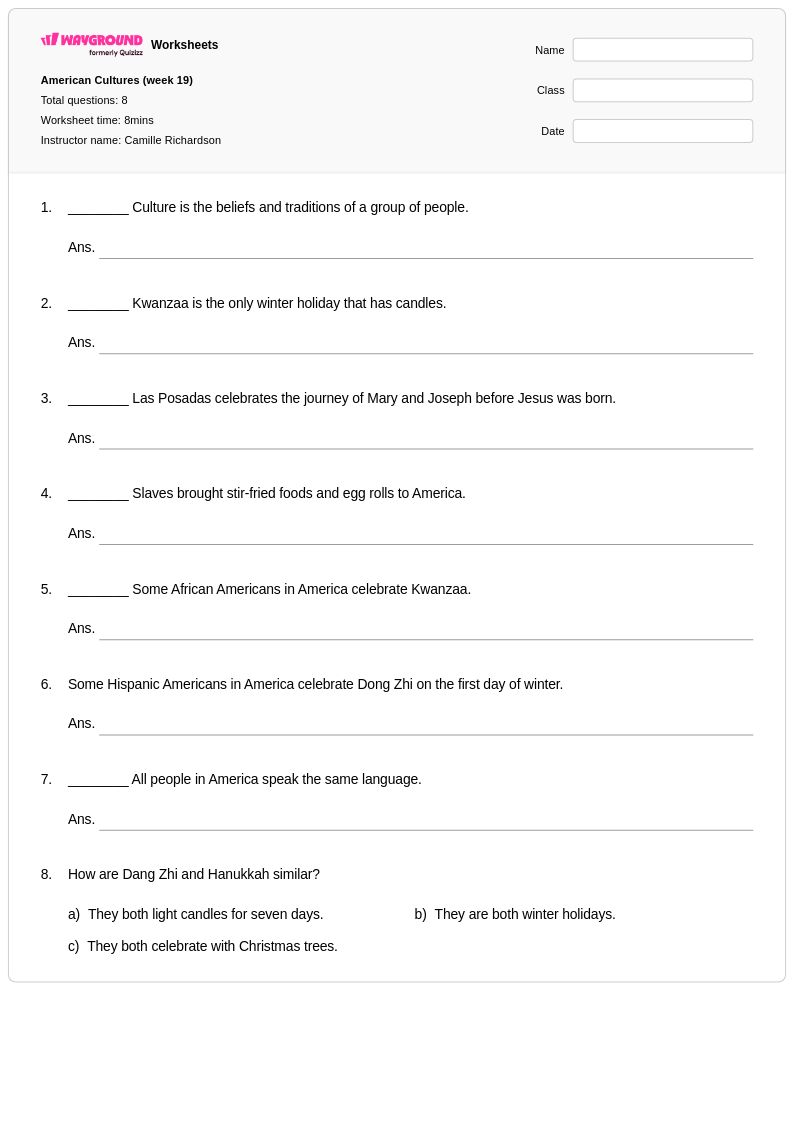
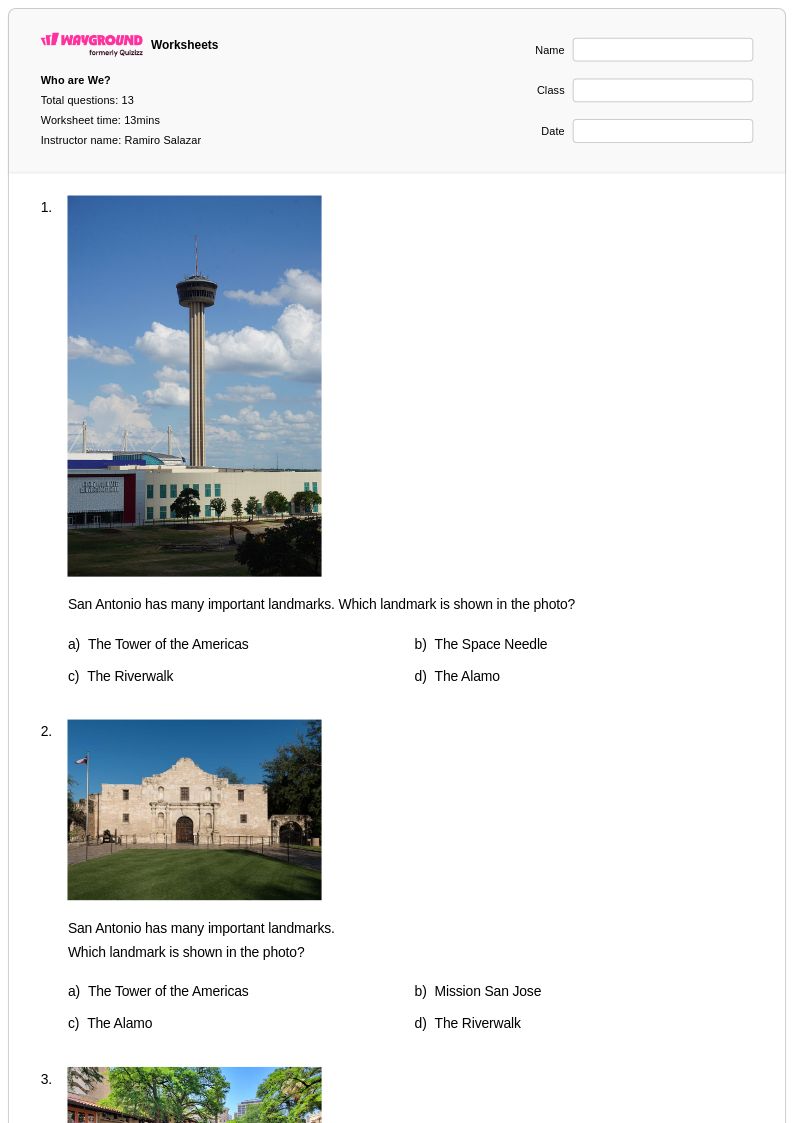
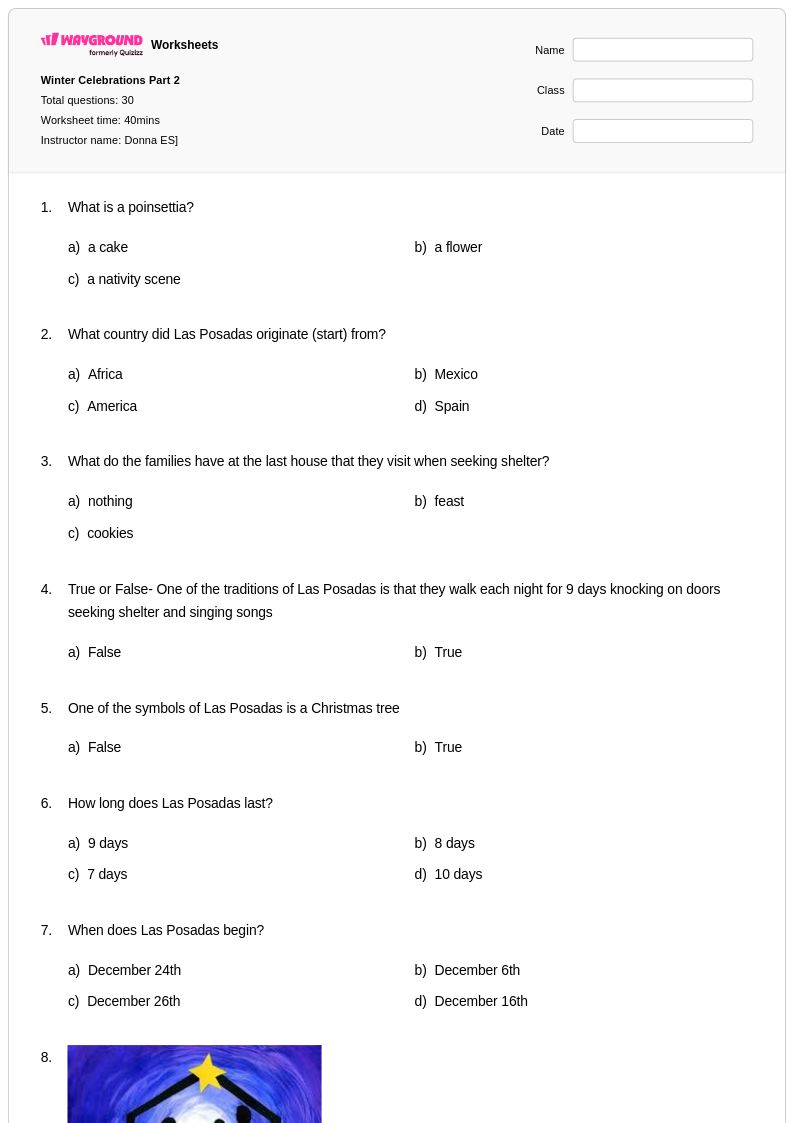
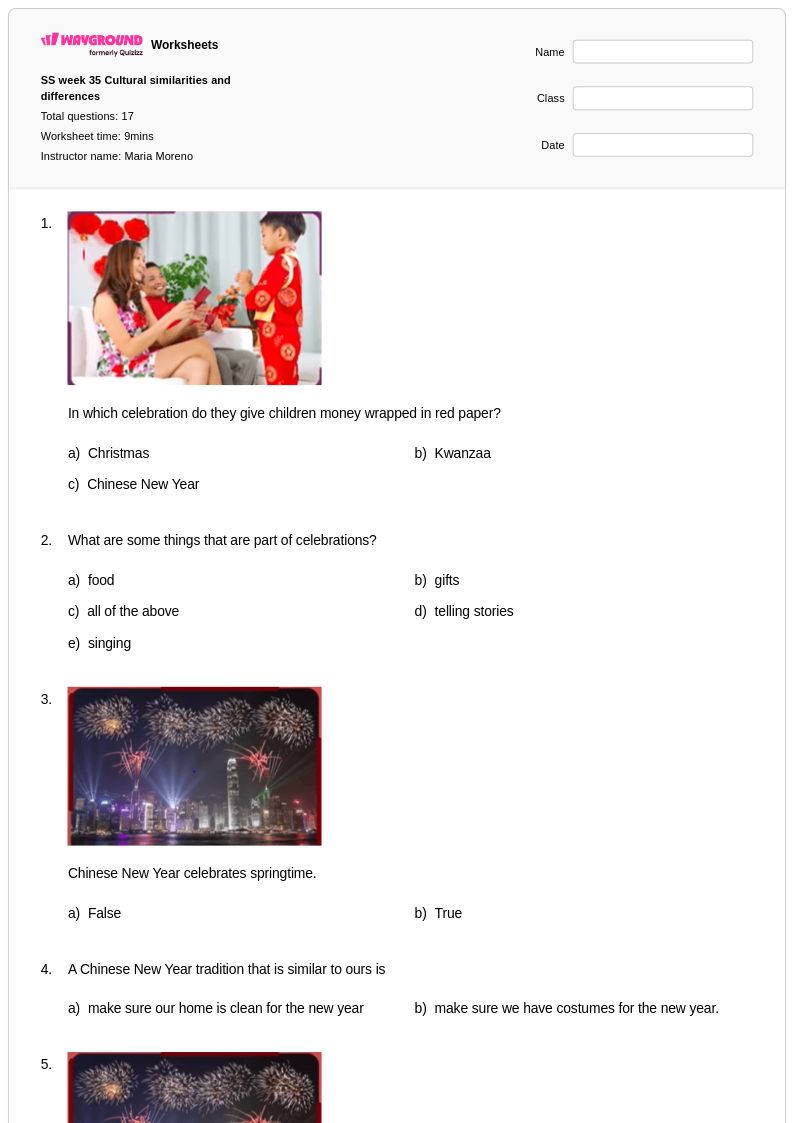
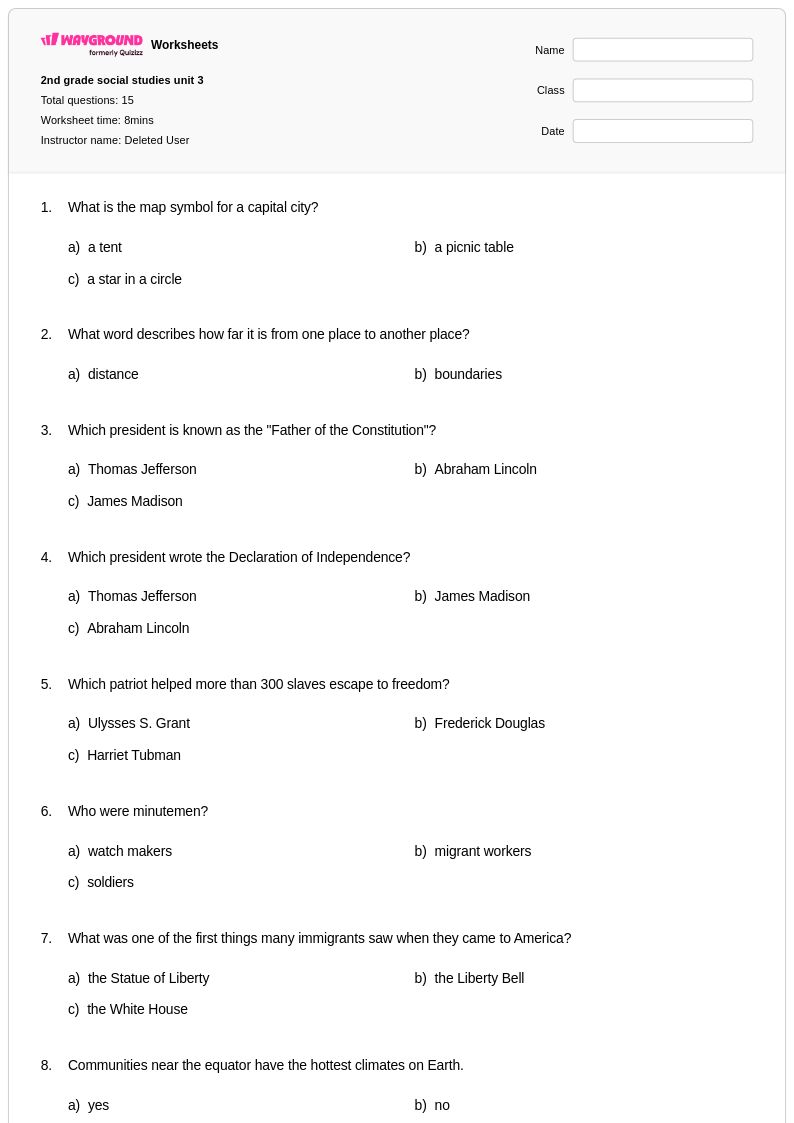
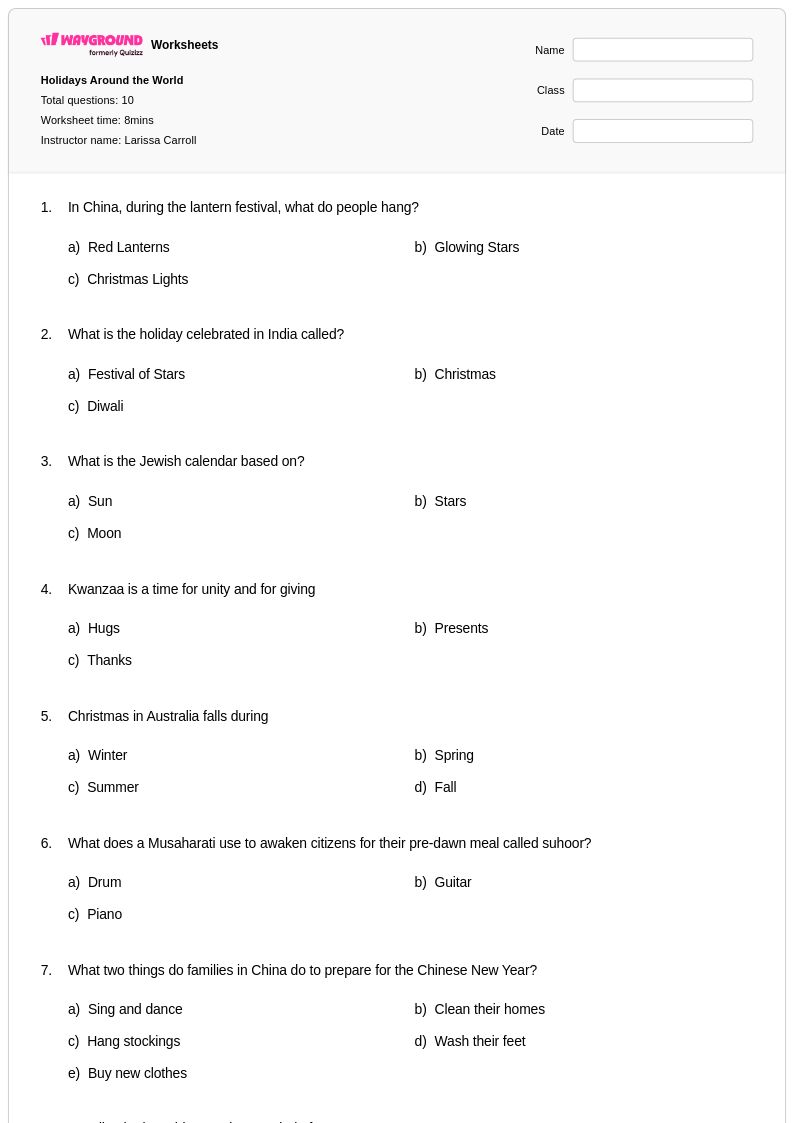
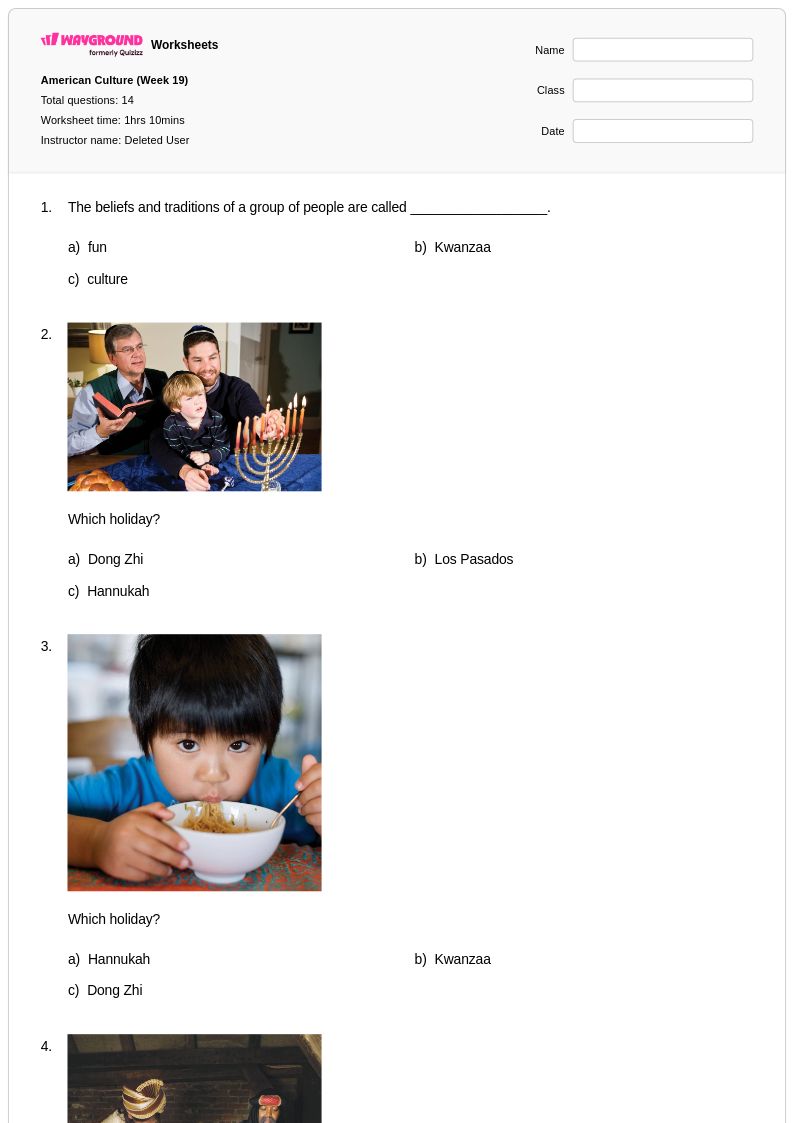
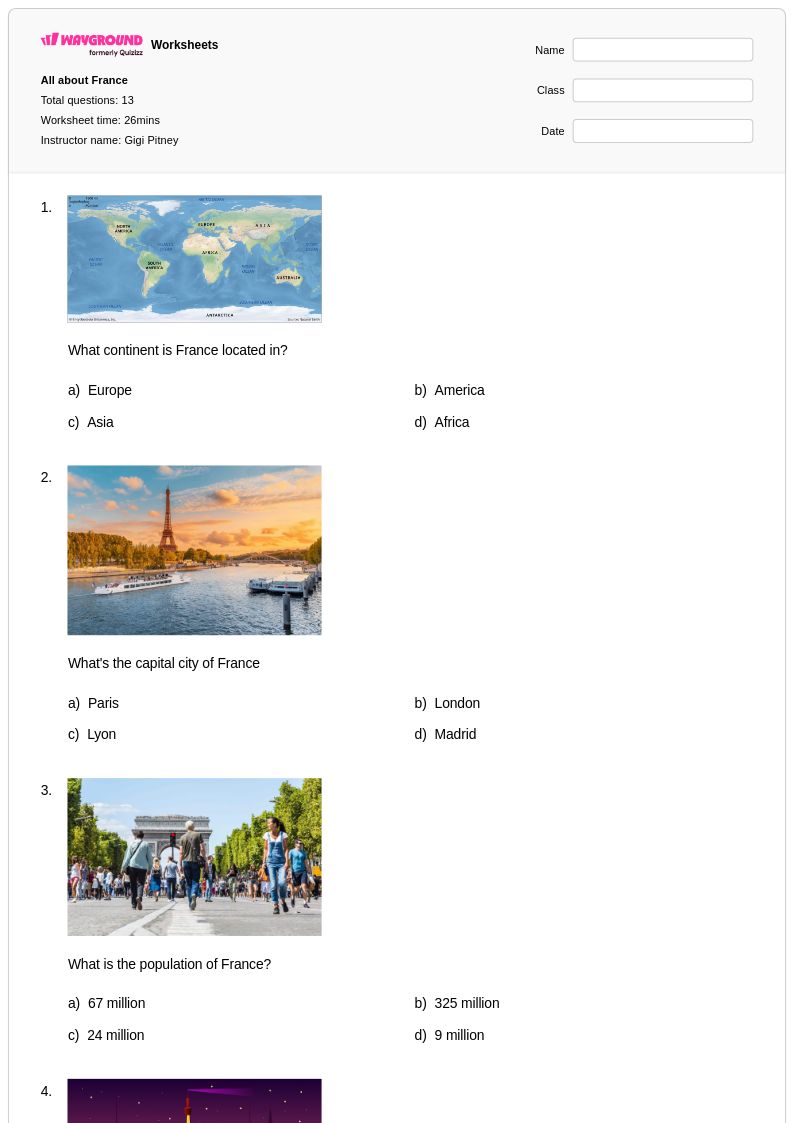
Explore Wayground's free Year 2 Kwanzaa worksheets and printables that help students discover the traditions, principles, and cultural significance of this important African-American celebration through engaging practice problems with answer keys.
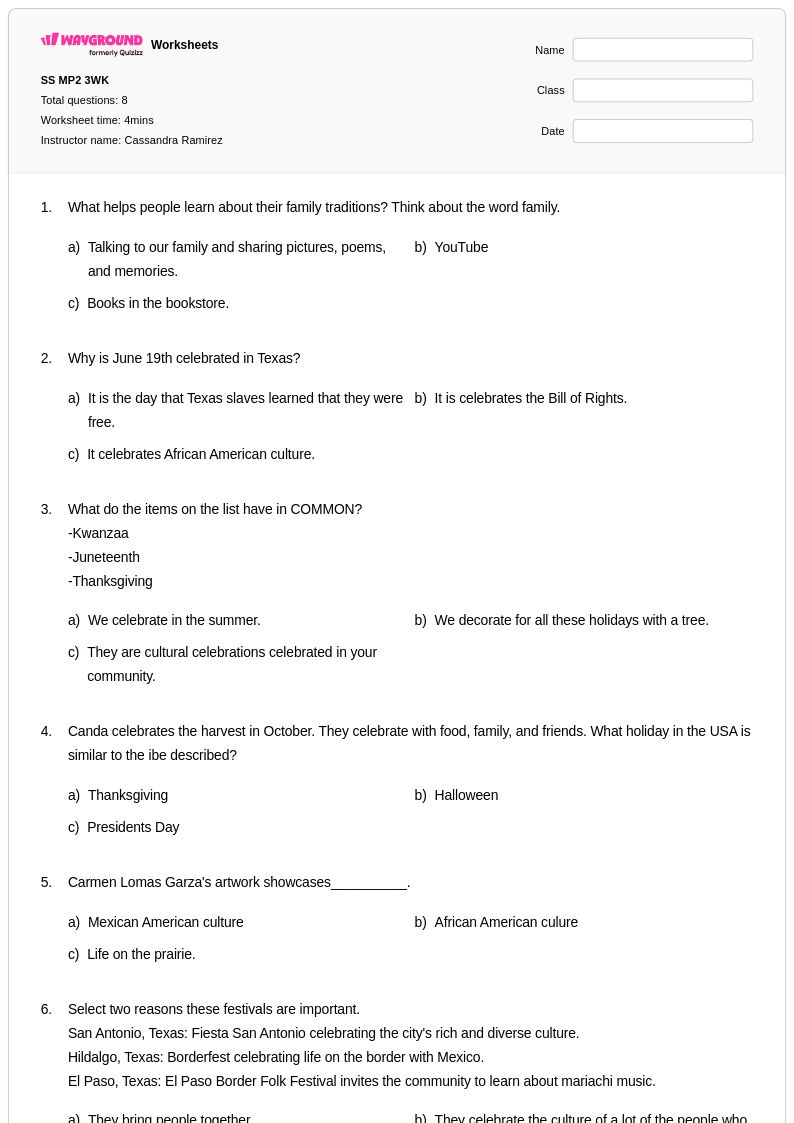
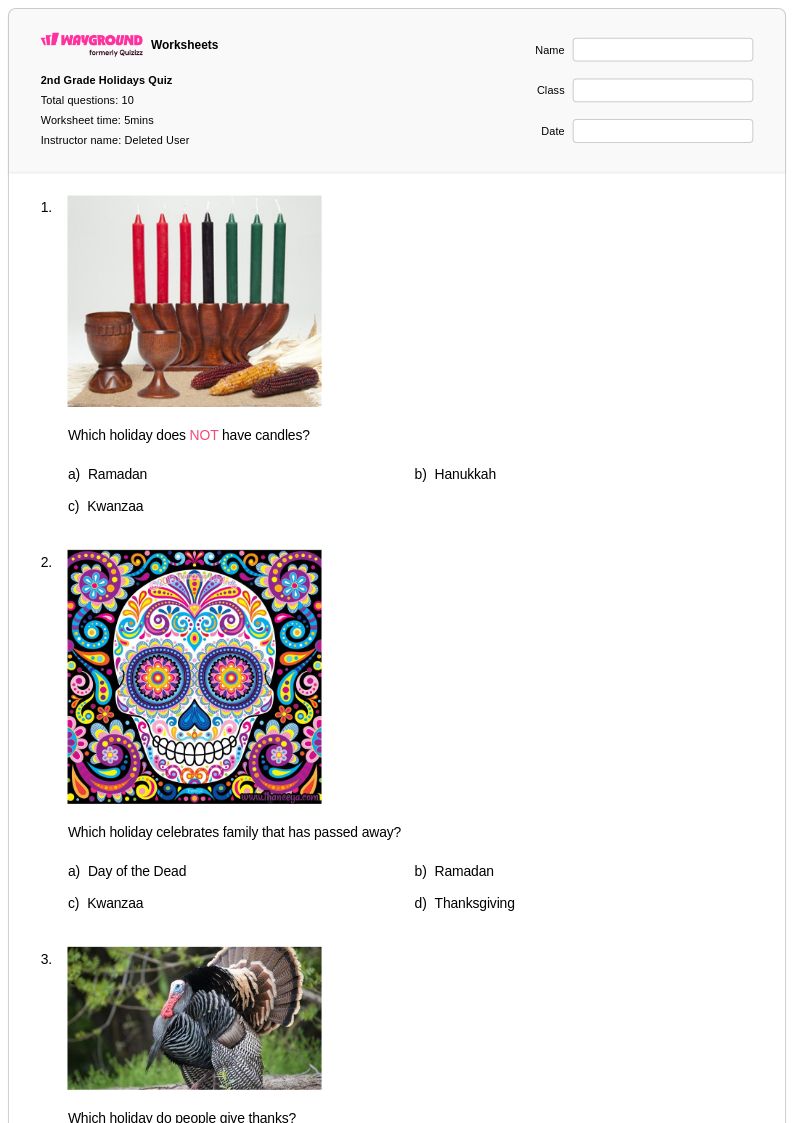
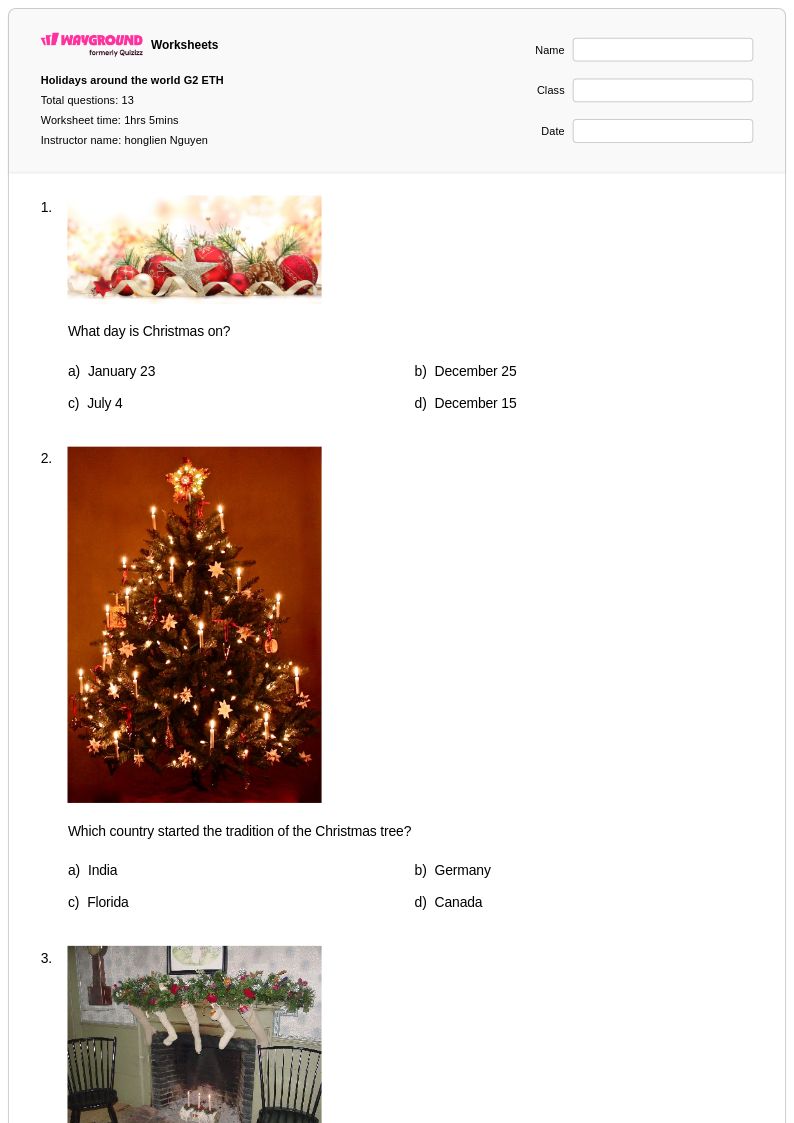
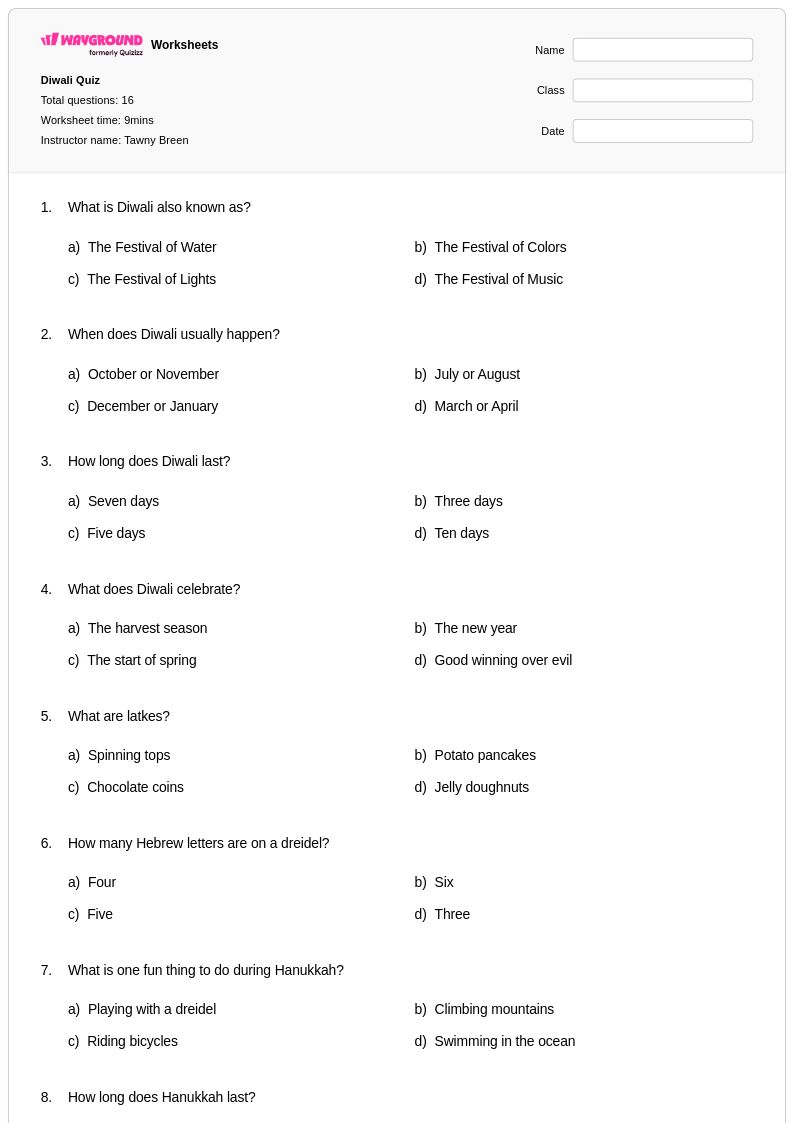
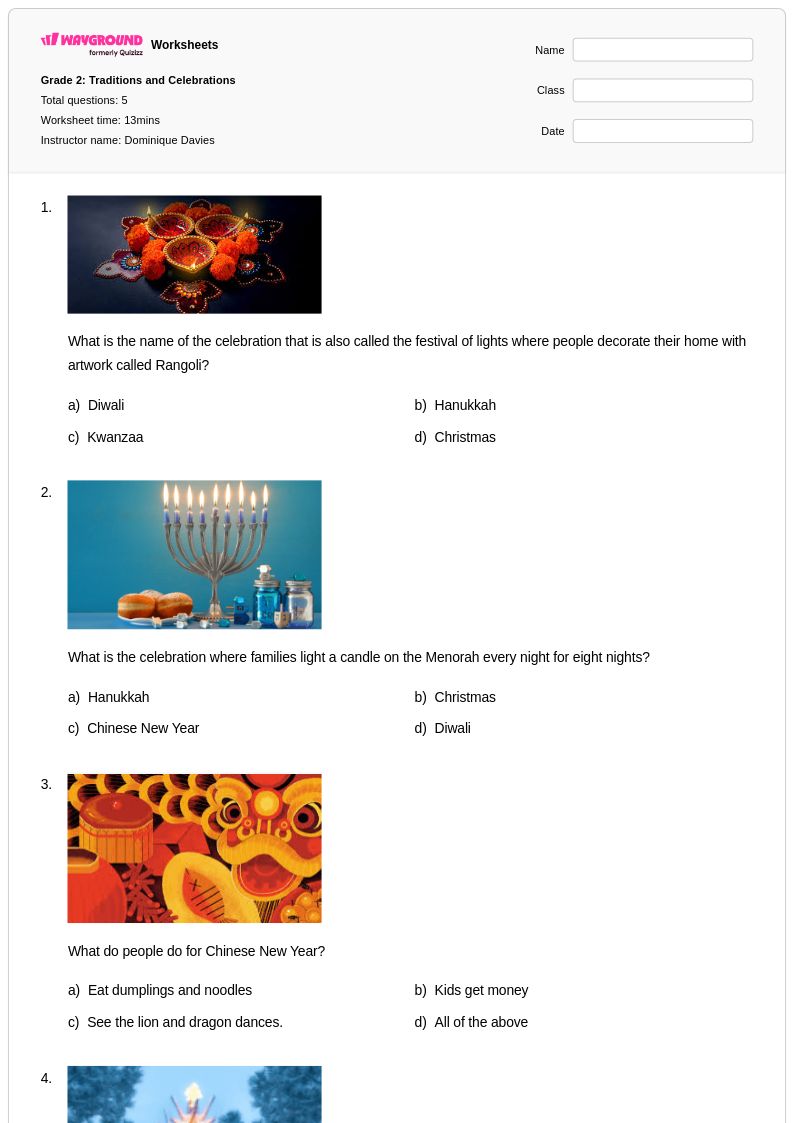
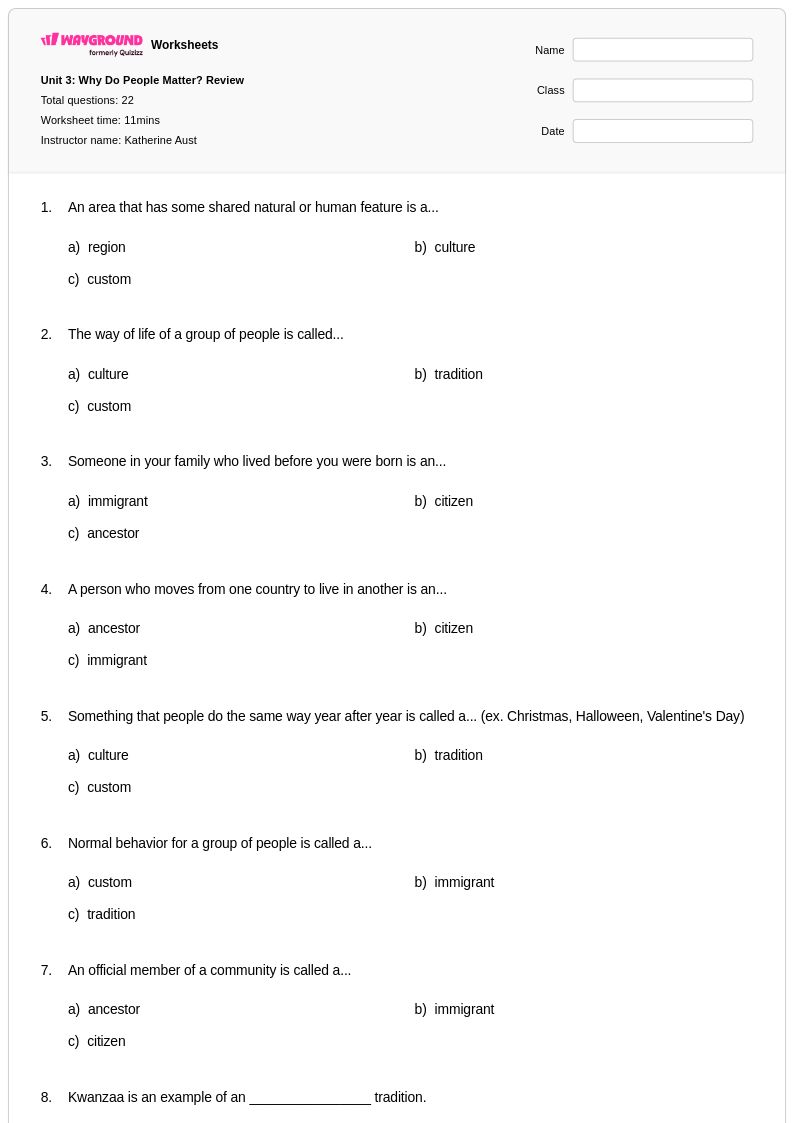
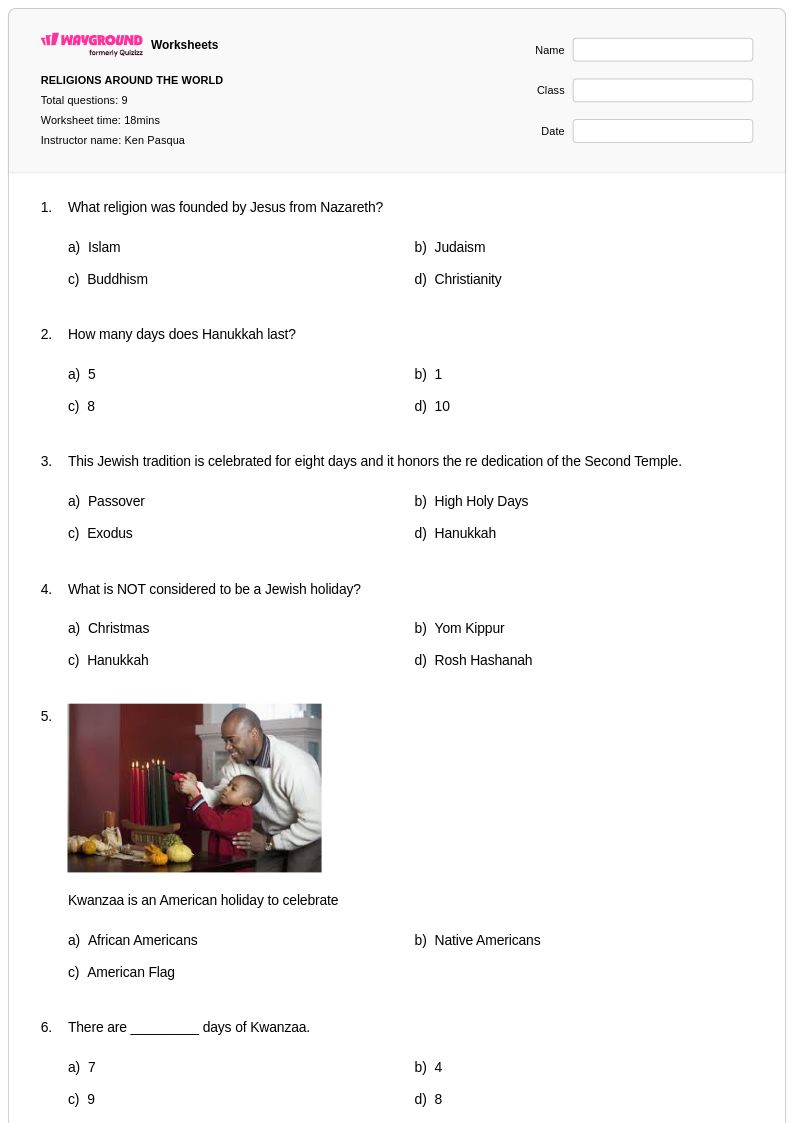
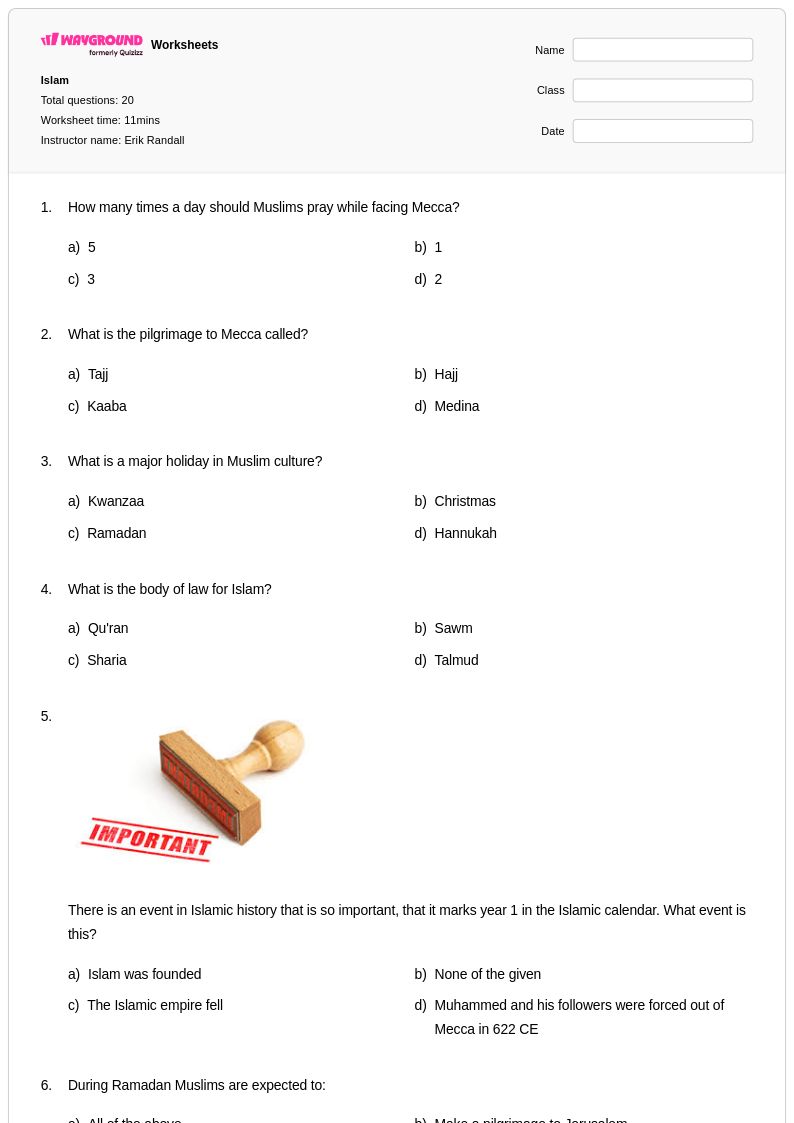
Kwanzaa worksheets for Year 2 students available through Wayground (formerly Quizizz) provide young learners with engaging opportunities to explore this important African-American cultural celebration and its seven core principles. These carefully designed educational resources help second-grade students develop cultural awareness, reading comprehension, and critical thinking skills as they learn about Kwanzaa's history, symbols, and traditions. The worksheet collection includes interactive practice problems that guide students through understanding the meaning of each Kwanzaa principle, identifying traditional symbols like the kinara and mkeka, and exploring how families celebrate this meaningful holiday. Teachers can access comprehensive answer keys and free printable materials that support diverse learning needs, making these pdf resources ideal for both classroom instruction and independent practice sessions.
Wayground (formerly Quizizz) empowers educators with access to millions of teacher-created resources specifically designed for Year 2 social studies instruction, including extensive Kwanzaa-focused materials that align with community and cultures curriculum standards. The platform's robust search and filtering capabilities allow teachers to quickly locate age-appropriate worksheets that match their specific lesson objectives and student skill levels. These differentiation tools enable educators to customize content for diverse learners, offering both remediation support for struggling students and enrichment opportunities for advanced learners. Available in both printable and digital formats, including convenient pdf downloads, these resources streamline lesson planning while providing flexible options for skill practice, cultural education, and meaningful holiday learning experiences that celebrate diversity and promote cultural understanding in the elementary classroom.
FAQs
How do I teach Kwanzaa in the classroom?
Teaching Kwanzaa effectively starts with grounding students in its historical context — it was created in 1966 by Maulana Karenga as a way to honor African-American heritage and community values. From there, guide students through the seven principles of the Nguzo Saba, connecting each principle to real-world examples students can relate to. Pairing direct instruction with vocabulary work on key symbols like the kinara, mkeka, and unity cup helps students build both cultural awareness and content comprehension.
What worksheets or activities help students learn the seven principles of Kwanzaa?
Activities that ask students to match each Nguzo Saba principle — Umoja, Kujichagulia, Ujima, Ujamaa, Nia, Kuumba, and Imani — to its meaning and a real-life example are highly effective for building retention. Reading comprehension passages focused on individual principles, along with vocabulary exercises using Swahili terms, help reinforce both content knowledge and language skills. Reflection prompts that ask students to connect a principle to their own community experiences deepen personal engagement with the material.
What common misconceptions do students have about Kwanzaa?
A frequent misconception is that Kwanzaa is a religious holiday or a replacement for Christmas — it is a cultural celebration, not a religious one, and many families observe it alongside other December traditions. Students also sometimes confuse the African origins of the holiday's symbols with it being an African holiday, when in fact Kwanzaa is an African-American celebration rooted in Pan-African cultural values. Addressing these distinctions explicitly during instruction helps students develop a more accurate and respectful understanding.
How can I use Kwanzaa worksheets to build cultural competency in social studies?
Kwanzaa worksheets are a natural fit for social studies units on cultural diversity, community values, and African-American history. Use them to prompt discussion about how communities create and sustain traditions, and to help students recognize shared values across different cultural celebrations. Structured activities that ask students to analyze the symbolism behind Kwanzaa objects — like the seven candles of the kinara representing each principle — build critical thinking alongside cultural awareness.
How do I use Kwanzaa worksheets from Wayground in my classroom?
Kwanzaa worksheets on Wayground are available as printable PDFs for traditional classroom use and in digital formats for technology-integrated or distance learning environments, giving teachers flexibility in how they assign and deliver the material. Each worksheet collection includes answer keys, reducing prep time for educators. Teachers can also host worksheets as a quiz directly on Wayground, and platform tools allow individual accommodations — such as read aloud, extended time, or reduced answer choices — to be applied per student without disrupting the rest of the class.
How do I differentiate Kwanzaa instruction for students at different learning levels?
For students who need additional support, simplified vocabulary matching activities and illustrated symbol identification tasks lower the entry point without removing cultural content. Advanced students benefit from analytical tasks that ask them to compare Kwanzaa principles to values found in other cultural traditions or to evaluate how the holiday's symbols reinforce its core message. On Wayground, teachers can apply individual accommodations such as read aloud for language learners or reduced answer choices for students who need less cognitive load, all without signaling differences to other students.