Free Printable Relationship Expectations Worksheets for Year 12
Explore our free Year 12 relationship expectations worksheets and printables that help students develop healthy interpersonal skills through engaging practice problems and comprehensive answer keys in PDF format.
Explore printable Relationship Expectations worksheets for Year 12
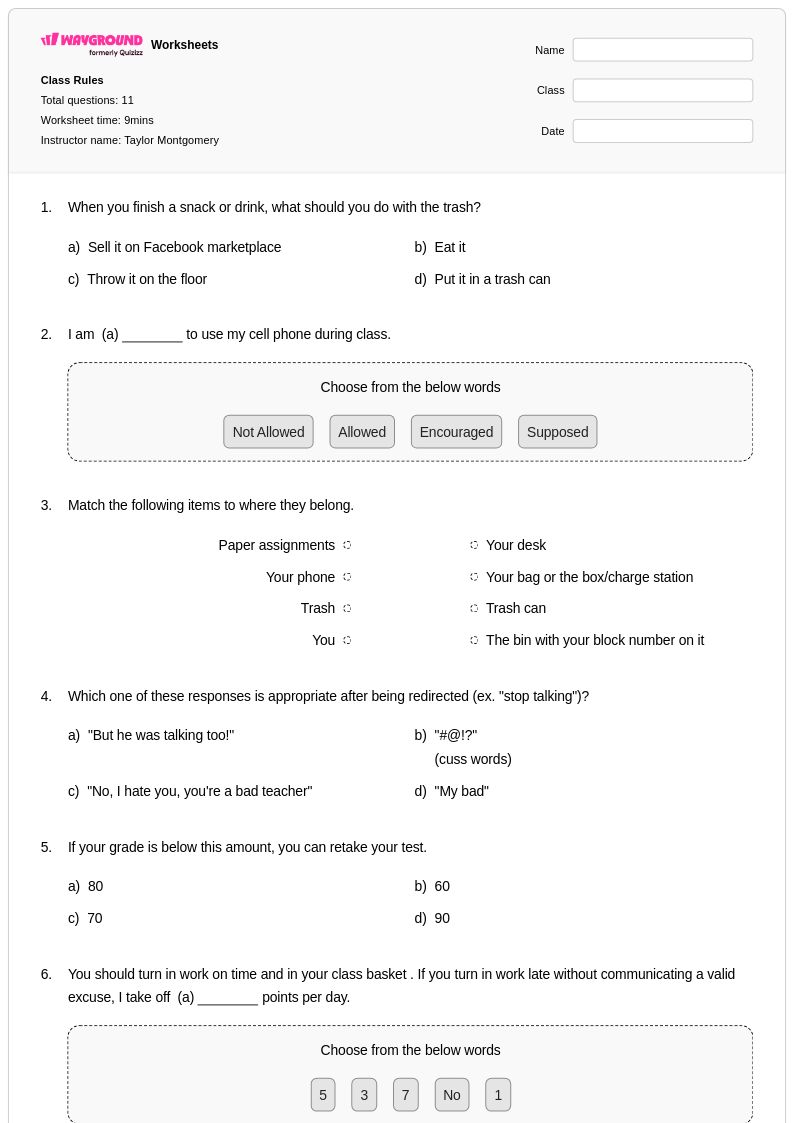
Relationship expectations worksheets for Year 12 social studies through Wayground provide essential practice for developing mature interpersonal skills that students need as they transition into adulthood. These comprehensive resources help students examine healthy relationship dynamics, establish appropriate boundaries, and understand the importance of mutual respect in various types of relationships including romantic partnerships, friendships, and professional connections. The worksheets feature realistic scenarios and practice problems that challenge students to analyze communication patterns, identify red flags in relationships, and develop strategies for maintaining healthy expectations. Each printable resource includes detailed answer keys that facilitate self-assessment and classroom discussions, while the free pdf format ensures accessibility for all students regardless of their technological resources.
Wayground's extensive collection of relationship expectations worksheets draws from millions of teacher-created resources that have been carefully curated to support Year 12 social studies instruction. The platform's advanced search and filtering capabilities allow educators to quickly locate materials that align with specific curriculum standards and learning objectives, while built-in differentiation tools enable teachers to customize content for students with varying skill levels and learning needs. These versatile resources are available in both printable and digital formats, making them ideal for traditional classroom settings, remote learning environments, or hybrid instructional models. Teachers can efficiently plan comprehensive units on healthy relationships, create targeted remediation materials for students who need additional support, and develop enrichment activities that challenge advanced learners to explore complex relationship dynamics and ethical considerations.
FAQs
How do I teach relationship expectations to students?
Teaching relationship expectations works best when students can examine real-world scenarios and reflect on their own experiences. Start by establishing shared vocabulary around boundaries, mutual respect, and communication, then use structured activities that ask students to evaluate specific relationship situations. Grounding lessons in social-emotional learning frameworks helps students connect these concepts to their daily interactions with peers, family, and community members.
What activities help students practice identifying healthy vs. unhealthy relationship dynamics?
Scenario-based practice problems are among the most effective tools for this skill, as they require students to apply criteria rather than simply recall definitions. Worksheets that present realistic peer or family situations and ask students to identify patterns of mutual respect, communication, and boundary-setting give learners repeated, low-stakes opportunities to build judgment. Structured reflection prompts following each scenario deepen the learning by connecting the activity to students' own relationship contexts.
What misconceptions do students commonly have about relationship expectations?
A common misconception is that boundary-setting is confrontational or signals distrust, when in fact clear boundaries are a marker of a healthy relationship. Students also frequently confuse intensity of feeling with relationship quality, assuming that strong emotions automatically mean a relationship is positive. Worksheets that explicitly contrast healthy and unhealthy relationship patterns help students develop more nuanced frameworks for evaluation.
How can I use relationship expectations worksheets to support conflict resolution skills?
Relationship expectations worksheets that include conflict scenarios ask students to identify the communication breakdown, consider each party's perspective, and propose resolution strategies, directly building conflict resolution competency. Using these worksheets as guided instruction tools allows teachers to facilitate class discussion around student responses before moving to independent practice. Repeated exposure to structured conflict scenarios helps students internalize strategies they can apply in real interactions.
How do I use relationship expectations worksheets in my classroom?
Relationship expectations worksheets from Wayground are available as printable PDFs for traditional classroom use and in digital formats for technology-integrated environments, giving teachers flexibility for in-class instruction, homework, or remediation. Teachers can also host these worksheets as a quiz directly on Wayground, enabling interactive digital completion with built-in answer key support. Each worksheet includes an answer key, making them suitable for both independent student work and guided whole-class instruction.
How can I differentiate relationship expectations worksheets for students with diverse learning needs?
Wayground's accommodation tools allow teachers to apply individualized settings such as read aloud, extended time, reduced answer choices, and adjustable reading modes to specific students without disrupting the experience for the rest of the class. These settings can be configured from the Students tab or session settings page and are saved for reuse across future assignments. This makes it practical to support students with different literacy levels or processing needs within the same relationship expectations unit.