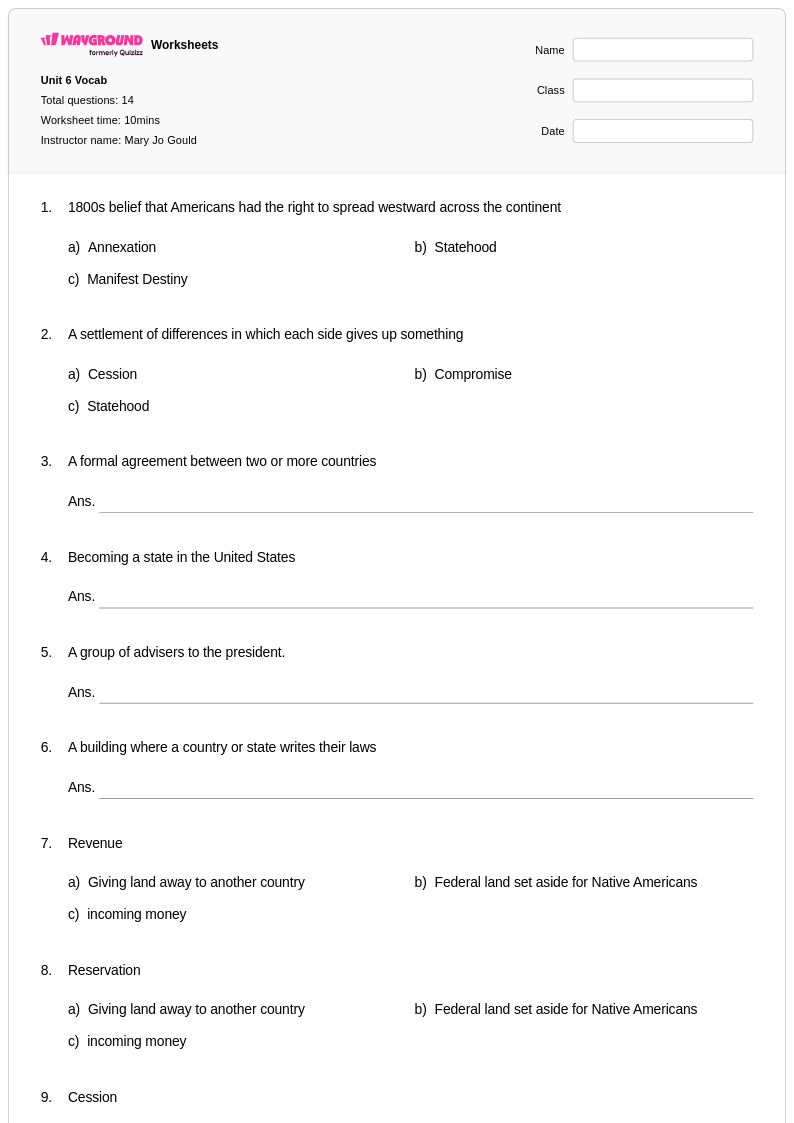
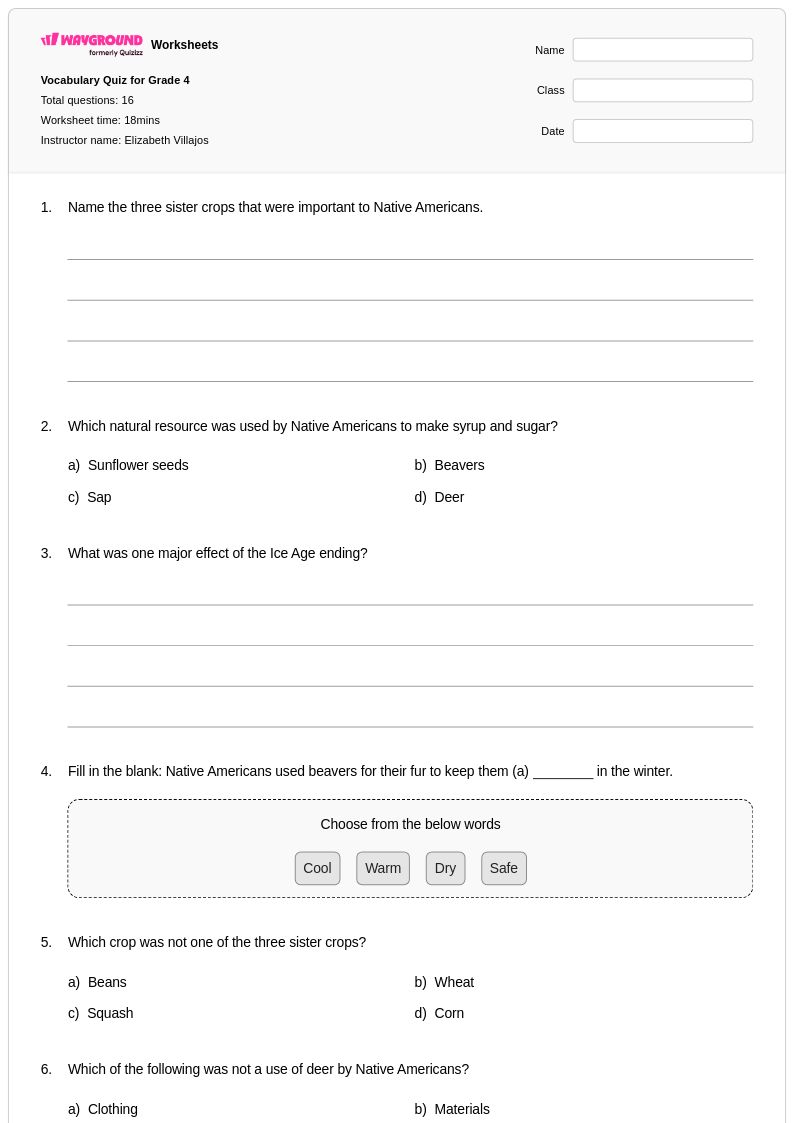
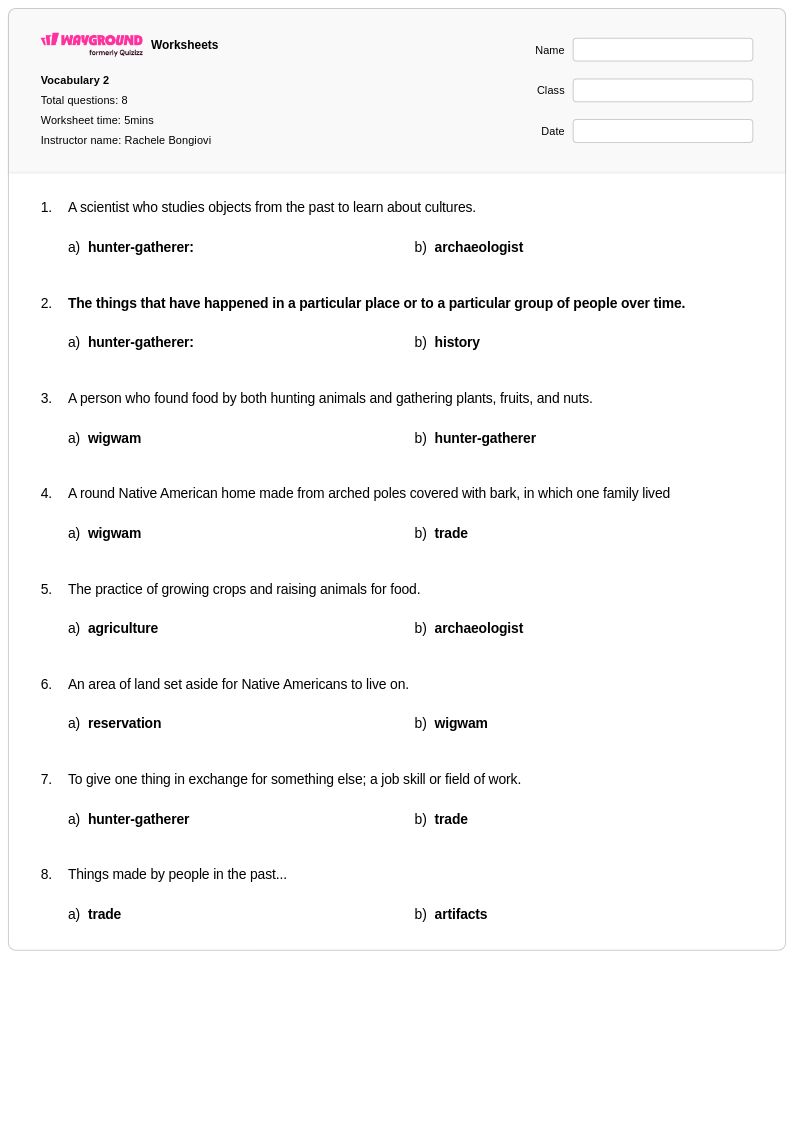
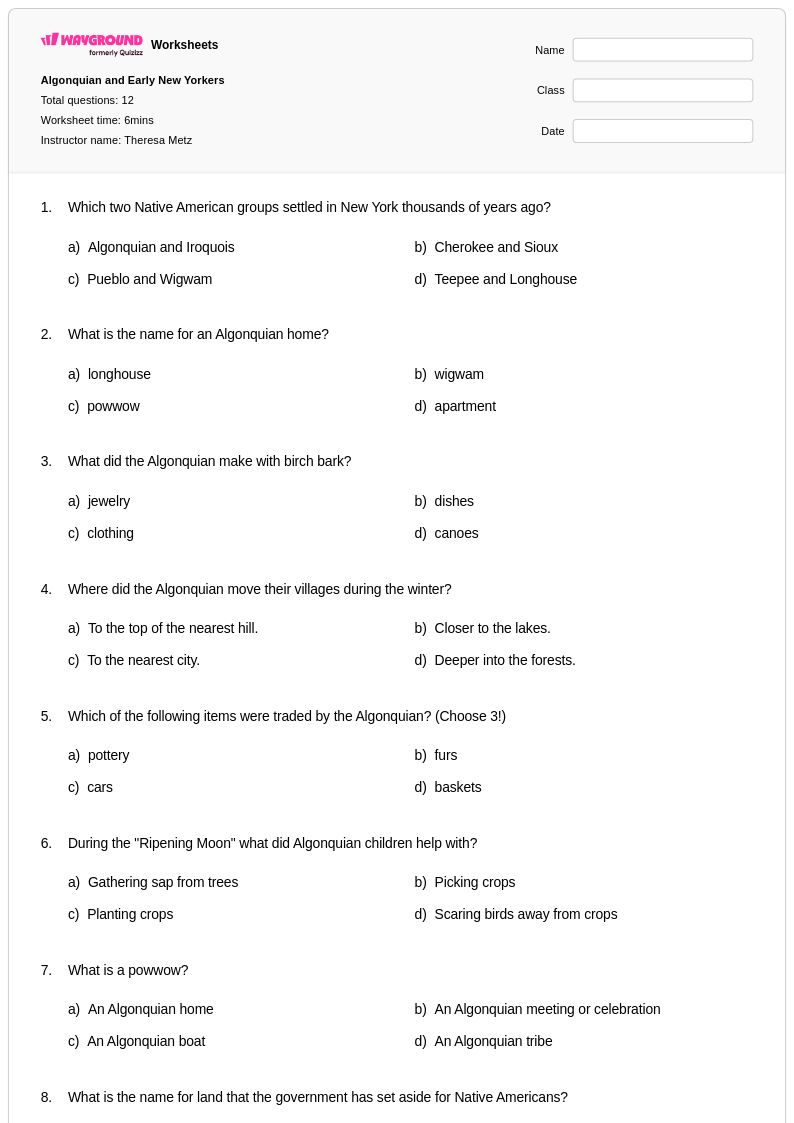
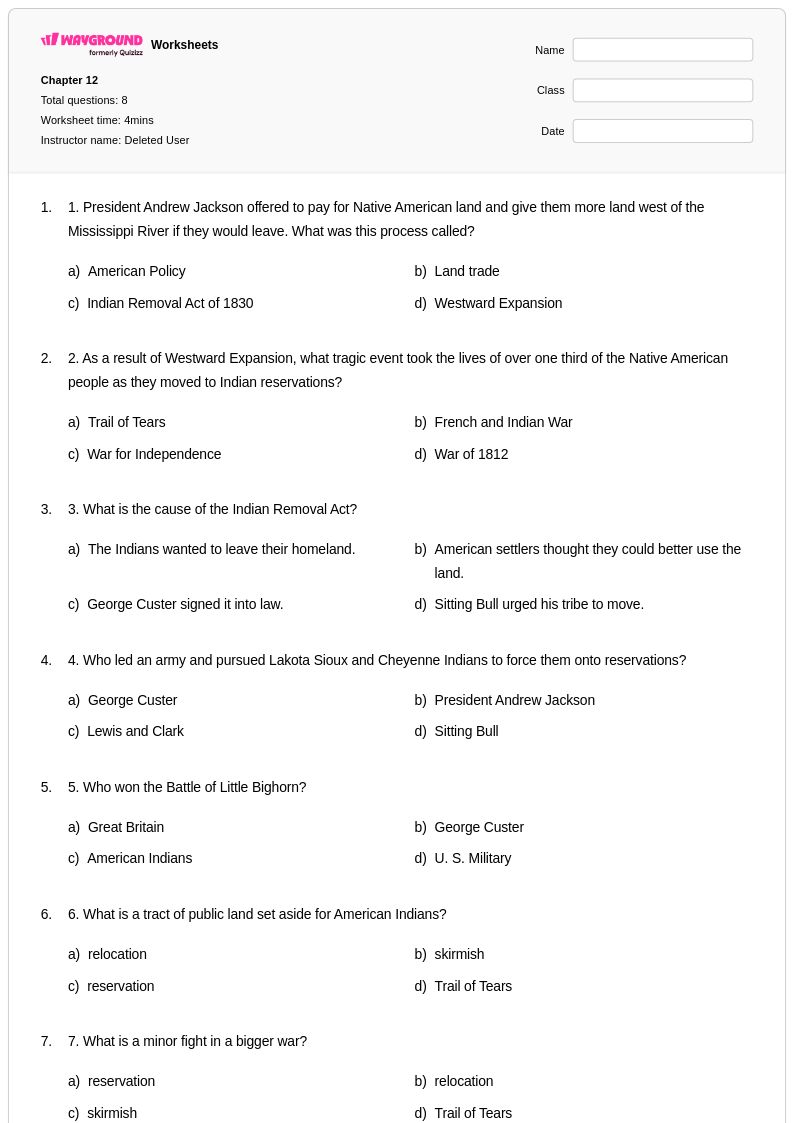
Year 4 reservation worksheets and printables help students explore Native American communities, tribal cultures, and historical perspectives through engaging social studies practice problems with comprehensive answer keys.
Explore printable Reservation worksheets for Year 4
Reservation worksheets for Year 4 students through Wayground (formerly Quizizz) provide comprehensive educational resources that explore Native American reservations as vital components of community and cultural studies. These carefully designed worksheets strengthen students' understanding of reservation systems, tribal sovereignty, cultural preservation, and the historical context surrounding Native American communities in the United States. Students engage with practice problems that develop critical thinking skills about geography, government structures, and cultural traditions while building empathy and respect for diverse communities. Each worksheet collection includes detailed answer keys to support accurate learning assessment, and teachers can access these valuable resources as free printables in convenient PDF format for seamless classroom integration.
Wayground (formerly Quizizz) empowers educators with millions of teacher-created resources specifically focused on reservation studies and broader community and culture topics, featuring robust search and filtering capabilities that help teachers quickly locate grade-appropriate materials. The platform's standards alignment ensures that worksheet collections meet educational requirements while offering sophisticated differentiation tools that accommodate diverse learning needs within the same classroom. Teachers benefit from flexible customization options that allow them to modify content for specific lesson objectives, whether for remediation support or enrichment activities. Available in both printable and digital formats including downloadable PDFs, these comprehensive worksheet collections streamline lesson planning while providing targeted skill practice that deepens students' appreciation for Native American communities and their enduring cultural contributions to American society.
FAQs
How do I teach Native American reservations to students?
Teaching Native American reservations effectively requires grounding students in the historical context of treaty negotiations, westward expansion, and federal Indian policy before moving into contemporary governance and cultural issues. Start with primary source documents such as treaties and congressional acts to help students understand how reservations were legally established and what rights tribal nations retained. From there, build toward discussions of tribal sovereignty, cultural preservation, and the ongoing relationship between tribal nations and the federal government. Framing reservation history as an ongoing and evolving story, rather than a historical endpoint, helps students develop more accurate and respectful perspectives.
What exercises help students practice understanding Native American reservation history and culture?
Effective practice exercises for reservation topics include analyzing historical timelines of federal Indian policy, comparing treaty language with actual outcomes, and examining case studies of specific tribal nations across different regions. Document-based questions that ask students to evaluate primary sources, such as treaty excerpts or tribal governance documents, build critical thinking alongside content knowledge. Structured activities that ask students to connect historical events like the Dawes Act or Indian Reorganization Act to their long-term consequences on reservation communities help reinforce cause-and-effect reasoning skills.
What misconceptions do students commonly have about Native American reservations?
A common misconception is that reservations are simply land grants given to Native Americans by the government, when in fact most reservations represent remnants of much larger territories that tribes were forced to cede through treaties or federal policy. Students also frequently misunderstand tribal sovereignty, assuming reservation communities fall entirely under state jurisdiction rather than operating as distinct governmental entities with their own legal authority. Another persistent error is treating Native American cultures and reservation experiences as uniform, when in reality there is significant diversity across hundreds of tribal nations, each with distinct histories, governance structures, and cultural practices.
How can I use reservation worksheets to support students with different learning needs?
Reservation worksheets on Wayground are available as printable PDFs for traditional classroom use and in digital formats for technology-integrated environments, including the option to host them as a quiz on Wayground. For students who need additional support, Wayground's accommodation tools allow teachers to enable Read Aloud so questions and content are read to students, or to apply extended time on a per-student basis without disrupting the rest of the class. Reduced answer choices can also be activated for selected students to lower cognitive load when working through complex historical content. These settings are saved and reusable across future sessions, making differentiation manageable even for large and diverse classrooms.
How do I connect reservation history to broader social studies standards?
Reservation history connects directly to social studies standards covering civics, geography, U.S. history, and cultural competency. Teachers can frame reservation topics within units on constitutional government by exploring tribal sovereignty and federal trust responsibilities, or within geography units by examining how reservation boundaries shaped settlement patterns and resource access. Cultural competency objectives are well served by activities that ask students to investigate how reservation communities actively maintain cultural identities, languages, and governance traditions in contemporary contexts.