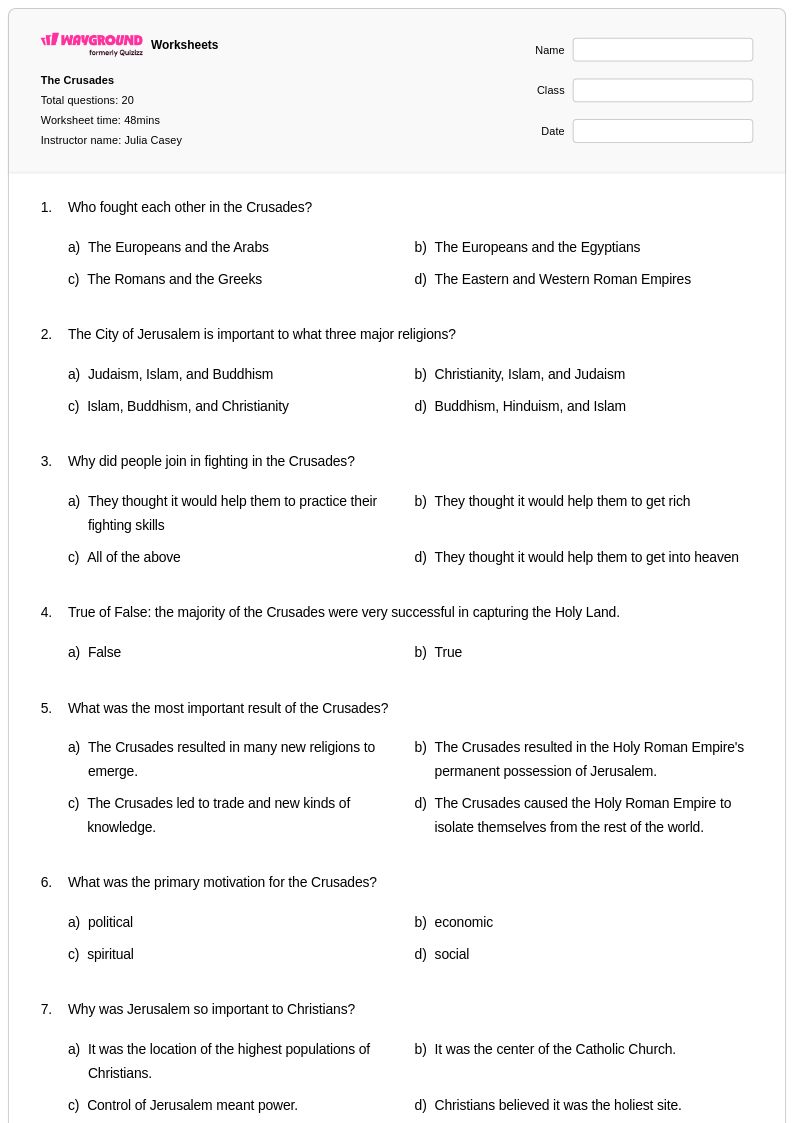
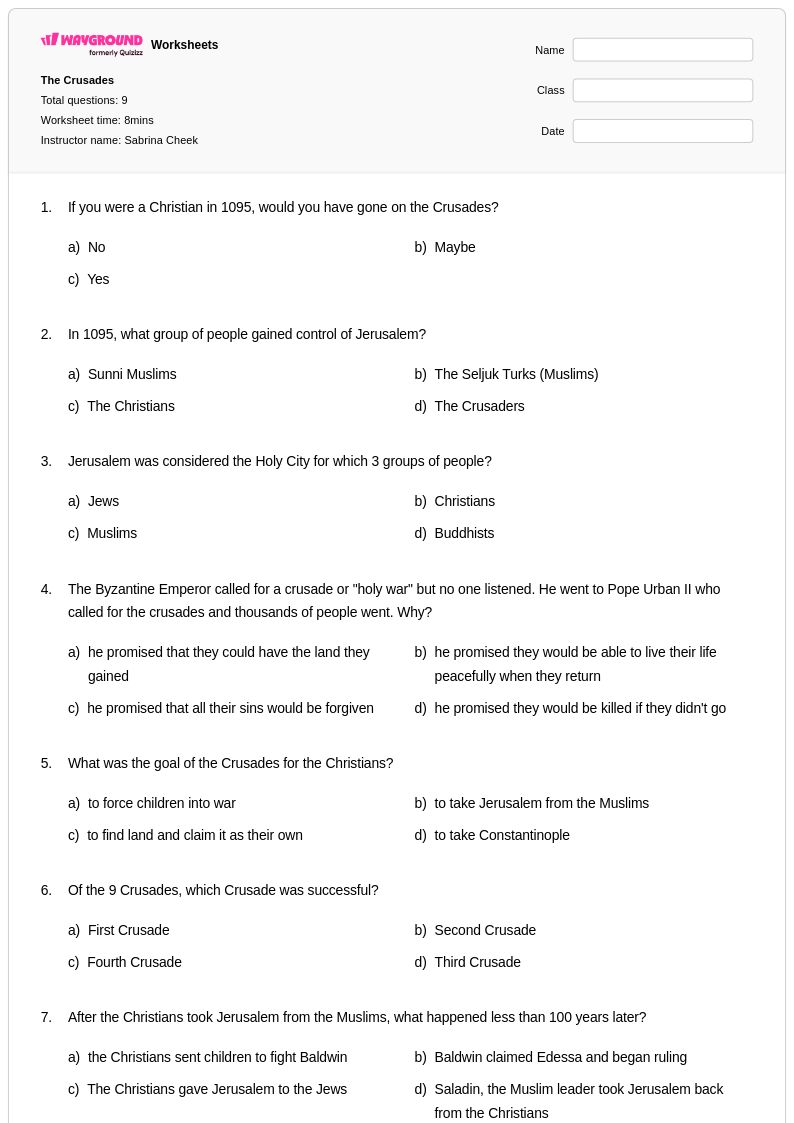
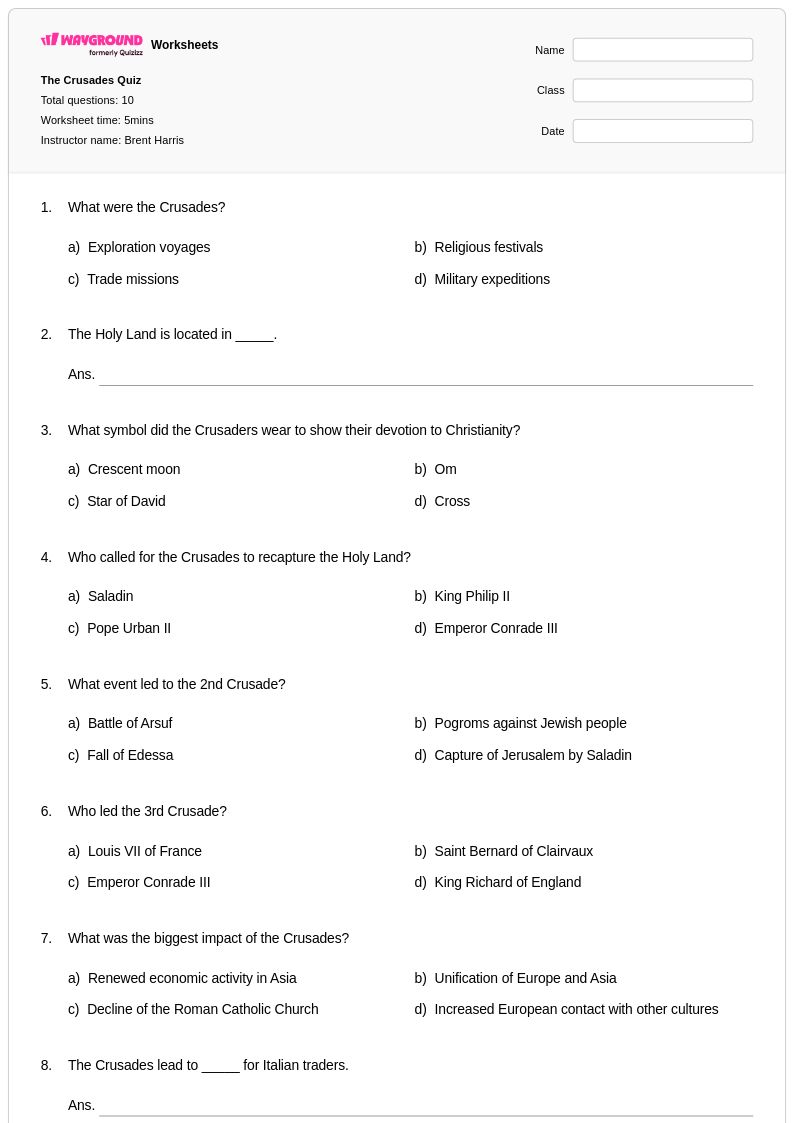
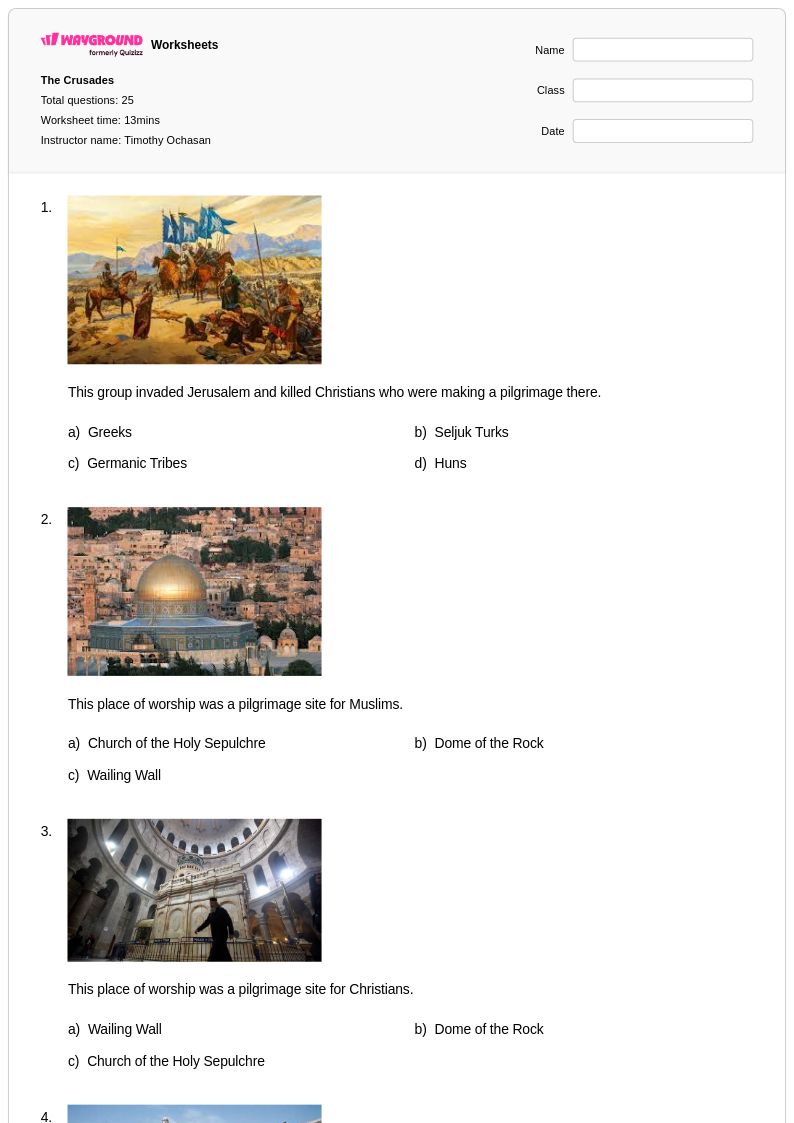
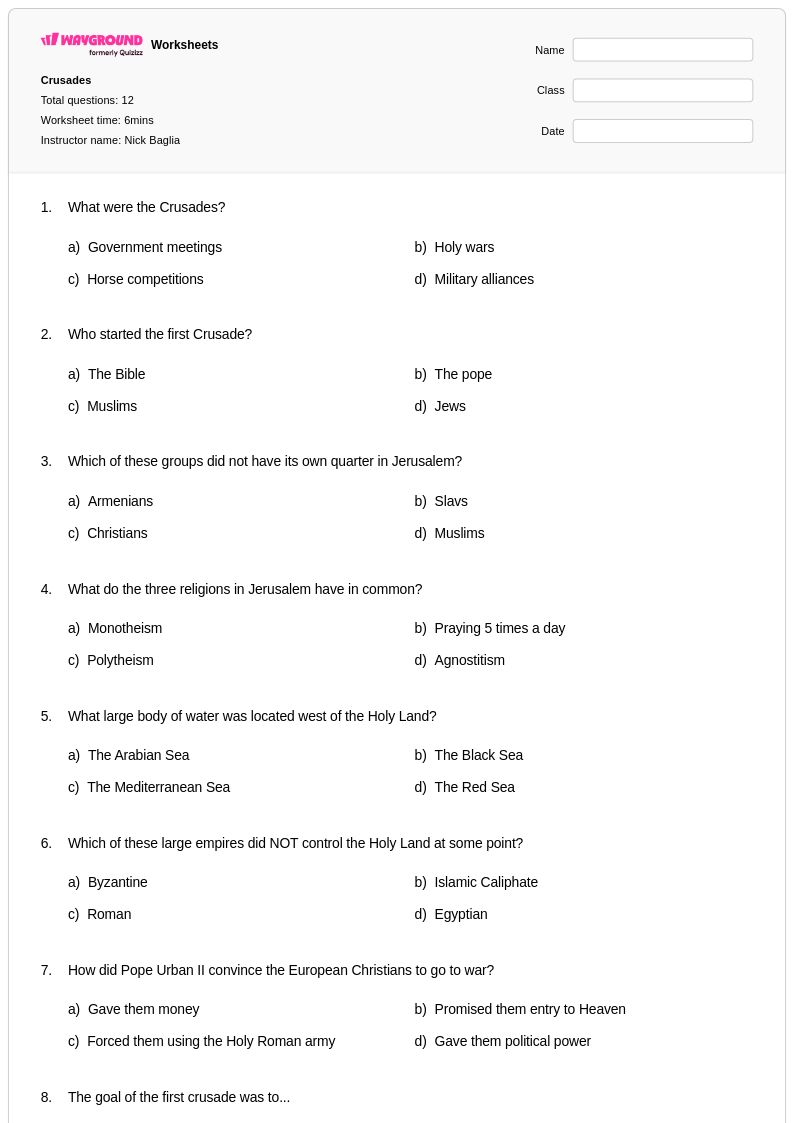
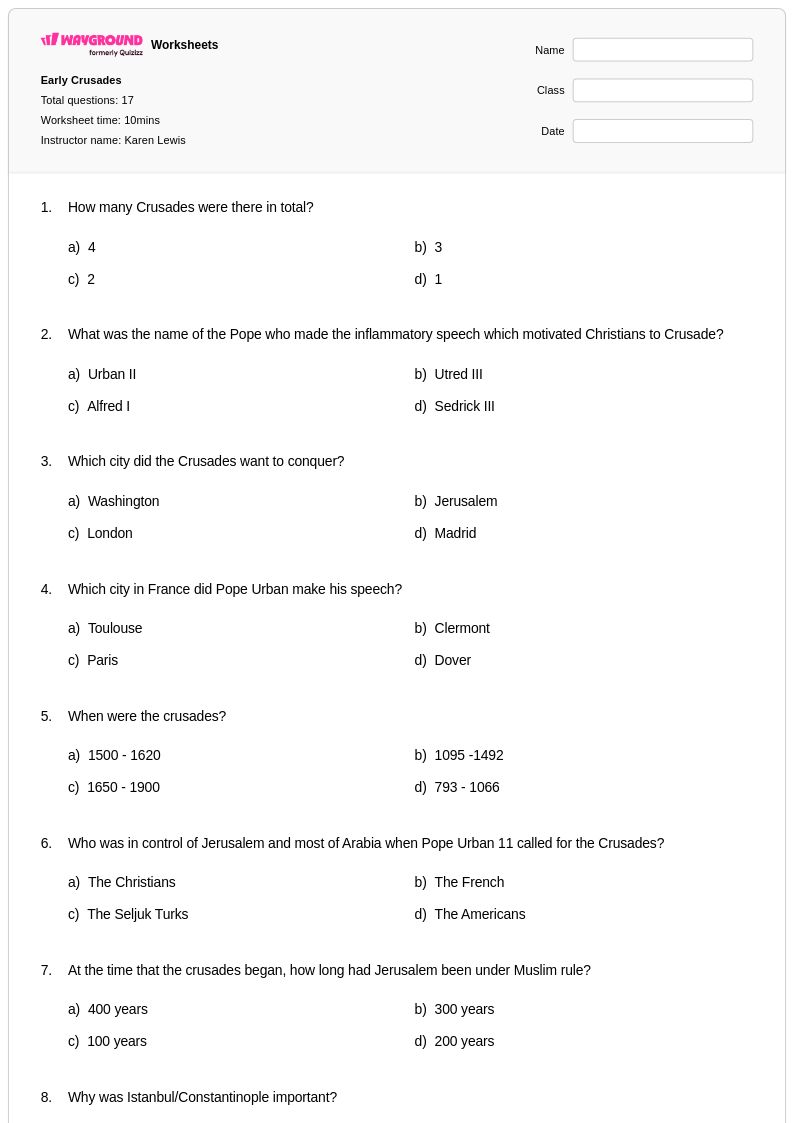
Explore Wayground's comprehensive collection of free Crusades worksheets and printables that help students analyze medieval religious wars, key battles, and historical impacts through engaging practice problems with answer keys.
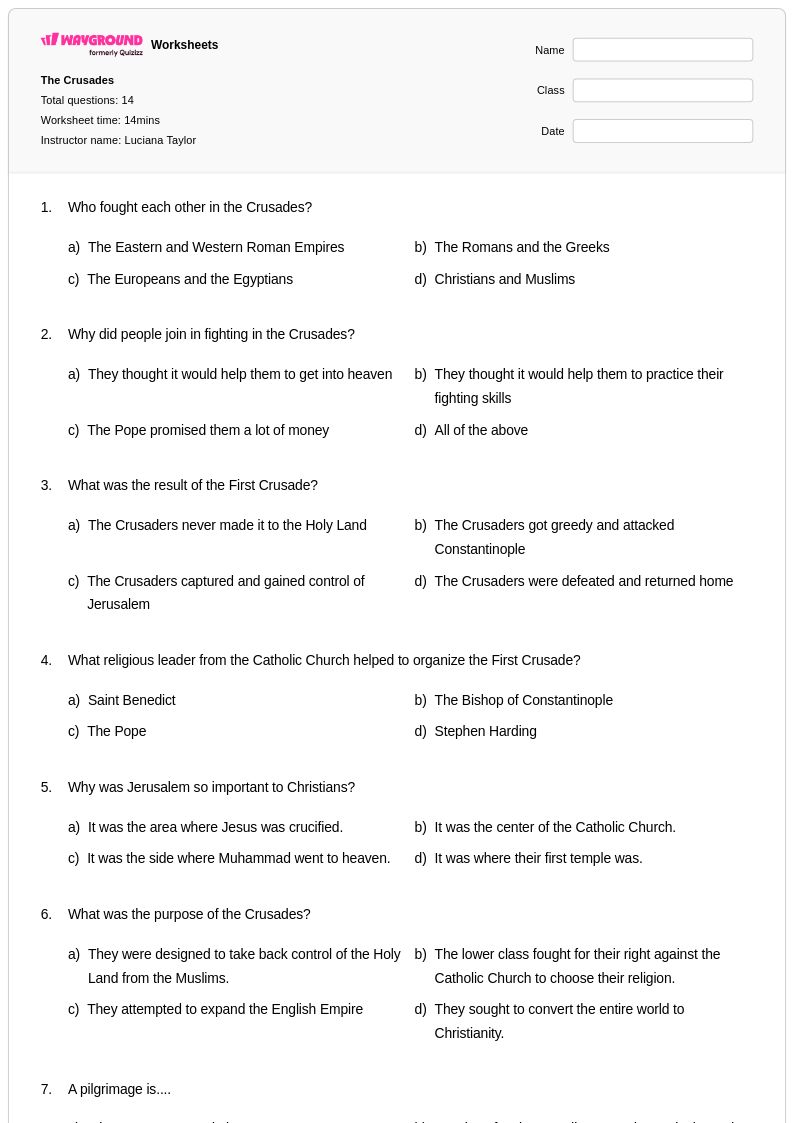
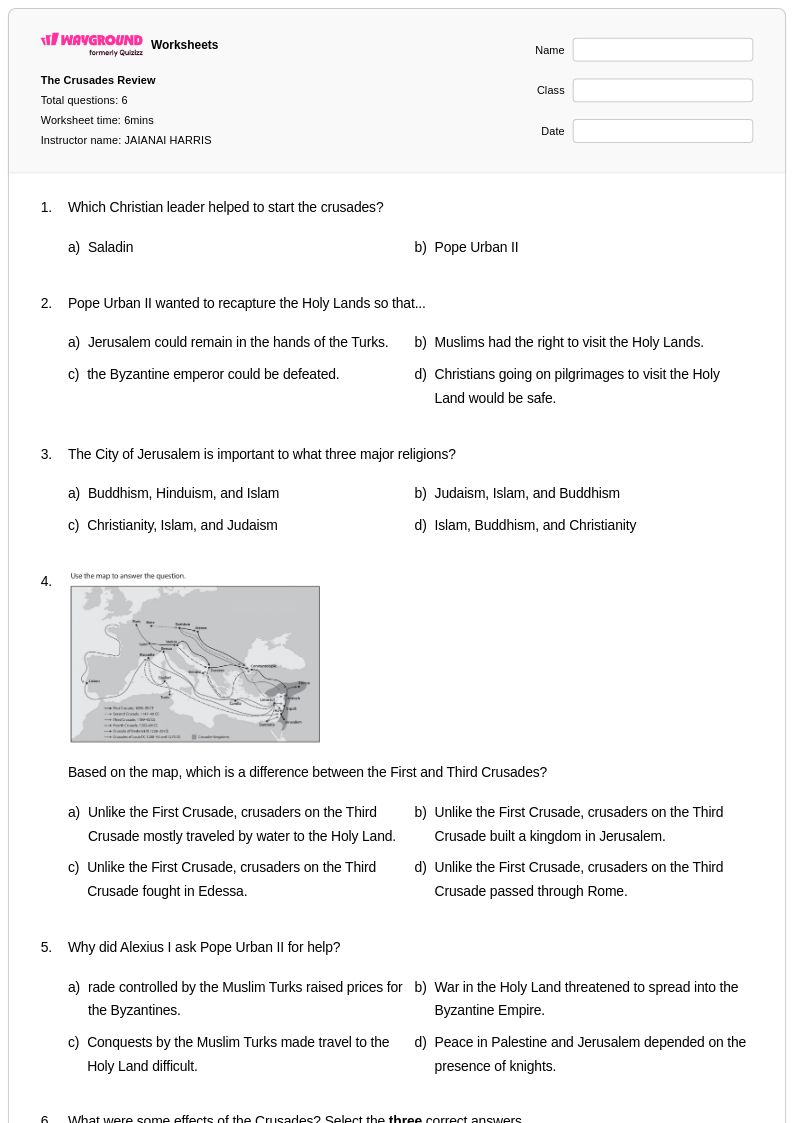
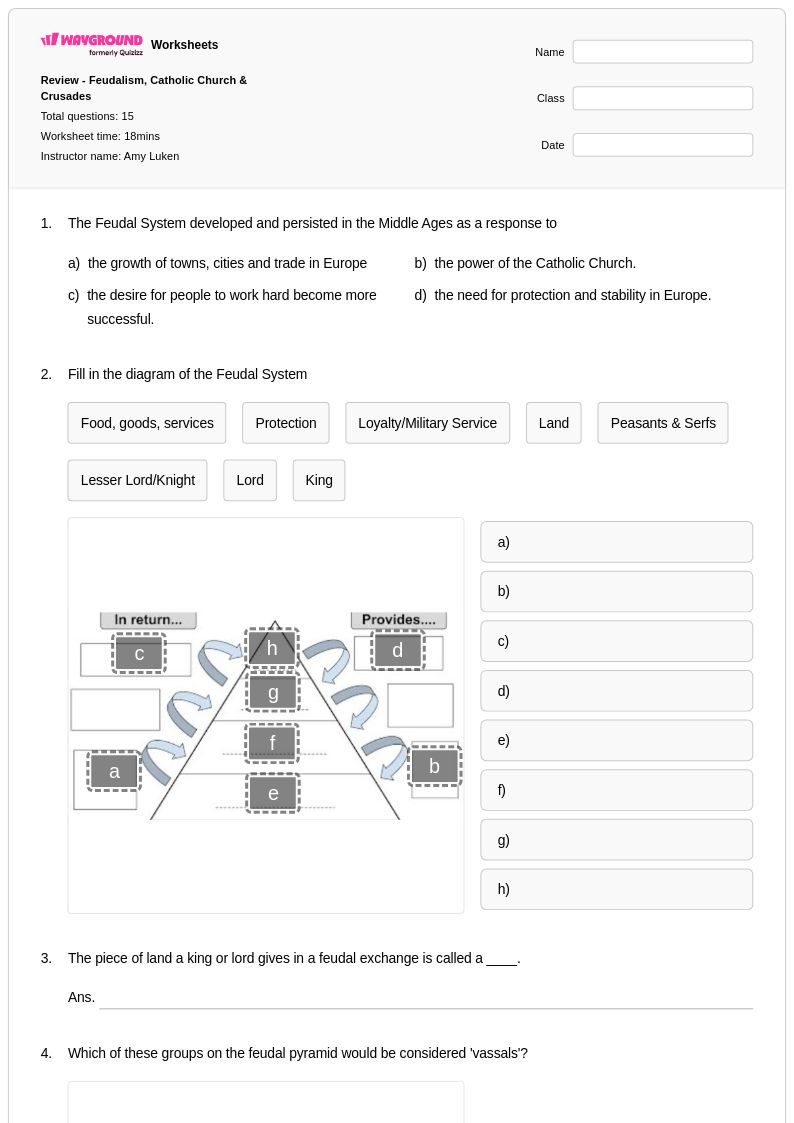
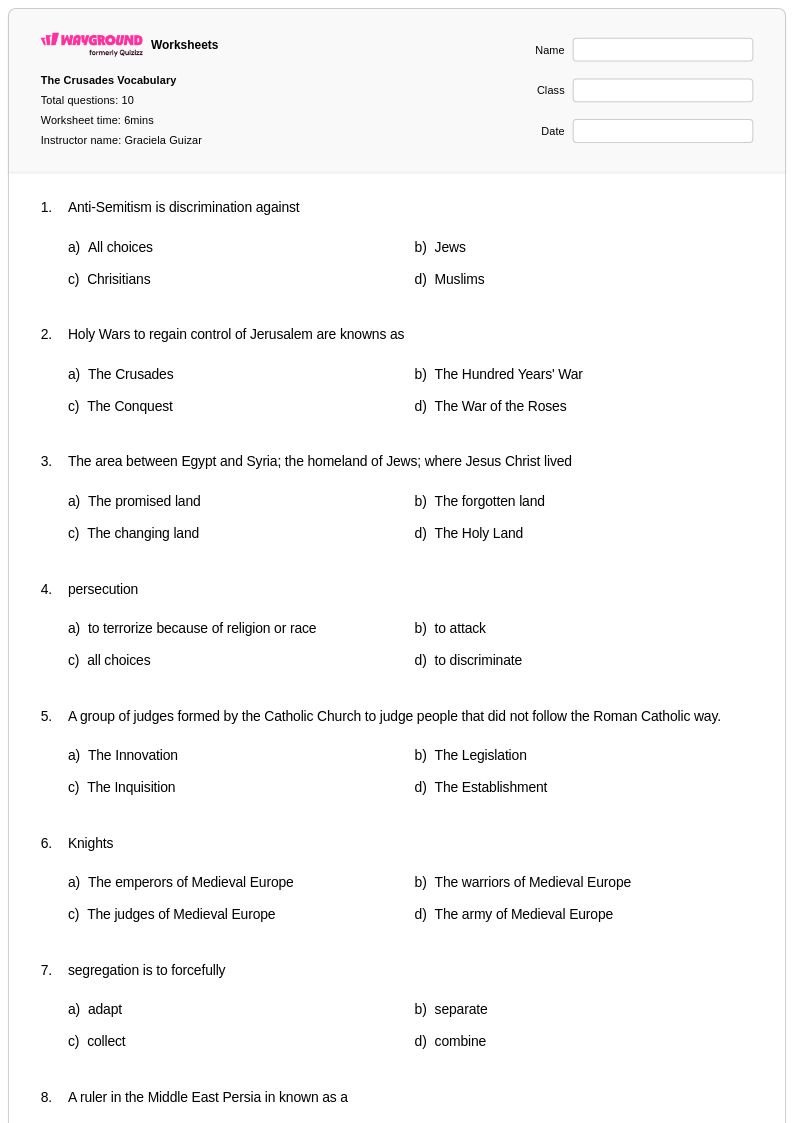
The Crusades worksheets available through Wayground (formerly Quizizz) provide comprehensive educational resources that help students explore this pivotal period of medieval history spanning from the late 11th to late 13th centuries. These expertly crafted materials strengthen critical thinking skills by guiding students through the complex political, religious, and social factors that motivated European Christians to launch military expeditions to reclaim the Holy Land. Students engage with primary source documents, analyze the perspectives of different civilizations, and examine the lasting impact of these conflicts on European and Middle Eastern societies. Each worksheet collection includes detailed answer keys to support independent learning, and teachers can access free printables in convenient pdf format alongside interactive practice problems that reinforce key historical concepts and chronological understanding.
Wayground (formerly Quizizz) empowers educators with millions of teacher-created Crusades resources that feature robust search and filtering capabilities, allowing instructors to quickly locate materials aligned with specific learning standards and curriculum requirements. The platform's differentiation tools enable teachers to customize worksheets for diverse learning needs, while flexible formatting options provide both printable pdf versions for traditional classroom use and digital formats for technology-integrated lessons. These comprehensive collections support effective lesson planning by offering varied question types and assessment formats, facilitate targeted remediation for students struggling with medieval history concepts, and provide enrichment opportunities for advanced learners ready to explore the nuanced cultural exchanges and technological innovations that emerged from Crusader interactions with Byzantine and Islamic civilizations.
FAQs
How do I teach the Crusades to middle or high school students?
Teaching the Crusades effectively means framing them as a convergence of religious zeal, political ambition, and economic interest rather than a simple conflict between faiths. Start by establishing the political fragmentation of Europe and the rise of Islamic powers before introducing the First Crusade. From there, guide students through the shifting motivations across different Crusades, using primary source documents and multiple-perspective analysis to build critical thinking. Comparing European Christian, Byzantine, and Islamic viewpoints helps students understand why the Crusades had such lasting consequences for both medieval and modern history.
What kinds of exercises help students practice their understanding of the Crusades?
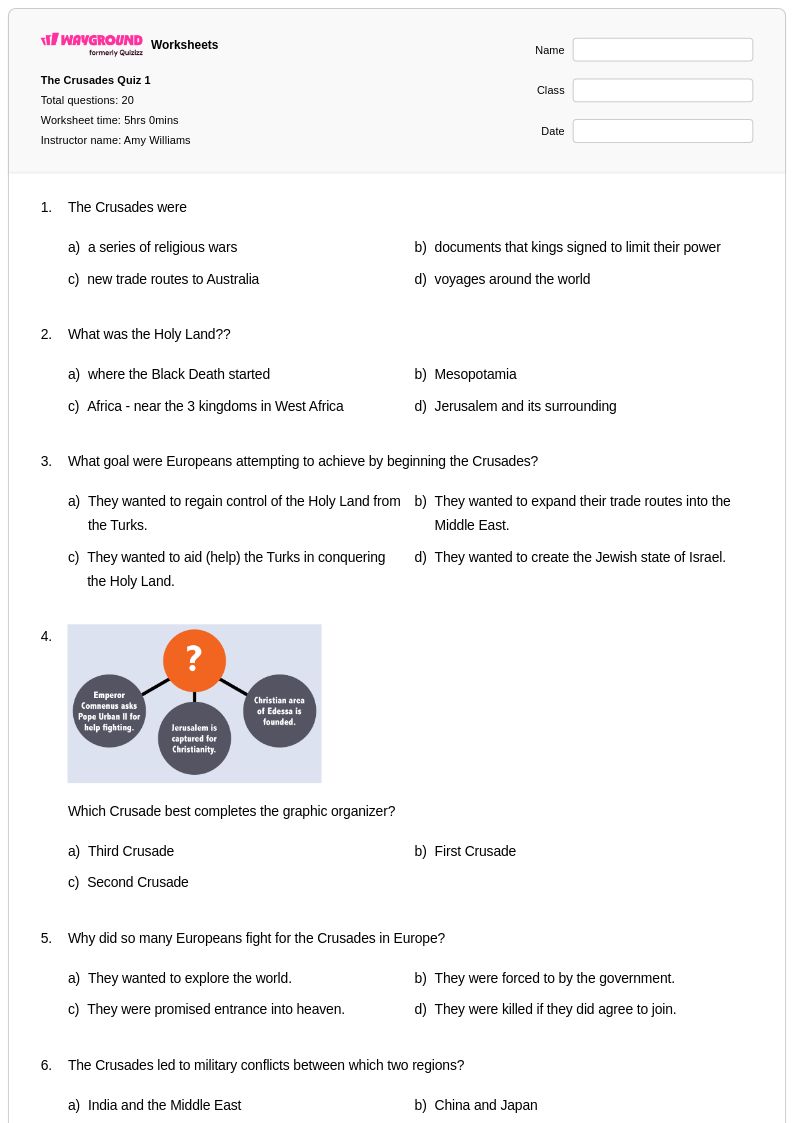
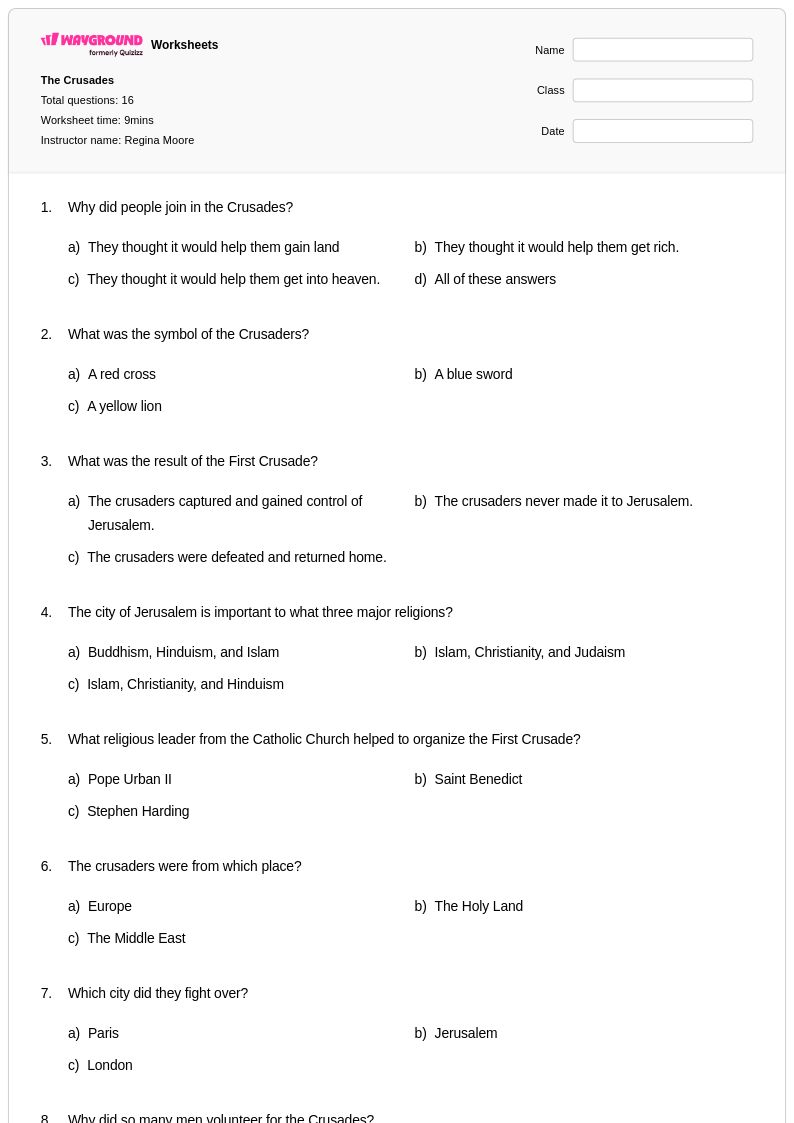
Effective practice exercises for the Crusades include chronological sequencing of major expeditions, cause-and-effect analysis of political and religious motivations, and document-based questions using primary sources from Crusader, Byzantine, and Islamic perspectives. Mapping activities that trace the routes of key Crusades and the territories gained or lost also reinforce spatial and historical understanding. Varied question formats, such as multiple choice for factual recall and short-response prompts for analysis, help students consolidate both content knowledge and historical thinking skills.
What common mistakes do students make when learning about the Crusades?
The most common misconception is that the Crusades were a straightforward religious war with a clear villain and hero, which flattens the political, economic, and social complexity of the period. Students often conflate all Crusades into one event rather than recognizing that each expedition had distinct causes, participants, and outcomes. Another frequent error is viewing the Crusades solely from a European perspective, which overlooks how Byzantine and Islamic civilizations experienced, responded to, and were permanently shaped by these conflicts. Worksheets that require students to analyze multiple perspectives and trace change over time directly address these gaps.
How do I use Crusades worksheets in my classroom?
Crusades worksheets on Wayground are available as printable PDFs for traditional classroom use and in digital formats for technology-integrated environments, so they work equally well as in-class handouts, homework assignments, or independent study materials. Teachers can also host worksheets as a quiz directly on Wayground, making it easy to assign interactive practice and track student responses in one place. Answer keys are included with each worksheet, supporting both teacher-led instruction and independent student work.
How can I help students understand the long-term impact of the Crusades?
To help students grasp the lasting impact of the Crusades, connect the military campaigns to their broader consequences: the weakening of feudal lords, the strengthening of European monarchies, the disruption and eventual decline of the Byzantine Empire, and the intensification of religious tensions that echoed into later centuries. The cultural and intellectual exchanges that occurred through Crusader contact with Islamic and Byzantine civilizations, including the transmission of Greek texts, mathematics, and medicine to Western Europe, are equally important and often overlooked. Guided analysis activities that ask students to trace these outcomes across time and geography are particularly effective for building this understanding.
How do I differentiate Crusades instruction for students with different learning needs?
Differentiation for a topic as complex as the Crusades often means adjusting the density of source material and the level of scaffolding provided for analysis tasks. On Wayground, teachers can apply individual accommodations such as read aloud support for students who need audio assistance, reduced answer choices to lower cognitive load on assessments, and extended time settings configured per student. These accommodations are saved and reusable across future sessions, so teachers can set them once and apply them consistently without disrupting the rest of the class.