Explore Wayground's comprehensive Year 10 tides worksheets and printables that help students master ocean tidal patterns, gravitational forces, and lunar cycles through engaging practice problems with complete answer keys.
Year 10 tides worksheets available through Wayground (formerly Quizizz) provide comprehensive coverage of oceanic tidal phenomena, helping students master the complex gravitational relationships between Earth, moon, and sun that create these predictable water level changes. These educational resources strengthen critical thinking skills as students analyze tidal cycles, calculate tidal ranges, and interpret tide charts while exploring concepts such as spring tides, neap tides, and the influence of coastal geography on local tidal patterns. The collection includes practice problems that challenge students to apply mathematical concepts to real-world scenarios, with accompanying answer key materials that support independent learning and self-assessment. Teachers can access these free printables in convenient pdf format, making it simple to distribute materials for both classroom instruction and homework assignments that reinforce understanding of tidal mechanics and their environmental impacts.
Wayground (formerly Quizizz) empowers educators with millions of teacher-created tides worksheets that streamline lesson planning and support differentiated instruction for Year 10 Earth and Space Science curricula. The platform's robust search and filtering capabilities allow teachers to quickly locate resources aligned with specific learning standards, while built-in customization tools enable modification of existing materials to match diverse student needs and ability levels. These digital and printable worksheet collections facilitate targeted skill practice, remediation for struggling learners, and enrichment opportunities for advanced students exploring marine science applications. Whether teachers need quick formative assessments, comprehensive review packets, or supplementary practice materials, the flexible pdf and digital formats ensure seamless integration into existing instructional frameworks while providing the depth and rigor necessary for thorough understanding of tidal phenomena and their broader significance in Earth's oceanic systems.
FAQs
How do I teach tides to middle or high school students?
Start by grounding students in the gravitational relationship between Earth, the moon, and the sun before introducing tidal bulges and tidal cycles. Use tidal charts from real coastal locations to make the concept tangible, then layer in the distinction between spring tides and neap tides as lunar phases change. Connecting tidal patterns to practical applications like navigation, marine ecosystems, and coastal planning helps students see why this topic matters beyond the classroom.
What types of practice problems help students understand tides?
Effective tides practice includes analyzing tidal charts to identify high and low tide intervals, calculating tidal range from given data, and matching lunar phases to corresponding tidal types such as spring and neap tides. Problems that ask students to explain tidal bulges on both sides of Earth, or to evaluate how coastal geography affects local tidal variation, push beyond memorization into applied reasoning. Scaffolded problem sets that begin with terminology and build toward real-world tidal prediction scenarios are especially effective for building lasting understanding.
What misconceptions do students commonly have about tides?
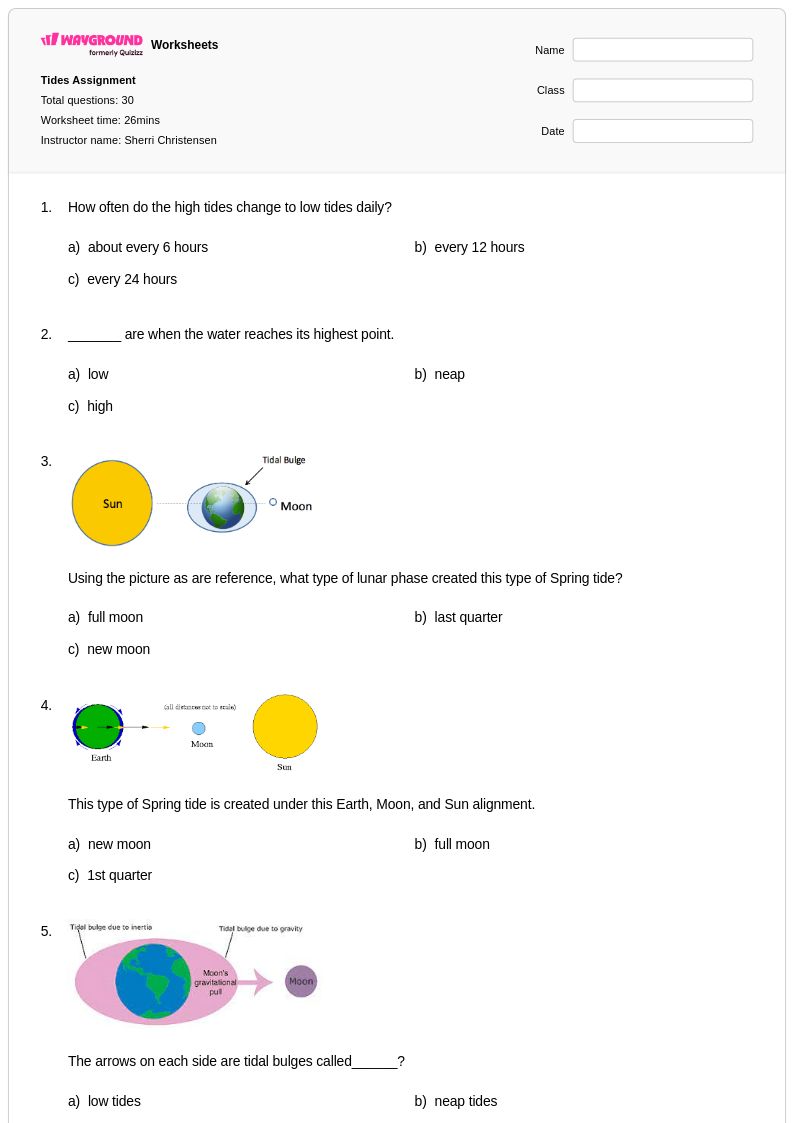
One of the most persistent misconceptions is that there is only one tidal bulge, on the side of Earth closest to the moon, when in fact there is a second bulge on the opposite side caused by inertia and the center-of-mass orbital mechanics of the Earth-moon system. Students also frequently confuse spring tides with the season of spring rather than understanding them as the result of the sun, Earth, and moon aligning. Another common error is assuming all coastlines experience two equal high tides per day, when in reality local geography can produce mixed or diurnal tidal patterns.
How do tides worksheets help students connect lunar phases to tidal cycles?
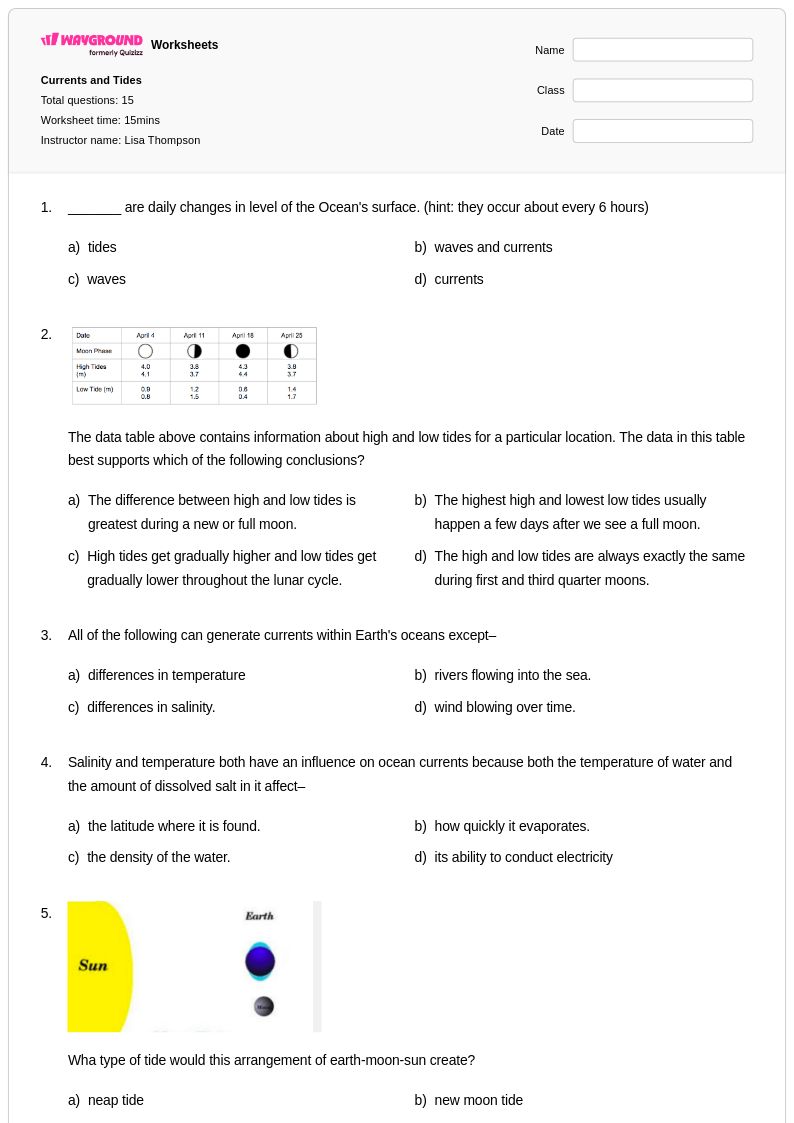
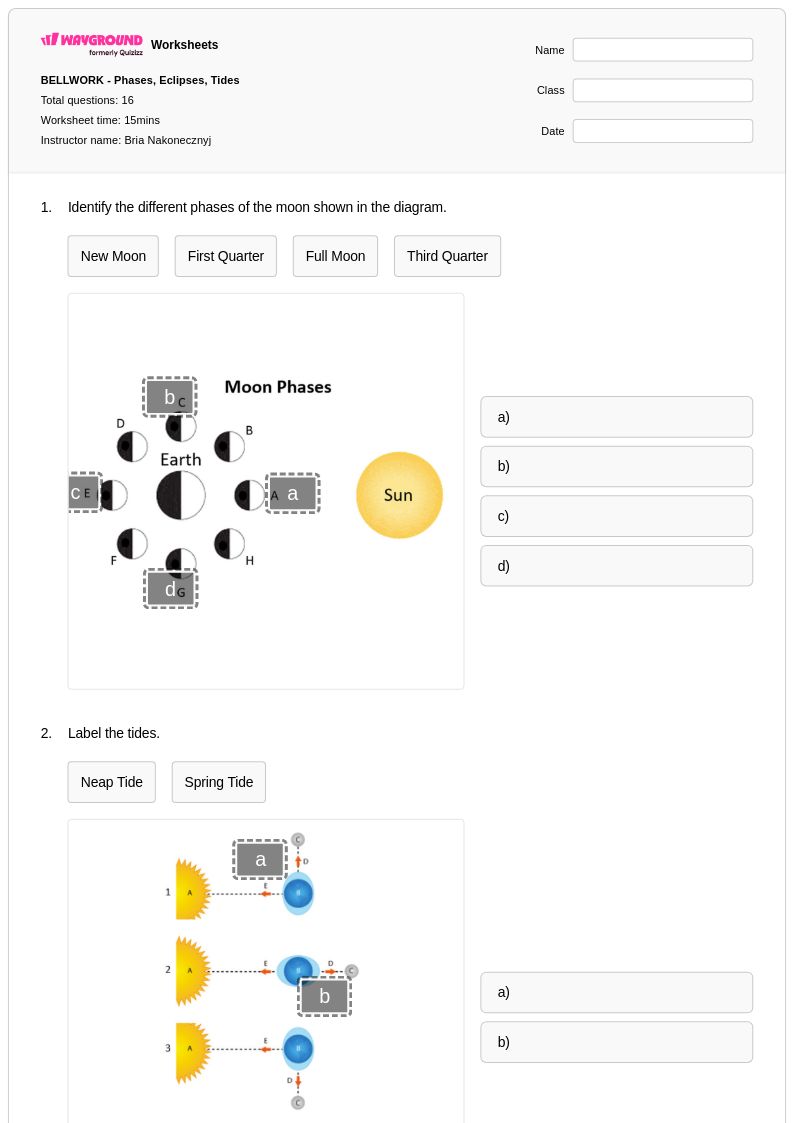
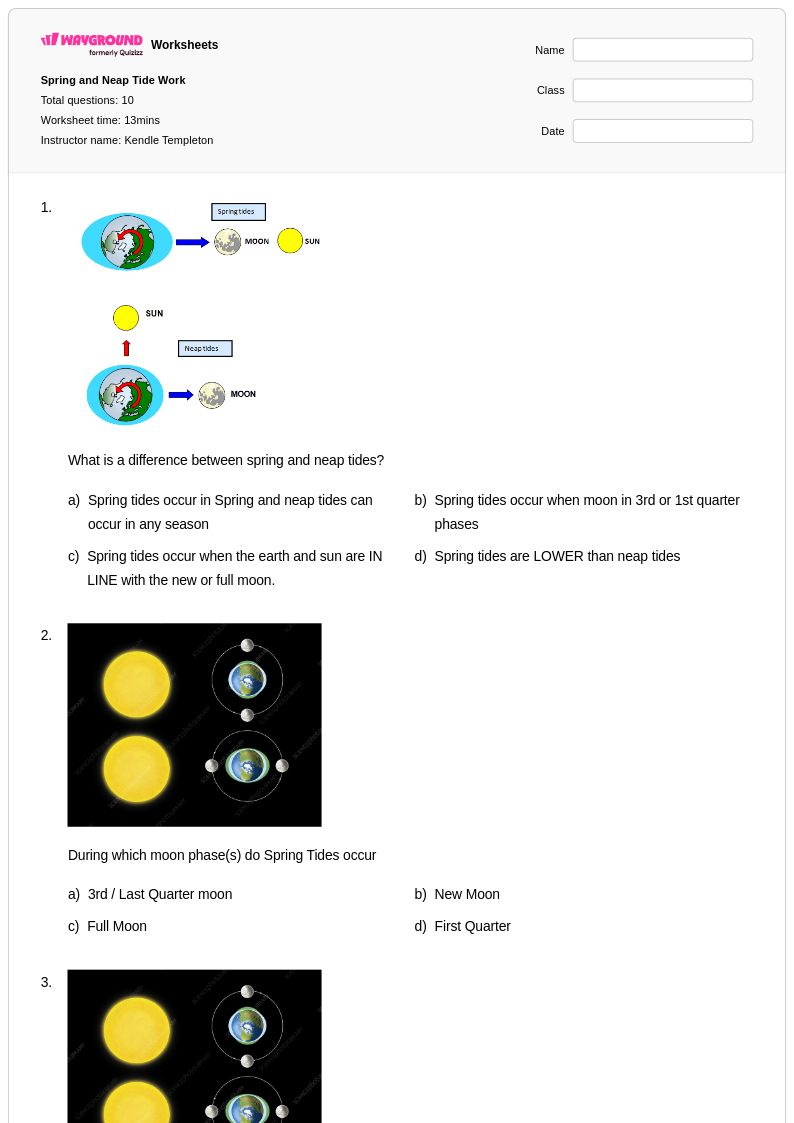
Tides worksheets that pair lunar phase diagrams with tidal data tables require students to actively trace the relationship between moon position and tidal type rather than simply reading about it. When students calculate tidal ranges during full and new moon phases versus first and third quarter phases, they build an evidence-based understanding of why spring tides and neap tides occur when they do. This kind of side-by-side analysis is more durable than lecturing on the concept alone because it asks students to reason from data.
How can I use Wayground's tides worksheets in my classroom?
Wayground's tides worksheets are available as free printable PDFs for traditional classroom use and in digital formats for technology-integrated environments, including the option to host them as a quiz directly on Wayground. The collection covers spring tides, neap tides, tidal bulges, tidal range calculations, and the influence of coastal geography, with each worksheet including a complete answer key. Teachers can use these materials for initial instruction, targeted remediation, or enrichment depending on where students are in their understanding of gravitational forces and oceanic tidal patterns.
How do I differentiate tides instruction for students at different skill levels?
For students who are new to the topic, focus on foundational vocabulary such as tidal bulge, spring tide, neap tide, and tidal range before introducing charts or calculations. More advanced students can work through problems involving tidal coefficients, harmonic analysis, or the compounding effect of solar and lunar gravity during syzygy. On Wayground, teachers can apply accommodations such as read aloud support, reduced answer choices, and extended time to individual students, making it possible to run differentiated practice within a single class session without disrupting the rest of the group.