Year 12 Wise Mind free worksheets and printables help students develop emotional regulation and balanced decision-making skills through practice problems, guided exercises, and comprehensive answer keys available as downloadable PDFs.
Explore printable Wise Mind worksheets for Year 12
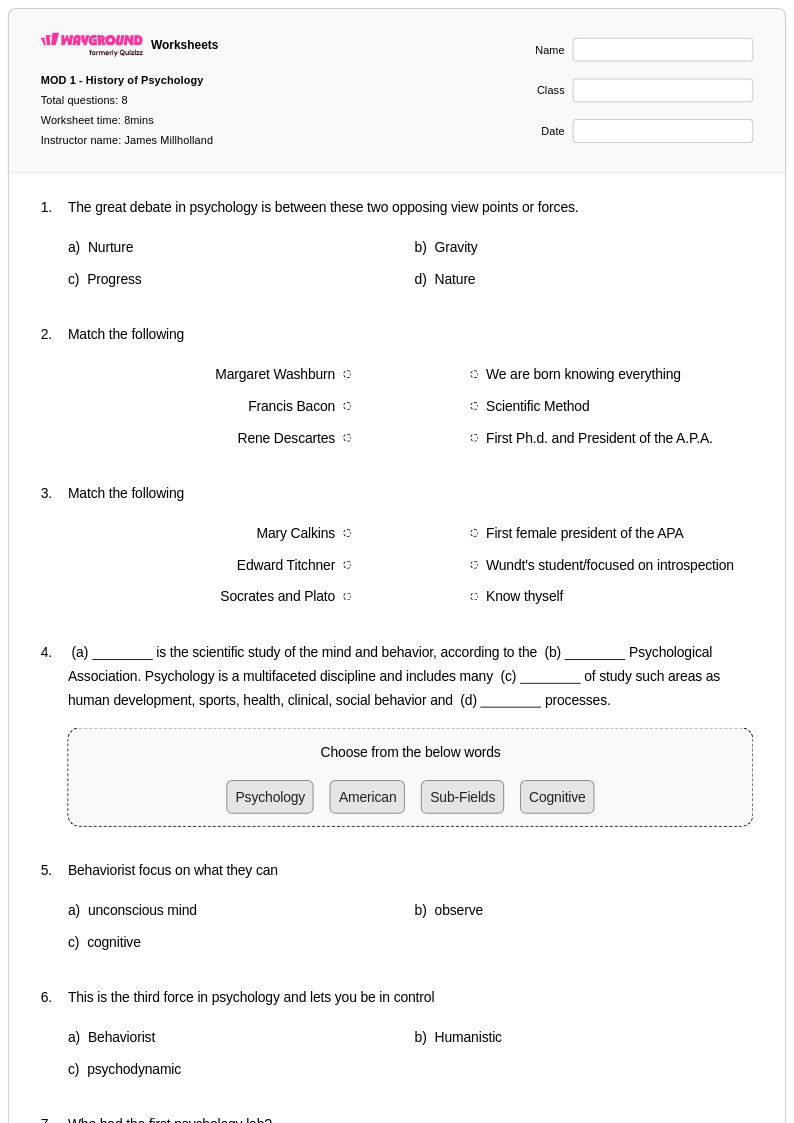
Wise Mind worksheets for Year 12 students available through Wayground (formerly Quizizz) provide comprehensive practice in developing emotional regulation and balanced decision-making skills essential for young adults transitioning to post-secondary life. These thoughtfully designed resources help students understand the concept of Wise Mind as the intersection of rational thinking and emotional awareness, teaching them to integrate logic with intuition when facing complex personal and academic challenges. The worksheets include varied practice problems that guide students through scenarios requiring balanced judgment, complete with detailed answer keys that allow for self-assessment and deeper reflection. Teachers can access these free printables in convenient pdf format, making it simple to distribute materials that strengthen students' ability to navigate relationships, academic pressures, and future career decisions with greater emotional intelligence and practical wisdom.
Wayground (formerly Quizizz) supports educators with an extensive collection of teacher-created Wise Mind resources, drawing from millions of professionally developed materials that address the sophisticated social-emotional learning needs of Year 12 students. The platform's robust search and filtering capabilities enable teachers to quickly locate worksheets that align with specific learning objectives and developmental stages, while differentiation tools allow for seamless customization based on individual student needs and learning preferences. These resources are available in both printable and digital formats, including downloadable pdf versions, giving teachers the flexibility to implement materials across various learning environments and instructional approaches. The comprehensive nature of these worksheet collections supports effective lesson planning, targeted remediation for students struggling with emotional regulation concepts, and enrichment opportunities for advanced learners ready to apply Wise Mind principles to complex real-world situations and future planning scenarios.
FAQs
How do I teach the Wise Mind concept to students?
Wise Mind is best introduced using the three-states model from Dialectical Behavior Therapy (DBT): Emotion Mind, Reasonable Mind, and Wise Mind as the balanced intersection of the two. Start with concrete, relatable scenarios where students identify which mind state is driving a character's decision, then work toward self-reflective practice where students apply the framework to their own experiences. Visual diagrams showing the overlapping circles of emotion and reason are particularly effective for making the abstract concept tangible.
What exercises help students practice Wise Mind skills in the classroom?
Scenario-based practice is the most effective approach: present students with real-world social conflicts or decisions and ask them to identify the Emotion Mind response, the Reasonable Mind response, and then construct a Wise Mind response that honors both. Journaling prompts that ask students to reflect on a recent decision they made and evaluate which mind state guided them also build self-awareness over time. These exercises reinforce perspective-taking, self-regulation, and mindful communication simultaneously.
What common mistakes do students make when learning about Wise Mind?
The most frequent misconception is that Wise Mind simply means suppressing emotions in favor of logic. Students often conflate Reasonable Mind with Wise Mind, treating emotional responses as obstacles rather than valid inputs to a balanced decision. Another common error is applying Wise Mind retrospectively only, rather than developing the habit of pausing to access it in real time. Worksheets that present in-the-moment decision scenarios, rather than only reflective prompts, help correct this pattern.
How does Wise Mind connect to social-emotional learning (SEL) standards?
Wise Mind directly supports core CASEL SEL competencies, particularly self-awareness, self-management, and responsible decision-making. By teaching students to identify their emotional state and integrate it with rational thinking before acting, Wise Mind practice builds the metacognitive habits that underpin healthy interpersonal relationships and conflict resolution. It is especially effective as a framework in advisory, counseling, or SEL-dedicated class periods.
How can I use Wayground's Wise Mind worksheets in my classroom?
Wayground's Wise Mind worksheets are available as printable PDFs for traditional classroom use and in digital formats for technology-integrated or remote learning environments, and can also be hosted as a quiz directly on the Wayground platform. Each worksheet includes a complete answer key, supporting both independent student work and teacher-led guided instruction. For students who need additional support, Wayground's accommodation tools allow you to enable features like Read Aloud or extended time on an individual basis without affecting the rest of the class.
How do I differentiate Wise Mind instruction for students with varying social-emotional skill levels?
For students newer to SEL concepts, begin with highly structured scenarios that have clear Emotion Mind and Reasonable Mind pulls, reducing the cognitive demand of identifying the tension. More advanced students can tackle ambiguous scenarios where the 'right' Wise Mind response is genuinely debatable, encouraging deeper reflection and discussion. On Wayground, you can also apply accommodations such as reduced answer choices or Read Aloud to individual students, ensuring that access barriers don't interfere with the emotional learning itself.