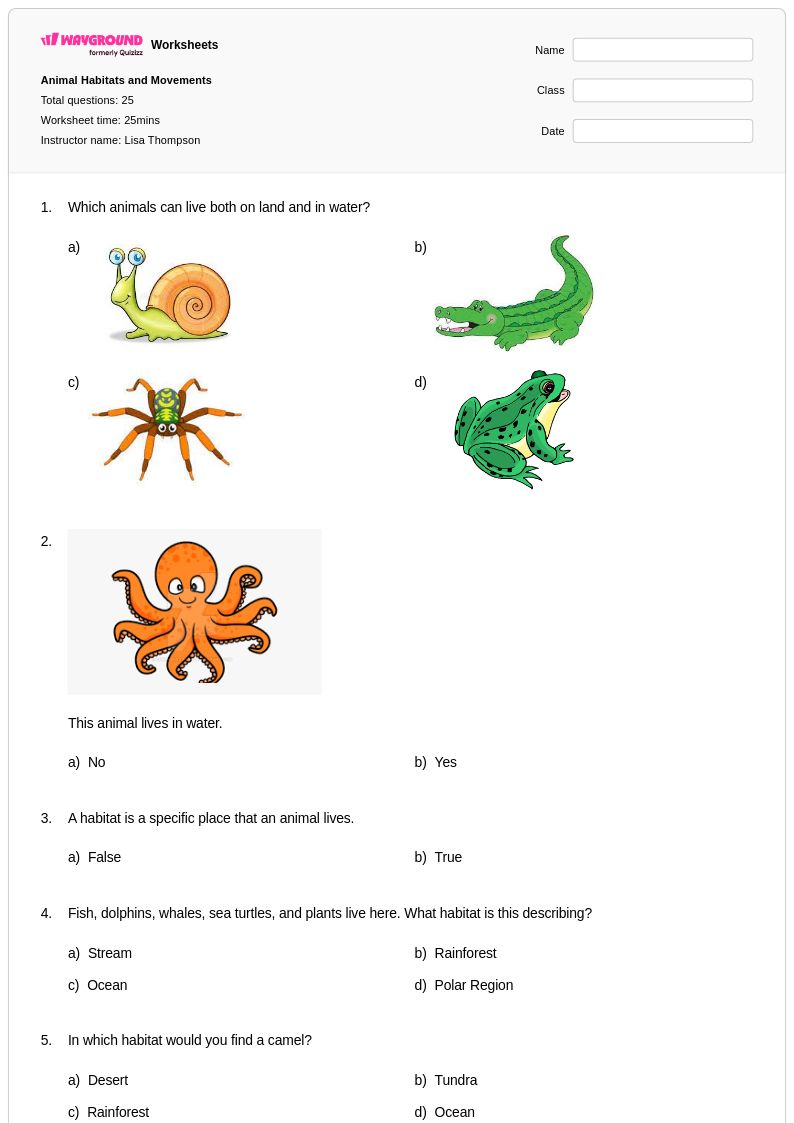
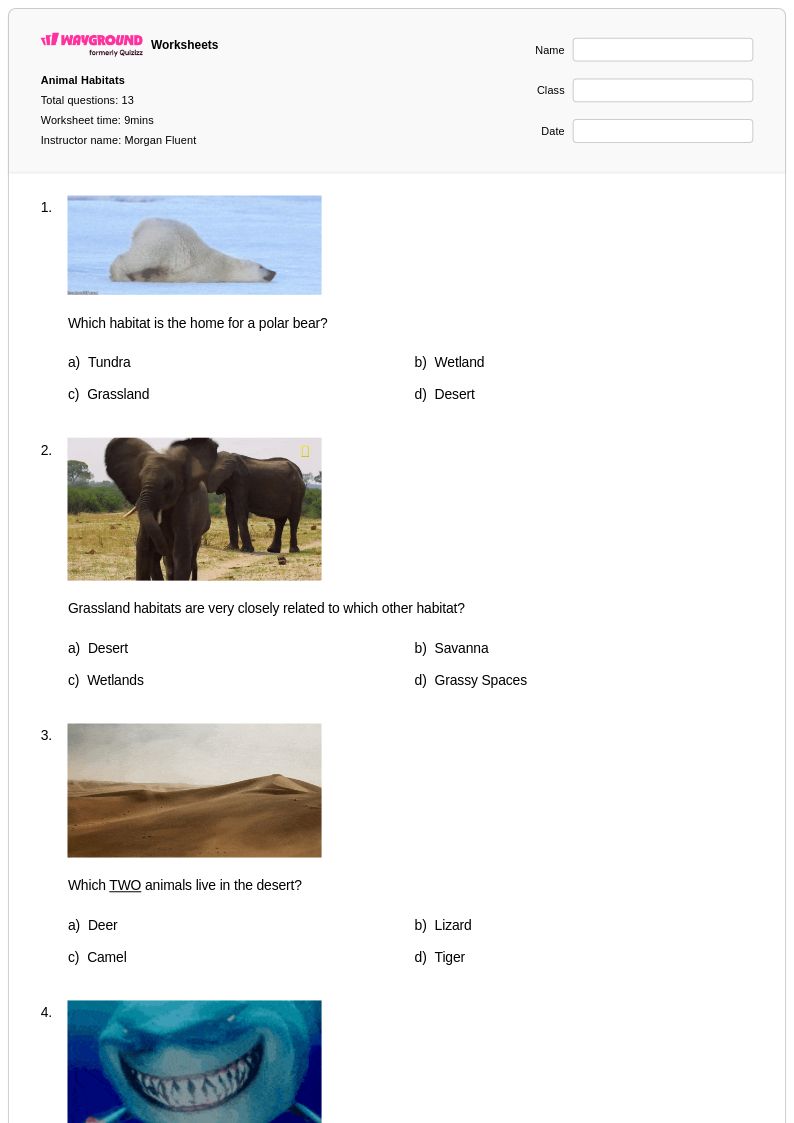
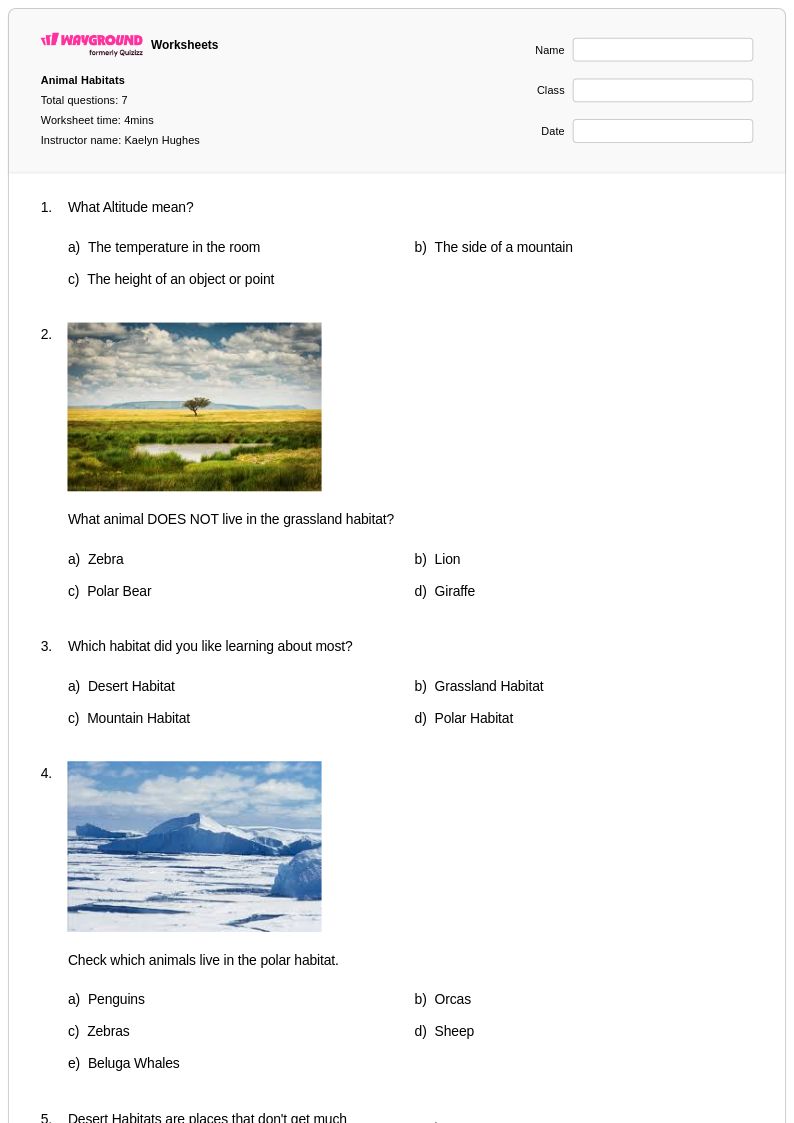
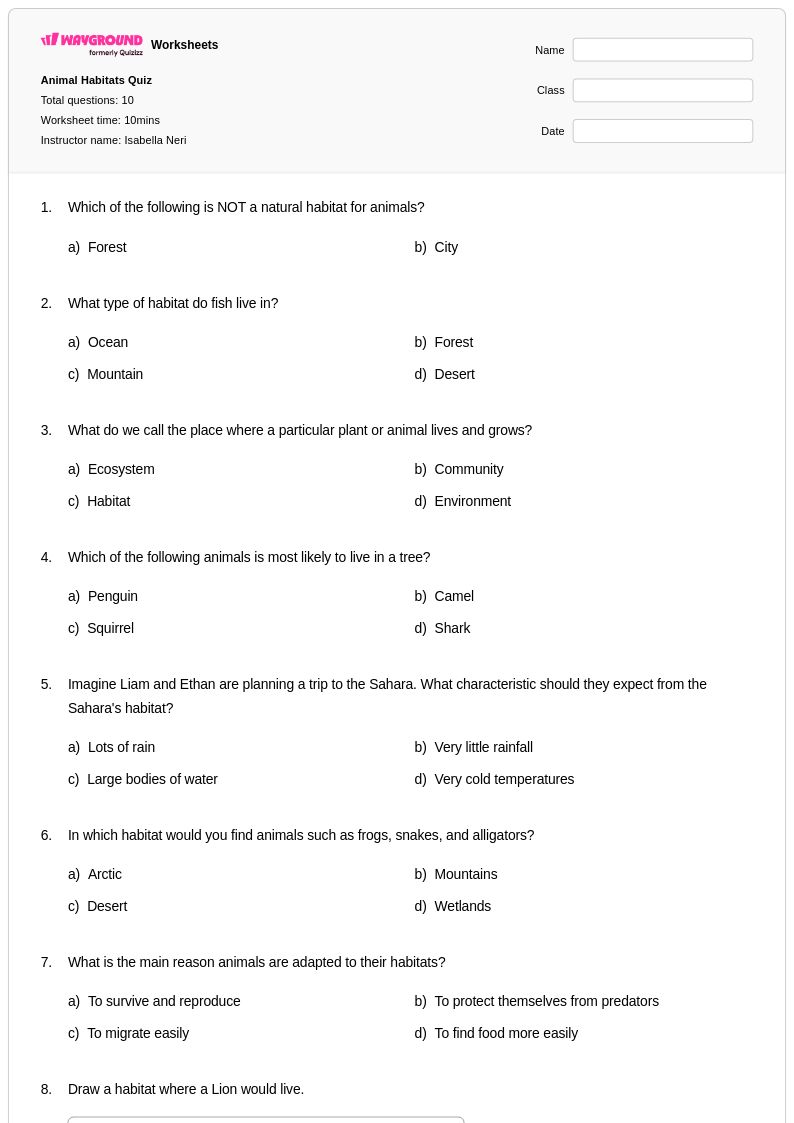
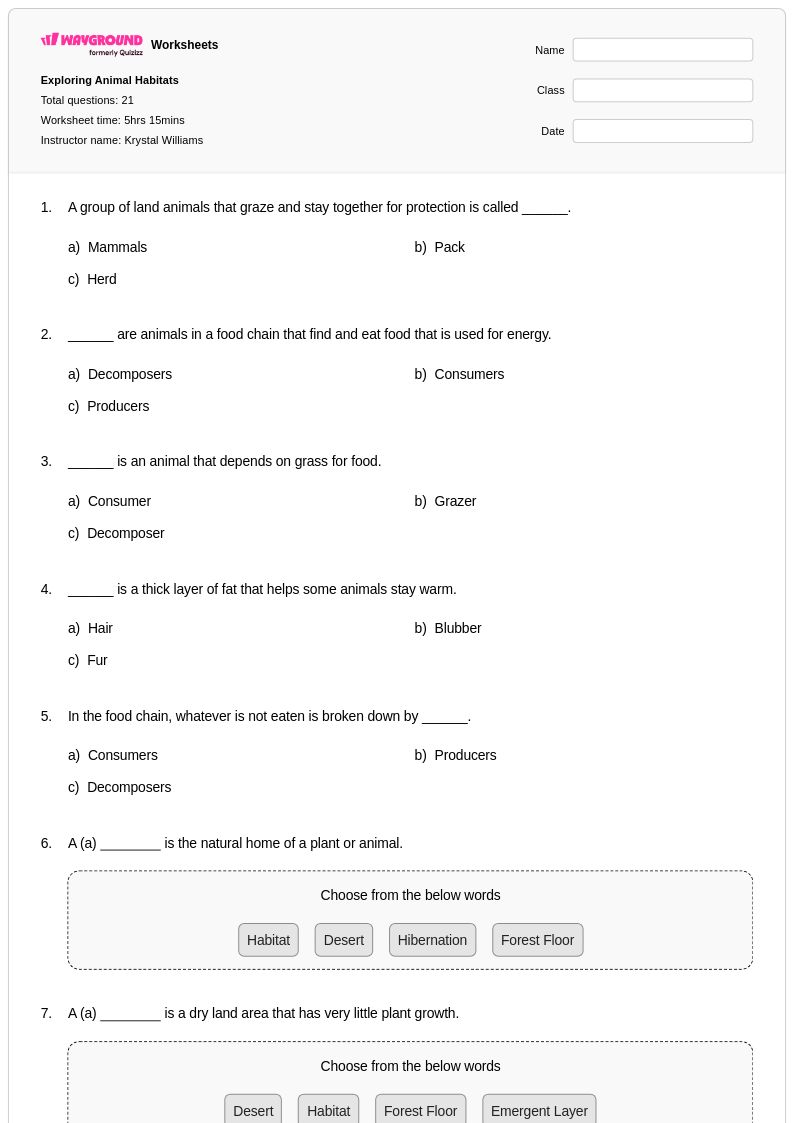
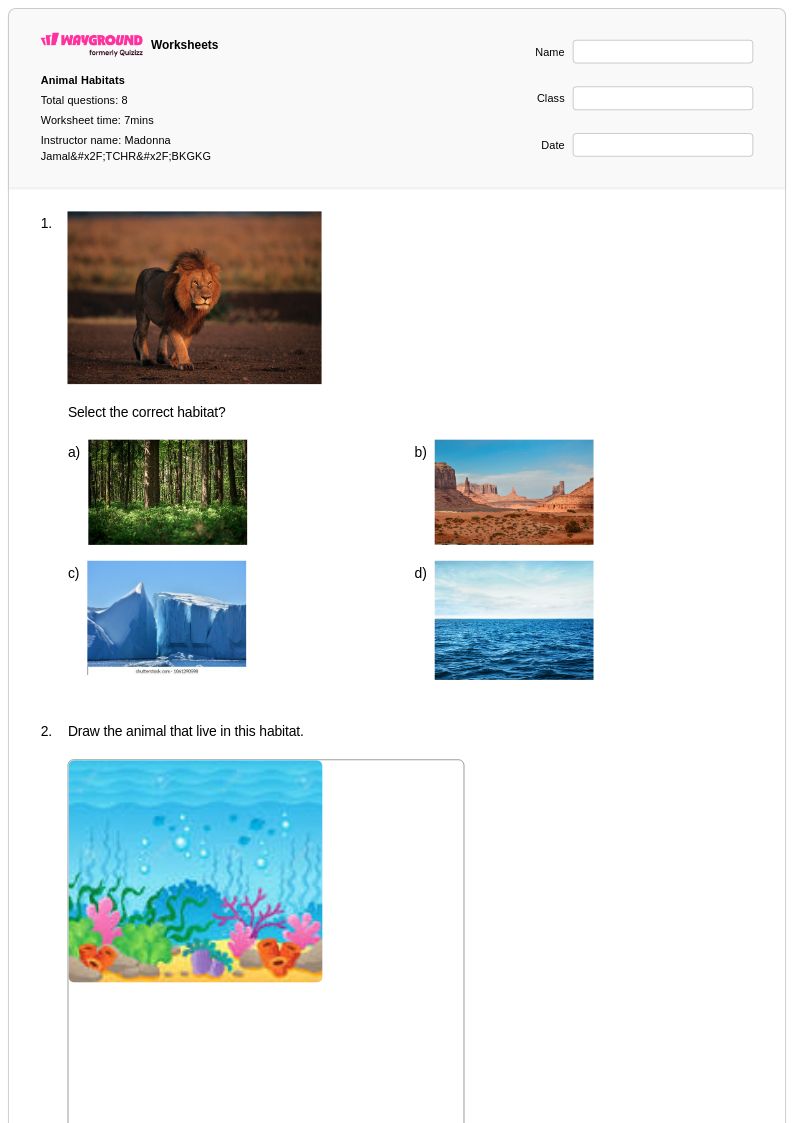
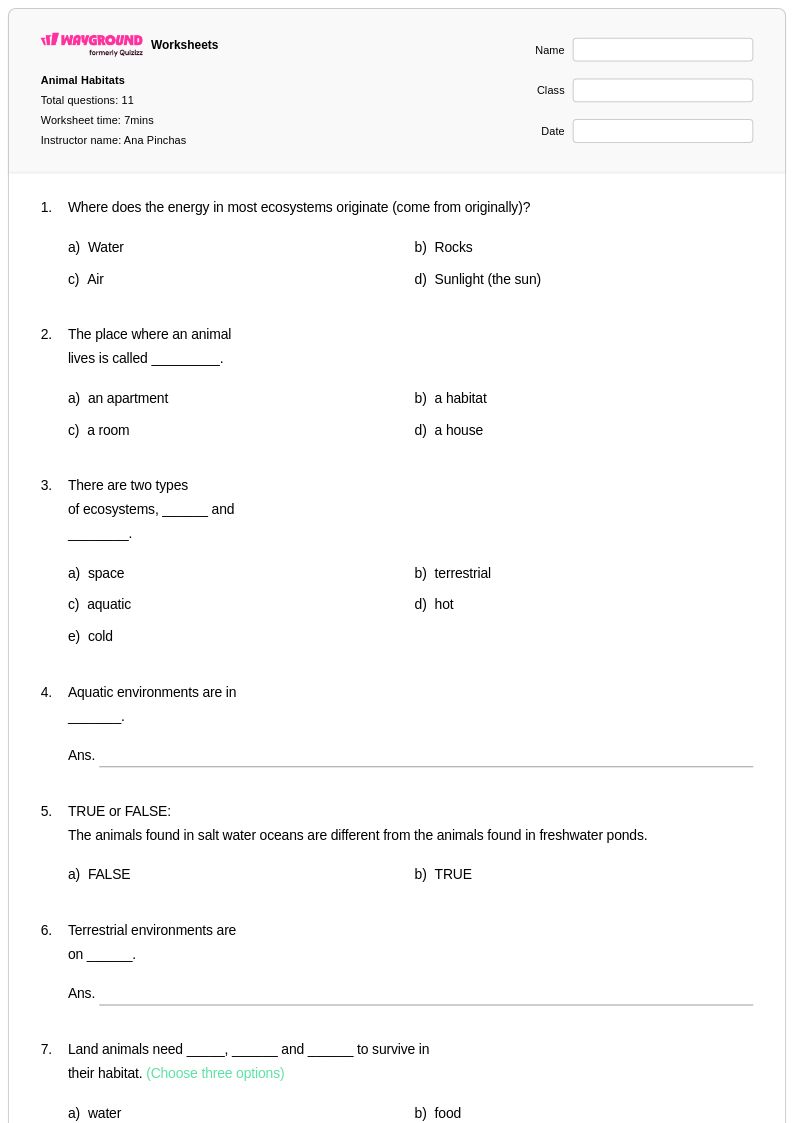
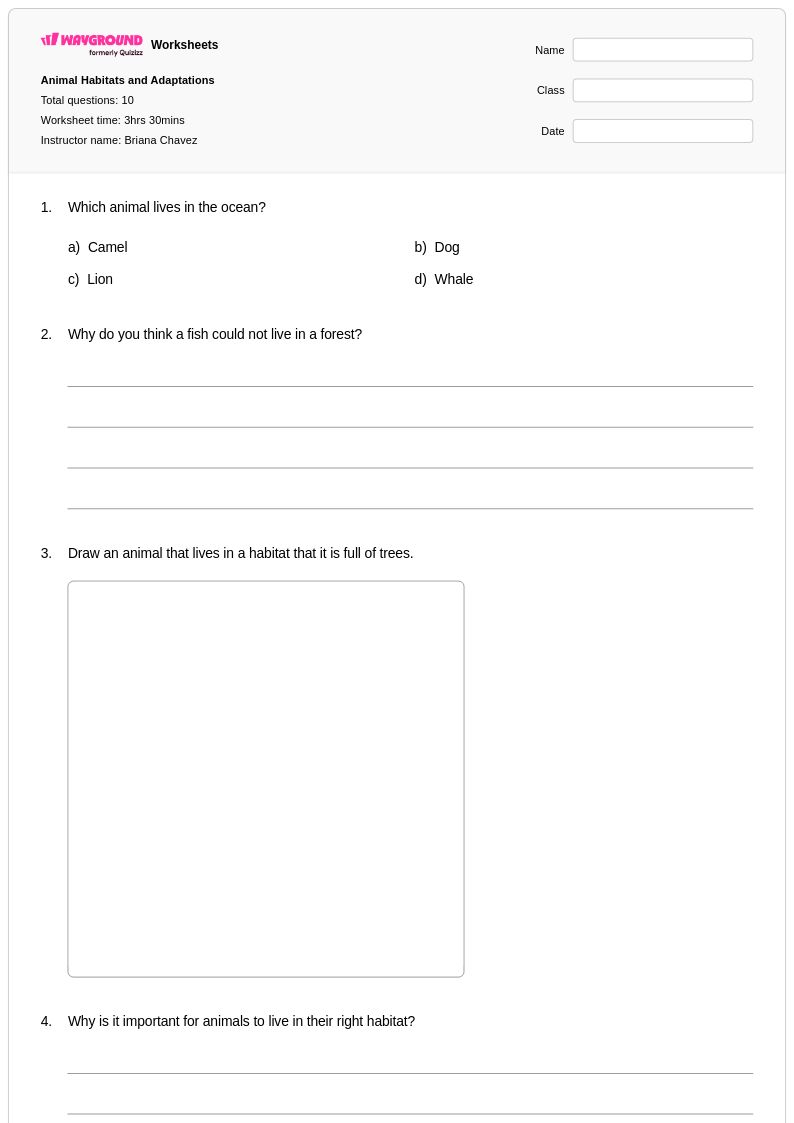
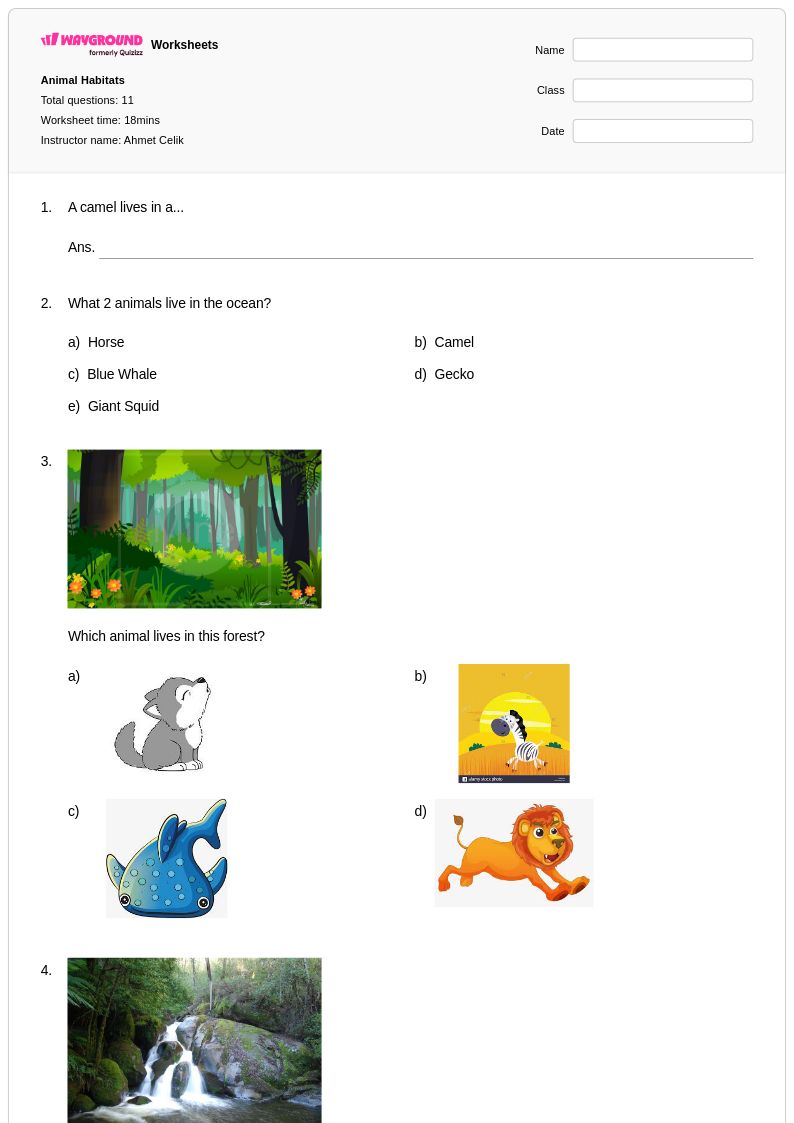
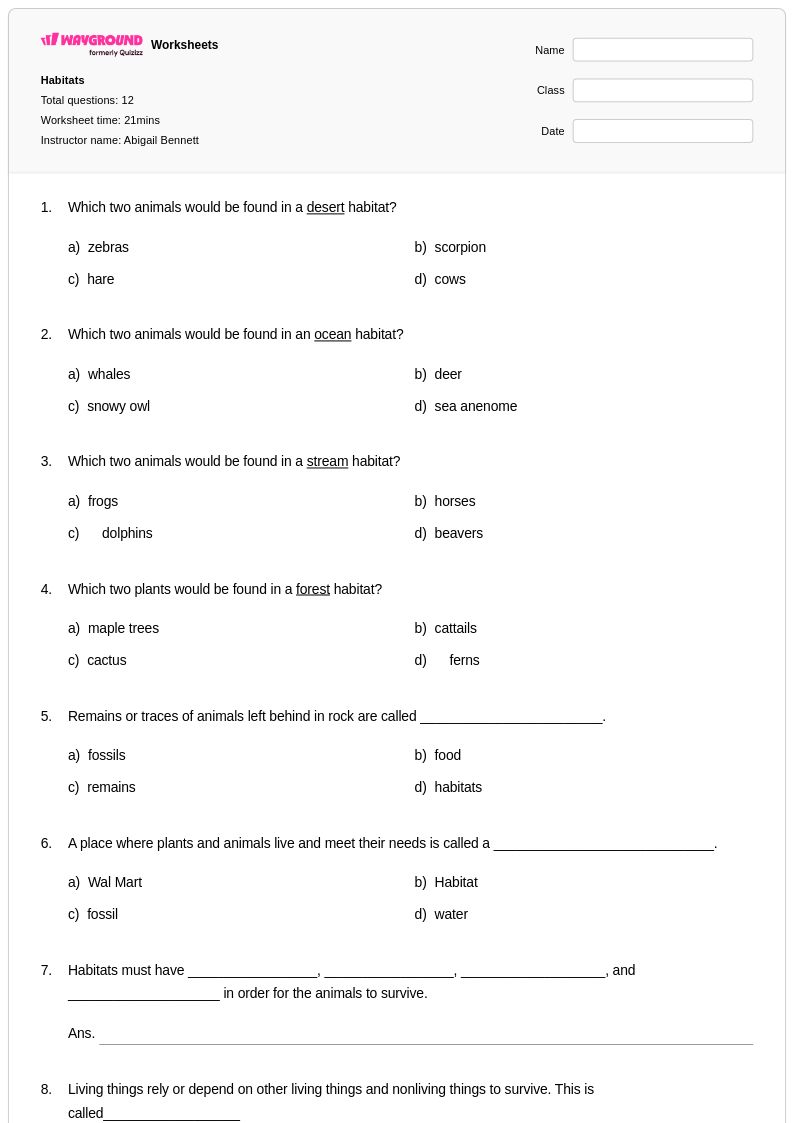
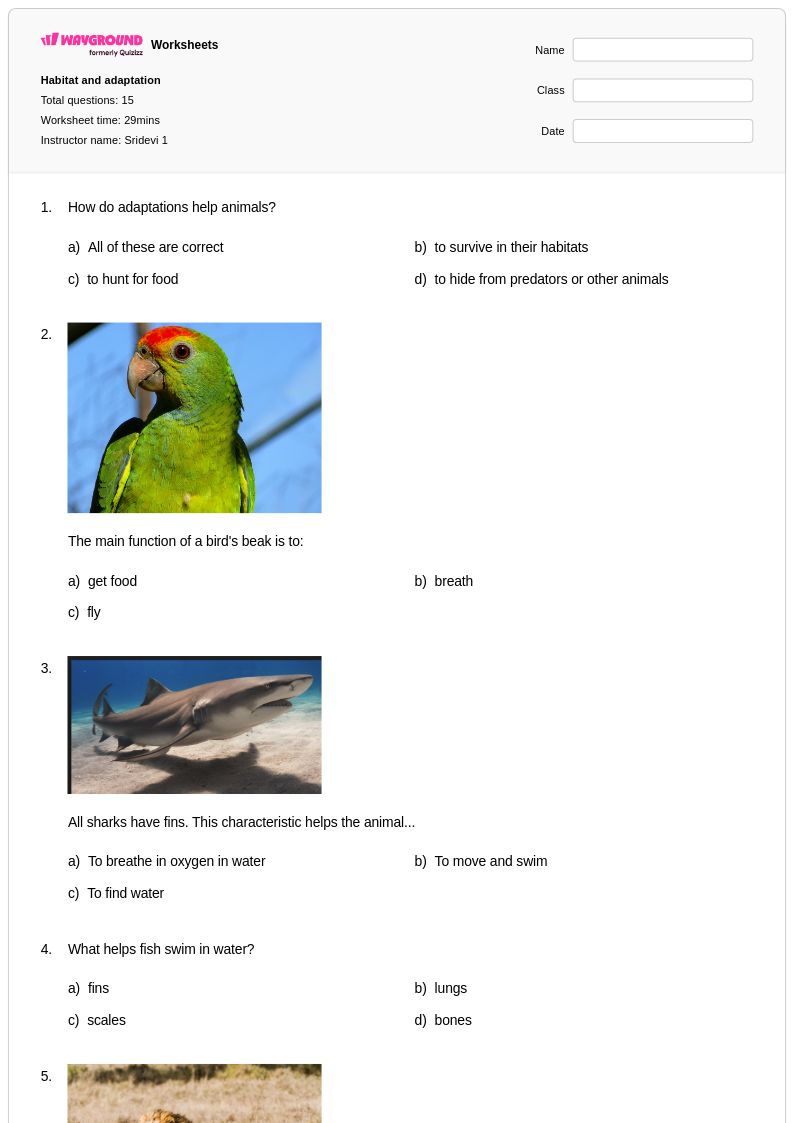
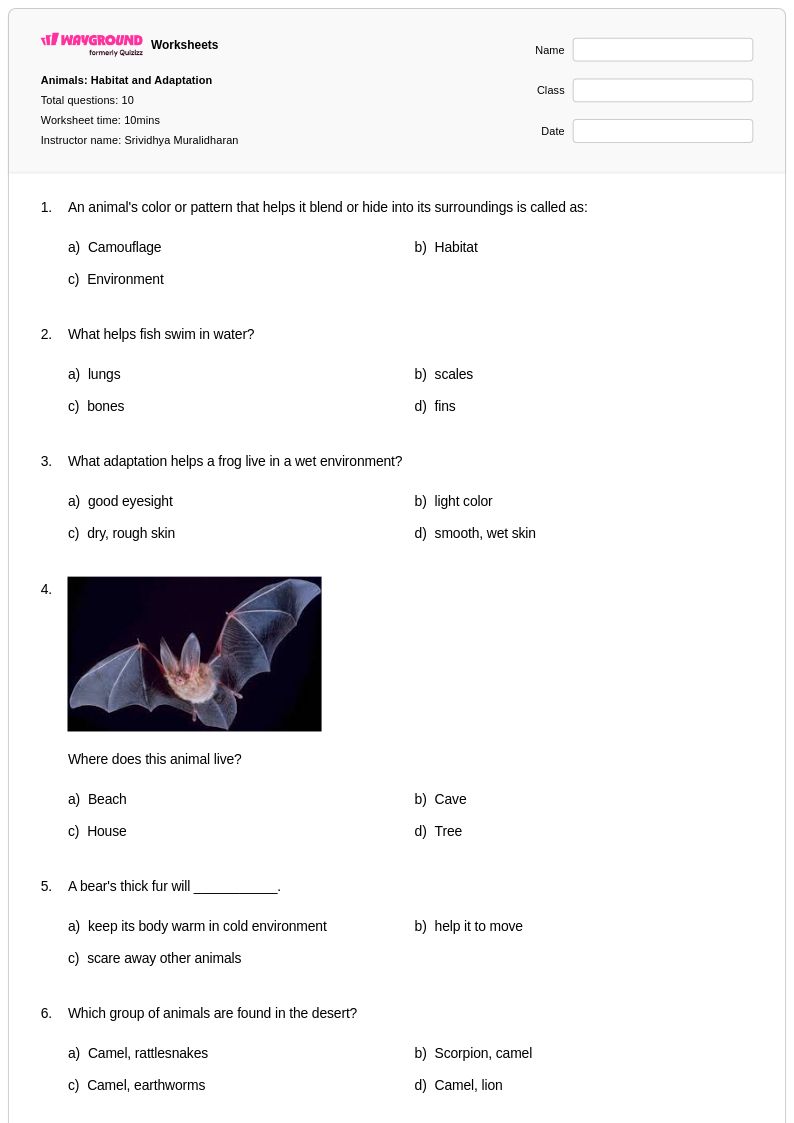
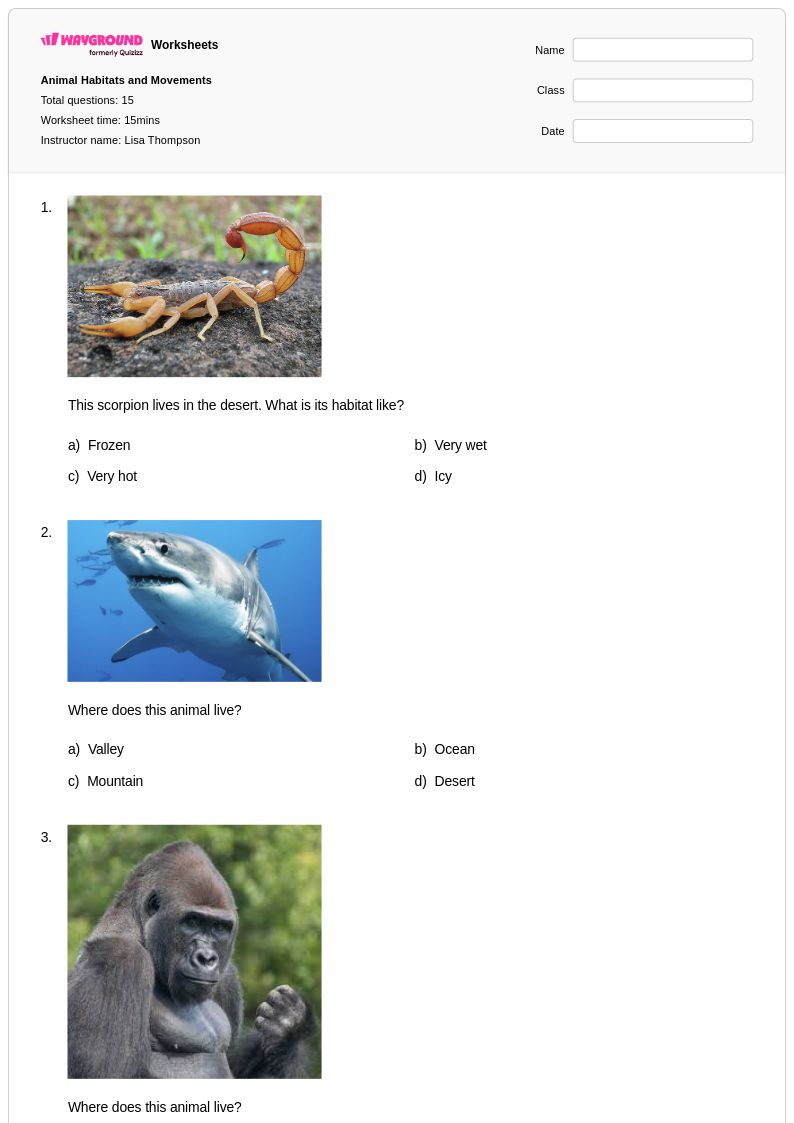
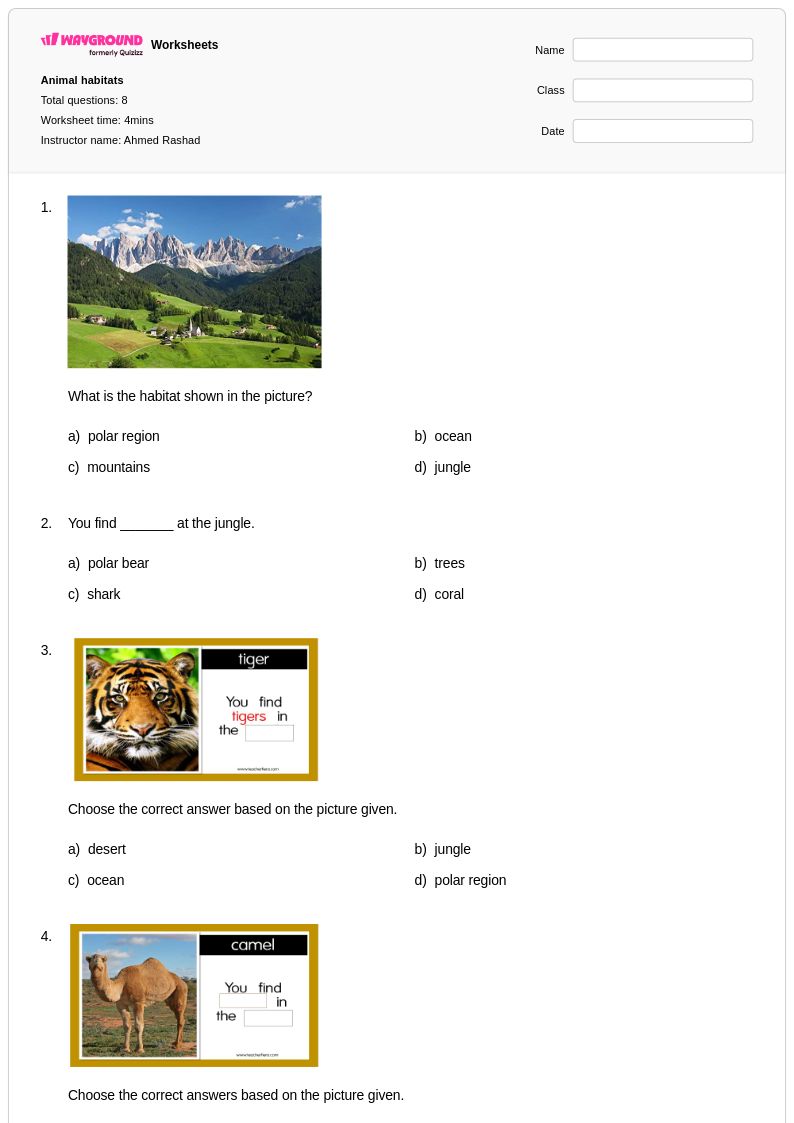
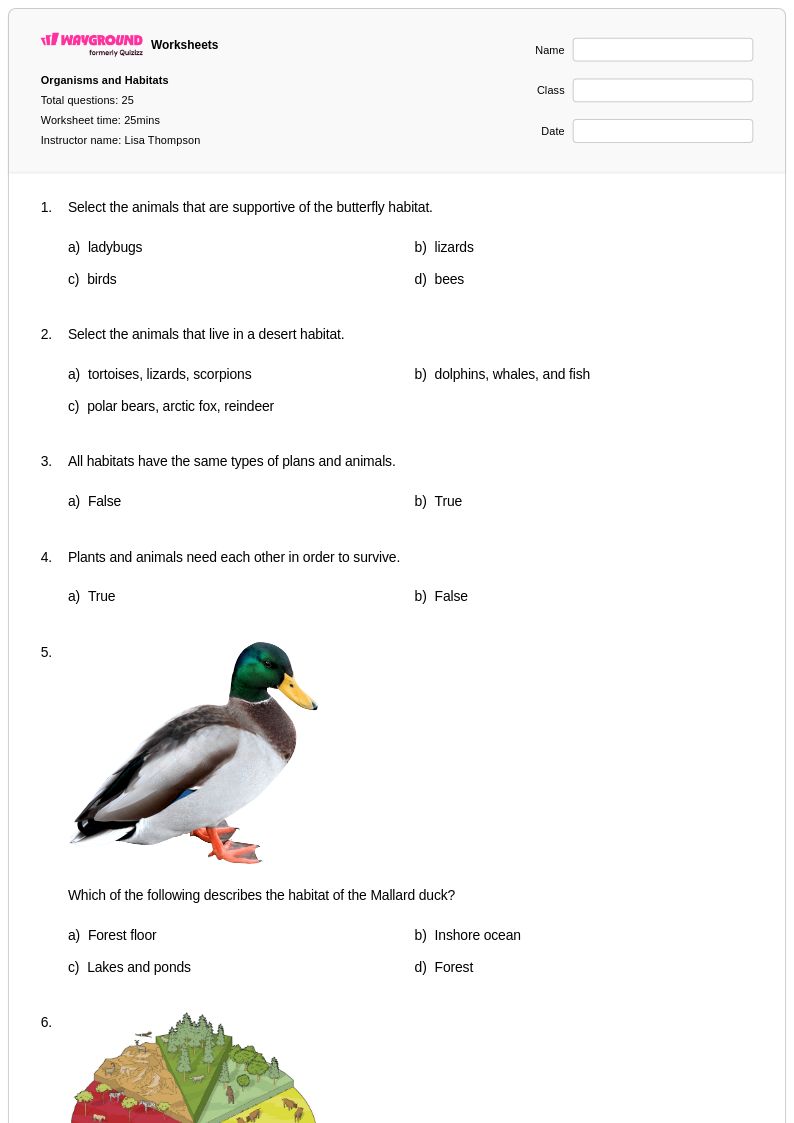
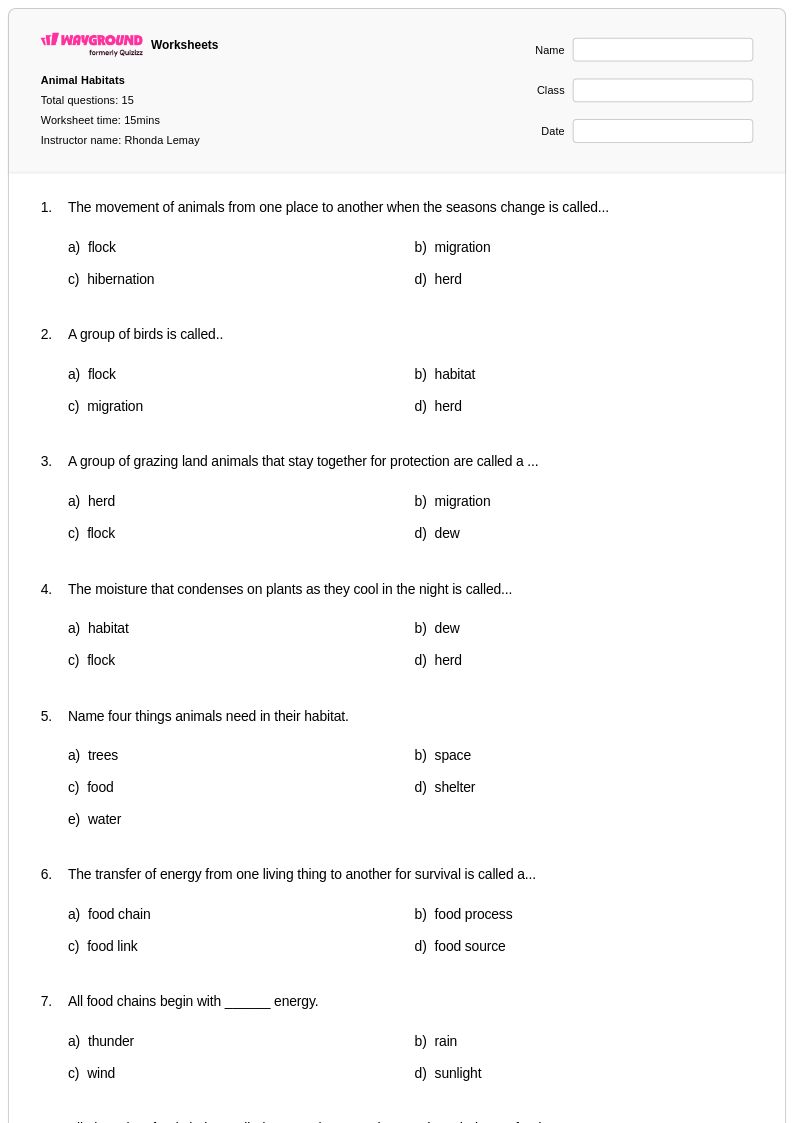
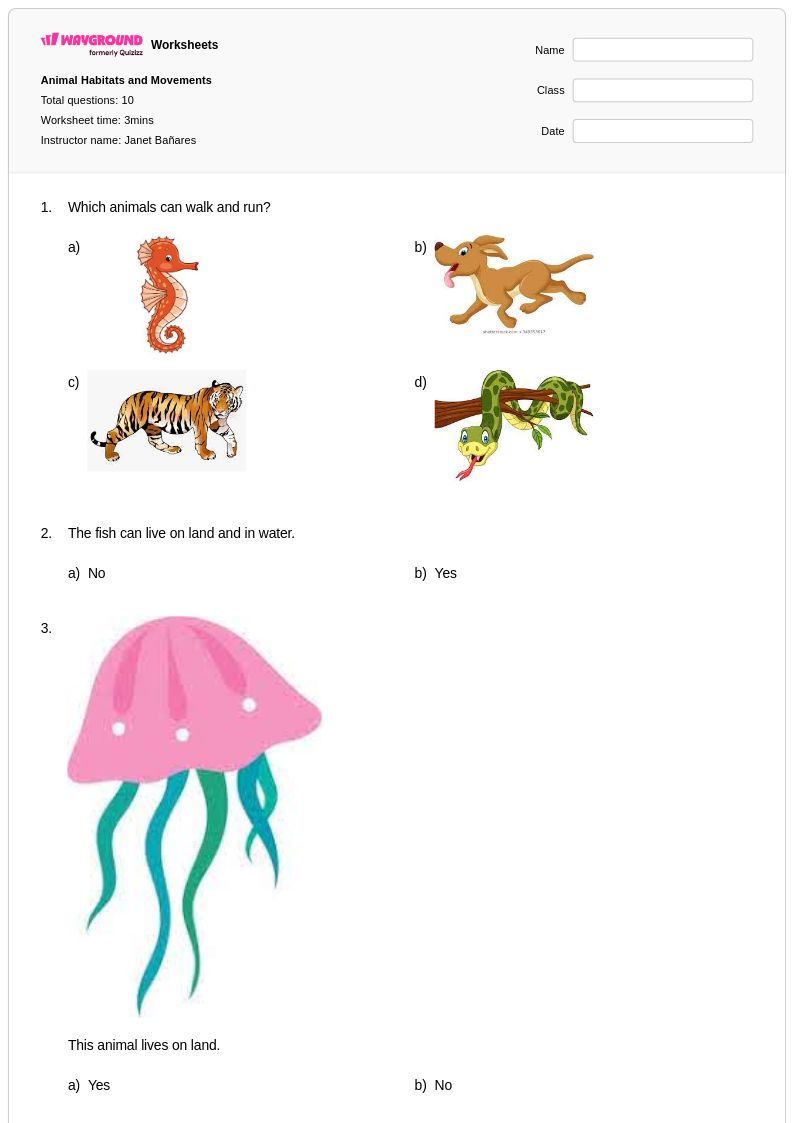
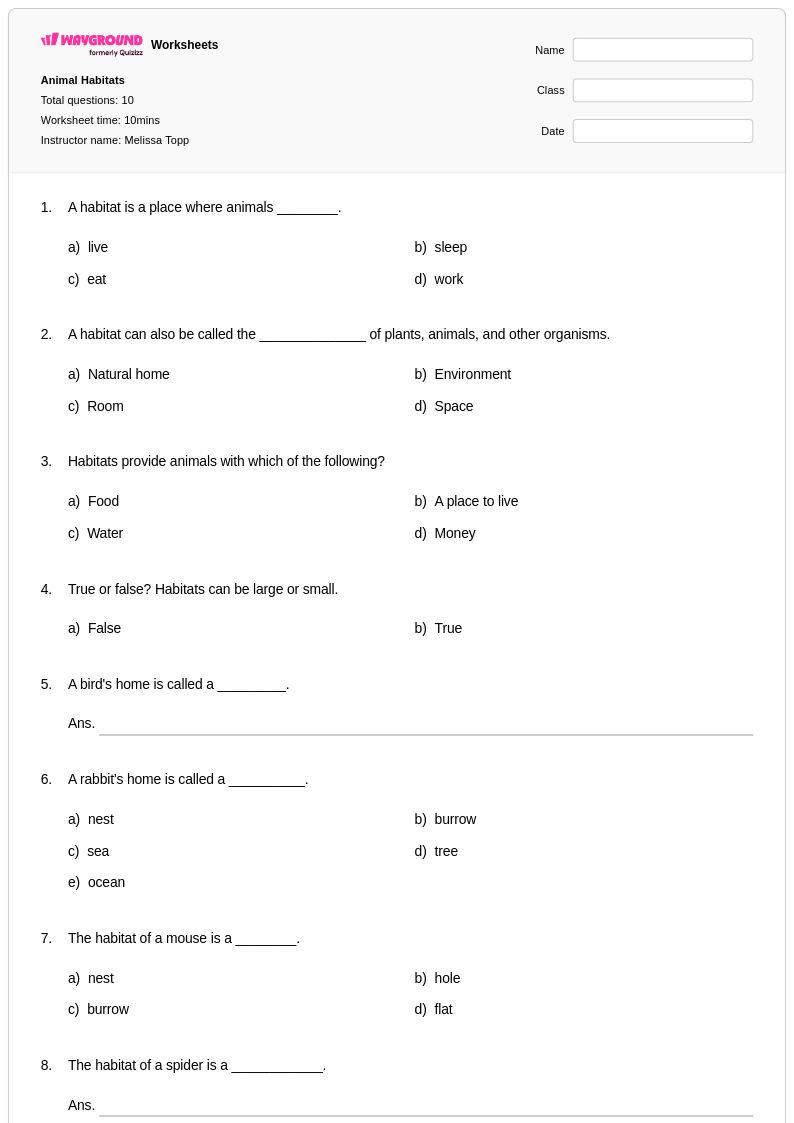
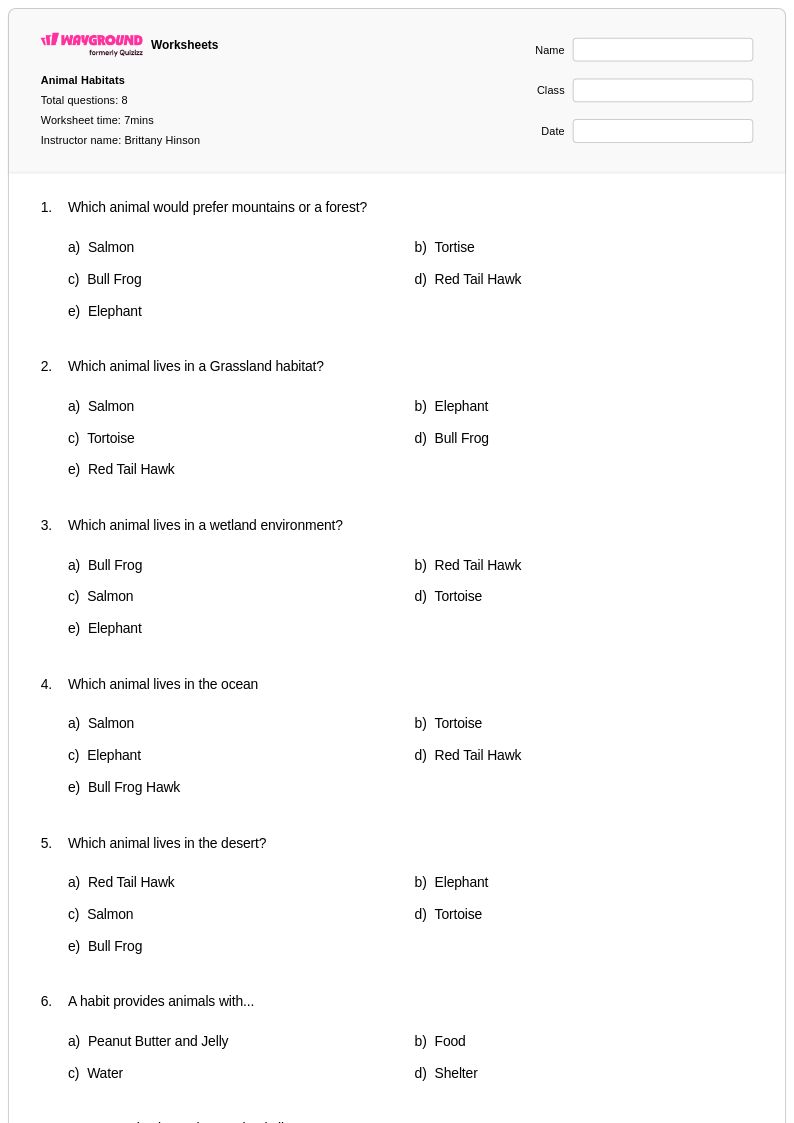
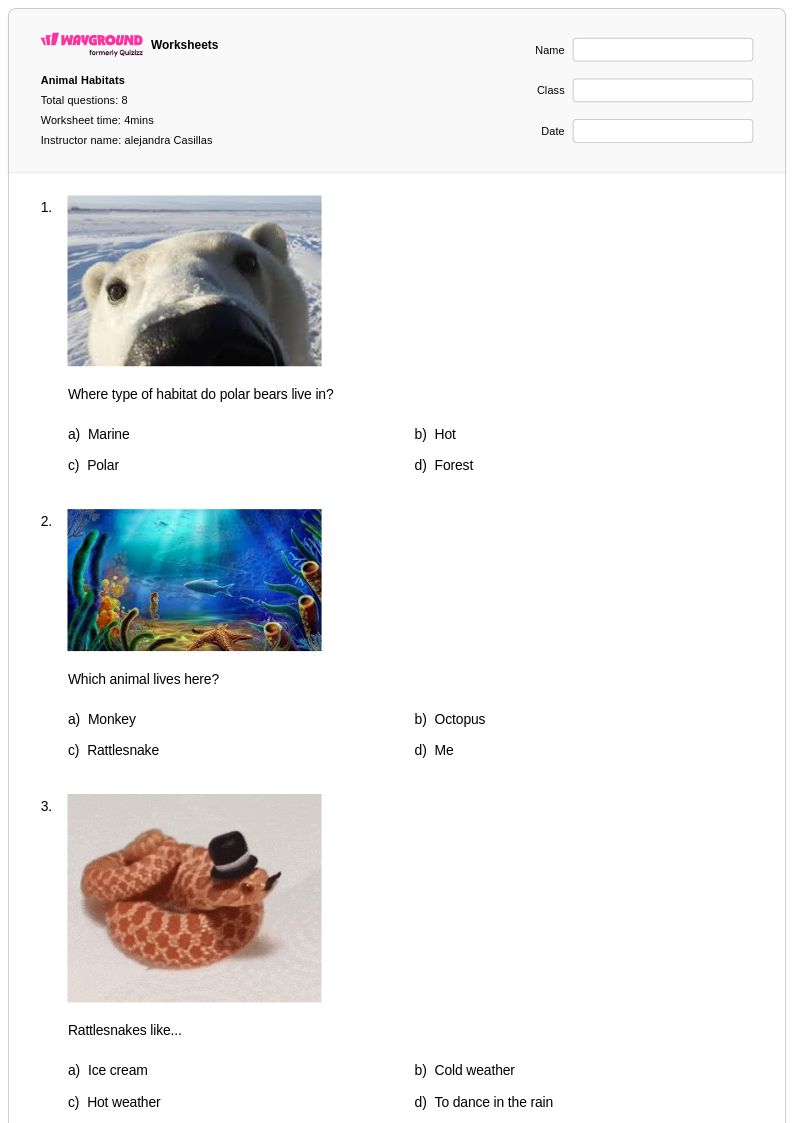
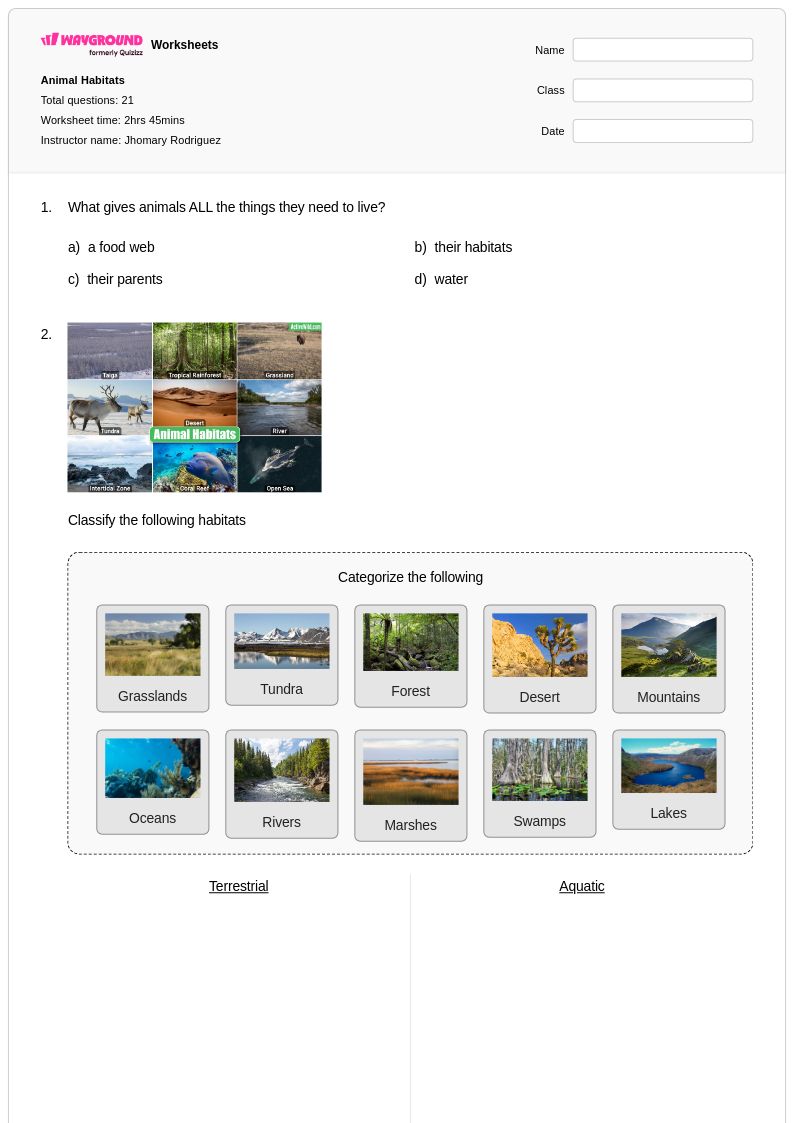
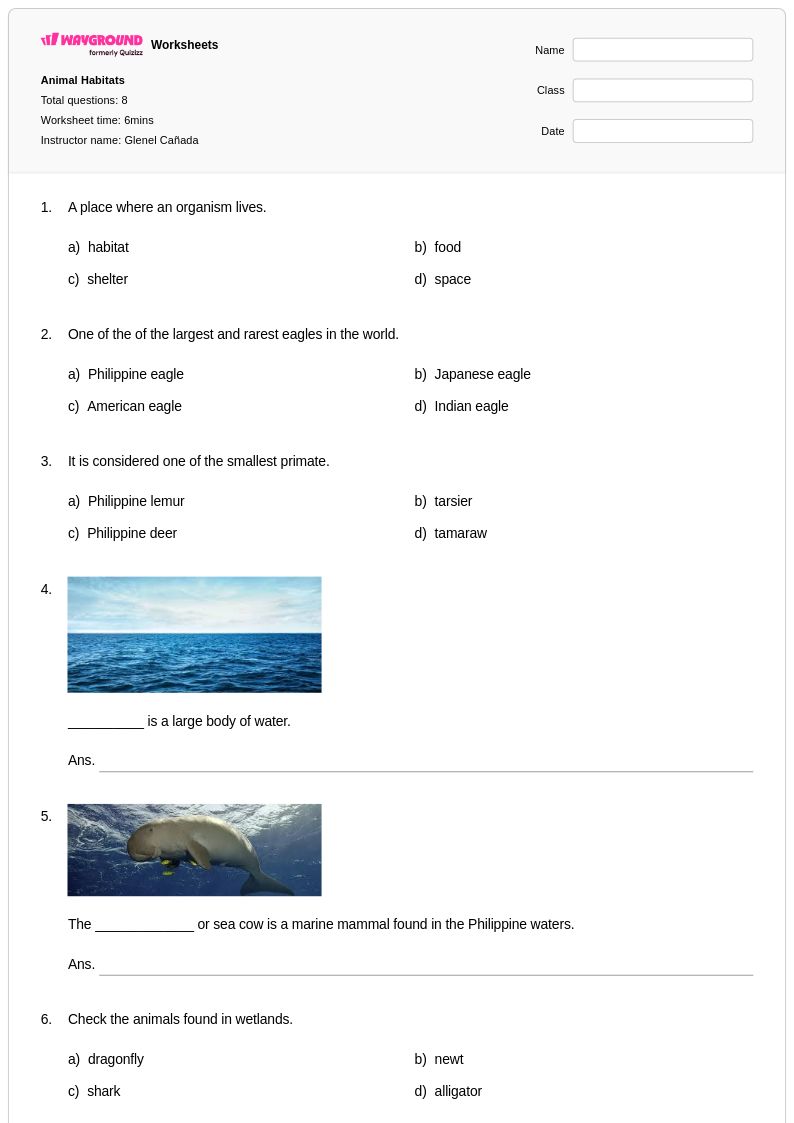
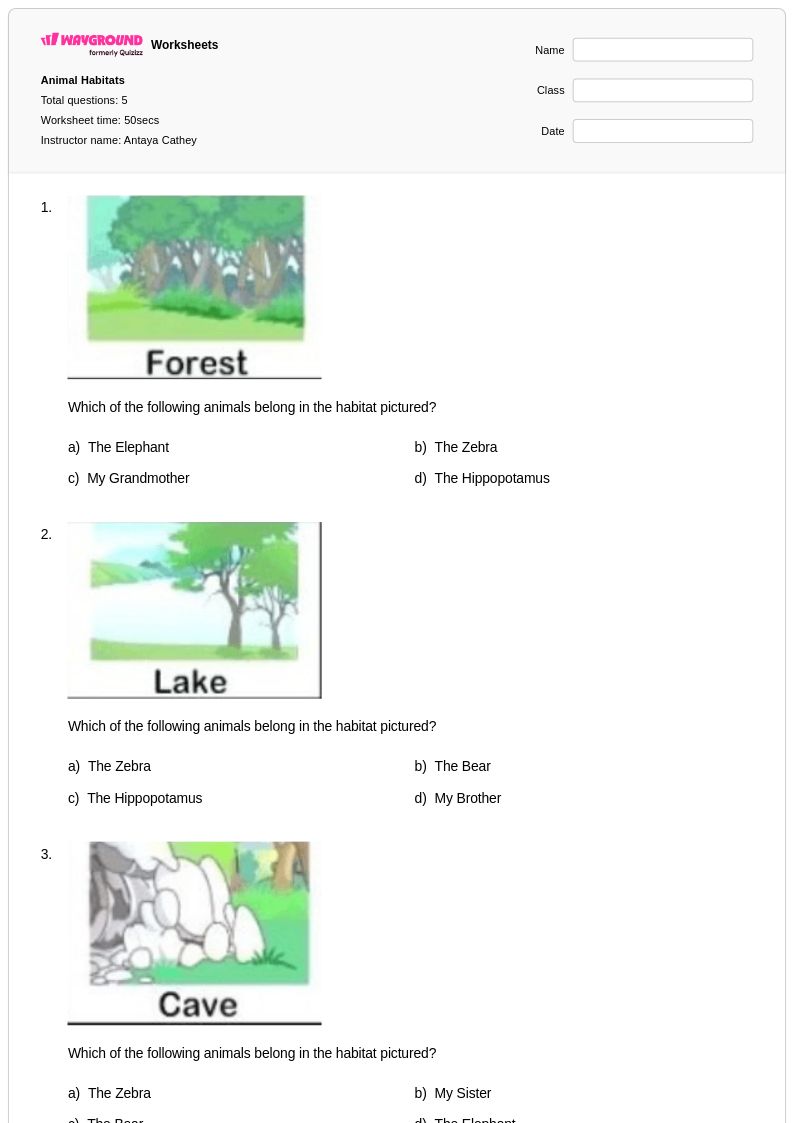
Explore Wayground's free animal habitats worksheets and printables that help students discover where different animals live, with engaging practice problems and complete answer keys in convenient PDF format.
Animal habitats worksheets available through Wayground (formerly Quizizz) provide comprehensive educational resources that help students explore the diverse environments where animals live, survive, and thrive. These expertly designed worksheets strengthen critical thinking skills as students analyze the relationships between organisms and their surroundings, examining how physical characteristics enable animals to adapt to specific environments like deserts, rainforests, oceans, and grasslands. Each worksheet collection includes detailed answer keys and practice problems that guide students through identifying habitat features, matching animals to appropriate environments, and understanding concepts such as food webs, shelter requirements, and seasonal adaptations. Available as free printables in convenient pdf format, these resources support hands-on learning while reinforcing essential life science vocabulary and ecological principles.
Wayground (formerly Quizizz) empowers educators with millions of teacher-created animal habitats worksheets that streamline lesson planning and enhance classroom instruction across diverse learning environments. The platform's robust search and filtering capabilities allow teachers to quickly locate resources aligned with curriculum standards, while differentiation tools enable customization for varied skill levels and learning needs. These flexible worksheet collections are available in both printable pdf and interactive digital formats, making them ideal for traditional classroom settings, remote learning, or hybrid educational models. Teachers can seamlessly integrate these resources into their instructional strategies for initial skill introduction, targeted remediation, advanced enrichment activities, or ongoing practice sessions, ensuring that all students develop a thorough understanding of how animals interact with and depend upon their natural habitats.
FAQs
How do I teach animal habitats to elementary students?
Start by anchoring instruction in familiar environments students can visualize, such as forests, oceans, and deserts, before introducing less familiar biomes like tundras or rainforests. Use concrete comparisons to help students understand why specific animals are suited to specific places, focusing on physical features like fur thickness, body shape, or coloration as evidence of adaptation. Connecting habitat to survival needs such as food, water, and shelter gives students a functional framework rather than just a list of animals and places.
What exercises help students practice matching animals to their habitats?
Matching activities that pair animals with environment illustrations are highly effective because they require students to apply reasoning rather than memorization. Cut-and-sort tasks, habitat mapping exercises, and food web diagrams push students to think about how animals depend on specific environmental features rather than simply identifying where an animal lives. Practice problems that include habitat features such as temperature, vegetation, and water source help students build criteria-based thinking about animal-environment relationships.
What misconceptions do students commonly have about animal habitats?
A frequent misconception is that animals can live anywhere as long as they have food, overlooking the role of climate, shelter, and physical adaptations in survival. Students also often confuse habitat with biome, treating them as interchangeable when in fact a biome is a broad climate zone and a habitat is the specific local environment where an organism lives. Another common error is assuming that adaptation is a choice animals make rather than a trait that develops over generations through natural selection.
How can I use animal habitats worksheets to support different skill levels in the same class?
Differentiated versions of habitat worksheets can range from visual matching tasks for developing readers to analytical prompts that ask students to explain why a specific animal could not survive outside its native habitat. On Wayground, teachers can apply student-level accommodations such as read aloud support for students who need questions read to them, reduced answer choices to lower cognitive load for students who need scaffolding, and extended time for those who require it. These settings can be applied to individual students without notifying the rest of the class, so all students work through the same material at an appropriate level of support.
How do I use Wayground's animal habitats worksheets in my classroom?
Wayground's animal habitats worksheets are available as printable PDFs for traditional classroom use and in digital formats for technology-integrated or remote learning environments. Teachers can also host the worksheets as interactive quizzes directly on Wayground, making it easy to collect student responses and review answers in real time. The included answer keys make these resources practical for independent practice, homework, or formative assessment without additional preparation.
What life science vocabulary should students know before working on animal habitats worksheets?
Students should be familiar with terms like habitat, adaptation, organism, predator, prey, and food web before engaging with higher-order habitat activities. Understanding the difference between biotic factors such as plants and animals and abiotic factors such as sunlight, water, and temperature helps students analyze habitats with greater precision. Pre-teaching this vocabulary through a brief word wall or vocabulary activity ensures students can focus on the ecological concepts rather than decoding unfamiliar terms mid-worksheet.