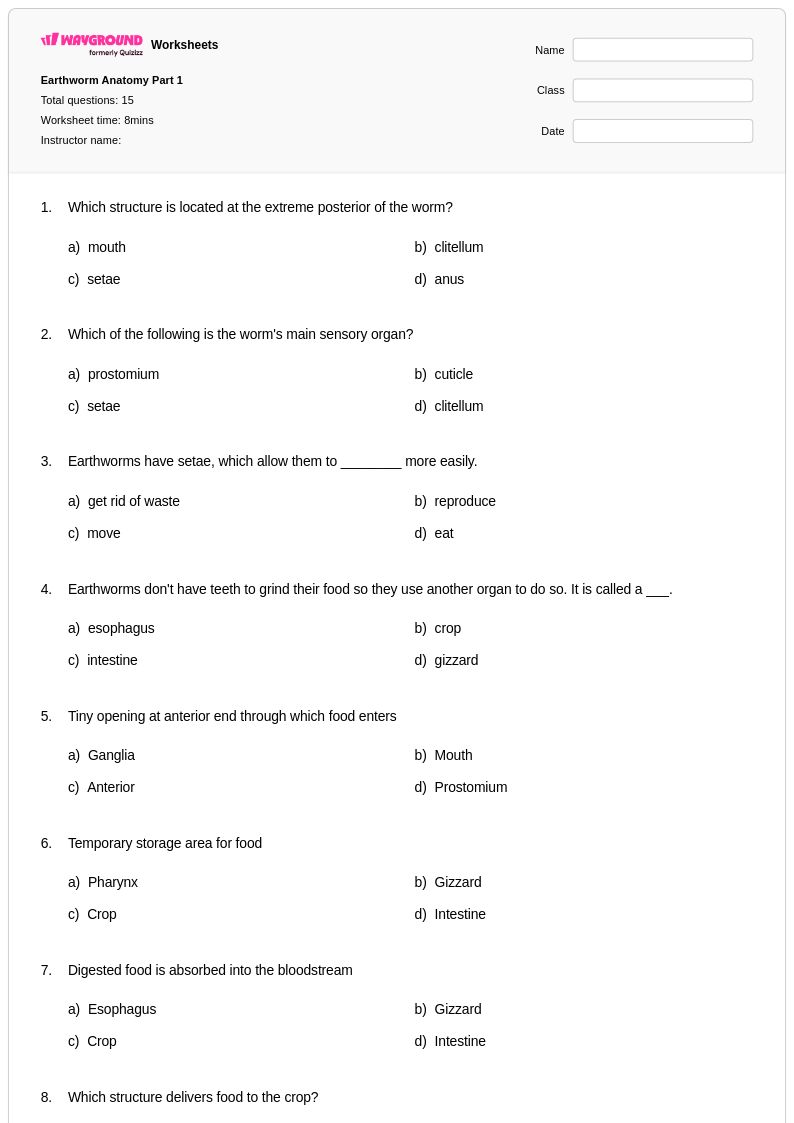
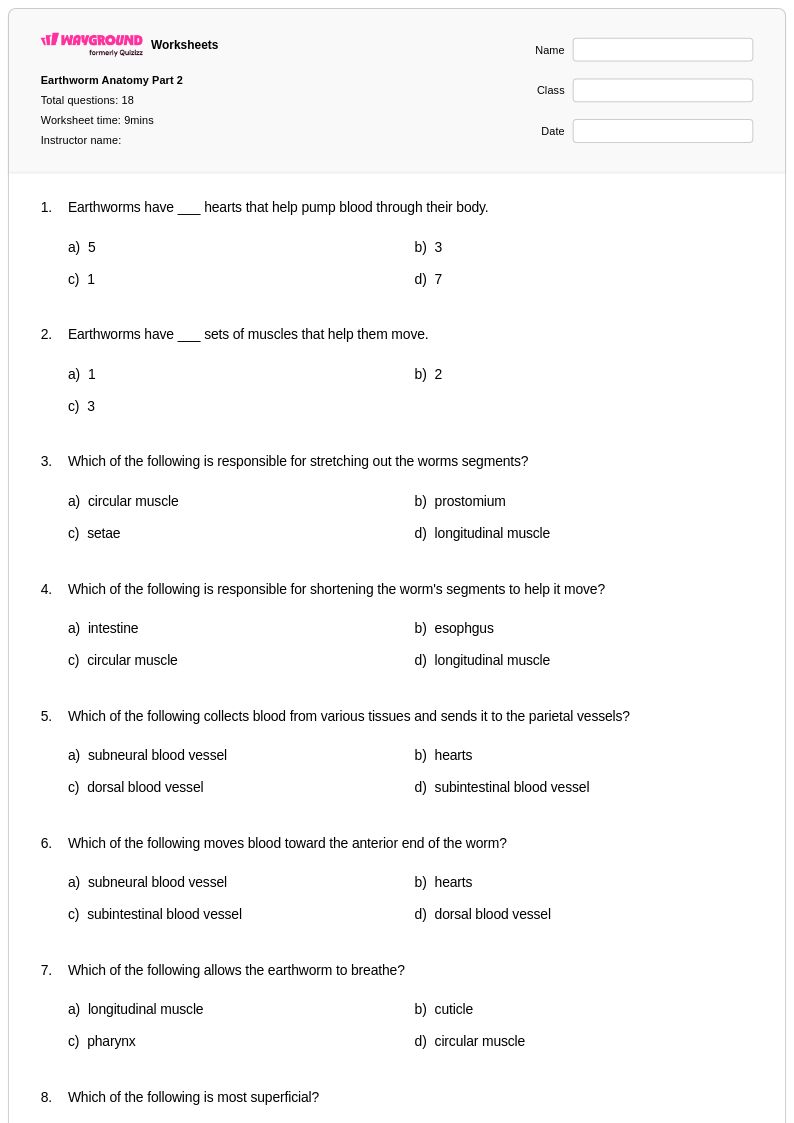
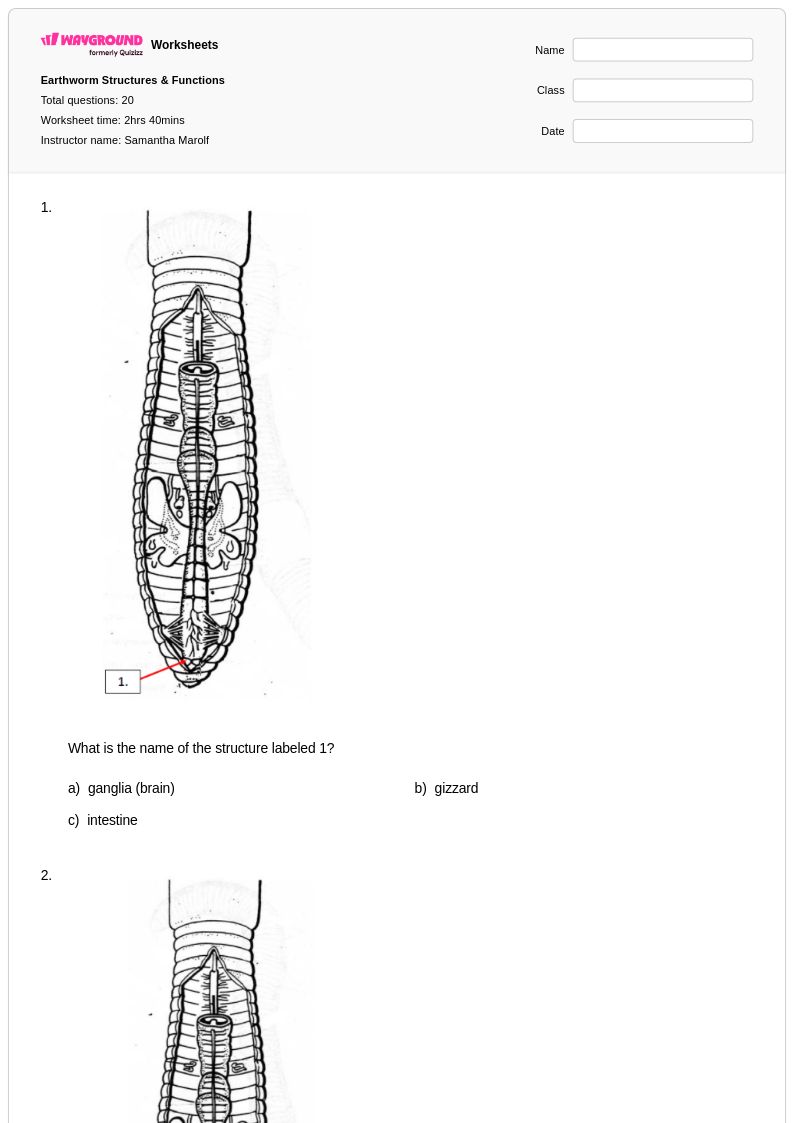
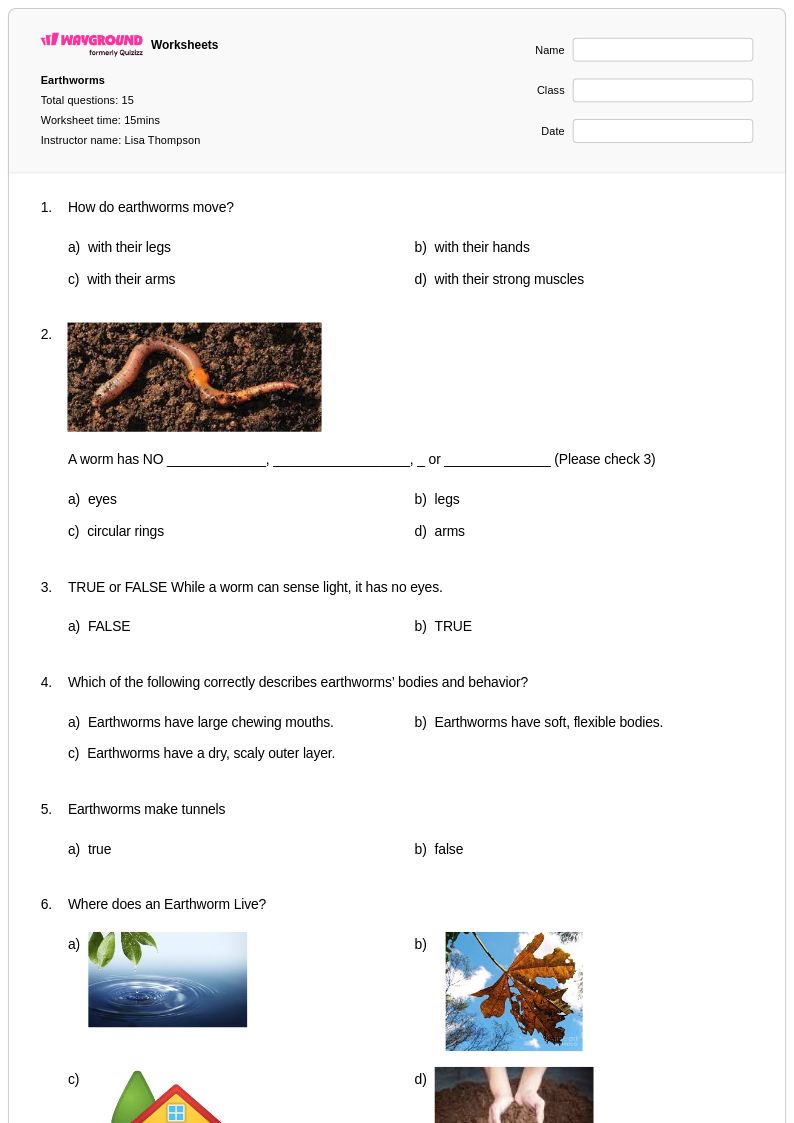
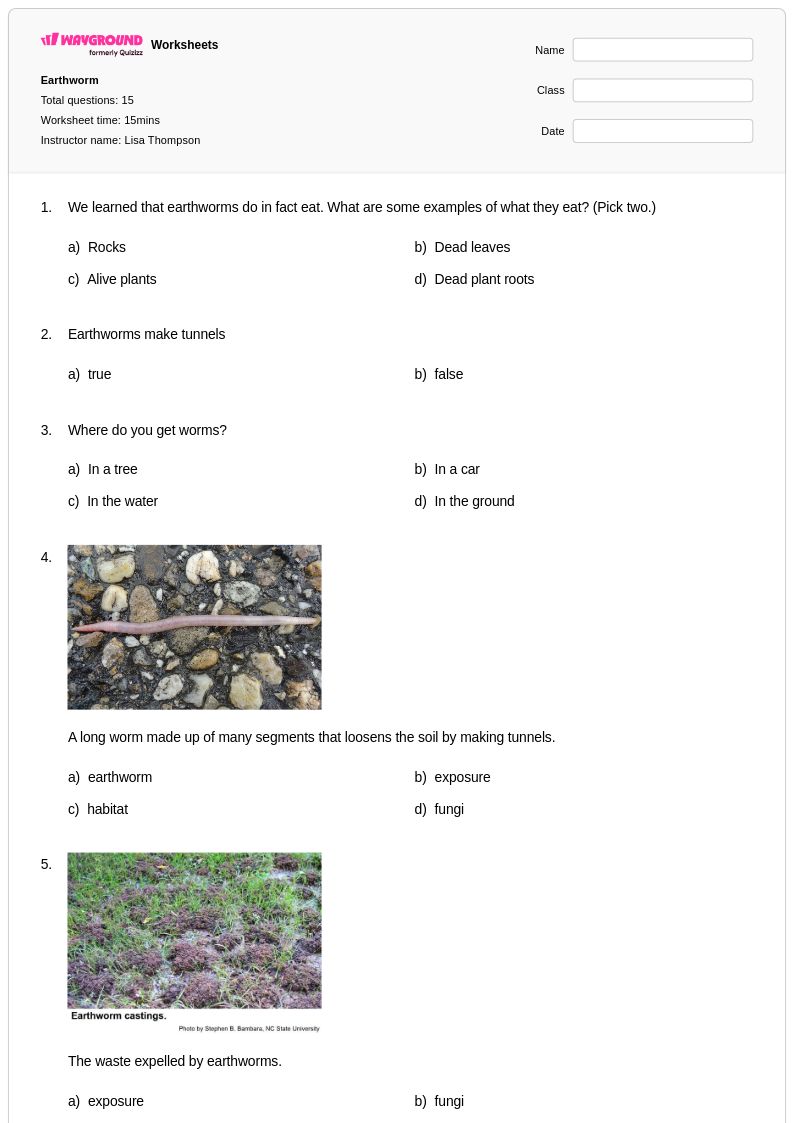
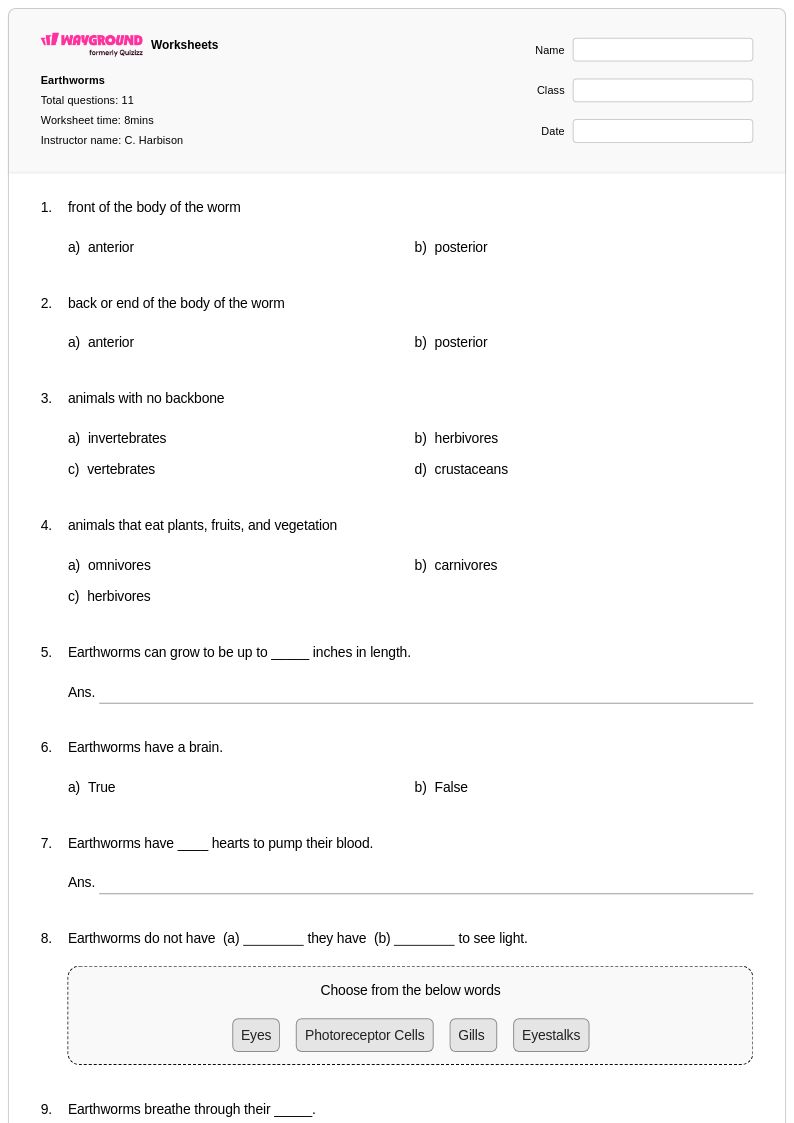
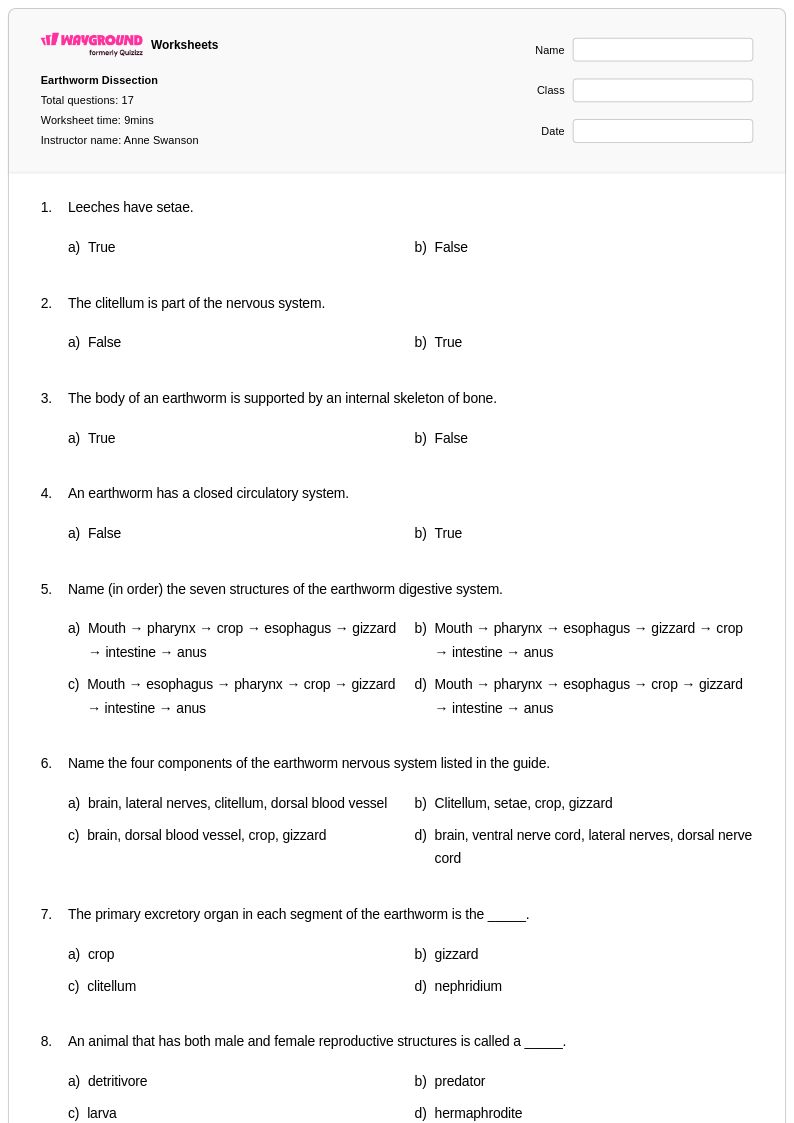
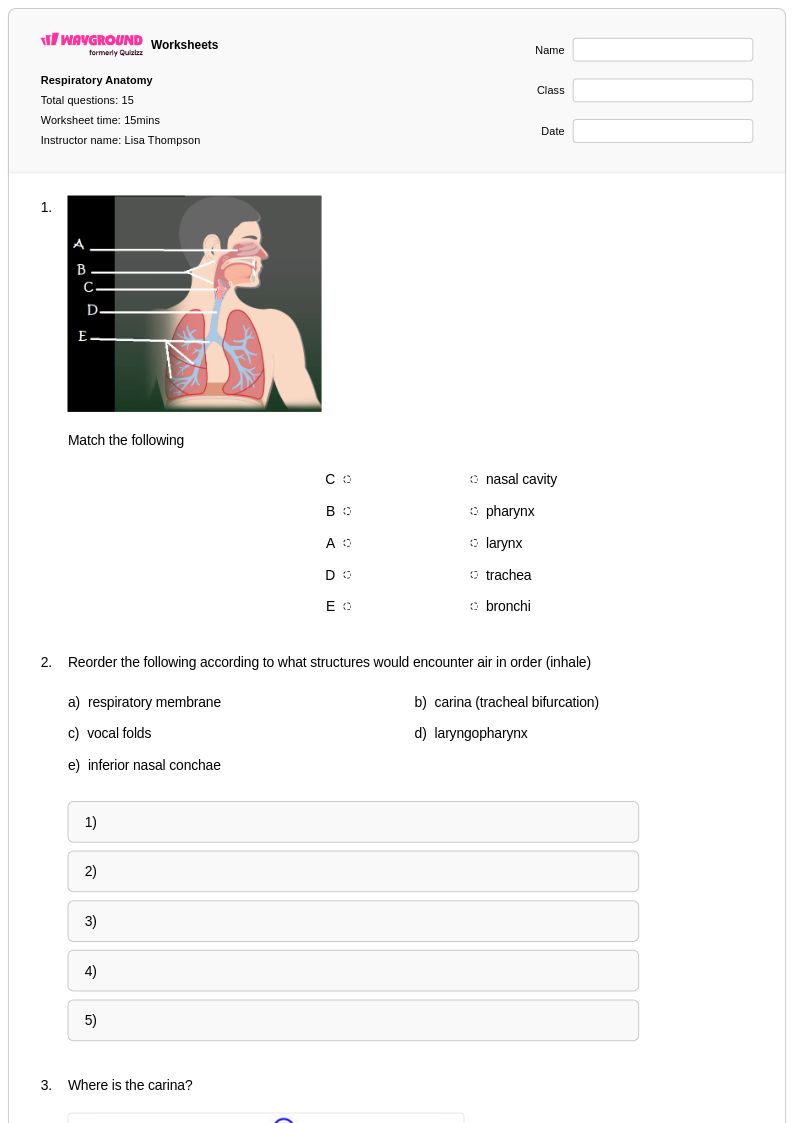
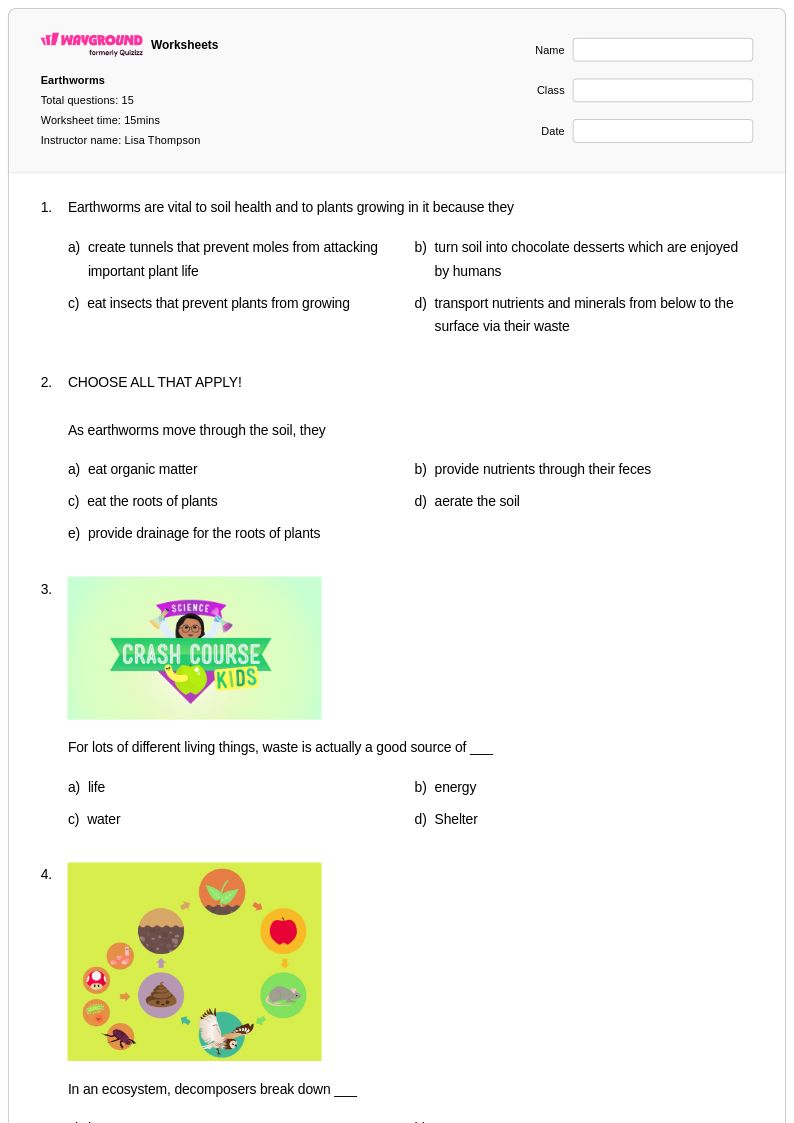
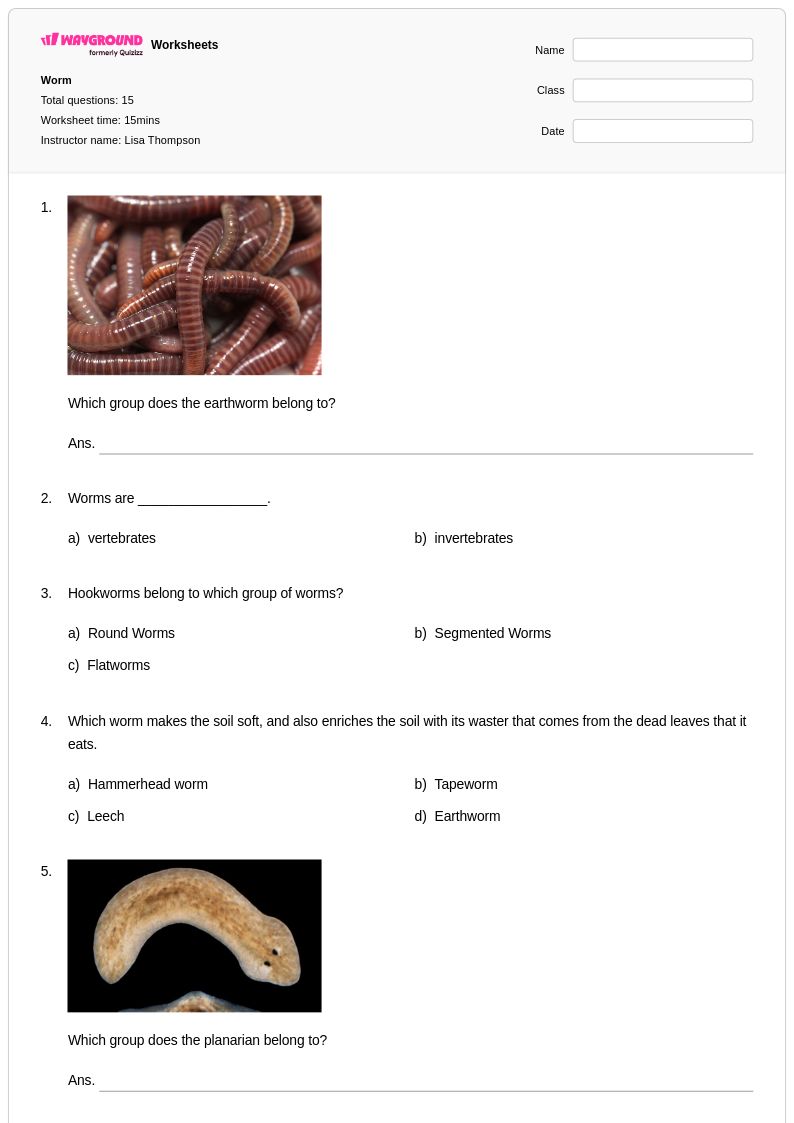
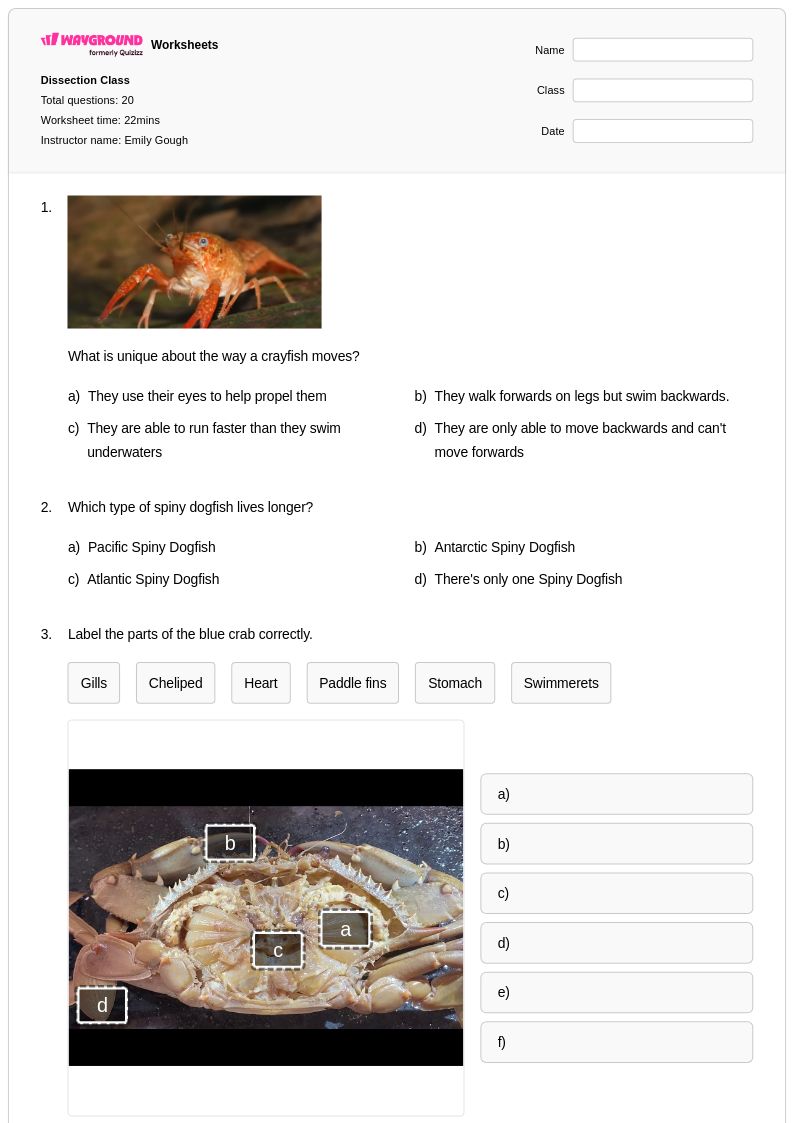
Discover free earthworm anatomy worksheets and printables that help students explore the internal and external structures of earthworms through detailed diagrams, practice problems, and comprehensive answer keys.
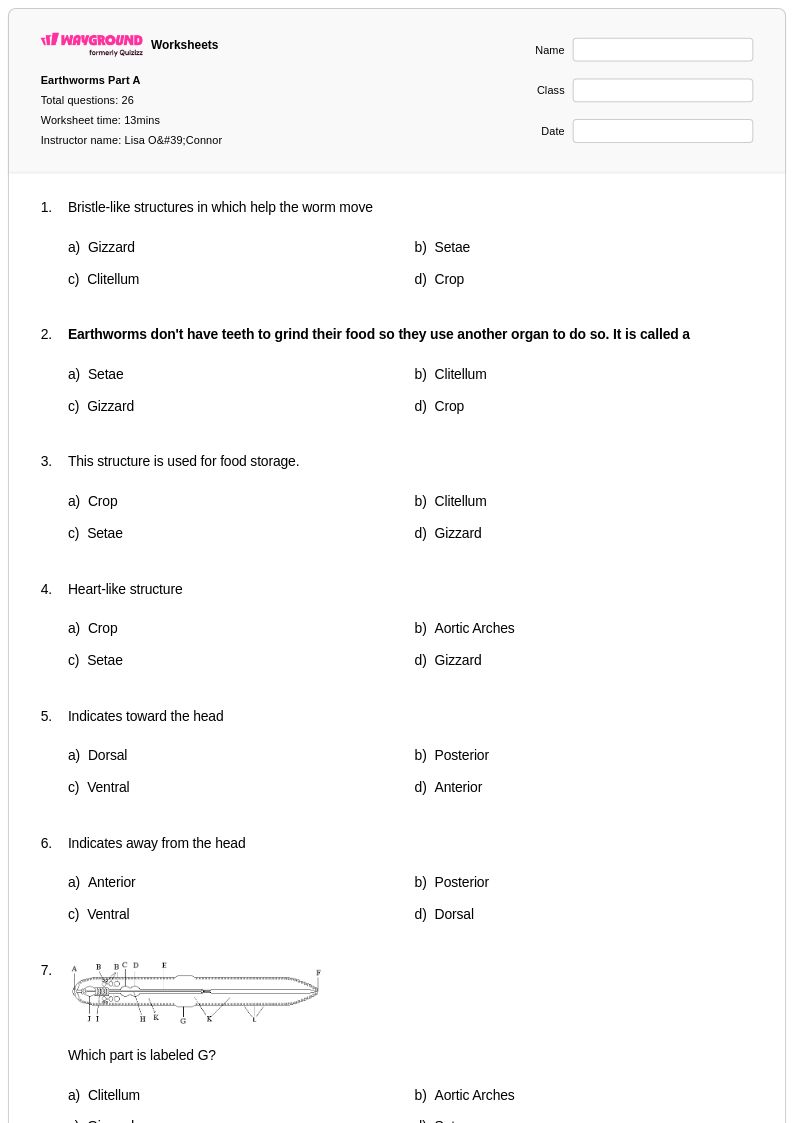
Earthworm anatomy worksheets available through Wayground (formerly Quizizz) provide comprehensive resources for exploring the fascinating internal and external structures of these essential invertebrates. These educational materials guide students through detailed examinations of earthworm body segments, the digestive system, circulatory components, and reproductive organs, strengthening critical observation skills and biological vocabulary development. The collection includes practice problems that challenge learners to identify key anatomical features such as the clitellum, setae, and pharynx, while answer key materials support both independent study and classroom instruction. Free printable resources complement hands-on dissection activities, allowing students to reinforce their understanding through labeled diagrams, cross-sectional views, and comparative anatomy exercises that highlight the earthworm's role as a model organism for understanding segmented body plans.
Wayground (formerly Quizizz) empowers educators with millions of teacher-created earthworm anatomy worksheets that feature robust search and filtering capabilities, enabling quick access to materials aligned with specific learning standards and curriculum requirements. The platform's differentiation tools allow teachers to customize worksheet difficulty levels, modify content for diverse learning needs, and create targeted practice sessions for both remediation and enrichment purposes. These versatile resources are available in both printable pdf formats for traditional classroom use and digital formats that support interactive learning environments, making lesson planning more efficient while providing flexible options for skill practice. Teachers can seamlessly integrate these materials into comprehensive life science units, using the extensive worksheet library to scaffold student understanding from basic earthworm identification through complex physiological processes and ecological relationships.
FAQs
How do I teach earthworm anatomy to my students?
Teaching earthworm anatomy is most effective when you combine visual labeling activities with hands-on or virtual dissection. Start by introducing external structures like the clitellum, setae, and prostomium using a diagram before moving to internal systems such as the digestive tract, aortic arches, and nephridia. Pairing labeled diagrams with cross-sectional views helps students build spatial understanding of how organ systems are arranged within a segmented body plan.
What worksheets or exercises help students practice earthworm anatomy?
Practice worksheets that ask students to label diagrams of both external and internal earthworm structures are highly effective for reinforcing anatomical vocabulary. Cross-sectional diagram exercises are particularly useful for helping students distinguish between organ systems that are difficult to visualize in a whole-body view. Including identification questions about structures like the pharynx, crop, gizzard, and seminal vesicles challenges students to move beyond surface-level recall toward functional understanding.
What mistakes do students commonly make when learning earthworm anatomy?
Students frequently confuse the crop and gizzard because both are part of the digestive system and are physically adjacent — the key distinction is function, since the crop stores food while the gizzard grinds it. Another common error is misidentifying the clitellum as a wound or abnormality rather than a reproductive structure. Students also struggle to locate the aortic arches and often incorrectly call them a heart, so emphasizing that earthworms have multiple pumping vessels rather than a single heart helps correct this misconception early.
How does earthworm anatomy connect to broader biology concepts?
Earthworm anatomy is a foundational topic in invertebrate biology because earthworms serve as a model organism for understanding segmentation, coelom development, and organ system specialization. Their digestive, circulatory, and excretory systems illustrate core biological principles that apply across many animal phyla. Because earthworms are relatively simple compared to vertebrates, they provide an accessible entry point for discussing how organ systems work together to maintain homeostasis.
How do I use Wayground's earthworm anatomy worksheets in my classroom?
Wayground's earthworm anatomy worksheets are available as printable PDFs for traditional classroom use and in digital formats for technology-integrated or remote learning environments. You can also host them as a quiz directly on Wayground, allowing students to complete the activity interactively while you track responses in real time. The included answer keys support both self-paced independent study and whole-class instruction, making these worksheets flexible enough for introduction, guided practice, or review.
How can I differentiate earthworm anatomy instruction for students with different learning needs?
For students who need additional support, simplified diagrams with fewer structures to label and reduced answer choices can lower cognitive load without removing the core learning objective. Wayground allows teachers to apply accommodations at the individual student level, including read-aloud support for students who struggle with anatomical terminology and extended time for students who need it. These settings can be configured per student and applied across multiple sessions without affecting the experience of other students in the class.