Free Printable Derivative Graphs Worksheets for Class 12
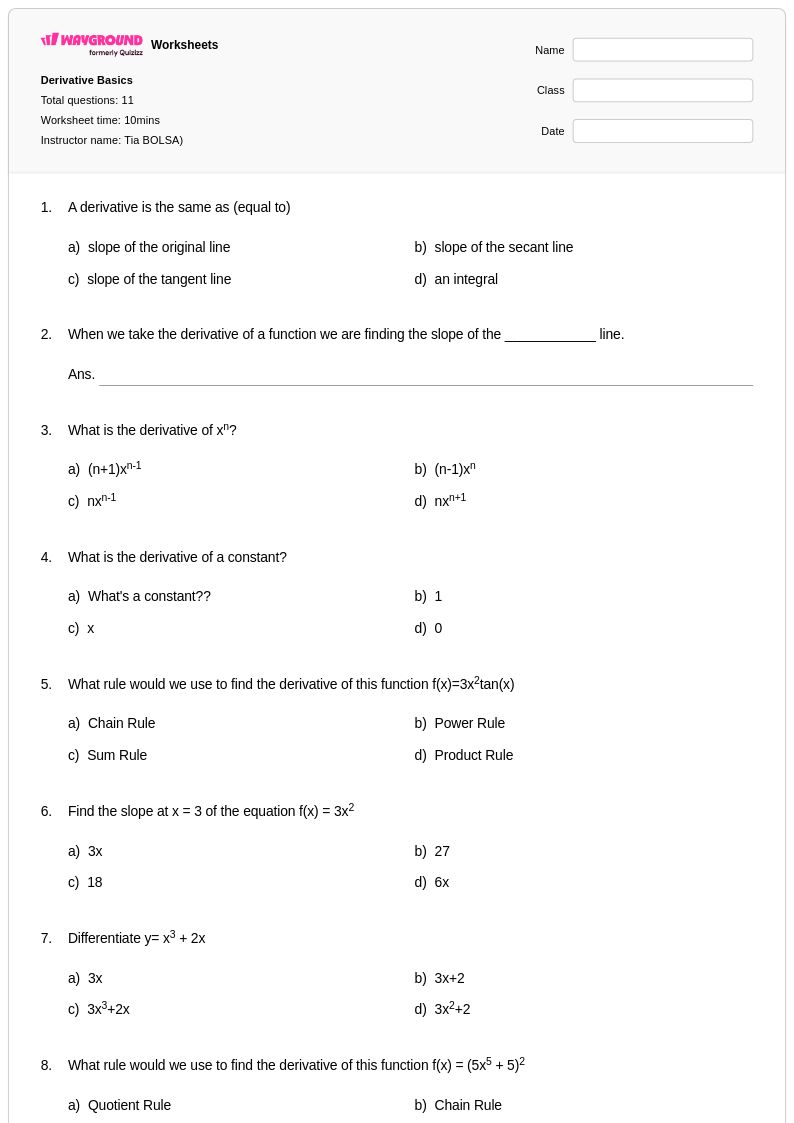
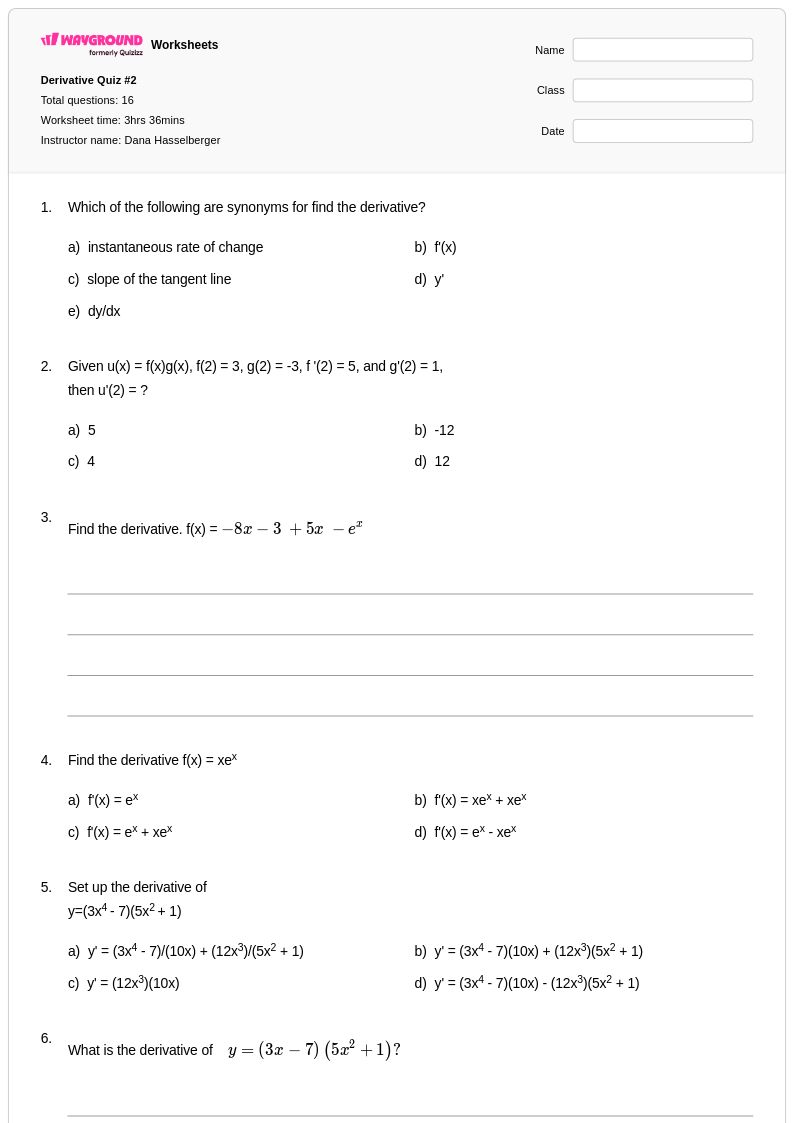
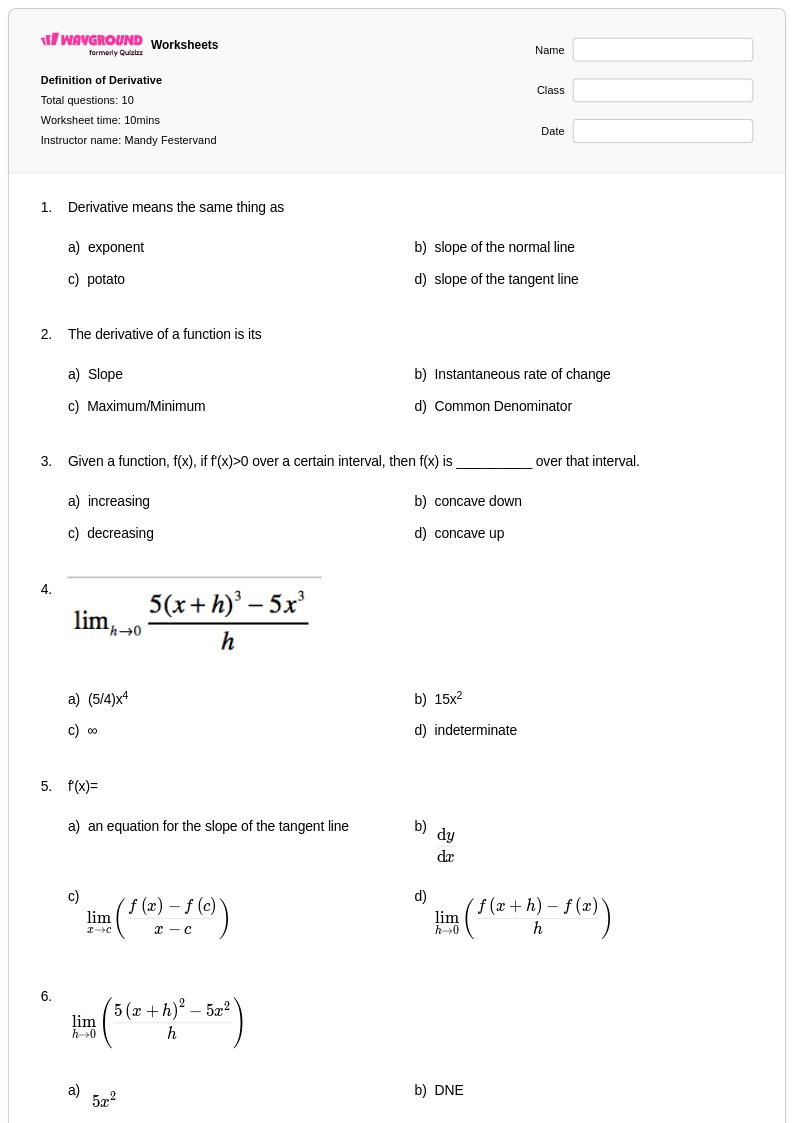
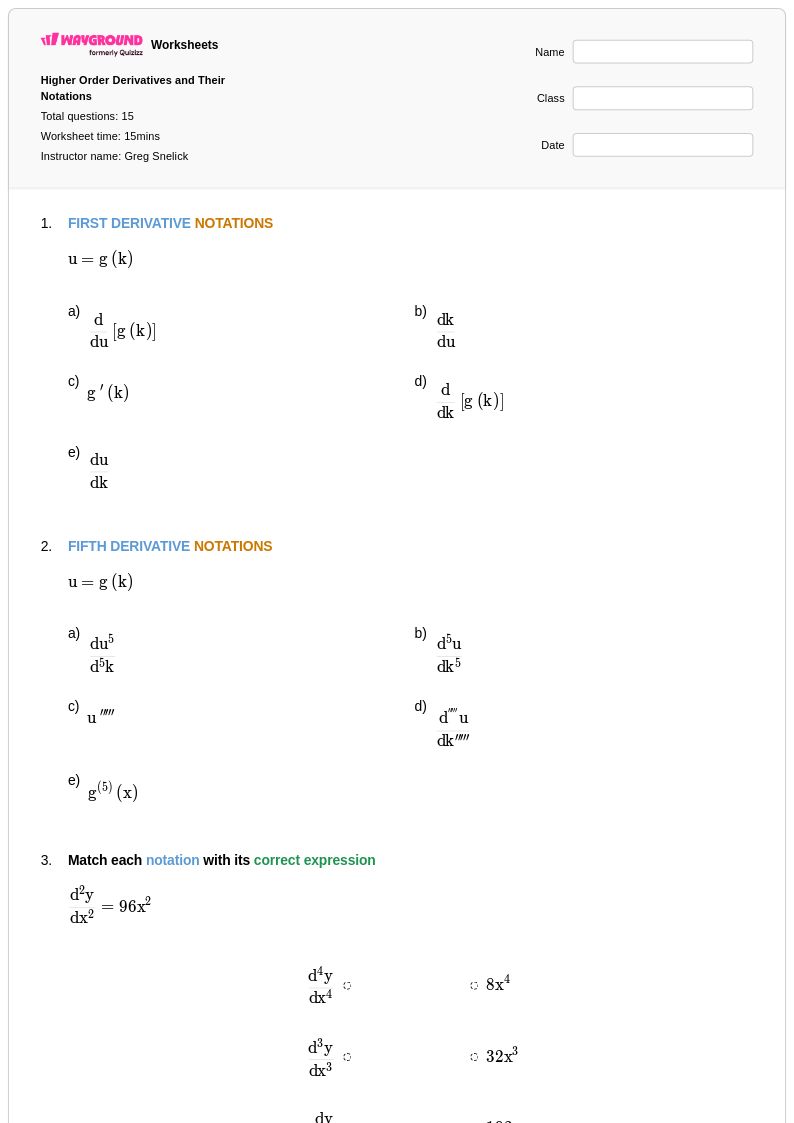
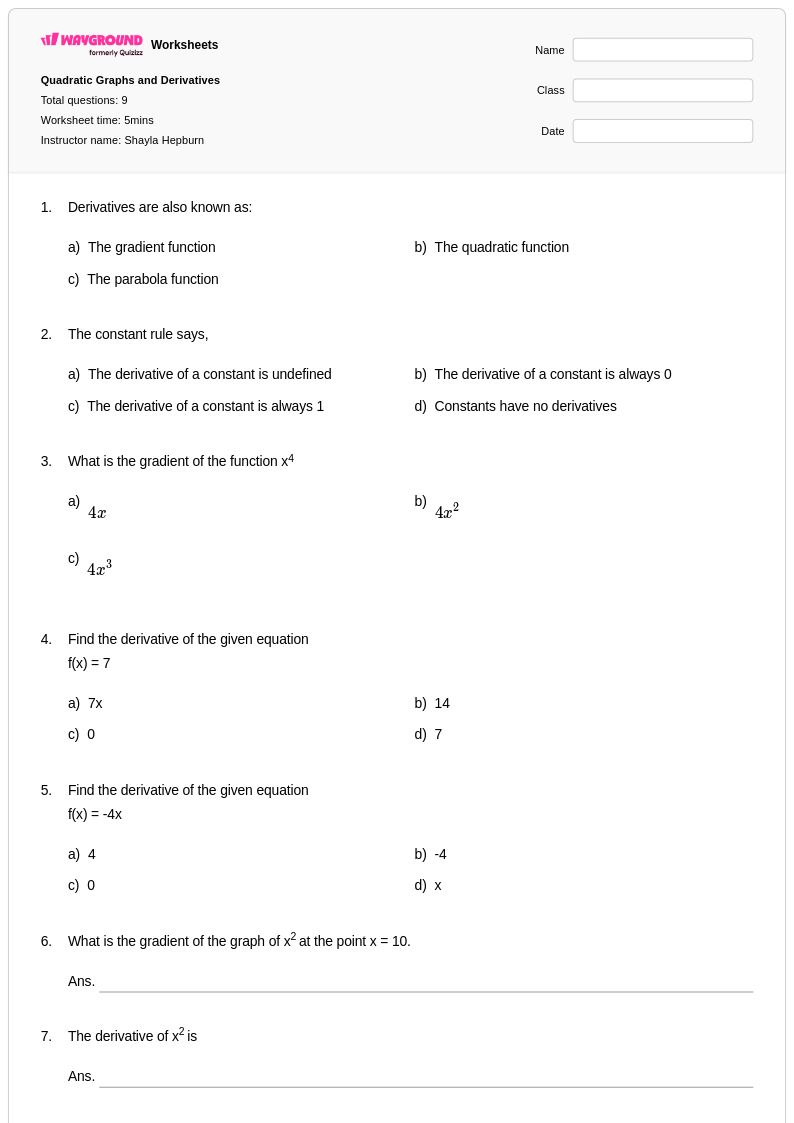
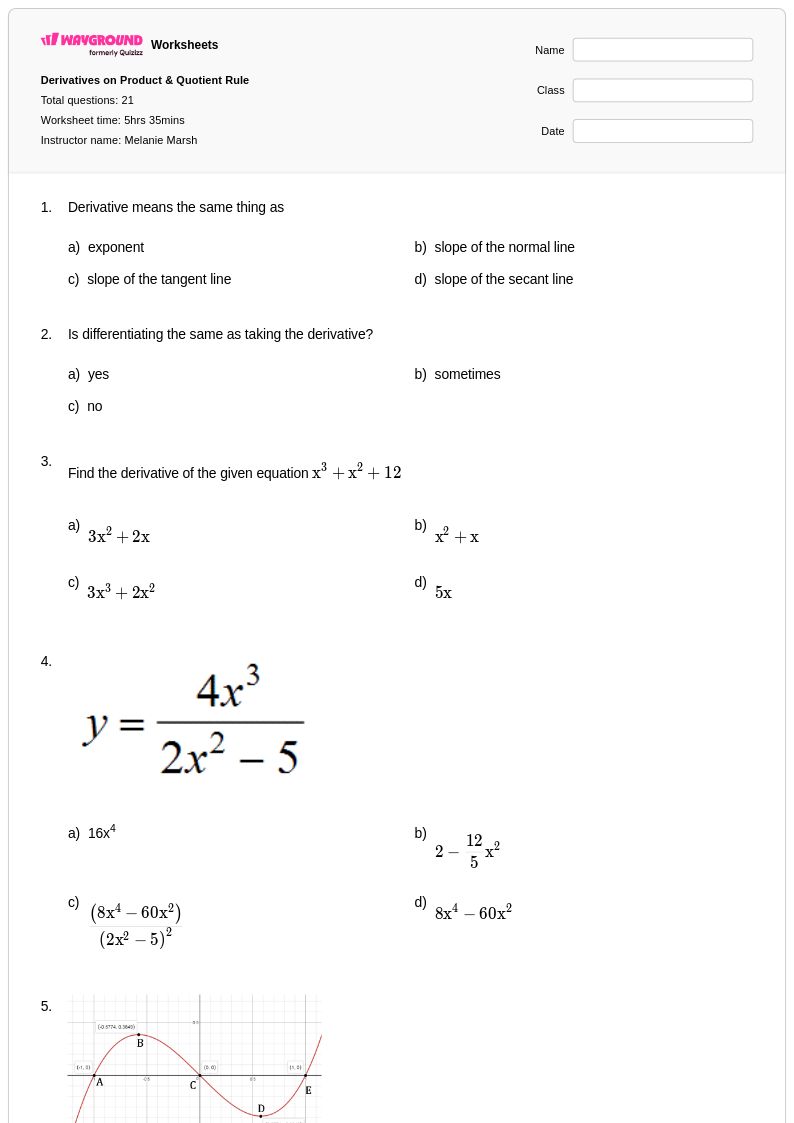
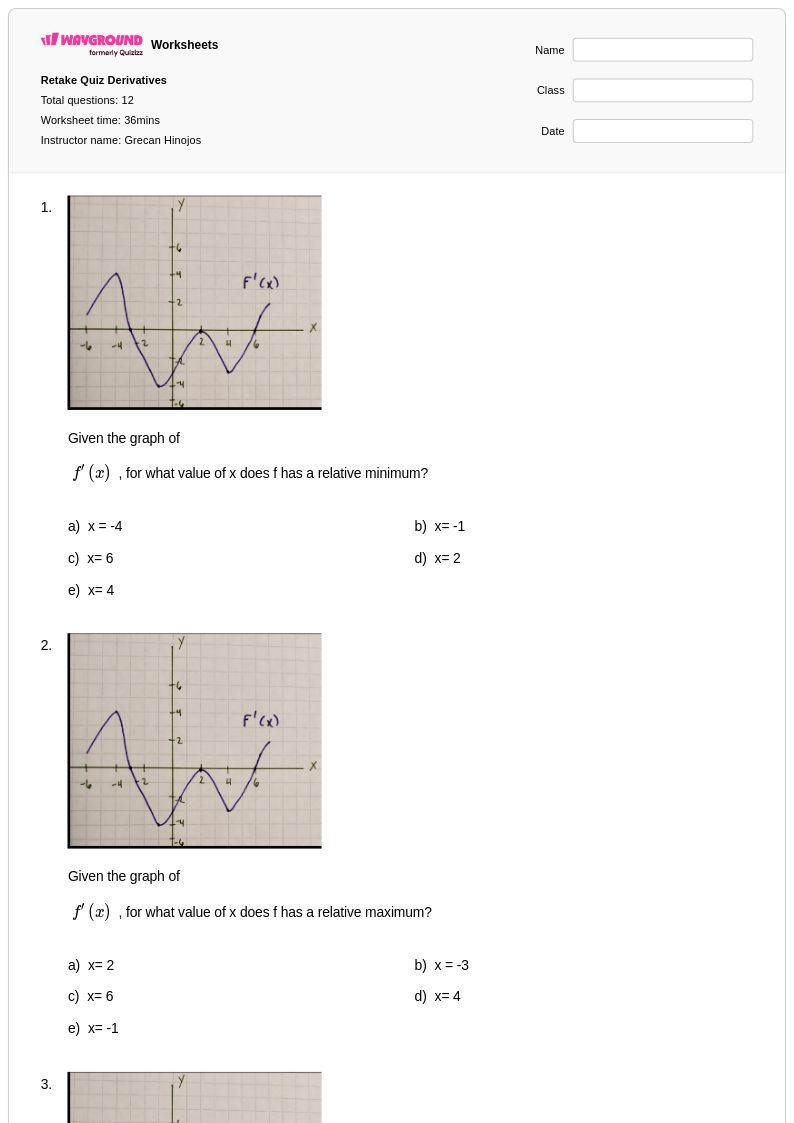
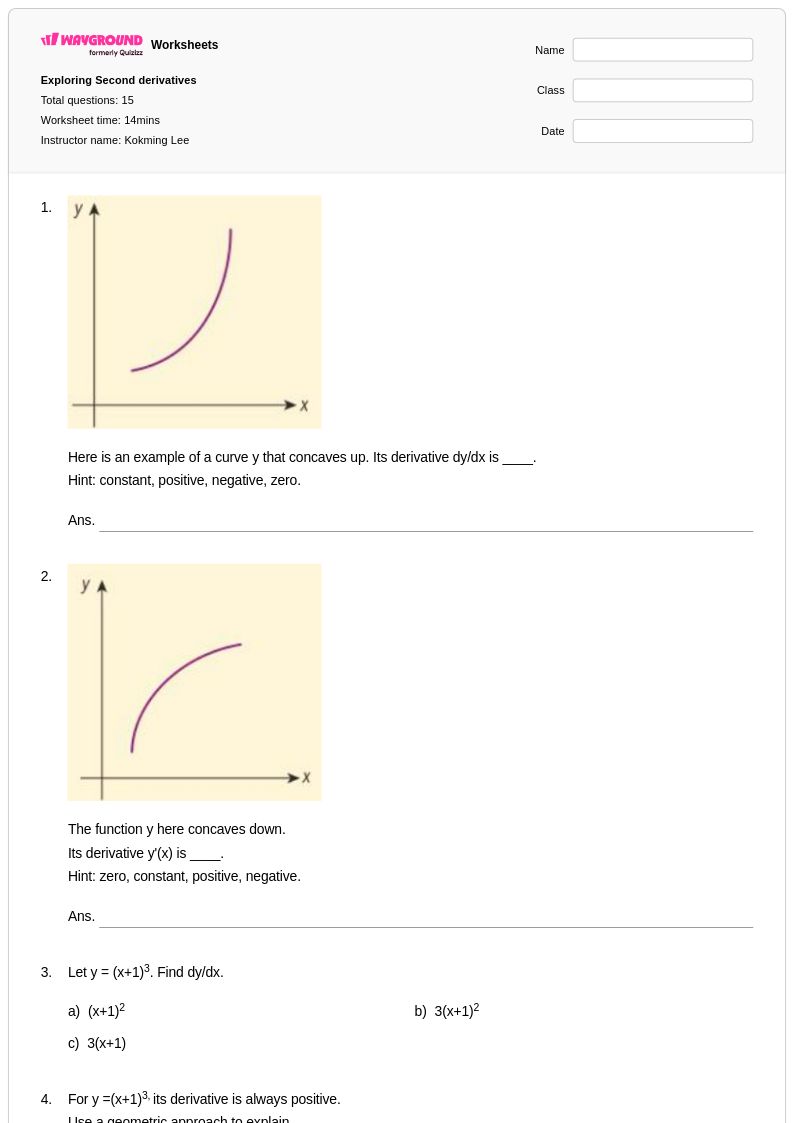
Class 12 derivative graphs worksheets from Wayground provide comprehensive printables and practice problems with answer keys to help students master graphing derivatives, analyzing function behavior, and understanding the relationship between functions and their derivatives.
Explore printable Derivative Graphs worksheets for Class 12
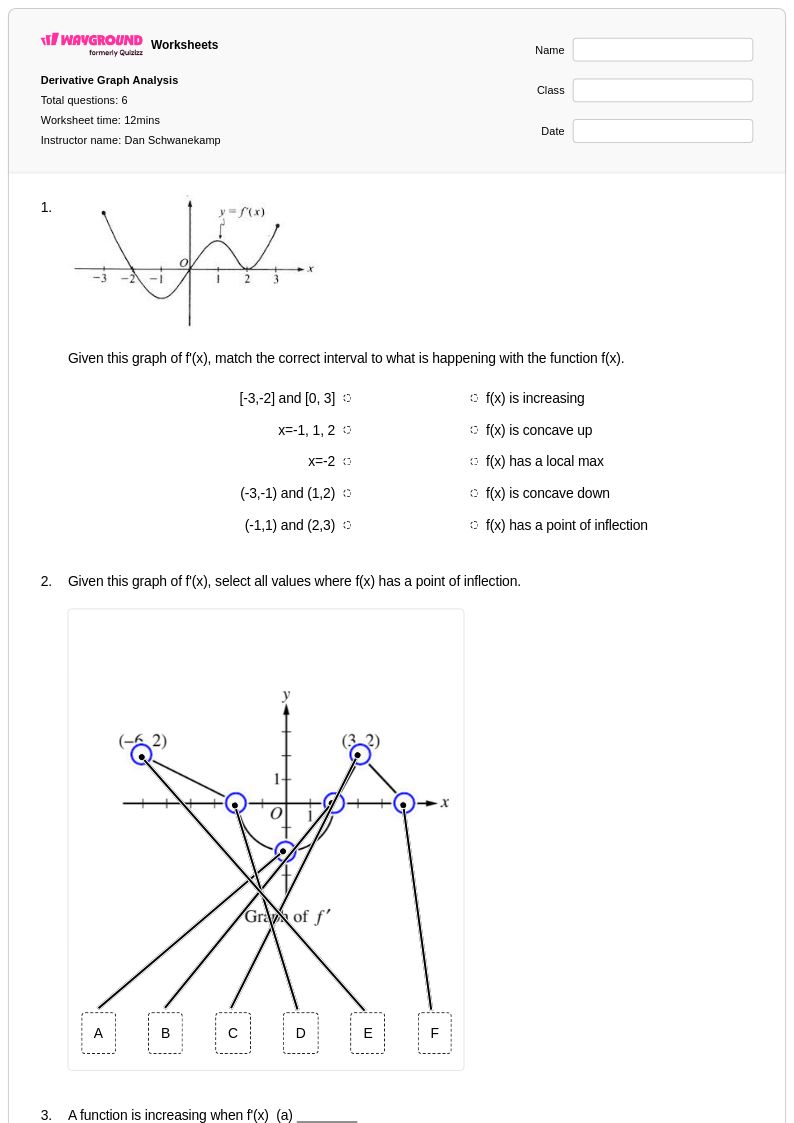
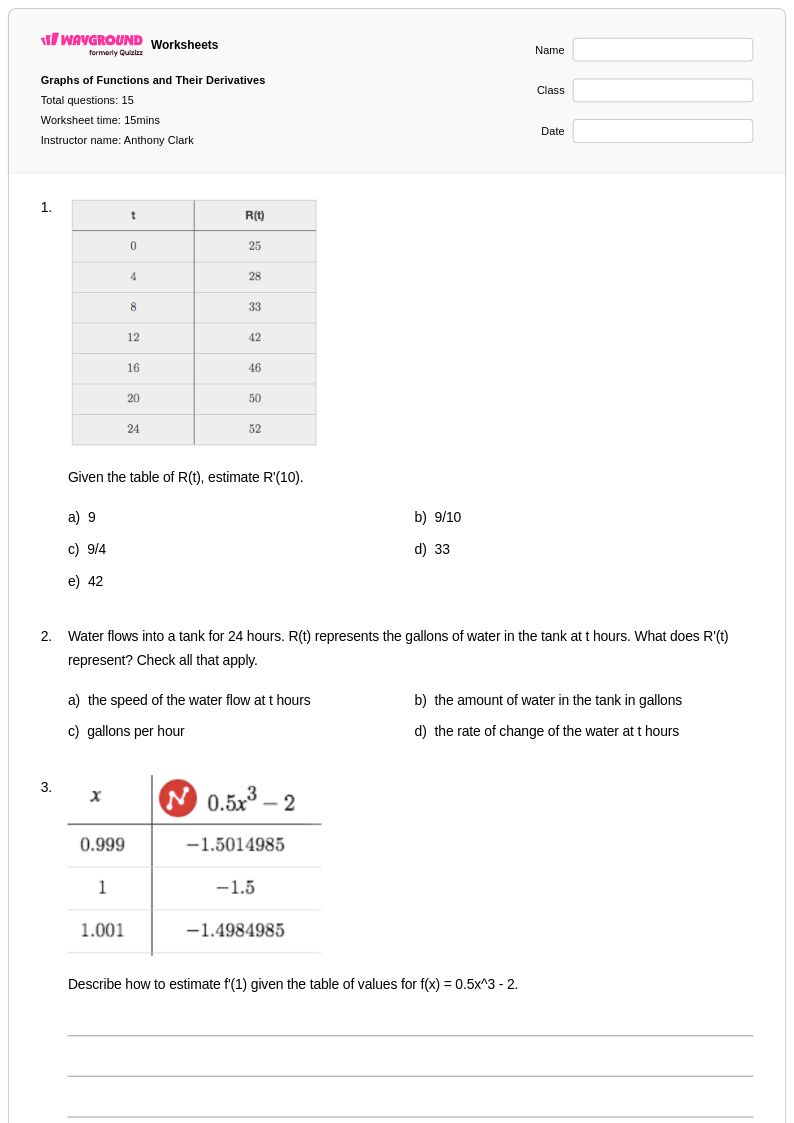
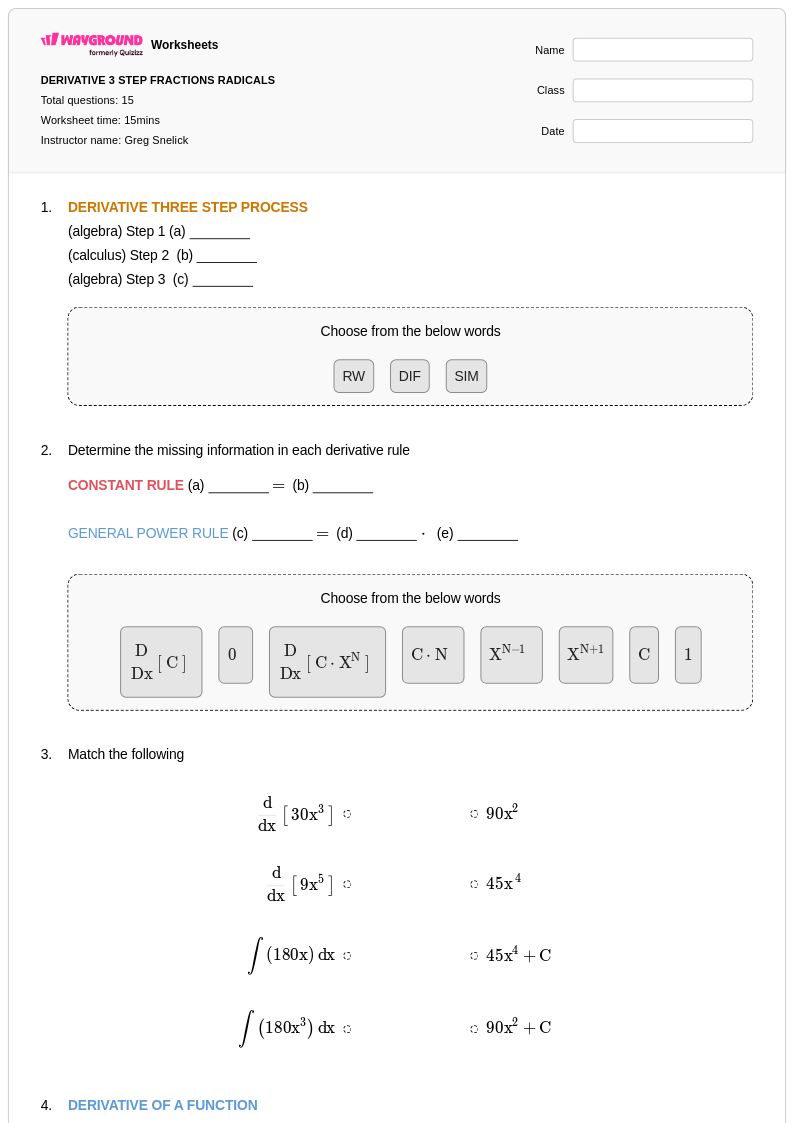
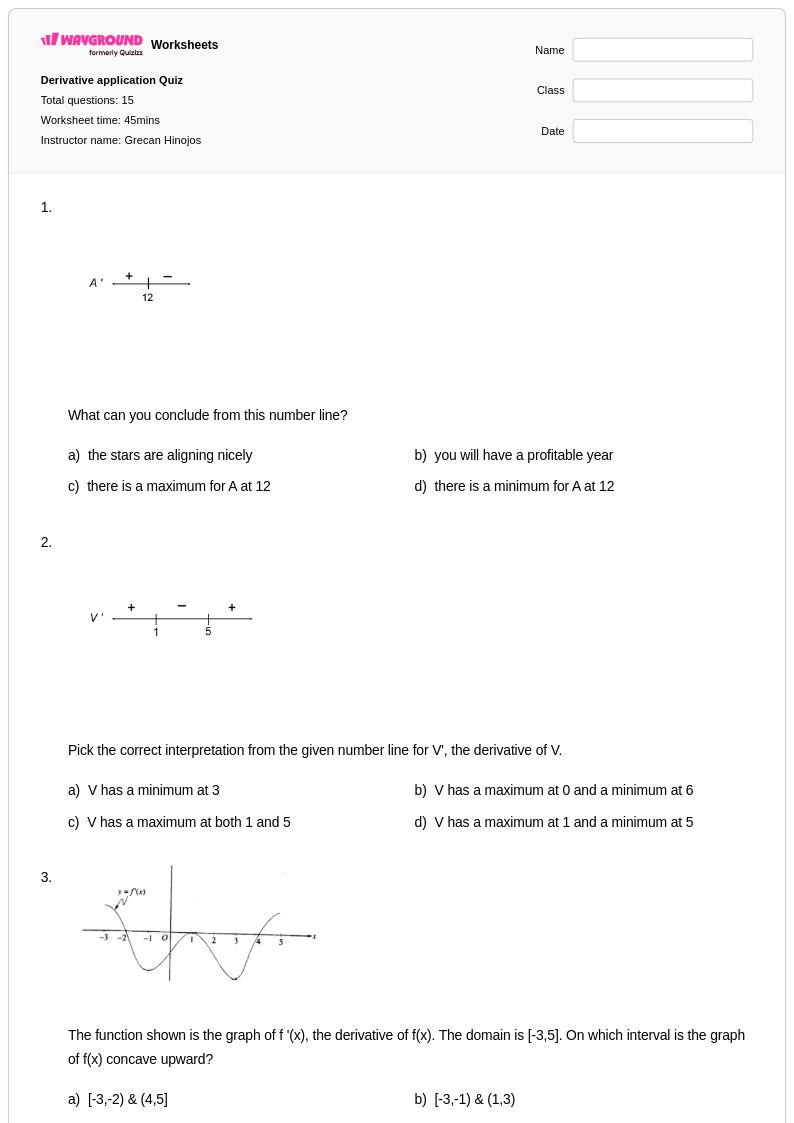
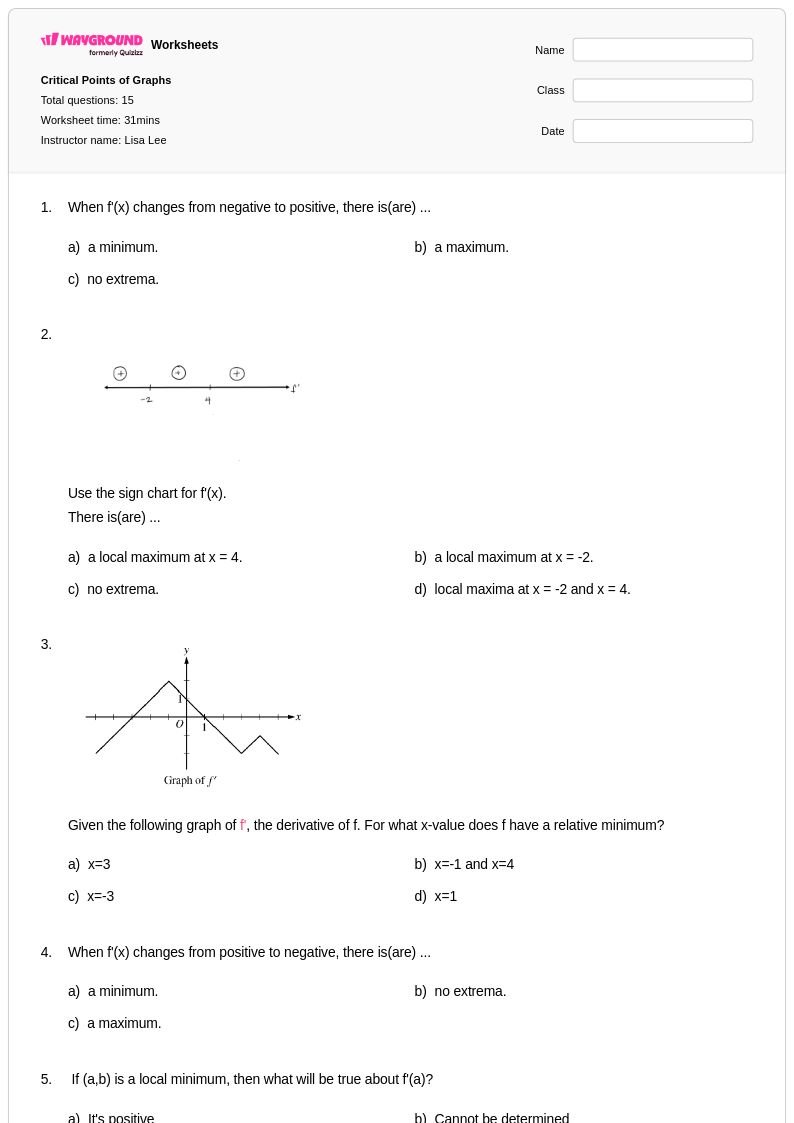
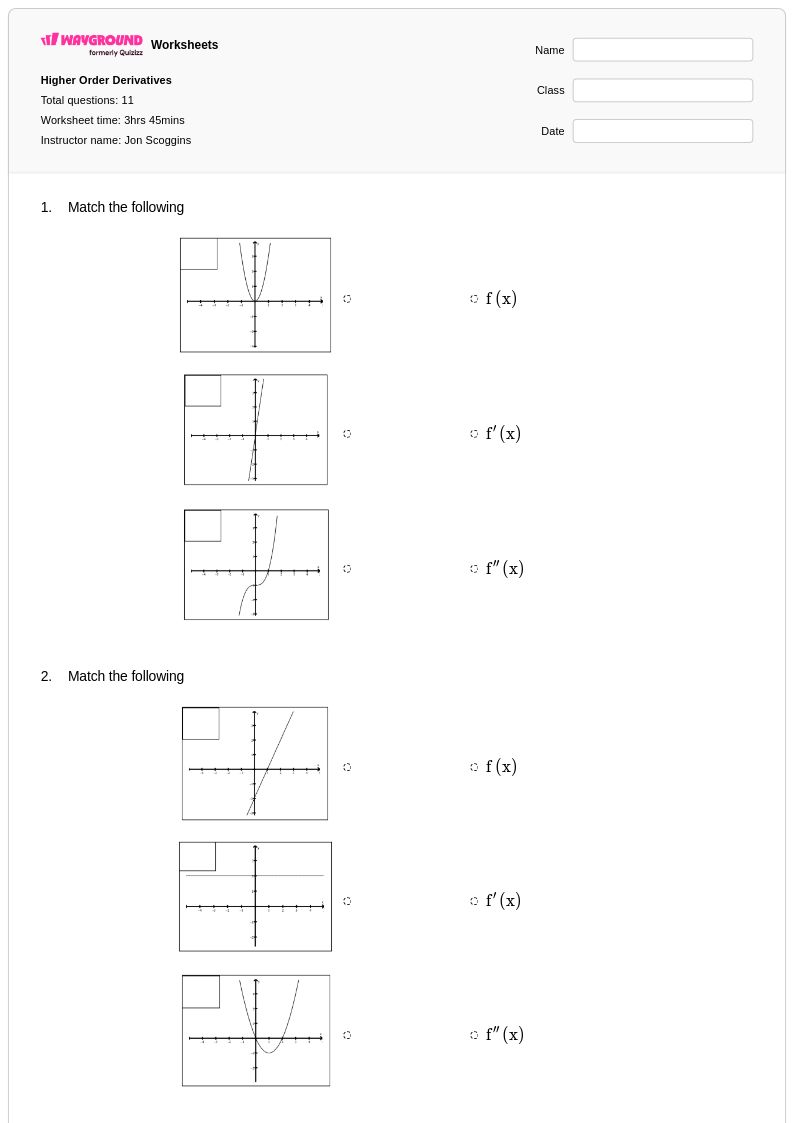
Derivative graphs worksheets for Class 12 students available through Wayground (formerly Quizizz) provide comprehensive practice in analyzing and interpreting the graphical relationships between functions and their derivatives. These expertly designed worksheets strengthen critical calculus skills including identifying critical points, determining intervals of increasing and decreasing behavior, locating local maxima and minima, and understanding the connection between a function's derivative and its rate of change. Students work through carefully scaffolded practice problems that progress from basic derivative sketching to complex analysis of higher-order derivatives, with each printable worksheet including a detailed answer key to support independent learning. The free resources cover essential concepts such as the first and second derivative tests, inflection points, and the graphical interpretation of concavity, ensuring students develop both computational fluency and conceptual understanding of how derivative information translates to function behavior.
Wayground (formerly Quizizz) empowers educators with an extensive collection of millions of teacher-created derivative graphs worksheets specifically designed for Class 12 calculus instruction. The platform's robust search and filtering capabilities allow teachers to quickly locate resources aligned with curriculum standards and differentiated for various skill levels, from foundational practice to advanced problem-solving scenarios. These customizable worksheets are available in both printable pdf format and interactive digital versions, enabling flexible implementation across diverse classroom environments and learning preferences. Teachers can seamlessly integrate these resources into lesson planning for initial instruction, targeted remediation for struggling students, or enrichment activities for advanced learners, while the comprehensive answer keys and step-by-step solutions facilitate efficient grading and provide valuable feedback opportunities that enhance student understanding of derivative graph relationships.
FAQs
How do I teach derivative graphs in Grade 12 calculus?
At Grade 12, students should be moving beyond mechanical sketching toward genuine analysis. Push them to work from f′ to f: given only the derivative graph, can they describe where f is increasing, where it has local extrema, and where it changes concavity? This direction is harder and more revealing than sketching f′ from f, and it's what AP Calculus free-response questions actually test. Pair that with second derivative analysis, connecting the slope of f′ to the concavity of f, and students develop the layered reading of graphs that distinguishes strong calculus students from those who've only memorized the rules.
What practice problems are most effective for Grade 12 derivative graph skills?
At this level, the most valuable problems are the ones that require students to synthesize multiple pieces of derivative information at once: given a graph of f′, identify all local maxima and minima of f, all inflection points, and all intervals where f is concave up or down — without ever seeing f. Wayground's Grade 12 worksheets include scaffolded problems that progress from basic derivative sketching to this kind of higher-order analysis, along with first and second derivative test applications and graphical interpretation of concavity.
What errors do Grade 12 students still make on derivative graph problems?
Even strong Grade 12 students make two persistent errors. First, they mishandle inflection points — marking every zero of f′ as an inflection point of f, rather than checking whether f′ actually changes sign there. A zero of f′ where f′ touches but doesn't cross the x-axis is a local extremum of f, not an inflection point. Second, students struggle with higher-order derivative graphs: they can read f′ from f, but lose orientation when asked to sketch f′′ or reason about what f′′ tells them about f′. Both errors are worth targeting explicitly before AP exam prep.
How do I use Wayground's Grade 12 derivative graphs worksheets for AP Calculus prep?
The printable PDF format works especially well for AP prep — students should practice sketching and annotating derivative graphs by hand, since that's what the exam requires. Download the worksheet, assign it as a timed practice set, and use the included answer key to review. For earlier in the unit, the digital quiz format on Wayground gives students immediate feedback as they work through graph interpretation problems, which helps catch misconceptions before they solidify.
How does derivative graph analysis fit into the Grade 12 calculus curriculum?
By Grade 12, Common Core's high school functions progression has given students a thorough grounding in analyzing function behavior — and derivative graphs are where that analysis becomes calculus. The sequence at this level moves from graphical interpretation (reading f′ from f and vice versa) to the first and second derivative tests (classifying critical points algebraically) to curve sketching (combining both to produce accurate graphs without a calculator) to optimization (applying derivative analysis to real-world maximum and minimum problems). Derivative graph fluency is the foundation every subsequent topic in the course depends on.
How can I differentiate derivative graph practice for my Grade 12 class?
For students who are still building confidence with graph reading, Wayground's reduced answer choices accommodation is useful on identification problems — it keeps the focus on the calculus reasoning rather than the process of ruling out distractors. For students who need visual accessibility support, the dyslexia-friendly font and adjustable font size options are available at the worksheet level. For your most advanced students, the best differentiation is problem selection: prioritize problems that give only f′ and ask for a complete analysis of f, which demands the kind of synthesis that straightforward sketching problems don't.
What is the difference between the first and second derivative tests on a graph?
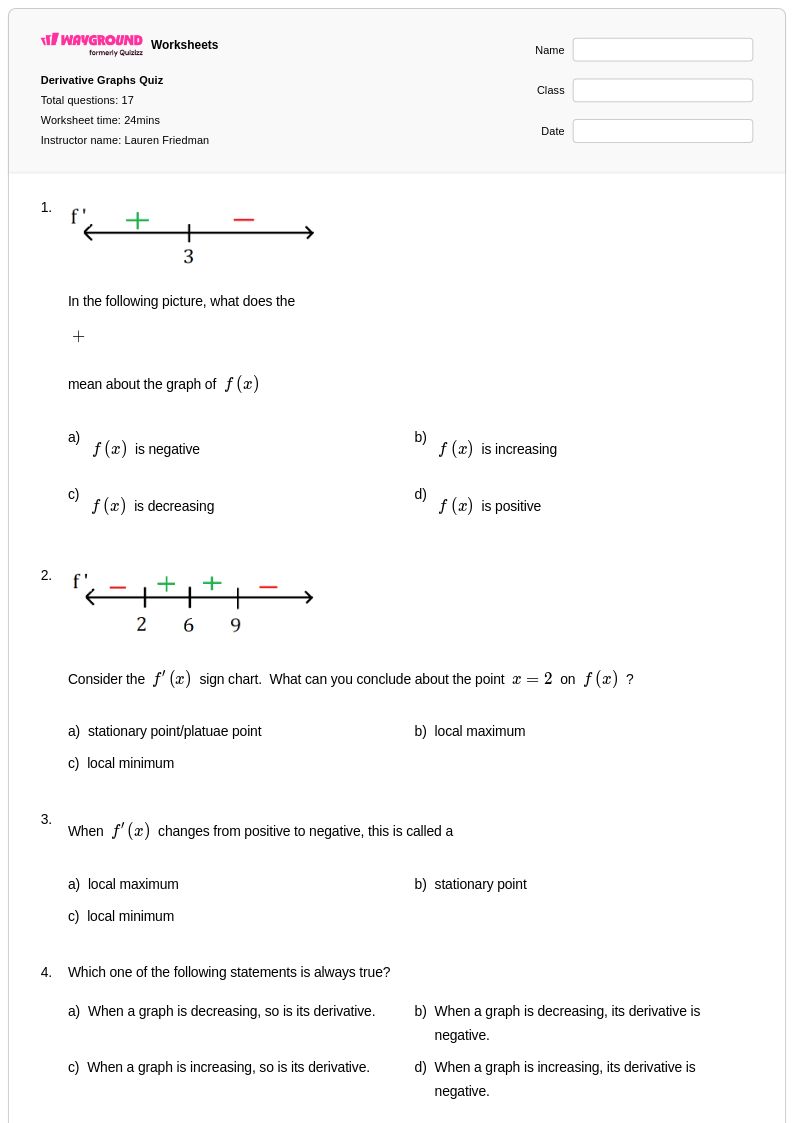
The first derivative test uses sign changes in f′ to classify critical points: if f′ goes from positive to negative at a point, f has a local maximum there; negative to positive means a local minimum. The second derivative test uses the value of f′′ at a critical point instead: if f′′ is negative, the function is concave down and the critical point is a local maximum; if f′′ is positive, it's concave up and a local minimum. The graphical version of this is reading whether f′ is decreasing or increasing at the point where f′ crosses zero.