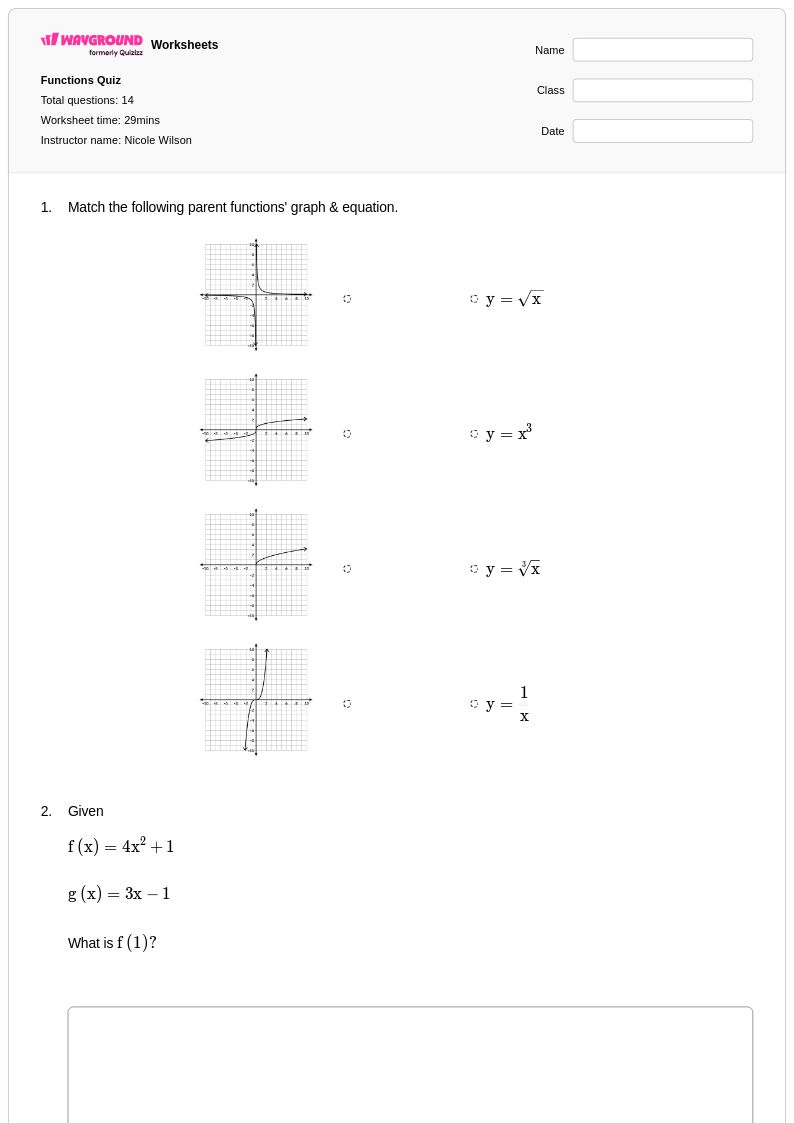
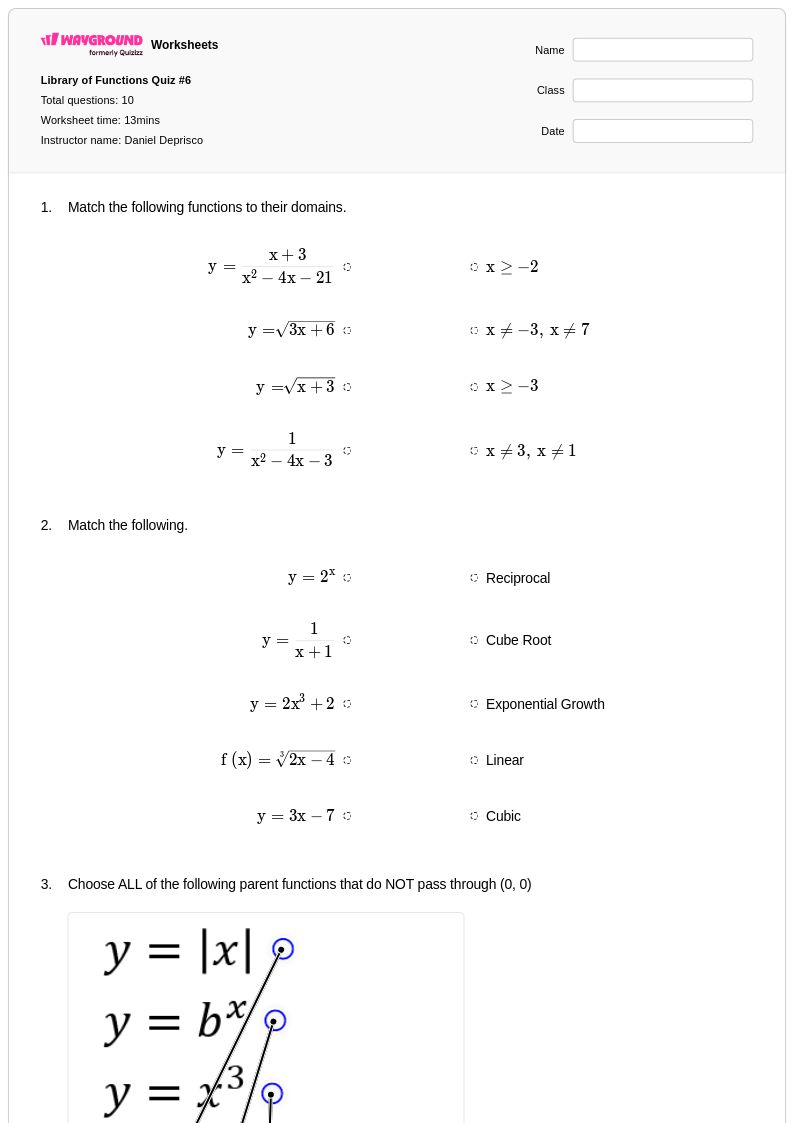
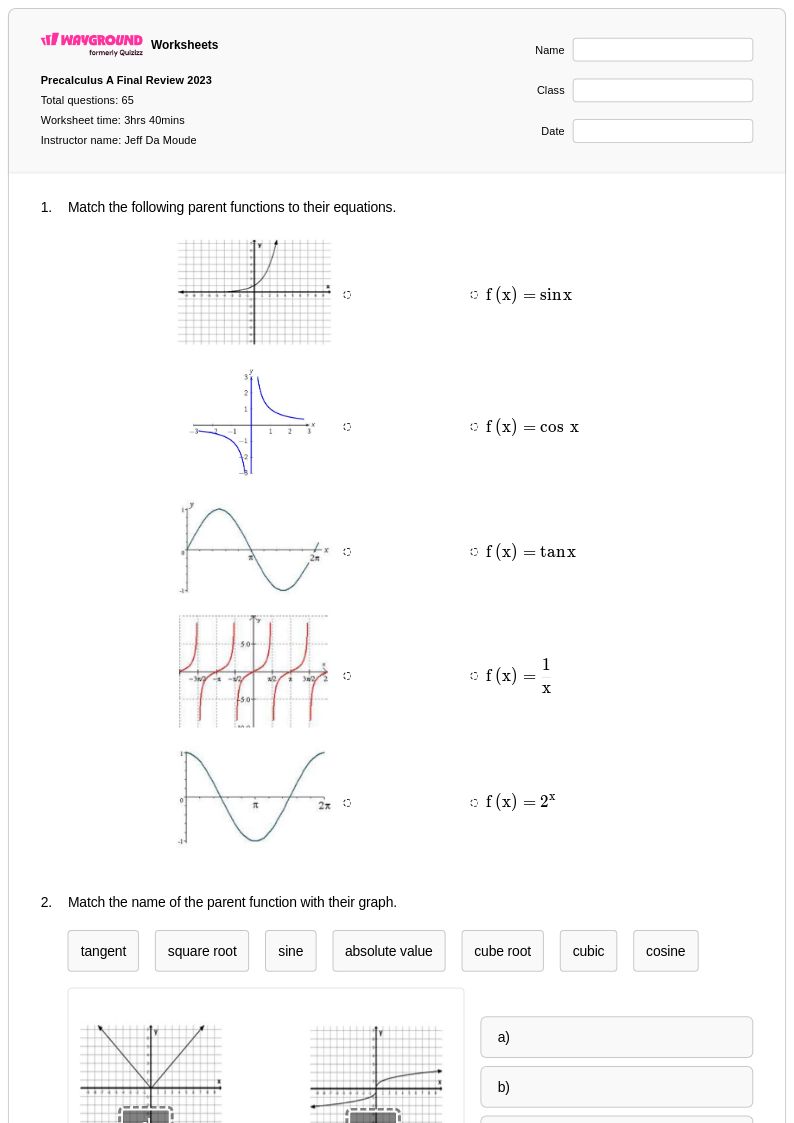
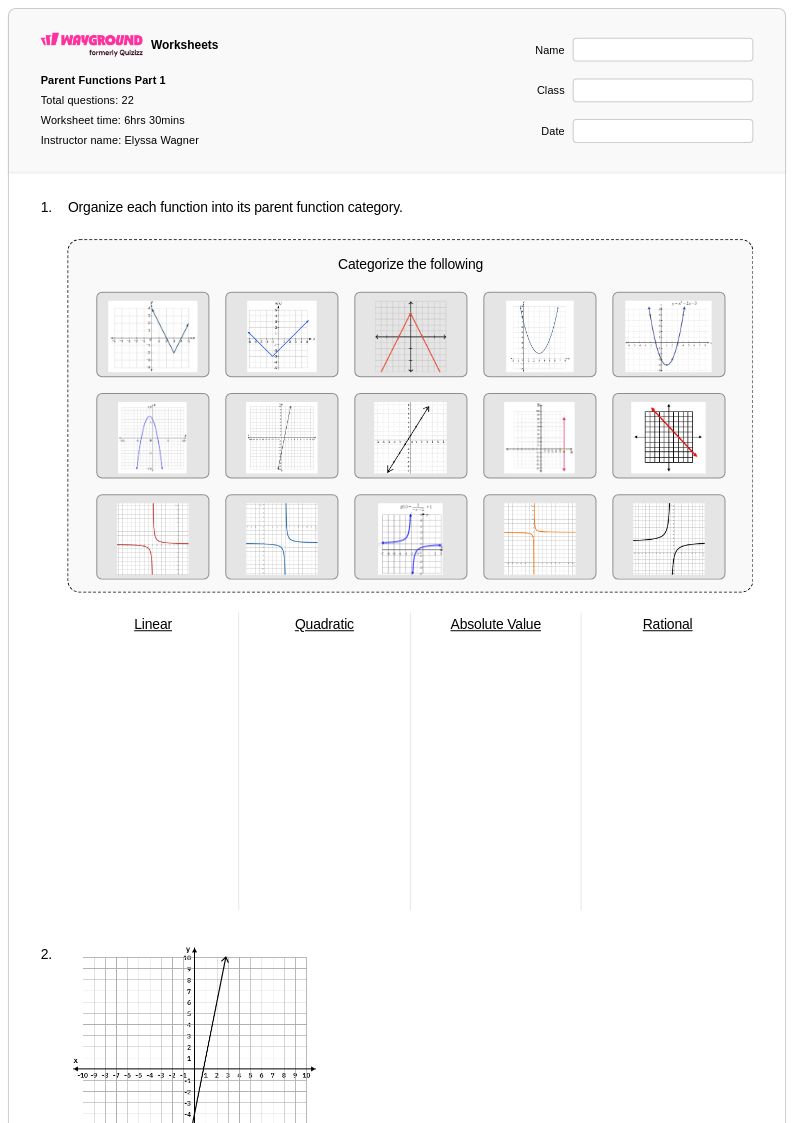
Free Printable Domain, Range, and End Behavior worksheets
Explore Wayground's comprehensive collection of free domain, range, and end behavior worksheets with printable PDFs, practice problems, and answer keys to help students master function analysis skills.
Explore printable Domain, Range, and End Behavior worksheets
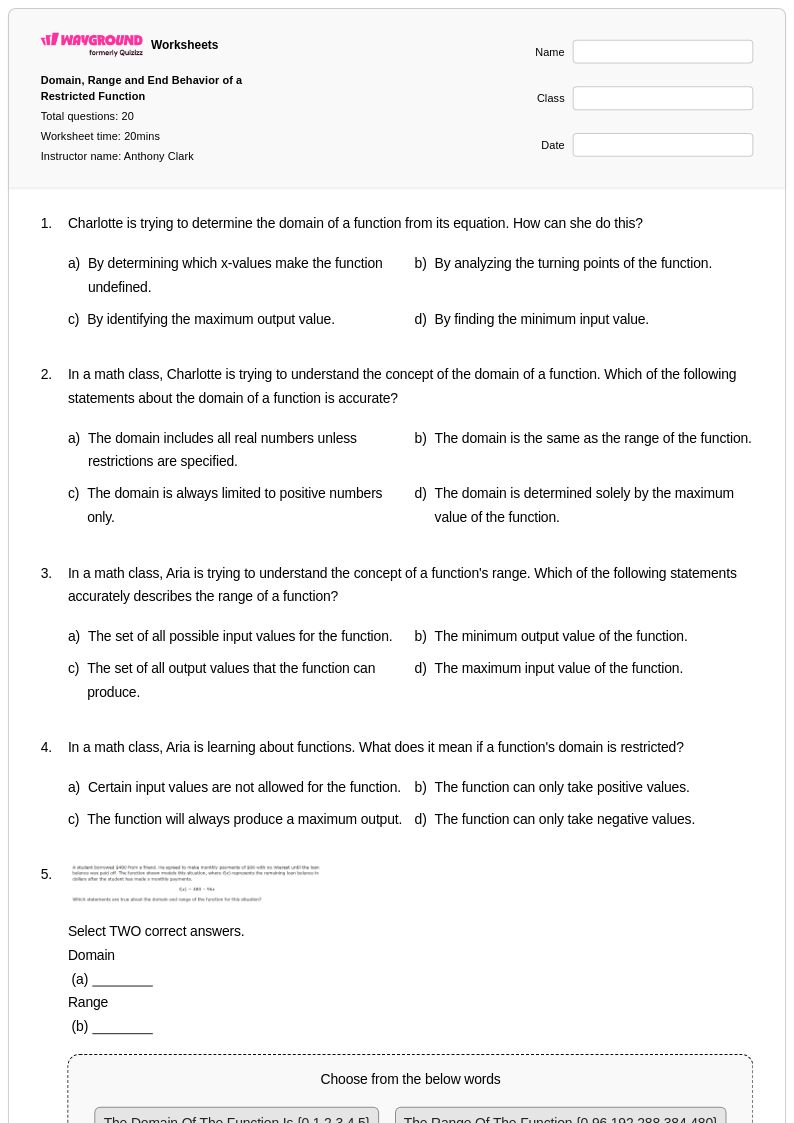
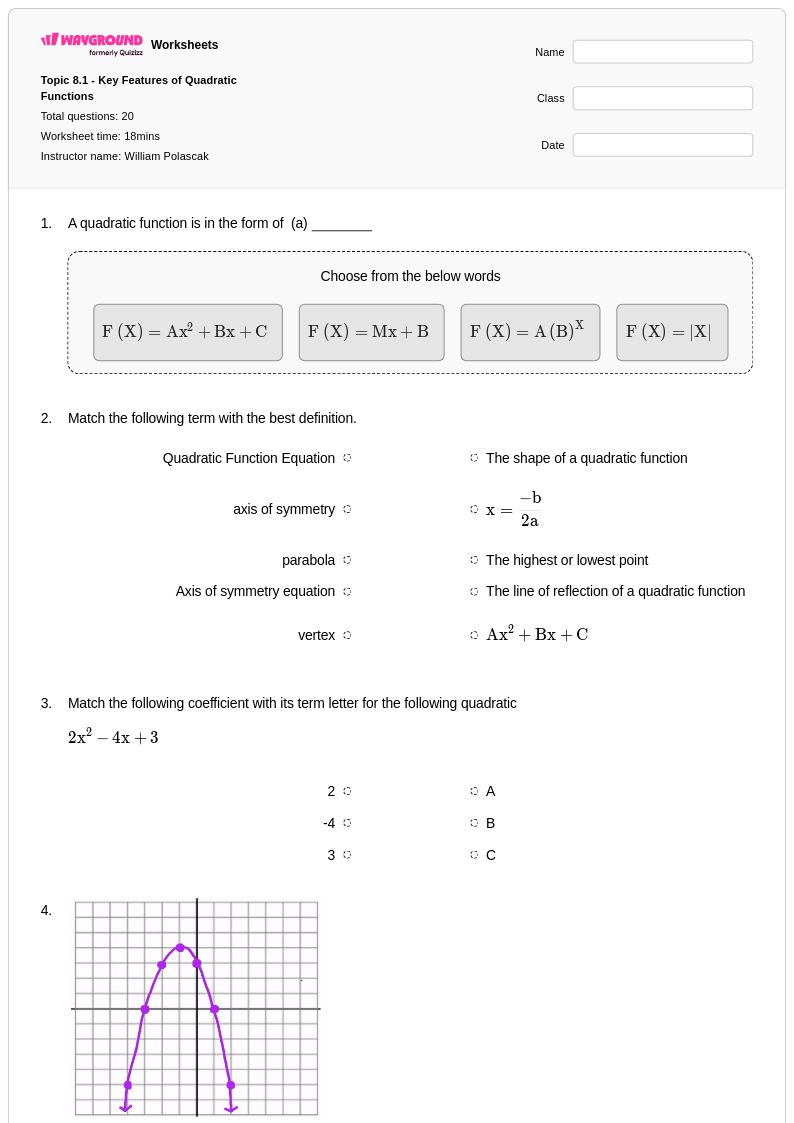
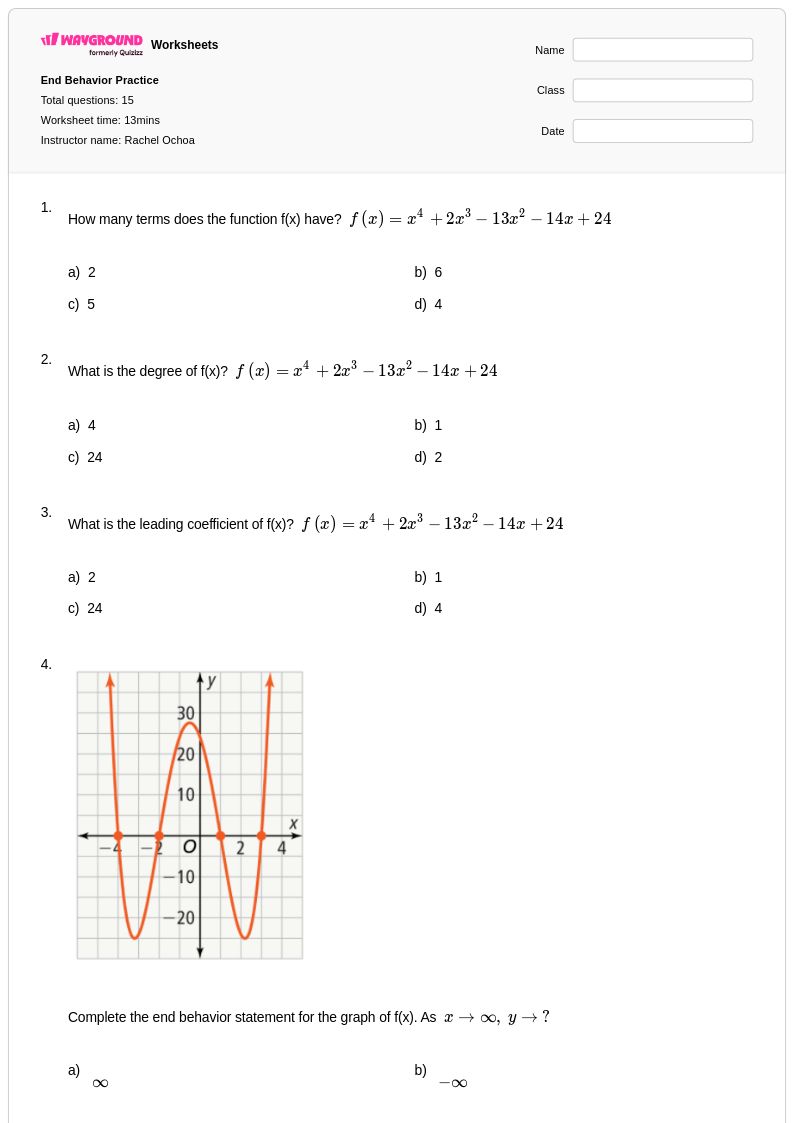
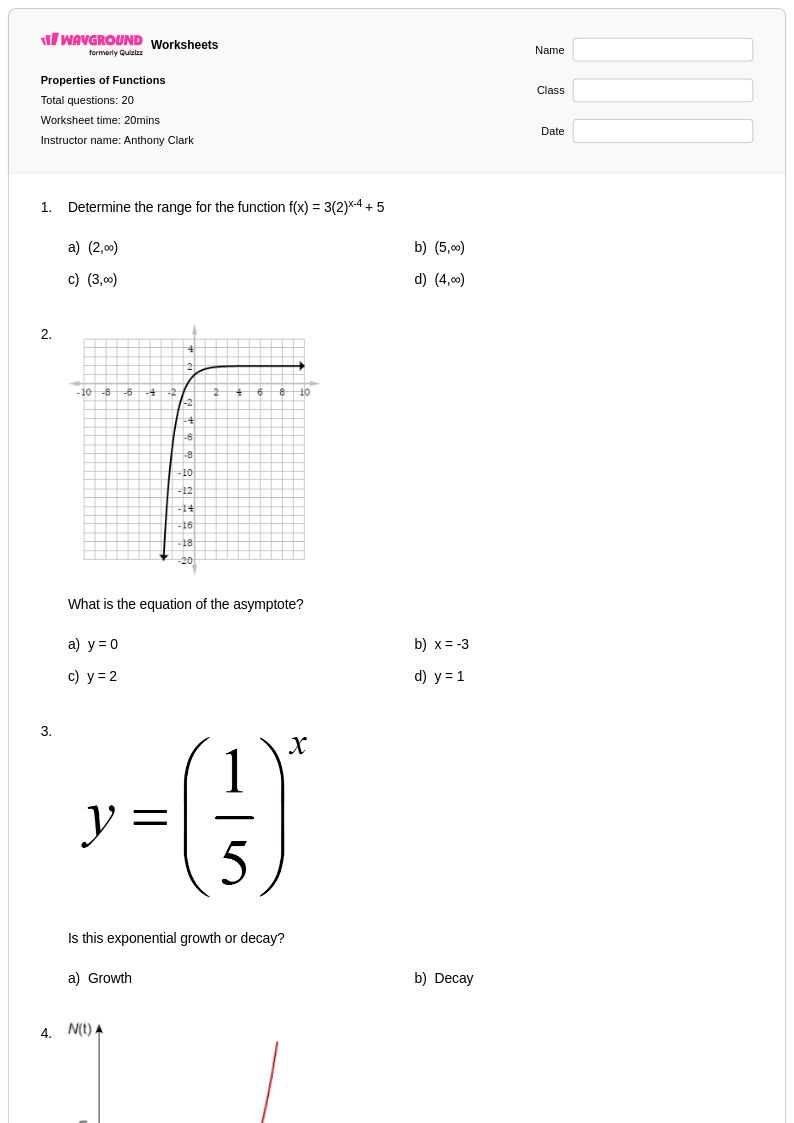
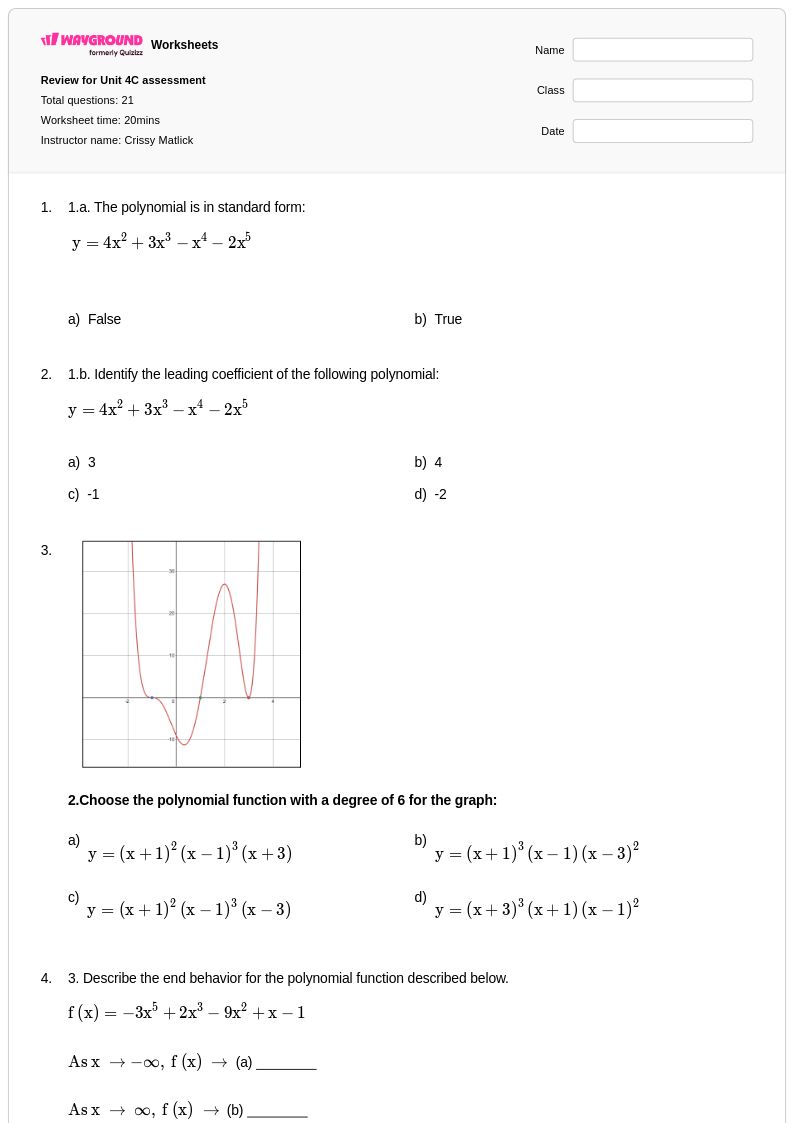
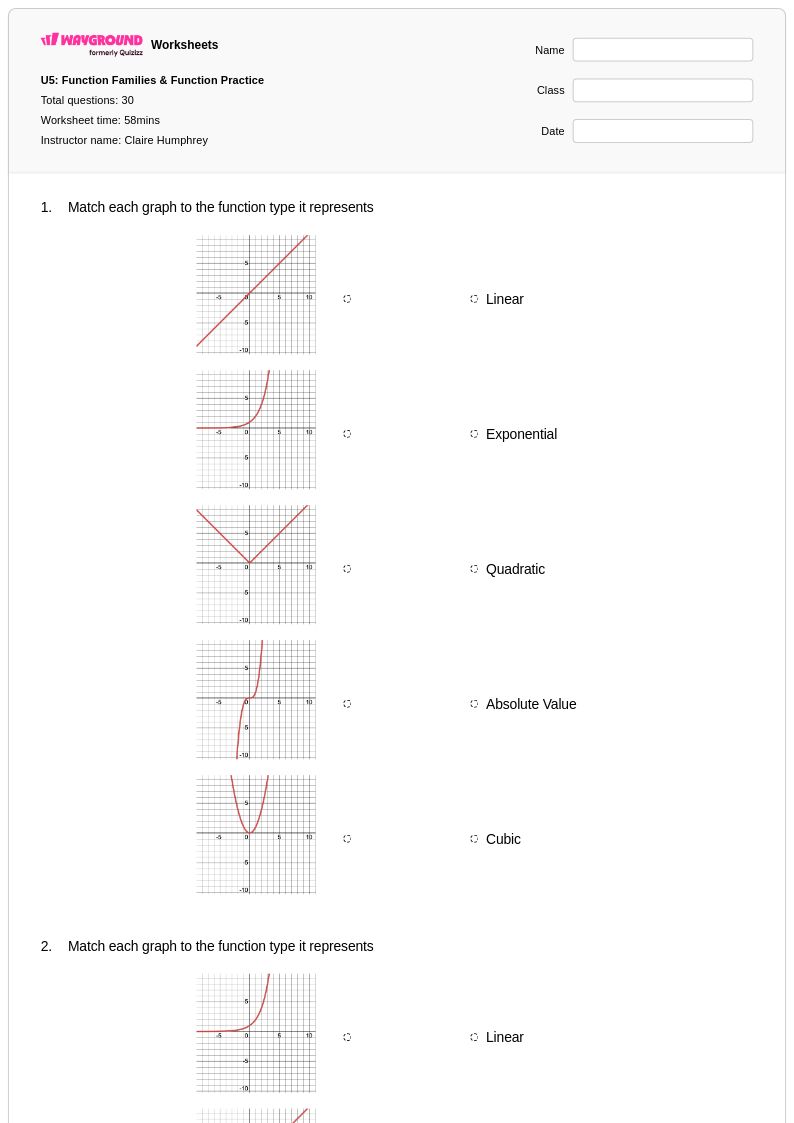
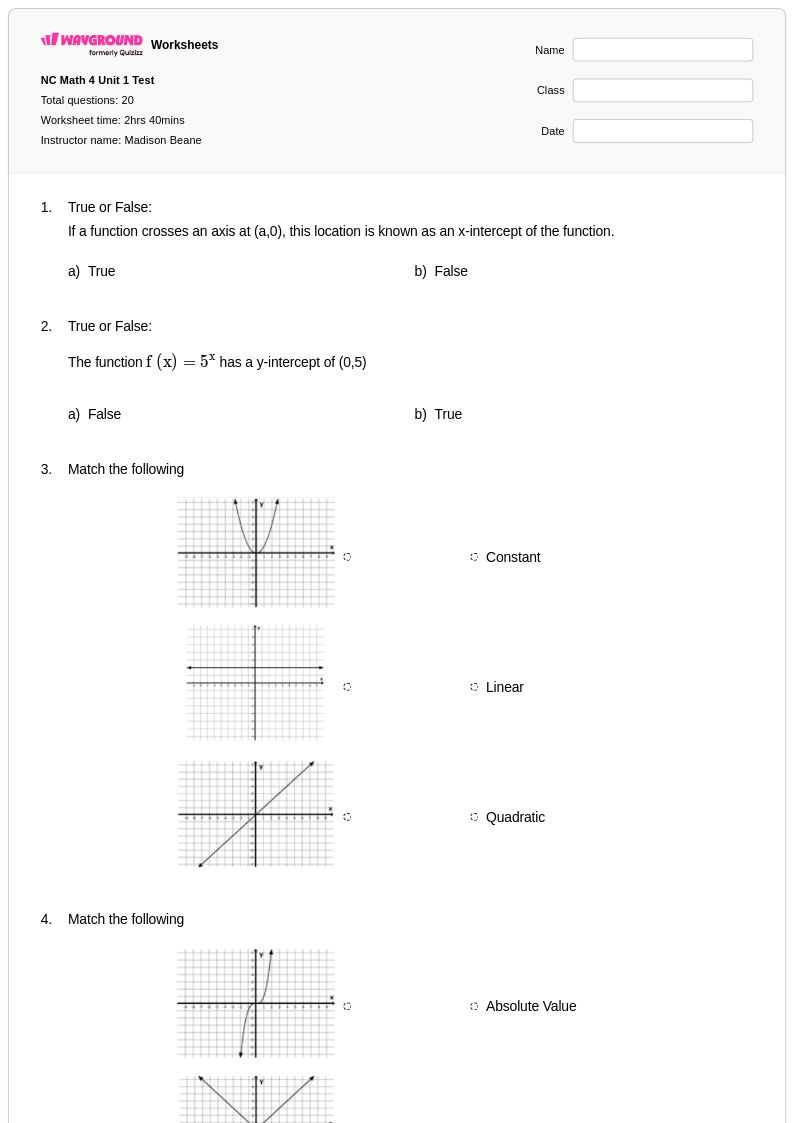
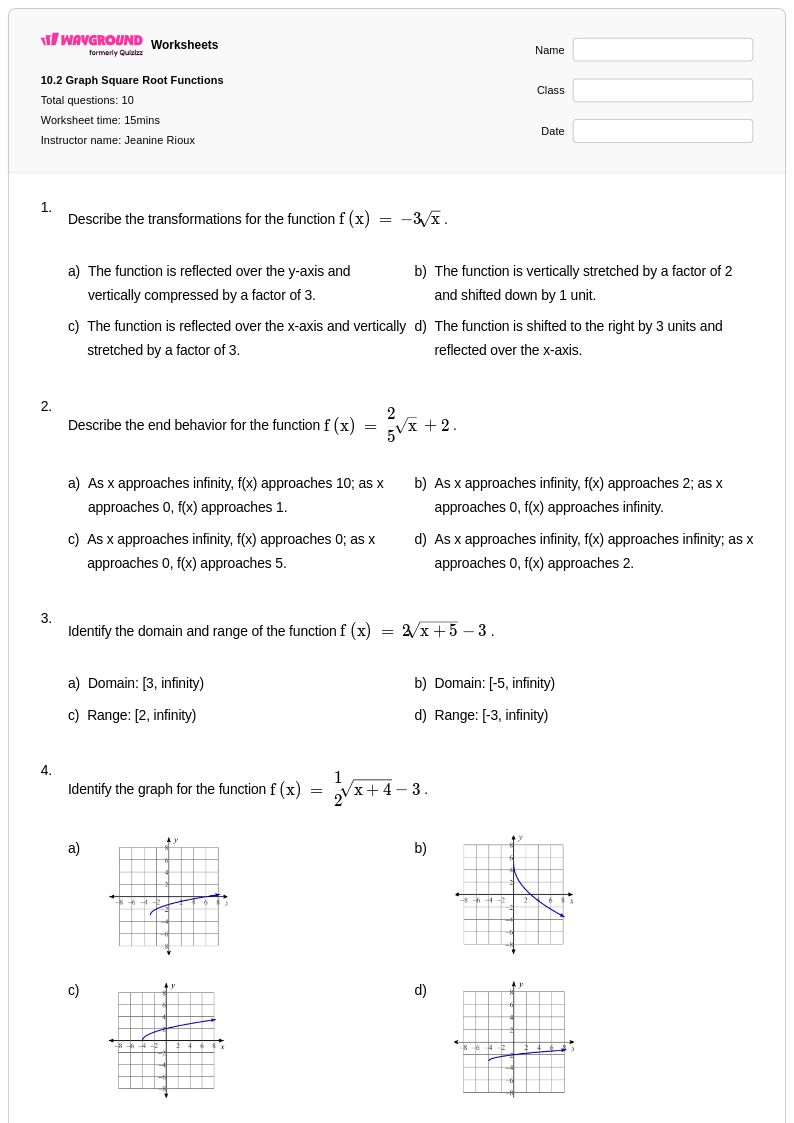
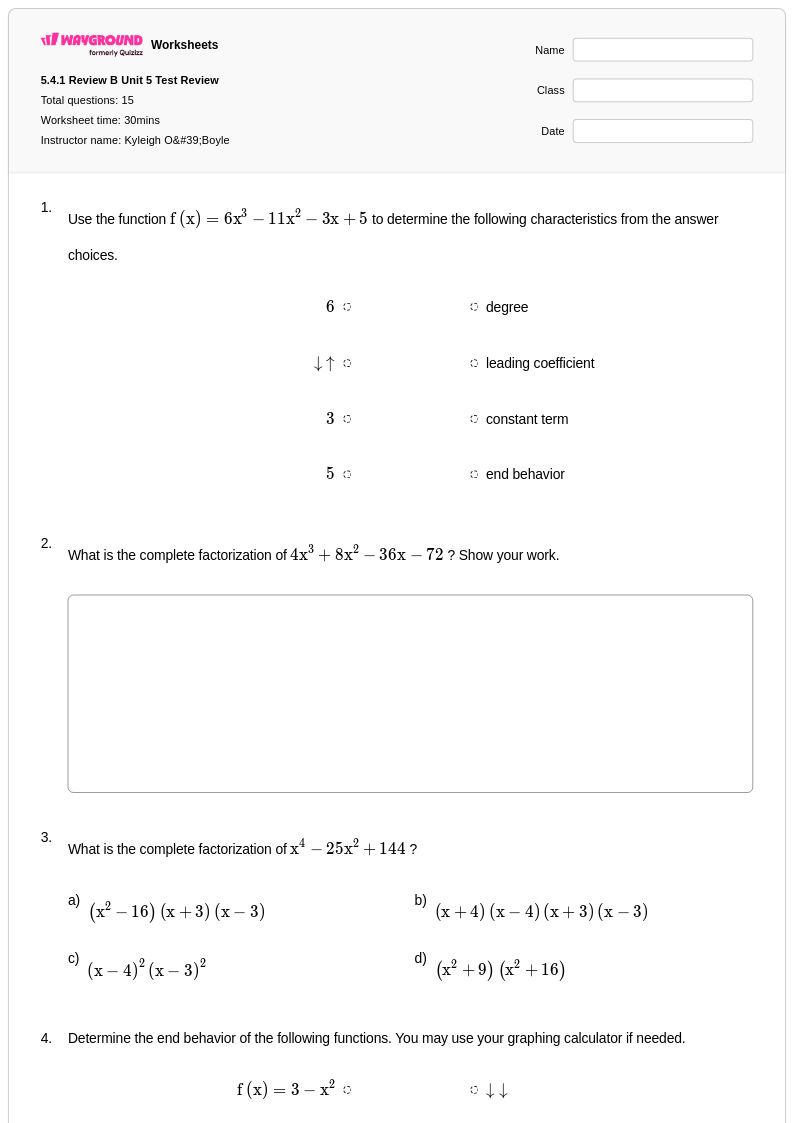
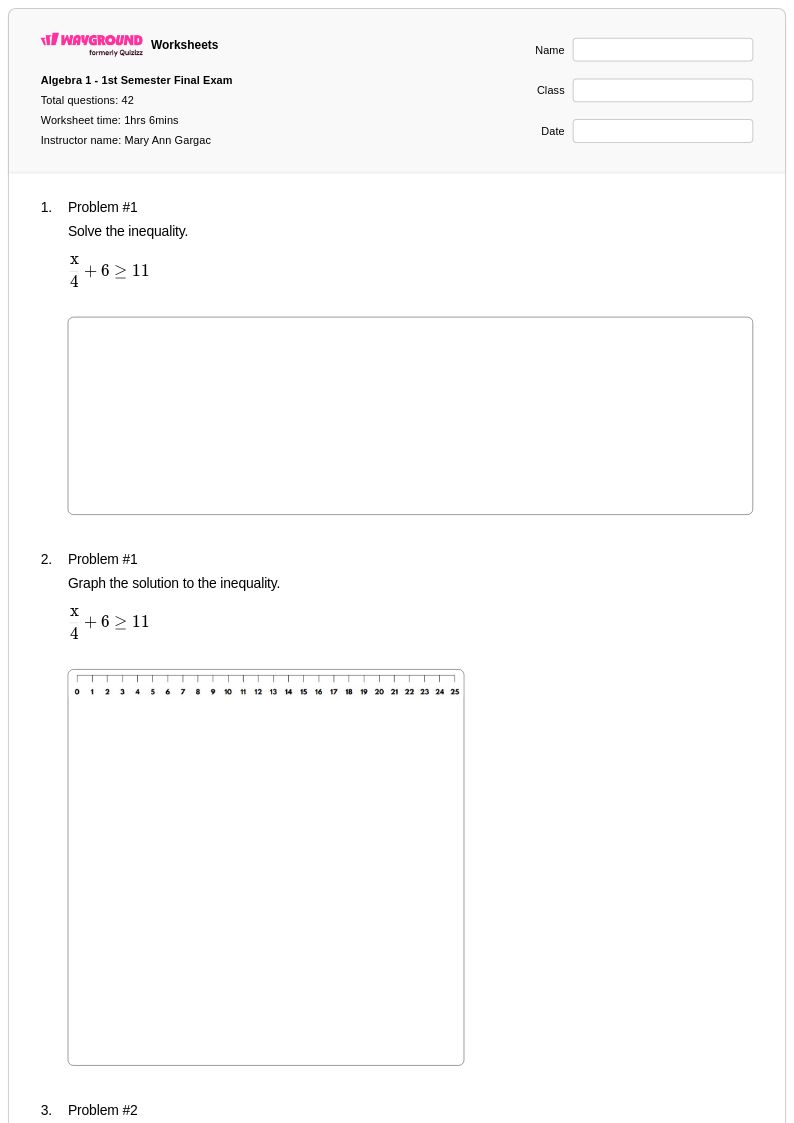
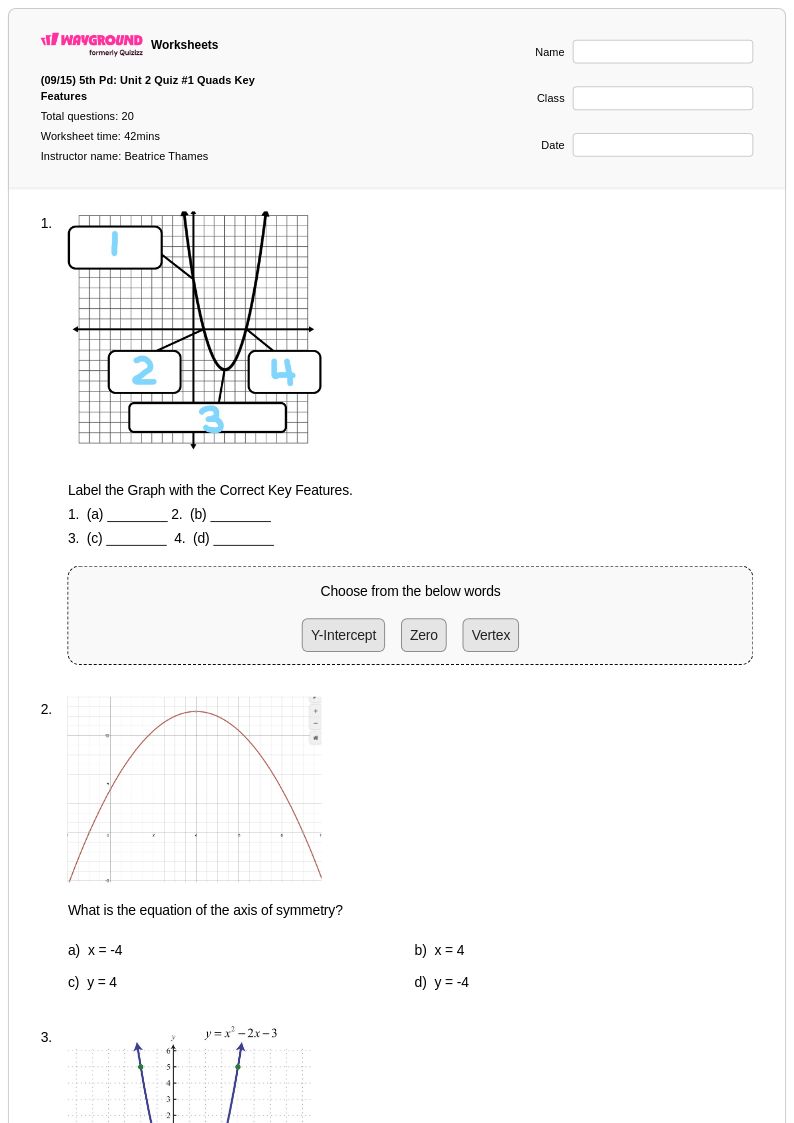
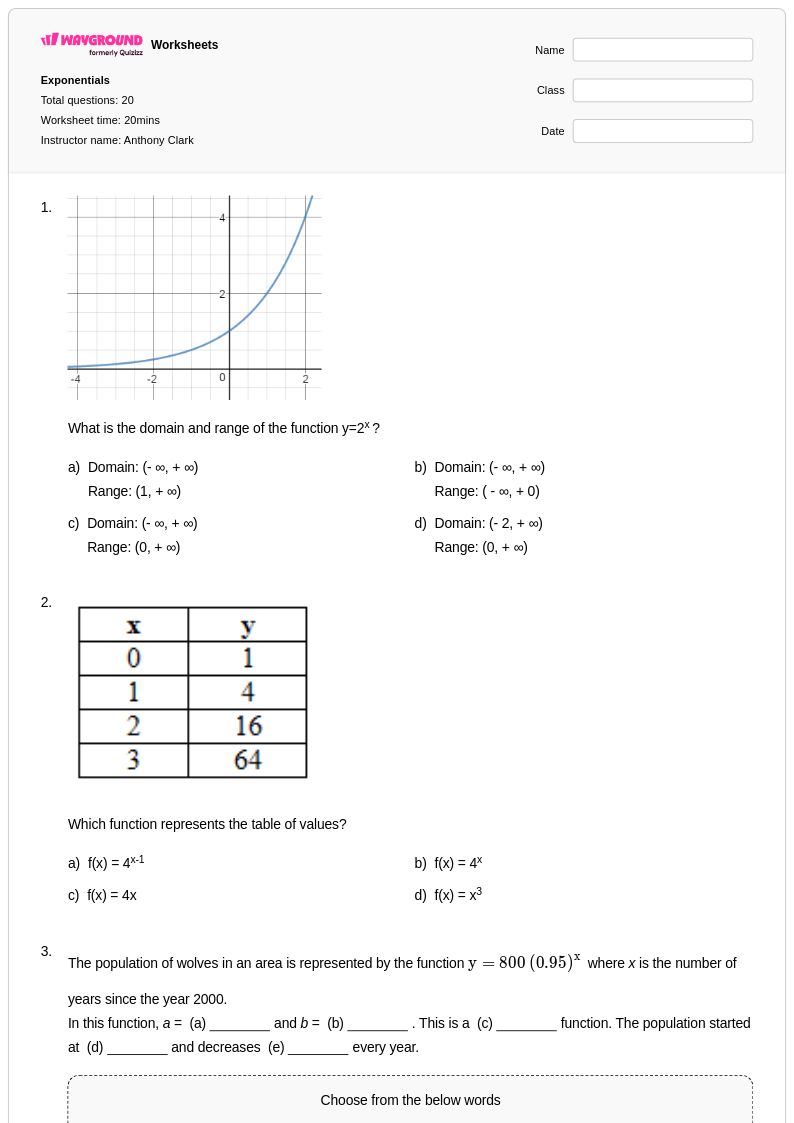
Domain, range, and end behavior worksheets available through Wayground (formerly Quizizz) provide comprehensive practice opportunities for students to master these fundamental concepts in function analysis. These expertly crafted resources strengthen critical mathematical skills including identifying input and output values of functions, determining restrictions on domain sets, analyzing range limitations, and interpreting the long-term behavior of functions as they approach positive and negative infinity. The worksheet collections feature diverse problem types ranging from basic domain identification with rational and radical functions to complex end behavior analysis of polynomial and exponential functions, complete with detailed answer keys that support both independent study and classroom instruction. Students benefit from free printable pdf formats that allow for flexible practice sessions, while the comprehensive practice problems progress systematically from foundational concepts to advanced applications.
Wayground (formerly Quizizz) empowers mathematics educators with an extensive library of millions of teacher-created resources specifically designed to support domain, range, and end behavior instruction across multiple learning contexts. The platform's robust search and filtering capabilities enable teachers to quickly locate worksheets aligned with specific curriculum standards, while built-in differentiation tools allow for seamless customization based on individual student needs and skill levels. These versatile resources are available in both printable and digital pdf formats, providing maximum flexibility for classroom instruction, homework assignments, remediation sessions, and enrichment activities. Teachers can efficiently plan comprehensive lesson sequences, target specific skill gaps through focused practice problems, and support diverse learners with appropriately scaffolded materials that reinforce essential function analysis concepts through systematic, progressive skill development.
FAQs
How do I teach domain, range, and end behavior?
Start with domain and range using concrete function representations — graphs and tables before algebraic notation. Students grasp 'what x-values are allowed' more readily when they can see a graph with a hole or vertical asymptote than when they encounter a rational expression cold. Once domain and range are solid, introduce end behavior by asking students to trace what happens to y as x grows very large or very small. Polynomial functions are the clearest entry point: even-degree polynomials go the same direction on both ends, odd-degree polynomials go opposite directions. Anchor the language ('approaches positive infinity,' 'approaches negative infinity') early and reinforce it consistently.
What exercises help students practice domain, range, and end behavior?
The most effective practice mixes representations. Give students the same function as a graph, a table, and an equation and ask them to identify domain and range from each — the comparison reveals where their understanding is surface-level. For end behavior, problems that ask students to match polynomial or exponential functions to their end behavior descriptions (without graphing calculators) build the analytical habit. These worksheets progress from basic domain identification with rational and radical functions to complex end behavior analysis of polynomial and exponential functions, so teachers can assign problems that match exactly where a class is in the unit.
What mistakes do students commonly make with domain and range?
Three errors come up repeatedly. First, students confuse domain and range — they know one is inputs and one is outputs but mix up which is which under pressure. Second, they miss domain restrictions in rational functions by forgetting to set the denominator equal to zero, or in radical functions by forgetting the radicand must be non-negative. Third, they write range incorrectly for quadratic functions, listing all real numbers instead of recognizing the vertex creates a minimum or maximum bound. End behavior errors usually trace back to students not distinguishing between even and odd degree, or ignoring the sign of the leading coefficient.
How do I use these domain, range, and end behavior worksheets in my class?
Each worksheet includes a complete answer key, so it works equally well for guided practice, independent work, or homework. You can assign it as a printable PDF for paper-based practice — useful for classes reducing screen time — and then grade submissions using the Wayground for Teachers app, which lets you scan or capture student work directly. Alternatively, host the worksheet as a digital quiz on Wayground so students complete it on a device and results come back to you automatically.
How does Common Core sequence domain, range, and end behavior?
Common Core introduces the concept of a function and its domain in 8th grade, where students work with linear functions and simple input-output relationships. In high school, the progression moves to defining domain and range precisely for a wider function family — linear, quadratic, exponential — and then to analyzing key features of functions including end behavior. By the time students reach polynomial and rational functions, they are expected to interpret end behavior in terms of the leading term and connect it to the graph's long-run shape. Domain, range, and end behavior sit at the intersection of the Functions and Algebra conceptual categories in Common Core's high school standards.
How can I differentiate domain, range, and end behavior practice for mixed-ability classes?
The core challenge with this topic is that some students are still shaky on function notation while others are ready for piecewise or rational functions — so the same worksheet can be too easy and too hard in the same room. On Wayground, you can create alternate worksheet versions with wider font spacing or a larger font size for students who struggle with dense notation, and apply a dyslexia-friendly font where needed. For students who need additional support during a digital session, the Read Aloud accommodation reads questions aloud, and reduced answer choices lowers the cognitive load on multiple-choice end behavior problems without changing the underlying math.
What grade level covers domain, range, and end behavior?
Domain and range are typically introduced in Algebra 1 (around Grade 8–9), starting with linear and quadratic functions. End behavior analysis — especially for polynomial, rational, and exponential functions — is a Grade 10–12 topic, appearing most heavily in Algebra 2 and Precalculus. Students revisit and deepen all three concepts across multiple courses rather than mastering them in a single grade.