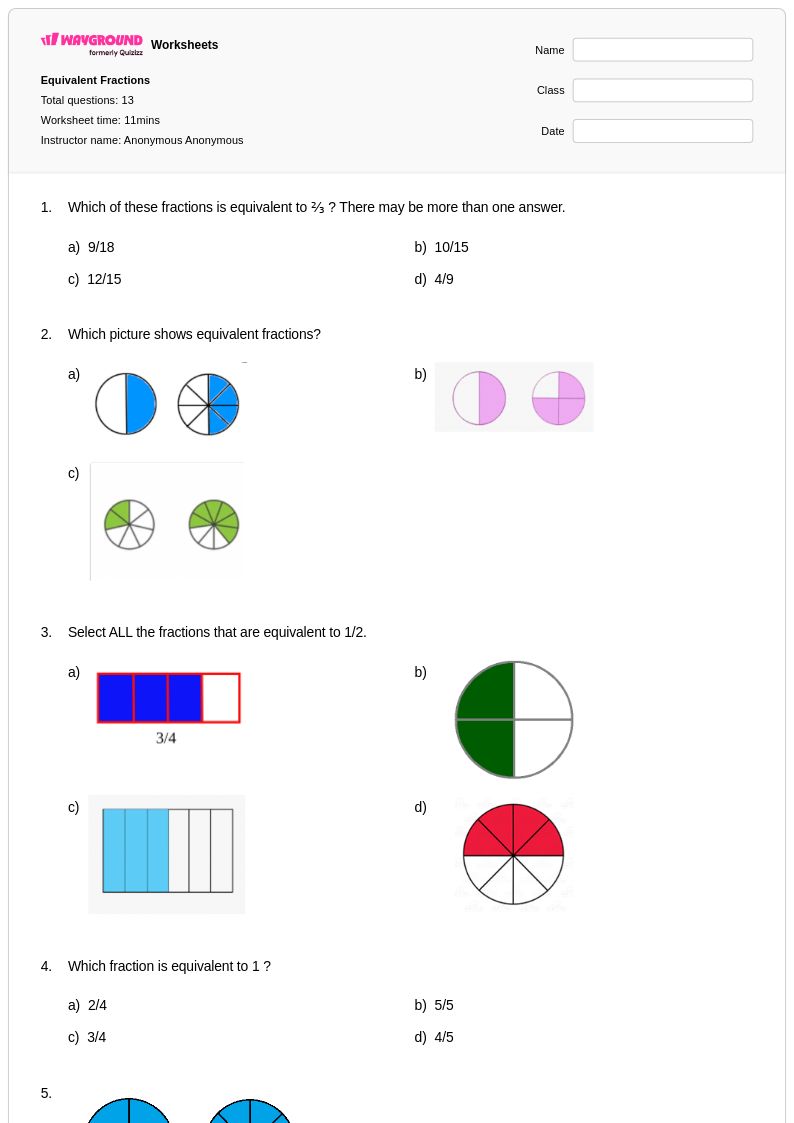
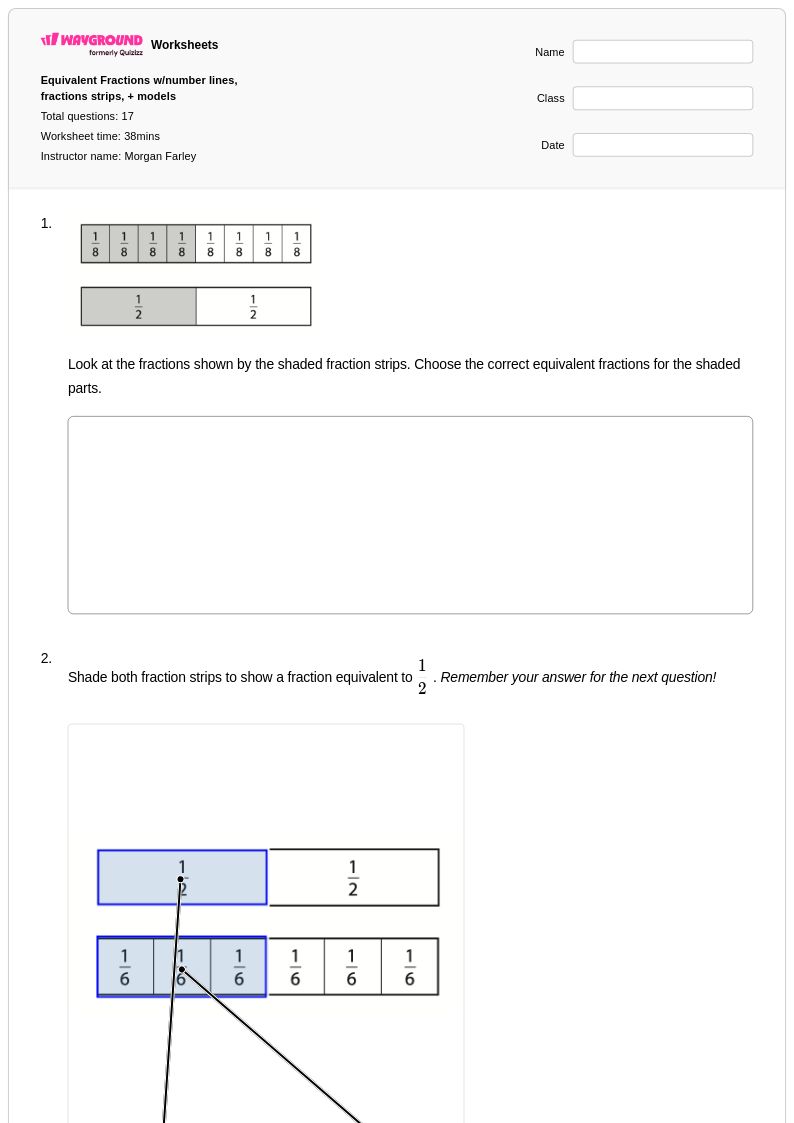
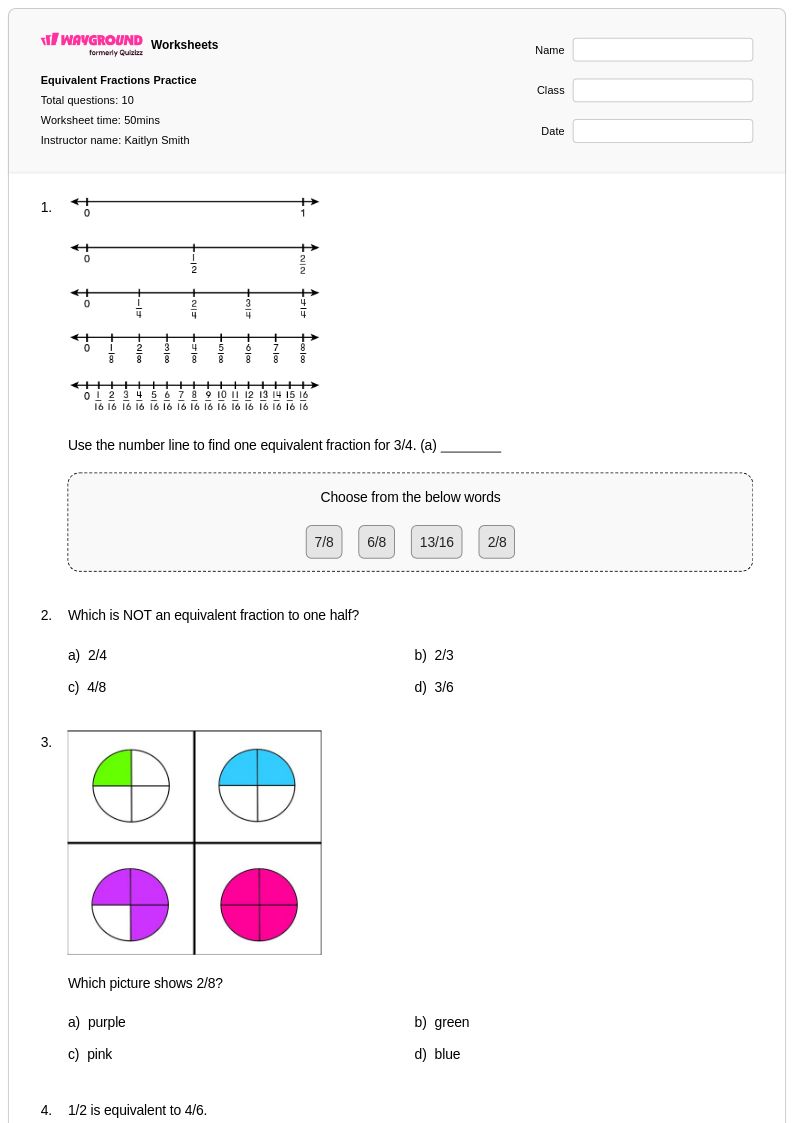
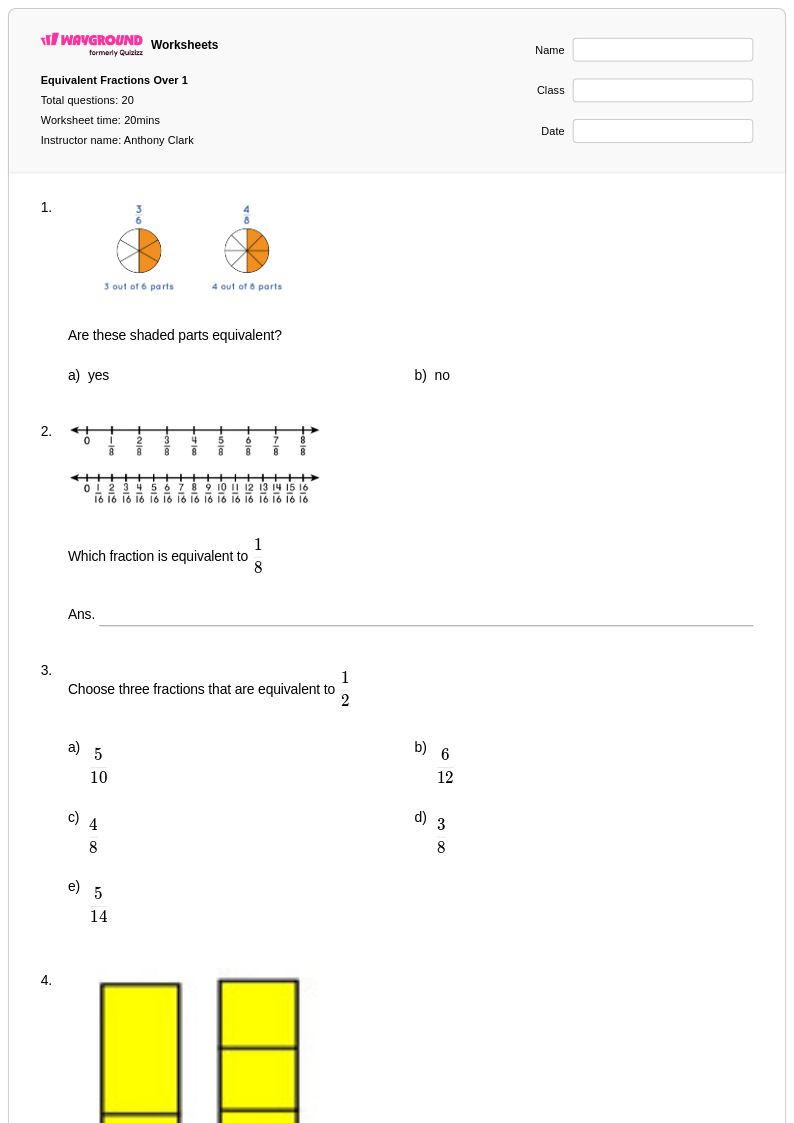
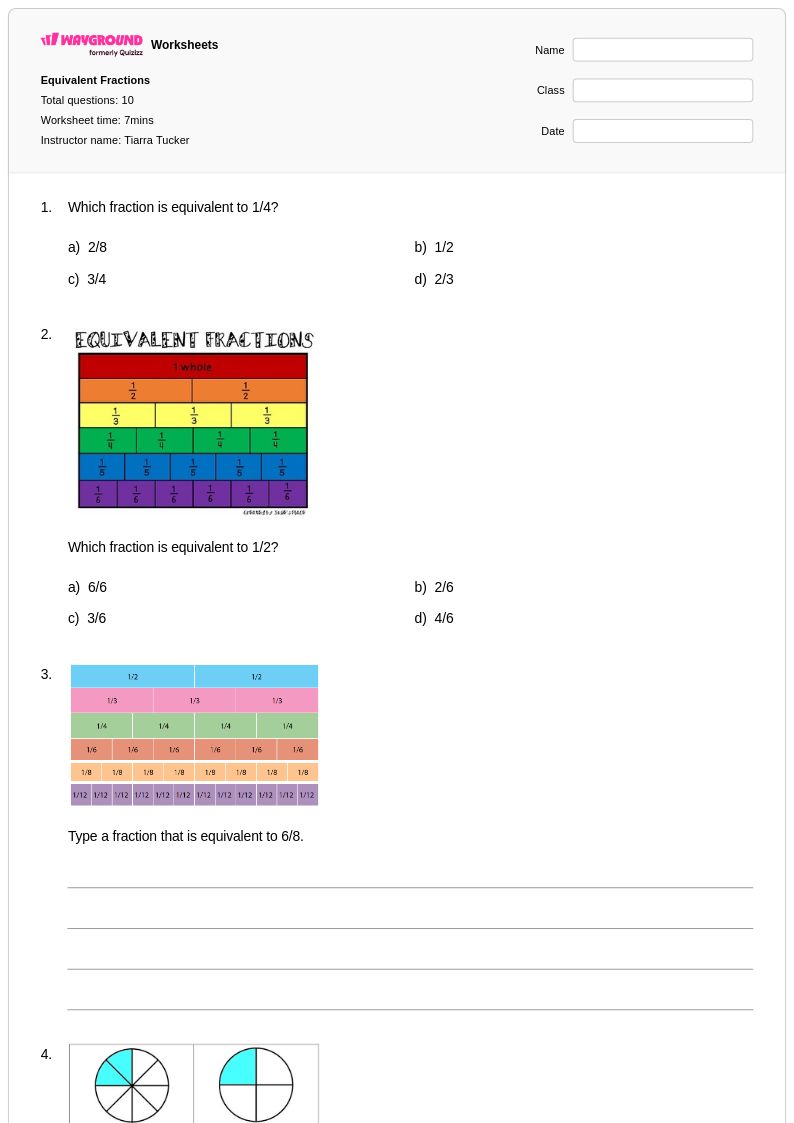
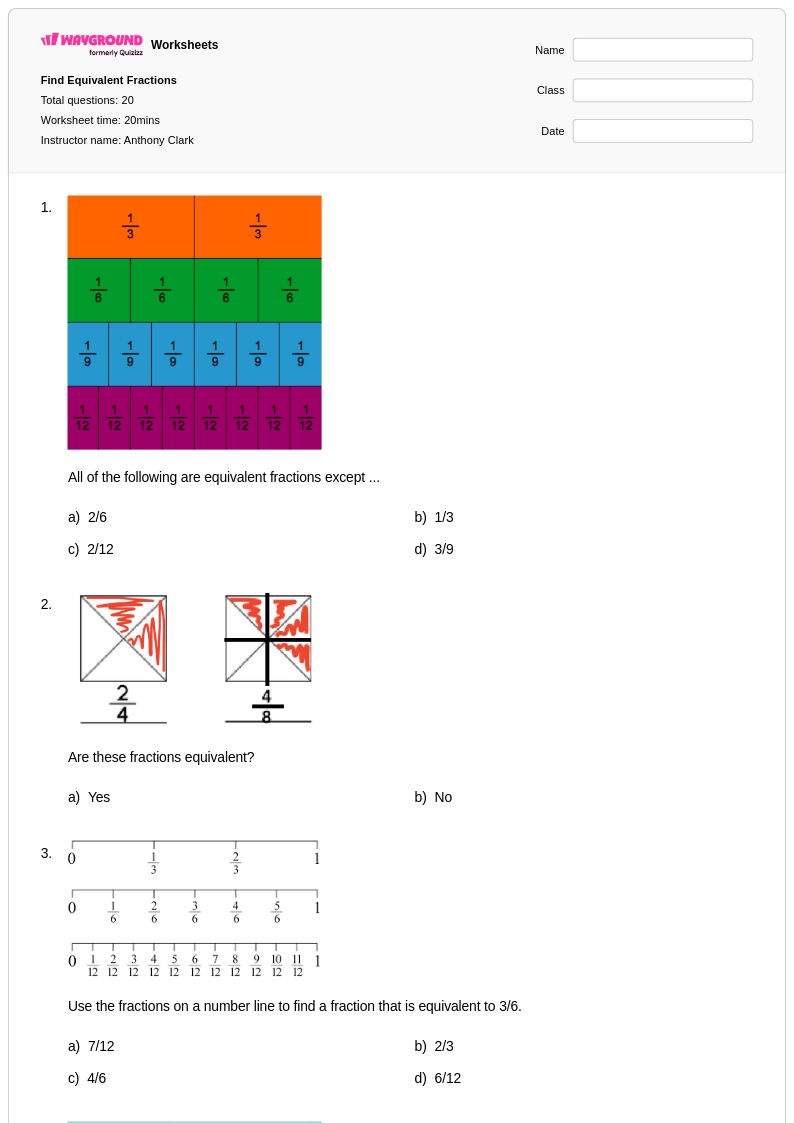
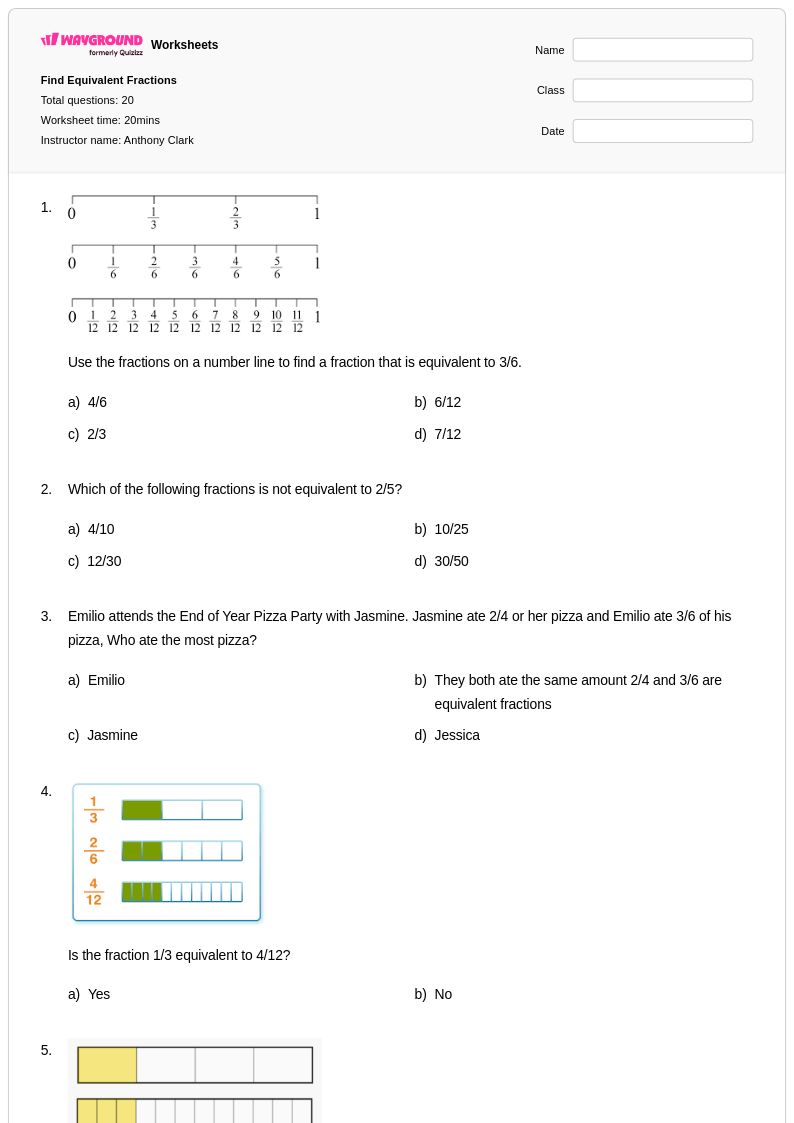
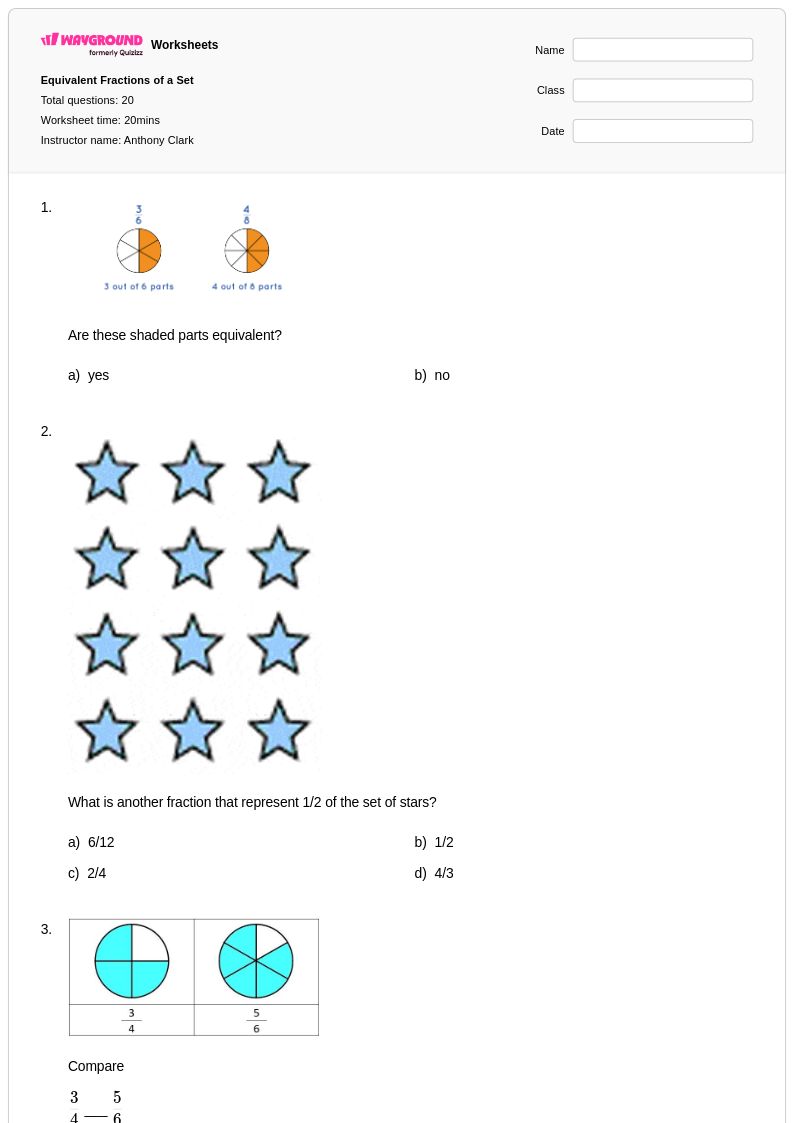
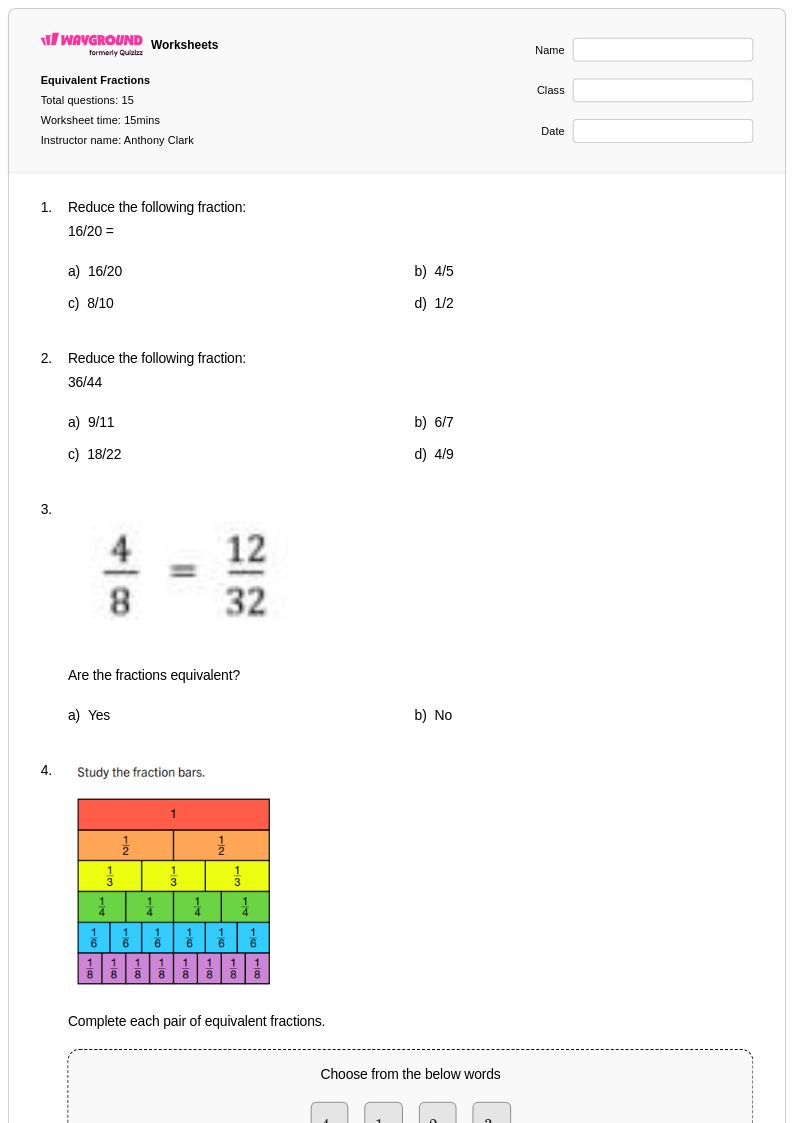
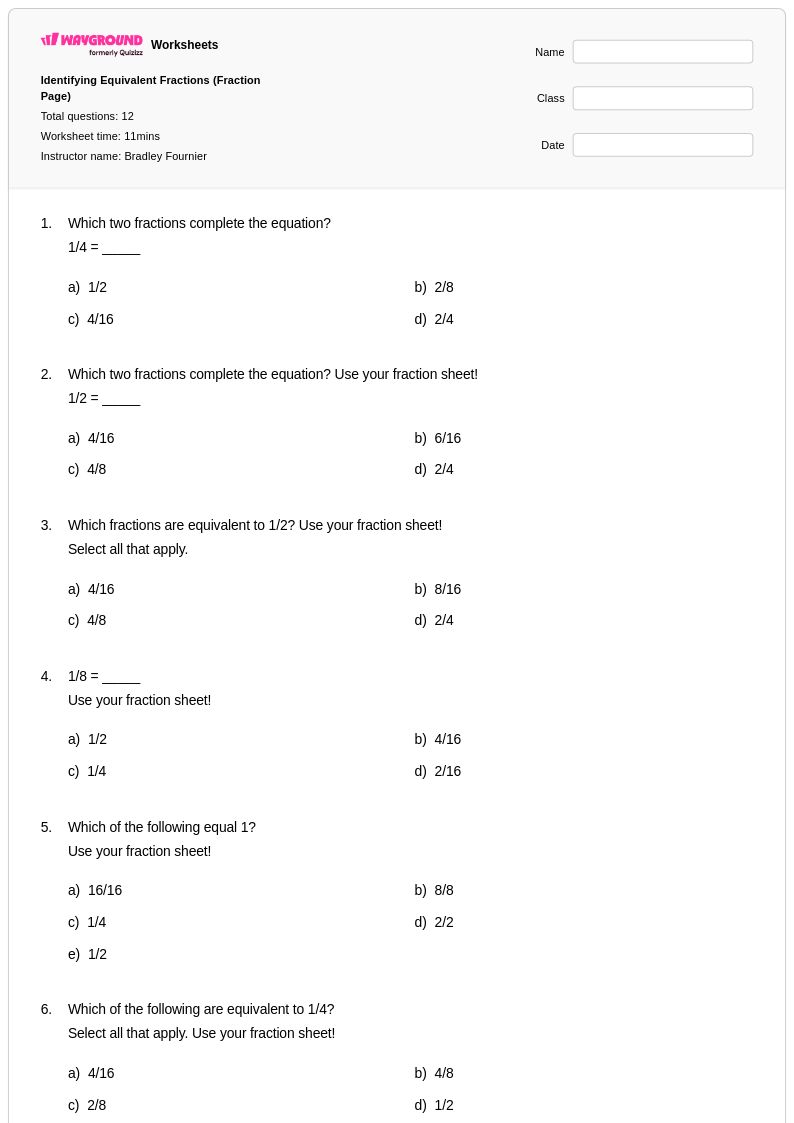
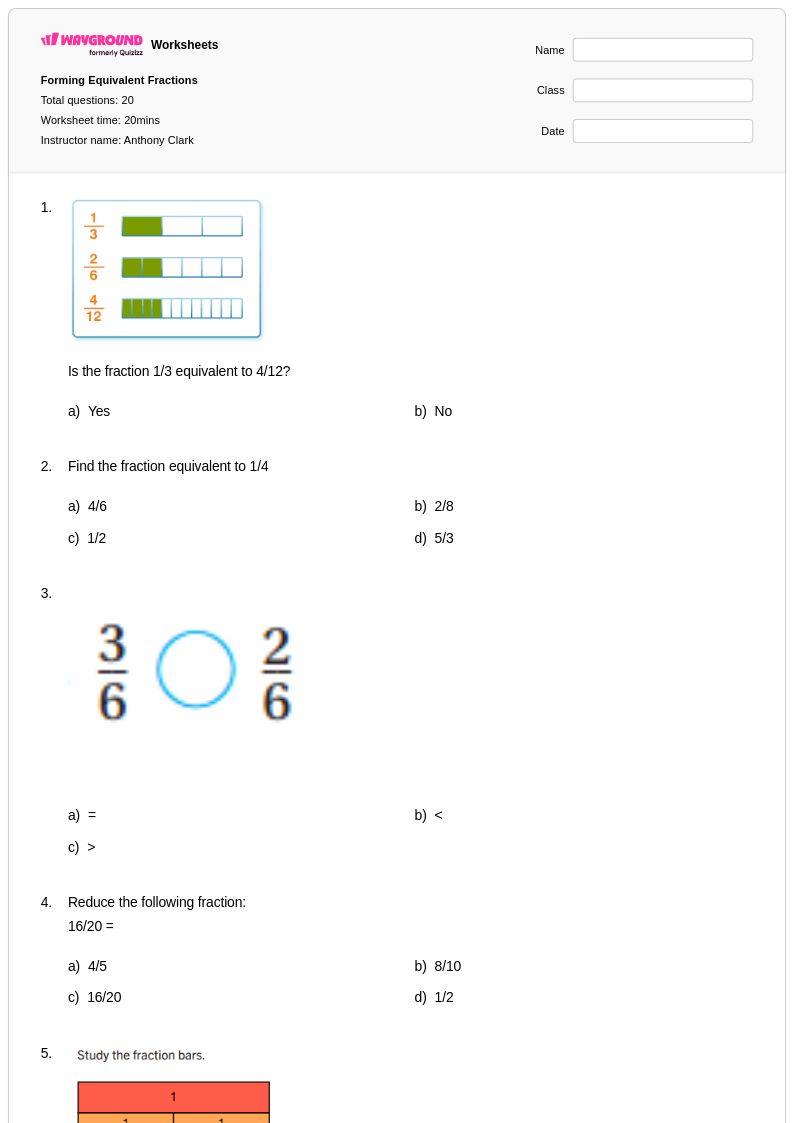
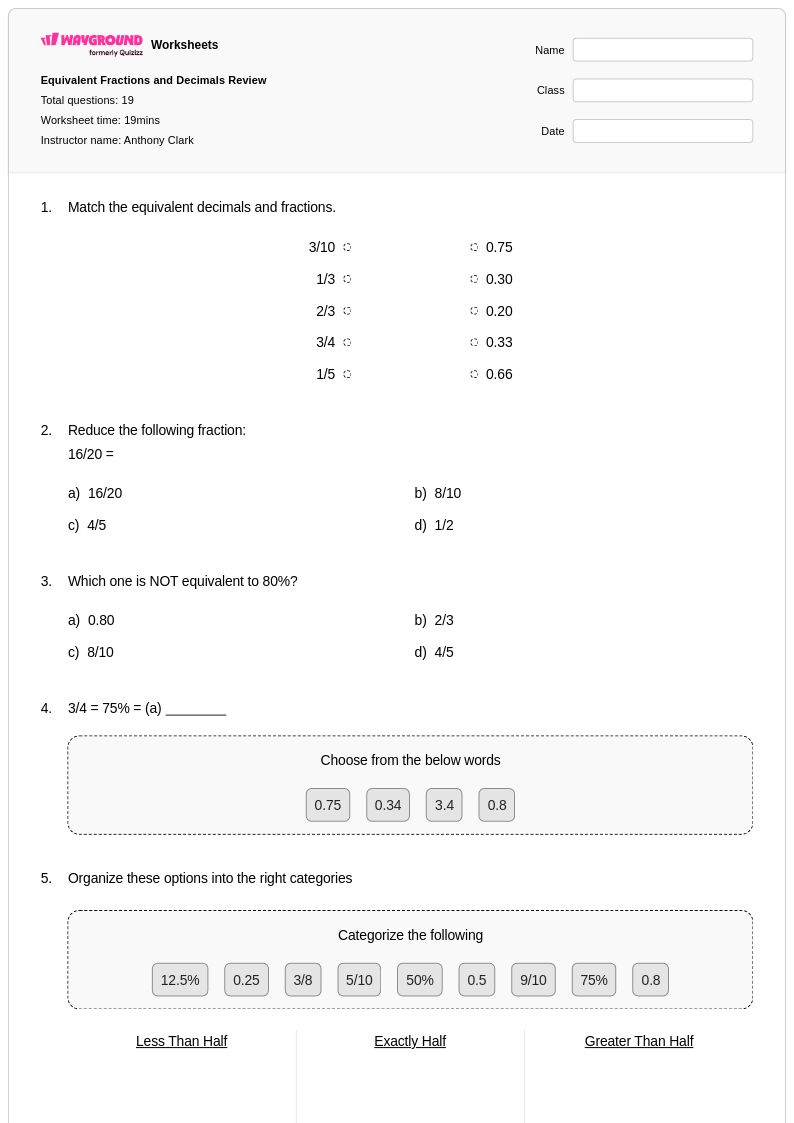
Discover free equivalent fractions worksheets and printables from Wayground that help students master identifying and creating equal fractional relationships through engaging practice problems with comprehensive answer keys.
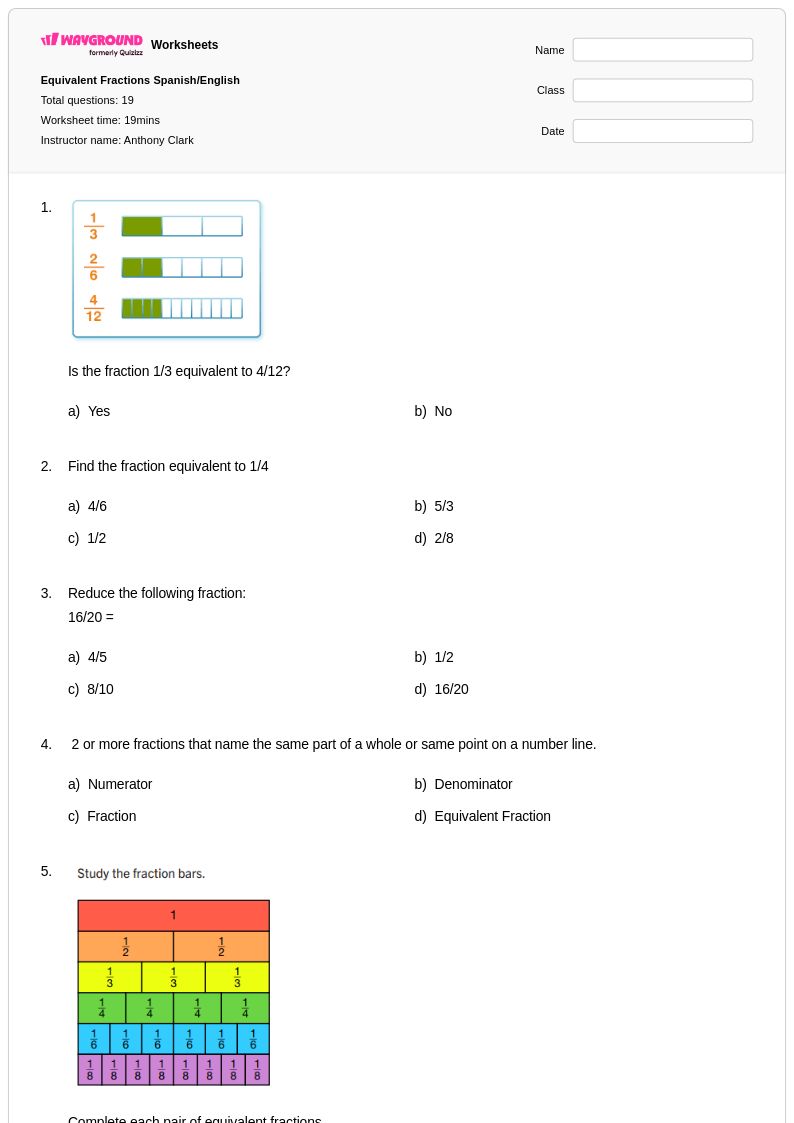
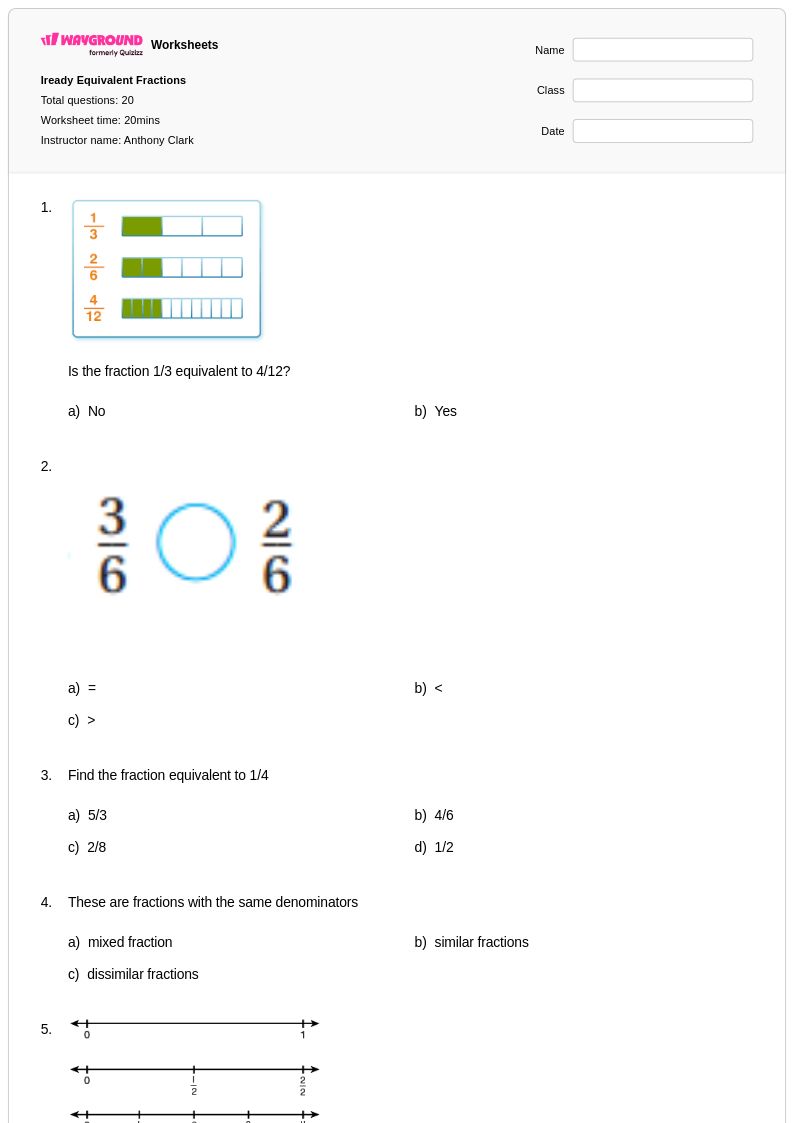
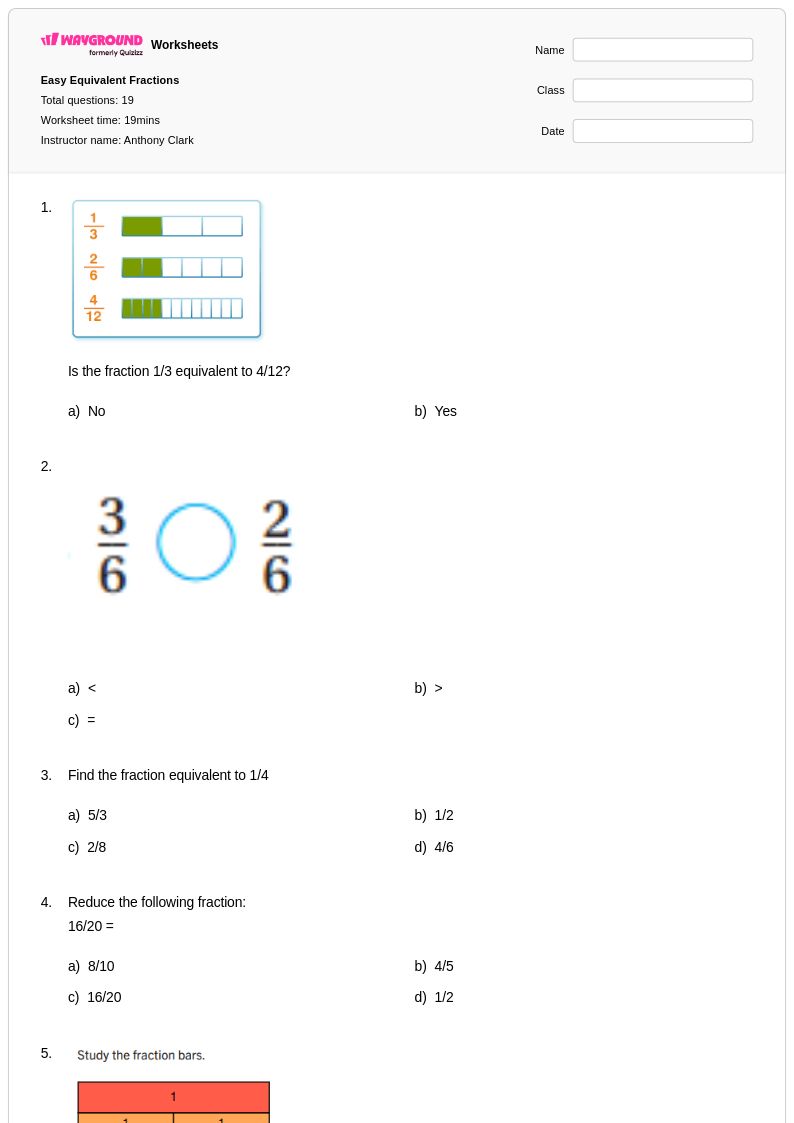
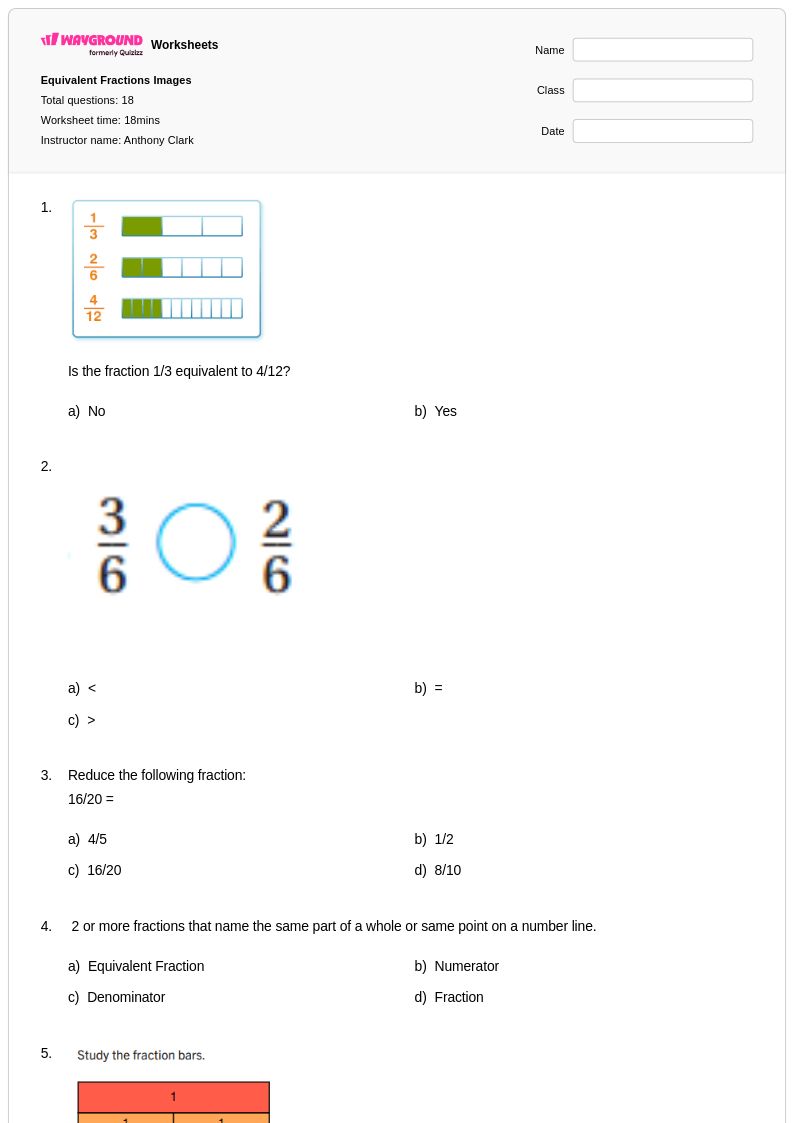
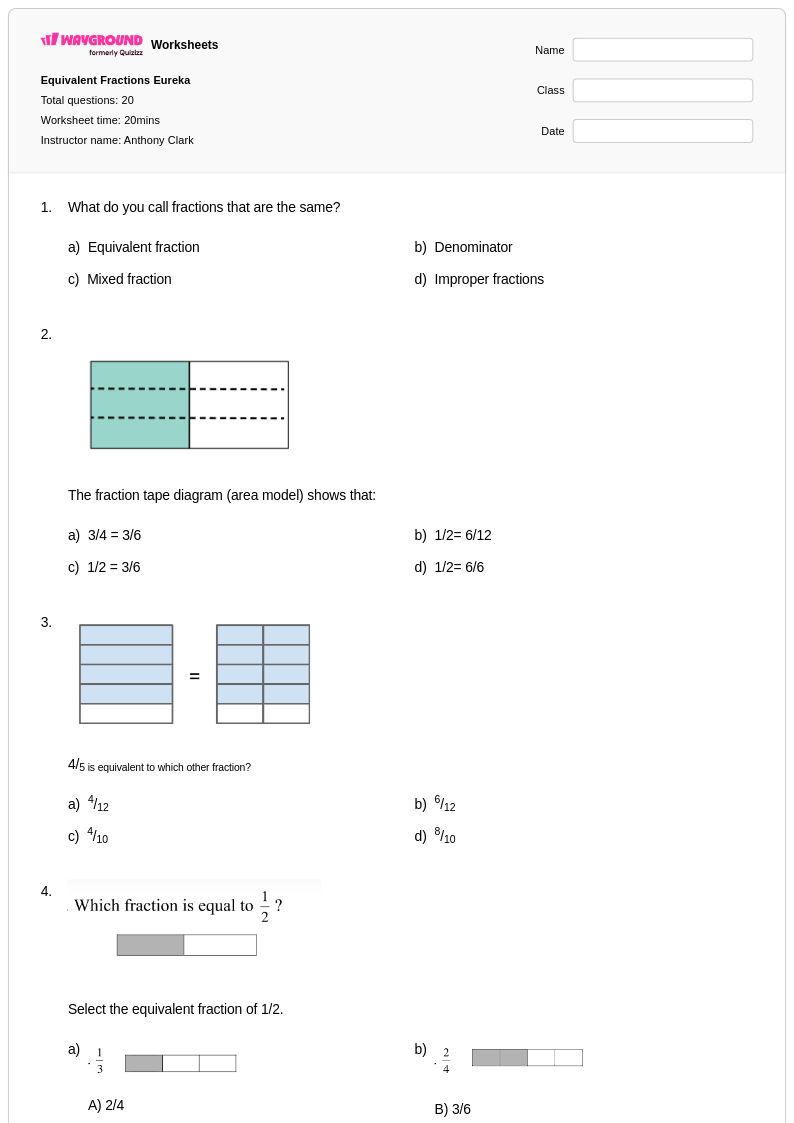
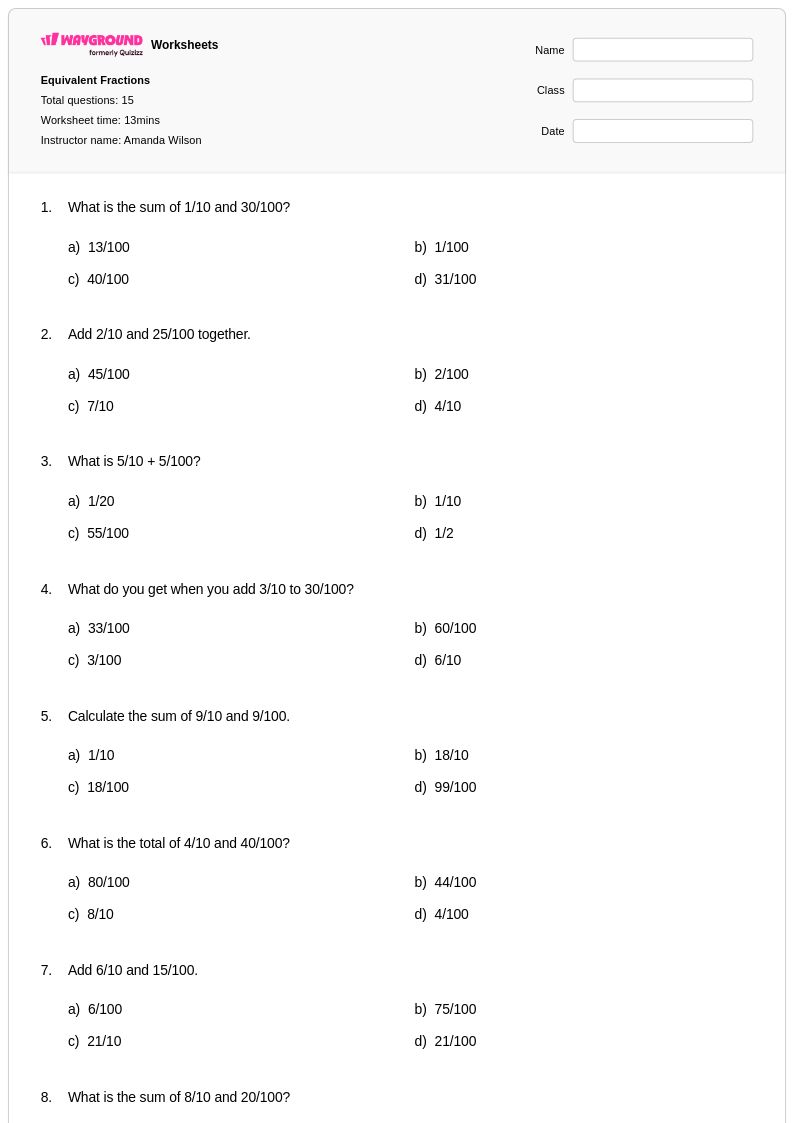
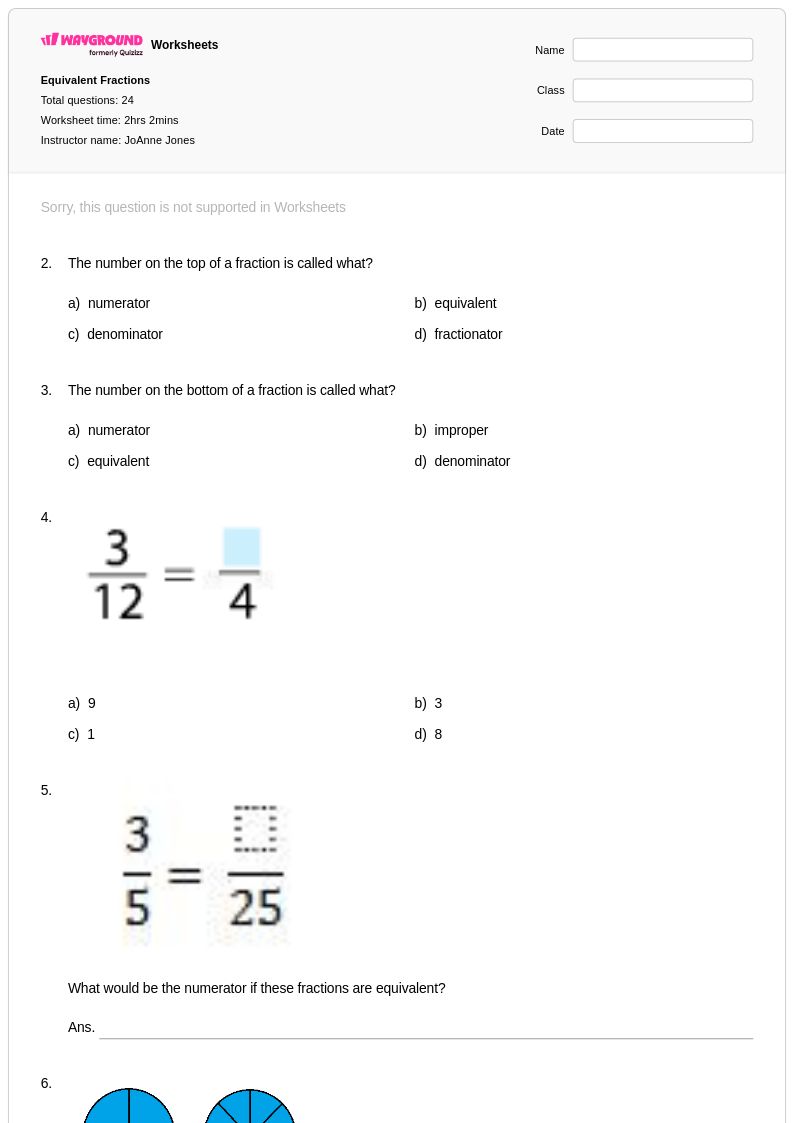
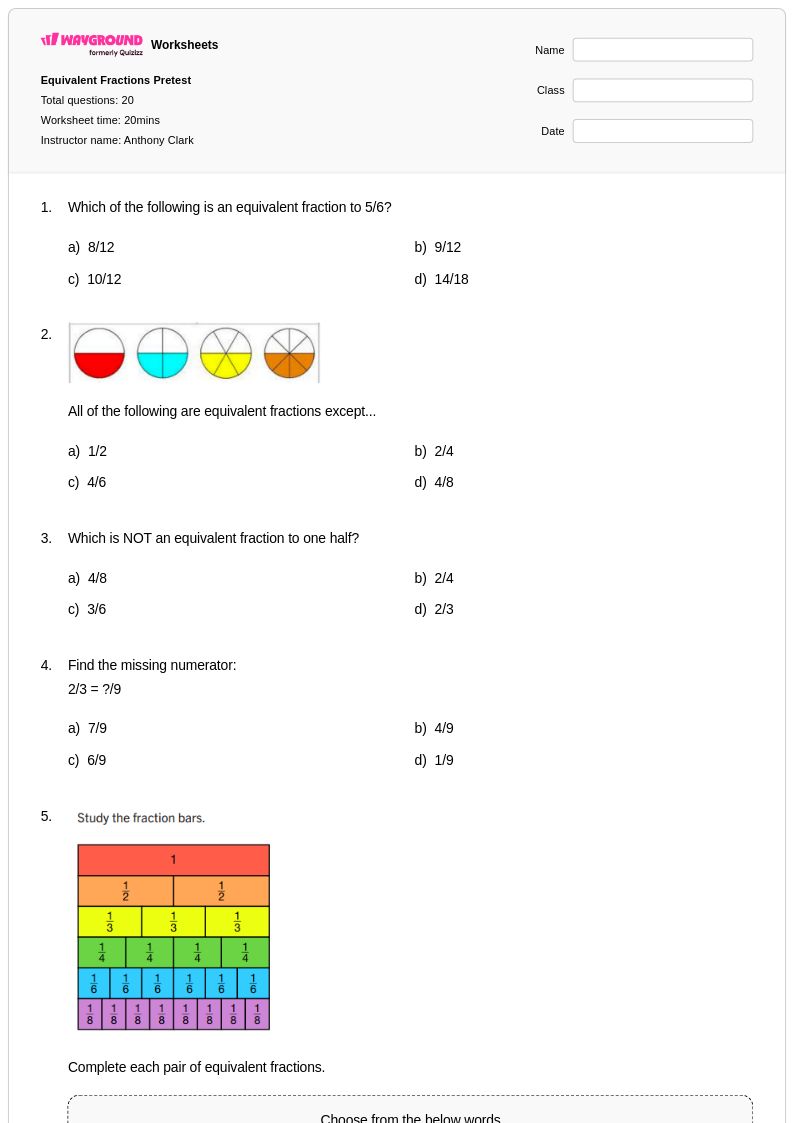
Equivalent fractions worksheets available through Wayground (formerly Quizizz) provide comprehensive practice opportunities for students to master this fundamental mathematical concept. These carefully designed resources help students develop critical number sense skills by learning to identify, create, and work with fractions that represent the same value despite having different numerators and denominators. The worksheets strengthen essential abilities including visual fraction recognition, cross-multiplication techniques, simplification strategies, and the understanding that fractions like 1/2, 2/4, and 3/6 are mathematically identical. Students engage with varied practice problems that progress from basic equivalent fraction identification using visual models to more complex algebraic manipulation, with each worksheet including a complete answer key for immediate feedback and self-assessment. These free printables offer structured practice in both computational skills and conceptual understanding, ensuring students build confidence with equivalent fractions through repeated exposure to diverse problem types available in convenient pdf format.
Wayground (formerly Quizizz) empowers educators with an extensive collection of teacher-created equivalent fractions worksheets drawn from millions of high-quality educational resources. The platform's robust search and filtering capabilities allow teachers to quickly locate materials that align with specific learning standards and match their students' developmental needs, whether for initial instruction, targeted remediation, or advanced enrichment activities. Teachers can easily customize existing worksheets or create new ones using the platform's flexible tools, adapting content difficulty, problem quantity, and visual elements to support differentiated instruction across diverse learning styles and abilities. These equivalent fractions resources are available in both printable pdf format for traditional classroom use and digital formats for interactive online learning, giving educators the versatility to seamlessly integrate practice activities into any lesson plan while ensuring students receive focused skill practice that builds mathematical proficiency and conceptual mastery.
FAQs
How do I teach equivalent fractions?
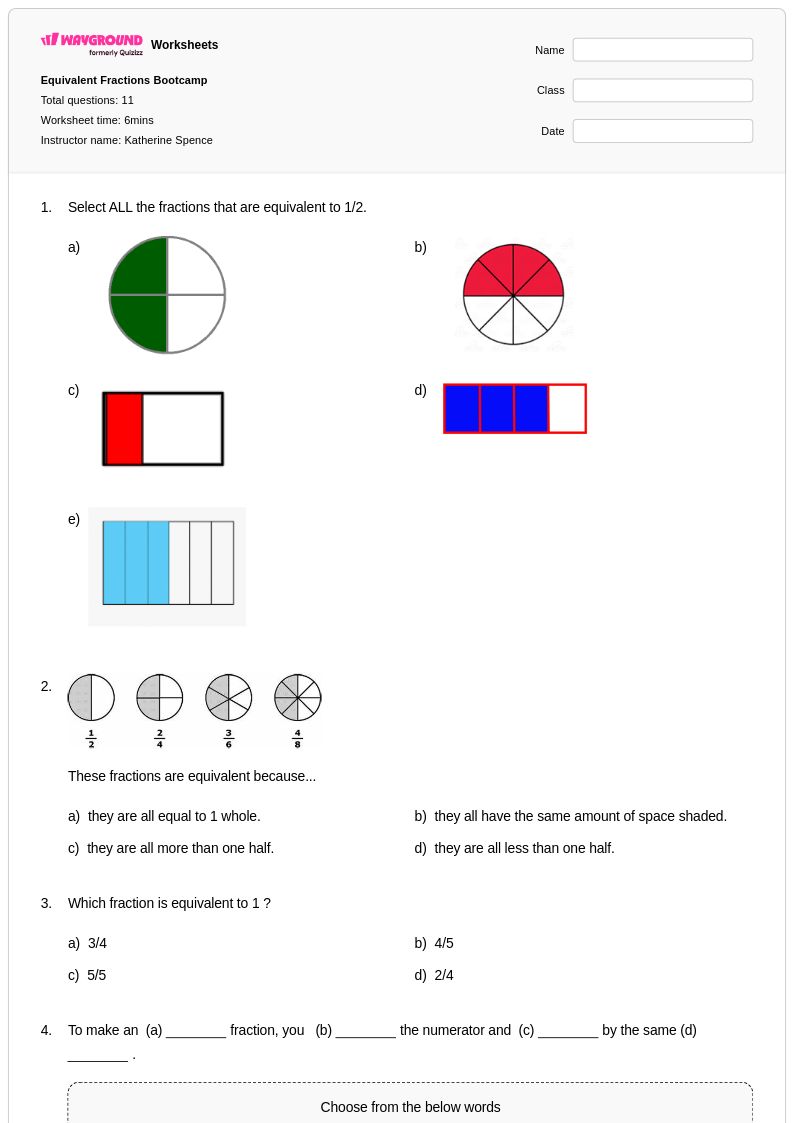
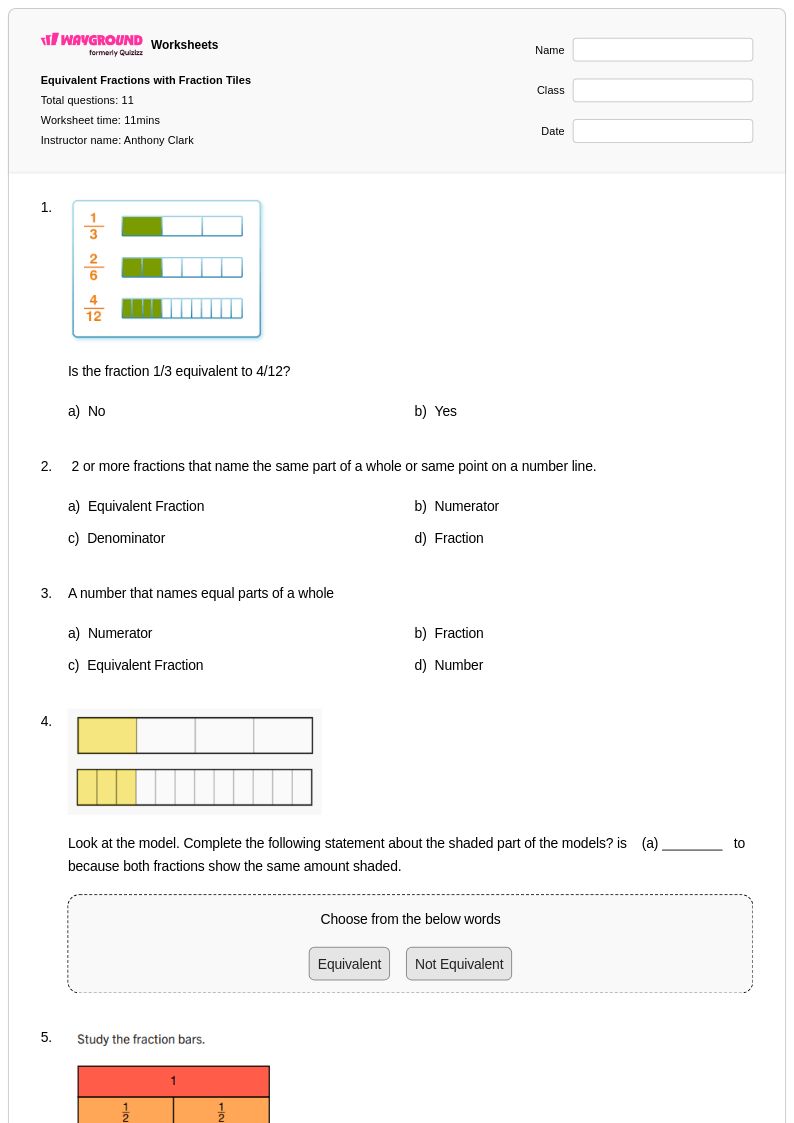
Start with visual models — fraction bars and area models make it concrete before you introduce any procedure. Once students can see that 1/2 and 2/4 shade the same amount, introduce the multiply-or-divide rule: whatever you do to the numerator, do to the denominator. Number lines are especially useful for students who struggle with area models, since they show equivalence as the same point on a line rather than the same shaded region.
What exercises help students practice equivalent fractions?
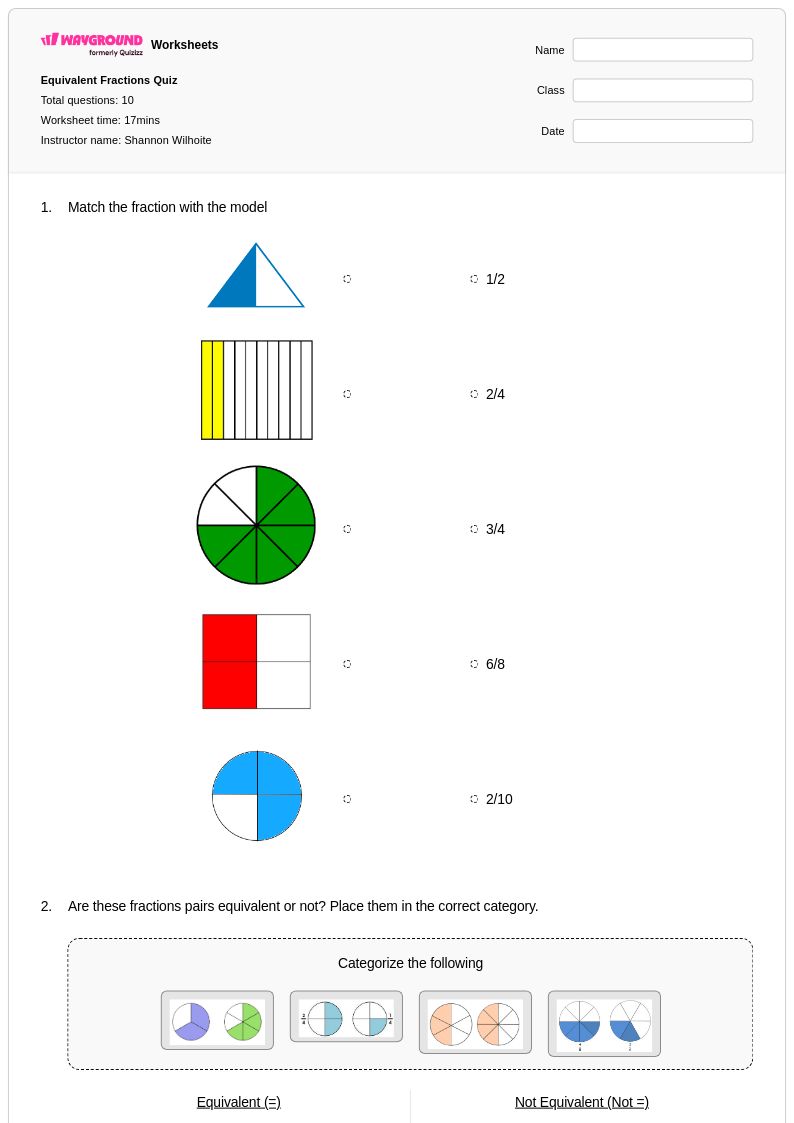
The most effective practice mixes problem types: identifying whether two fractions are equivalent, filling in a missing numerator or denominator, and generating a set of equivalent fractions from a given one. Visual matching tasks (pairing a fraction to its picture) build conceptual understanding, while missing-number problems push students toward the multiplicative relationship. Wayground's equivalent fractions worksheets include this range of problem types, progressing from visual models to algebraic manipulation.
What mistakes do students commonly make with equivalent fractions?
The most persistent error is adding the same number to both the numerator and denominator instead of multiplying — students who do this think 1/2 and 3/4 are equivalent because they added 2 to each part. A second common mistake is treating the numerator and denominator as independent whole numbers rather than as a ratio, which leads to confusion about why 2/4 and 1/2 are "the same." Catching the additive error early matters most, because it signals the student hasn't yet grasped the multiplicative structure of fractions.
How do I use Wayground's equivalent fractions worksheets in my class?
You can run any worksheet as a digital quiz hosted on Wayground — students complete it on a device and you get instant results — or download the PDF and assign it on paper, which works well for schools managing screen time. Every worksheet includes a complete answer key. If you go the paper route, the Wayground for Teachers app lets you scan or capture student submissions for grading without re-entering anything manually.
How does Common Core sequence equivalent fractions across grade levels?
Common Core introduces equivalent fractions in third grade using visual fraction models, where the goal is recognition rather than procedure. Fourth grade is where the multiplicative rule becomes explicit: students learn to generate equivalent fractions by multiplying or dividing numerator and denominator by the same number. By fifth grade, equivalent fractions are a tool rather than a topic — students apply them to add and subtract fractions with unlike denominators. Each stage builds directly on the last, so gaps in the visual foundation at third grade tend to surface as procedural errors in fourth.
How can I differentiate equivalent fractions practice for mixed-ability classes?
For students who need more support, Wayground's Read Aloud accommodation reads questions aloud, and reduced answer choices lower the cognitive load on multiple-choice items so students can focus on the fraction concept itself. For accessibility needs around print, you can generate an alternate version of the same worksheet with a larger font size or a dyslexia-friendly font — same problems, adjusted presentation. Advanced students can work from the standard version while supported students use the scaffolded one, all from the same worksheet.
Is equivalent fractions a Common Core topic?
Yes. Equivalent fractions sit squarely within Common Core's Number and Operations — Fractions domain. The standard progression moves from building understanding with visual models in third grade to using multiplication and division to generate equivalent fractions in fourth grade, then applying that skill to fraction operations in fifth grade.