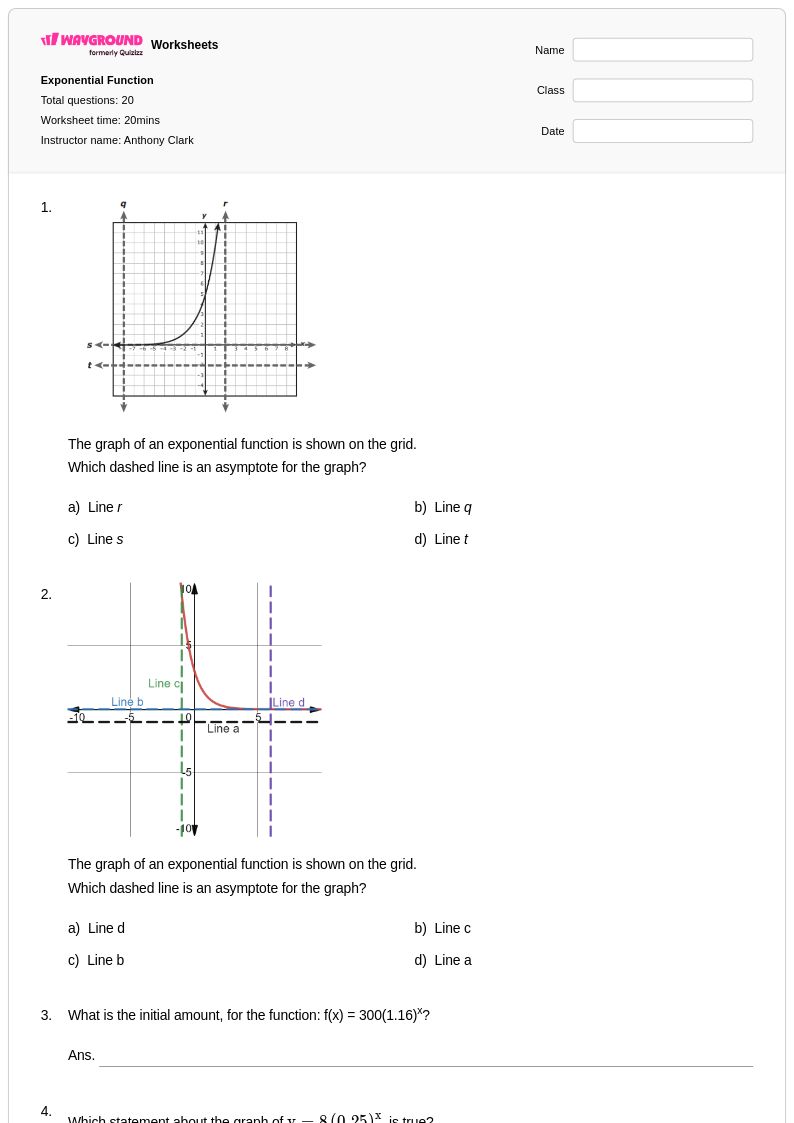
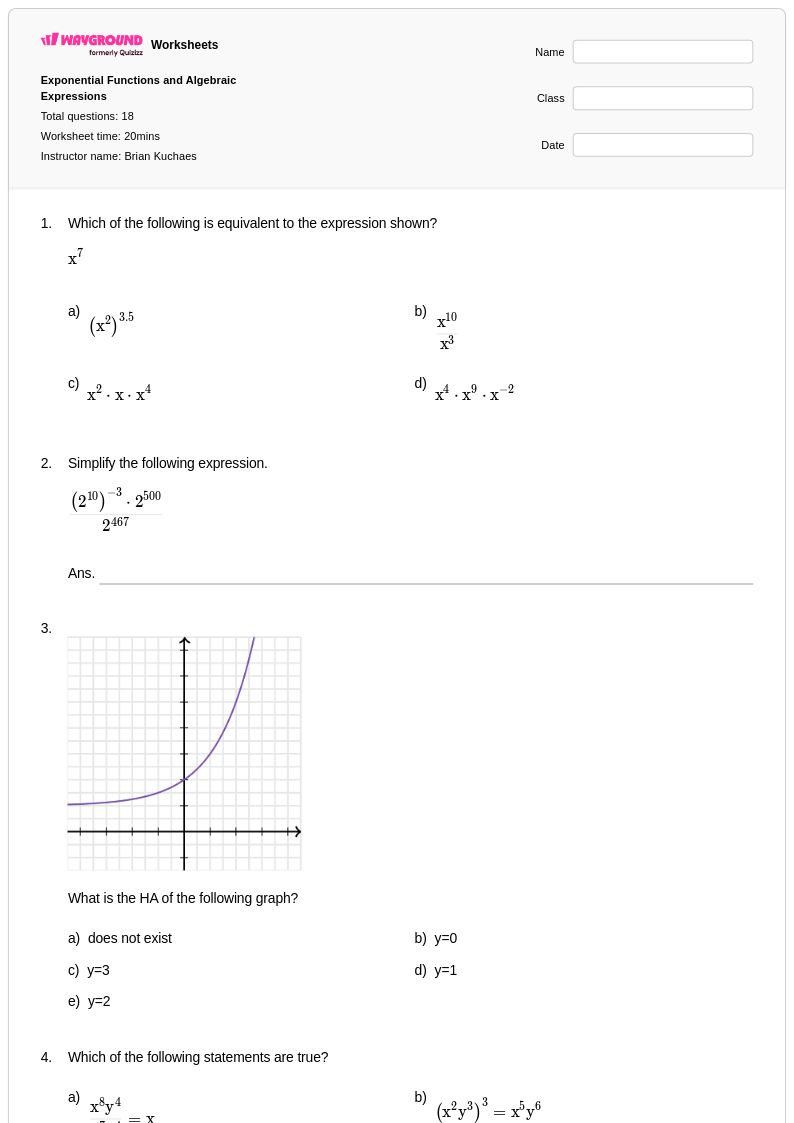
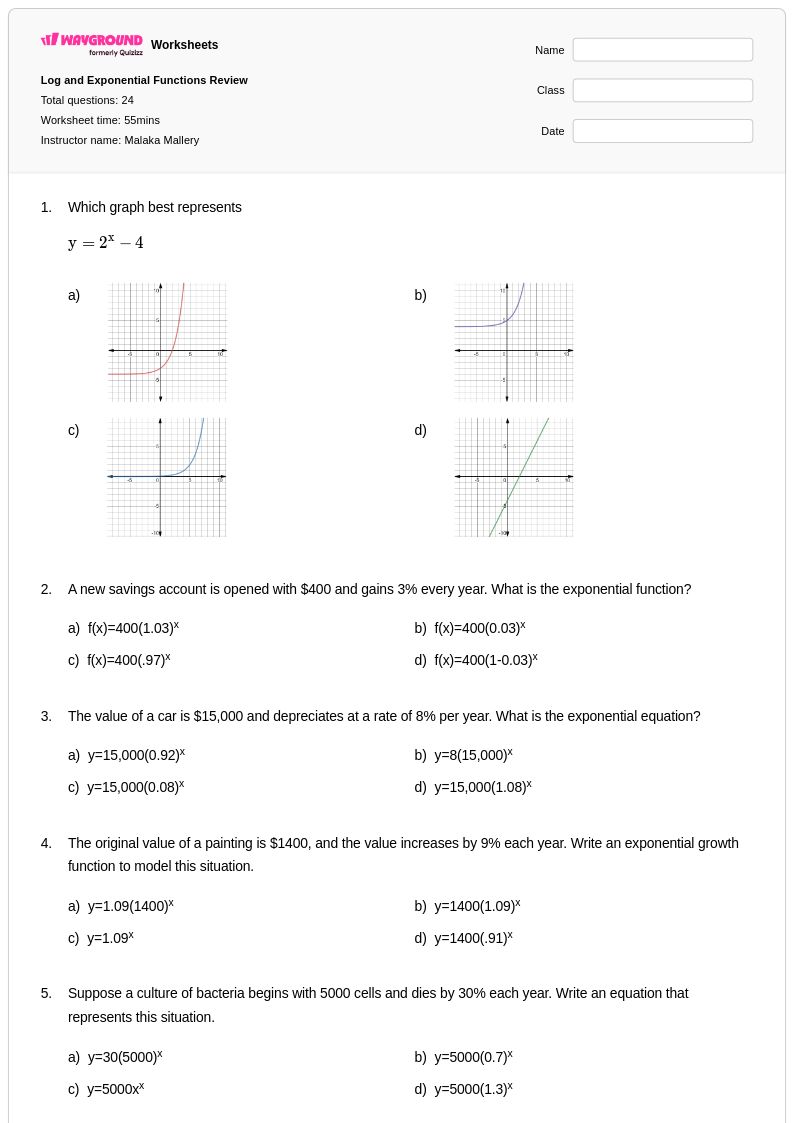
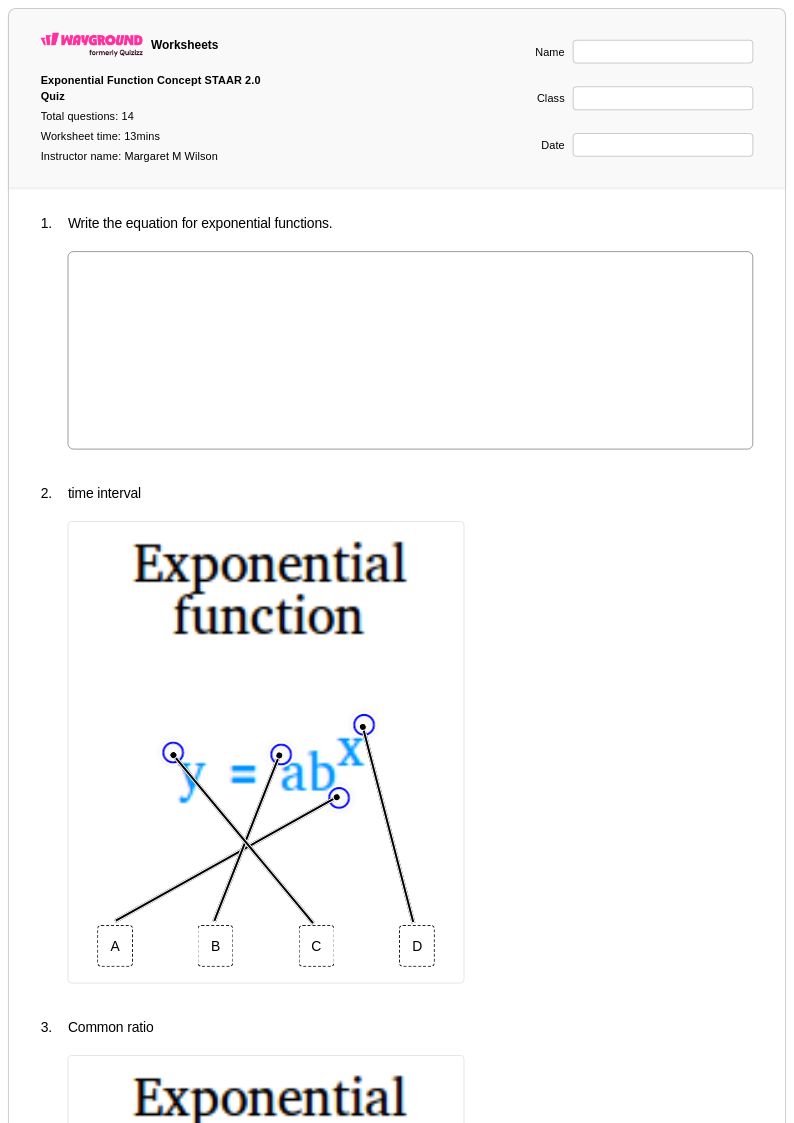
Free Printable Exponential Function Manipulation worksheets
Master exponential function manipulation with Wayground's comprehensive collection of free worksheets, featuring printable PDFs with practice problems and answer keys to help students develop advanced mathematical skills.
Explore printable Exponential Function Manipulation worksheets
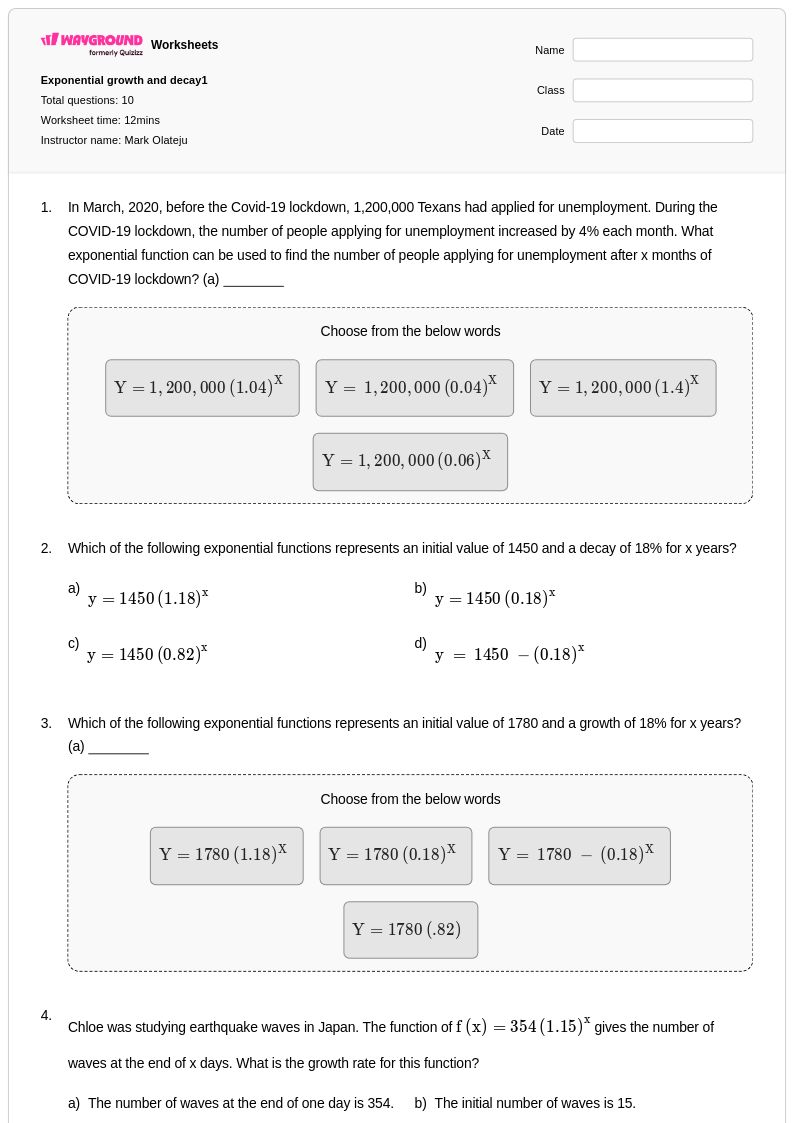
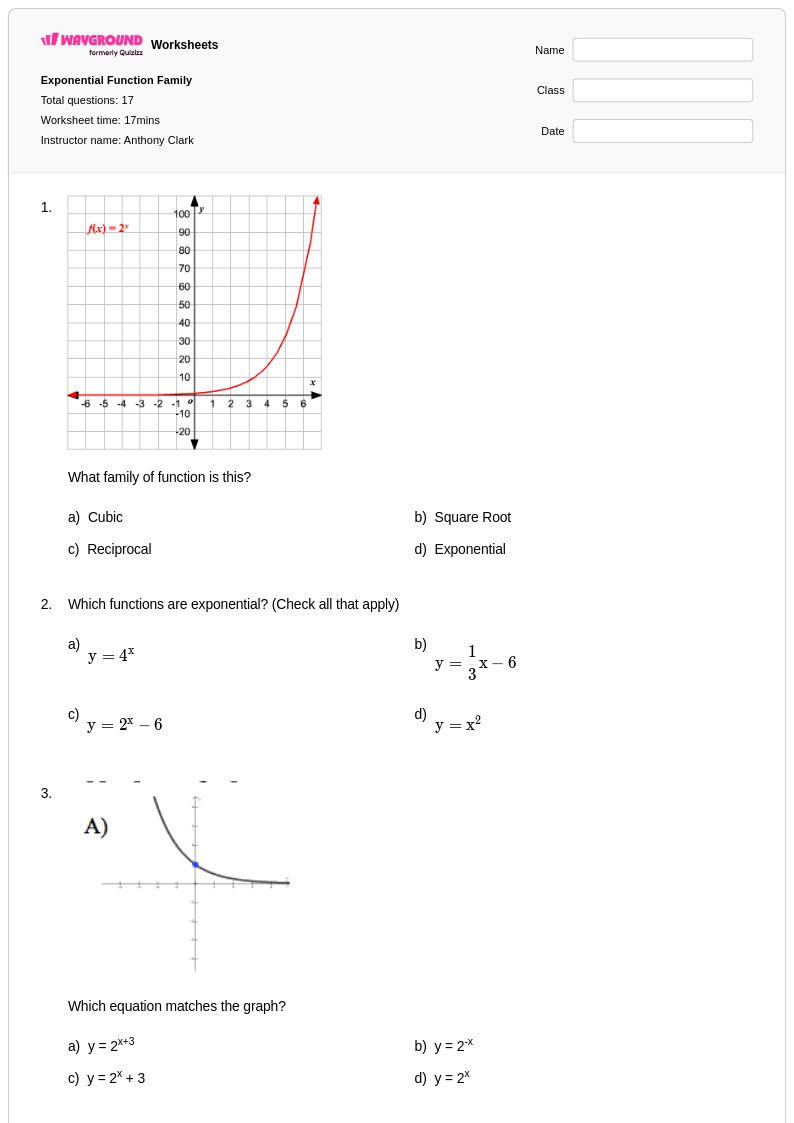
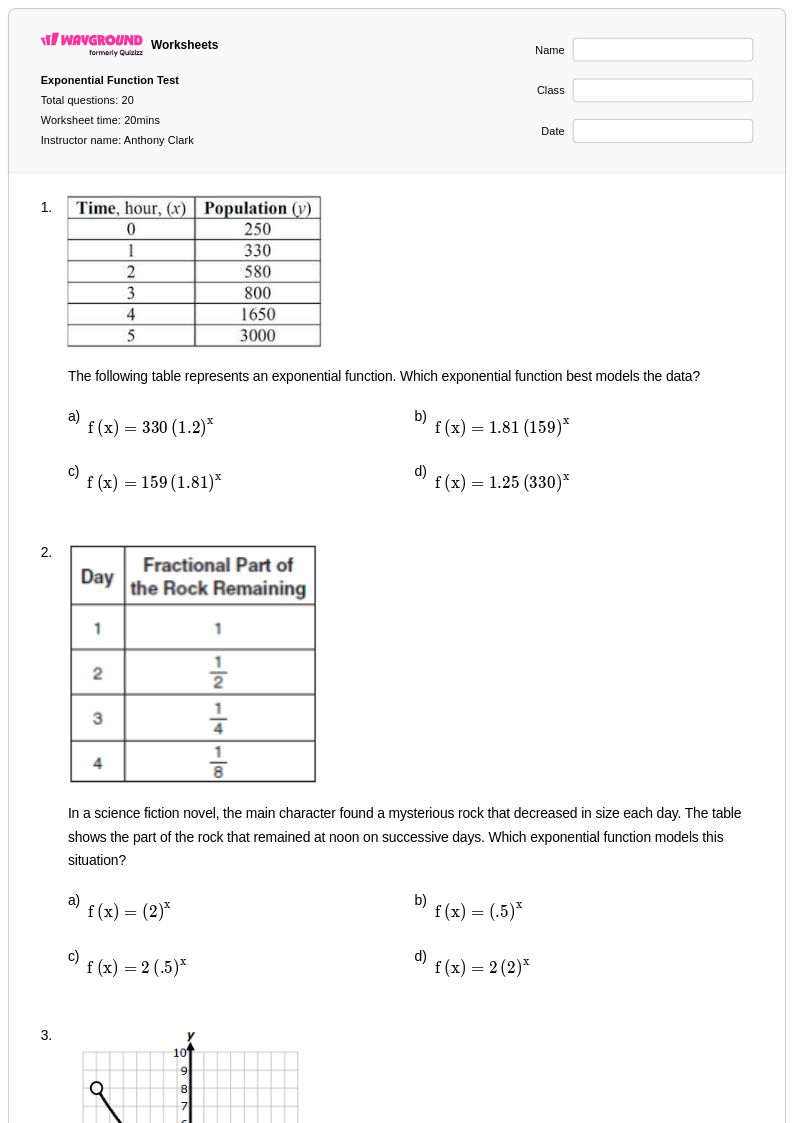
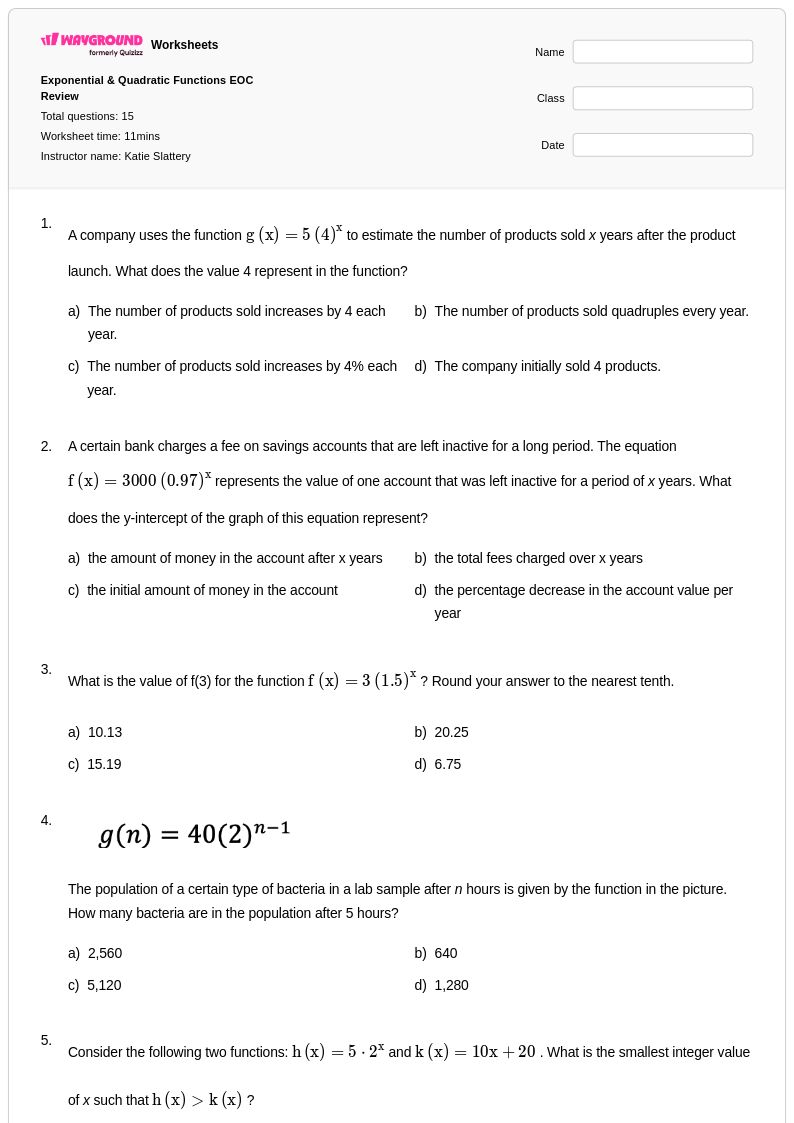
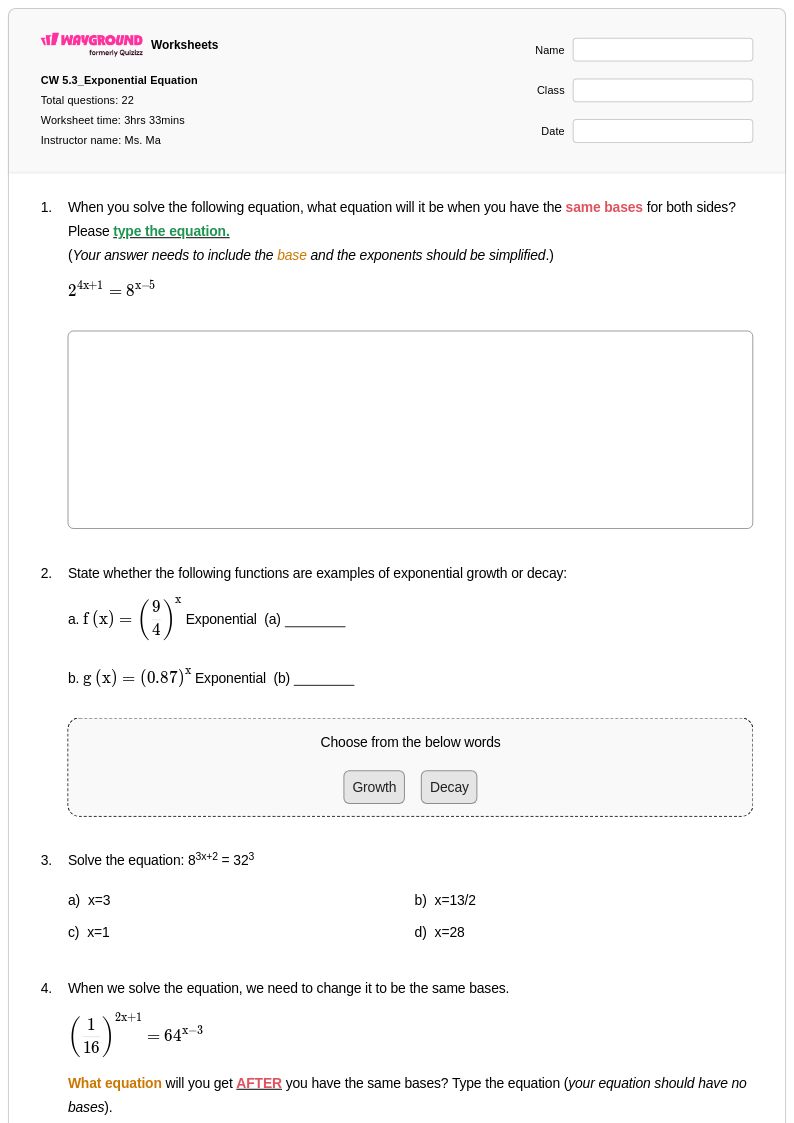
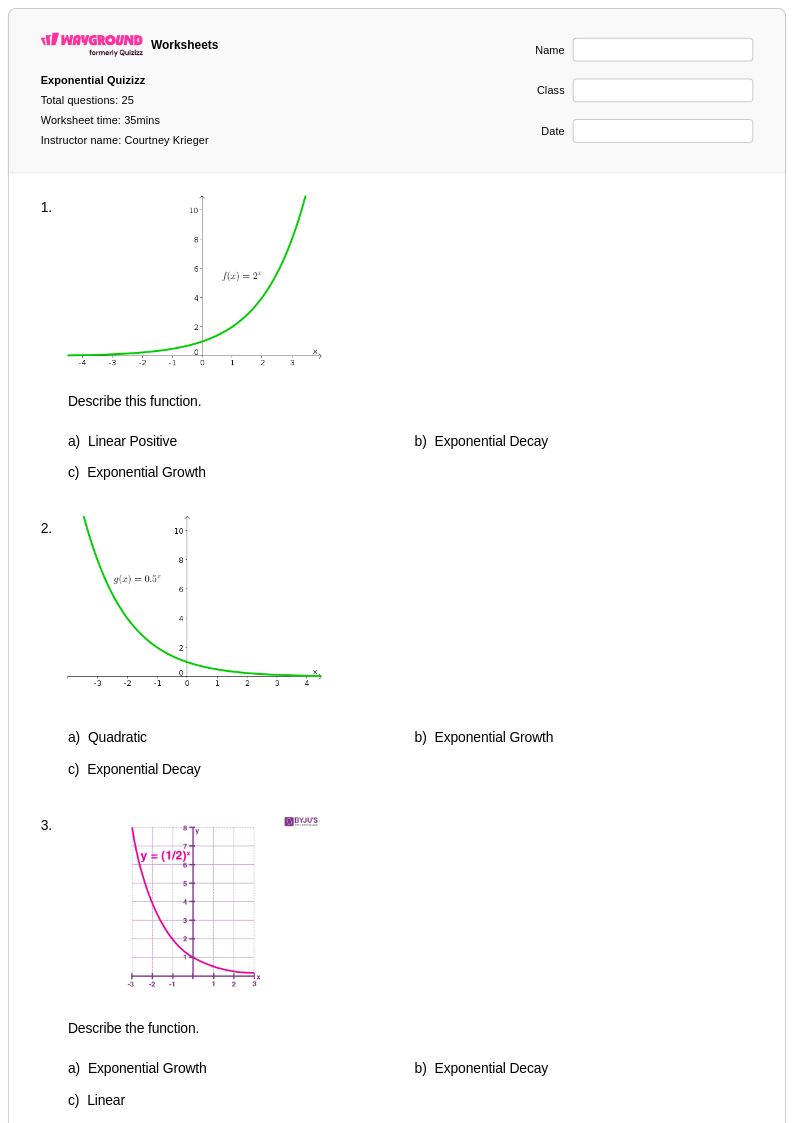
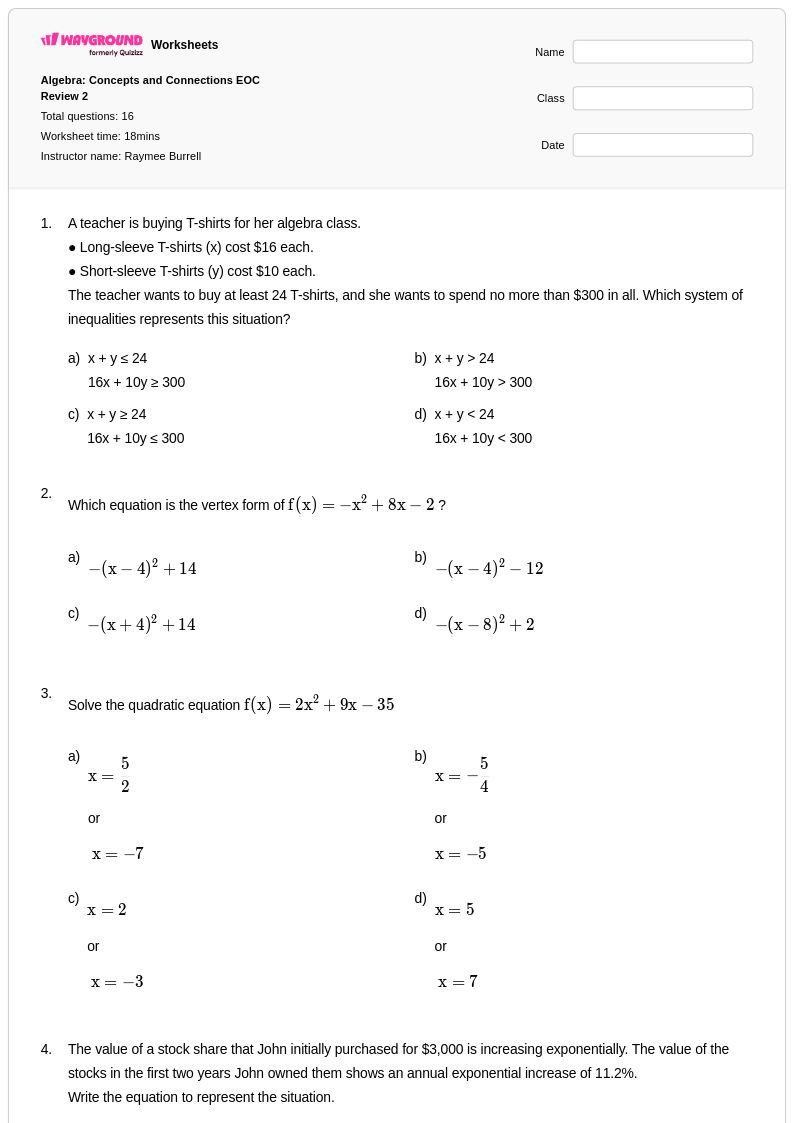
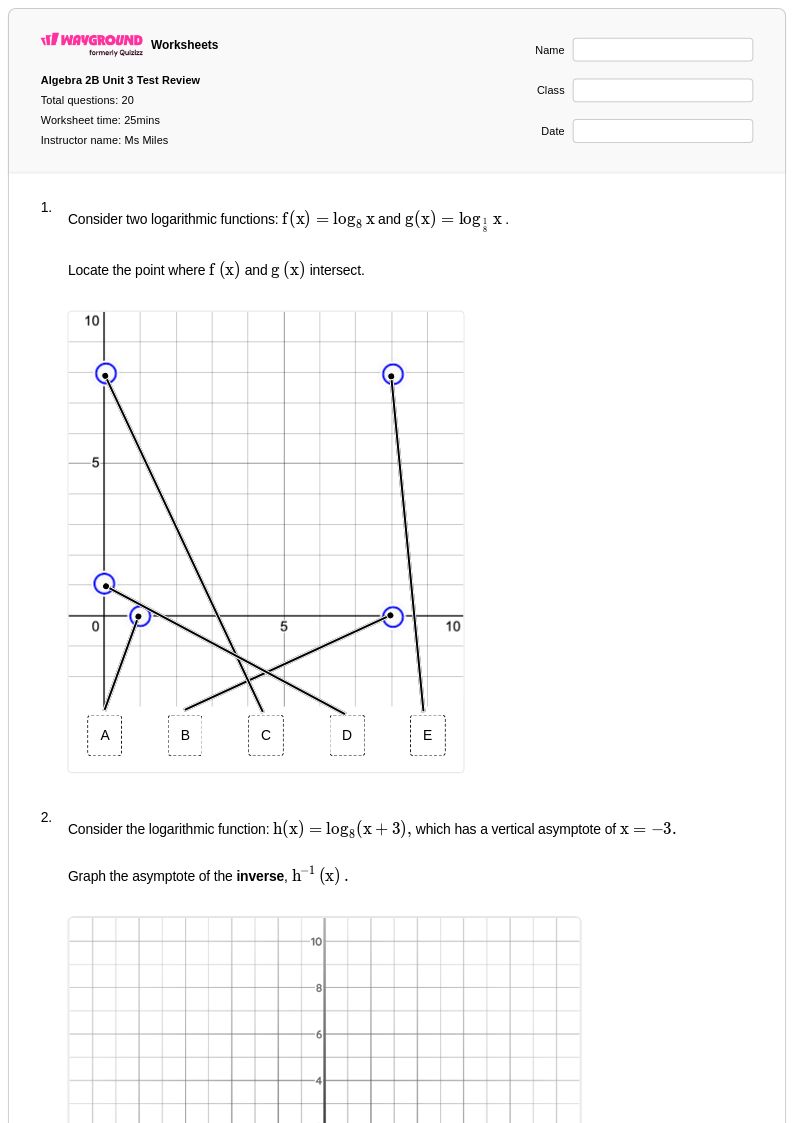
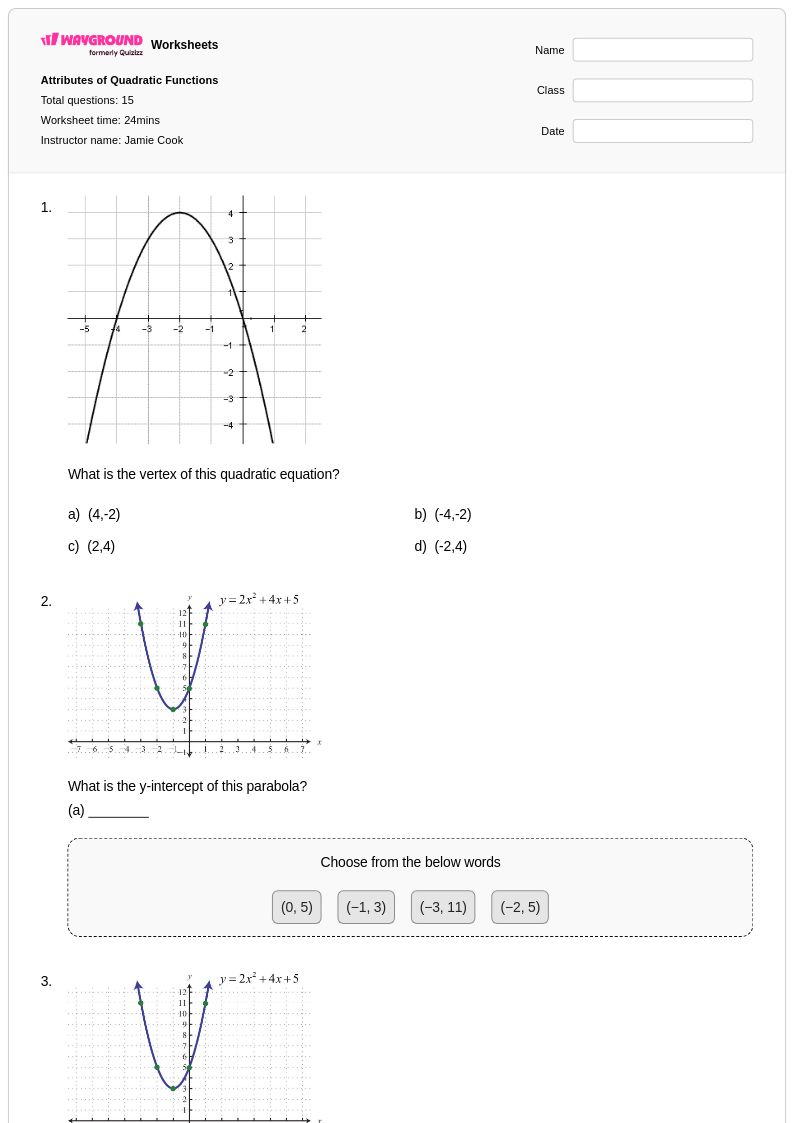
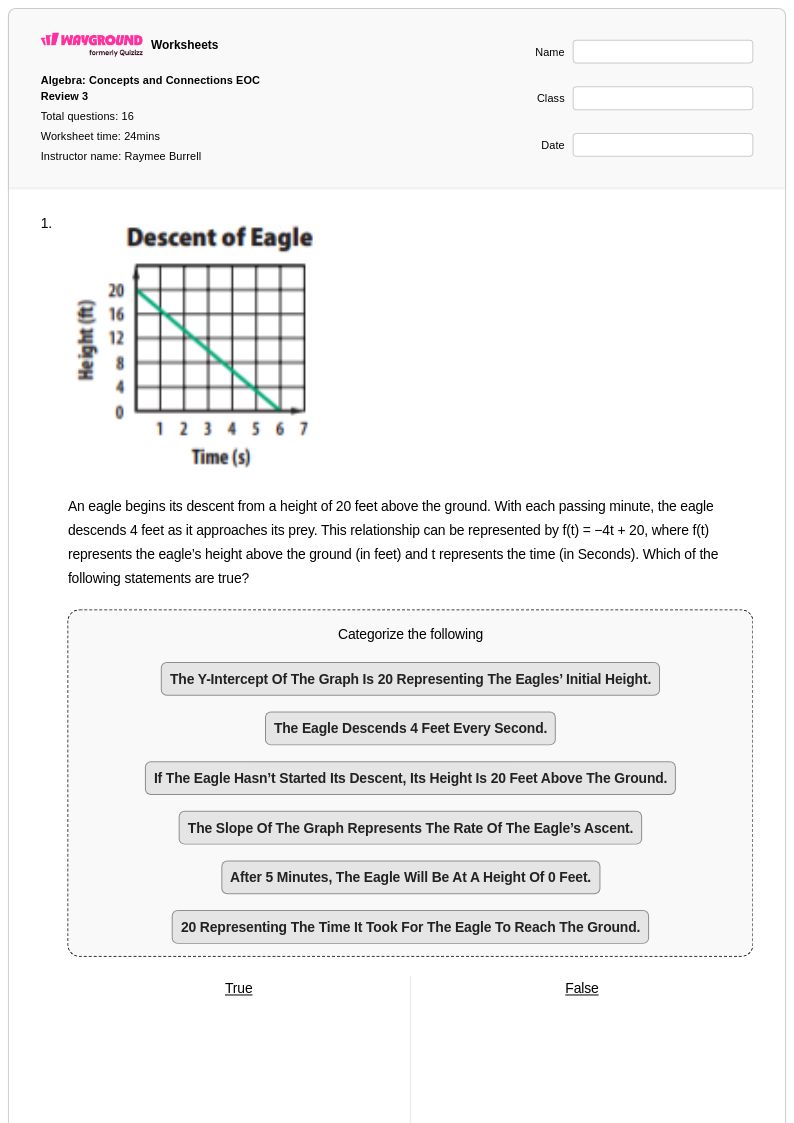
Exponential function manipulation worksheets available through Wayground (formerly Quizizz) provide comprehensive practice for students learning to transform, analyze, and work with exponential functions across various mathematical contexts. These carefully designed resources strengthen essential skills including shifting exponential graphs vertically and horizontally, applying reflections and stretches, composing exponential functions with other function types, and solving complex exponential equations through algebraic manipulation. Students develop proficiency in recognizing how parameter changes affect exponential function behavior, interpreting real-world applications involving exponential growth and decay, and connecting graphical transformations to algebraic representations. Each worksheet comes with a detailed answer key and is available as free printables in pdf format, making it easy for educators to incorporate targeted practice problems into their curriculum while supporting students' understanding of these fundamental mathematical concepts.
Wayground (formerly Quizizz) empowers teachers with millions of educator-created exponential function manipulation resources that can be easily discovered through robust search and filtering capabilities. The platform's standards alignment ensures worksheets meet specific curriculum requirements, while built-in differentiation tools allow teachers to customize content difficulty and problem types to match individual student needs. Teachers can seamlessly switch between printable pdf versions for traditional classroom use and digital formats for interactive learning environments, providing maximum flexibility for diverse instructional approaches. These comprehensive worksheet collections support effective lesson planning by offering ready-made materials for initial skill introduction, targeted remediation for struggling students, and enrichment opportunities for advanced learners, ultimately enabling teachers to provide consistent, high-quality practice that builds mathematical confidence and competency in exponential function manipulation.
FAQs
How do I teach exponential function manipulation?
Start with the base form y = ab^x and make sure students can identify what each parameter does before any manipulation begins. From there, build transformations one at a time: vertical shifts first, then horizontal shifts, then reflections and stretches. Students who try to absorb all transformations at once tend to conflate them. Connecting each algebraic change to its graphical effect — and back again — is what makes the manipulation stick rather than becoming a set of memorized rules.
What exercises help students practice exponential function manipulation?
The most productive practice moves between representations: give students an equation and ask them to sketch the transformation, then reverse it — give them a graph and ask them to write the equation. Composition problems (combining an exponential with a linear or quadratic function) push students to apply manipulation skills in less predictable contexts. Exponential growth and decay word problems are also valuable because they require students to set up and manipulate the model, not just evaluate it.
What mistakes do students commonly make when manipulating exponential functions?
Three errors come up repeatedly. First, students confuse horizontal shift direction — they see f(x) = 2^(x−3) and shift left instead of right. Second, they misapply the order of operations when a vertical stretch and a vertical shift are both present, often multiplying the shift by the base. Third, when composing exponential functions with other types, students treat the exponent as a separate, independent expression rather than tracking how the inner function feeds into the base. Catching the second and third errors early prevents a lot of pain in later units.
How do I use Wayground's exponential function manipulation worksheets in my class?
Each worksheet includes a complete answer key, so it works well for independent practice or homework without extra prep on your end. You can run it as a digital quiz hosted on Wayground — useful for getting instant results — or download the printable PDF and assign it on paper, which works well for classes where you want students off screens. If you go the paper route, the Wayground for Teachers app lets you scan or capture student submissions for grading without re-entering everything manually.
Is exponential function manipulation aligned to Common Core standards?
Yes. Common Core sequences exponential functions so that students first build intuition with integer exponents and simple exponential growth patterns in middle school, then formalize function notation and transformations in high school algebra. Manipulation work — rewriting forms, applying transformations, composing functions — sits squarely in the high school Functions domain, where the emphasis is on understanding how changing parameters in f(x) = ab^(x−h) + k produces predictable graphical and algebraic effects. This lays the groundwork for logarithmic functions and eventually calculus-level analysis of exponential models.
How can I differentiate exponential function manipulation practice for mixed-ability classes?
For students who struggle with the algebraic notation, Wayground's reduced answer choices accommodation lowers the cognitive load on individual questions, letting them focus on the transformation concept rather than getting lost in the options. The dyslexia-friendly font and adjustable font size options help students who find dense equation formatting hard to parse. For language support, worksheets can be translated directly on the platform — useful when students are solid on the math but working through an English barrier. These settings are saved per student, so you configure them once and they carry forward.
What does exponential function manipulation build toward in the math curriculum?
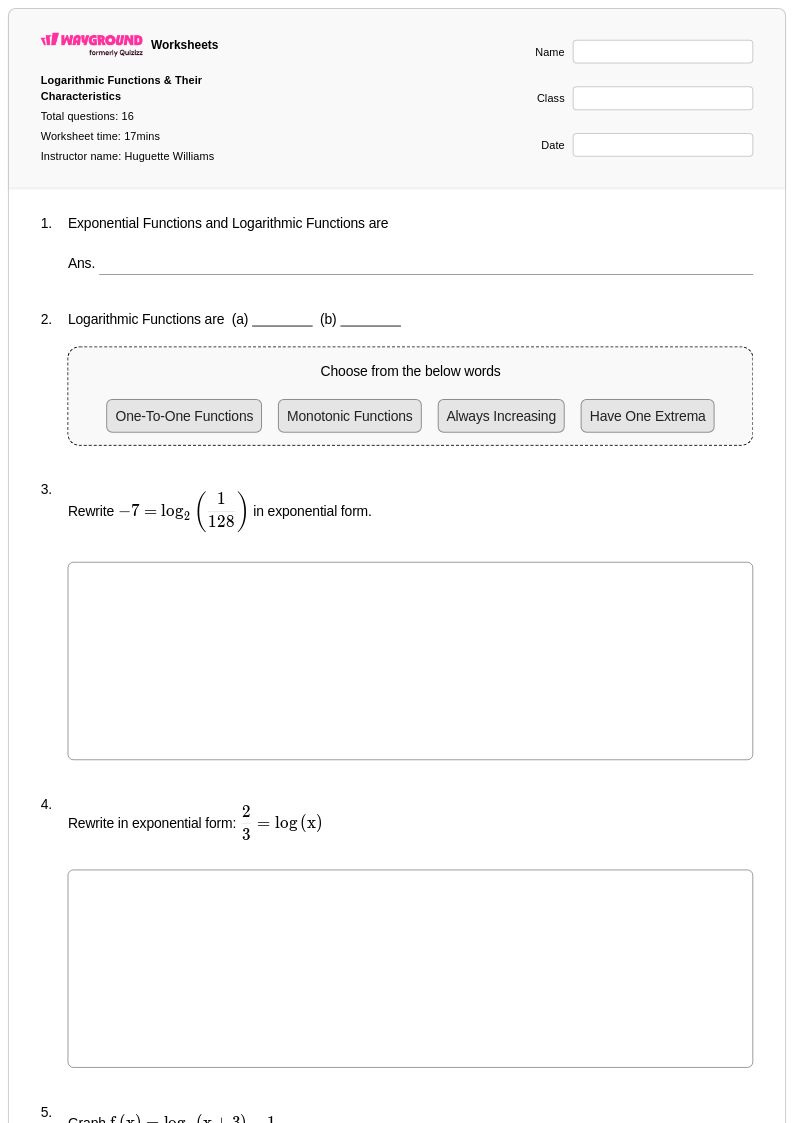
Fluency with exponential manipulation is the direct prerequisite for logarithmic functions — students who can't rewrite or transform exponential expressions reliably will struggle the moment logarithms are introduced as inverses. Beyond that, exponential models (growth, decay, compound interest) appear throughout precalculus and are revisited in calculus when students differentiate and integrate exponential functions. Getting the manipulation mechanics right at this stage prevents compounding gaps later.