Free Printable Galaxy Types Worksheets for Class 6
Class 6 galaxy types worksheets from Wayground help students explore spiral, elliptical, and irregular galaxies through engaging printables, practice problems, and comprehensive answer keys for effective space science learning.
Explore printable Galaxy Types worksheets for Class 6
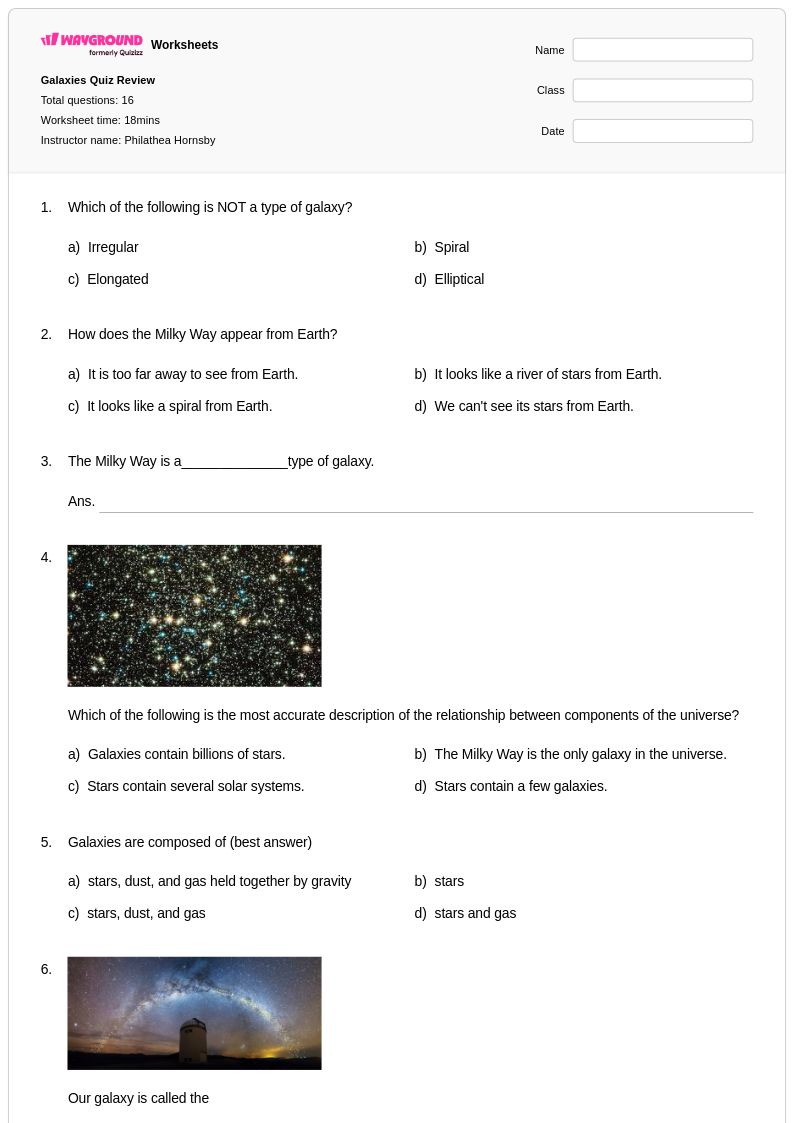
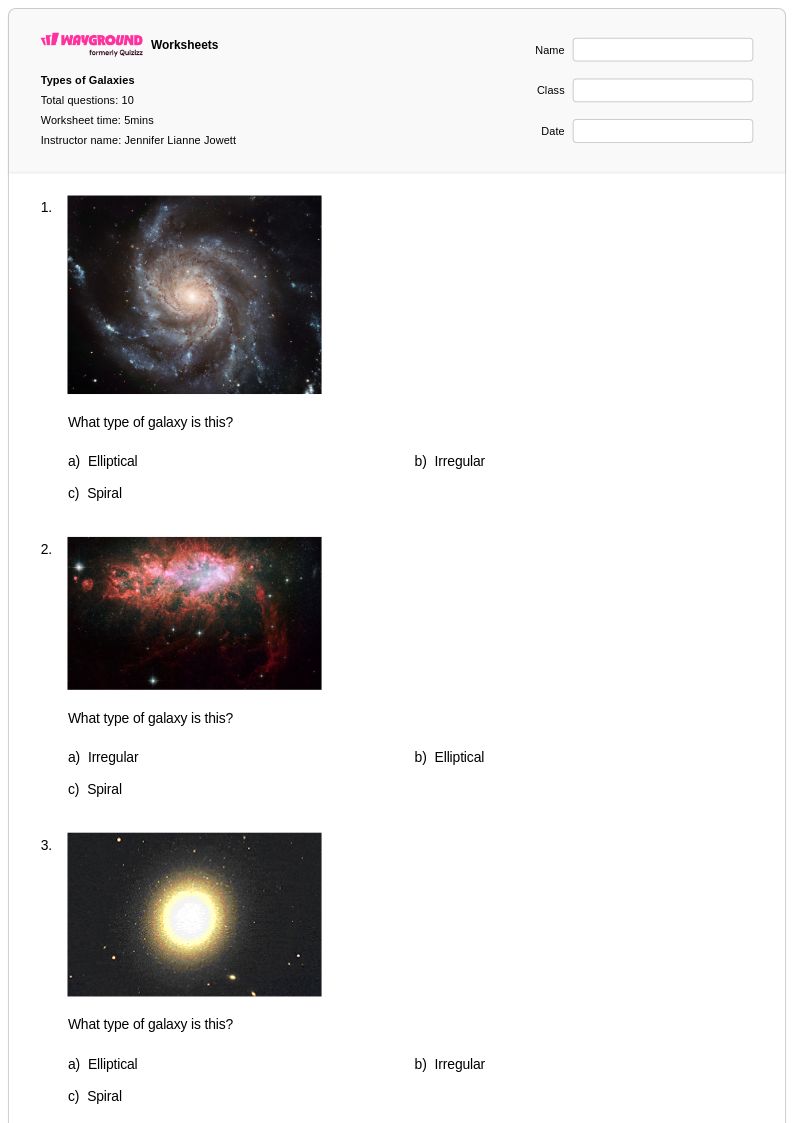
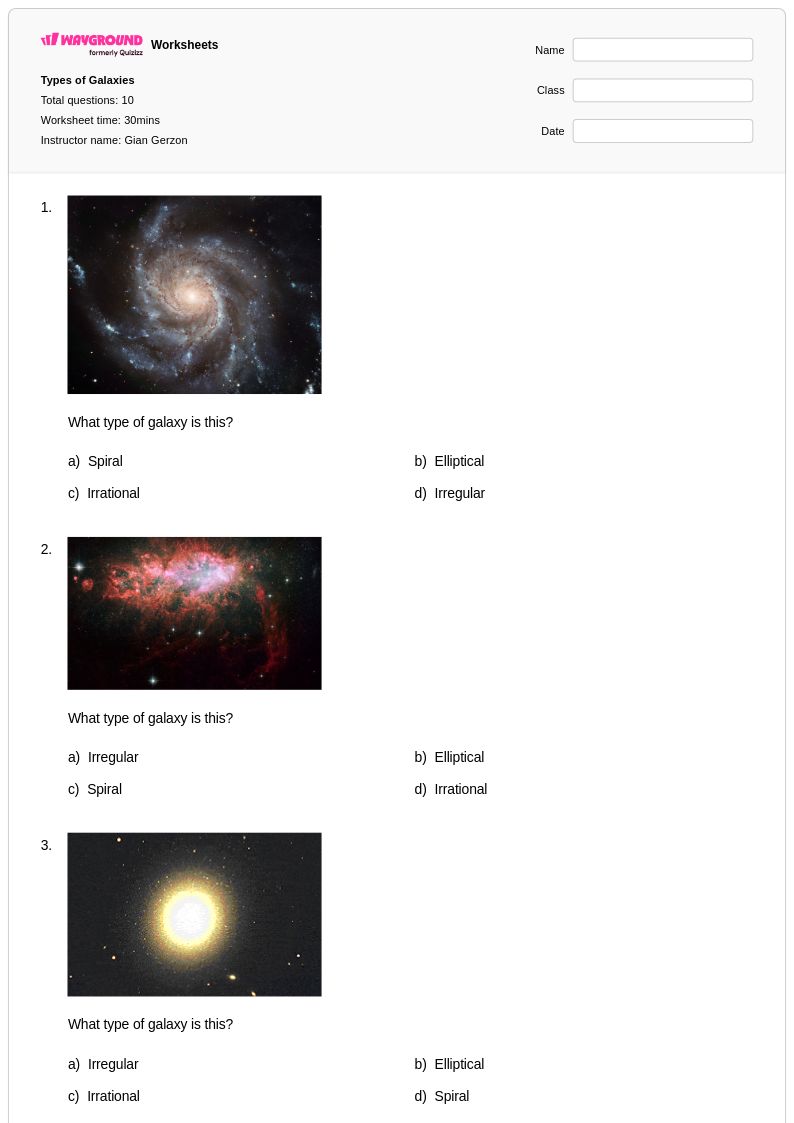
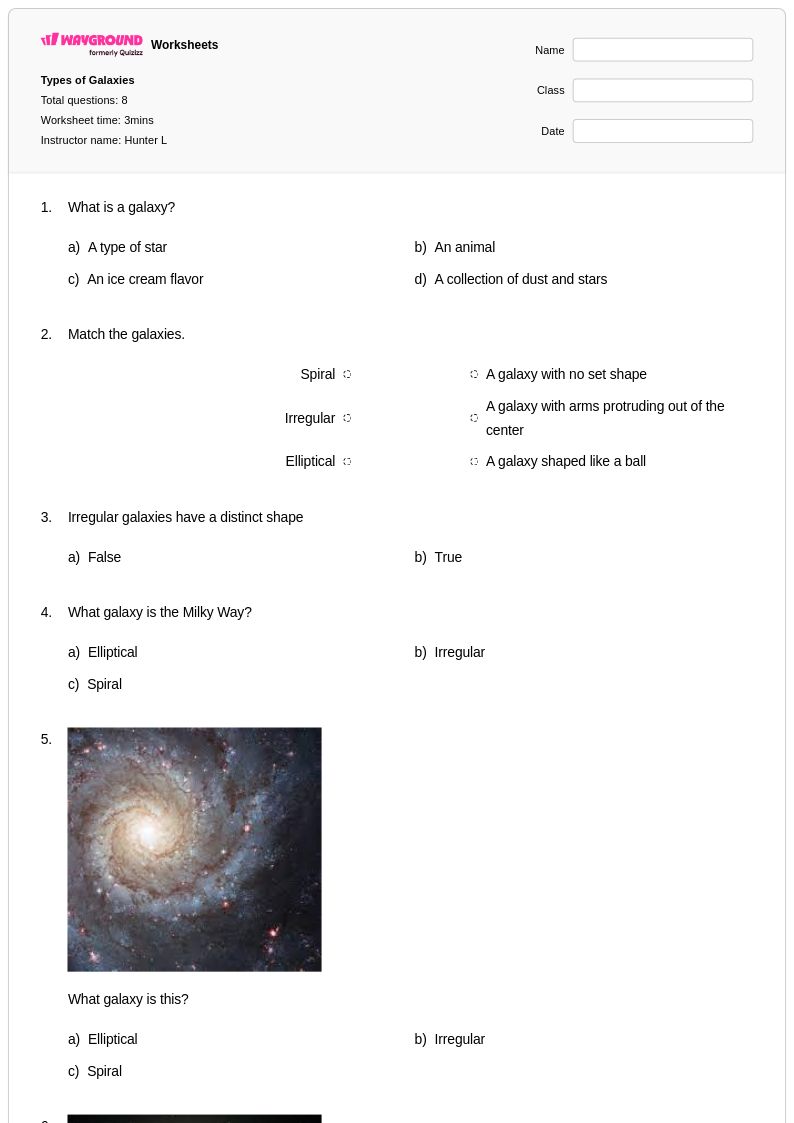
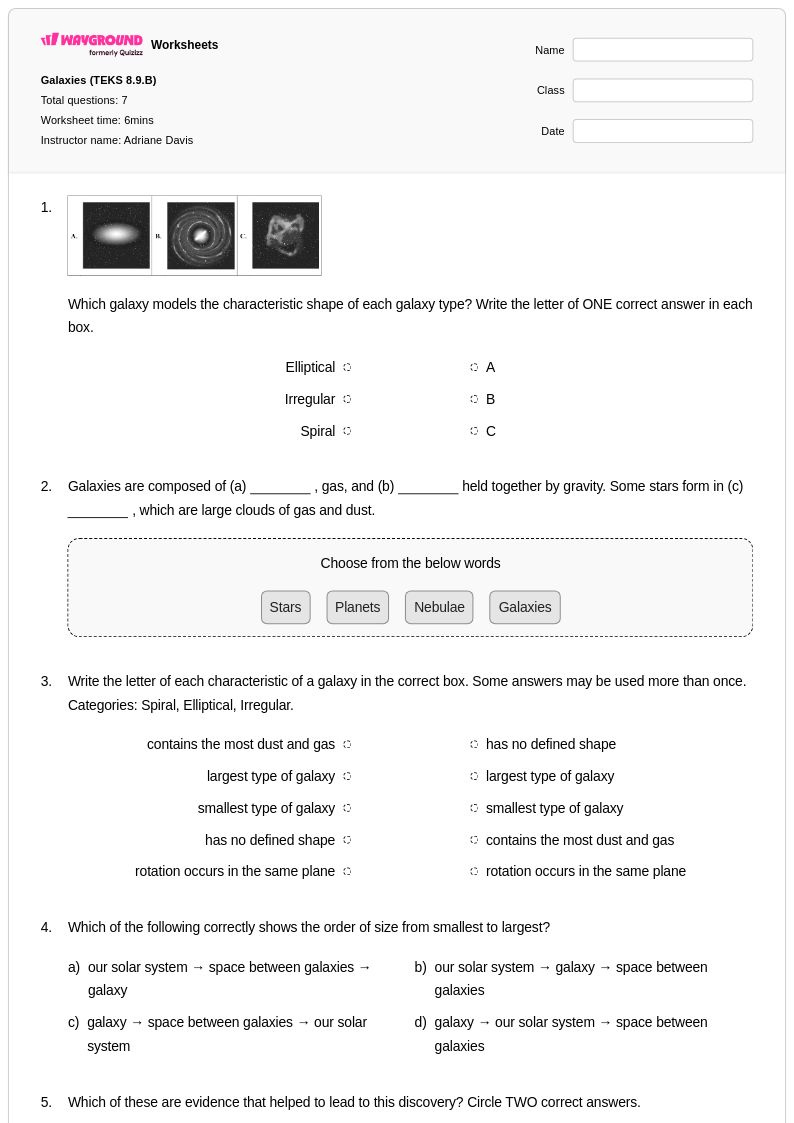
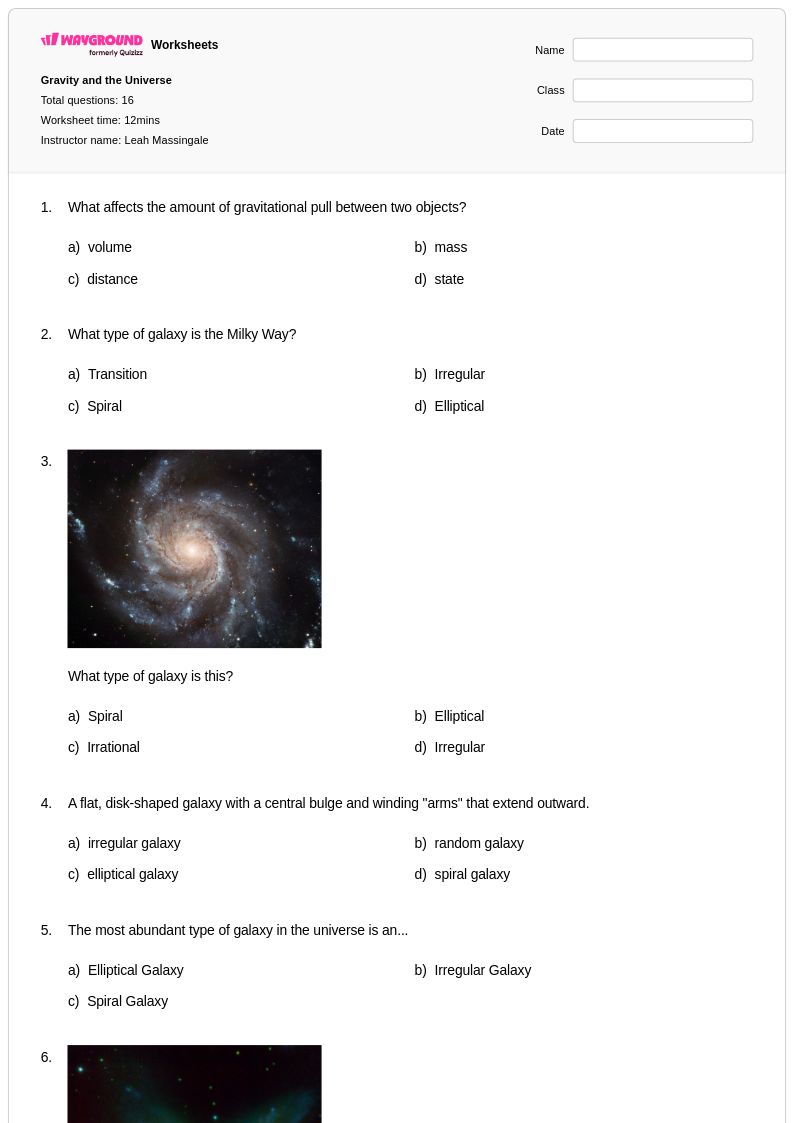
Galaxy types worksheets for Class 6 students available through Wayground (formerly Quizizz) provide comprehensive educational resources that deepen understanding of the diverse structures found throughout our universe. These carefully crafted materials help sixth-grade learners explore the fundamental characteristics of spiral, elliptical, and irregular galaxies while developing critical observation and classification skills essential to Earth and Space Science education. Students engage with practice problems that challenge them to identify distinguishing features of each galaxy type, analyze astronomical images, and understand the relationship between galaxy structure and stellar formation processes. The collection includes printable worksheets with detailed answer keys, allowing educators to seamlessly integrate these free resources into classroom instruction while providing students with immediate feedback on their comprehension of galactic morphology and cosmic organization.
Wayground (formerly Quizizz) empowers educators with access to millions of teacher-created galaxy types resources, featuring robust search and filtering capabilities that align with state and national science standards for Class 6 Earth and Space Science curricula. The platform's differentiation tools enable teachers to customize worksheet difficulty levels, ensuring appropriate challenge for diverse learning needs while maintaining focus on essential astronomical concepts. These versatile materials are available in both digital and printable pdf formats, supporting flexible lesson planning whether for in-person instruction, remote learning, or hybrid educational environments. Teachers can efficiently utilize these resources for initial concept introduction, targeted skill practice, remediation support for struggling students, or enrichment activities for advanced learners, creating a comprehensive approach to galaxy classification instruction that builds scientific literacy and spatial reasoning abilities.
FAQs
How do I teach galaxy types to students?
Start by introducing the three main galaxy classifications: spiral, elliptical, and irregular. Use real astronomical images to help students observe structural differences before asking them to categorize examples independently. Connecting galaxy morphology to formation processes, such as how elliptical galaxies form through mergers, gives students a conceptual framework rather than rote memorization.
What exercises help students practice identifying galaxy types?
Image-based classification activities are highly effective, where students examine photographs of galaxies and assign them to the correct category with written justification. Comparison charts that ask students to fill in characteristics such as shape, star age, and gas content for each galaxy type reinforce distinctions. Practice problems that mirror the classification systems used by professional astronomers build both vocabulary and analytical skills.
What mistakes do students commonly make when classifying galaxy types?
Students frequently confuse lenticular galaxies with elliptical ones, or misidentify edge-on spiral galaxies as elliptical because the disk structure is not visible from that angle. Another common error is assuming all irregular galaxies are simply small or faint, rather than understanding that their shape results from gravitational disturbances or early-universe formation conditions. Reinforcing that classification is based on structure, not size or brightness, helps correct these misconceptions.
How can I use galaxy types worksheets to support students with different learning needs?
Galaxy types worksheets on Wayground are available as printable PDFs for traditional classroom use and in digital formats for technology-integrated environments, including the option to host them as a quiz directly on Wayground. For students who need additional support, Wayground's accommodation tools allow teachers to enable read-aloud for question text, extend time per question, or reduce the number of answer choices to lower cognitive load. These settings can be applied to individual students without notifying the rest of the class, making differentiation seamless.
How do galaxy types fit into the Earth and Space Science curriculum?
Galaxy classification is a foundational concept in Earth and Space Science, connecting to broader topics such as the large-scale structure of the universe, stellar evolution, and cosmology. Understanding the differences between spiral, elliptical, and irregular galaxies helps students contextualize where our own Milky Way fits within the cosmos. Most standards address this as part of space systems or universe and stars units in middle or high school science.
What is the difference between spiral, elliptical, and irregular galaxies?
Spiral galaxies, like the Milky Way, have a central bulge with curved arms containing younger stars, gas, and dust. Elliptical galaxies are smooth, rounded, and composed mostly of older stars with little active star formation. Irregular galaxies lack a defined shape and are often the result of gravitational interactions with neighboring galaxies or represent early-stage galactic structures.