
Free Printable Linear Tables Worksheets for Class 8
Wayground's Class 8 linear tables worksheets provide comprehensive printables and practice problems to help students master algebraic relationships, featuring free PDF downloads with complete answer keys.
Keep exploring
Explore printable Linear Tables worksheets for Class 8
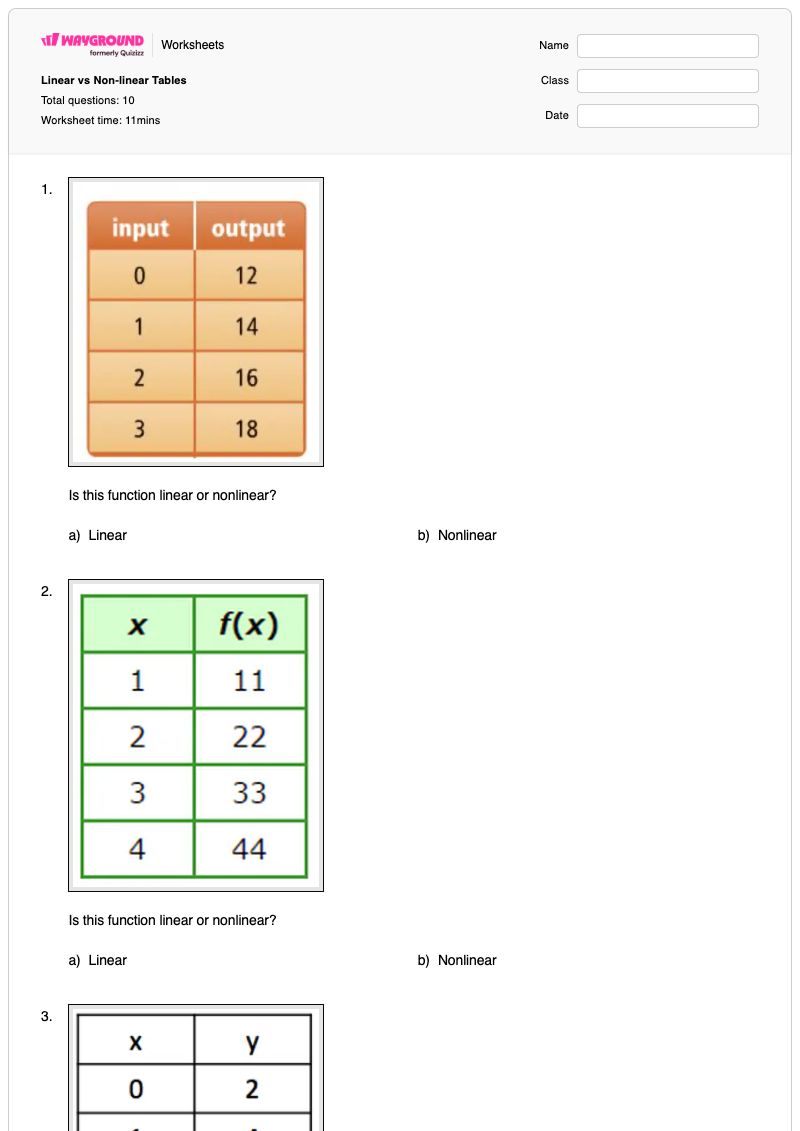
Linear tables worksheets for Class 8 students available through Wayground (formerly Quizizz) provide comprehensive practice in recognizing, creating, and analyzing linear relationships through tabular data. These carefully designed resources help students master essential algebraic concepts including identifying constant rates of change, determining linear patterns, writing equations from table values, and distinguishing between linear and non-linear relationships. Each worksheet collection includes detailed answer keys and is available as free printable pdf resources, offering structured practice problems that progress from basic pattern recognition to more complex applications involving real-world scenarios and multi-step problem solving.
Wayground (formerly Quizizz) empowers educators with access to millions of teacher-created linear tables worksheets, supported by robust search and filtering capabilities that allow for precise resource discovery based on specific learning objectives and standards alignment. The platform's differentiation tools enable teachers to customize worksheet difficulty levels and problem types to meet diverse student needs, while flexible formatting options provide both printable pdf versions for traditional classroom use and digital formats for interactive learning environments. These comprehensive features streamline lesson planning and support targeted remediation for struggling learners, enrichment opportunities for advanced students, and consistent skill practice that reinforces algebraic thinking and prepares students for advanced mathematical concepts in subsequent grade levels.
Explore Other Subject Worksheets for class 8
Frequently asked questions
Eighth graders move from informal patterns to formal algebraic representation. They are expected to calculate the slope (rate of change) and identify the y-intercept from a table to write the full linear equation in the form y = mx + b. They also learn to distinguish linear from non-linear functions presented in tables.