Explore Class 9 logic gates worksheets and printables from Wayground that help students master digital circuits through engaging practice problems, free PDF downloads, and comprehensive answer keys.
Explore printable Logic Gates worksheets for Class 9
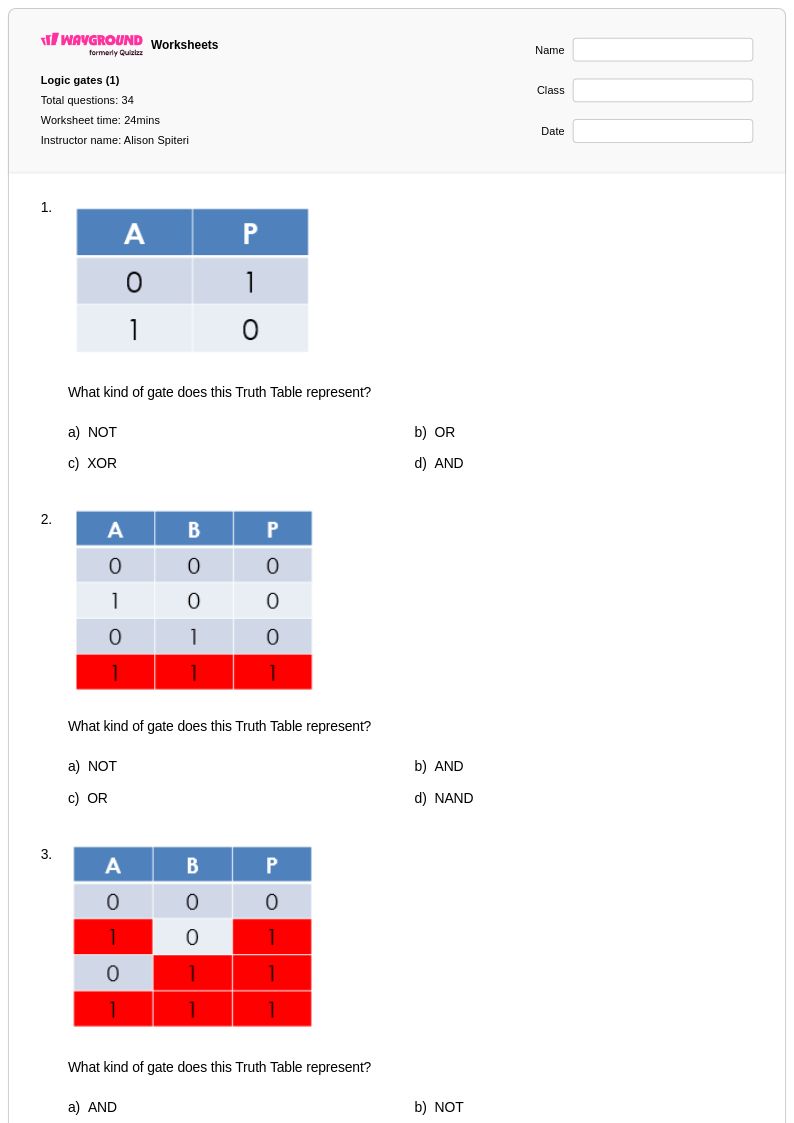
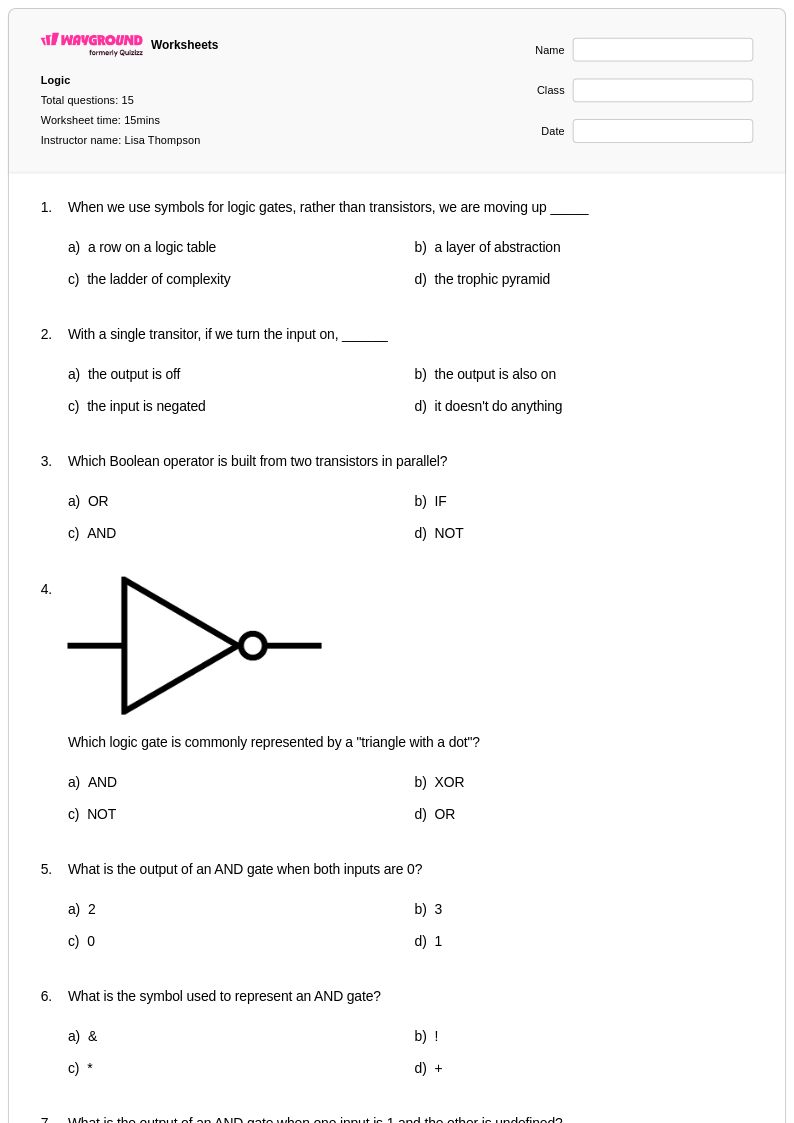
Logic gates worksheets for Class 9 students available through Wayground (formerly Quizizz) provide comprehensive coverage of digital logic fundamentals that form the cornerstone of modern computing and electronics. These carefully crafted educational resources guide ninth-grade learners through the essential concepts of AND, OR, NOT, NAND, NOR, and XOR gates, helping students master truth table construction, circuit diagram interpretation, and Boolean algebra applications. The worksheets strengthen critical thinking skills by presenting practice problems that require students to analyze input-output relationships, trace signal flow through complex circuits, and predict logical outcomes. Each printable resource includes detailed answer keys that support independent learning and self-assessment, while the free accessibility of these materials ensures all students can engage with challenging logic gate scenarios that build foundational understanding for advanced computer science and engineering studies.
Wayground (formerly Quizizz) empowers educators with an extensive collection of millions of teacher-created logic gates resources that streamline lesson planning and enhance instructional effectiveness. The platform's robust search and filtering capabilities allow teachers to quickly locate worksheets aligned with specific curriculum standards and tailored to diverse learning objectives, from basic gate identification to complex combinational logic design. These differentiation tools enable seamless customization of content difficulty, ensuring appropriate challenge levels for students across varying skill levels within the Class 9 classroom. Available in both printable pdf formats and interactive digital versions, these logic gates worksheets support flexible implementation for remediation sessions, enrichment activities, and regular skill practice, while comprehensive answer keys facilitate efficient grading and targeted feedback that accelerates student mastery of digital logic principles.
FAQs
How do I teach logic gates to students who have never seen binary logic before?
Start by grounding students in the concept of binary states — on/off, true/false, 1/0 — before introducing any gate symbol. Introduce AND, OR, and NOT gates first, using real-world analogies like light switches in series or parallel. Once students can reliably complete truth tables for single gates, move to combinations. Avoid introducing NAND, NOR, XOR, and XNOR until students have solid fluency with the basic three, as premature complexity is the leading cause of confusion in this unit.
What exercises help students practice reading and completing truth tables for logic gates?
The most effective practice involves progressive truth table completion: first filling in outputs for single-input gates (NOT), then two-input gates (AND, OR), then multi-gate combinations. Students should also practice working backwards — given an output column, identify which gate or combination produced it. Logic gates worksheets that include circuit diagram analysis alongside truth tables reinforce the connection between symbolic representation and logical behavior, which is critical for building transferable understanding.
What mistakes do students commonly make when working with logic gates and Boolean algebra?
The most common error is confusing OR with XOR — students frequently assume OR means 'one or the other but not both,' when standard OR is inclusive. A related misconception is treating NAND and NOR as simply 'the opposite' of AND and OR without understanding their distinct truth tables. Students also struggle with Boolean simplification, often failing to apply De Morgan's theorems correctly when negations are involved. Targeted practice with NAND and NOR truth tables alongside their AND/OR counterparts directly addresses these gaps.
How do I help students move from reading truth tables to actually simplifying Boolean expressions?
Students need to first internalize the truth table for each gate before attempting algebraic simplification. Once that foundation is in place, introduce Boolean identities (identity law, null law, complement law) with explicit gate-level examples. Have students verify each simplification step by checking it against a truth table rather than relying purely on algebraic manipulation. This bidirectional approach — moving between expression and table — builds the flexibility needed for more complex circuit analysis.
How do I use Wayground's logic gates worksheets in my classroom?
Wayground's logic gates worksheets are available as free printable PDFs for traditional classroom use and in digital formats for technology-integrated environments, giving teachers flexibility across different instructional settings. You can also host a worksheet as a quiz directly on Wayground, which allows you to assign it to students digitally and track their responses. Each worksheet includes a complete answer key, so students receive immediate feedback and teachers can efficiently review results. Wayground also supports student-level accommodations such as extended time, read aloud, and reduced answer choices, which can be configured individually without notifying other students.
How do logic gates connect to real-world applications I can use to motivate students?
Logic gates are the physical and conceptual foundation of every digital device — processors, memory chips, calculators, and smartphones all operate on combinations of these basic gates. Connecting gate behavior to tangible examples, such as how an AND gate models a security system that requires two conditions to be true simultaneously, makes the abstraction concrete. For older students, linking gate combinations to basic CPU operations or binary adders provides a compelling entry point into computer architecture and electrical engineering.