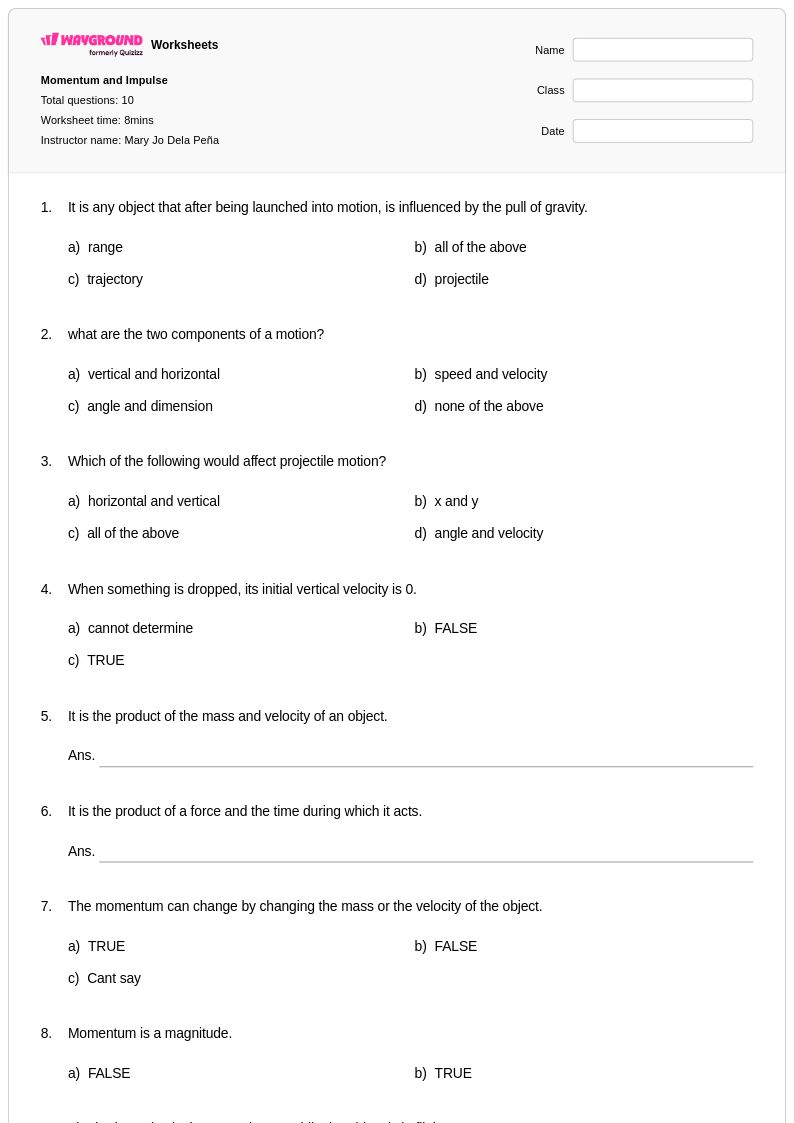
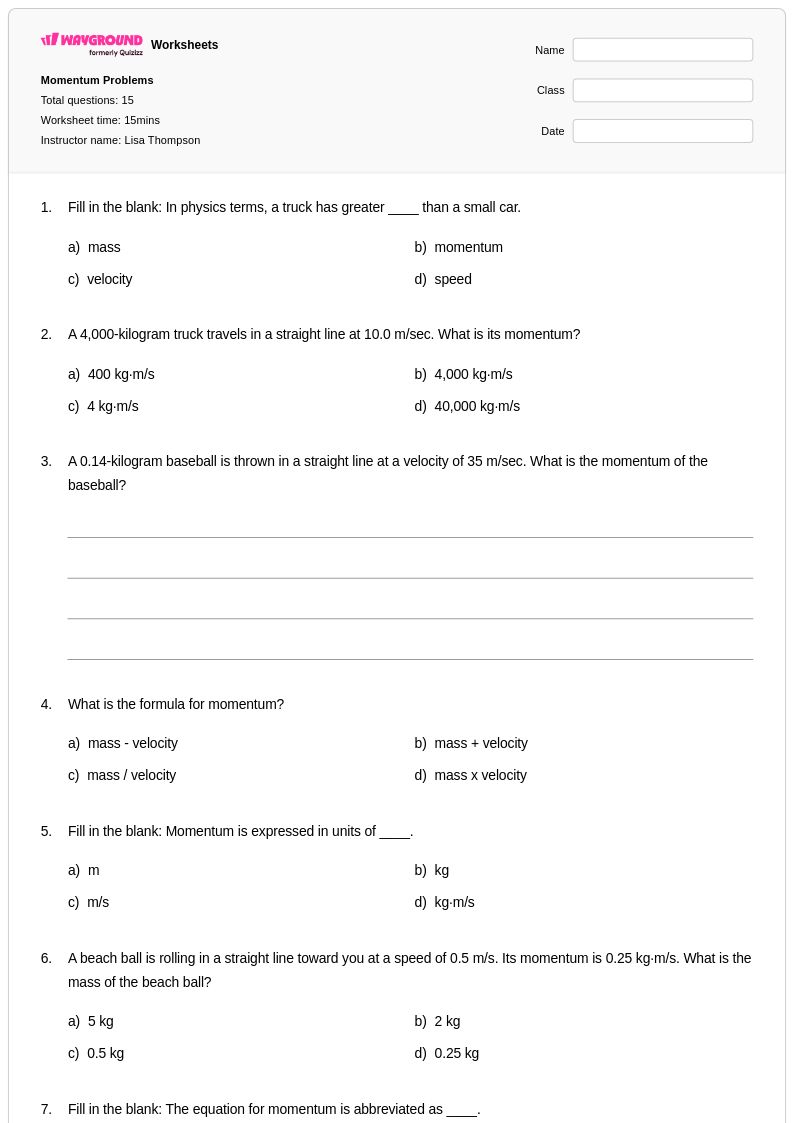
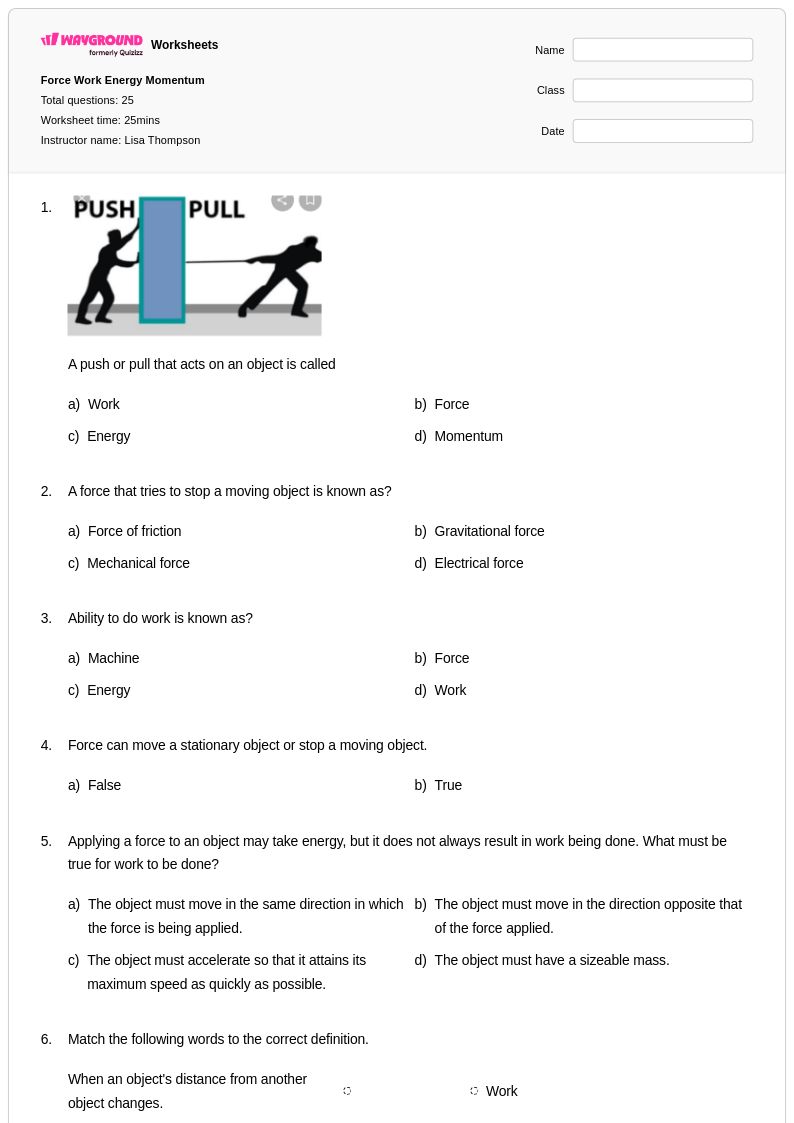
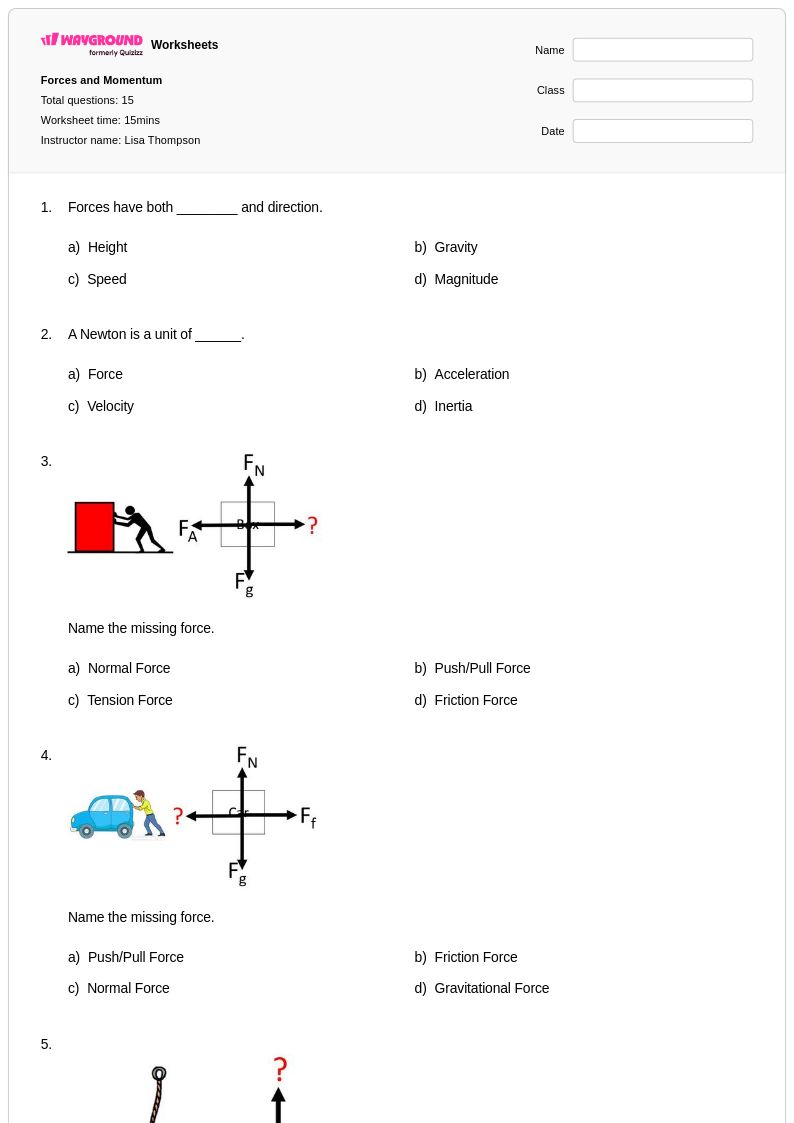
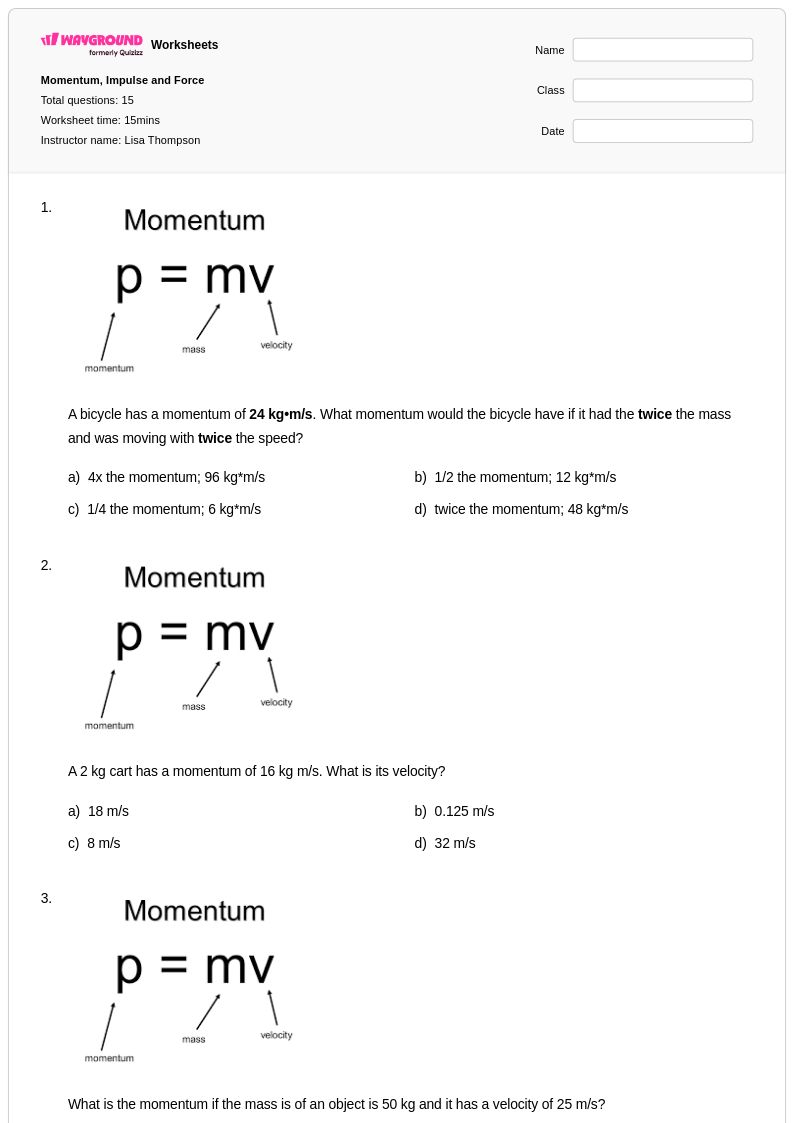
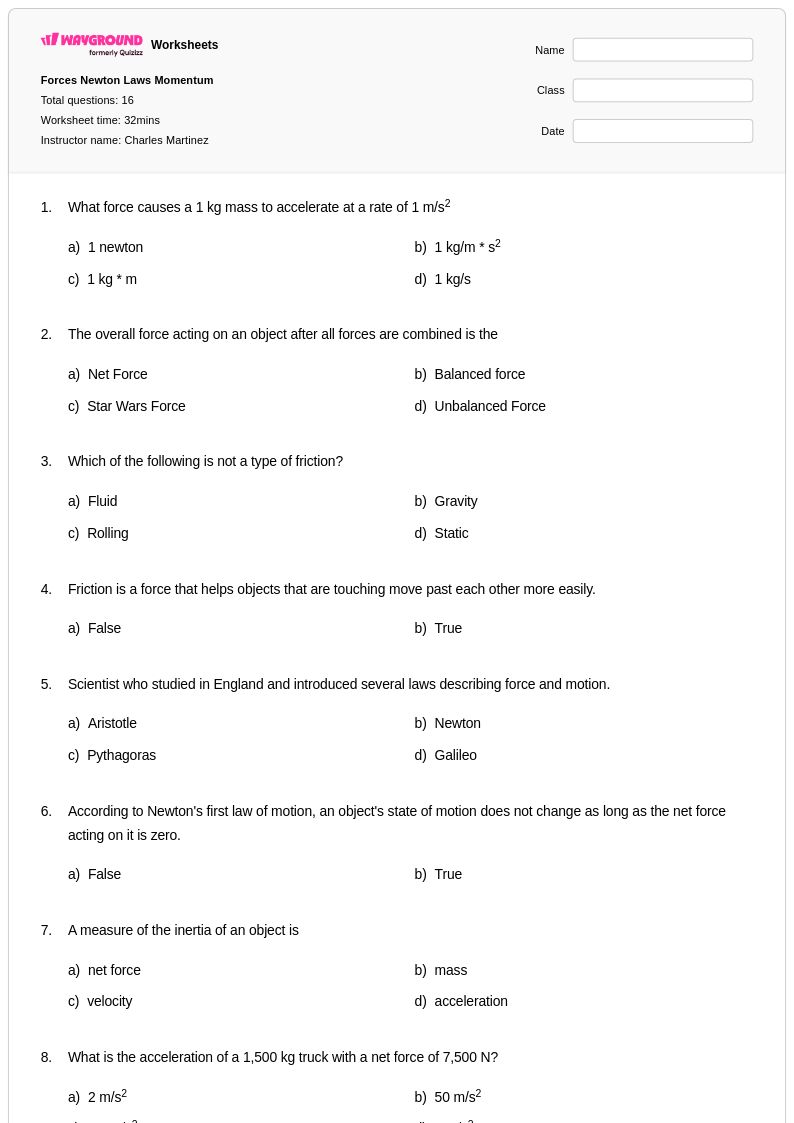
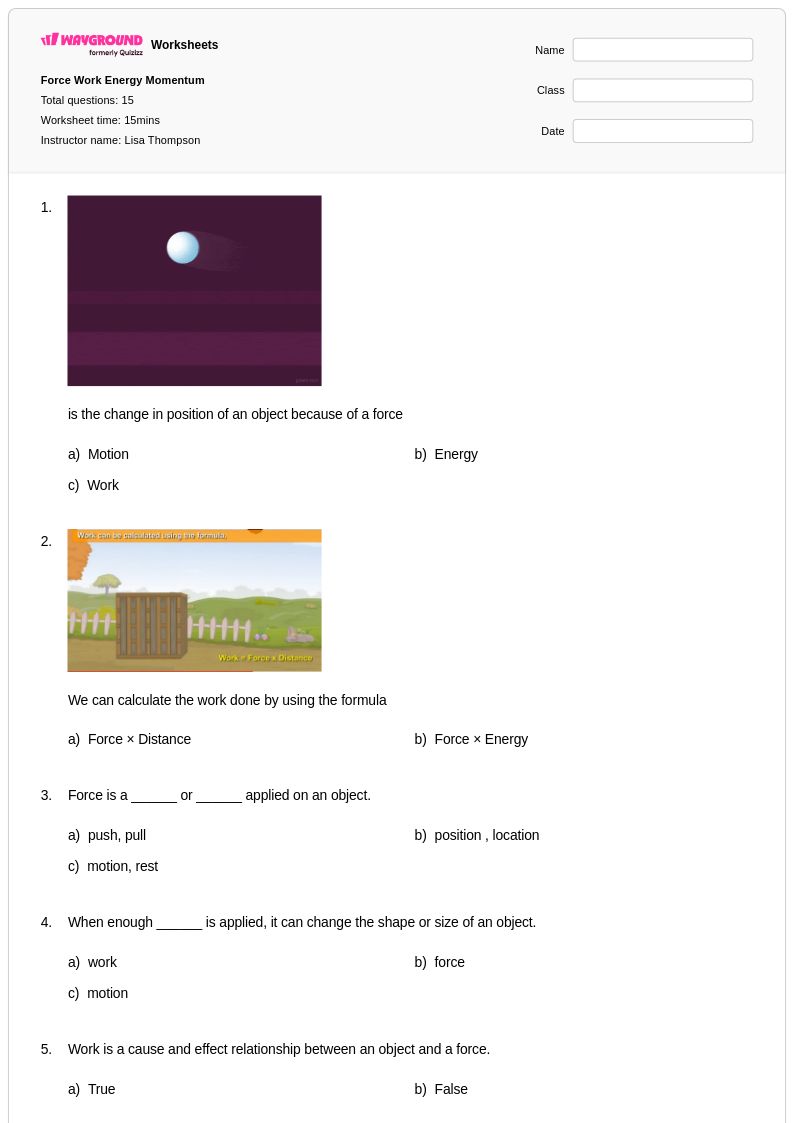
Class 9 momentum worksheets from Wayground offer comprehensive printables and practice problems that help students master the principles of momentum, conservation laws, and collision physics with detailed answer keys.
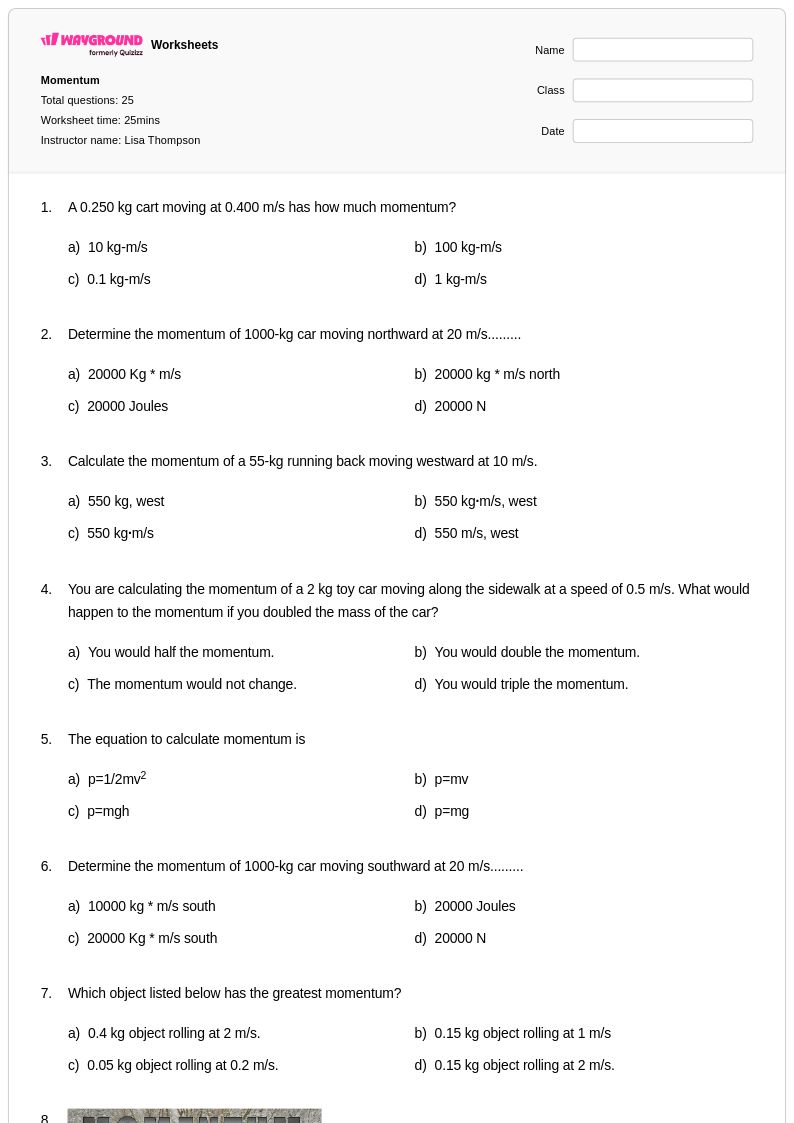
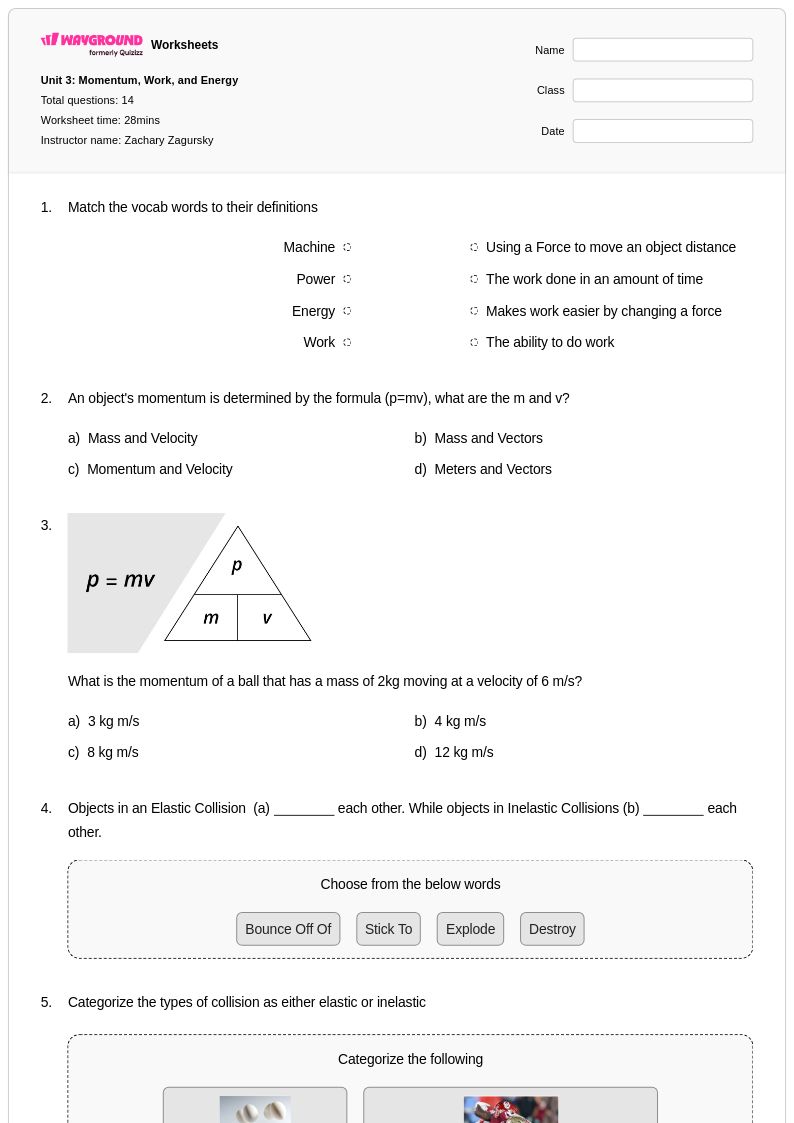
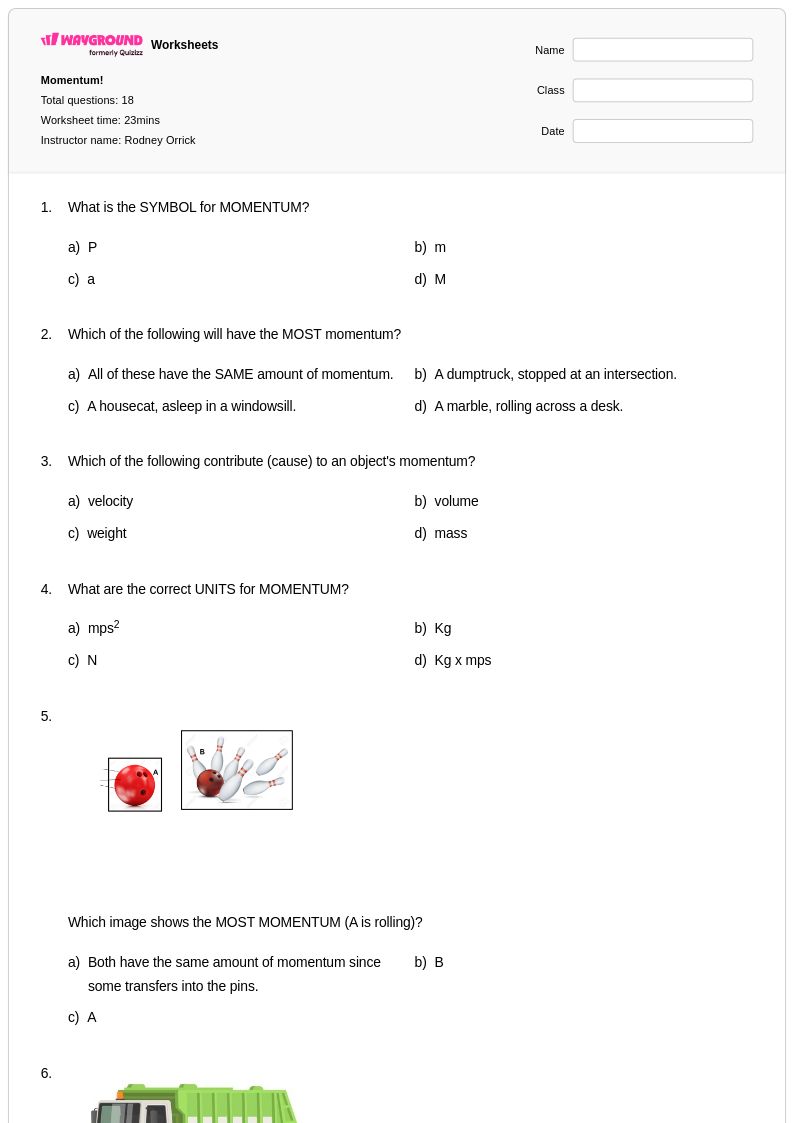
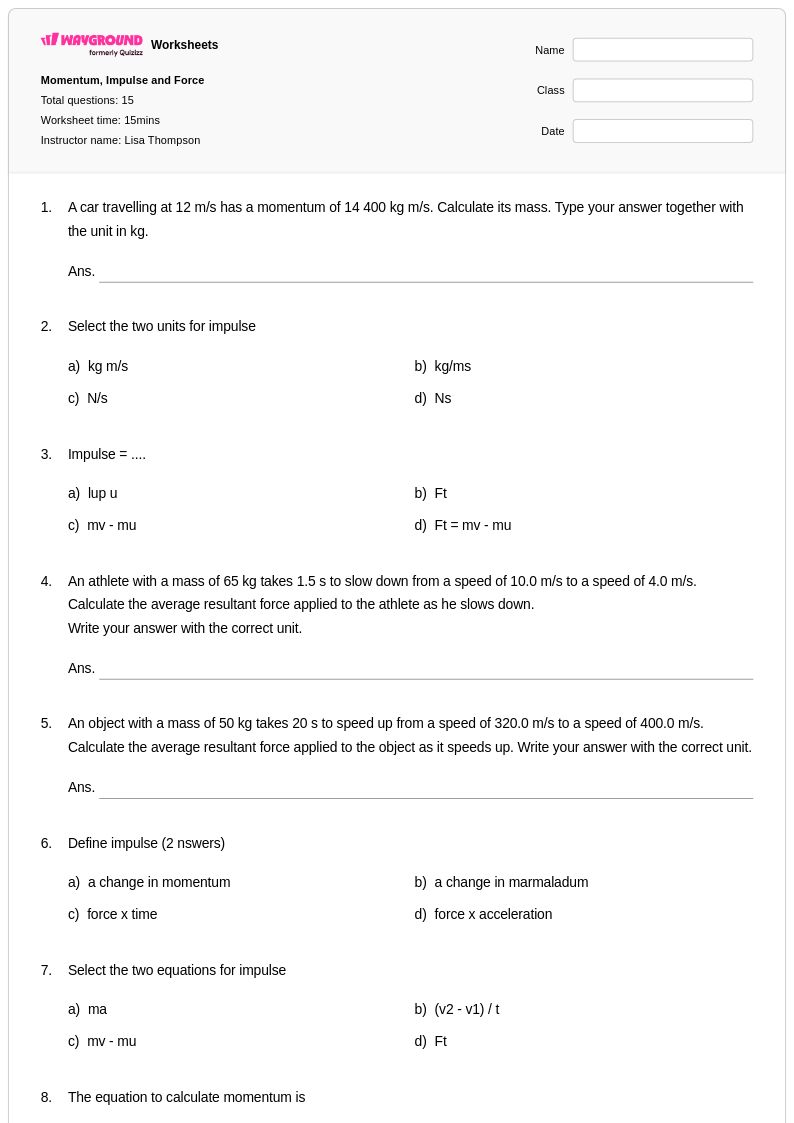
Momentum worksheets for Class 9 students available through Wayground (formerly Quizizz) provide comprehensive practice materials that strengthen students' understanding of this fundamental physics concept. These expertly crafted resources help ninth-grade learners master the calculation of momentum using the formula p = mv, explore conservation of momentum in collisions, and analyze momentum changes in various physical scenarios. The worksheets feature carefully sequenced practice problems that progress from basic momentum calculations to more complex applications involving elastic and inelastic collisions, impulse-momentum relationships, and real-world physics situations. Each worksheet collection includes detailed answer keys and is available as free printables in pdf format, enabling students to work through momentum problems systematically while developing critical problem-solving skills essential for advanced physics coursework.
Wayground (formerly Quizizz) empowers physics teachers with access to millions of educator-created momentum resources that streamline lesson planning and enhance student learning outcomes. The platform's robust search and filtering capabilities allow instructors to quickly locate Class 9 momentum worksheets aligned with specific physics standards, whether focusing on basic momentum concepts or advanced collision analysis. Teachers can differentiate instruction effectively using the platform's customization tools to modify existing worksheets or create targeted practice sets for students requiring remediation or enrichment activities. The flexible delivery options, including both printable pdf formats and interactive digital versions, accommodate diverse classroom environments and learning preferences while providing educators with comprehensive resources for skill practice, formative assessment, and standards-based instruction in momentum and related physics concepts.
FAQs
How do I teach momentum to high school physics students?
Start by building student understanding of mass and velocity as separate variables before introducing the momentum formula p = mv. Use real-world examples like collisions in sports or car crashes to ground the concept, then progress to conservation of momentum and the impulse-momentum theorem. Moving from conceptual understanding to quantitative problem-solving helps students connect the math to physical intuition before tackling multi-object collision scenarios.
What types of practice problems help students learn momentum?
Effective momentum practice should span a range of complexity, beginning with single-object calculations using p = mv and advancing to conservation problems involving elastic and inelastic collisions. Including both one-dimensional and two-dimensional scenarios ensures students can apply momentum principles across contexts. Problems that require students to solve for different unknowns, such as final velocity or change in momentum, build the flexible problem-solving skills assessed on physics exams.
What mistakes do students commonly make when solving momentum problems?
One of the most frequent errors is treating momentum as a scalar rather than a vector, which causes sign errors in collision problems where objects move in opposite directions. Students also commonly confuse momentum with kinetic energy and incorrectly apply conservation of energy to inelastic collisions where kinetic energy is not conserved. Another common mistake is failing to account for all objects in a system when applying conservation of momentum, particularly in two-dimensional problems.
How do I help students understand the difference between elastic and inelastic collisions?
Clarify that both elastic and inelastic collisions conserve momentum, but only elastic collisions also conserve kinetic energy. A useful classroom strategy is to have students calculate both momentum and kinetic energy before and after a collision to observe which quantity is preserved. Real-world examples help: a billiard ball collision approximates elastic, while a car crash where vehicles crumple and stick together is perfectly inelastic. Distinguishing these cases early prevents persistent misconceptions in later problem-solving.
How do I use Wayground momentum worksheets in my physics class?
Wayground momentum worksheets are available as printable PDFs for traditional classroom use and in digital formats for technology-integrated learning environments, giving teachers flexibility in how they distribute and assign practice. Teachers can also host worksheets as a quiz directly on Wayground, enabling interactive student sessions with built-in answer verification. The included answer keys allow students to self-check their work or enable teachers to conduct efficient formative review after problem sets.
How can I differentiate momentum instruction for students at different skill levels?
For students who need additional support, begin with scaffolded problems that provide the formula and walk through one variable at a time before requiring independent application. More advanced students can be challenged with multi-object systems, two-dimensional collision problems, or open-ended scenarios that require them to identify given and unknown quantities without prompting. On Wayground, teachers can apply accommodations such as reduced answer choices or extended time to individual students, allowing the same worksheet to serve the full range of learners in a single class.