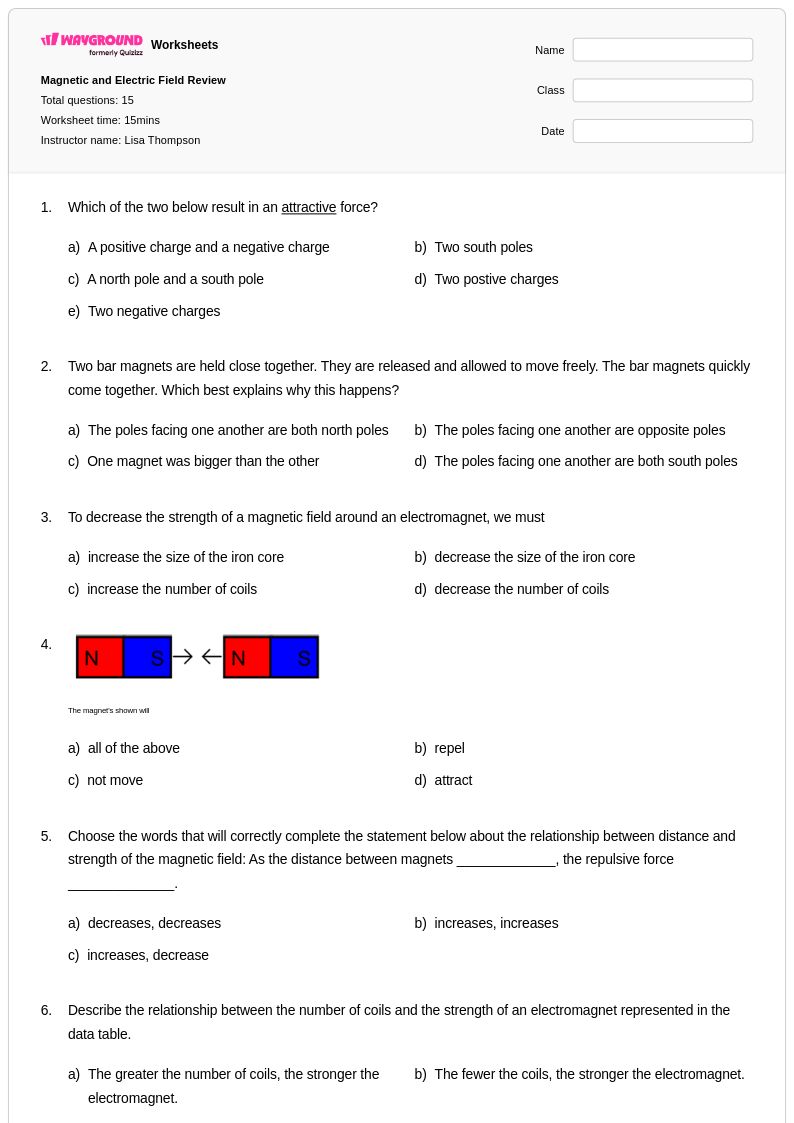
Free Printable Magnetic Forces, Magnetic Fields and Faraday's Law Worksheets for Class 9
Explore Wayground's comprehensive collection of Class 9 Physics worksheets focusing on Magnetic Forces, Magnetic Fields and Faraday's Law, featuring free printable PDFs with practice problems and answer keys to help students master electromagnetic concepts.
Explore printable Magnetic Forces, Magnetic Fields and Faraday's Law worksheets for Class 9
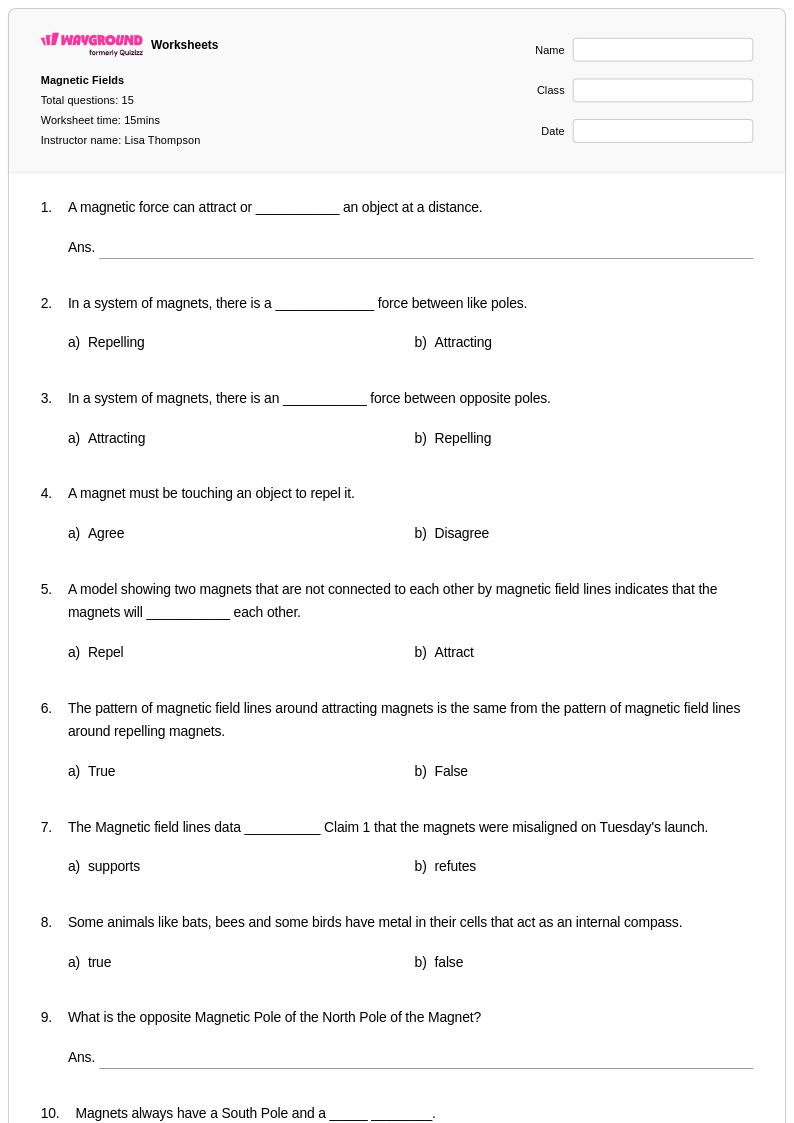
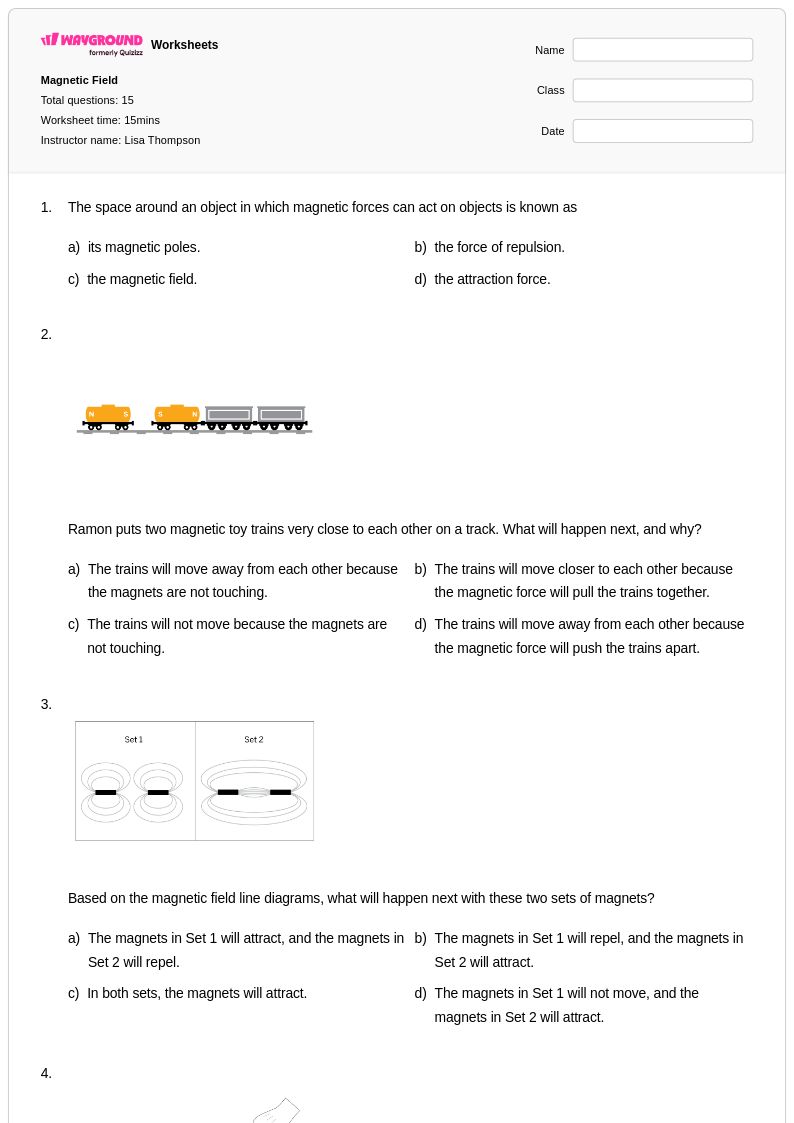
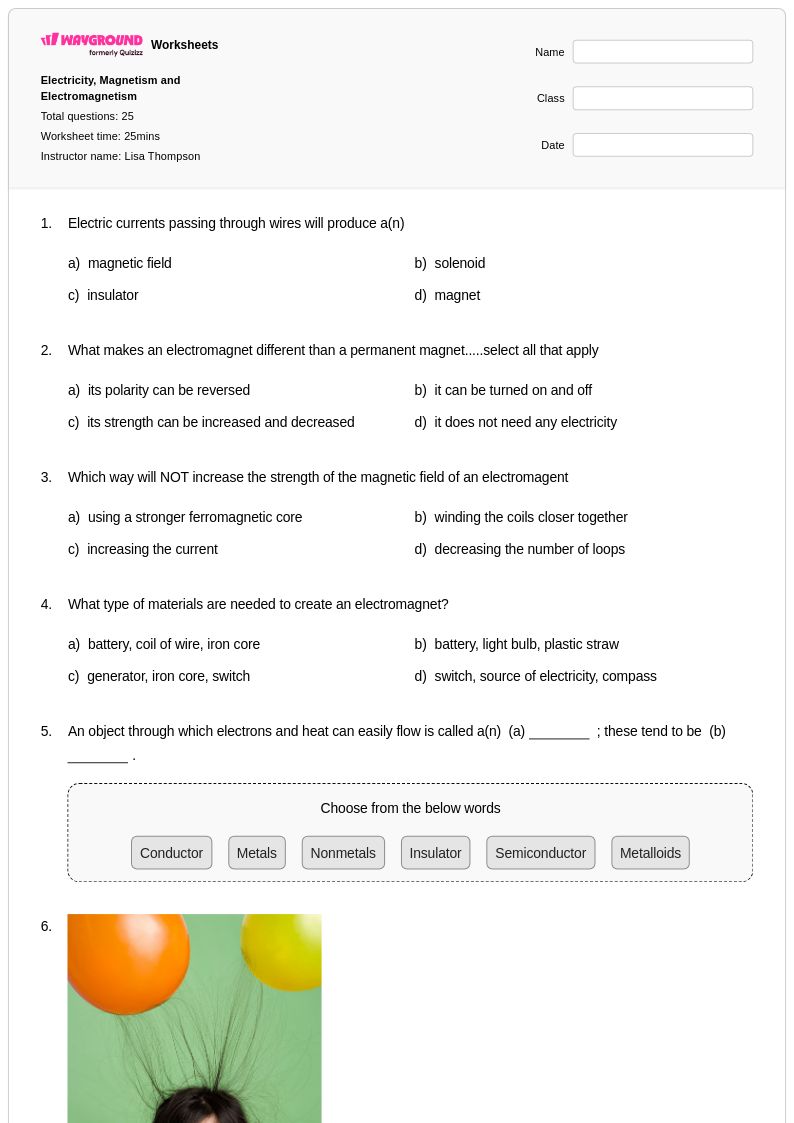
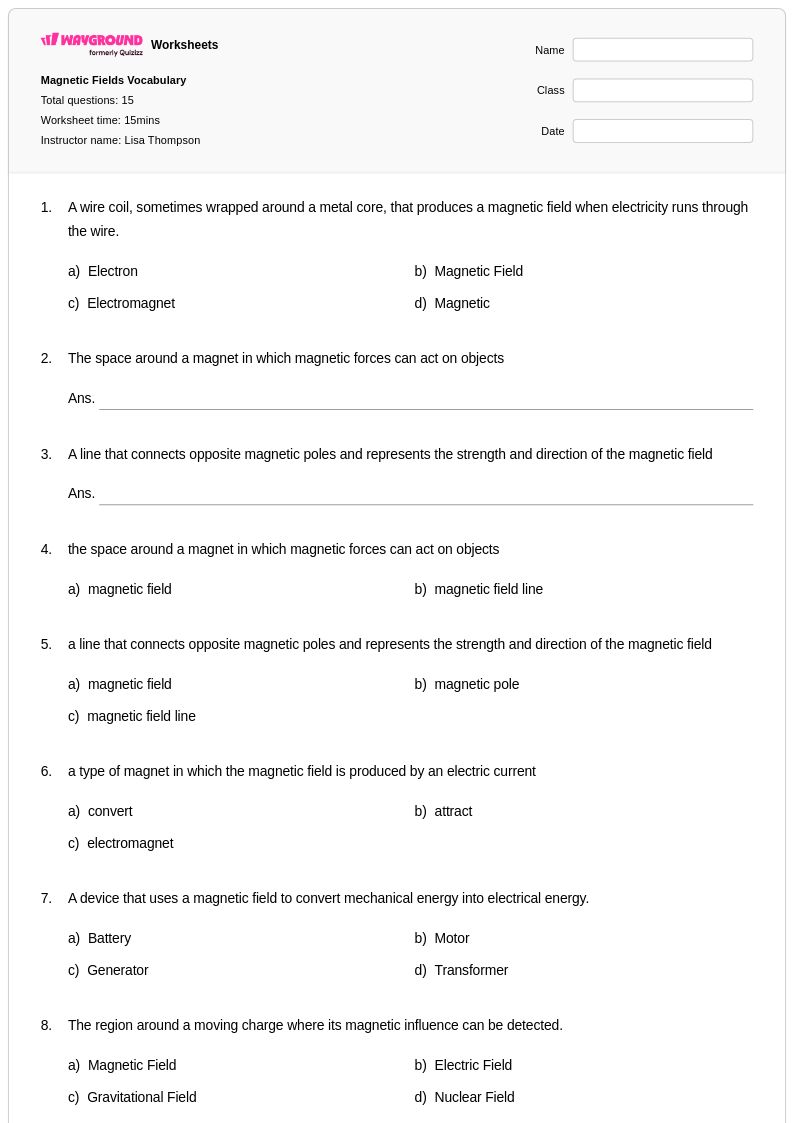
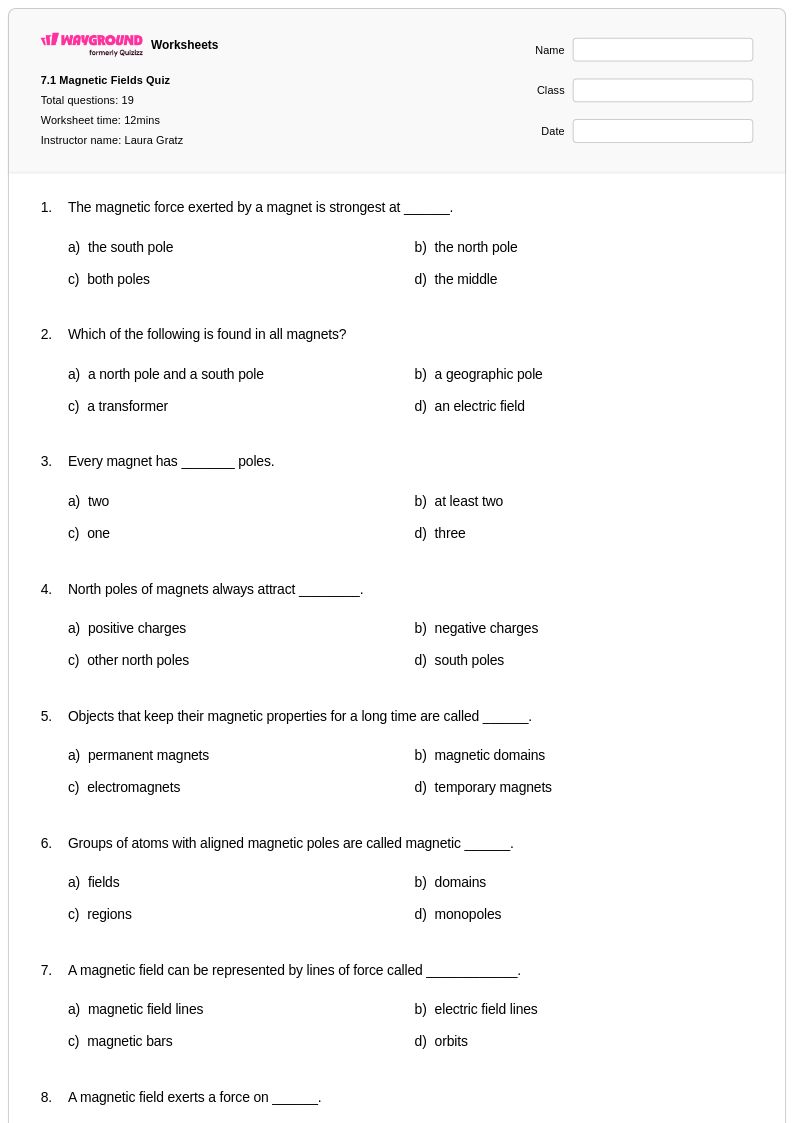
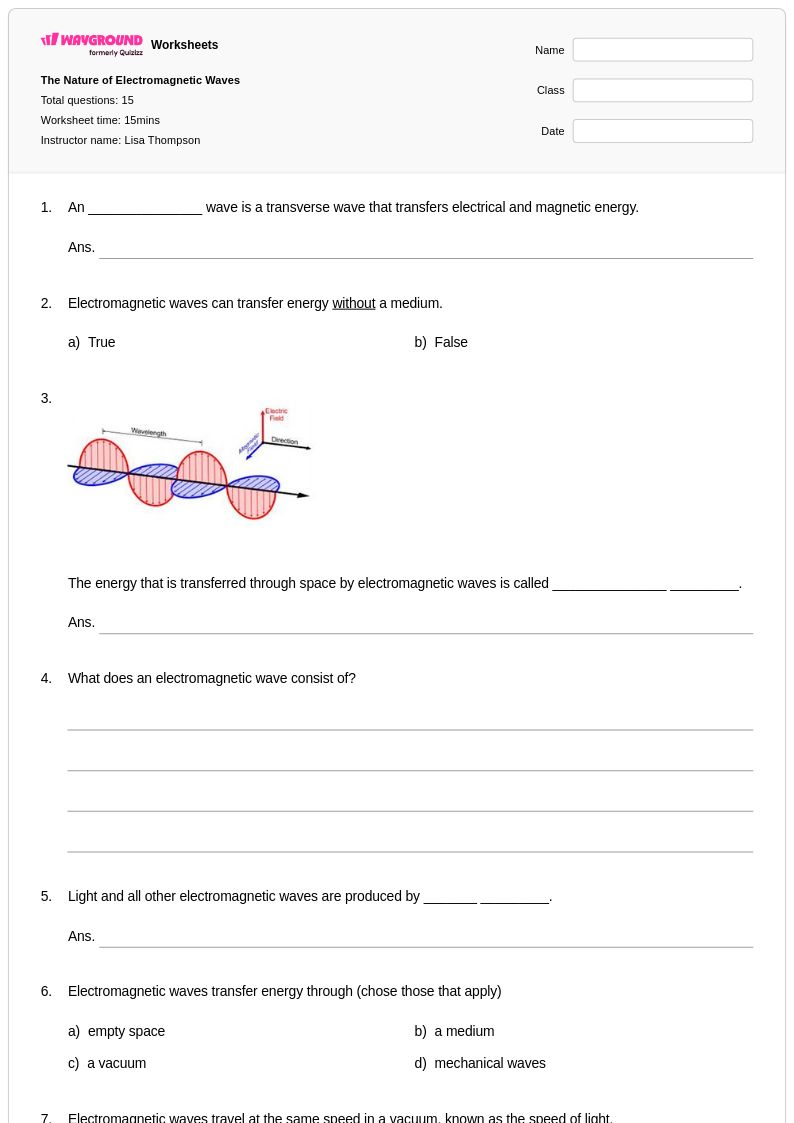
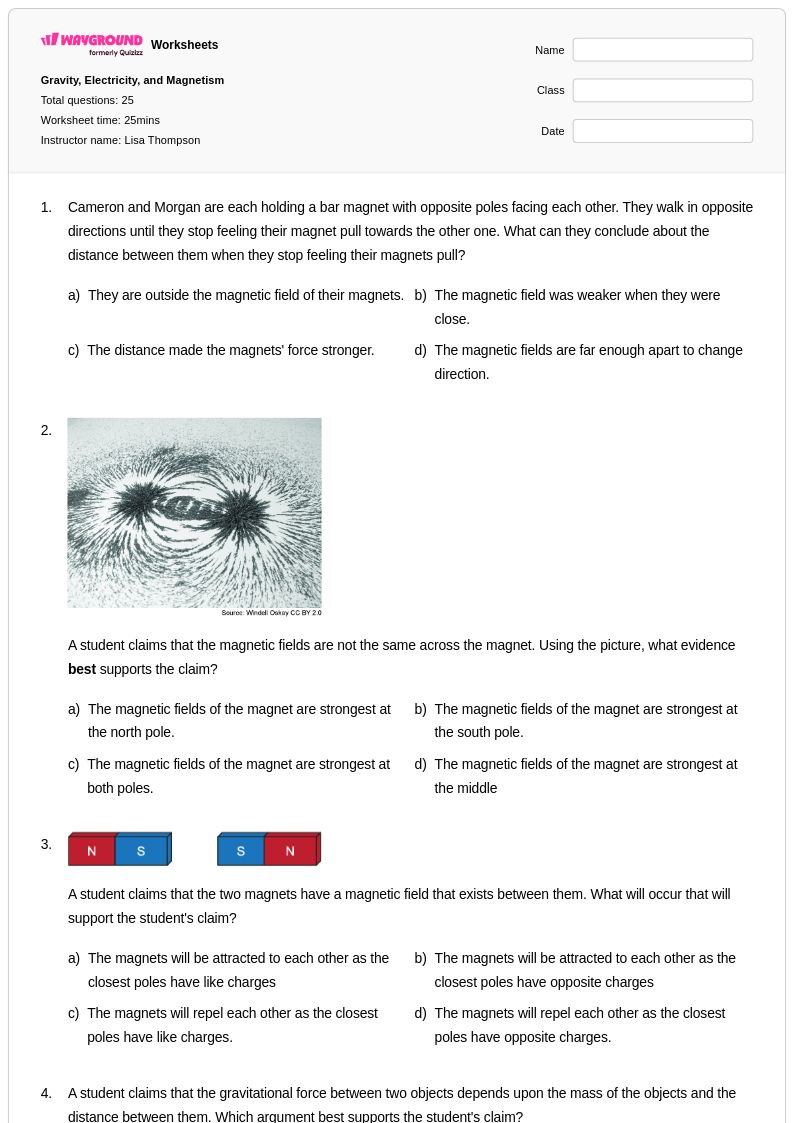
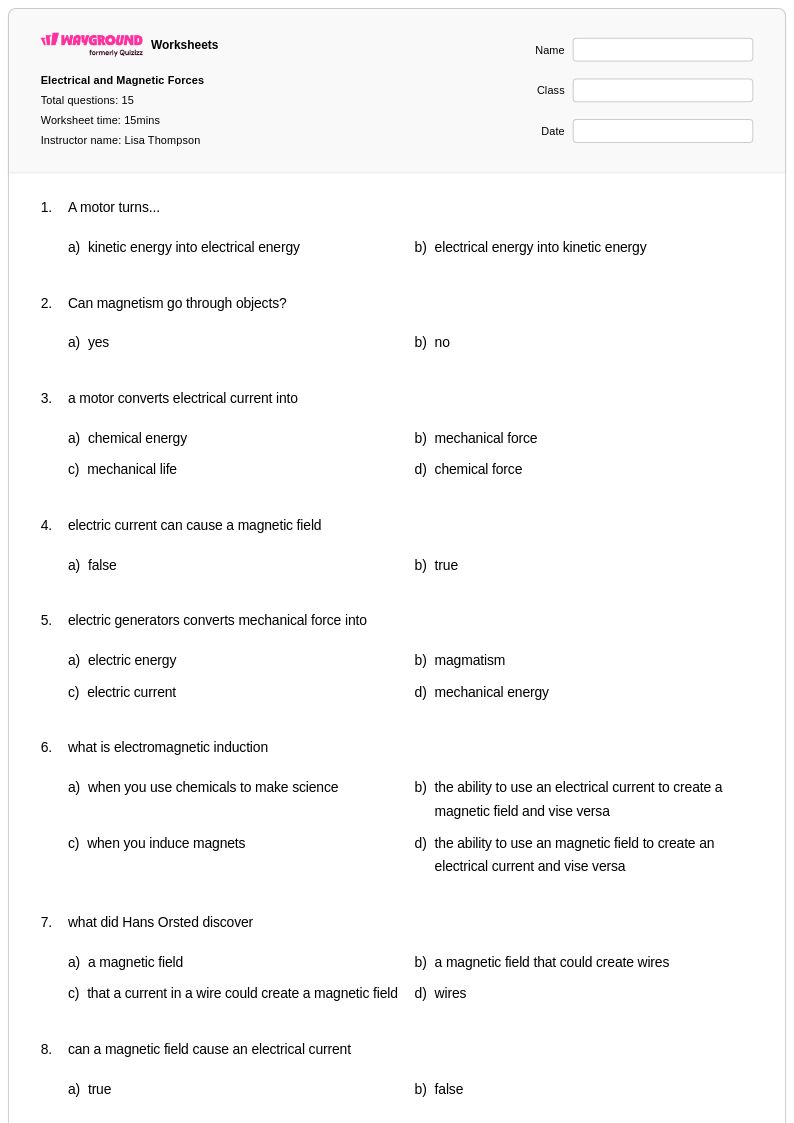
Magnetic Forces, Magnetic Fields and Faraday's Law worksheets for Class 9 students available through Wayground (formerly Quizizz) provide comprehensive coverage of fundamental electromagnetic principles that form the cornerstone of modern physics education. These carefully crafted educational resources help students develop critical analytical skills by exploring the invisible forces that govern magnetic interactions, understanding how magnetic fields are generated and visualized, and mastering Faraday's groundbreaking law of electromagnetic induction. The practice problems within these worksheets systematically guide learners through calculating magnetic force directions using the right-hand rule, interpreting magnetic field line diagrams, and solving quantitative problems involving induced electromotive force and changing magnetic flux. Each printable resource includes detailed answer keys that enable students to self-assess their understanding while providing teachers with reliable tools for formative assessment, and the free pdf format ensures accessibility for both classroom instruction and independent study.
Wayground (formerly Quizizz) empowers educators with an extensive collection of millions of teacher-created resources specifically designed to support magnetic forces, magnetic fields, and Faraday's Law instruction at the Class 9 level. The platform's robust search and filtering capabilities allow teachers to quickly locate worksheets that align with specific learning standards and curriculum requirements, while advanced differentiation tools enable seamless customization to meet diverse student needs and learning objectives. These versatile resources are available in both printable and digital formats, including downloadable pdf versions, making them ideal for traditional classroom settings, hybrid learning environments, and remote instruction scenarios. Teachers can strategically deploy these worksheets for initial skill-building practice, targeted remediation of challenging electromagnetic concepts, enrichment activities for advanced learners, and comprehensive review sessions, thereby creating a flexible and responsive instructional approach that supports all students in mastering these essential physics principles.
FAQs
How do I teach Faraday's Law to high school physics students?
Start by building student understanding of magnetic flux before introducing the concept of a changing flux inducing an EMF. Use concrete demonstrations such as moving a bar magnet through a coil connected to a galvanometer so students observe the induced current directly. From there, introduce the mathematical form of Faraday's Law and have students practice calculating induced EMF in scenarios involving generators and transformers. Connecting the abstract equation to observable phenomena significantly improves conceptual retention.
What practice problems help students understand the Lorentz force on a moving charge?
Effective practice problems require students to apply the Lorentz force equation F = qv × B by determining the magnitude and direction of the force on a charged particle moving through a uniform magnetic field. Problems should vary the angle between velocity and field vectors, include cases where the force is zero, and ask students to use the right-hand rule to determine force direction. Progressing from single-charge scenarios to forces on current-carrying wires reinforces the connection between particle-level and circuit-level physics.
What mistakes do students commonly make when working with magnetic field line diagrams?
Students frequently confuse the direction of magnetic field lines around a current-carrying conductor, often reversing the right-hand rule or misapplying it when current direction changes. Another common error is drawing field lines that cross each other, which is physically impossible and indicates a misunderstanding of field superposition. Students also tend to conflate magnetic field strength with field line spacing, so practice problems that explicitly ask them to interpret denser versus sparser field line regions help correct this misconception.
How do students commonly confuse electric fields and magnetic fields?
A persistent misconception is that magnetic forces, like electric forces, act on stationary charges — students must understand that the Lorentz magnetic force requires a moving charge and is always perpendicular to the velocity vector. Students also conflate field line conventions, sometimes drawing magnetic field lines originating on magnetic 'charges' analogous to electric monopoles, when in reality magnetic field lines always form closed loops. Explicitly contrasting the two field types during instruction and using side-by-side comparison problems can help students internalize the distinction.
How can I use Wayground's magnetic forces and Faraday's Law worksheets in my physics class?
Wayground's worksheets on magnetic forces, magnetic fields, and Faraday's Law are available as printable PDFs for traditional paper-based instruction and in digital formats for technology-integrated classrooms, making them adaptable to in-person, hybrid, and remote learning environments. Teachers can also host worksheets as a live quiz on Wayground, enabling real-time student response tracking. The platform includes robust search and filtering tools so teachers can quickly locate worksheets aligned to specific curriculum standards or skill areas, and each worksheet comes with a complete answer key to support efficient grading and student self-assessment.
How do I differentiate electromagnetic induction instruction for students at different ability levels?
For students who are struggling, focus on conceptual understanding first — use qualitative problems that ask whether induced EMF increases or decreases as a magnet moves faster or slower before introducing quantitative calculations. For advanced learners, introduce multi-loop induction problems, Lenz's Law applications, and real-world transformer efficiency scenarios that require integrating multiple electromagnetic principles. Wayground supports differentiation directly through student-level accommodations, including reduced answer choices to lower cognitive load for selected students and read-aloud features for those who need audio support, while other students receive default settings without disruption.
What types of problems should students be able to solve after studying Faraday's Law?
After studying Faraday's Law, students should be able to calculate the induced EMF given a changing magnetic flux, determine how changes in field strength, coil area, or the angle between the field and coil affect induction, and apply Lenz's Law to predict the direction of the induced current. Students should also be able to analyze how generators and transformers function as practical applications of electromagnetic induction. Proficiency requires both conceptual reasoning — explaining why induction occurs — and quantitative problem-solving using the flux formula and Faraday's equation.