Free Printable Maya Civilization Worksheets for Class 3
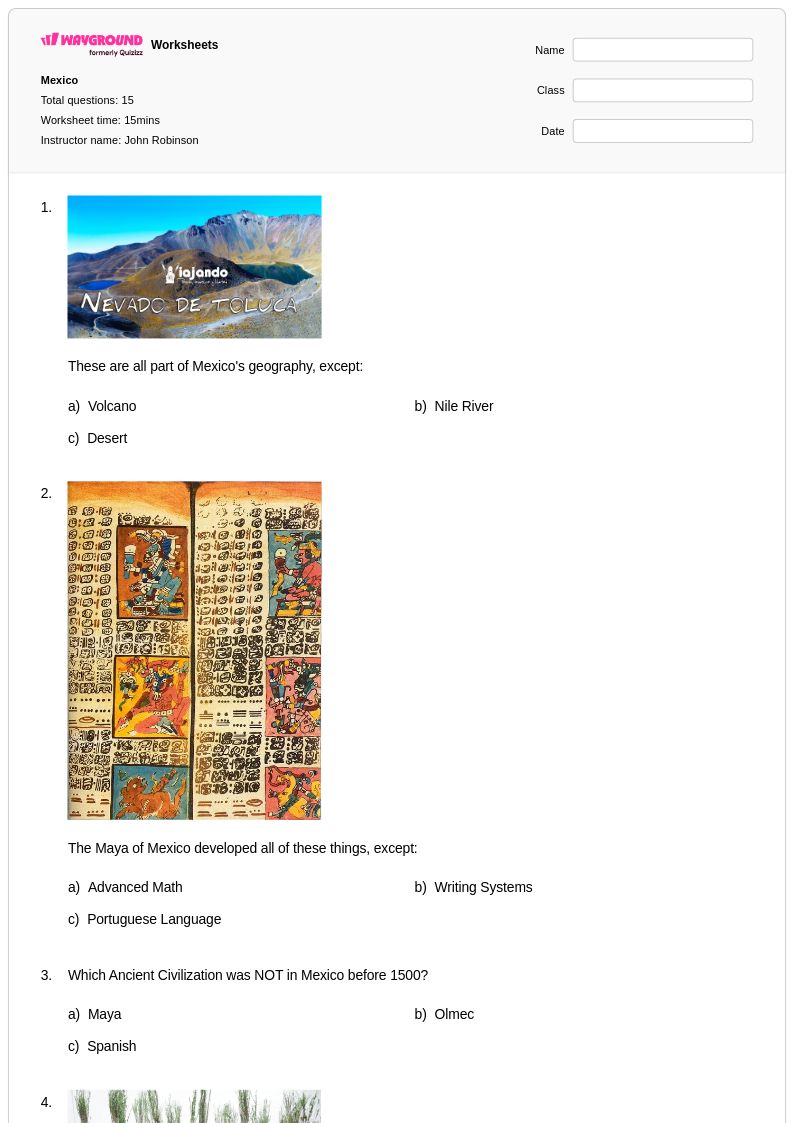
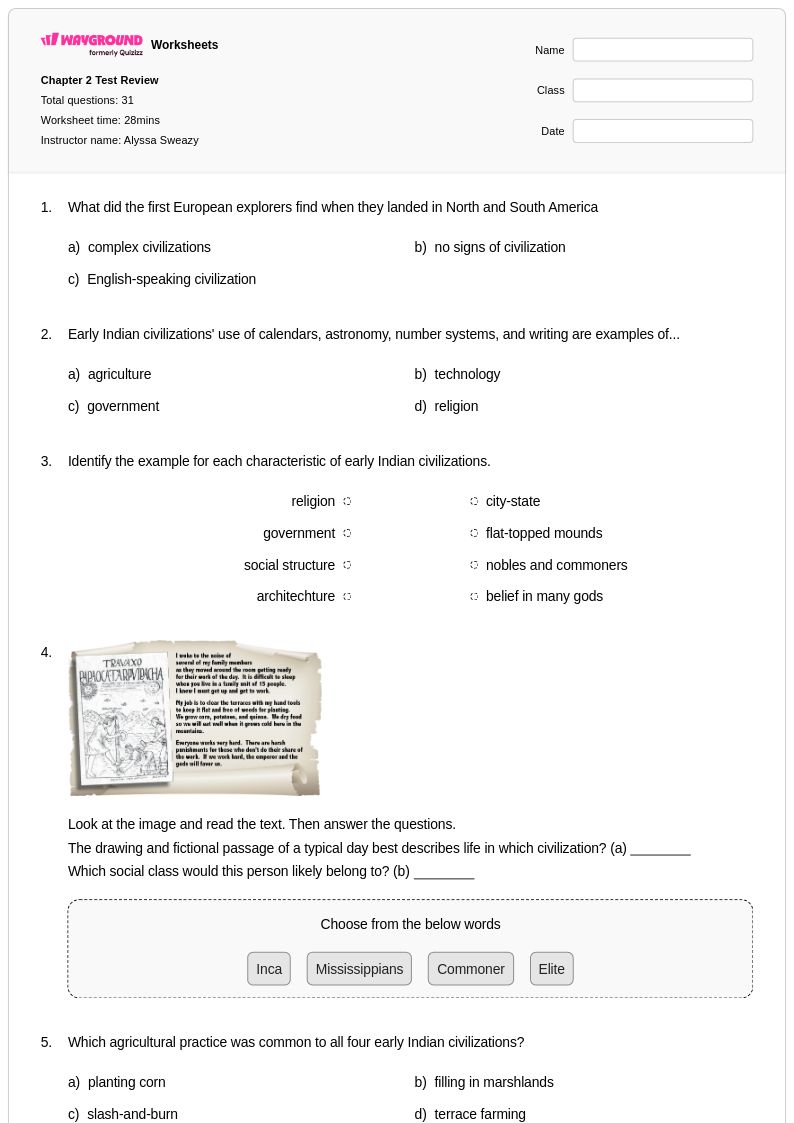
Explore Class 3 Maya Civilization worksheets and printables that help students discover ancient Mayan culture, achievements, and daily life through engaging practice problems and activities with answer keys.
Explore printable Maya Civilization worksheets for Class 3
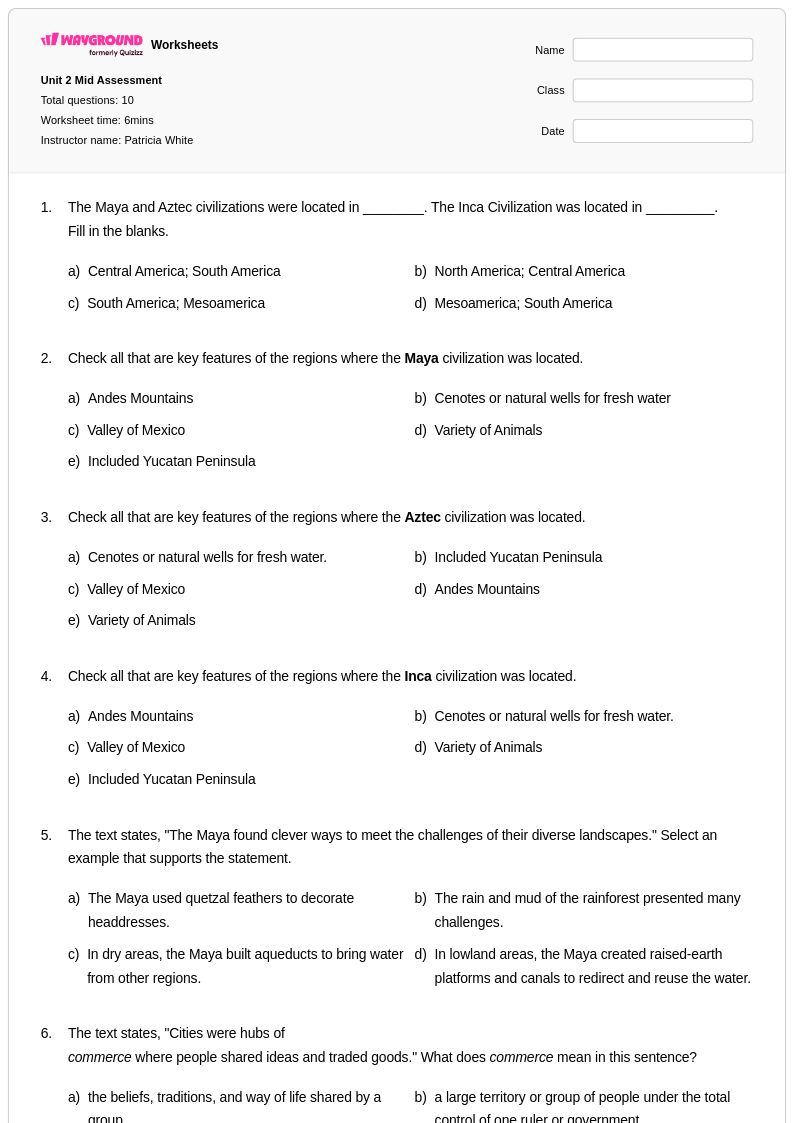
Maya Civilization worksheets for Class 3 students available through Wayground (formerly Quizizz) provide young learners with engaging opportunities to explore one of Mesoamerica's most fascinating ancient cultures. These educational resources strengthen critical thinking skills as students examine Maya achievements in mathematics, astronomy, agriculture, and architecture while developing their ability to analyze historical evidence and make connections between past and present civilizations. The comprehensive collection includes practice problems that challenge students to identify Maya innovations like their sophisticated calendar system and hieroglyphic writing, with each worksheet featuring detailed answer keys that support both independent learning and guided instruction. Teachers can access these free printables in convenient pdf format, making it simple to integrate Maya Civilization studies into social studies curriculum while building students' understanding of cultural diversity and historical chronology.
Wayground (formerly Quizizz) empowers educators with millions of teacher-created resources specifically designed to support Class 3 Maya Civilization instruction through robust search and filtering capabilities that align with social studies standards. The platform's differentiation tools enable teachers to customize worksheets based on individual student needs, offering both printable pdf versions for traditional classroom use and digital formats that accommodate diverse learning environments. These flexible resources streamline lesson planning by providing ready-to-use materials for introducing new concepts, reinforcing key learning objectives, and conducting formative assessments of student progress. Teachers can easily implement targeted remediation for students who need additional support understanding Maya cultural practices or provide enrichment opportunities for advanced learners ready to explore more complex aspects of this ancient civilization, ensuring that all Class 3 students develop a solid foundation in historical thinking and cultural awareness.
FAQs
How do I teach Maya civilization to students?
Teaching Maya civilization is most effective when students engage with primary evidence of Maya achievements rather than passive reading alone. Start with concrete systems students can analyze — the vigesimal (base-20) number system, the 365-day Haab calendar, and hieroglyphic writing — before moving to broader topics like city-state politics and agricultural innovations. Anchoring lessons in specific sites like Tikal or Chichen Itza helps students visualize the scale of Maya urban organization and makes abstract concepts like political hierarchy tangible.
What are good practice activities for a Maya civilization unit?
Strong practice activities for Maya civilization include decoding Maya numerals using the base-20 system, interpreting elements of Maya hieroglyphs, and comparing Maya city-states through structured analysis tasks. Students also benefit from activities that connect Maya agricultural techniques like raised field systems to environmental context, helping them understand how geography shaped civilization development. Worksheets that layer multiple Maya achievements — mathematics, astronomy, architecture, and writing — within a single task build integrative understanding more effectively than single-concept drills.
What mistakes do students commonly make when learning about the Maya?
One of the most persistent misconceptions is that Maya civilization 'collapsed' and disappeared entirely — students frequently conflate the decline of Classic Maya city-states with the extinction of the Maya people, who continue to exist today. Another common error is confusing the Maya number system's positional logic with the base-10 system students already know, leading to arithmetic mistakes when converting or interpreting Maya numerals. Students also tend to treat the Maya as a single unified empire rather than a collection of independent city-states with distinct political identities.
How does the Mayan number system work, and how do I teach it?
The Maya number system is a base-20 (vigesimal) positional system using only three symbols: a dot for one, a bar for five, and a shell glyph for zero. Unlike most ancient cultures, the Maya independently developed the concept of zero as a placeholder, making their system capable of representing very large numbers used in astronomical calculations. Teaching it works best by having students first master single-place values before attempting multi-place conversions, and by connecting the system's efficiency directly to the Maya's need for precise calendar and astronomical recordkeeping.
How can I use Maya civilization worksheets from Wayground in my classroom?
Wayground's Maya civilization worksheets are available as printable PDFs for traditional classroom use and in digital formats for technology-integrated or remote learning environments, and teachers can also host them as interactive quizzes directly on the Wayground platform. This flexibility makes them suitable for in-class instruction, independent homework assignments, and targeted remediation or enrichment activities. For students who need additional support, Wayground's accommodation tools — including read aloud, extended time, and reduced answer choices — can be applied to individual students without disrupting the rest of the class.
How do I differentiate Maya civilization instruction for students at different levels?
Differentiation in a Maya civilization unit can be structured around task complexity — lower-level tasks might ask students to identify Maya number symbols, while higher-level tasks require students to analyze how Maya astronomical knowledge influenced calendar design or religious practice. On the Wayground platform, teachers can apply individual accommodations such as read aloud for struggling readers, reduced answer choices to lower cognitive load, or extended time per question, all without signaling differences to other students. Pairing these digital tools with tiered written tasks ensures every learner engages meaningfully with the content.