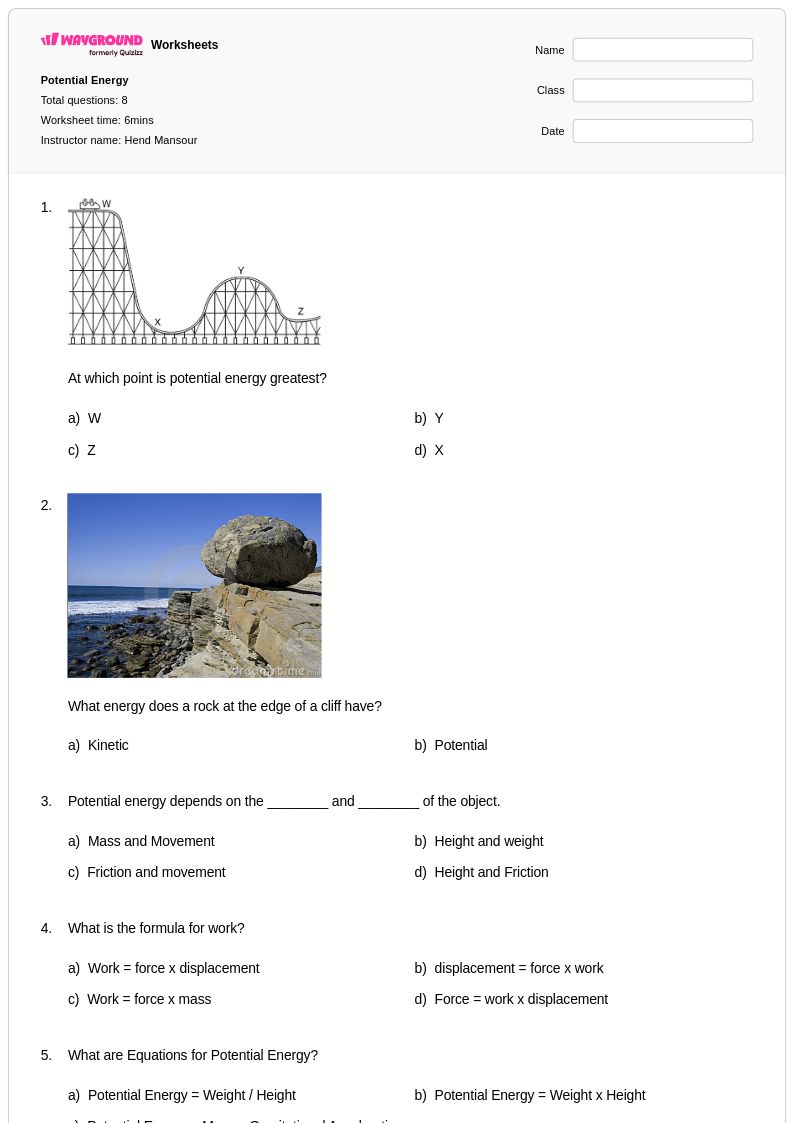
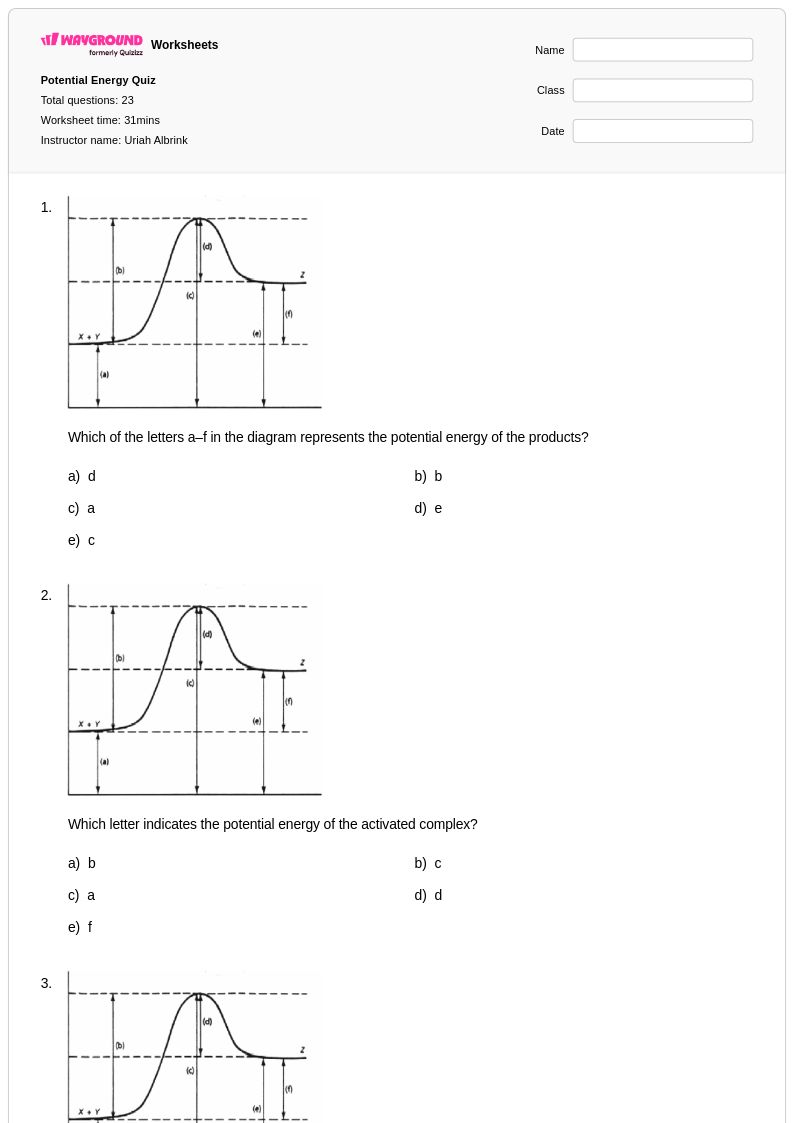
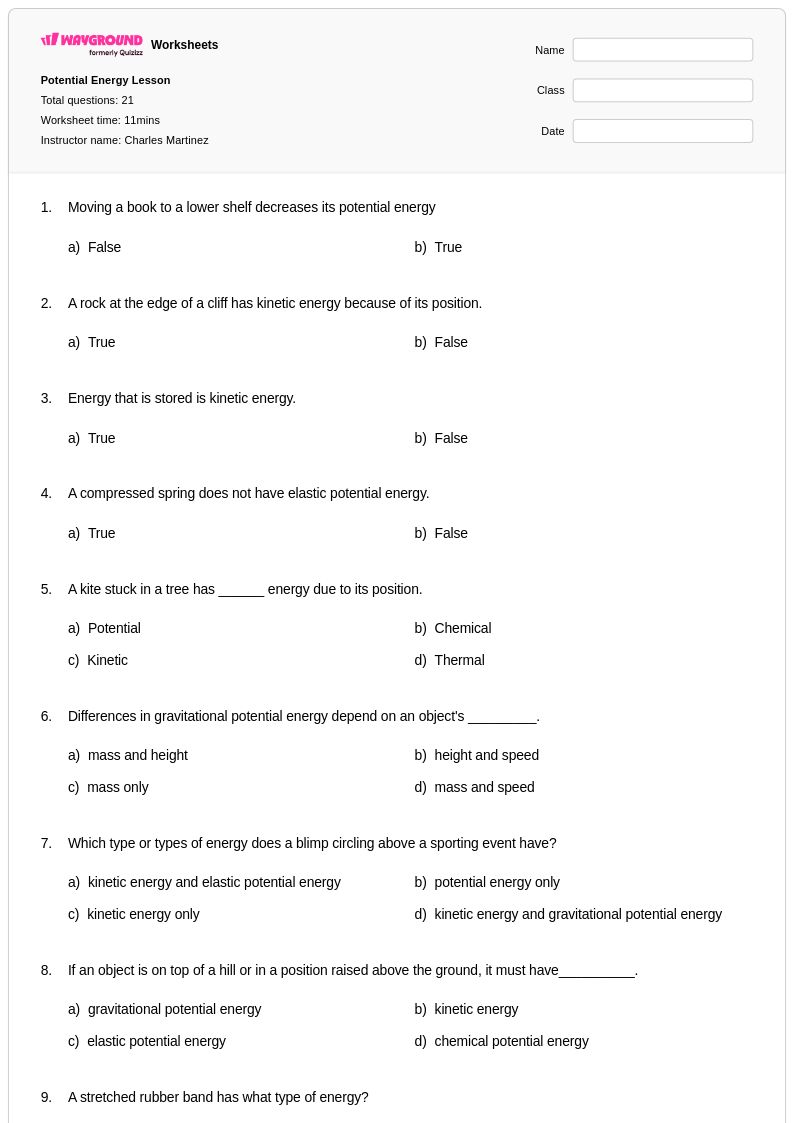
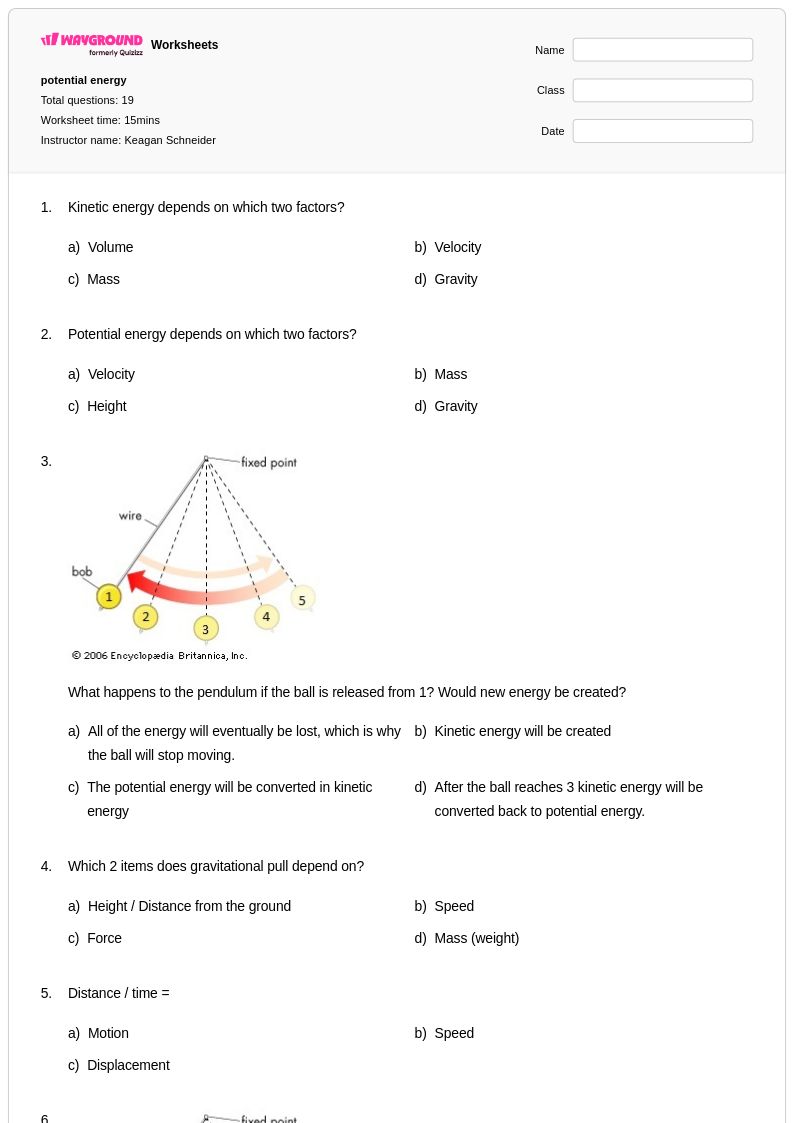
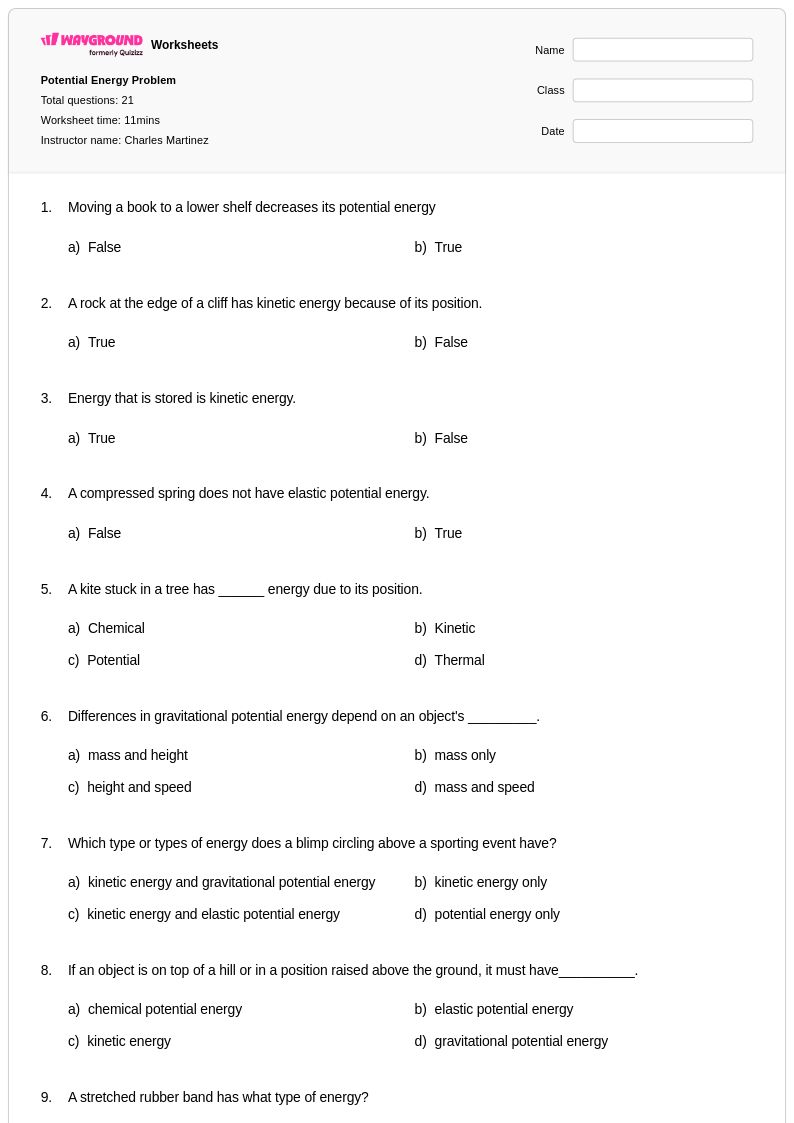
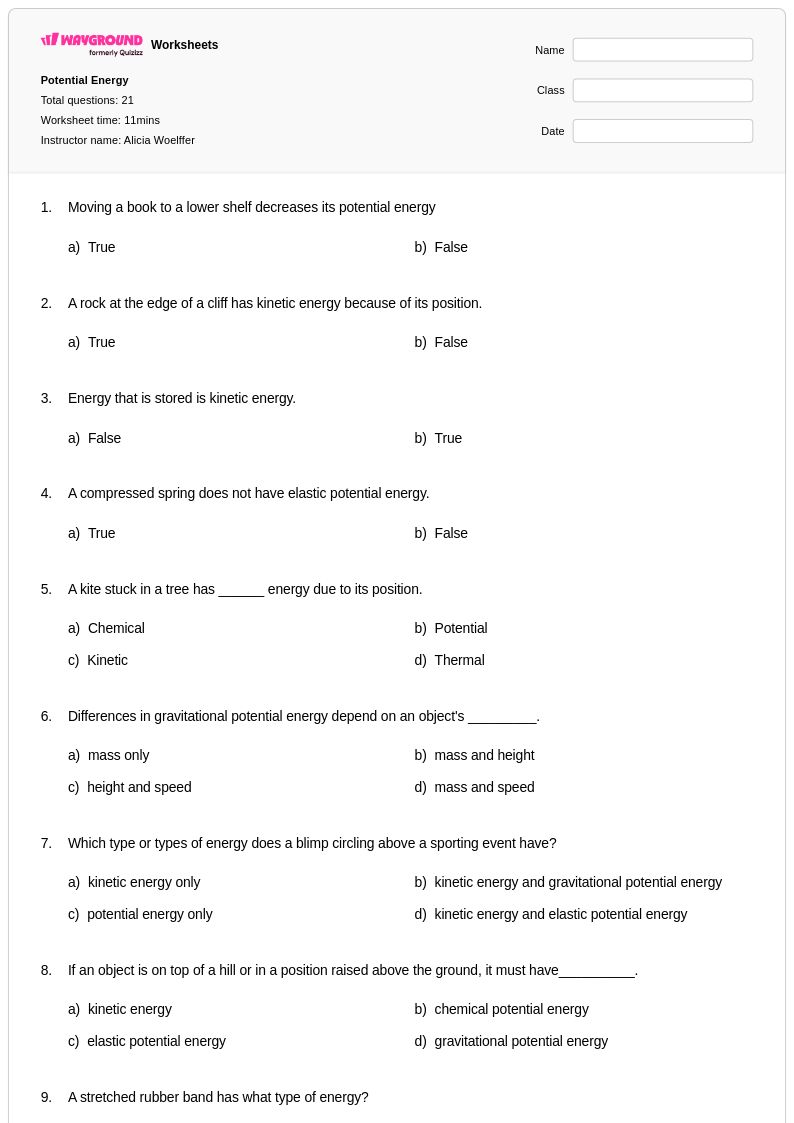
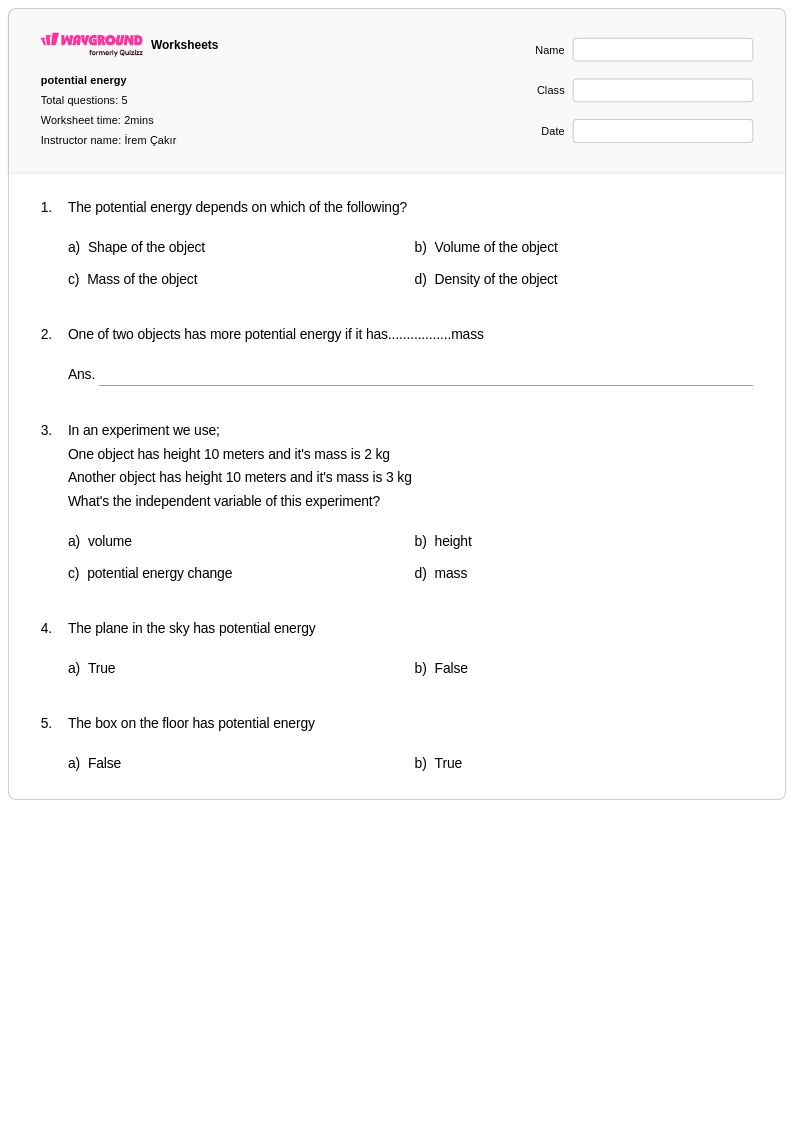
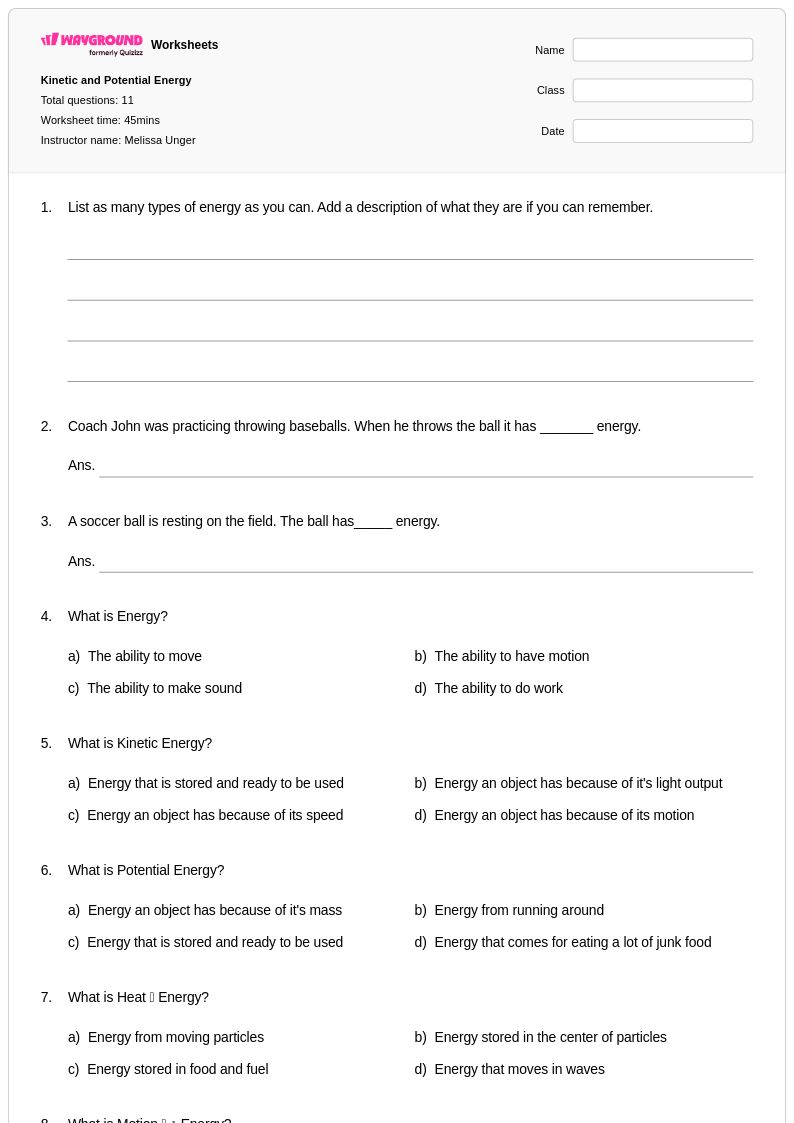
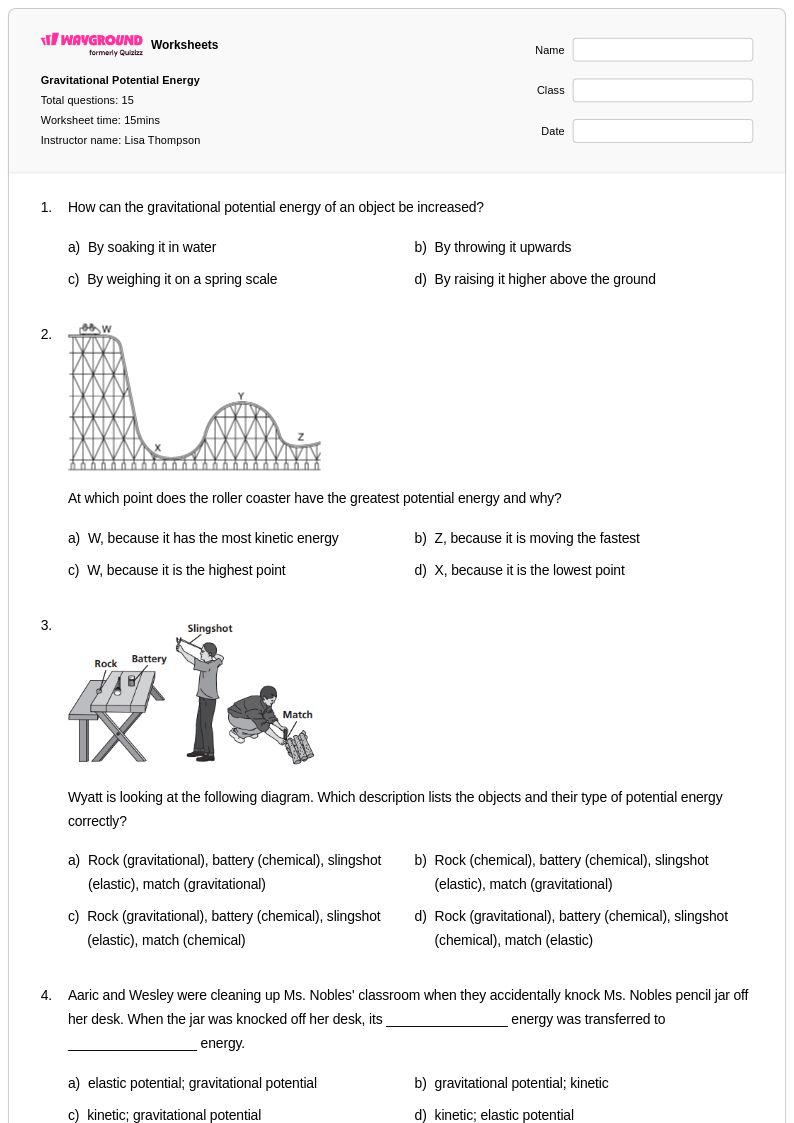
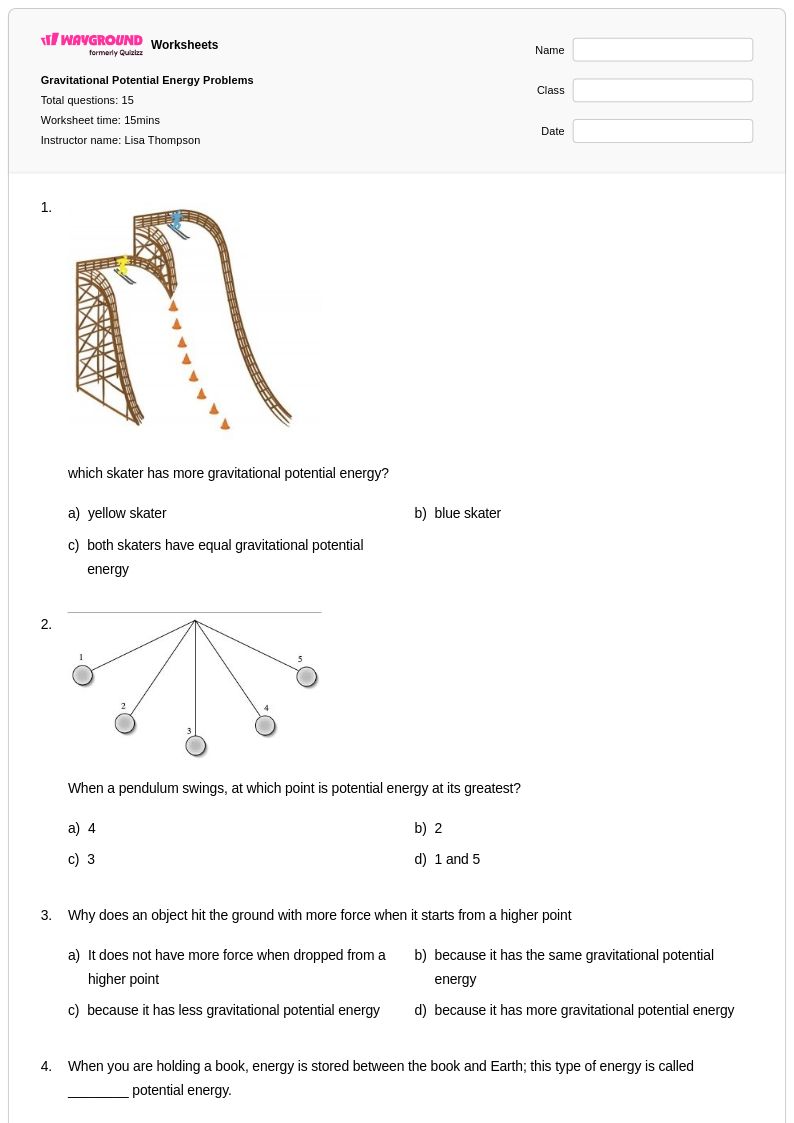
Explore Wayground's collection of potential energy worksheets featuring free printables and practice problems that help students master gravitational, elastic, and chemical potential energy concepts with comprehensive answer keys.
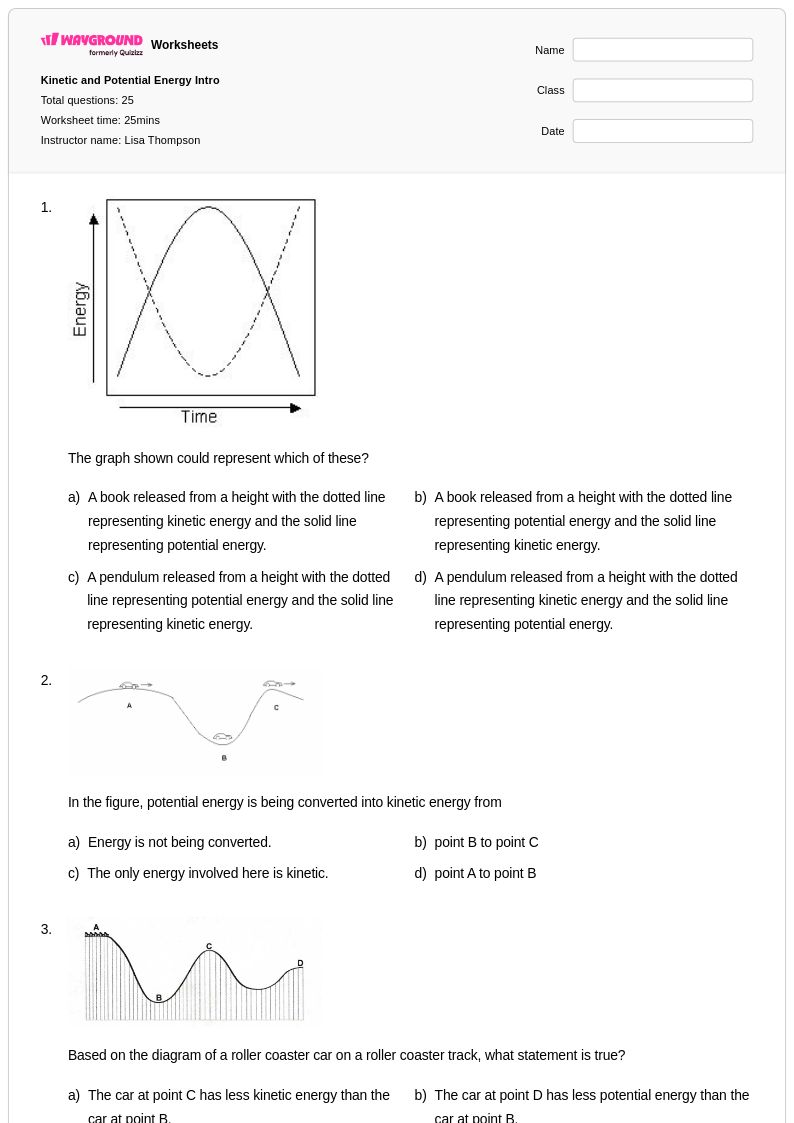
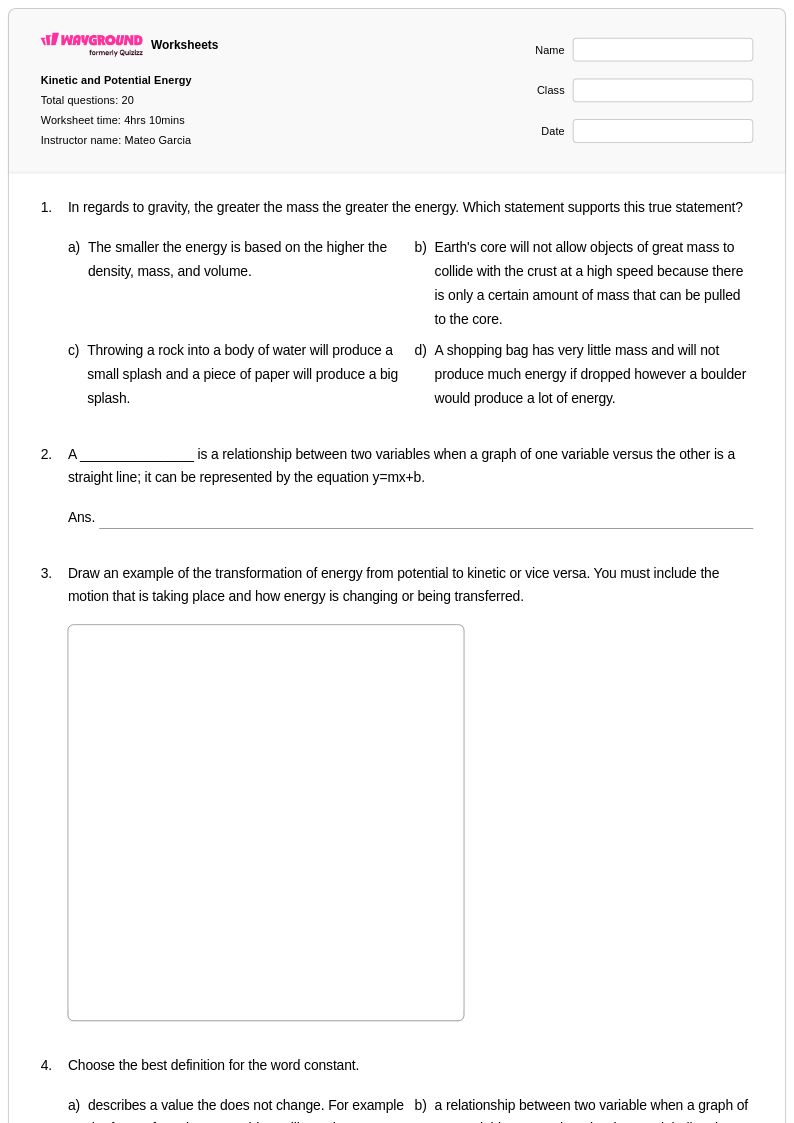
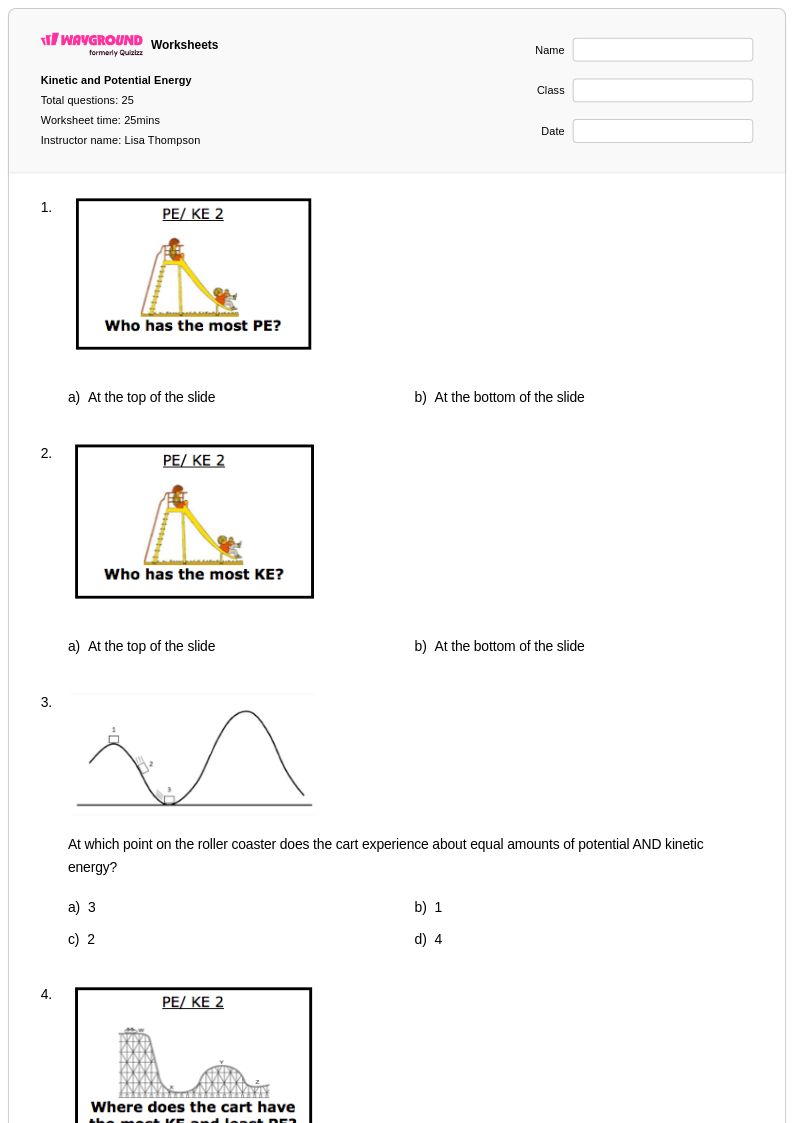
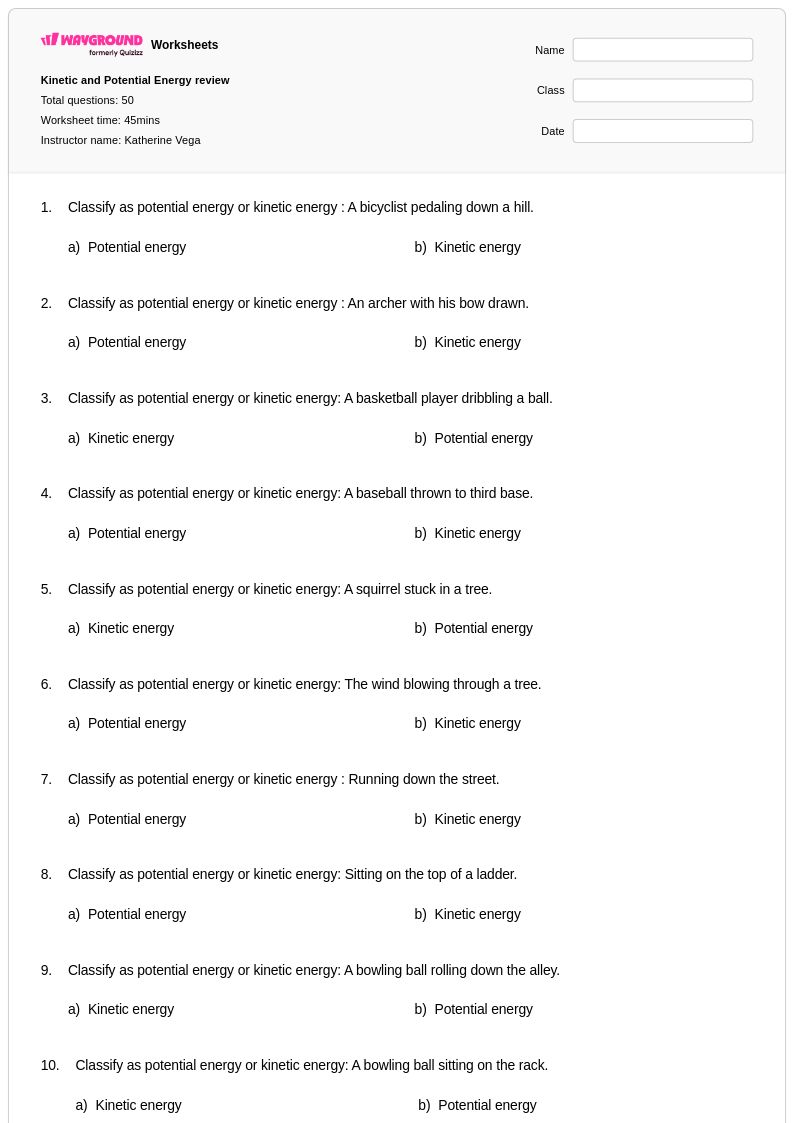
Potential energy worksheets available through Wayground (formerly Quizizz) provide comprehensive coverage of this fundamental physics concept, helping students master the relationship between an object's position and its stored energy capacity. These educational resources systematically guide learners through various forms of potential energy, including gravitational, elastic, and chemical potential energy, while reinforcing essential problem-solving skills through carefully structured practice problems. Students work with real-world scenarios such as calculating the gravitational potential energy of objects at different heights, analyzing spring compression and extension, and exploring energy transformations in mechanical systems. Each worksheet comes with a detailed answer key that enables independent learning and self-assessment, while the free printable format ensures accessibility for classroom and home use. The pdf materials feature progressive difficulty levels that build conceptual understanding from basic energy calculations to complex multi-step problems involving energy conservation principles.
Wayground (formerly Quizizz) empowers educators with an extensive collection of teacher-created potential energy resources, drawing from millions of high-quality worksheets and practice materials developed by physics educators worldwide. The platform's sophisticated search and filtering capabilities allow teachers to quickly locate materials that align with specific curriculum standards and match their students' skill levels, whether they need foundational practice with basic potential energy formulas or advanced applications involving energy transformations. Differentiation tools enable seamless customization of worksheet content, allowing educators to modify problems, adjust complexity, and create targeted assignments for remediation or enrichment purposes. These versatile resources are available in both printable and digital formats, including professionally formatted pdf documents, giving teachers the flexibility to implement potential energy instruction across various learning environments while supporting diverse student needs and learning preferences.
FAQs
How do I teach potential energy to physics students?
Effective potential energy instruction starts by grounding students in the core idea that stored energy is always relative to position, shape, or chemical state rather than motion. Begin with gravitational potential energy using everyday examples like a raised book or a roller coaster at its peak, then move to elastic potential energy with springs and rubber bands, and finally introduce chemical potential energy through familiar contexts like batteries or food. Connecting each form to real-world scenarios helps students build a conceptual framework before they tackle calculations using formulas like PE = mgh.
What exercises help students practice calculating gravitational potential energy?
Students benefit most from structured practice problems that require them to apply PE = mgh across varying conditions, such as calculating the stored energy of objects at different heights or comparing the potential energy of objects with different masses at the same height. Worked examples followed by scaffolded problems that increase in complexity reinforce the relationship between each variable. Multi-step problems that ask students to calculate potential energy and then determine how much kinetic energy is released during a fall are especially effective for deepening understanding of energy conservation.
What mistakes do students commonly make when solving potential energy problems?
One of the most frequent errors is failing to recognize that gravitational potential energy depends on the reference point chosen, leading to inconsistent height measurements. Students also commonly confuse the units, mixing up joules and newtons or forgetting that mass must be in kilograms when using standard SI values for g. Another persistent misconception is treating potential and kinetic energy as independent quantities rather than understanding that total mechanical energy is conserved as one converts to the other.
How do I differentiate potential energy instruction for students at different skill levels?
For foundational learners, start with single-variable problems where mass and g are held constant so students can isolate the effect of height on stored energy. More advanced students can work through multi-step problems that incorporate energy transformation, conservation of energy, and real-world contexts like pendulums or projectile motion. On Wayground, teachers can apply accommodations such as reduced answer choices or read-aloud support for individual students, and extended time settings can be configured per student without alerting the rest of the class.
How can I use Wayground's potential energy worksheets in my classroom?
Wayground's potential energy worksheets are available as printable PDFs for traditional classroom use and in digital formats for technology-integrated environments, giving teachers flexibility to assign them as in-class practice, homework, or assessments. Teachers can also host worksheets directly as a quiz on Wayground, enabling real-time student responses and immediate feedback. All worksheets include complete answer keys, which support self-assessment and independent practice, whether students are working in a classroom or remotely.
How do I help students understand the difference between gravitational, elastic, and chemical potential energy?
The clearest approach is to anchor each type to its defining condition: gravitational potential energy depends on an object's height and mass, elastic potential energy depends on how much an object like a spring is compressed or stretched, and chemical potential energy is stored in molecular bonds and released through reactions. Comparative problems that present all three forms side by side help students distinguish the conditions under which each type applies. Visual diagrams and energy transformation scenarios, such as a compressed spring launching a ball upward, reinforce how these forms relate to and convert into one another.