Explore Wayground's comprehensive collection of speed of sound worksheets featuring free printables, practice problems, and answer keys to help students master wave propagation, frequency calculations, and acoustic physics principles.
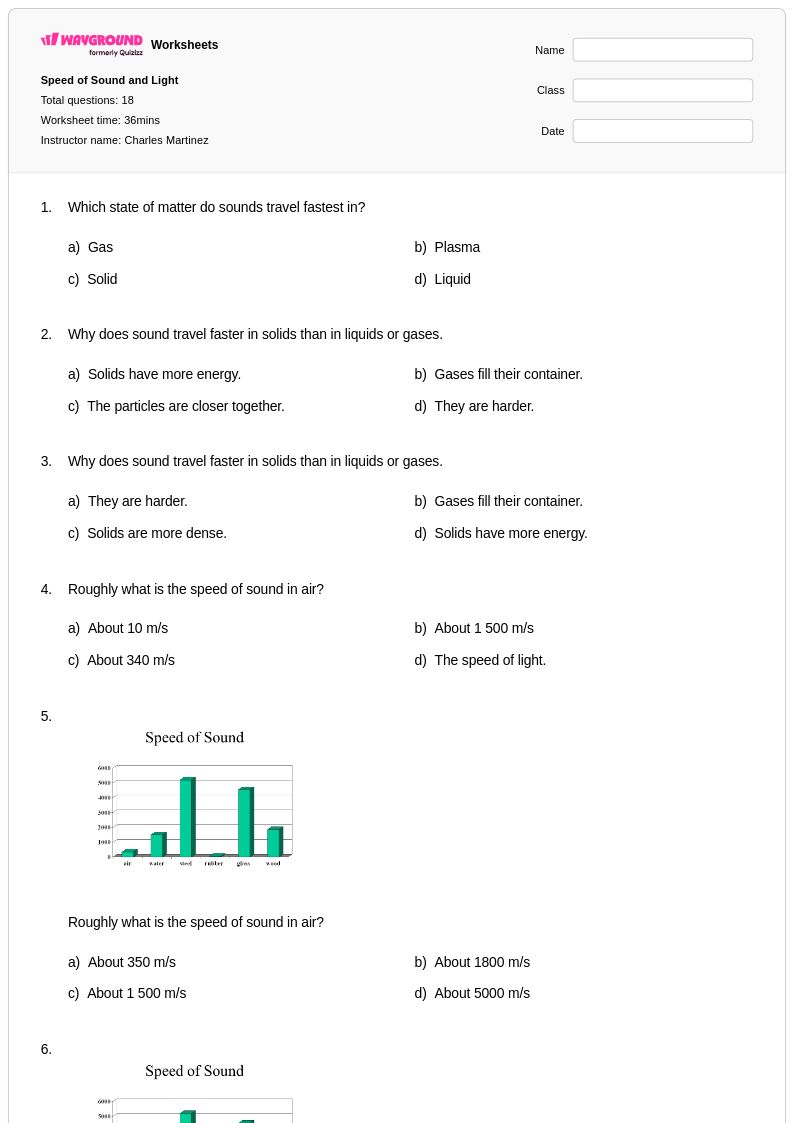
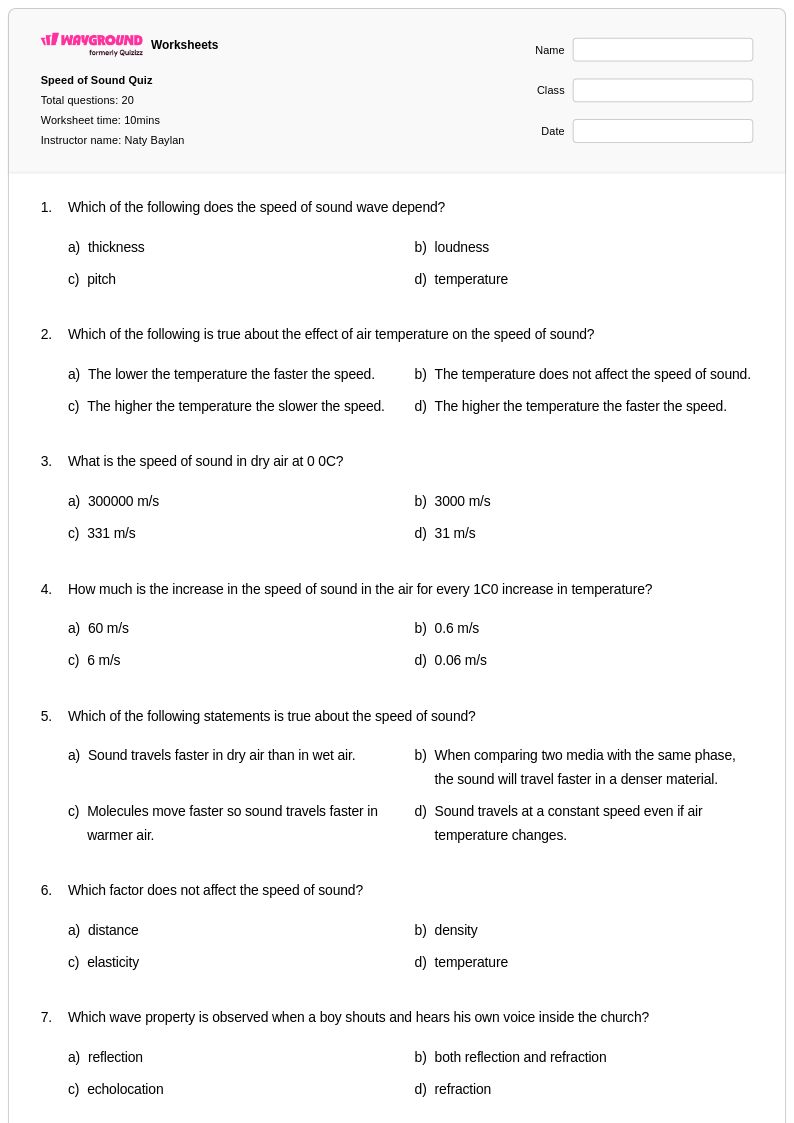
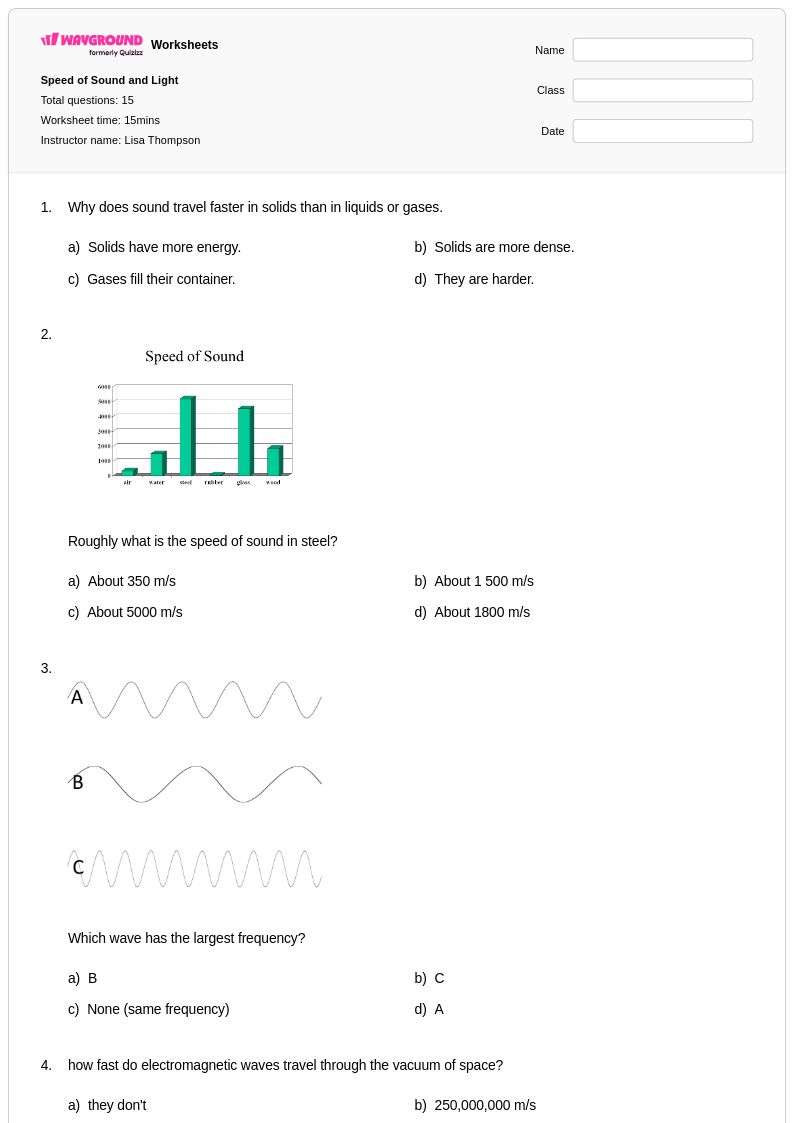
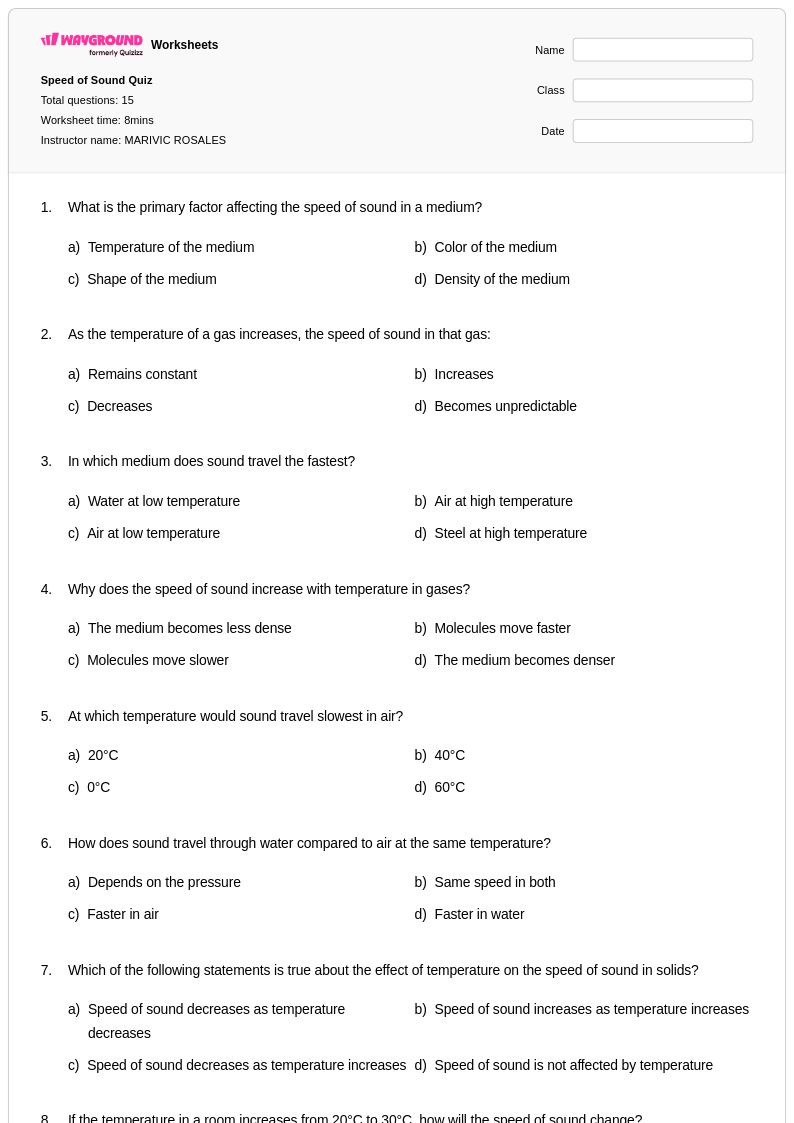
Speed of sound worksheets available through Wayground (formerly Quizizz) provide comprehensive resources for exploring the fundamental principles governing sound wave propagation through different media. These expertly crafted materials strengthen students' understanding of how temperature, density, and medium composition affect sound velocity, while reinforcing mathematical skills through calculation-based practice problems involving the relationship between frequency, wavelength, and wave speed. The worksheets incorporate real-world applications such as echolocation, seismic wave analysis, and acoustic engineering concepts, with each resource including detailed answer keys to support independent learning and self-assessment. Available as free printables in convenient PDF format, these materials guide students through progressively challenging scenarios that build conceptual mastery of wave mechanics and sound transmission properties.
Wayground's extensive collection of speed of sound worksheets draws from millions of teacher-created resources, offering educators powerful search and filtering capabilities to locate materials perfectly aligned with specific learning objectives and academic standards. The platform's differentiation tools enable seamless customization of content complexity, allowing teachers to modify problems and scenarios to meet diverse student needs during both remediation and enrichment activities. These versatile resources are available in both printable PDF format for traditional classroom use and digital formats for interactive learning environments, supporting flexible lesson planning across various instructional models. Teachers can efficiently integrate these materials into their physics curriculum to reinforce wave theory concepts, provide targeted skill practice, and assess student comprehension of fundamental acoustic principles through structured problem-solving exercises.
FAQs
How do I teach the speed of sound to students?
Start by helping students understand that sound is a mechanical wave that requires a medium to travel, and that its speed depends on the properties of that medium rather than the sound itself. Introduce the three key variables — temperature, density, and medium composition — before moving into calculations. Real-world examples like echolocation and seismic wave analysis give students concrete anchors for abstract wave propagation concepts, making the physics feel tangible and relevant.
What practice problems help students understand the speed of sound?
Calculation-based problems using the wave speed formula (v = fλ) are the most effective practice for building fluency with speed of sound concepts. Students benefit from problems that vary the unknown — sometimes solving for speed, sometimes for frequency or wavelength — so they develop flexibility rather than formula memorization. Progressively challenging scenarios, such as comparing sound speed in air versus water or calculating echo return times, help students apply the same core relationship across different contexts.
What mistakes do students commonly make when calculating the speed of sound?
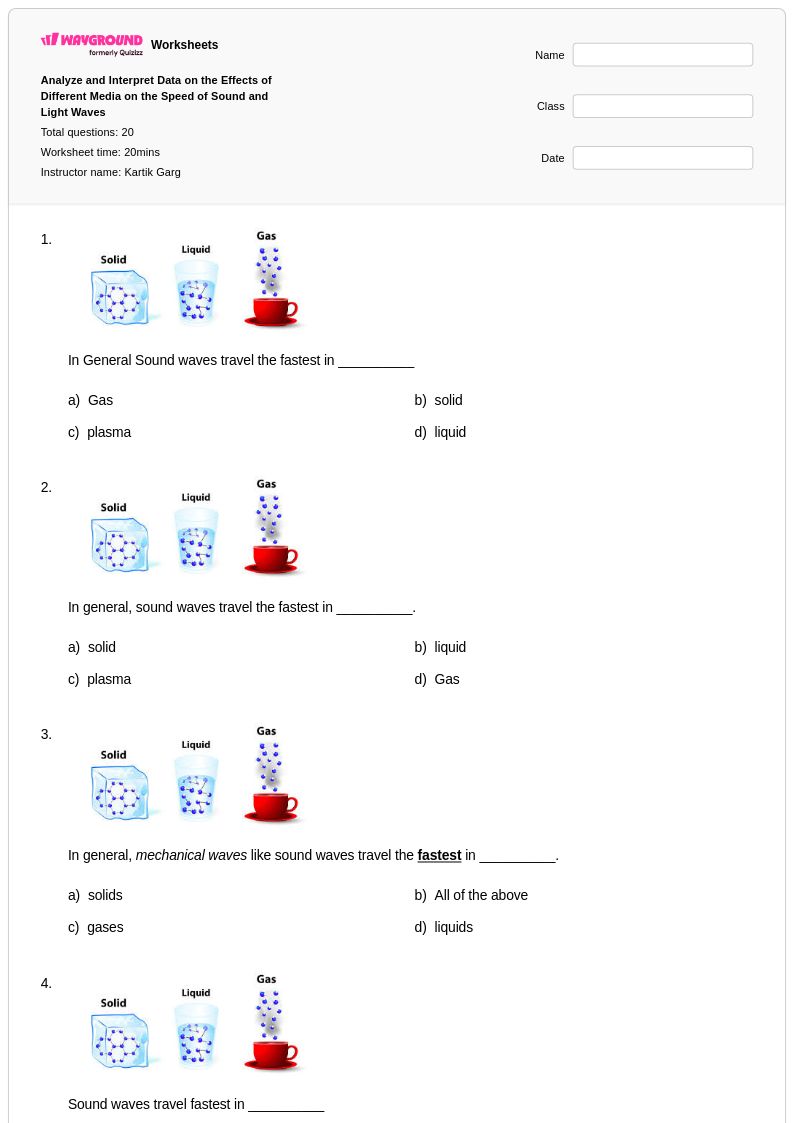
The most common error is treating the speed of sound as a fixed constant, typically 343 m/s in air, without accounting for how temperature or medium affects it. Students also frequently confuse frequency and wavelength or invert the wave speed formula when solving for an unknown variable. Another recurring misconception is assuming sound travels faster in less dense media, when in fact increased elasticity in denser solids like steel actually allows sound to travel faster than in air.
How does temperature affect the speed of sound, and how do I explain this to students?
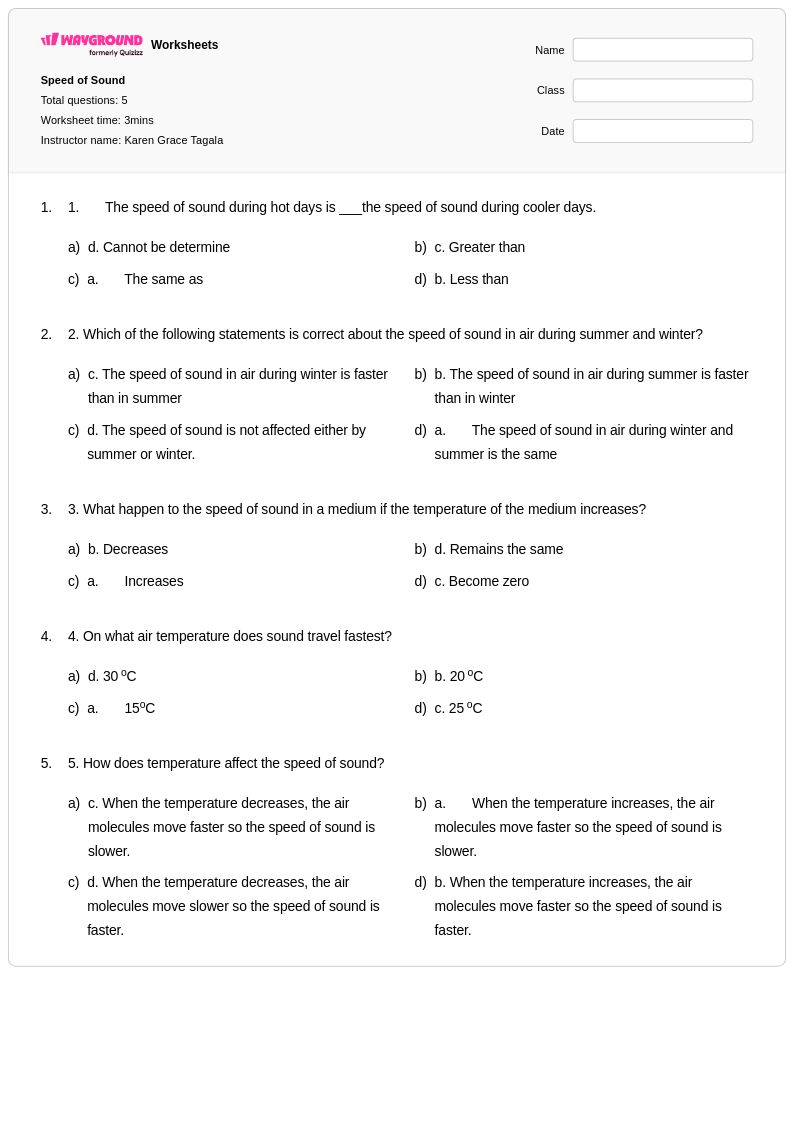
Temperature affects the speed of sound because warmer air gives gas molecules more kinetic energy, allowing them to collide and transfer the pressure wave more quickly. A useful rule of thumb for air is that sound speed increases by approximately 0.6 m/s for every 1°C rise in temperature. Having students calculate sound speed at different temperatures using the formula v = 331 + 0.6T makes this relationship concrete and reinforces the idea that medium conditions — not the sound source — determine propagation speed.
How do I use Wayground's speed of sound worksheets in my classroom?
Wayground's speed of sound worksheets are available as printable PDFs for traditional classroom use and in digital formats for technology-integrated environments, including the option to host them as a quiz directly on Wayground. Each worksheet includes a detailed answer key, which supports independent practice, self-assessment, and efficient teacher grading. For students who need additional support, Wayground's accommodation tools — such as read aloud, extended time, and reduced answer choices — can be assigned individually without disrupting the rest of the class.
How can I differentiate speed of sound instruction for students at different levels?
For students who need remediation, start with conceptual questions about how medium and temperature affect sound before introducing calculations, and use reduced answer choices to lower cognitive load during early practice. For advanced learners, extend problems into acoustic engineering or seismic wave analysis contexts that require multi-step reasoning. On Wayground, differentiation settings like extended time and read aloud can be applied to individual students, so the same worksheet assignment accommodates diverse needs simultaneously.