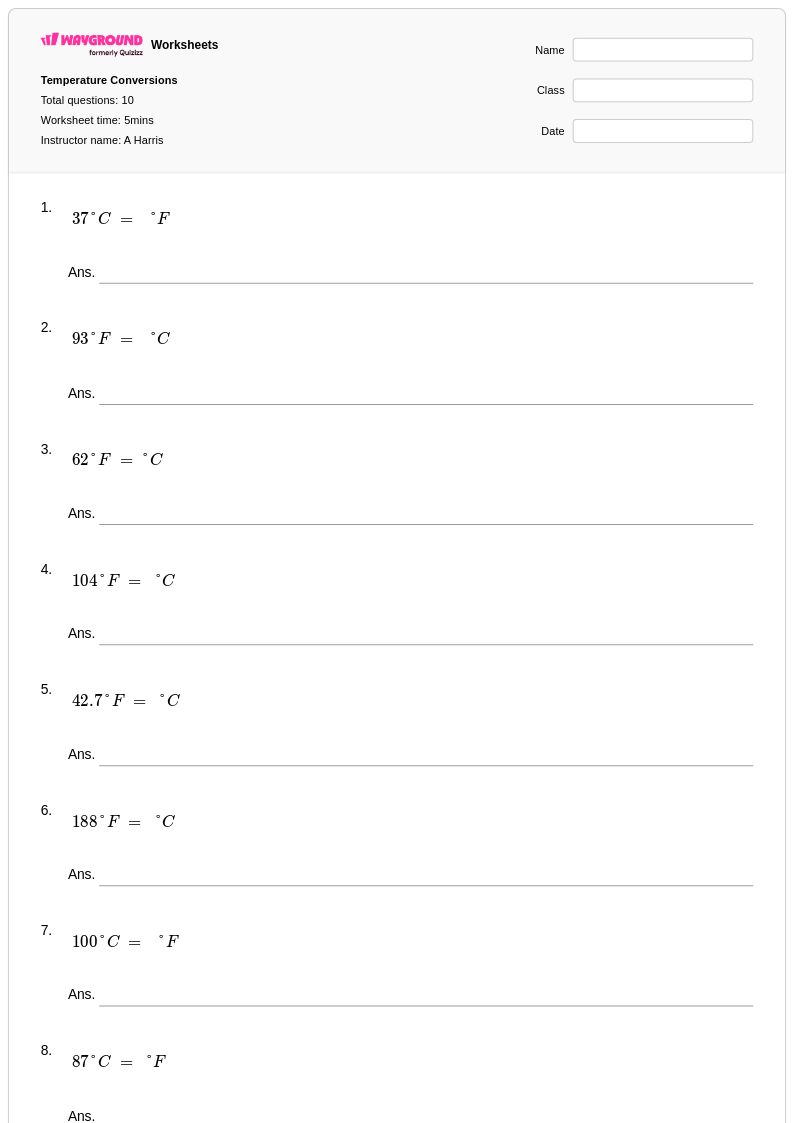
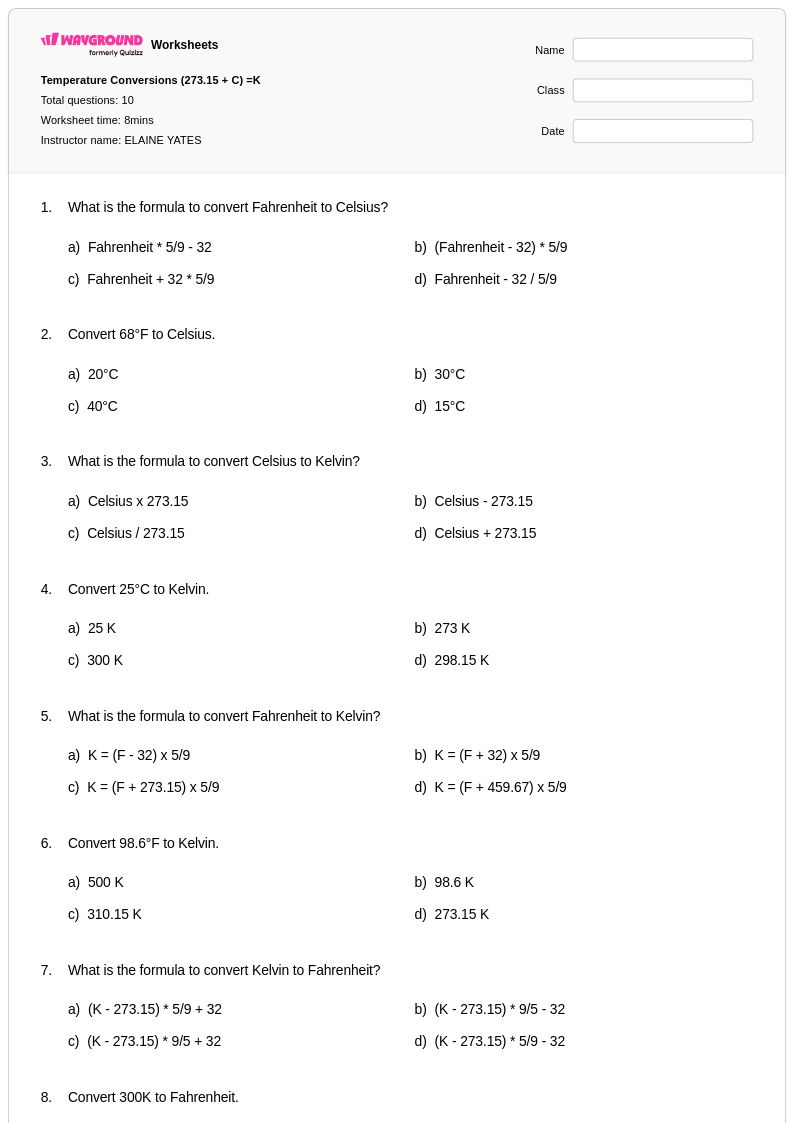
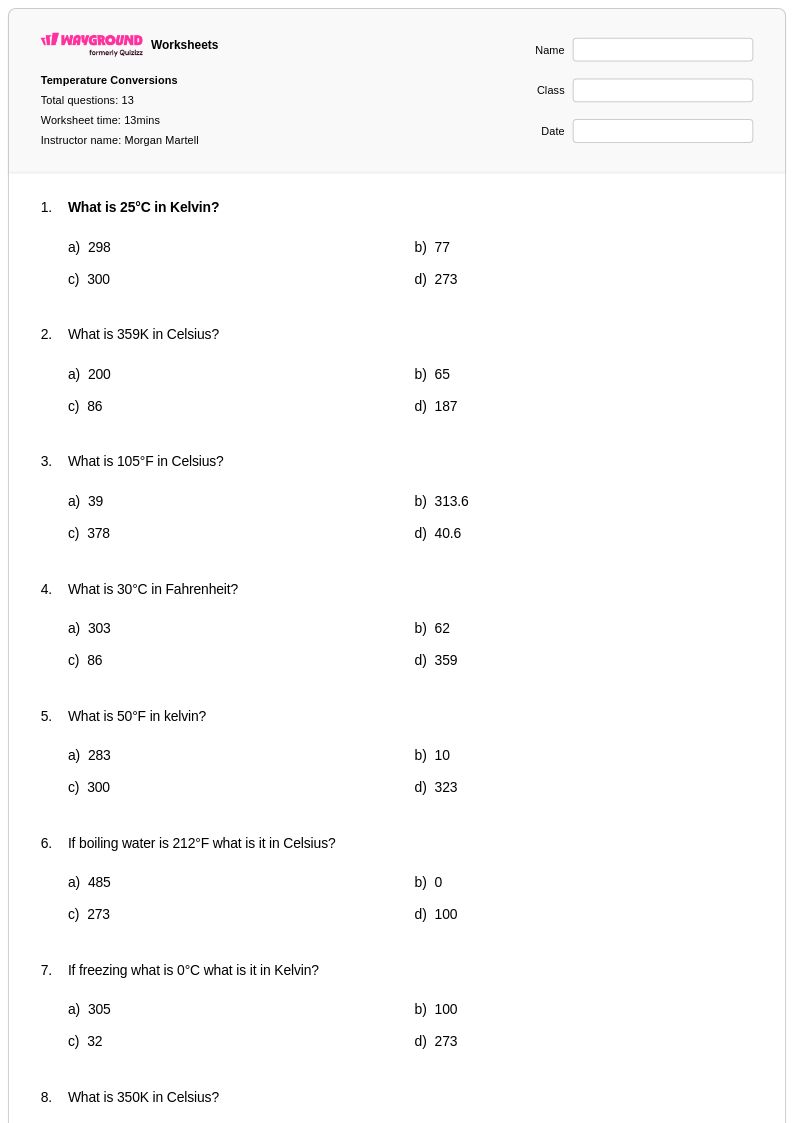
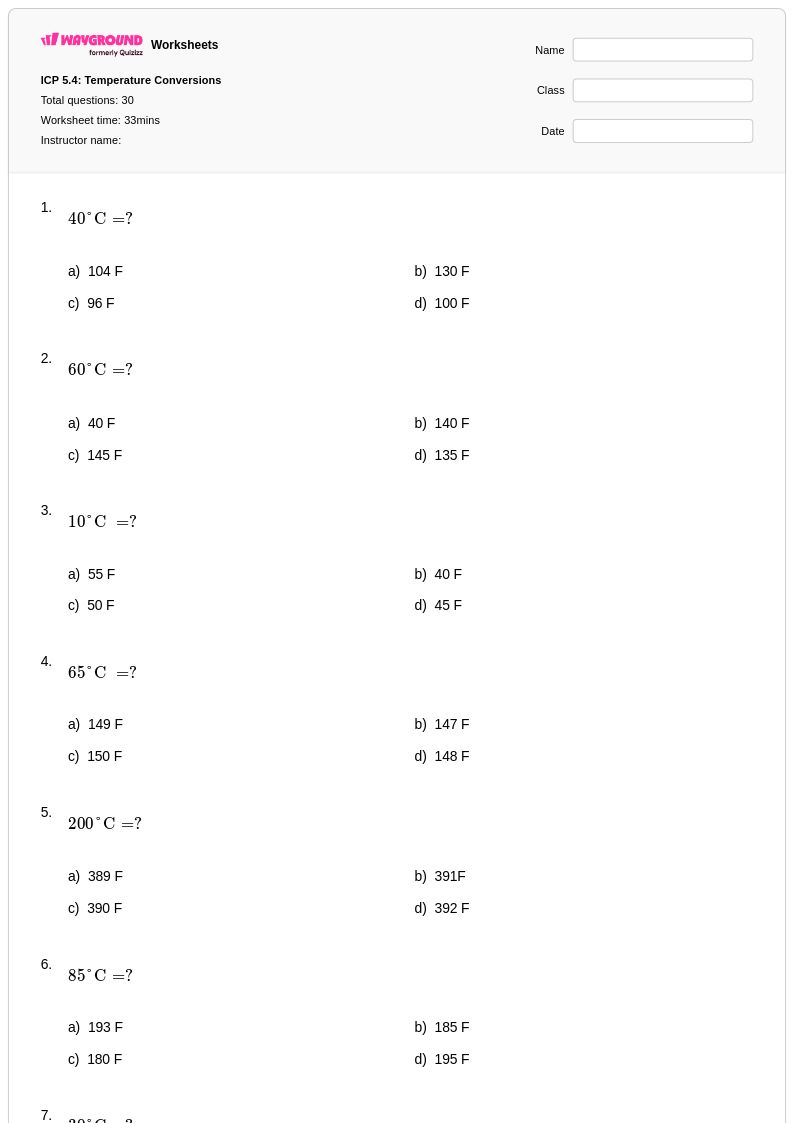
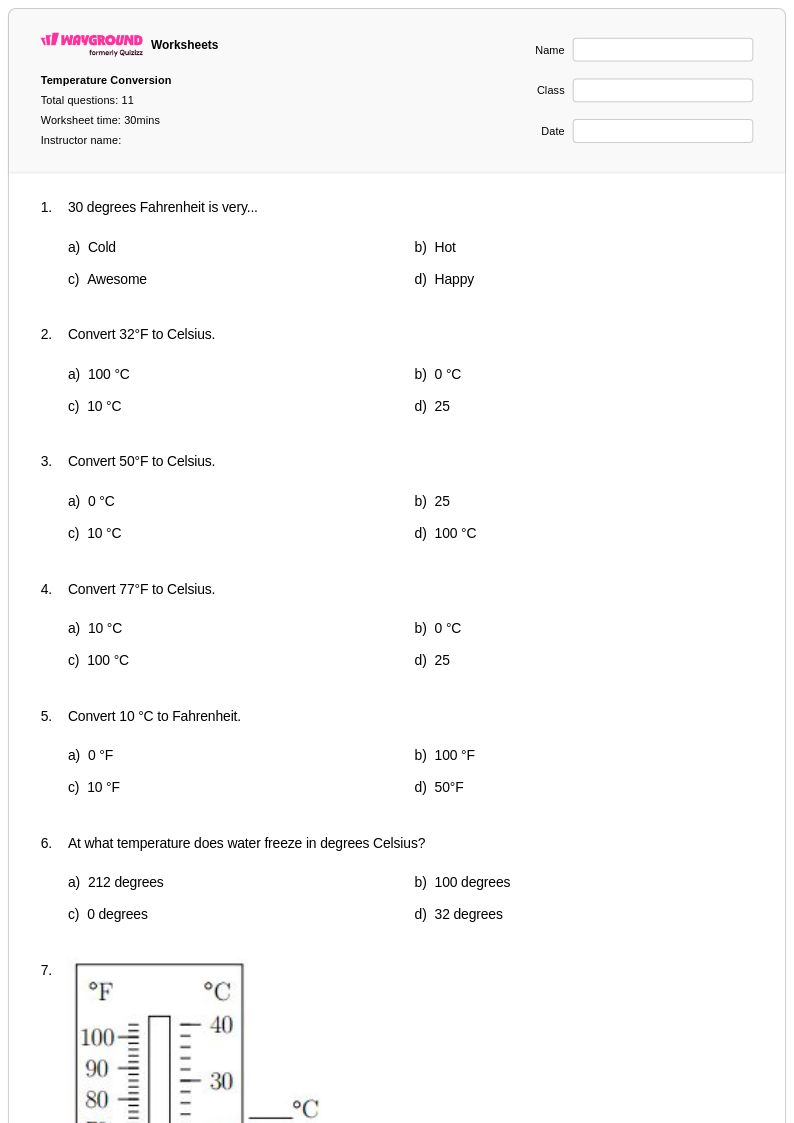
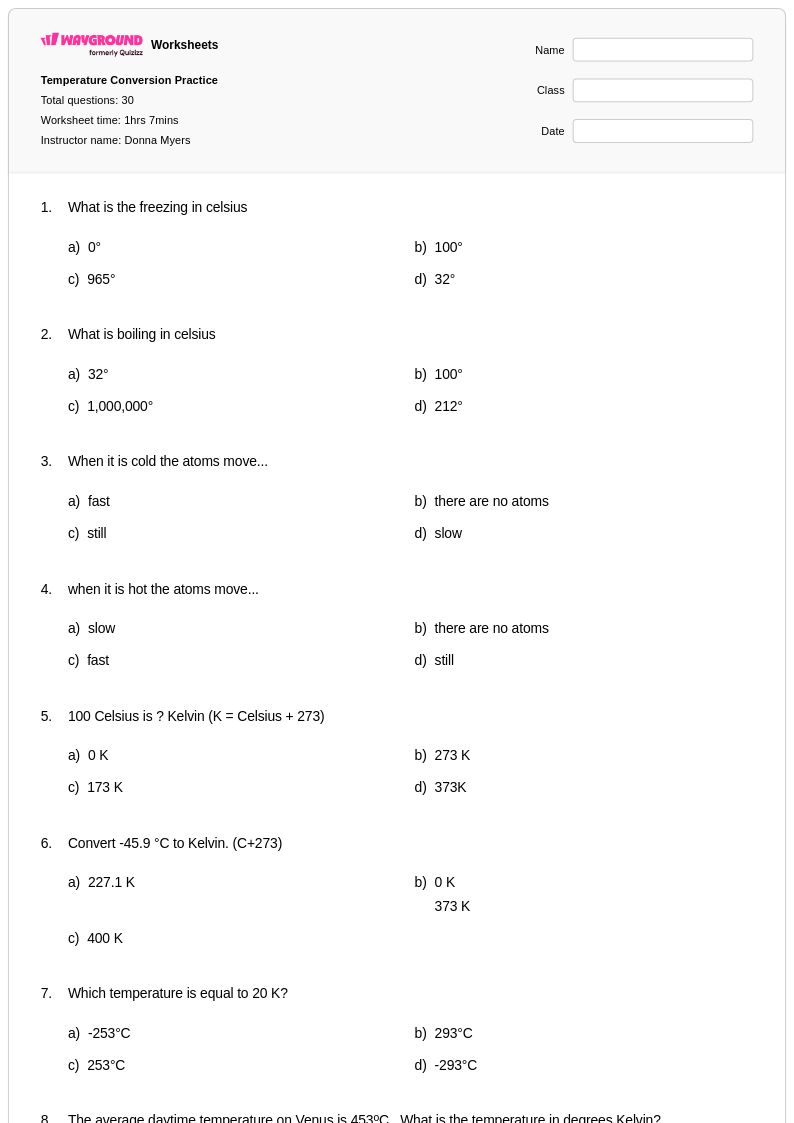
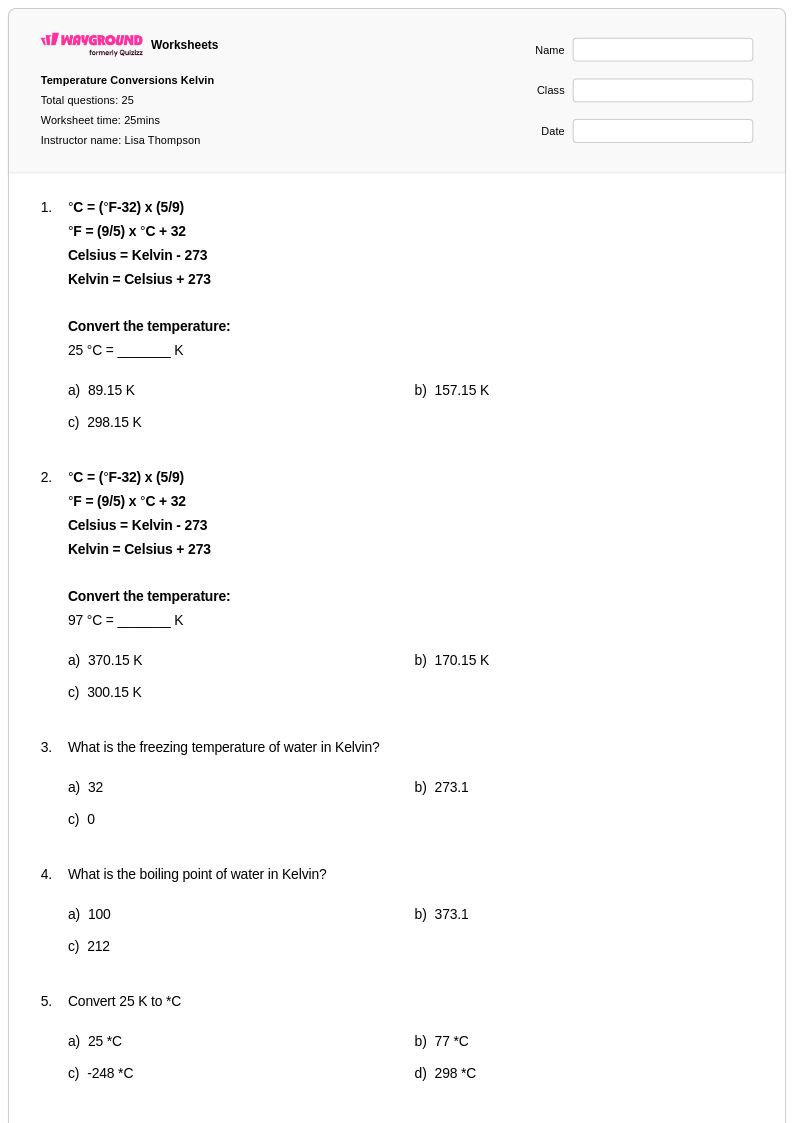
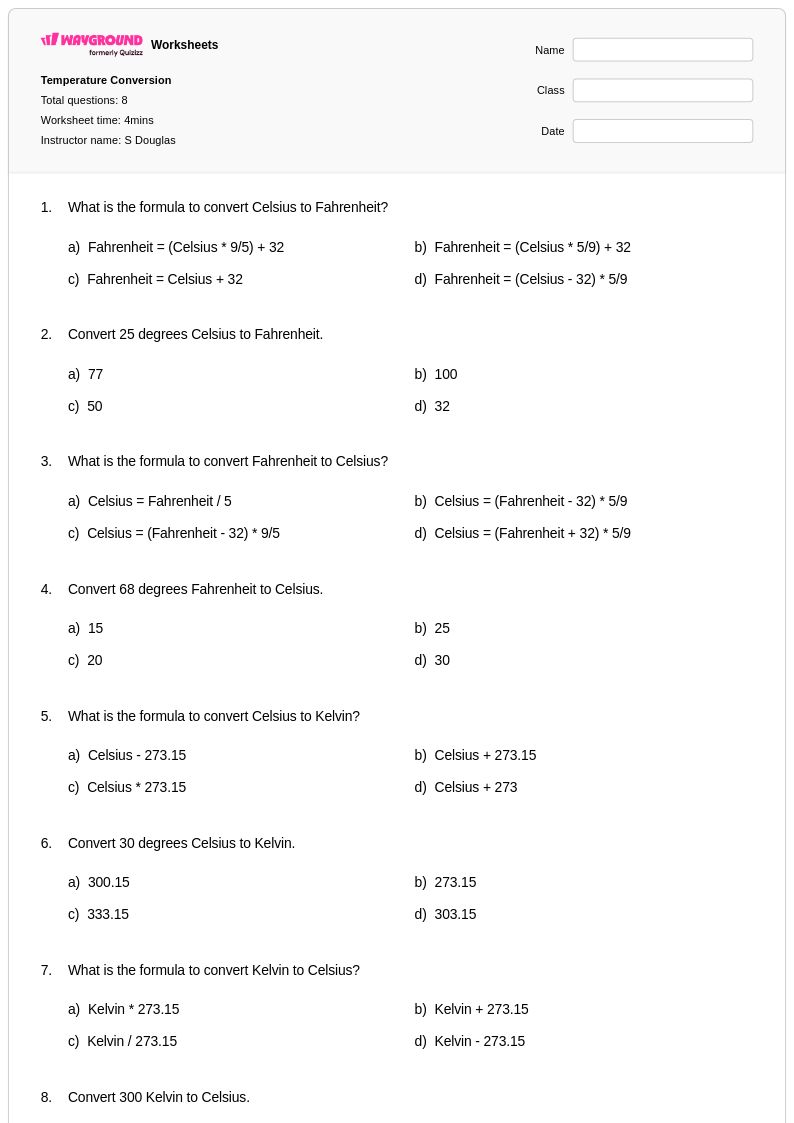
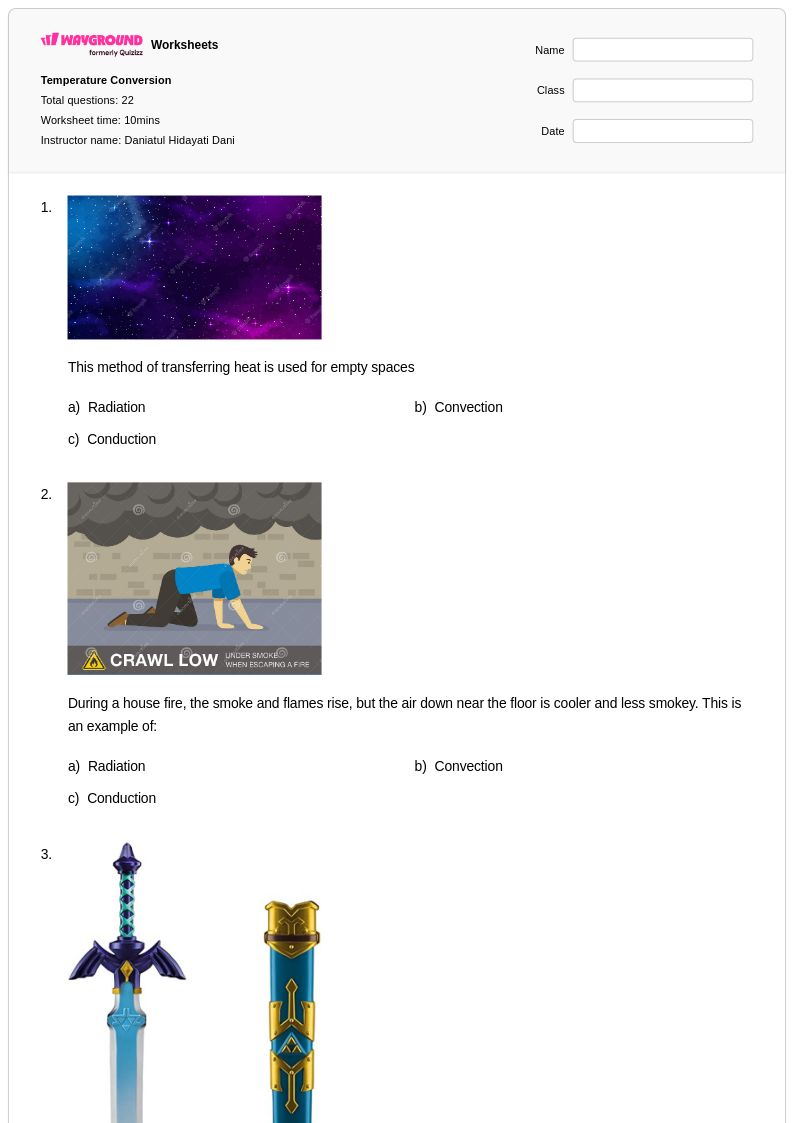
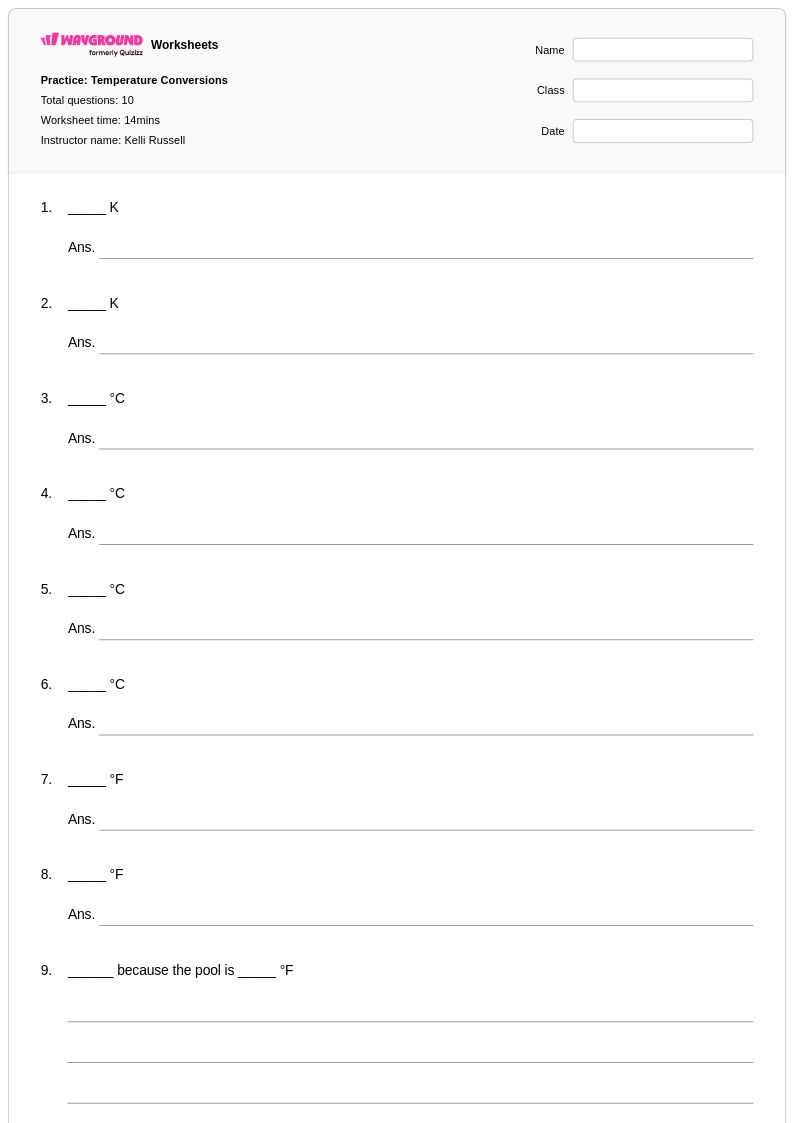
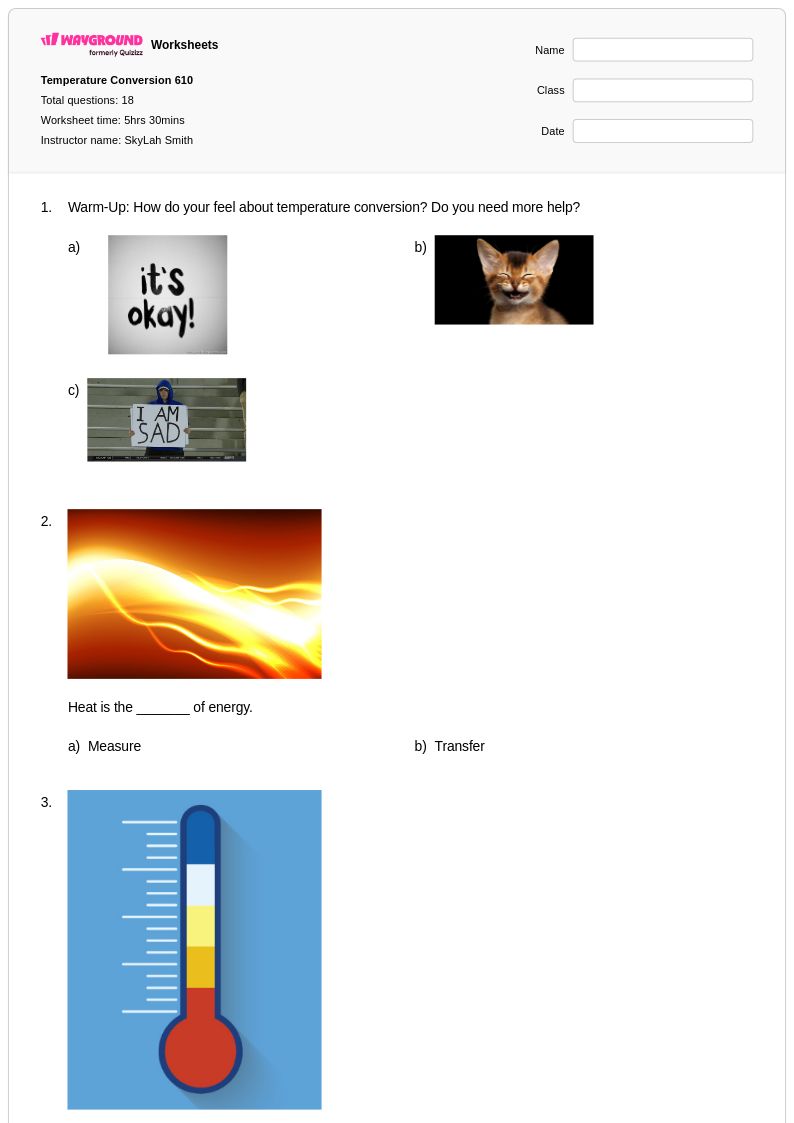
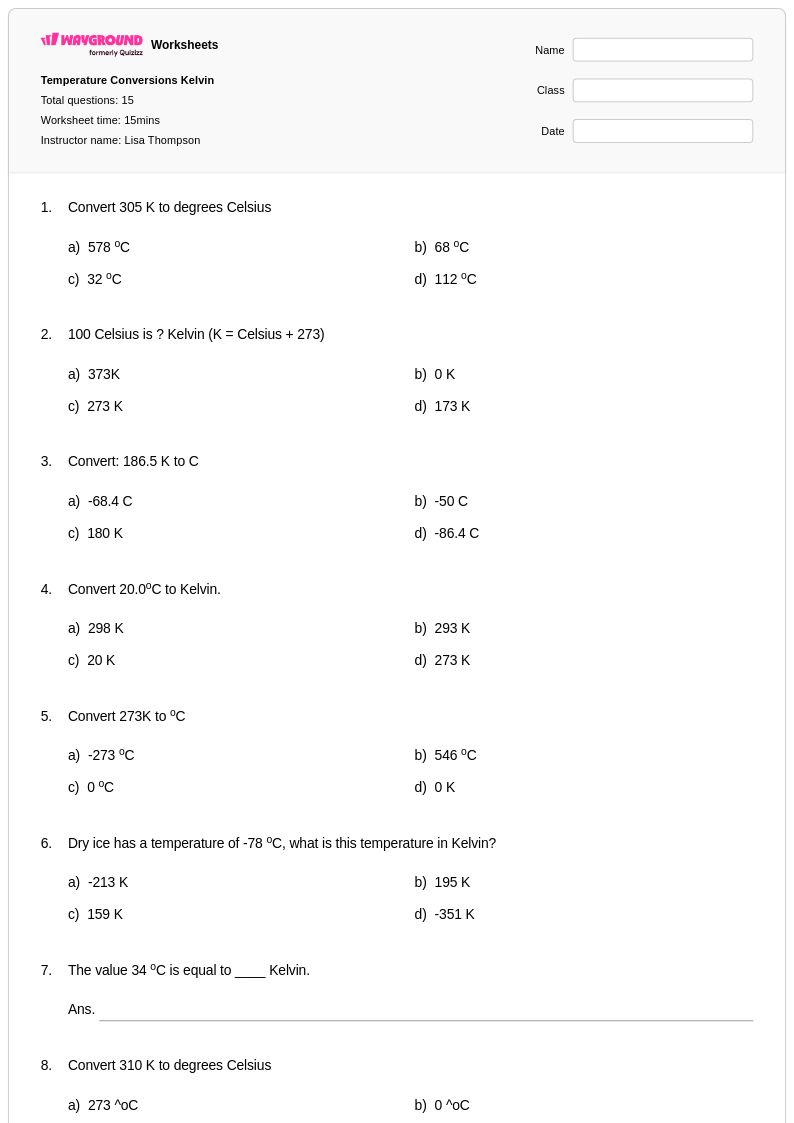
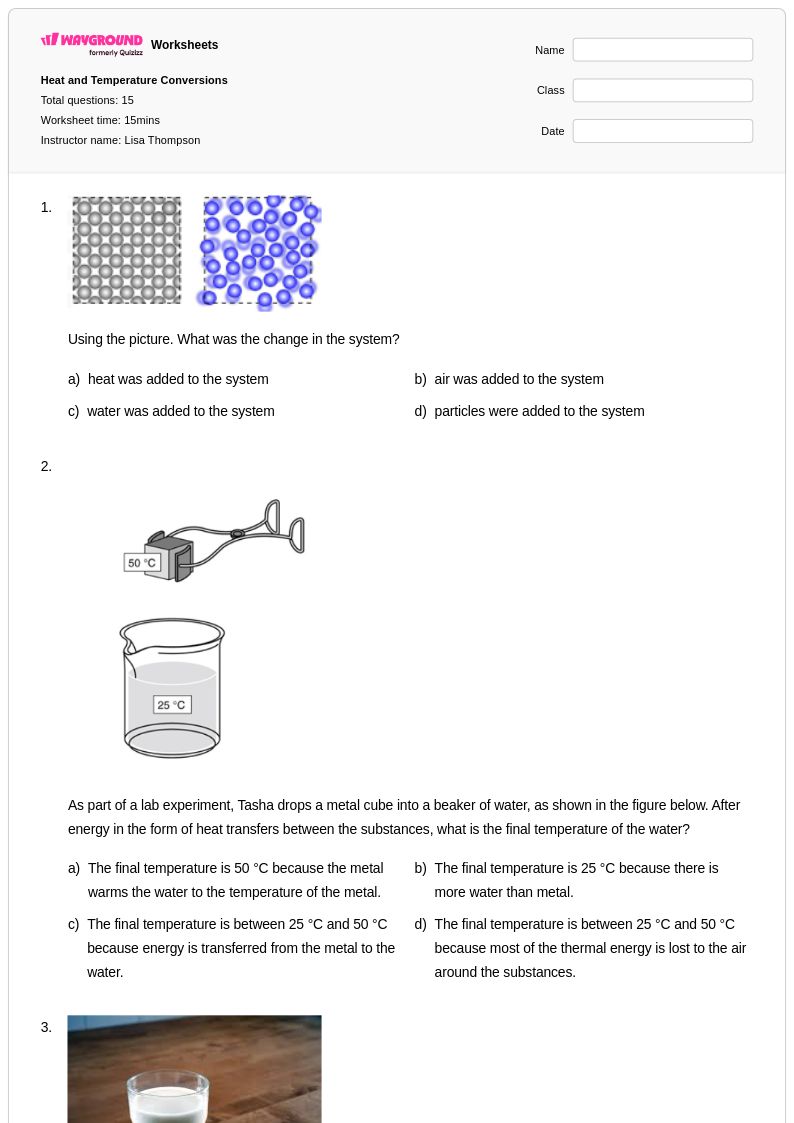
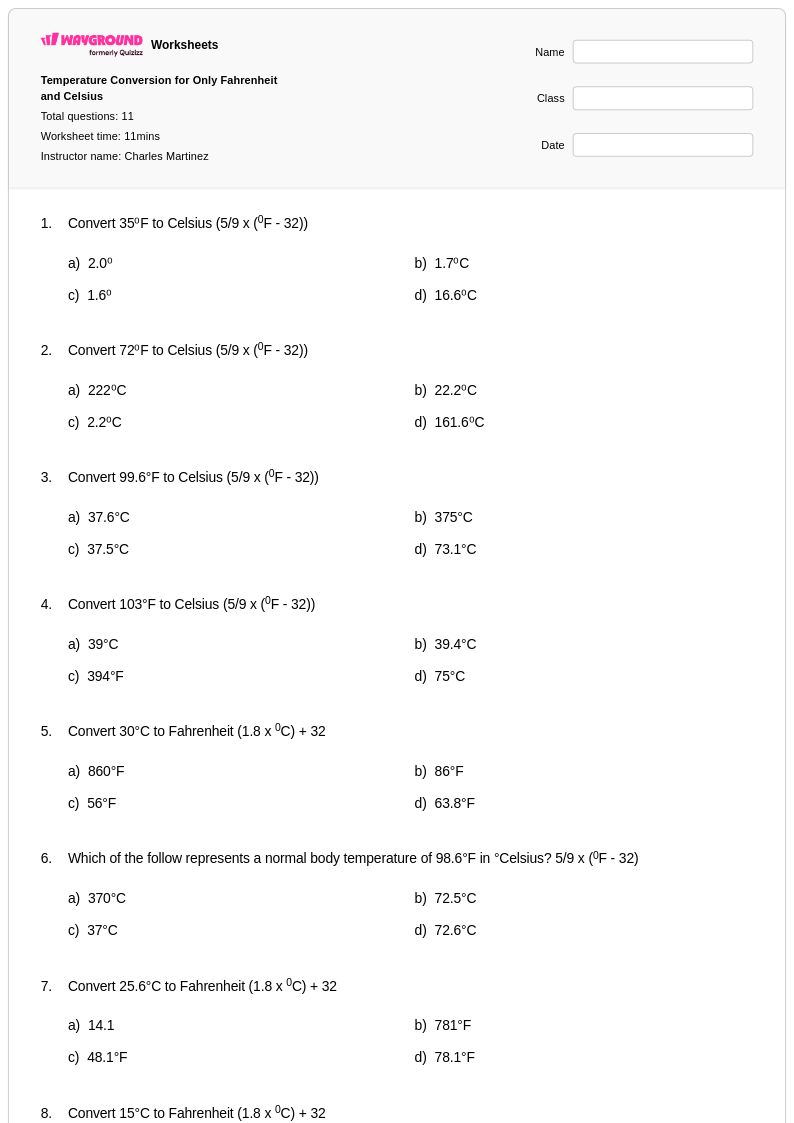
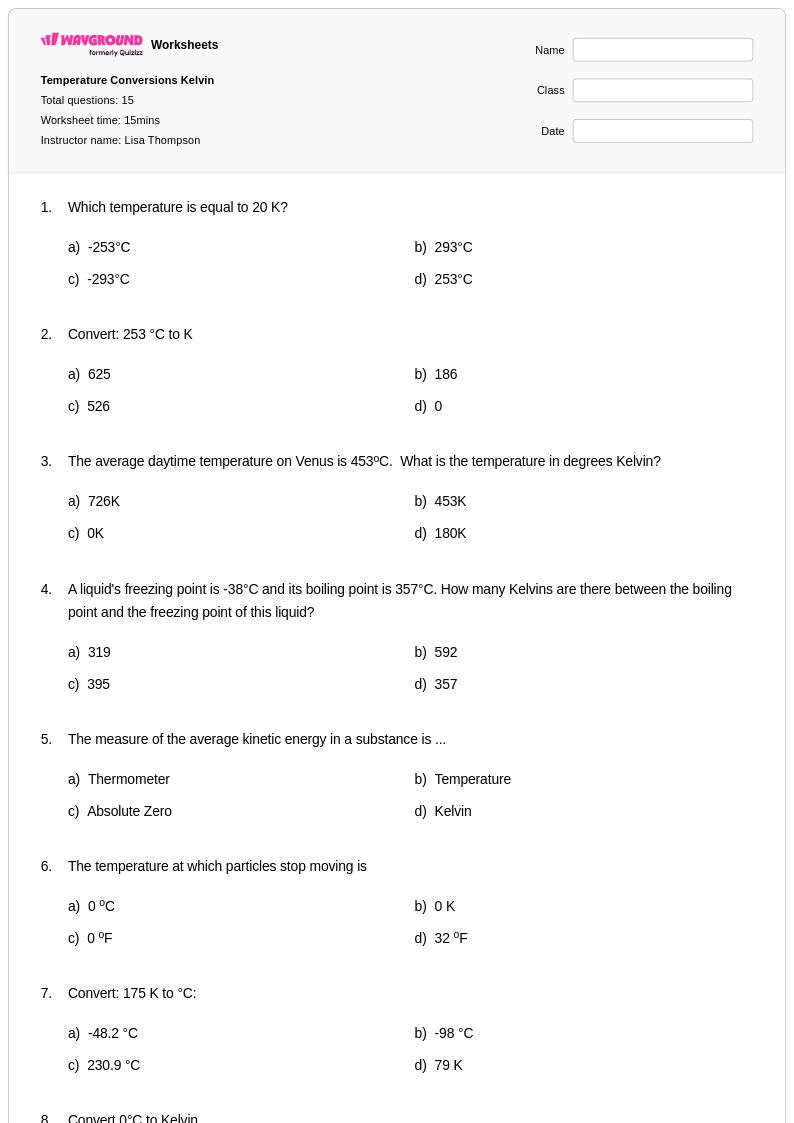
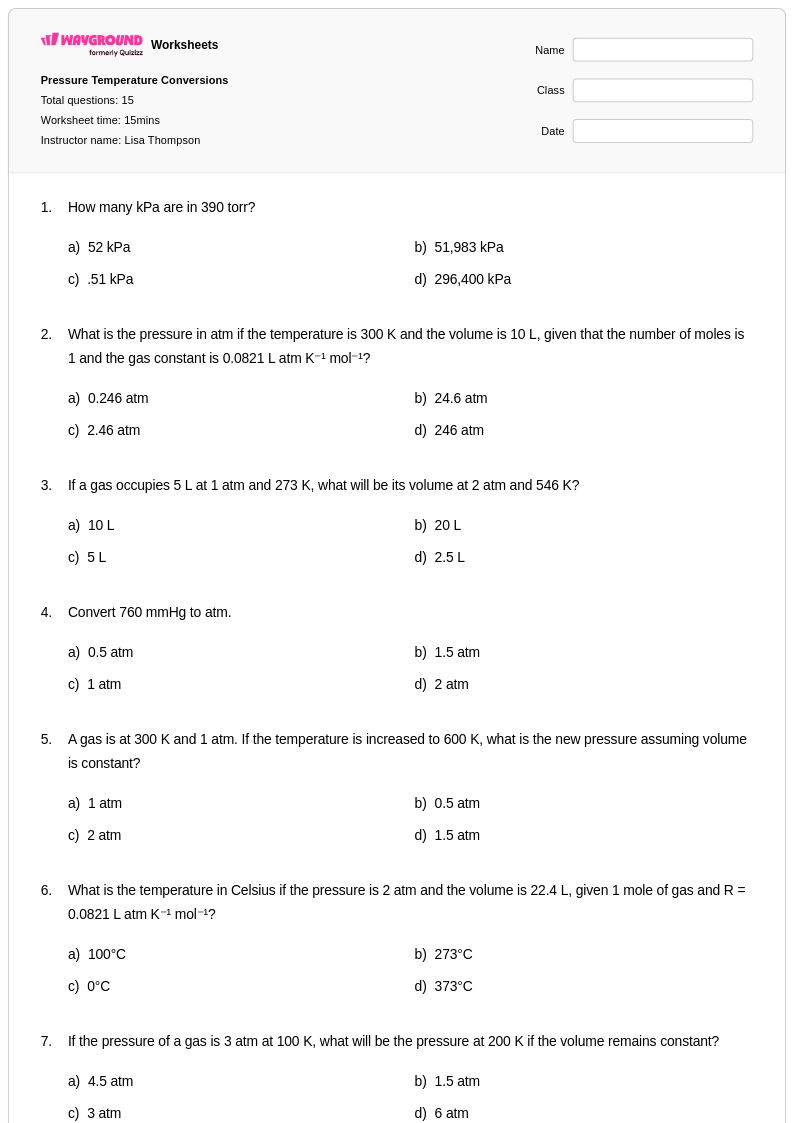
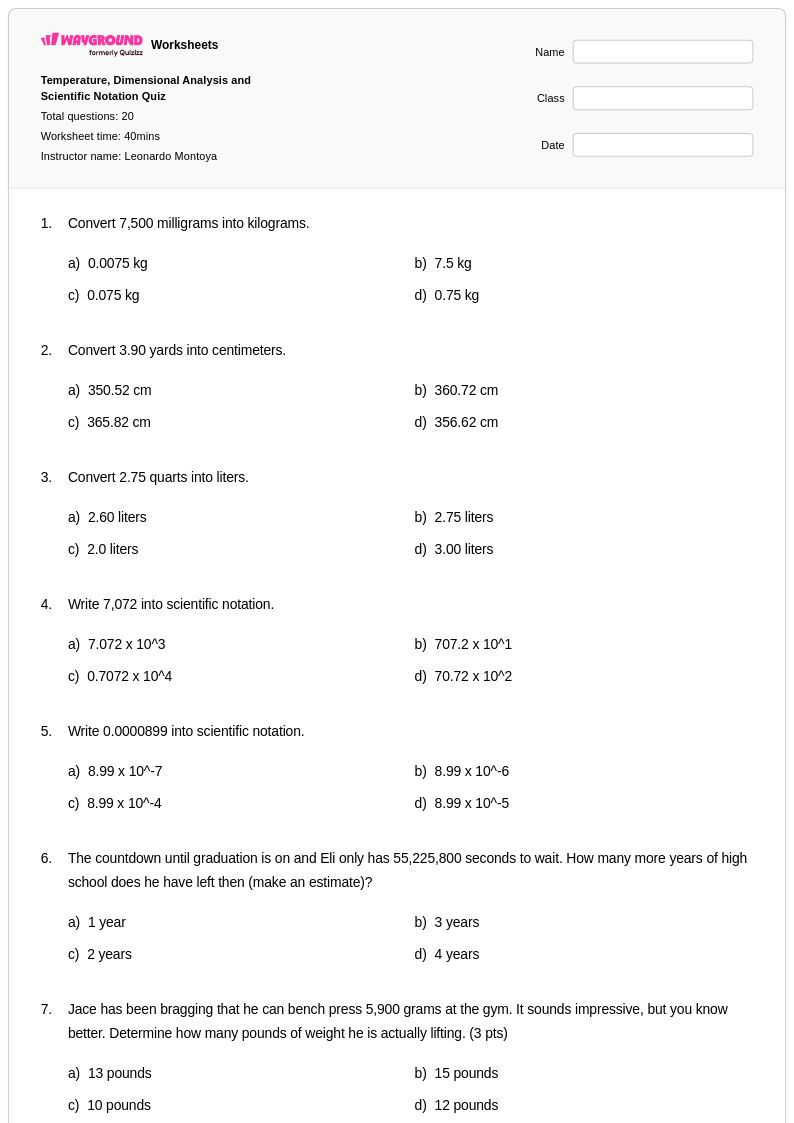
Free temperature conversion worksheets and printables help students master converting between Celsius, Fahrenheit, and Kelvin with step-by-step practice problems, guided exercises, and comprehensive answer keys for effective science learning.
Explore printable Temperature Conversion worksheets
Temperature conversion worksheets available through Wayground (formerly Quizizz) provide comprehensive practice opportunities for students to master the essential skill of converting between Celsius, Fahrenheit, and Kelvin temperature scales. These carefully designed resources strengthen students' understanding of mathematical relationships between temperature units while reinforcing critical problem-solving techniques used throughout scientific study. The worksheets feature diverse practice problems ranging from basic conversions using standard formulas to complex multi-step calculations involving real-world scenarios, with each printable resource including a detailed answer key to support independent learning and self-assessment. These free educational materials serve multiple instructional purposes, from initial concept introduction to advanced application practice, ensuring students develop both computational accuracy and conceptual understanding of temperature measurement systems used across scientific disciplines.
Wayground (formerly Quizizz) empowers educators with access to millions of teacher-created temperature conversion resources that can be seamlessly integrated into any science curriculum through powerful search and filtering capabilities. The platform's extensive worksheet collection supports differentiated instruction by offering materials at varying complexity levels, allowing teachers to customize content for remediation, standard practice, or enrichment activities based on individual student needs. These versatile resources are available in both printable pdf formats for traditional classroom use and digital formats for technology-enhanced learning environments, with built-in standards alignment features that help educators match activities to specific curriculum requirements. Teachers can efficiently plan engaging temperature conversion lessons while providing targeted skill practice that addresses diverse learning objectives, from basic formula application to advanced scientific calculation techniques.
FAQs
How do I teach temperature conversion between Celsius, Fahrenheit, and Kelvin?
Start by introducing each scale's reference points — the freezing and boiling points of water — so students build conceptual anchors before touching formulas. Then introduce the conversion formulas one at a time: Celsius to Fahrenheit (°F = °C × 9/5 + 32), Fahrenheit to Celsius (°C = (°F − 32) × 5/9), and Kelvin (K = °C + 273.15). Once students are comfortable with individual conversions, introduce multi-step problems that require chaining conversions, such as converting Fahrenheit to Kelvin, to deepen procedural fluency.
What exercises help students practice temperature conversion?
Effective practice includes a mix of straightforward formula-application problems, real-world scenario problems (such as converting body temperature or weather data), and multi-step calculations that require converting across all three scales. Timed drills build automaticity with the formulas, while word problems reinforce why accurate conversion matters in scientific contexts. Worksheets that present problems in both directions — Celsius to Fahrenheit and Fahrenheit to Celsius — prevent students from memorizing only one formula pathway.
What mistakes do students commonly make when converting temperatures?
The most common error is misapplying order of operations — for example, adding 32 before multiplying by 9/5 when converting Celsius to Fahrenheit instead of multiplying first. Students also frequently confuse which formula to use in which direction, particularly when converting to Kelvin, where they may subtract instead of add 273.15. A third common mistake is forgetting that Kelvin has no negative values, which can cause students to distrust correct answers when working with very cold temperatures.
How do I use Wayground's temperature conversion worksheets in my classroom?
Wayground's temperature conversion worksheets are available as printable PDFs for traditional classroom use and in digital formats for technology-integrated learning environments, making them flexible for in-person, hybrid, or remote instruction. Teachers can also host them as a quiz directly on Wayground, enabling real-time tracking of student responses. Each worksheet includes a complete answer key, so they work equally well for guided practice, independent work, or self-paced review. For students who need additional support, Wayground's accommodation tools — including read aloud and reduced answer choices — can be applied individually without disrupting the rest of the class.
How can I differentiate temperature conversion practice for students at different skill levels?
Assign basic single-step conversion problems to students who are still building formula fluency, and reserve multi-step or real-world scenario problems for students ready for a challenge. On Wayground, teachers can further support struggling learners by enabling accommodations such as extended time, read aloud for word problems, or reduced answer choices — each applied per student without alerting peers. Grouping students by complexity level and rotating through scaffolded problem sets ensures both remediation and enrichment are addressed within the same lesson.
At what grade level is temperature conversion typically taught?
Temperature conversion is most commonly introduced in middle school science courses, typically grades 6 through 8, when students begin working with the metric system and laboratory measurement. It is reinforced in high school chemistry and physics, where Kelvin becomes essential for gas law calculations and thermodynamics. Because the skill requires applying algebraic formulas, it is best introduced after students have a working understanding of order of operations and basic equation manipulation.