Free Printable Carbon Cycle Worksheets for Grade 9
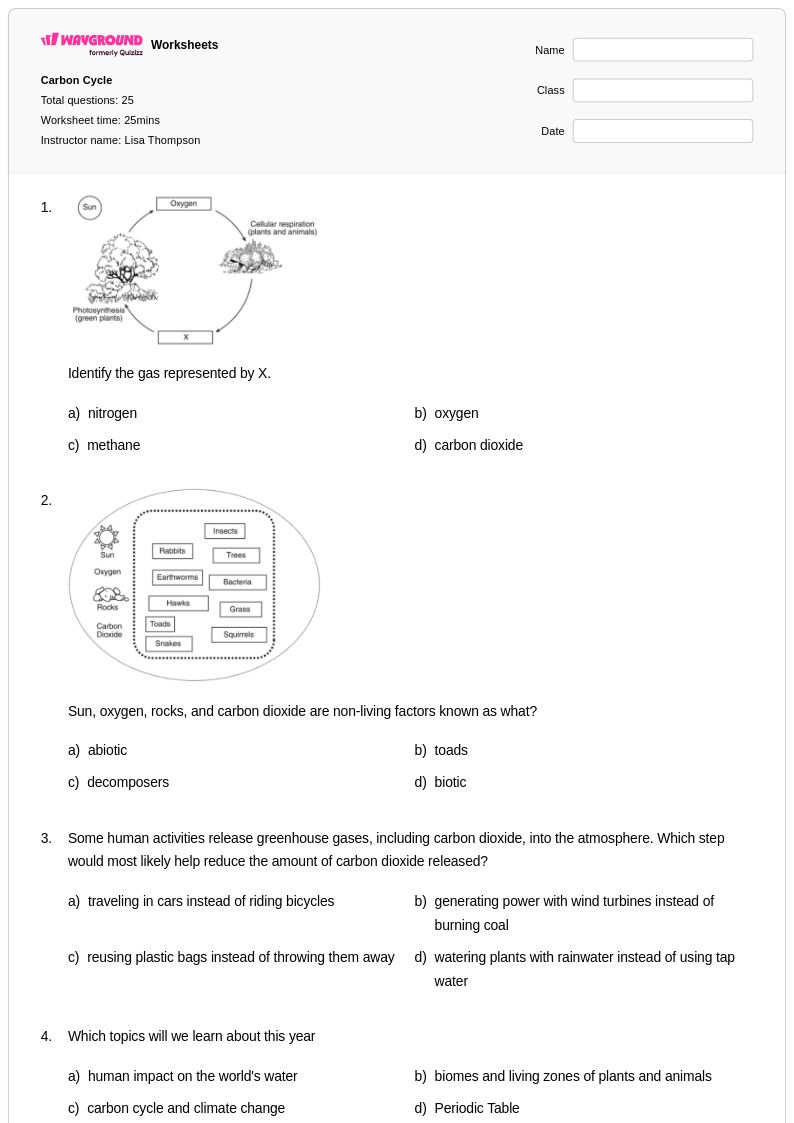
Explore Wayground's free Grade 9 Carbon Cycle worksheets and printables that help students master the movement of carbon through Earth's systems with engaging practice problems and comprehensive answer keys.
Explore printable Carbon Cycle worksheets for Grade 9
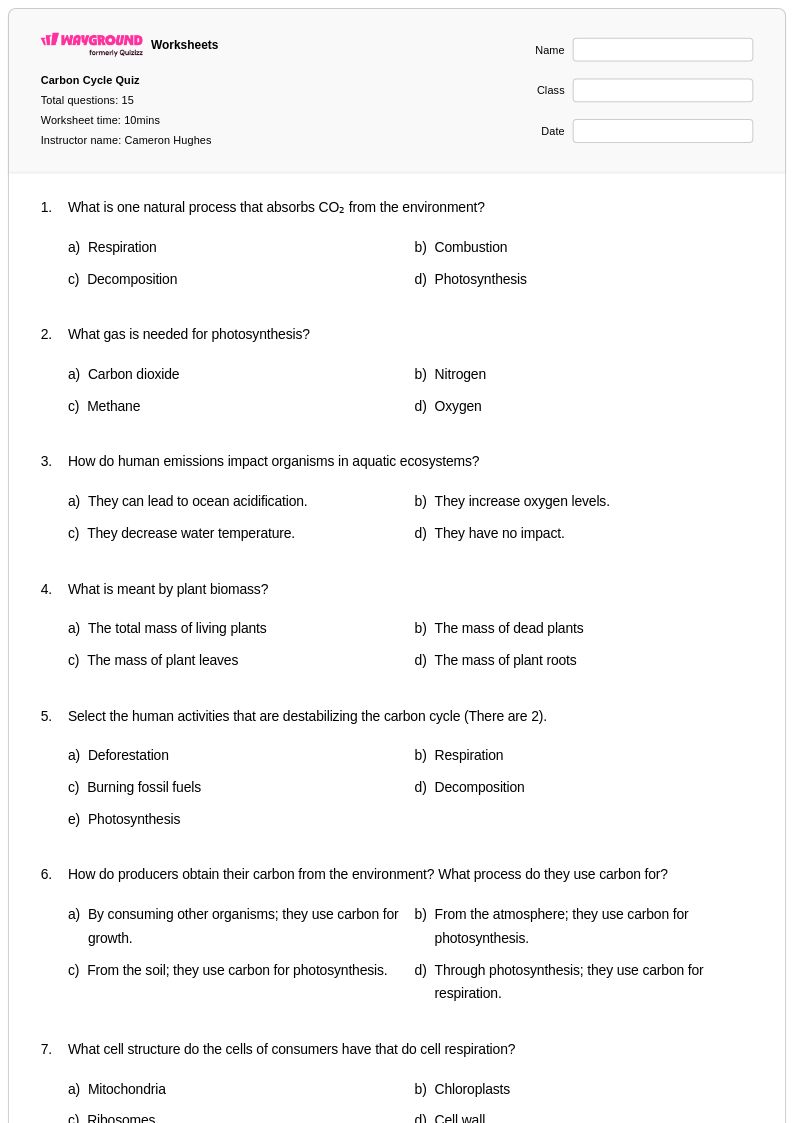
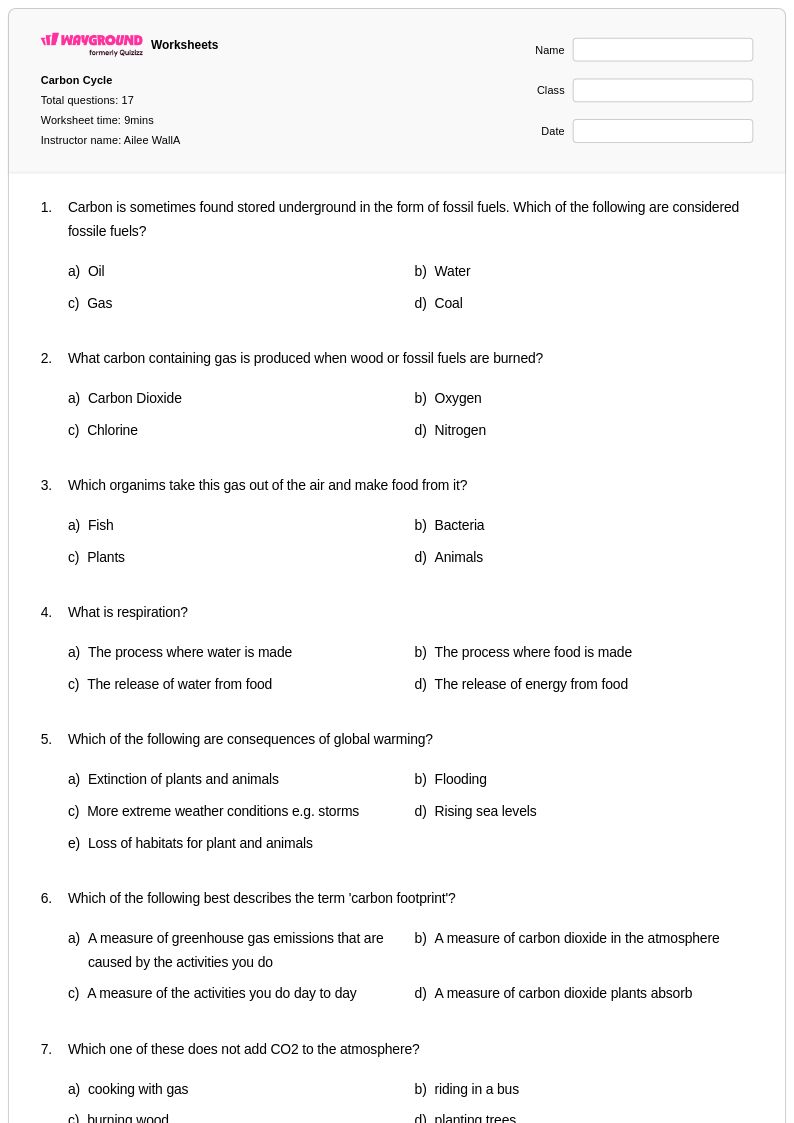
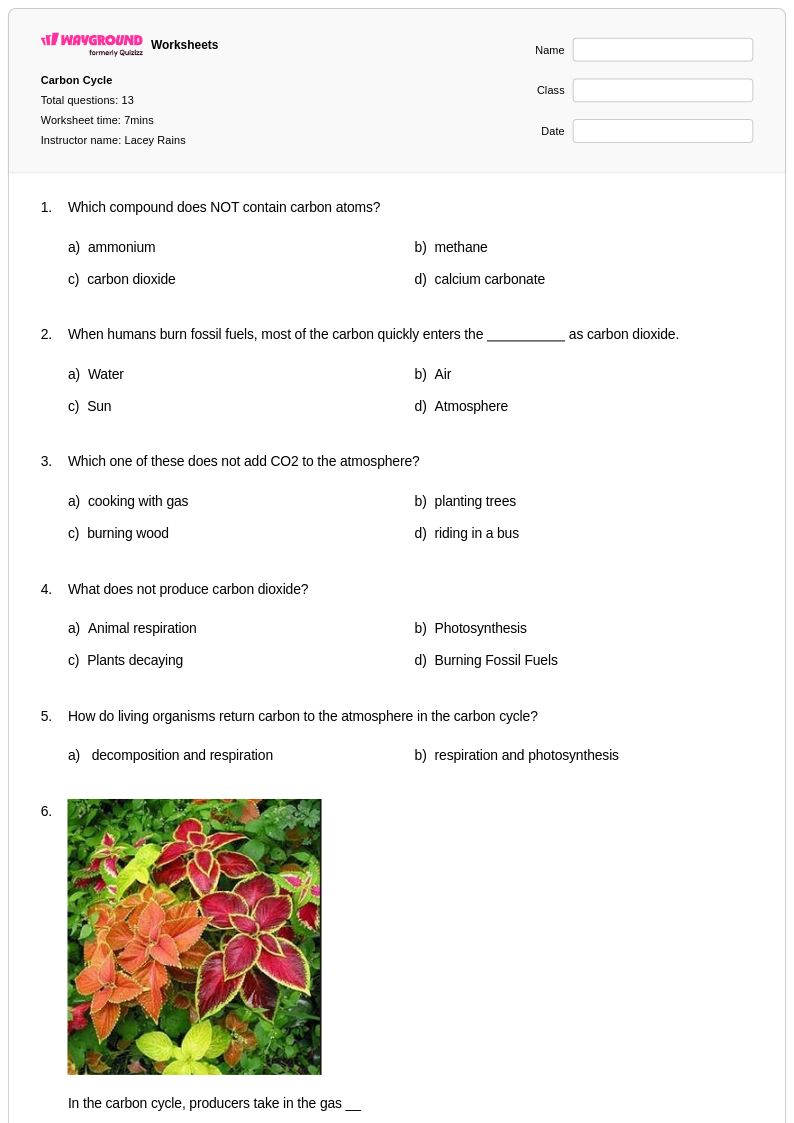
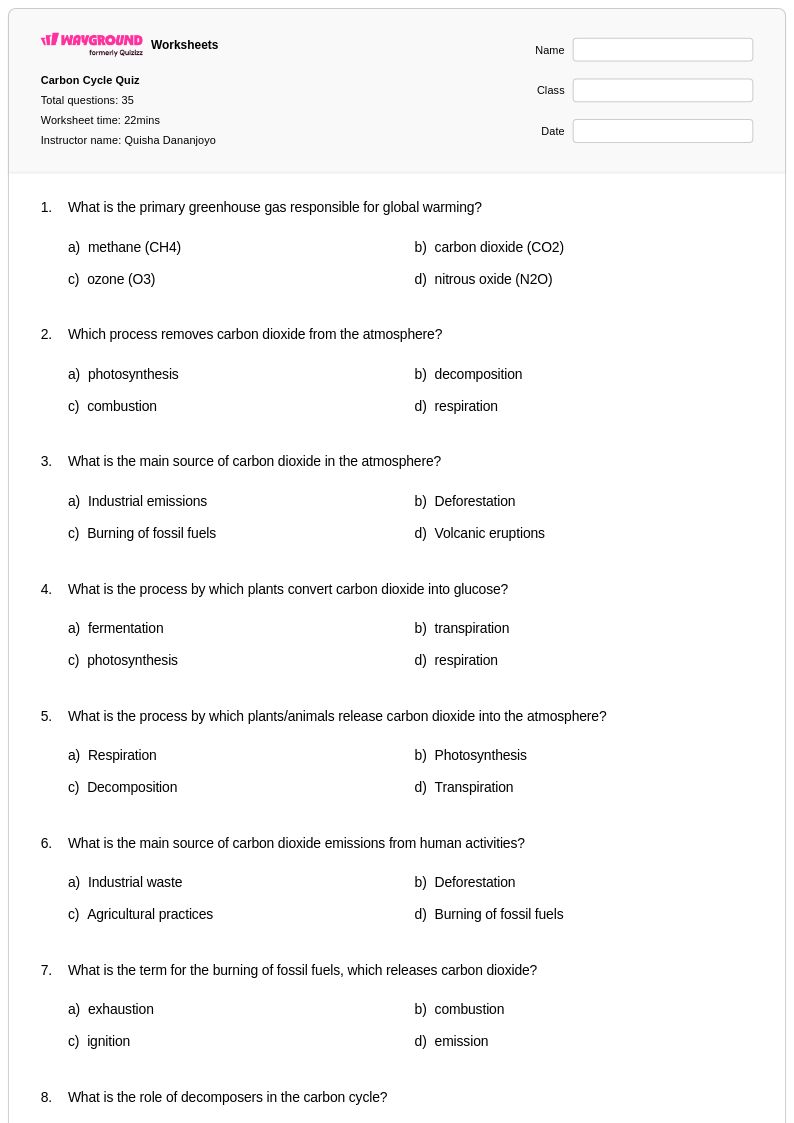
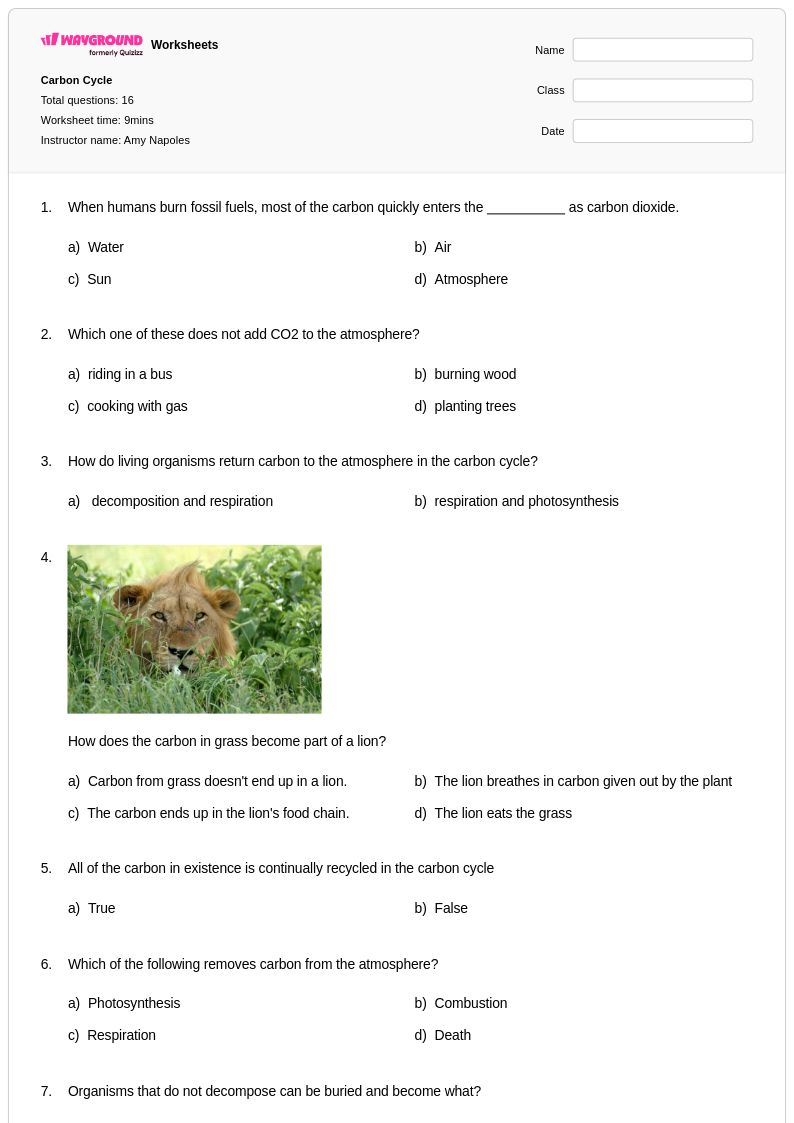
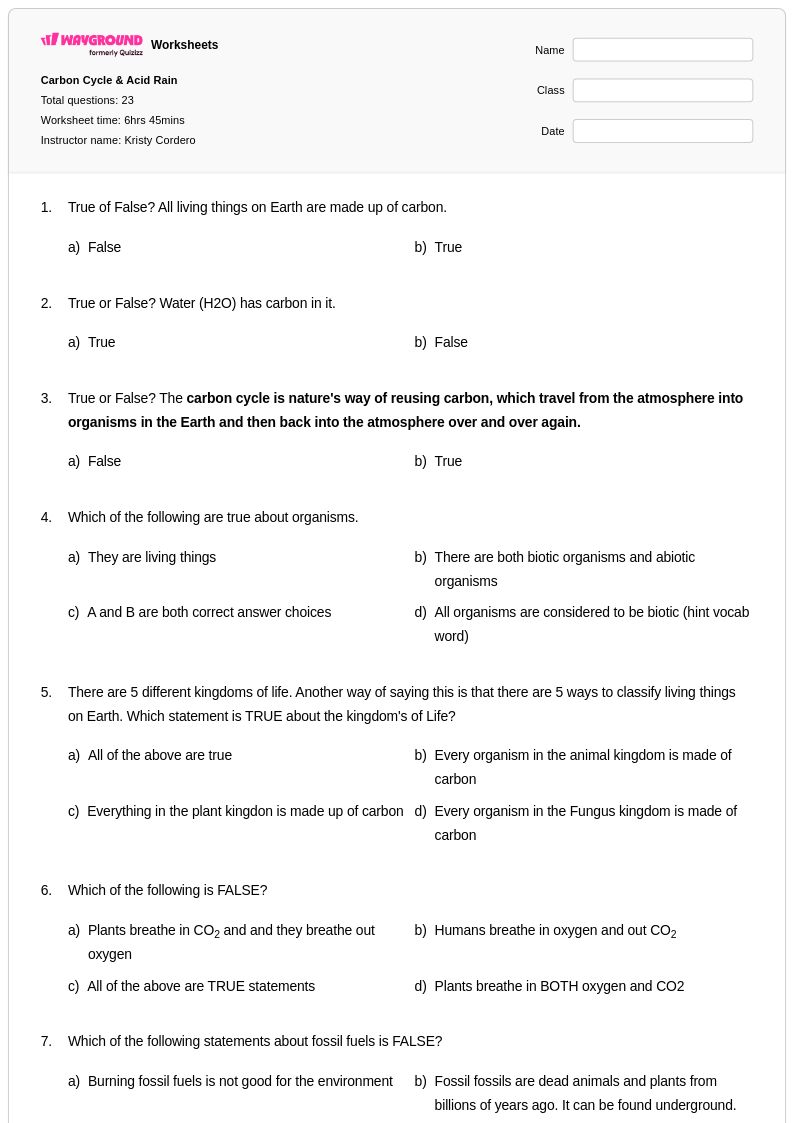
Carbon cycle worksheets for Grade 9 students available through Wayground (formerly Quizizz) provide comprehensive coverage of this fundamental Earth and Space Science concept that demonstrates how carbon moves through Earth's interconnected systems. These educational resources strengthen students' understanding of carbon reservoirs, including the atmosphere, biosphere, hydrosphere, and geosphere, while developing critical thinking skills about the processes that transfer carbon between these spheres. The worksheet collection includes detailed practice problems that challenge students to analyze photosynthesis, cellular respiration, decomposition, and geological processes, with each printable resource featuring a complete answer key to support independent learning and self-assessment. These free materials help ninth-grade students master complex scientific relationships through hands-on problem solving, data interpretation, and diagram analysis that reinforce their comprehension of how human activities influence global carbon cycling.
Wayground (formerly Quizizz) empowers educators with millions of teacher-created carbon cycle worksheets specifically designed for Grade 9 Earth and Space Science instruction, offering robust search and filtering capabilities that allow teachers to locate materials aligned with specific learning standards and curriculum requirements. The platform's differentiation tools enable instructors to customize worksheet difficulty levels and content focus areas, ensuring that both struggling learners and advanced students receive appropriate challenges in understanding carbon cycle dynamics. Teachers can access these resources in multiple formats, including downloadable PDF versions for traditional classroom use and interactive digital formats that provide immediate feedback on student responses. This comprehensive worksheet library supports effective lesson planning by offering materials suitable for initial concept introduction, skill reinforcement, remediation activities, and enrichment opportunities, allowing educators to seamlessly integrate carbon cycle instruction across various learning contexts and student ability levels.
FAQs
How do I teach the carbon cycle to middle and high school students?
Start by grounding students in the key carbon reservoirs (atmosphere, oceans, land, living organisms) before tracing how carbon moves between them through photosynthesis, cellular respiration, decomposition, and geological processes. Using labeled diagrams alongside process-based questions helps students build a mental map of these pathways. Once students can trace natural carbon flows, connect the concepts to human impacts on the global carbon balance to build relevance and critical thinking.
What kinds of practice problems help students understand the carbon cycle?
Effective carbon cycle practice problems ask students to identify specific carbon reservoirs, trace carbon atoms through multiple processes in sequence, calculate or estimate carbon fluxes, and interpret data diagrams showing carbon movement. Problems that require students to evaluate human impacts, such as fossil fuel combustion or deforestation, on the global carbon balance extend understanding beyond recall into analysis. Mixing diagram interpretation with short-answer and data questions ensures students engage with the concept at multiple cognitive levels.
What misconceptions do students commonly have about the carbon cycle?
A common misconception is that photosynthesis removes carbon from the cycle permanently rather than temporarily storing it in biomass. Students also frequently confuse cellular respiration with breathing, missing the biochemical role respiration plays in returning carbon to the atmosphere. Another persistent error is treating the carbon cycle as a simple loop rather than a network of interconnected reservoirs with varying flux rates and timescales.
How can I use carbon cycle worksheets to assess student understanding?
Carbon cycle worksheets are well-suited for formative assessment when you use diagram-labeling tasks to gauge whether students can accurately place processes like photosynthesis, decomposition, and combustion within the cycle. Follow-up questions that ask students to explain why a disruption in one process affects the entire system reveal depth of understanding beyond memorization. Answer keys included with structured worksheets allow teachers to quickly identify patterns in student errors and target reteaching accordingly.
How do I use Wayground's carbon cycle worksheets in my classroom?
Wayground's carbon cycle worksheets are available as printable PDFs for traditional classroom use and in digital formats for technology-integrated environments, making them flexible for in-person, hybrid, or remote instruction. Teachers can also host worksheets directly as a quiz on Wayground, enabling real-time student response and easy progress monitoring. Each worksheet includes a detailed answer key, supporting both independent student practice and teacher-led review.
How can I differentiate carbon cycle instruction for students with varying ability levels?
For students who struggle, scaffold instruction by providing partially completed diagrams or reducing the number of processes students must trace at one time. For advanced learners, extend worksheets with questions that require calculating carbon fluxes or evaluating the relative impact of human activities on different carbon reservoirs. On Wayground, teachers can apply individual accommodations such as read aloud support, reduced answer choices, or extended time to specific students without affecting the rest of the class.