Free Printable Centripetal Acceleration Worksheets for Grade 12
Grade 12 centripetal acceleration worksheets from Wayground help students master circular motion concepts through comprehensive printables featuring practice problems, detailed explanations, and complete answer keys for effective physics learning.
Explore printable Centripetal Acceleration worksheets for Grade 12
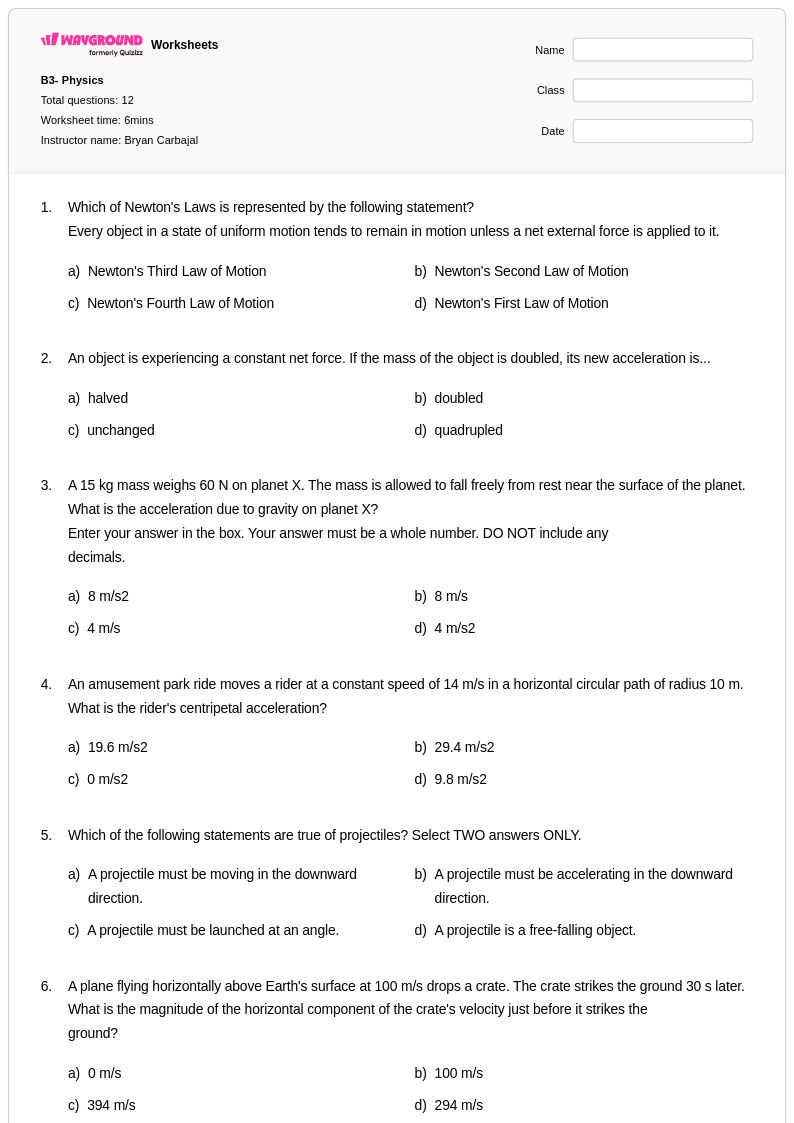
Centripetal acceleration worksheets for Grade 12 physics students available through Wayground (formerly Quizizz) provide comprehensive practice with the fundamental concepts governing circular motion dynamics. These expertly crafted resources strengthen students' ability to calculate centripetal acceleration using the formula a = v²/r, analyze the relationship between velocity, radius, and acceleration in uniform circular motion, and solve complex problems involving banking angles, vertical circles, and satellite orbits. The worksheets feature graduated difficulty levels with detailed answer keys, enabling students to master vector analysis of acceleration directed toward the center of circular paths. Free printables include practice problems covering real-world applications such as car navigation through curves, amusement park rides, and planetary motion, while pdf formats ensure consistent formatting for both classroom instruction and independent study.
Wayground (formerly Quizizz) empowers physics educators with millions of teacher-created centripetal acceleration resources that streamline lesson planning and enhance student comprehension of circular motion principles. The platform's robust search and filtering capabilities allow teachers to locate worksheets aligned with specific physics standards, whether focusing on conceptual understanding or quantitative problem-solving skills. Differentiation tools enable customization of problem complexity and mathematical rigor, supporting both remediation for students struggling with vector concepts and enrichment activities for advanced learners exploring topics like non-uniform circular motion. Available in both printable and digital pdf formats, these versatile worksheet collections facilitate flexible implementation across diverse learning environments while providing teachers with comprehensive assessment tools to monitor student progress in mastering centripetal acceleration calculations and conceptual applications.
FAQs
How do I teach centripetal acceleration to physics students?
Start by grounding students in the idea that circular motion requires a continuously changing velocity direction, which means acceleration is always present even at constant speed. Use concrete examples like a car rounding a curve or a satellite in orbit to make the concept tangible before introducing the formula a = v²/r. Once students can visualize the acceleration vector pointing toward the center of the circular path, they are much better prepared to work through quantitative problems accurately.
What practice problems help students master centripetal acceleration calculations?
Effective practice problems ask students to calculate centripetal acceleration given velocity and radius, then vary which variable is unknown so students must rearrange a = v²/r fluently. Problems set in real-world contexts, such as determining the acceleration of a car navigating a curve or a satellite maintaining orbital speed, help students connect the formula to physical meaning. Mixing straightforward calculations with multi-step problems that require unit conversion or distinguishing centripetal from tangential acceleration builds the full skill set students need.
What mistakes do students commonly make when calculating centripetal acceleration?
The most frequent error is confusing centripetal acceleration with centrifugal force, leading students to misidentify the direction of the acceleration vector as pointing outward rather than toward the center. Students also frequently forget to square the velocity in a = v²/r, or they conflate centripetal and tangential acceleration when an object's speed is also changing. A third common mistake is unit inconsistency, particularly when radius is given in kilometers or velocity in km/h, which produces incorrect numerical results.
How can I use centripetal acceleration worksheets to differentiate instruction?
Tiered problem sets work well here: assign foundational calculation problems using a = v²/r to students still building fluency, while directing advanced learners toward problems that integrate centripetal acceleration with Newton's second law or orbital mechanics. On Wayground, teachers can apply individual accommodations such as extended time, read-aloud support, or reduced answer choices for specific students, allowing the same worksheet session to serve diverse learners without singling anyone out. Accommodation settings are saved per student and carry over to future sessions, reducing setup time for recurring differentiation needs.
How do I use Wayground's centripetal acceleration worksheets in my classroom?
Wayground's centripetal acceleration worksheets are available as printable PDFs for traditional classroom use and in digital formats for technology-integrated environments, so they fit both paper-based and one-to-one device settings. Teachers can also host any worksheet as a live quiz on Wayground, enabling real-time student responses and instant performance data. Each worksheet includes a detailed answer key, supporting both teacher-led review and independent student self-assessment.
How do I help students distinguish between centripetal and tangential acceleration?
Emphasize that centripetal acceleration always points perpendicular to the velocity vector, directed toward the center of the circular path, and is responsible solely for changing direction. Tangential acceleration, by contrast, is parallel to the velocity vector and only appears when an object's speed is increasing or decreasing along the circular path. A practical exercise is to present scenarios, such as a car accelerating around a curve, and have students identify which acceleration component accounts for the change in direction versus the change in speed.