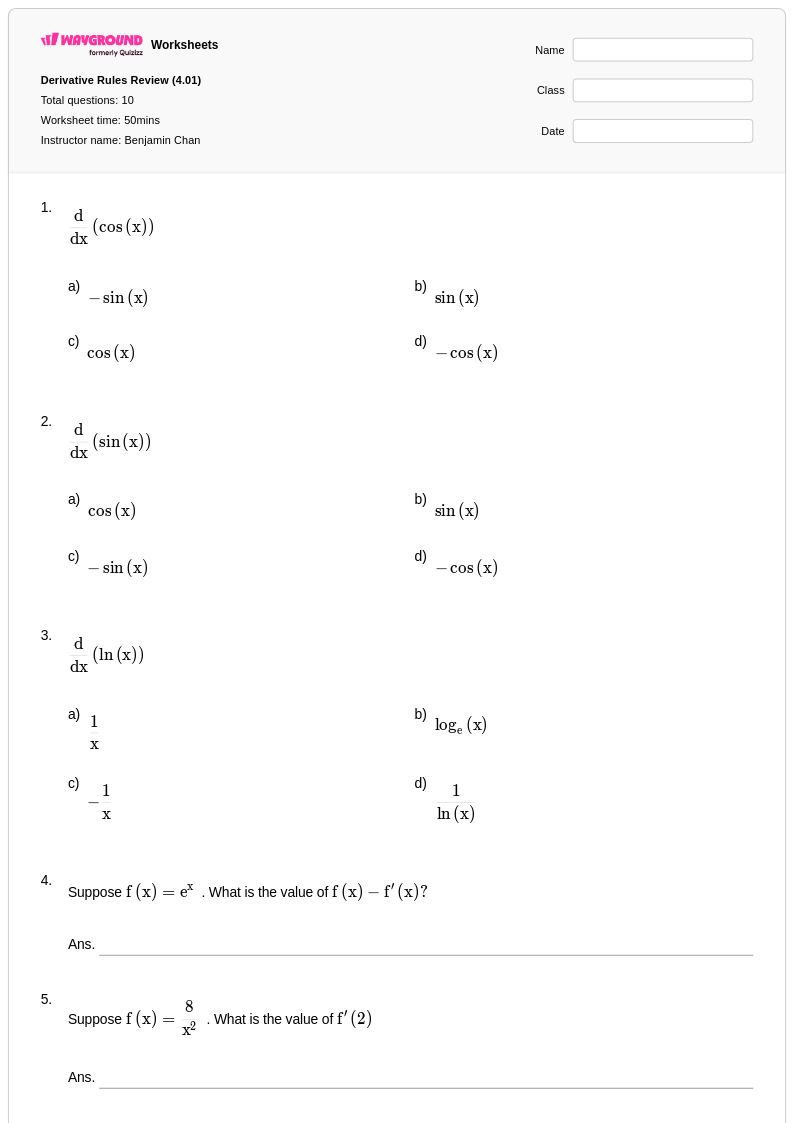
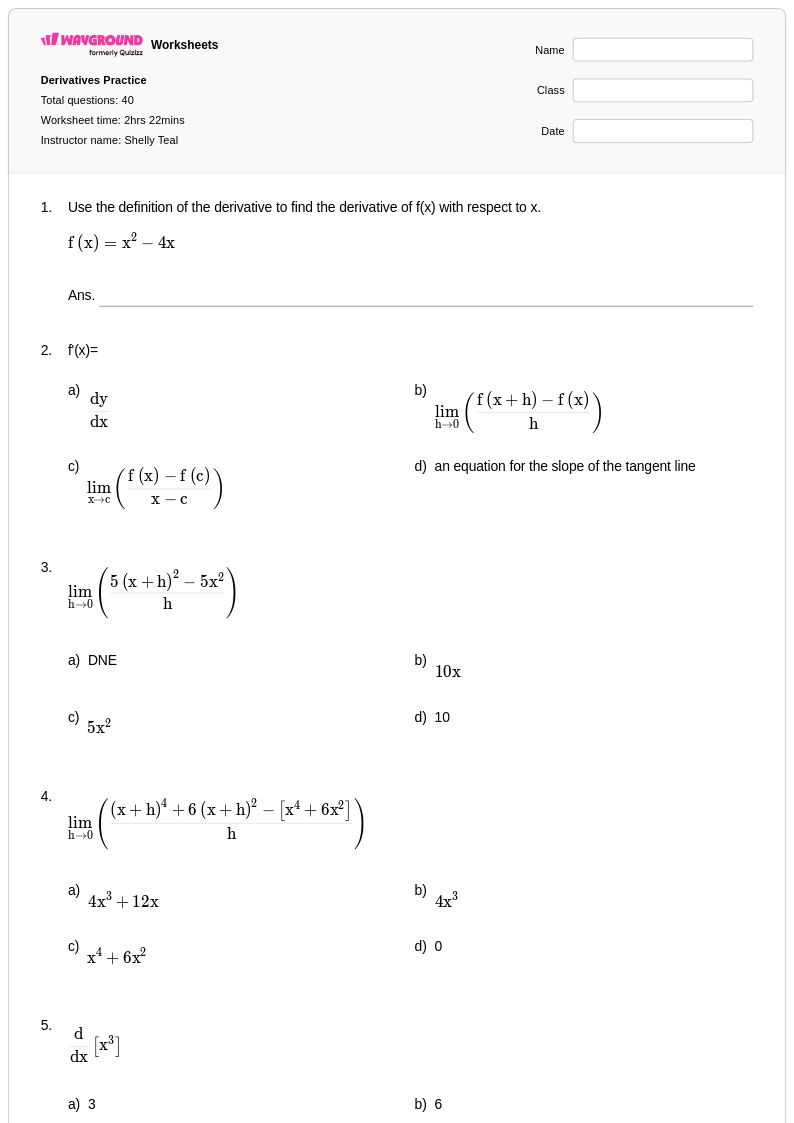
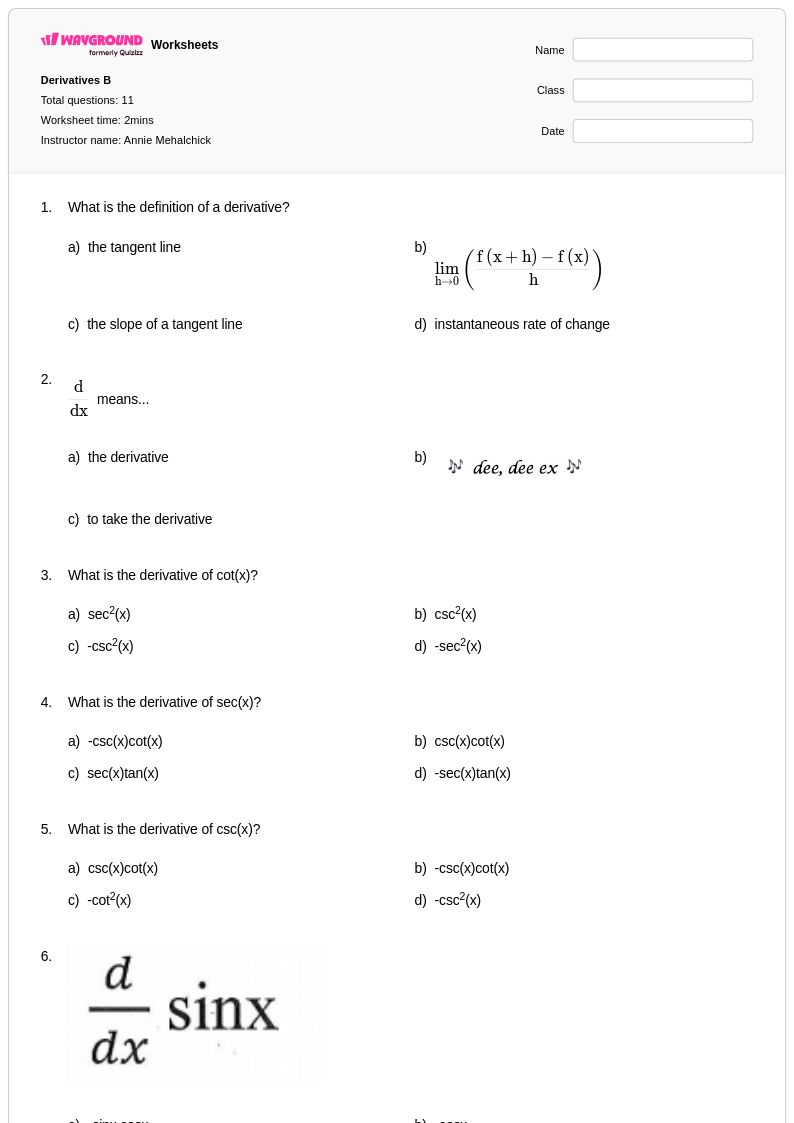
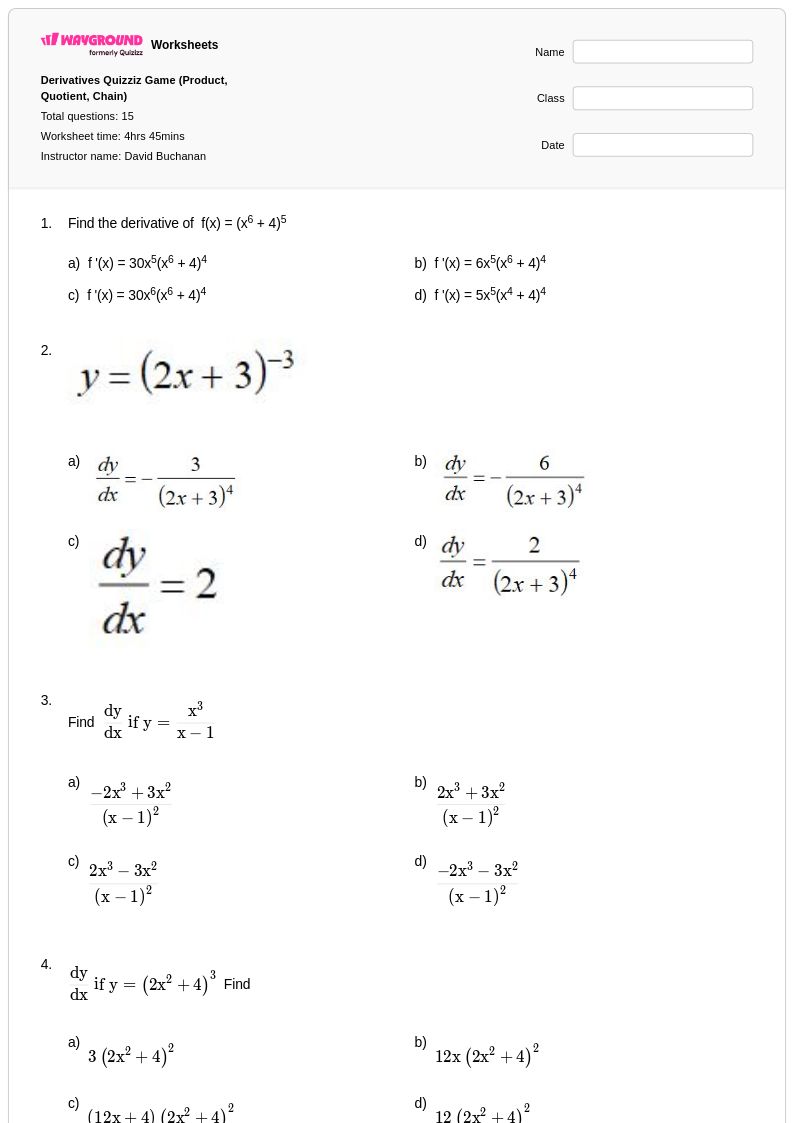
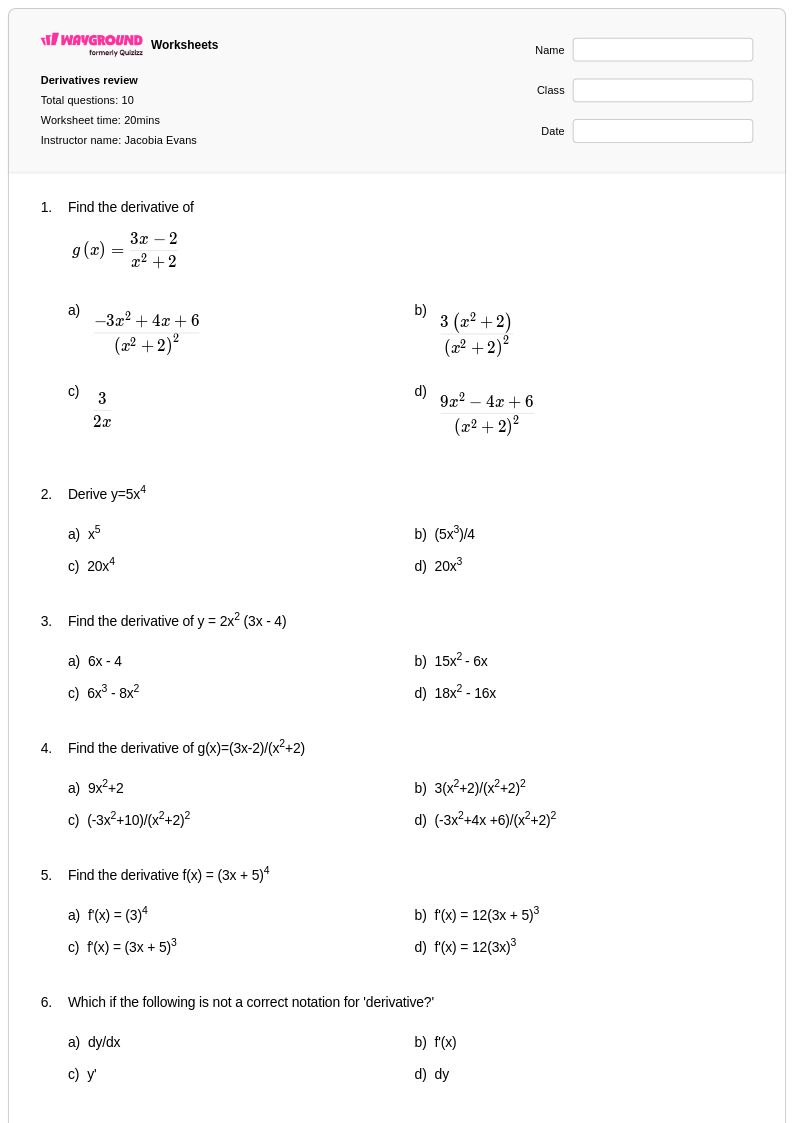
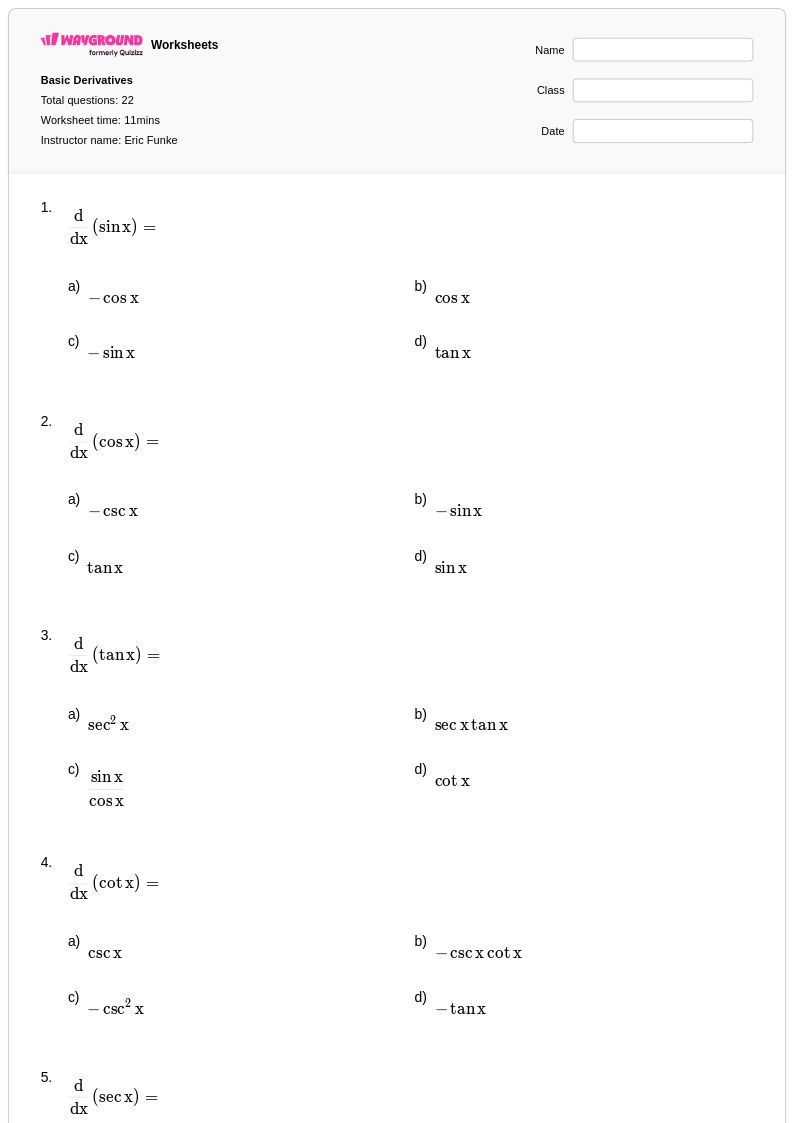
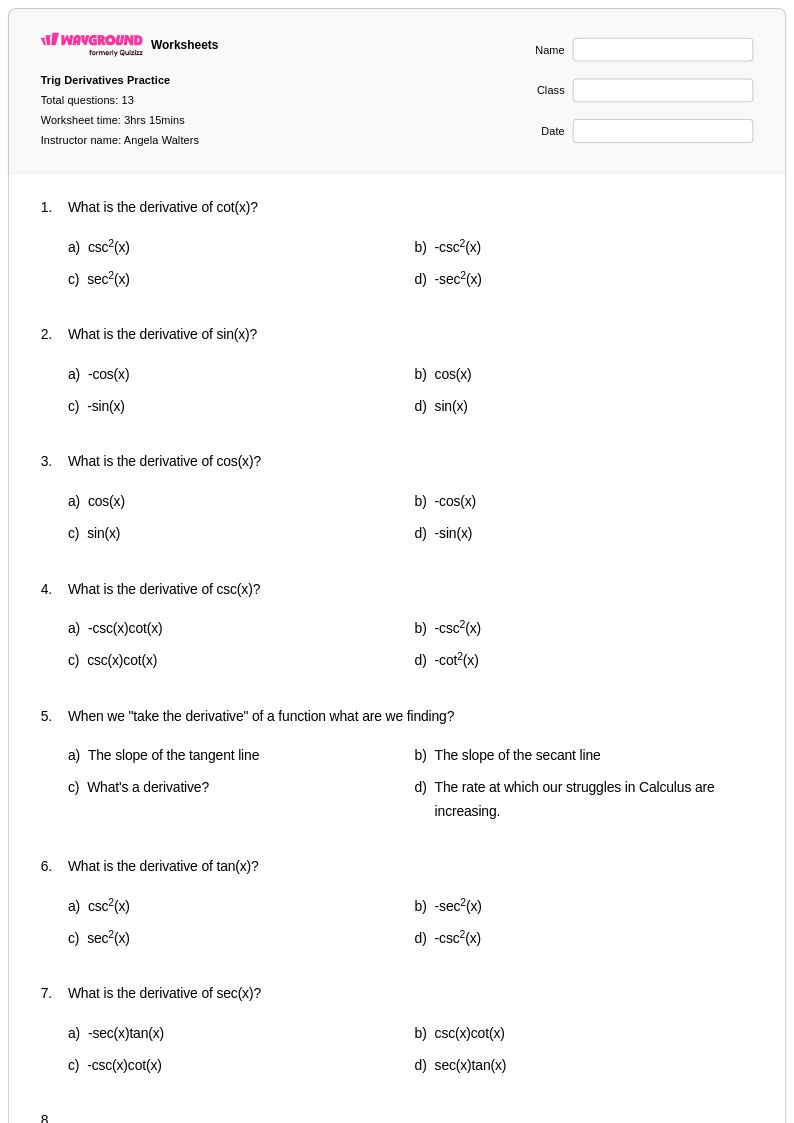
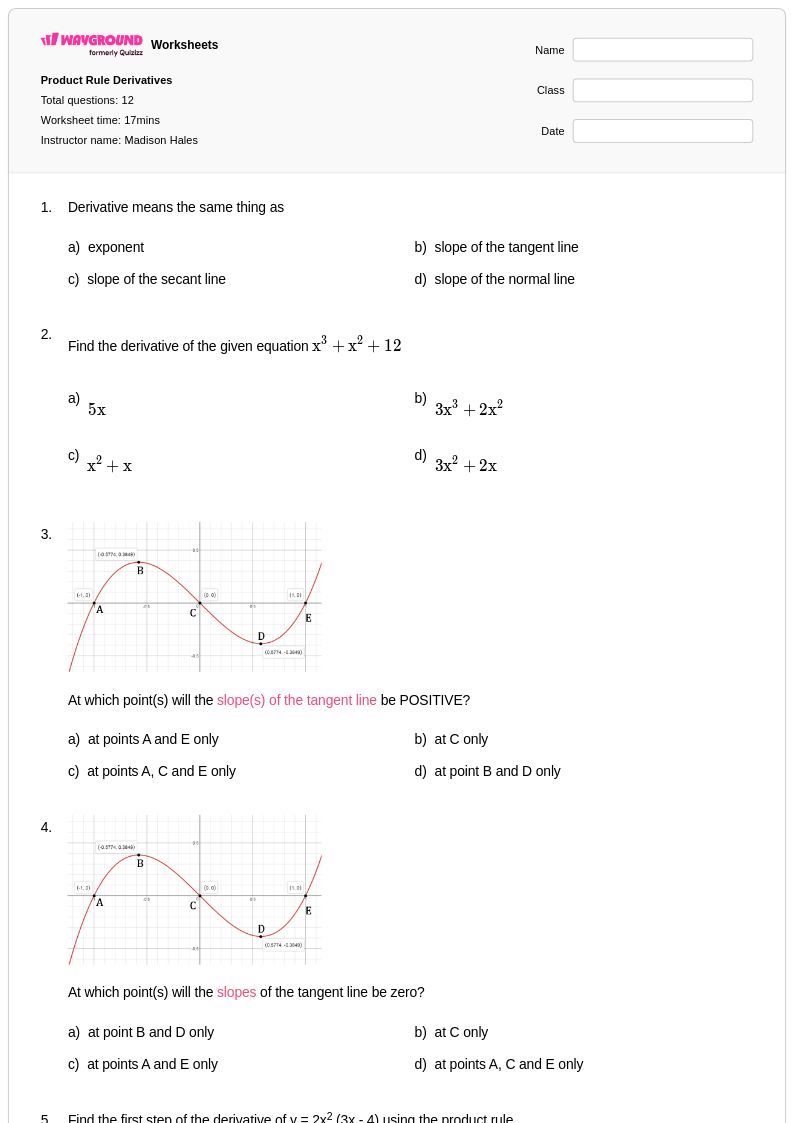
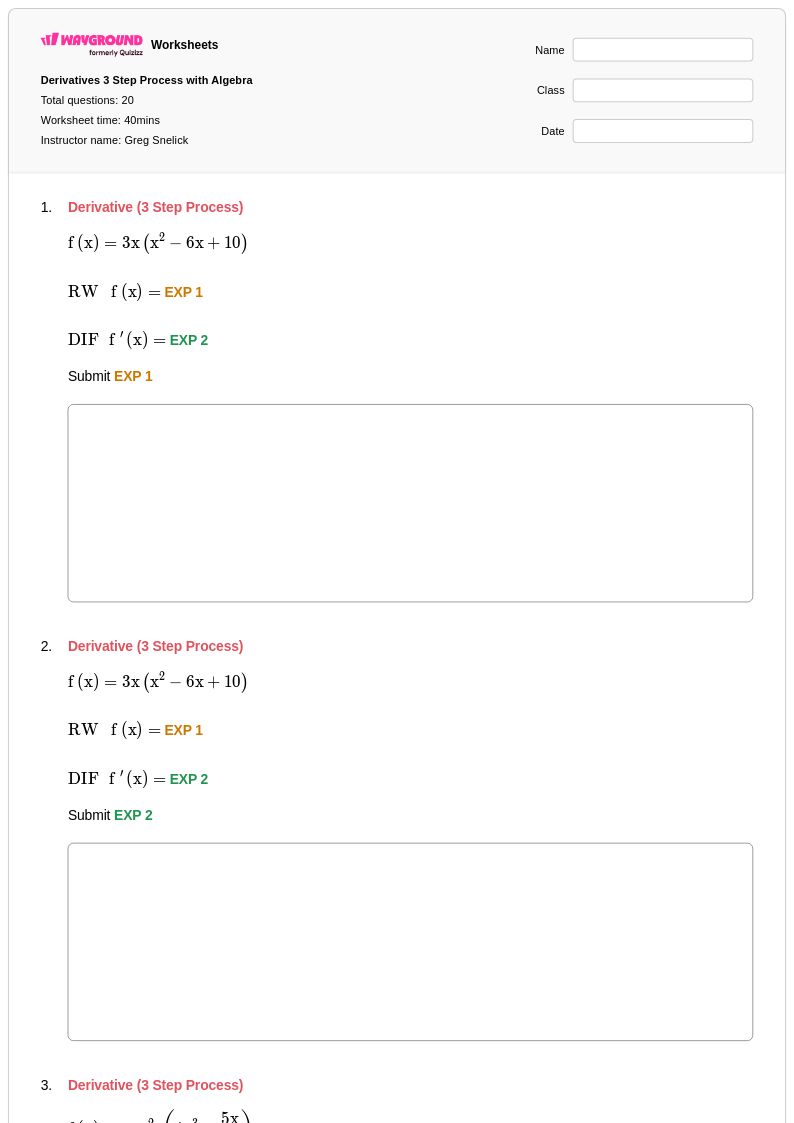
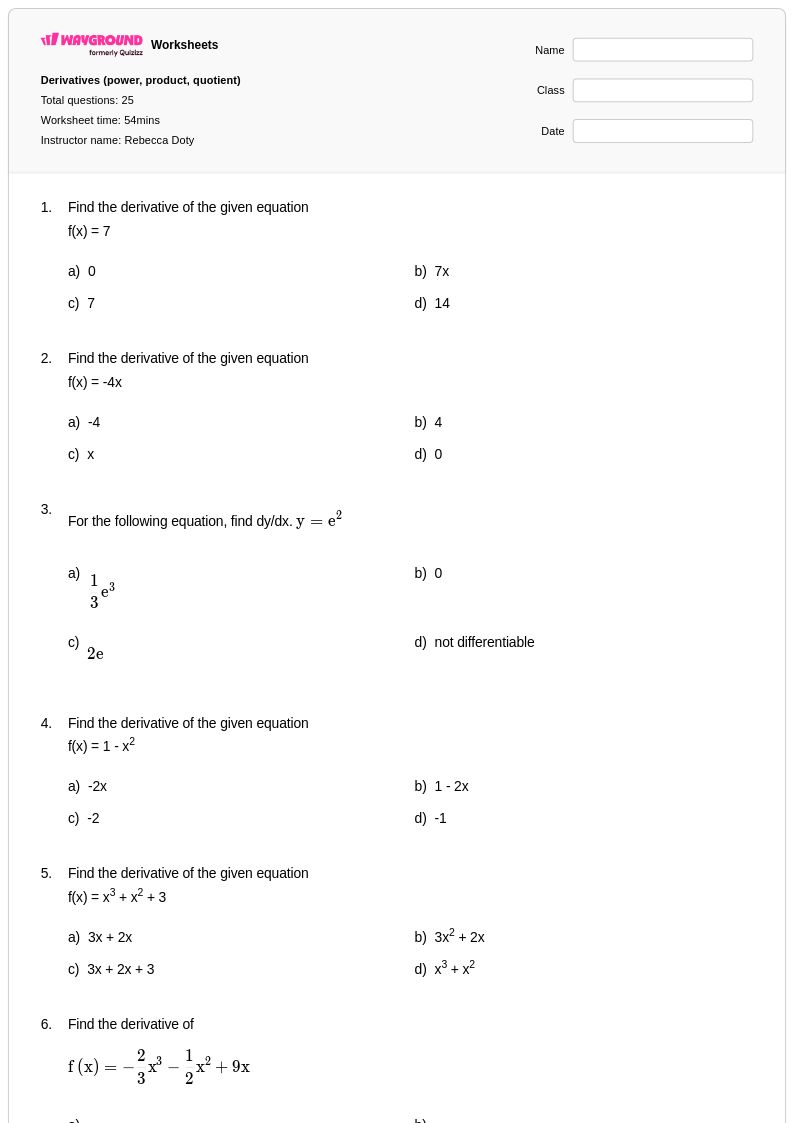
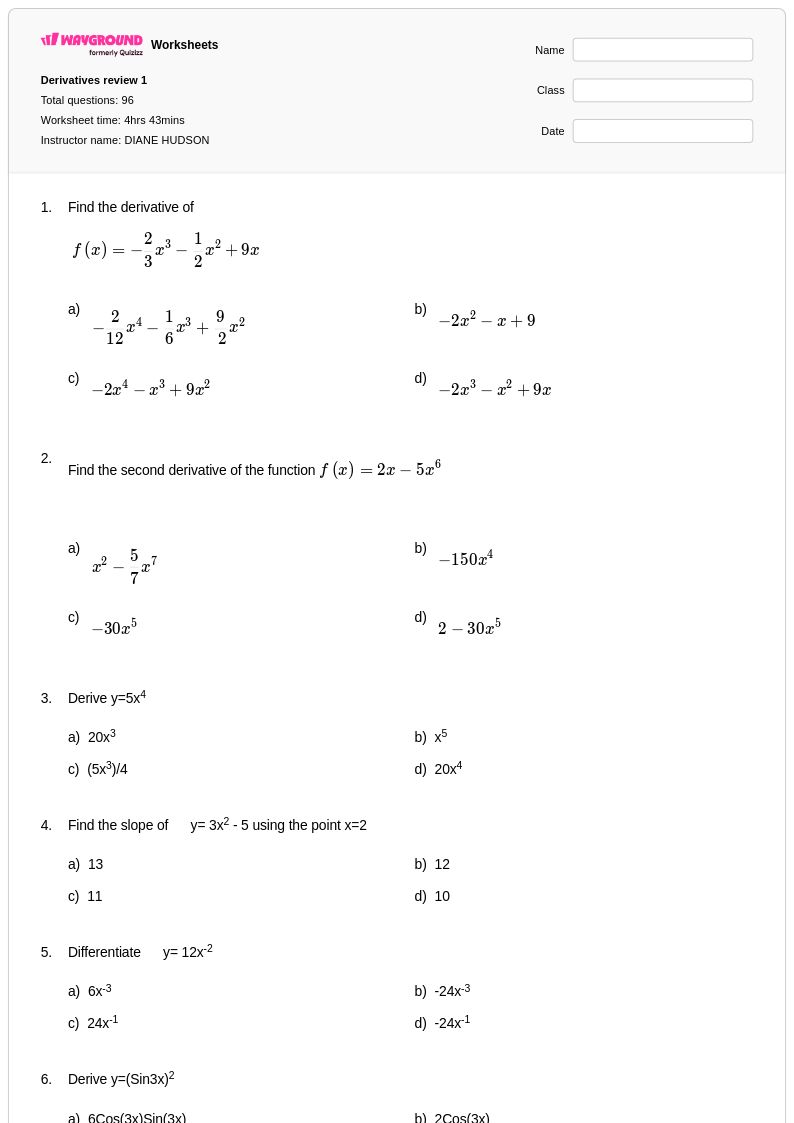
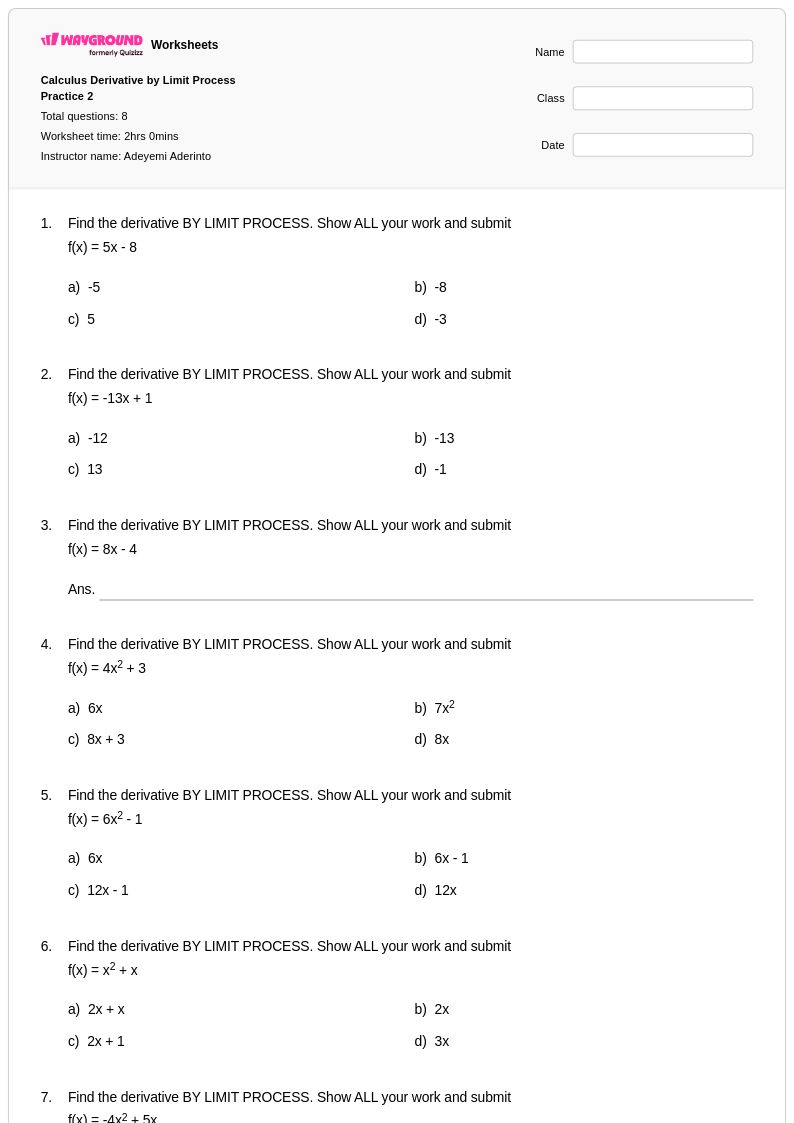
Explore printable Derivatives worksheets for Grade 9
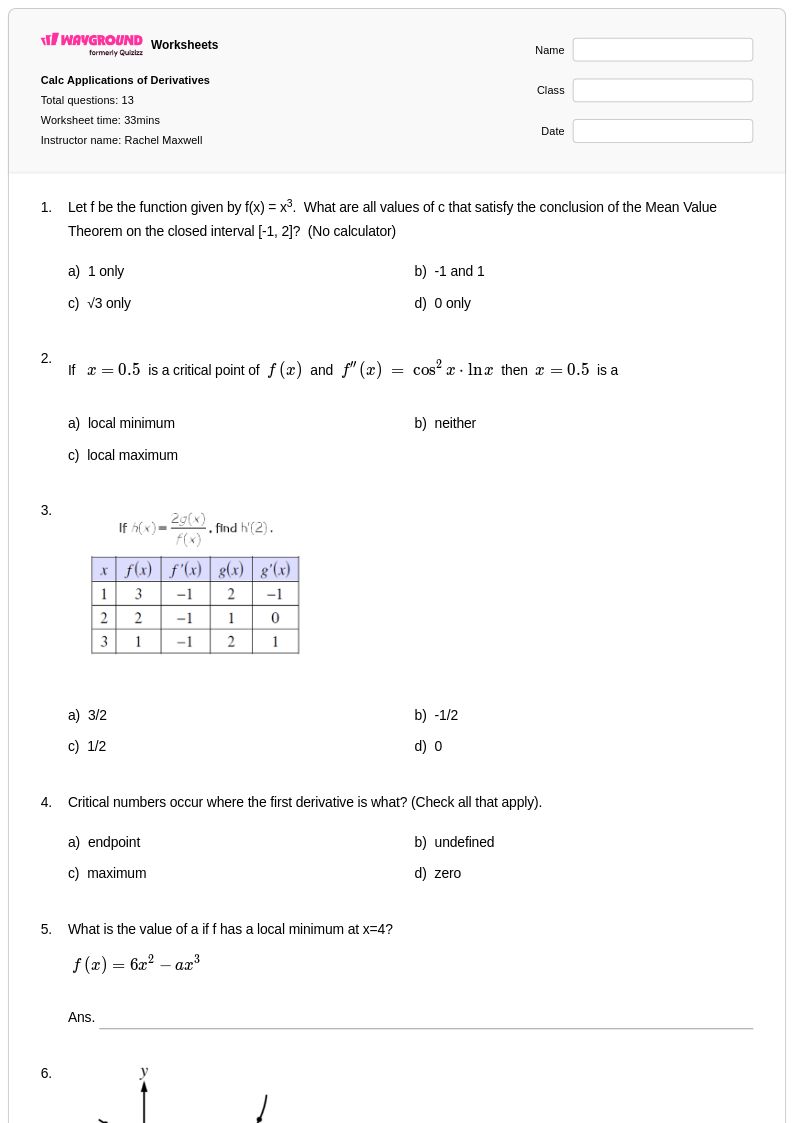
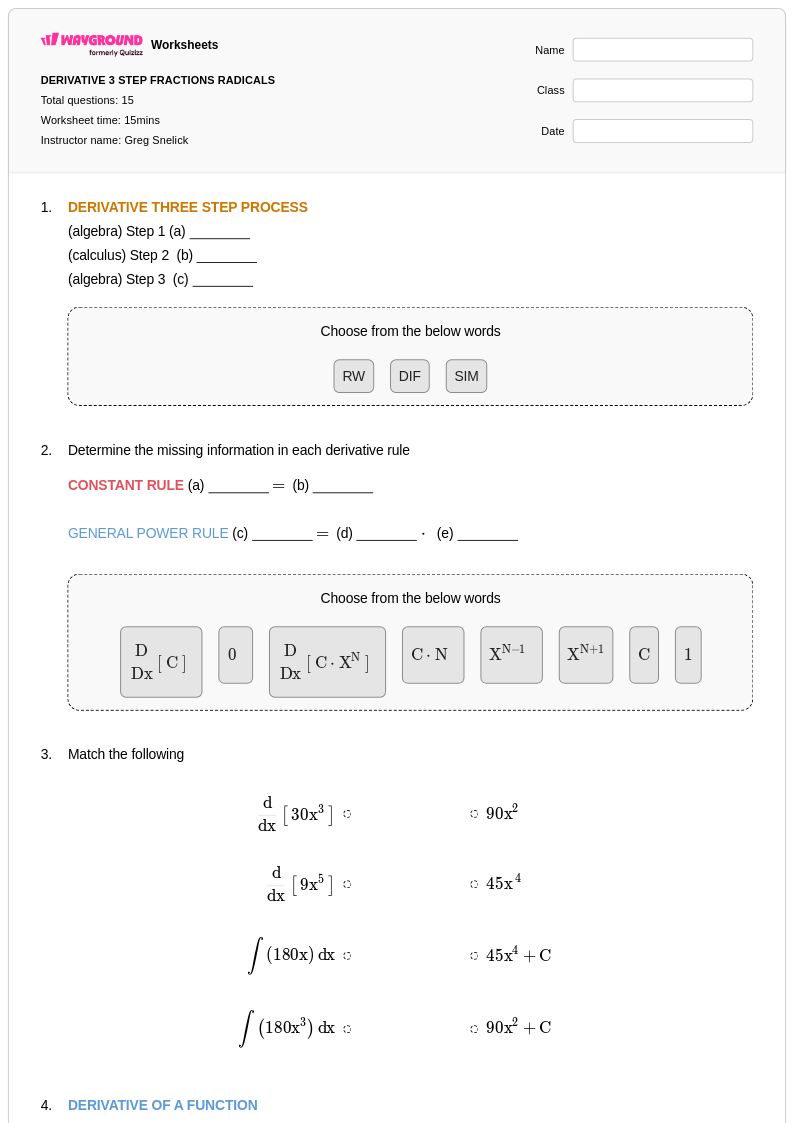
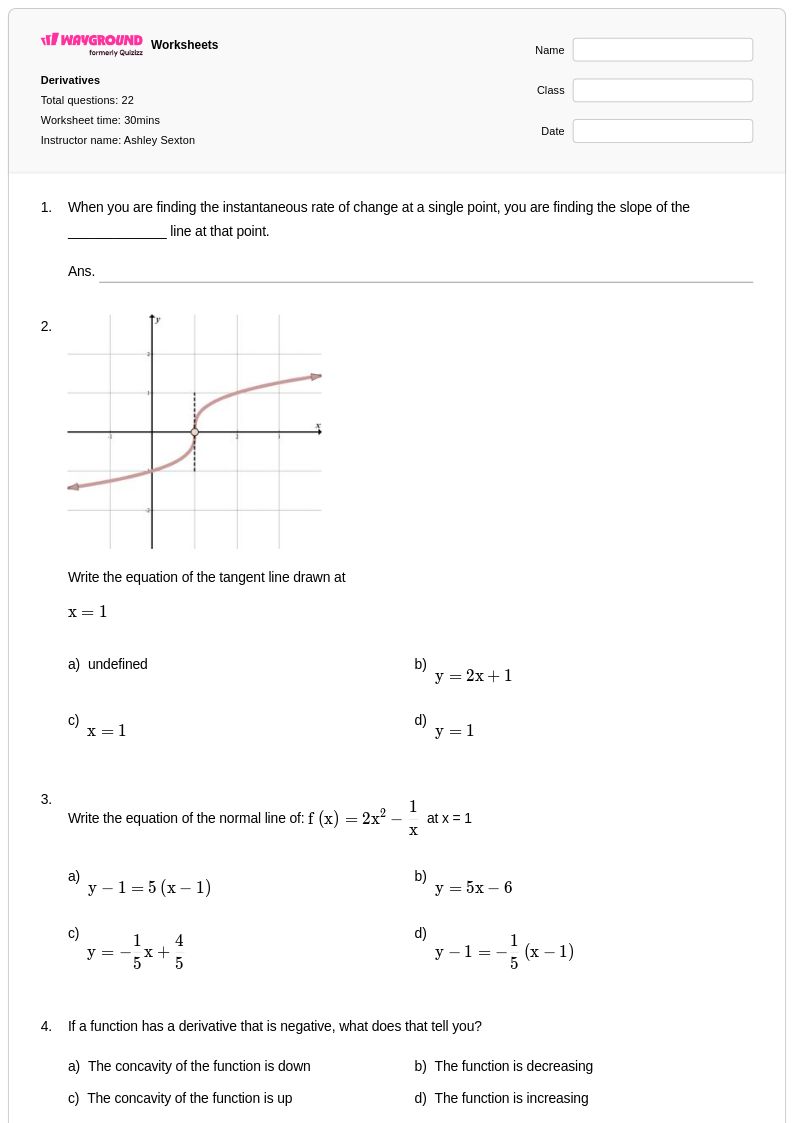
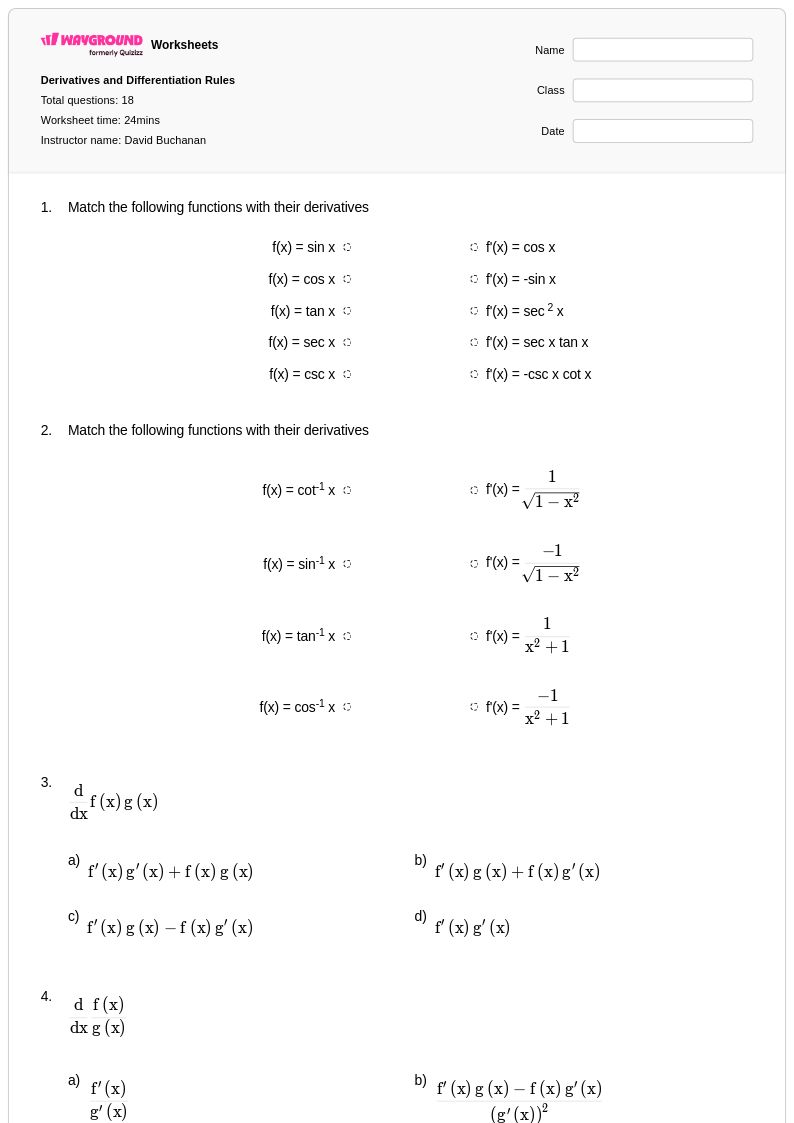
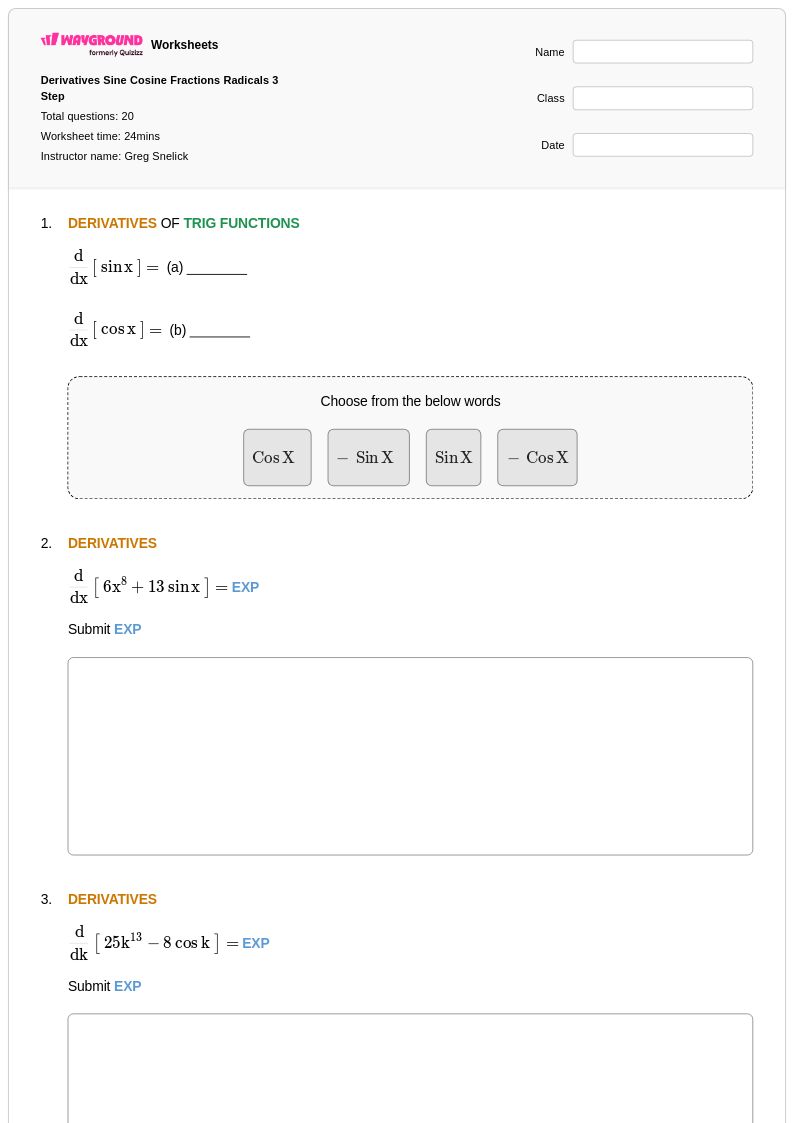
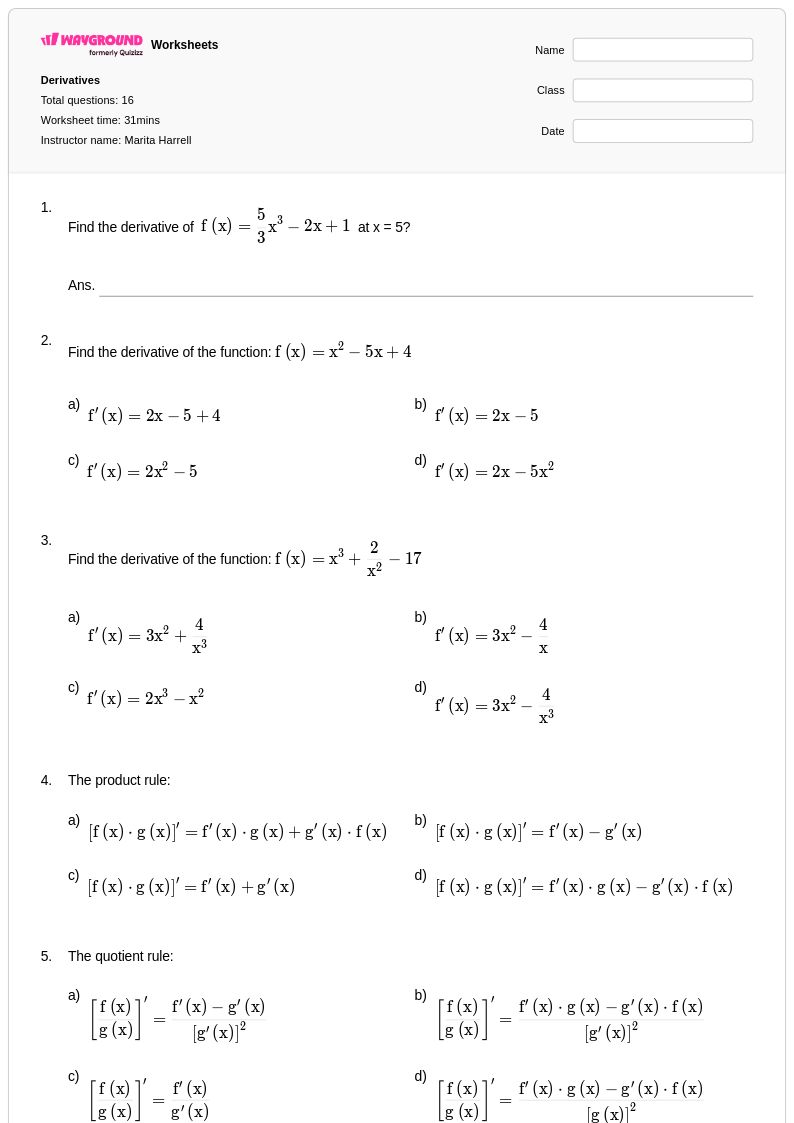
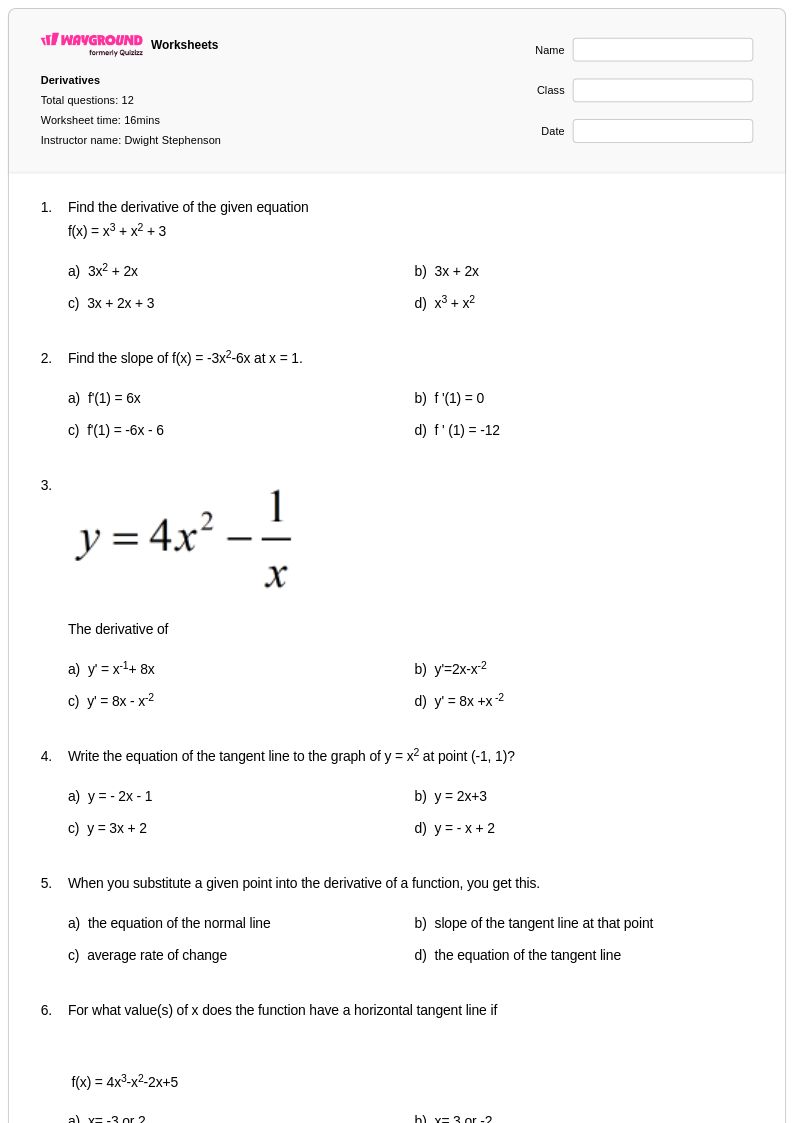
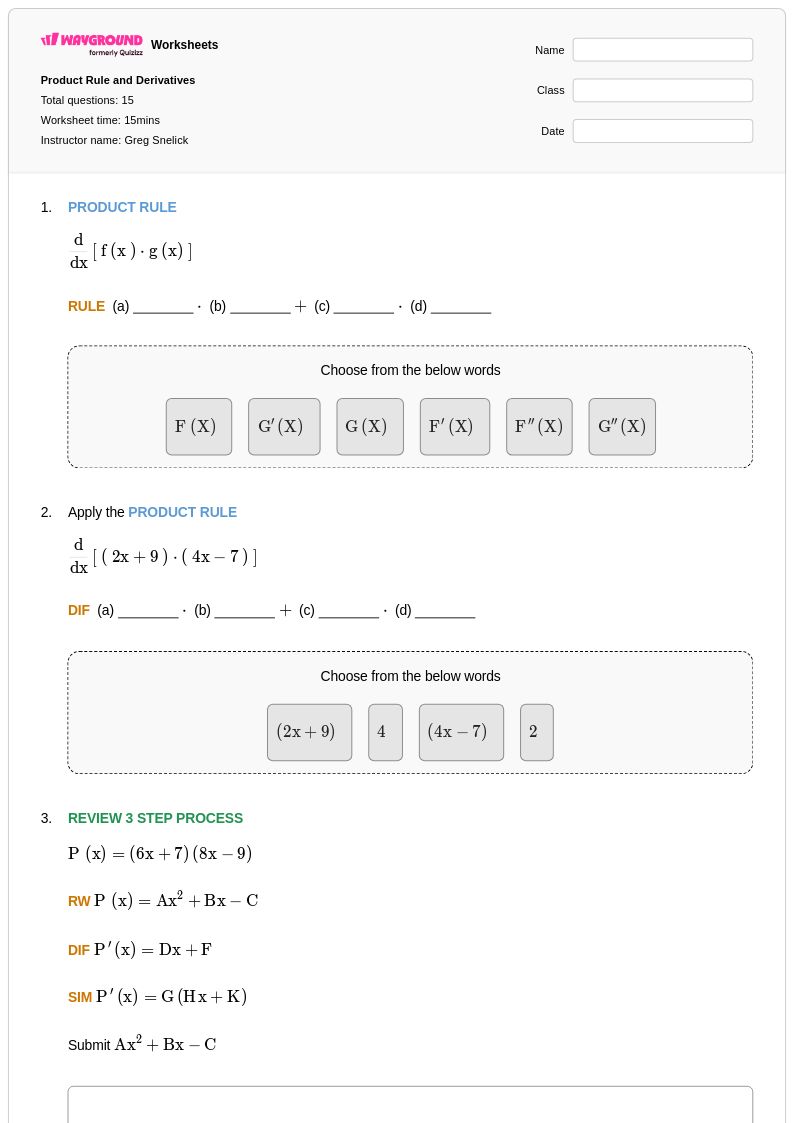
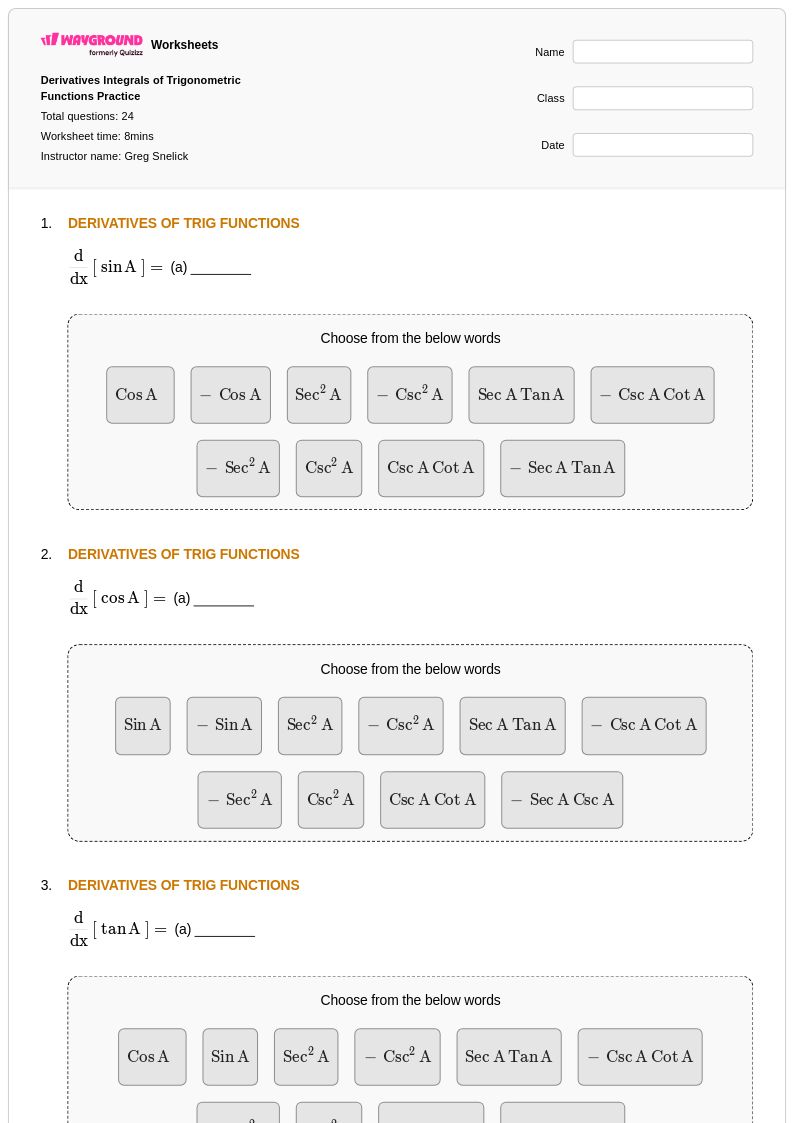
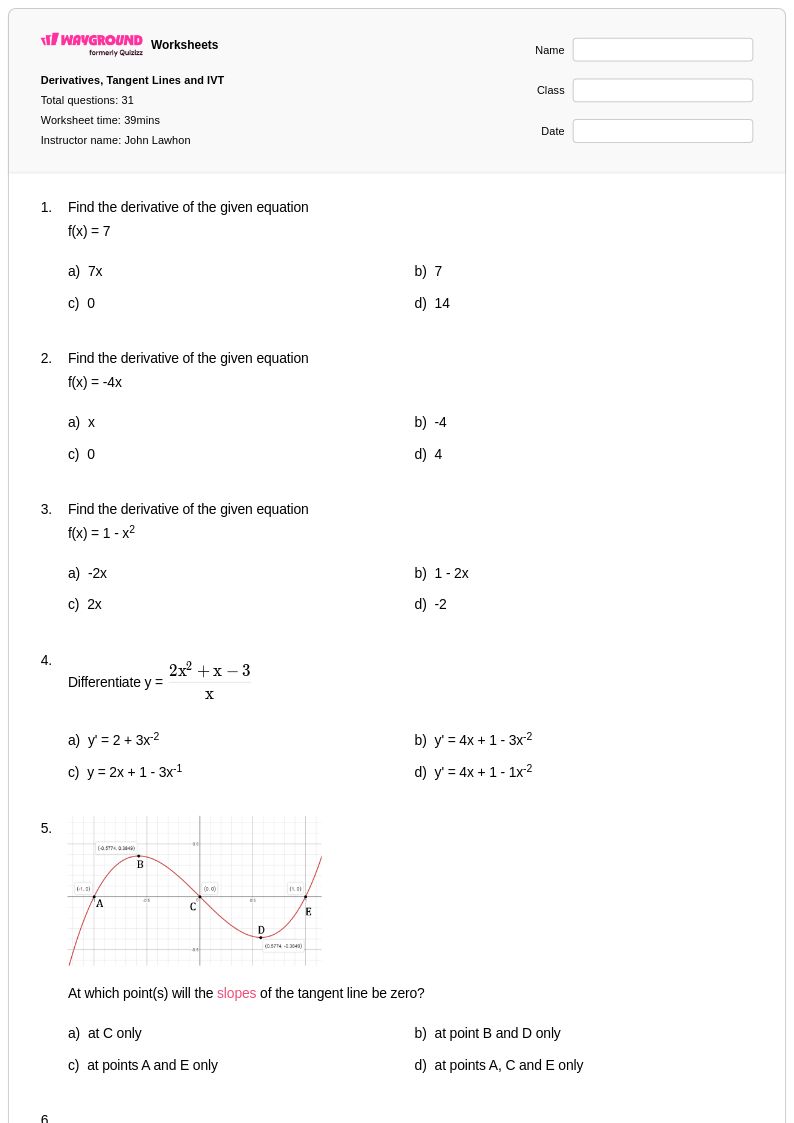
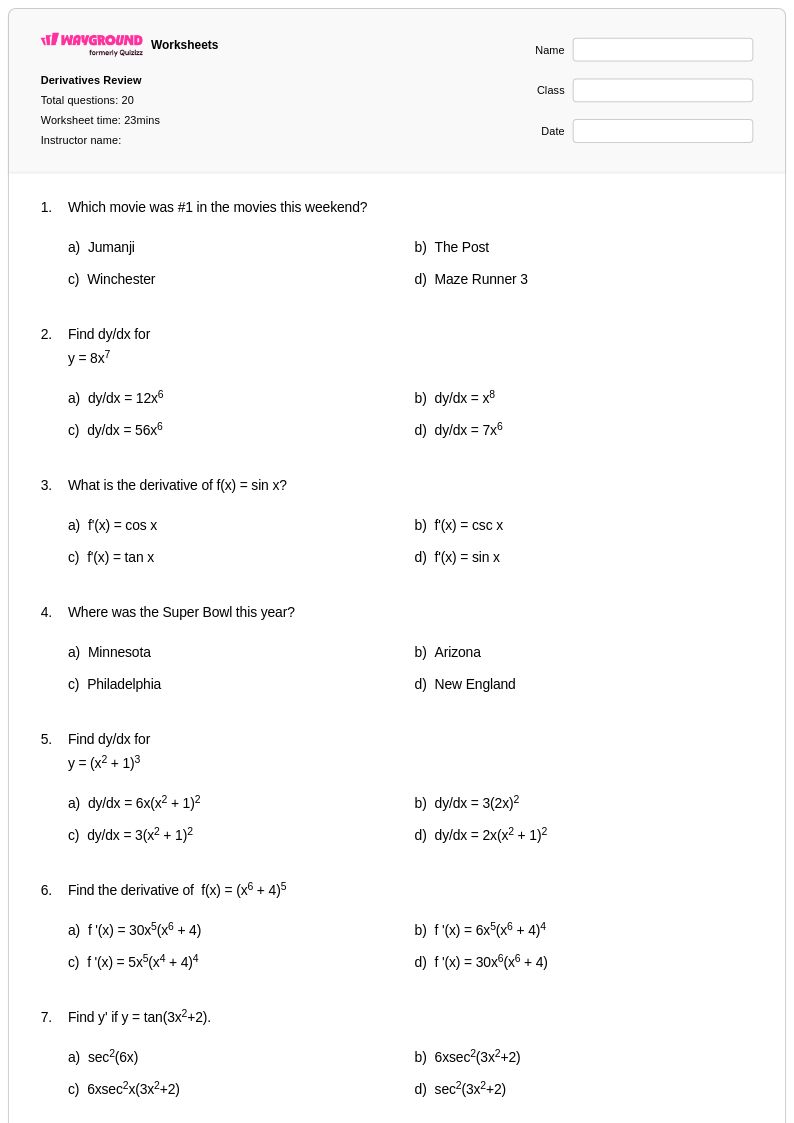
Derivatives worksheets for Grade 9 students through Wayground (formerly Quizizz) provide comprehensive practice in understanding the fundamental concepts of calculus, including limits, rates of change, and basic differentiation rules. These carefully designed worksheets help students develop essential skills in finding derivatives using power rules, product rules, and chain rules while building confidence in mathematical notation and problem-solving techniques. Each worksheet collection includes detailed answer keys and step-by-step solutions, with free printable pdf options that allow students to work through practice problems at their own pace, reinforcing core concepts through repetitive application and guided discovery.
Wayground (formerly Quizizz) empowers teachers with millions of educator-created derivative worksheets that feature robust search and filtering capabilities, enabling quick identification of resources aligned with specific learning standards and grade-level expectations. The platform's differentiation tools allow instructors to customize worksheet difficulty levels and problem types, supporting both remediation for struggling learners and enrichment opportunities for advanced students. Teachers can access these resources in flexible digital and printable pdf formats, facilitating seamless integration into lesson planning, homework assignments, and targeted skill practice sessions that address individual student needs while maintaining curriculum pacing and academic rigor.
FAQs
Should Grade 9 students be learning derivatives?
In most US curricula, derivatives are a precalculus or calculus topic introduced in Grade 11 or 12. Grade 9 students encountering derivatives are typically in an accelerated or advanced track — for example, a school that sequences Algebra II and Precalculus early, or an international curriculum with an earlier calculus entry point. If your Grade 9 students are seeing derivatives, it's worth confirming the course is genuinely calculus-ready and that students have solid foundations in functions and rates of change first.
How do I introduce derivatives to Grade 9 students who haven't seen calculus before?
Anchor the concept in something they already know: slope. A derivative is the slope of a curve at a specific point, which connects directly to linear functions from earlier grades. Start with average rate of change over an interval, then ask what happens as that interval shrinks toward zero — that's the limit intuition behind the derivative. Keep early problems focused on polynomial functions so students can build confidence with the power rule before encountering product, quotient, or chain rule.
What exercises help Grade 9 students practice basic differentiation?
At this level, the most useful practice focuses on the power rule applied to polynomials, with problems that gradually increase the number of terms. Mixing in some rate-of-change word problems, like finding the instantaneous speed of an object given a position function, helps students see why the procedure matters. Avoid jumping to chain rule or implicit differentiation until power rule and basic notation feel automatic.
What mistakes do Grade 9 students commonly make when learning derivatives?
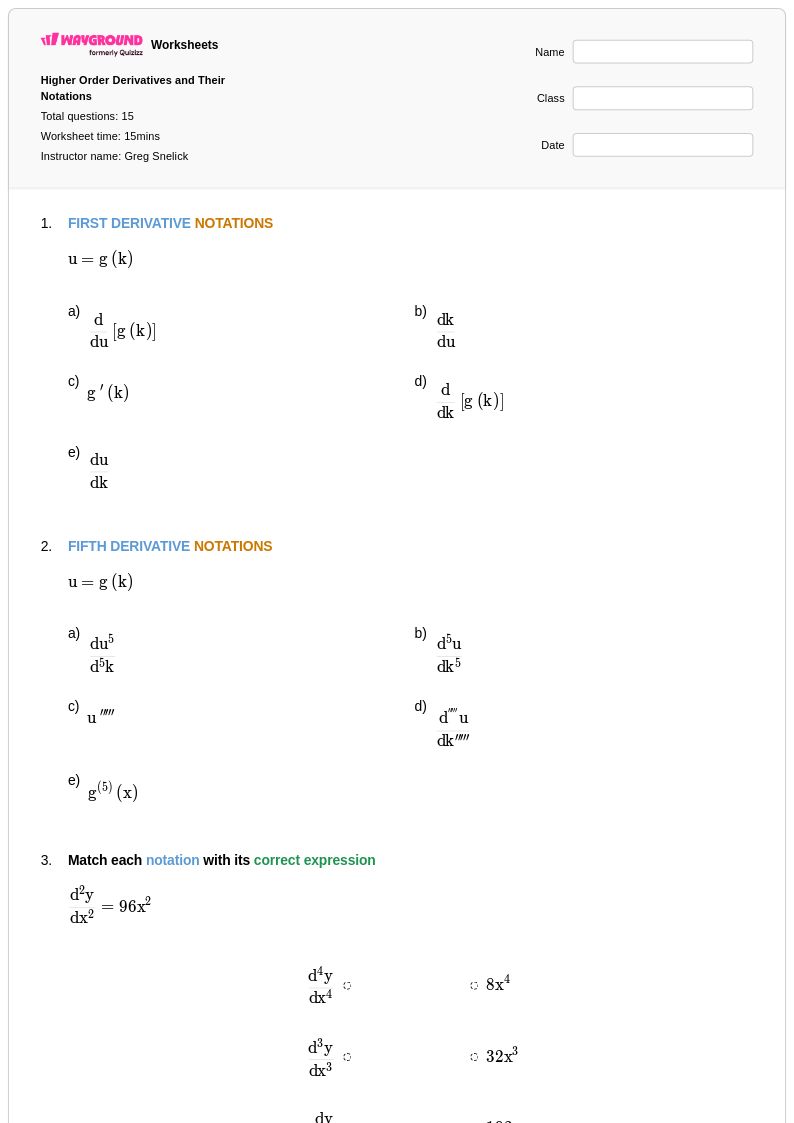
The most common early error is treating the derivative like a multiplication — writing the derivative of x³ as 3·x³ instead of 3x². Students also frequently forget to reduce the exponent after bringing it down. A subtler issue is notation confusion: mixing up f(x), f'(x), and dy/dx without understanding they can represent the same thing. Explicit notation practice alongside computation problems helps close that gap early.
How do I use Wayground's Grade 9 derivatives worksheets in my class?
Each worksheet is available as a printable PDF, useful for paper-based practice or schools managing screen time, and can also be hosted as a digital quiz on Wayground where you track student progress in real time. Every worksheet includes a complete answer key, so students can self-check when working independently or for homework.
How can I support Grade 9 students who struggle with derivatives notation and multi-step problems?
Notation is a genuine barrier at this level — students who are mathematically capable can still get lost in f'(x) versus dy/dx versus d/dx notation. Wayground's Read Aloud feature can help students who process written math slowly, and adjusting font size or applying a dyslexia-friendly font reduces visual load on multi-step problems. For students who need a simpler entry point, reducing answer choices on digital questions lets them focus on the concept rather than getting overwhelmed by options.