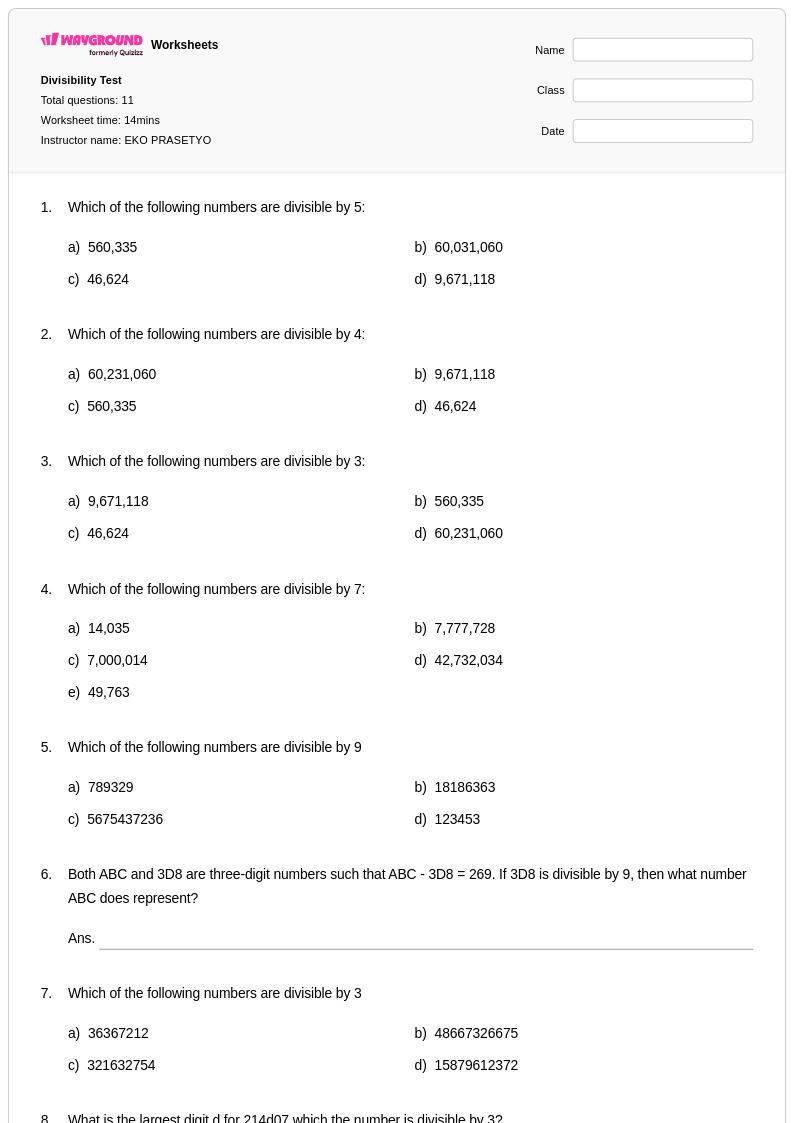
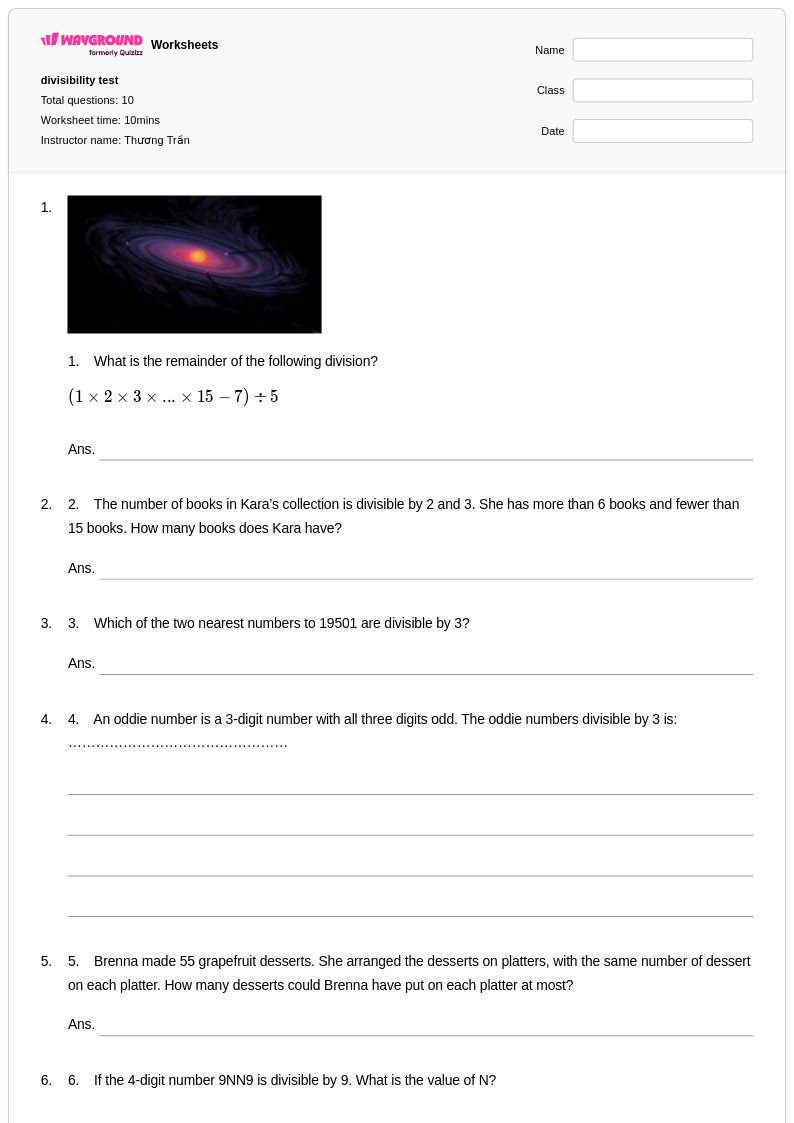
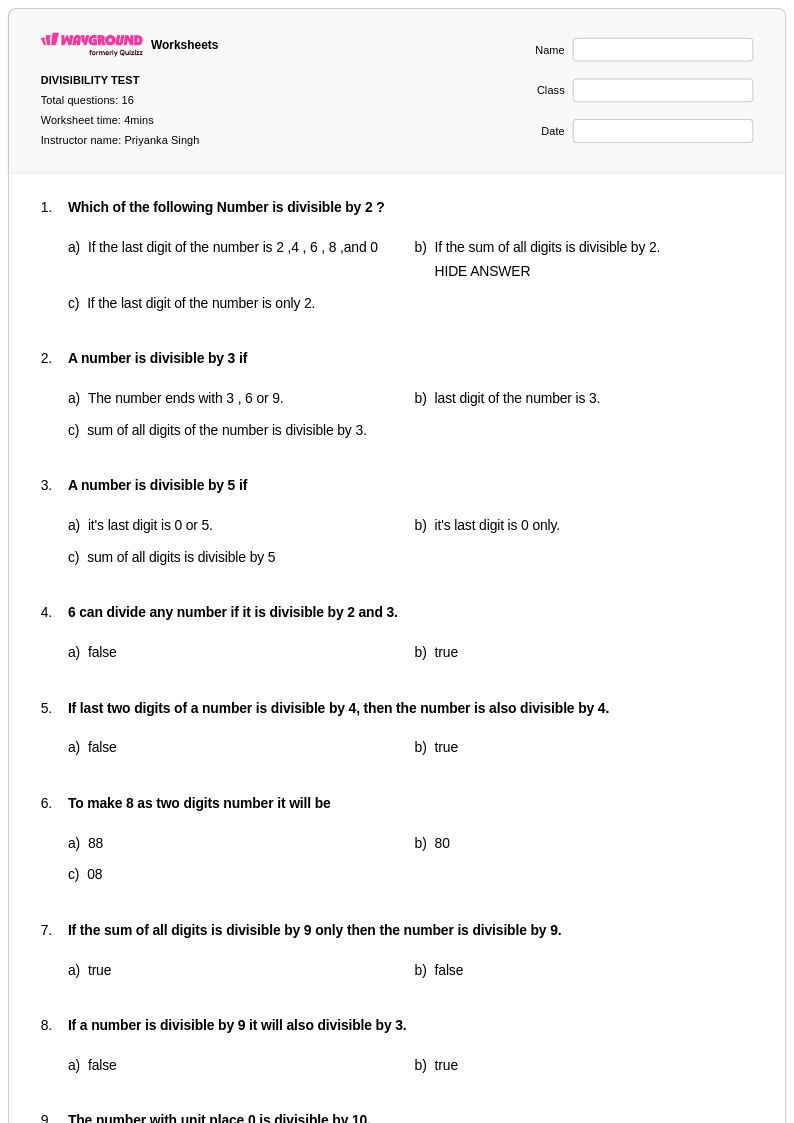
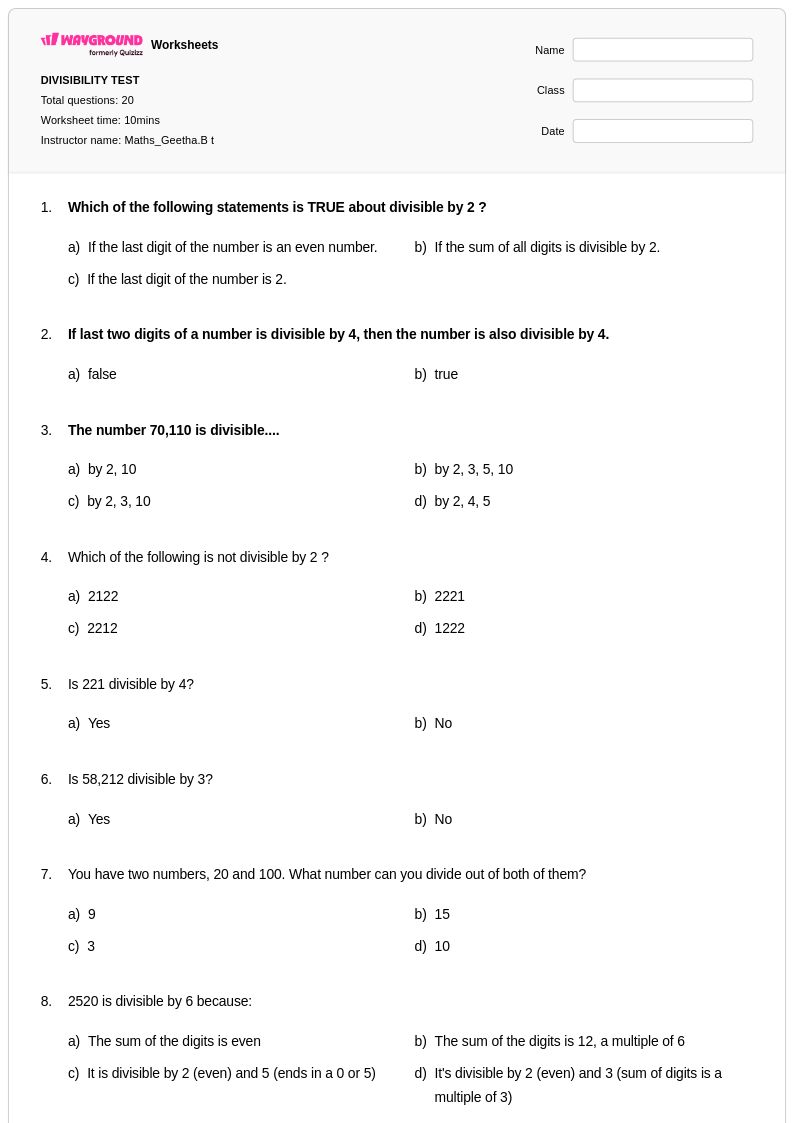
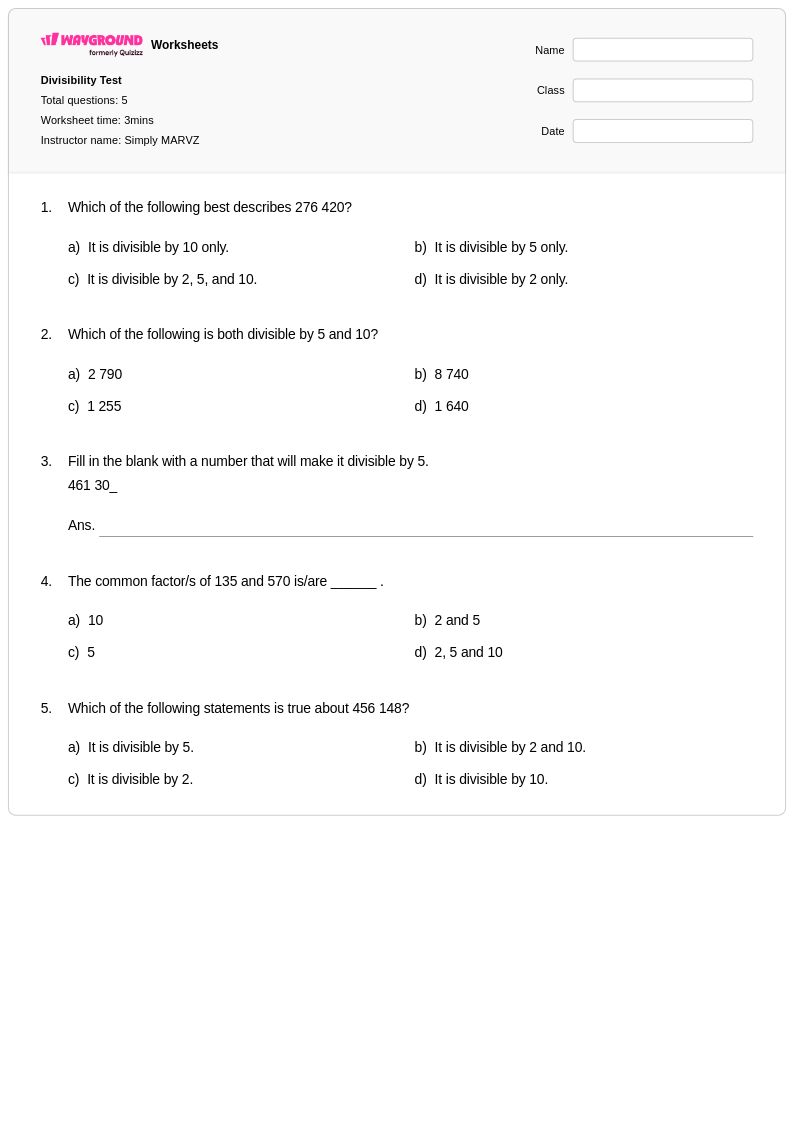
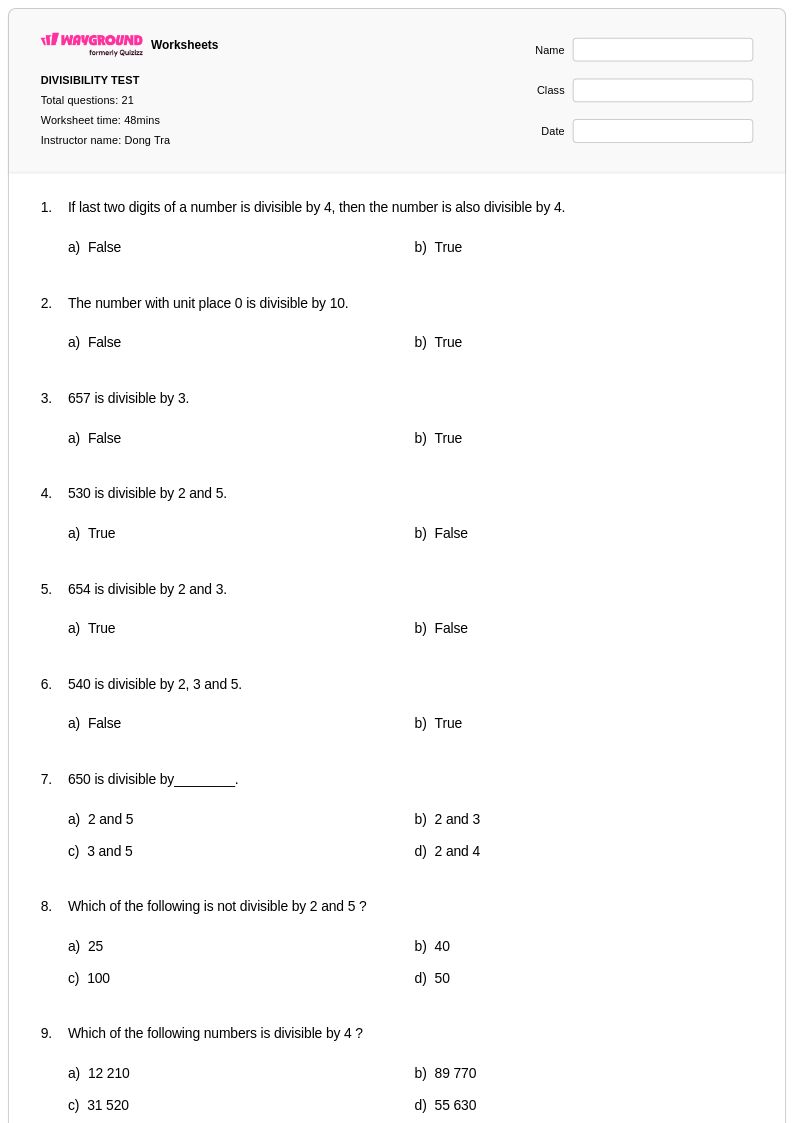
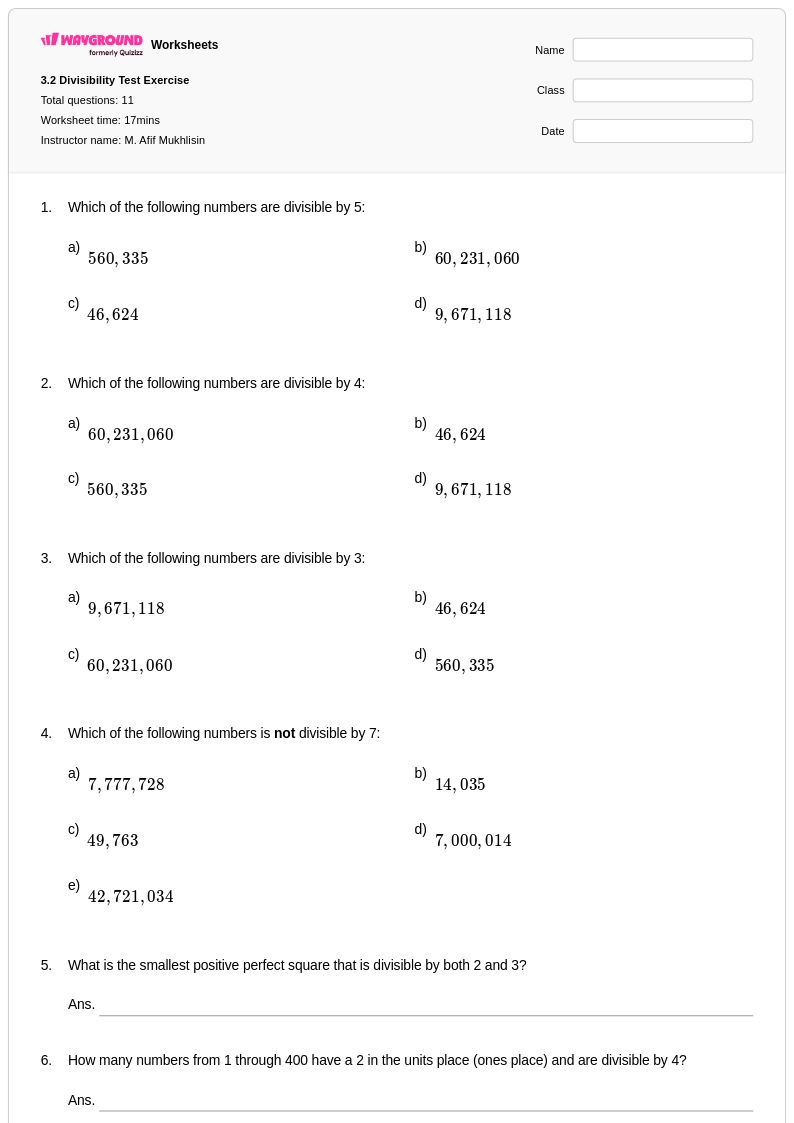
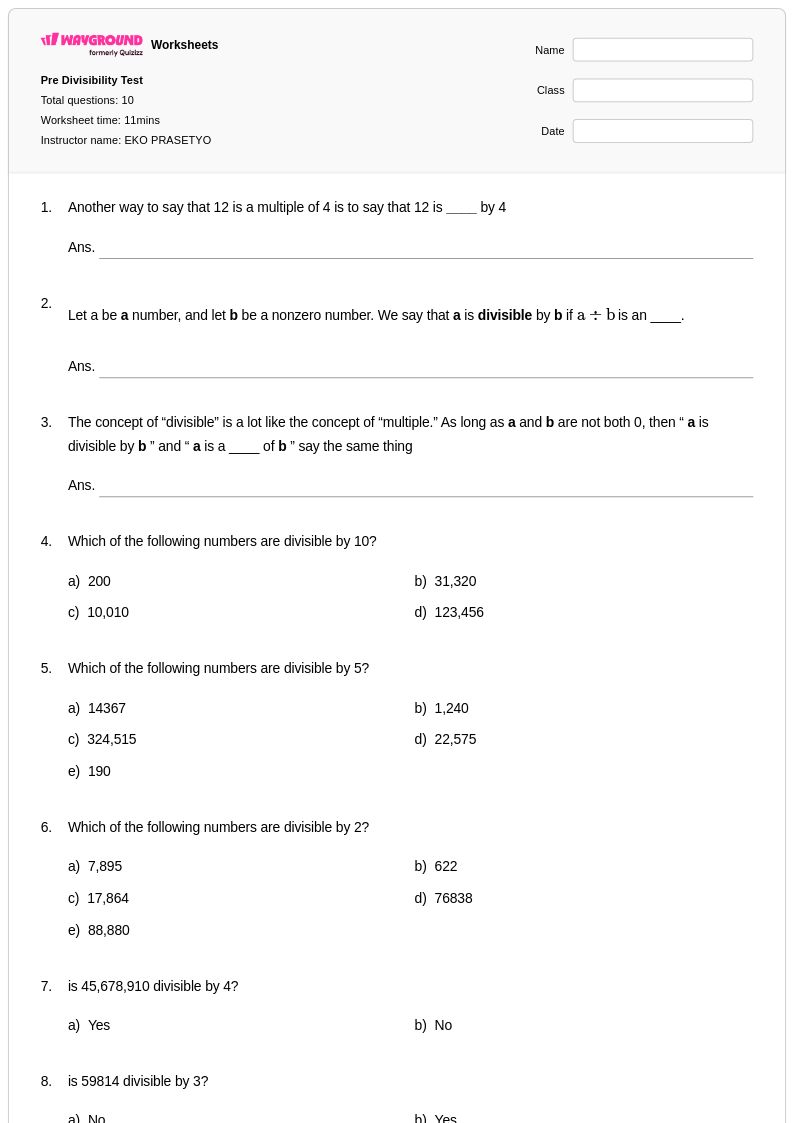
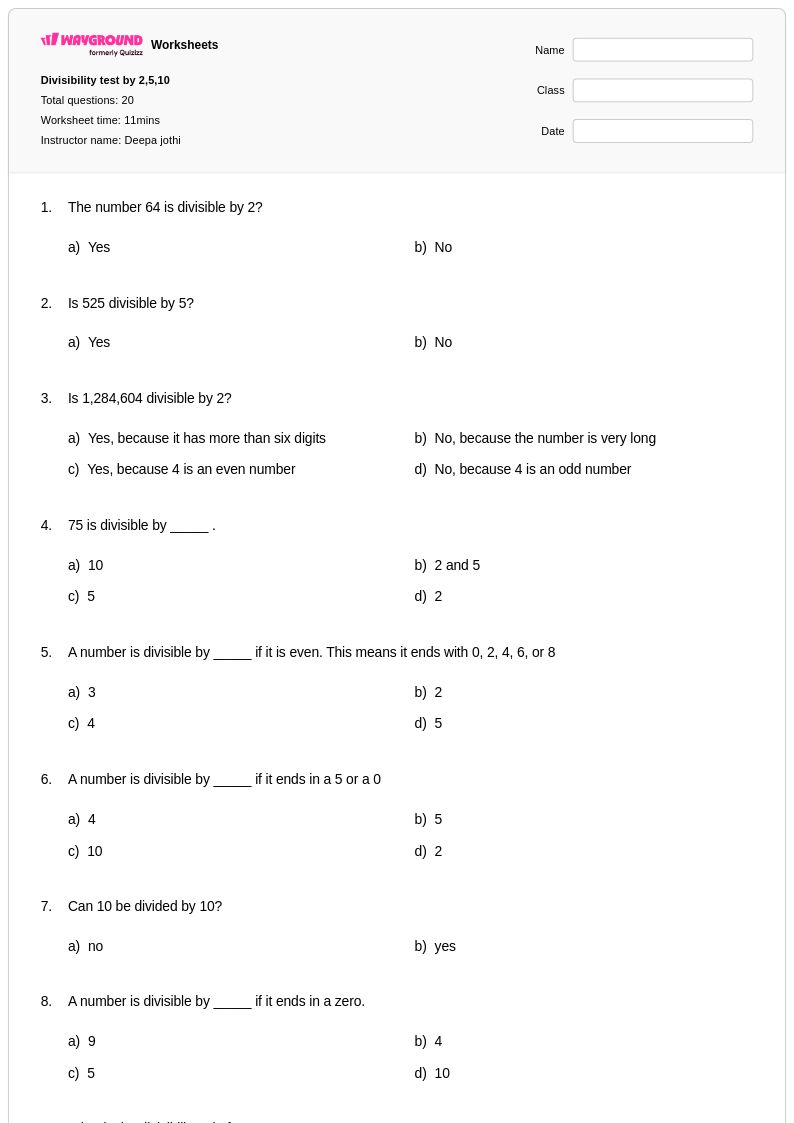
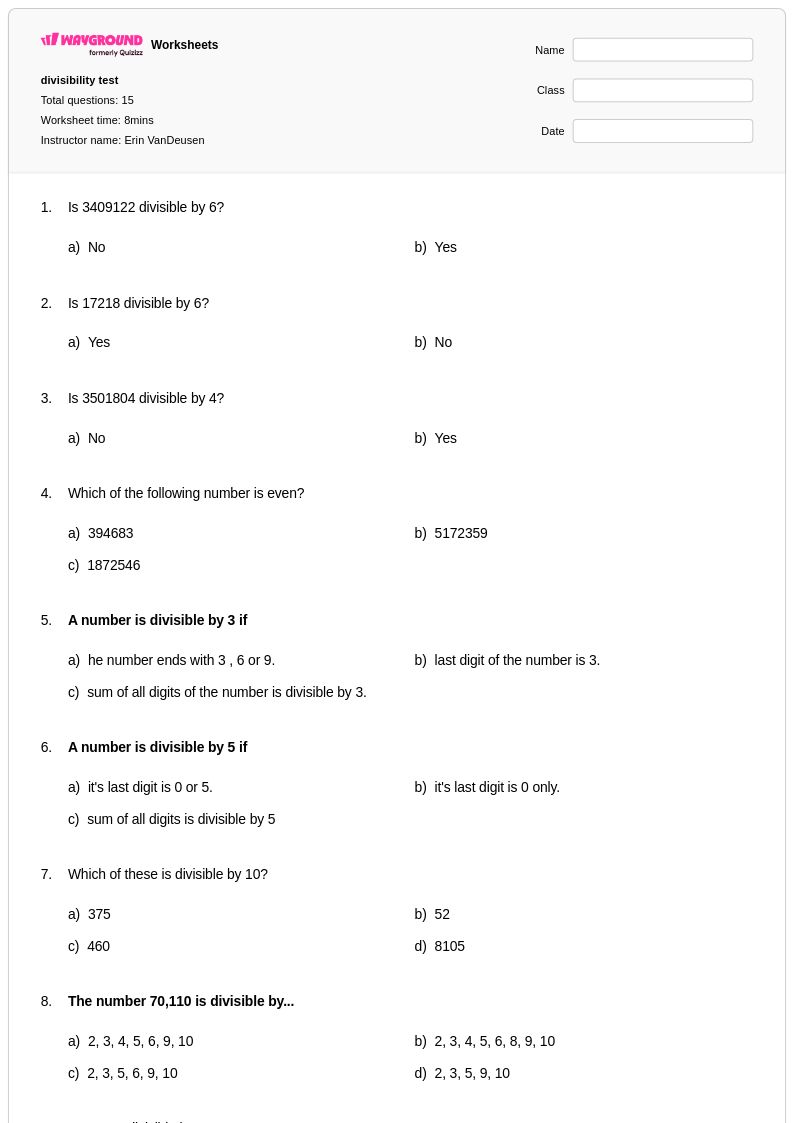
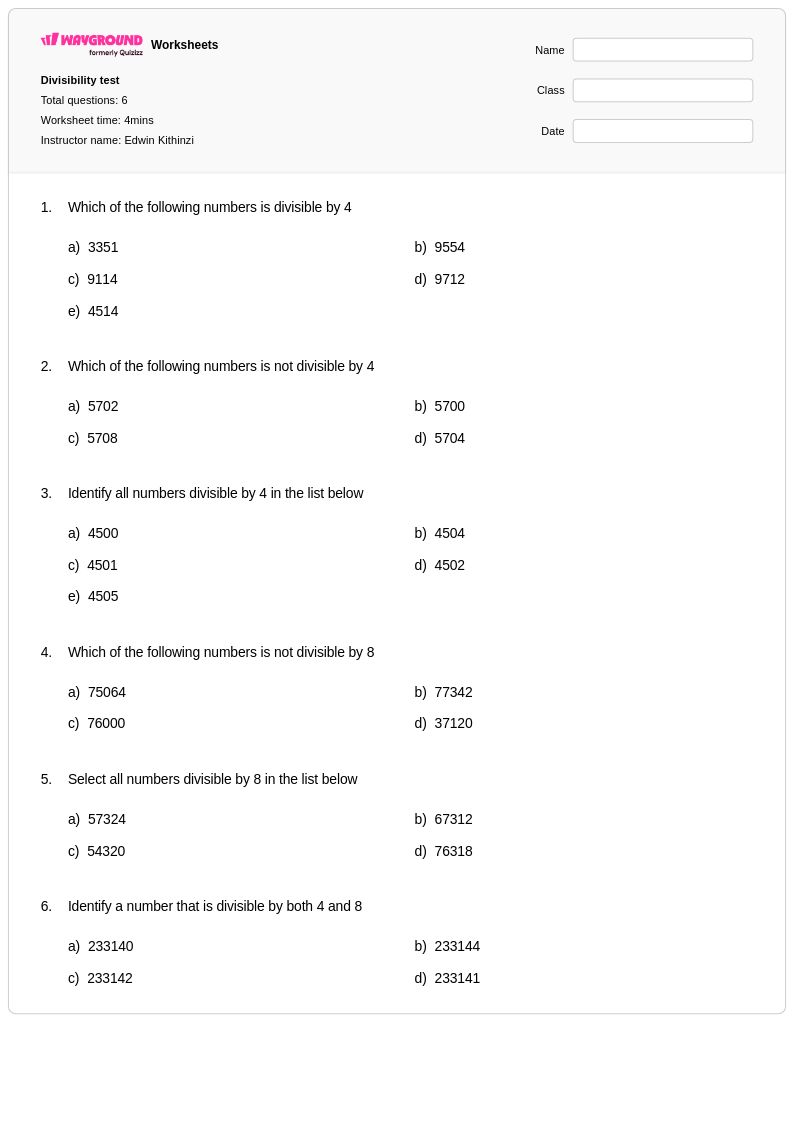
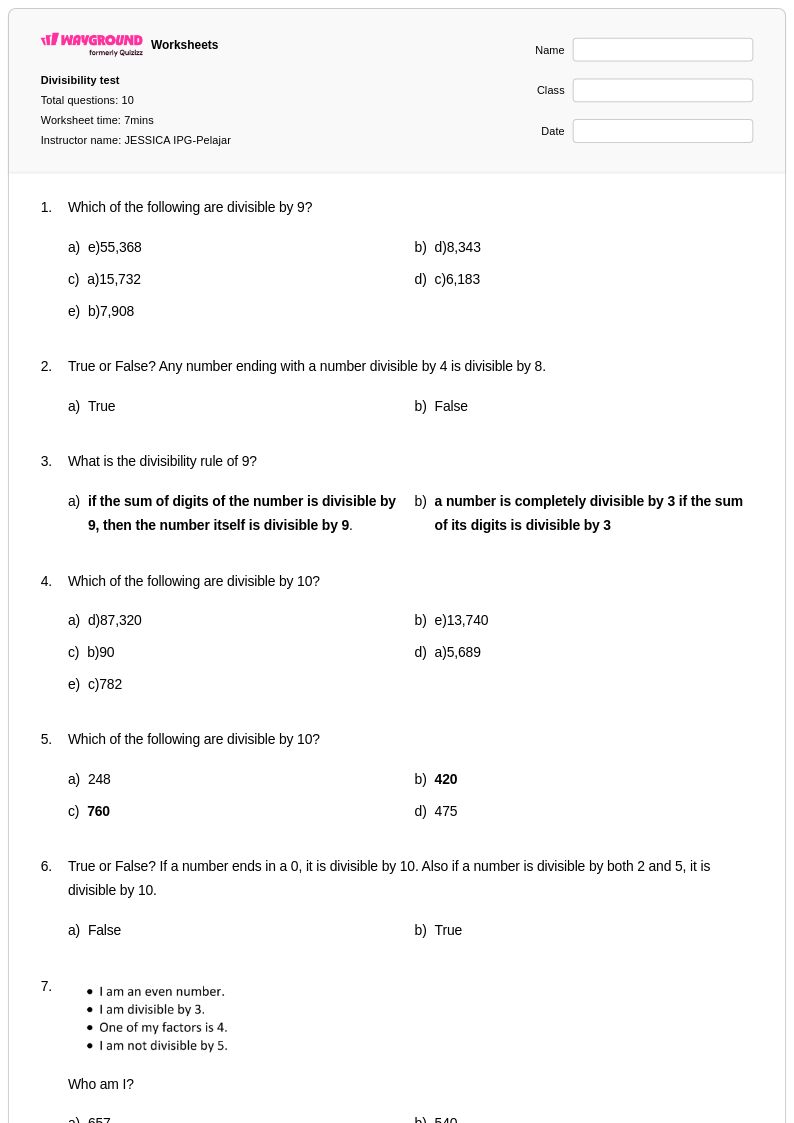
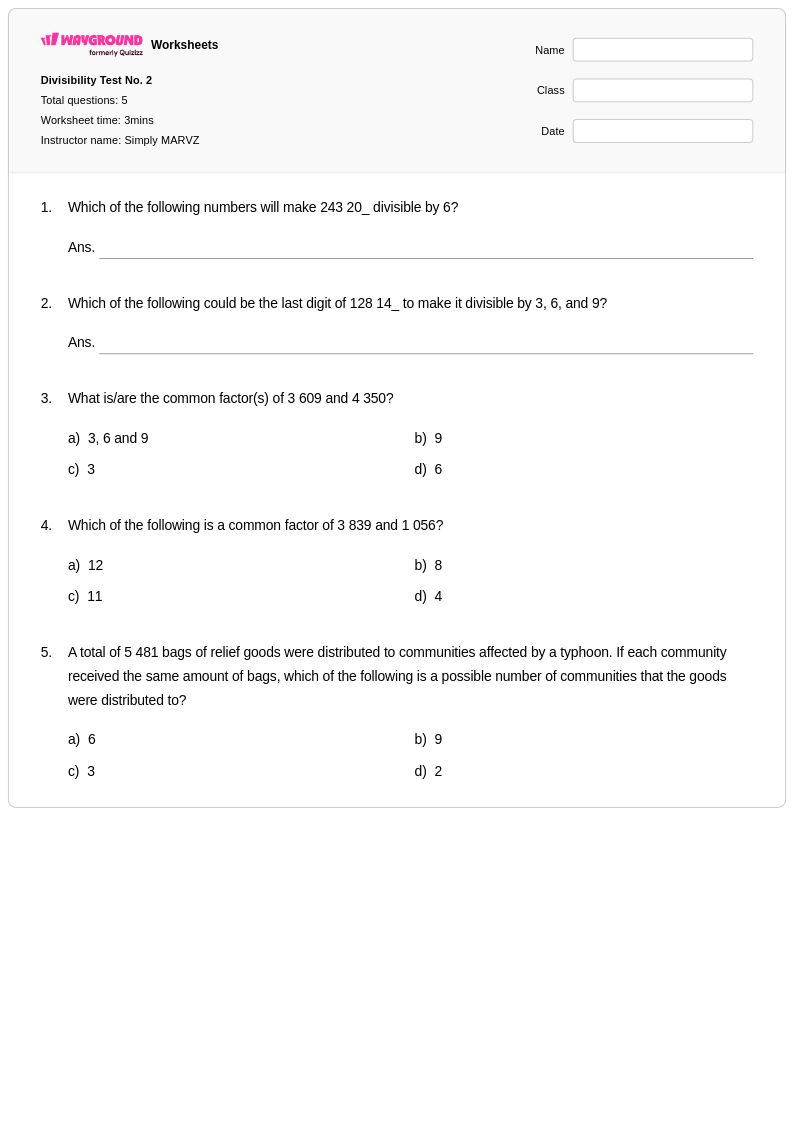
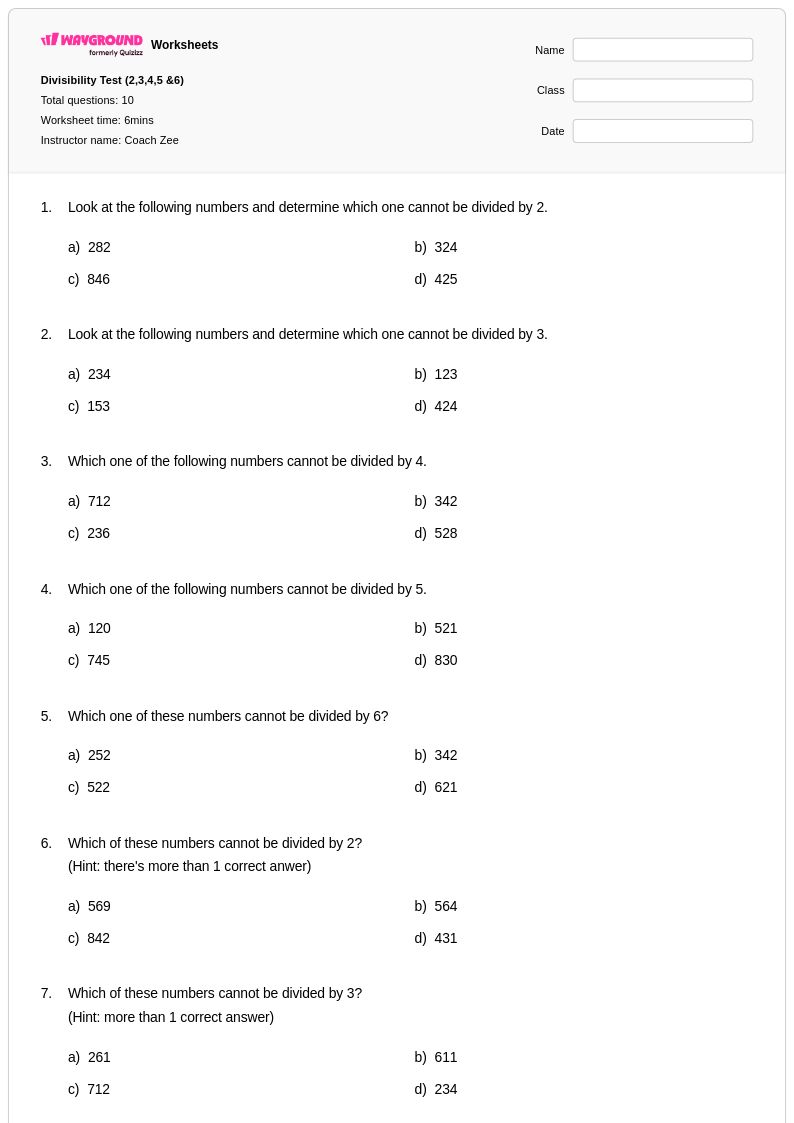
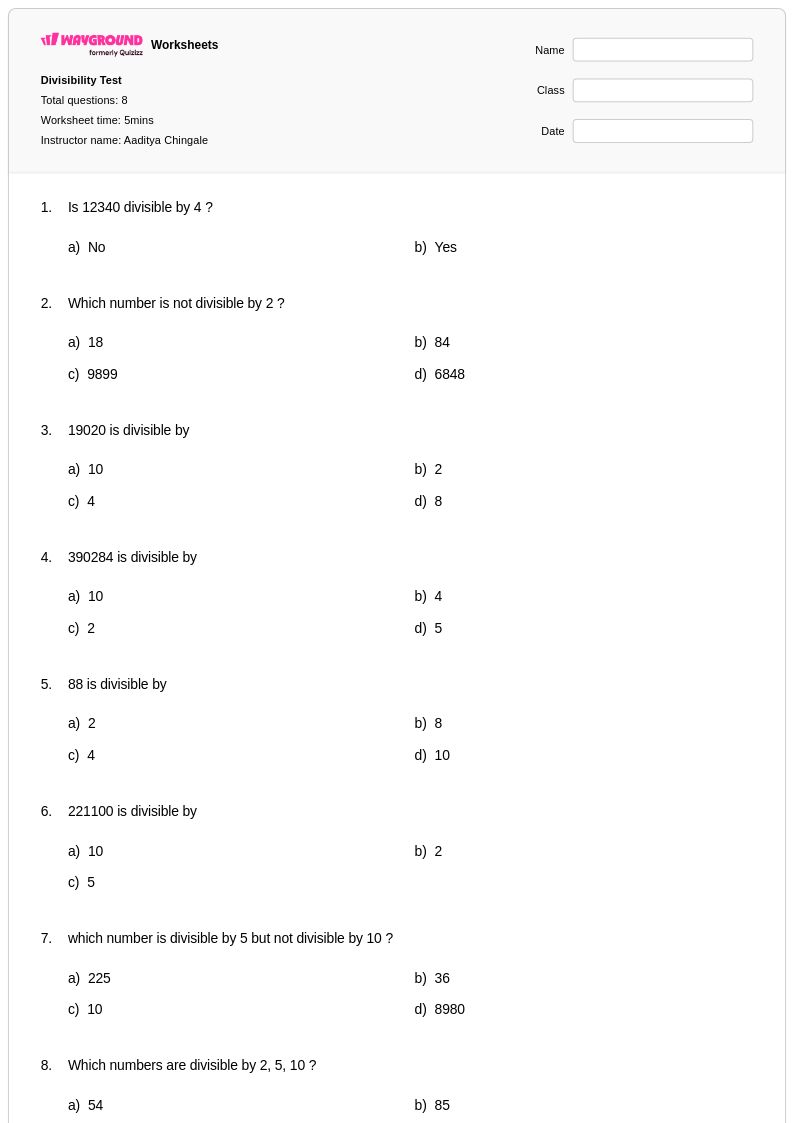
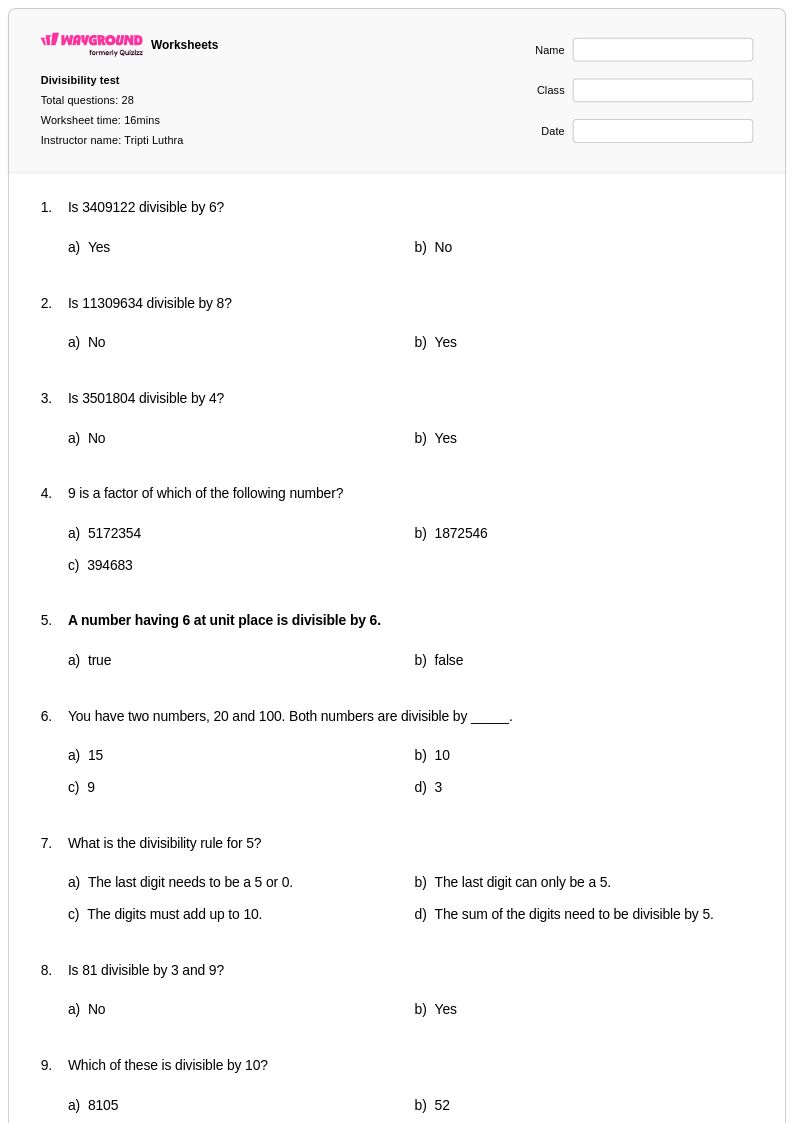
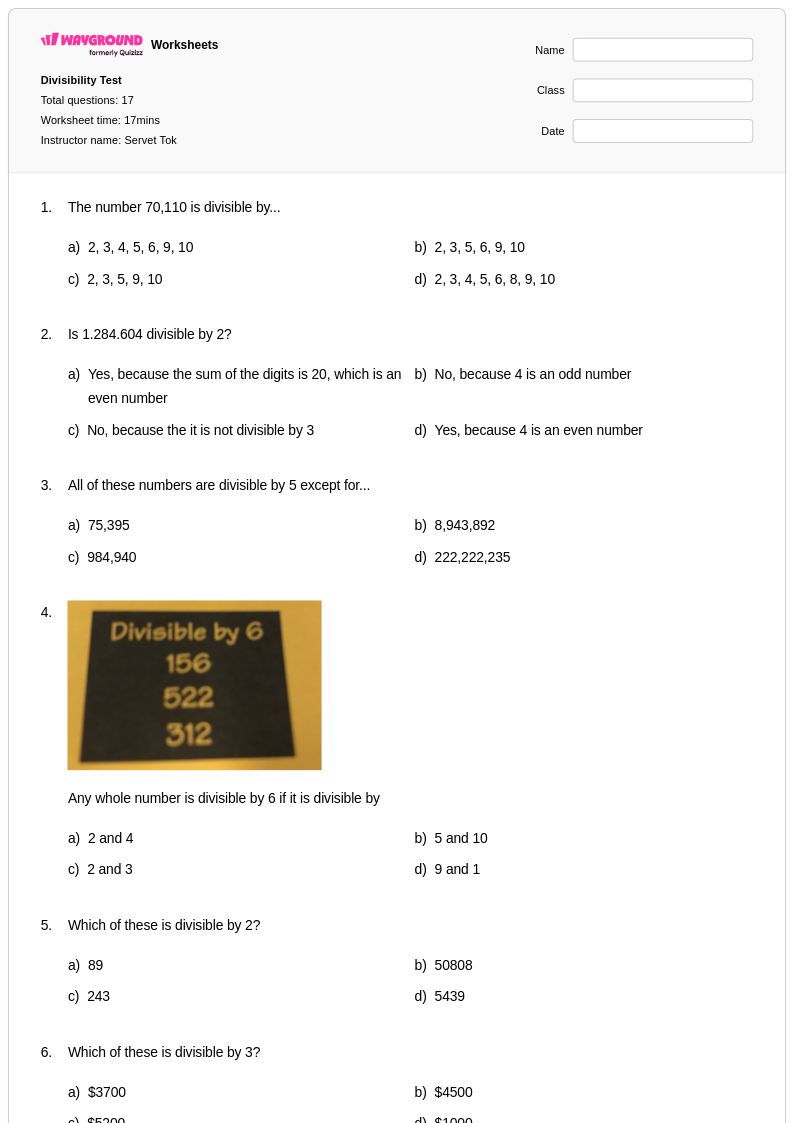
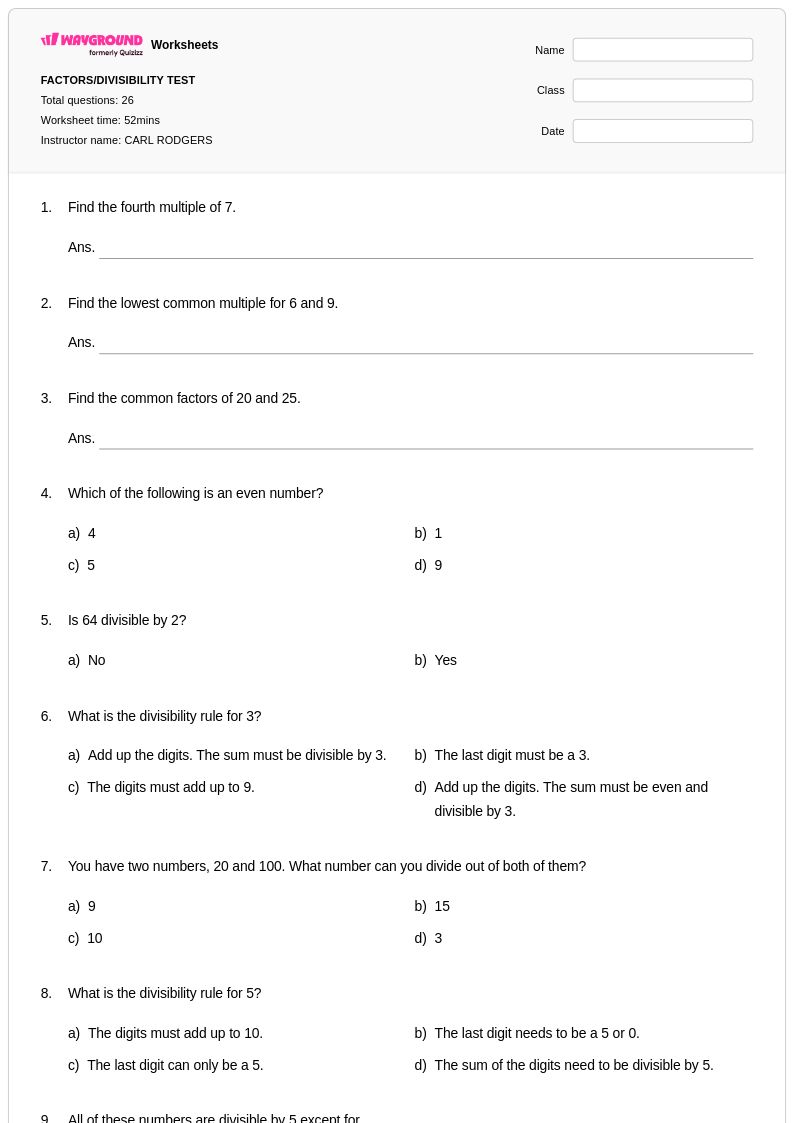
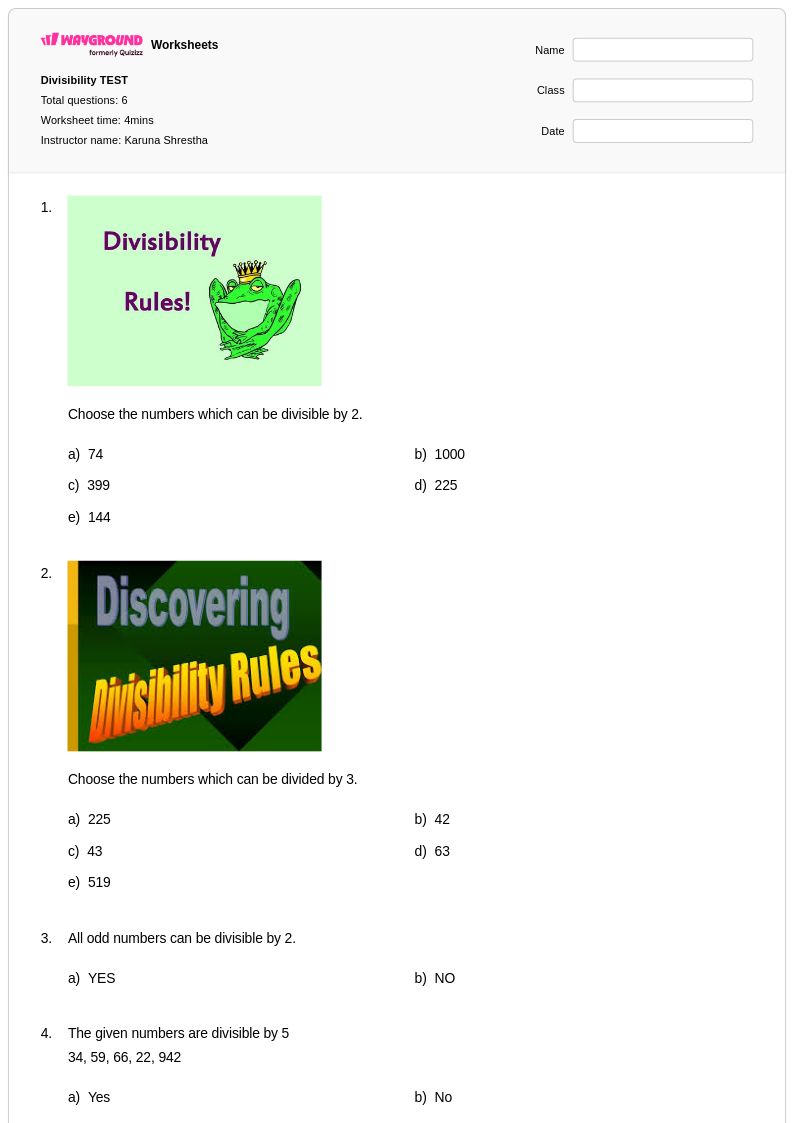
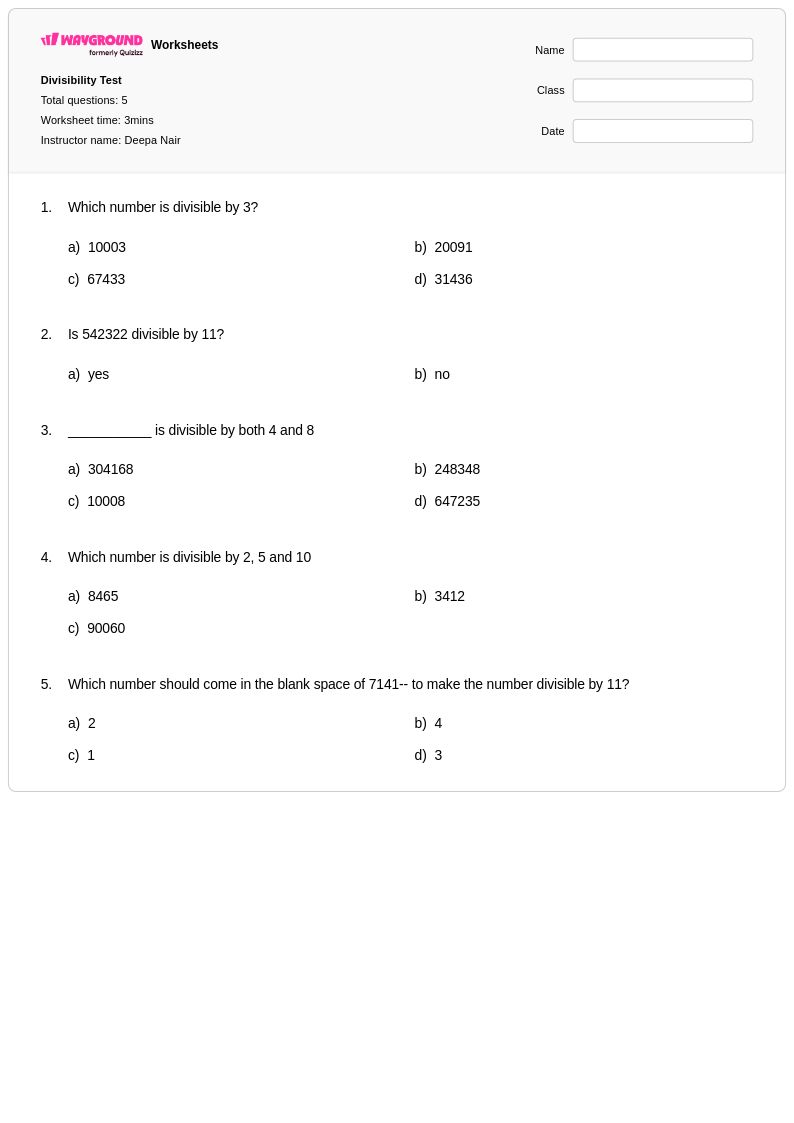
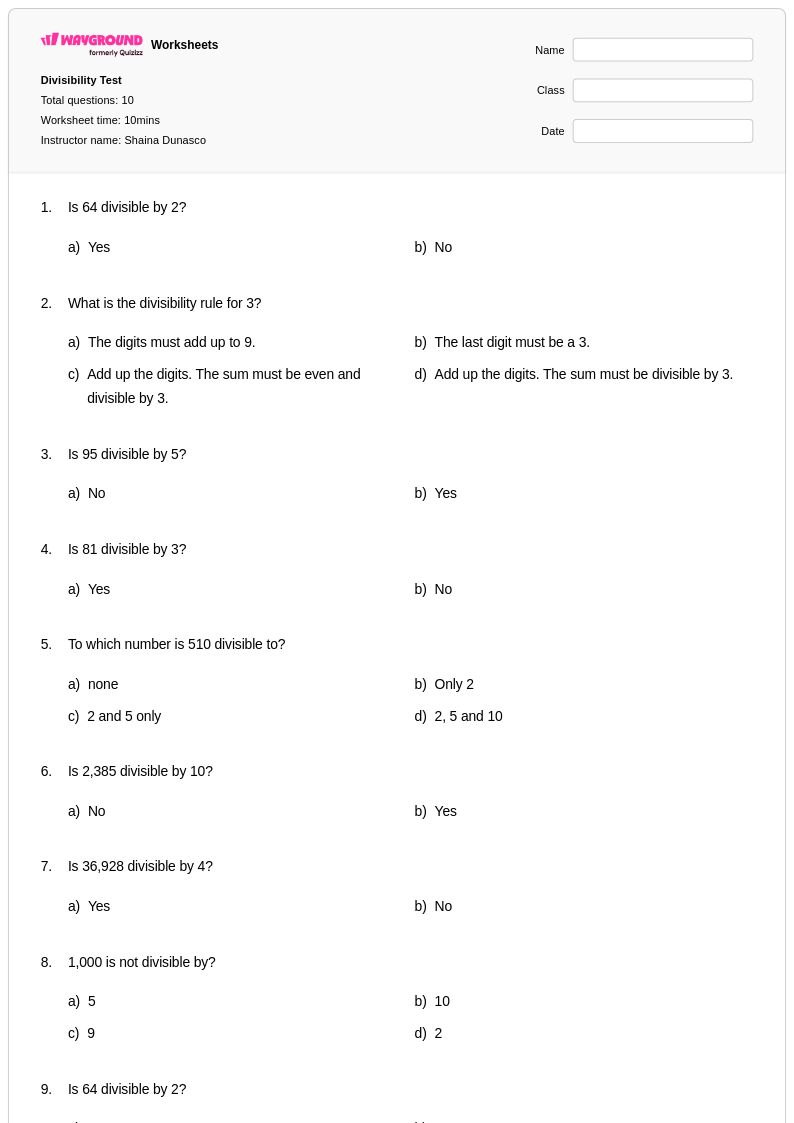
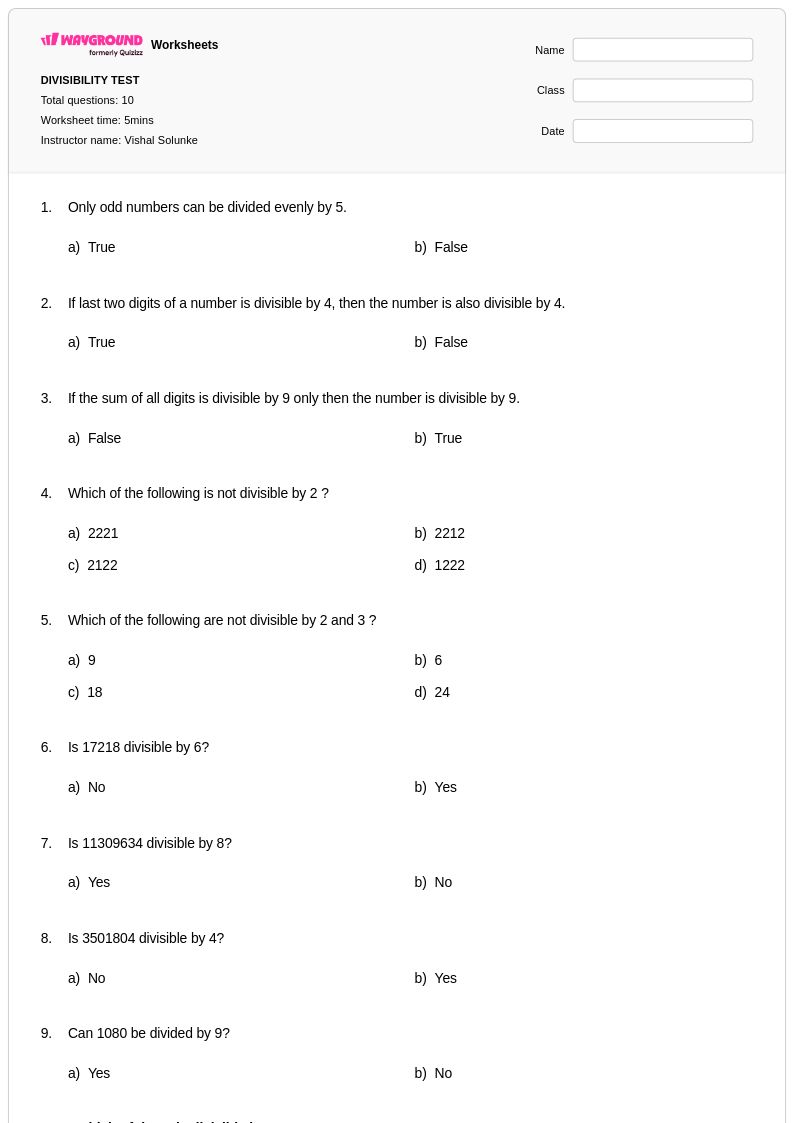
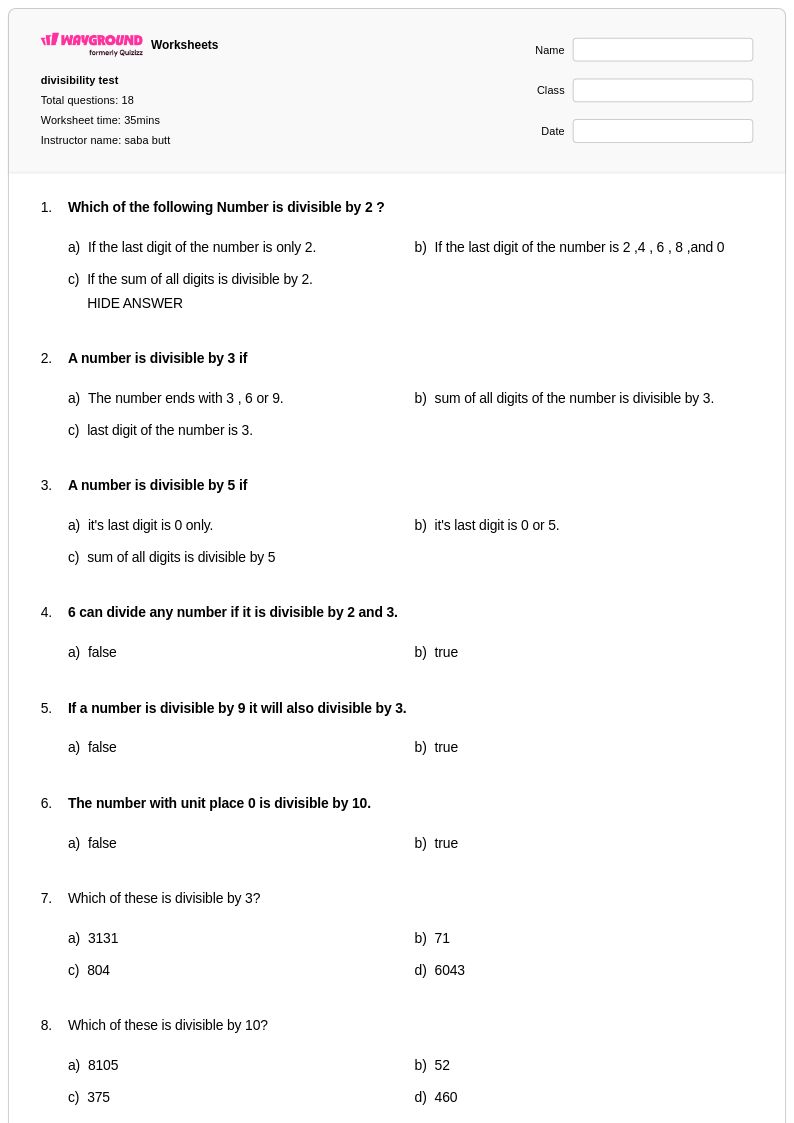
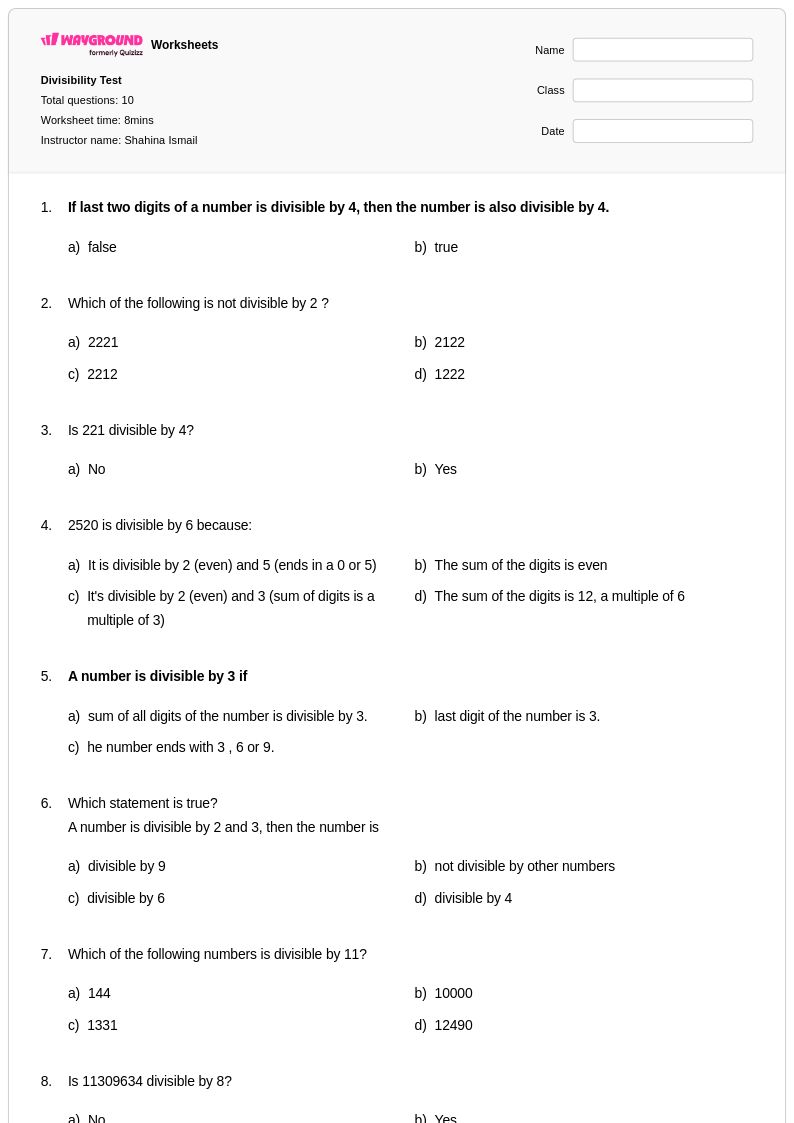
Discover free divisibility test worksheets and printables from Wayground that help students master mathematical shortcuts for determining if numbers are divisible without performing actual division calculations.
Divisibility test worksheets available through Wayground (formerly Quizizz) provide comprehensive practice materials that help students master the fundamental skill of determining whether one number can be divided evenly by another without performing long division. These expertly crafted resources focus on teaching students the specific rules and patterns for testing divisibility by numbers such as 2, 3, 4, 5, 6, 8, 9, 10, and 11, enabling them to quickly identify factors and multiples through strategic mathematical shortcuts. Each worksheet includes carefully structured practice problems that progressively build student confidence in applying divisibility rules, while complete answer keys allow for immediate verification and self-assessment. These free printable resources strengthen number sense, enhance mental math capabilities, and lay crucial groundwork for more advanced concepts including prime factorization, greatest common factors, and least common multiples.
Wayground (formerly Quizizz) empowers educators with an extensive collection of millions of teacher-created divisibility test worksheets that support diverse classroom needs through powerful search and filtering capabilities. Teachers can easily locate resources aligned to specific mathematical standards while utilizing sophisticated differentiation tools to accommodate varying skill levels within their classrooms. The platform's flexible customization options allow educators to modify existing worksheets or create targeted practice sets, ensuring optimal alignment with individual lesson objectives and student requirements. Available in both printable pdf format and interactive digital versions, these worksheets seamlessly integrate into lesson planning workflows while providing valuable tools for remediation, enrichment, and ongoing skill practice that helps students achieve mastery of essential divisibility concepts.
FAQs
How do I teach divisibility rules effectively?
Start with the rules students can see immediately — even numbers for 2, endings in 0 or 5 for 5 — before moving to the less obvious ones like the digit-sum rule for 3 and 9. Anchor each rule to a concrete example students can verify with actual division, so the shortcut feels earned rather than arbitrary. Once students trust a few rules, give them multi-divisor problems where they apply two or three rules to the same number. That's where the skill becomes genuinely useful.
What exercises help students practice divisibility tests?
The most effective practice moves from single-rule identification (is this number divisible by 4?) to multi-rule sorting (which of these numbers are divisible by both 3 and 5?). Mixing true/false problems with open-ended ones — "list all divisors from 2–10 for this number" — keeps students applying rules actively rather than pattern-matching by rote. These worksheets cover that full range, progressing from simple single-digit divisors to more complex multi-step problems.
What mistakes do students commonly make with divisibility tests?
The most common errors cluster around three rules. Students confuse the rule for 4 (last two digits divisible by 4) with the rule for 2 (just the last digit), so they misclassify numbers like 312. They also misapply the digit-sum rule — correctly summing digits for 3 but forgetting it also works for 9, or not reducing the sum a second time when it's still two digits. And divisibility by 6 trips students up because they forget it requires both the rule for 2 and the rule for 3 to hold simultaneously.
How do I use Wayground's divisibility test worksheets in my classroom?
You can run these as a digital quiz hosted on Wayground — students work through problems on their devices and results come back to you instantly. If you'd rather go paper, print the PDF and assign it traditionally; every worksheet includes a complete answer key so students can self-check or you can grade quickly. For grading paper submissions, the Wayground for Teachers app lets you scan or capture student work directly.
How do divisibility rules fit into the Common Core math progression?
Common Core builds toward divisibility through its emphasis on factors, multiples, and number patterns in the upper elementary grades, where students are expected to find factor pairs and recognize multiples before formal fraction work begins. Divisibility rules are the practical shortcut that makes those skills faster — knowing the digit-sum rule for 3, for instance, lets students quickly confirm whether a fraction can be simplified by 3 without long division. That foundation then carries directly into Grade 6 work on greatest common factors and least common multiples.
How can I differentiate divisibility test practice for mixed-ability classes?
For students who struggle with multi-step rules, Wayground's reduced answer choices accommodation lowers the cognitive load on individual problems while they build confidence. The worksheet-level tools let you create an alternate version with a larger font size or dyslexia-friendly font for students who need it — same problems, more accessible format. For language learners, the worksheet translation feature means the instructions aren't a barrier to demonstrating what students actually know about divisibility.
What grade level are divisibility rules taught?
Divisibility rules are typically introduced in grades 4–5, where students begin working with factors and multiples. The rules get extended and applied more rigorously in grades 6–7 as students use them to simplify fractions, find GCFs and LCMs, and factor expressions.