Explore Wayground's comprehensive collection of free Early Rebellions worksheets and printables that help students analyze pivotal uprisings in history through engaging practice problems and detailed answer keys.
Early rebellions worksheets from Wayground (formerly Quizizz) provide comprehensive coverage of the pivotal uprisings and resistance movements that shaped early American and world history. These expertly crafted educational materials help students analyze the causes, key figures, and lasting impacts of significant rebellions such as Bacon's Rebellion, Shays' Rebellion, the Whiskey Rebellion, and other foundational acts of resistance. The worksheets strengthen critical thinking skills through document analysis, cause-and-effect reasoning, and historical interpretation while offering varied practice problems that challenge students to connect rebellions to broader themes of governance, economic tensions, and social change. Each worksheet includes detailed answer keys and is available as free printable pdf resources, making them accessible for both classroom instruction and independent study.
Wayground (formerly Quizizz) supports educators teaching early rebellions through its extensive collection of millions of teacher-created resources specifically designed for history instruction. The platform's robust search and filtering capabilities allow teachers to quickly locate worksheets aligned with curriculum standards and tailored to specific learning objectives about resistance movements and their historical significance. These differentiation tools enable educators to customize content for diverse learning needs, whether providing remediation for struggling students or enrichment activities for advanced learners. Available in both printable and digital formats including downloadable pdfs, these worksheet collections streamline lesson planning while offering flexible options for skill practice, formative assessment, and deeper exploration of how early rebellions influenced the development of democratic institutions and civil rights movements.
FAQs
How do I teach early rebellions in a US history class?
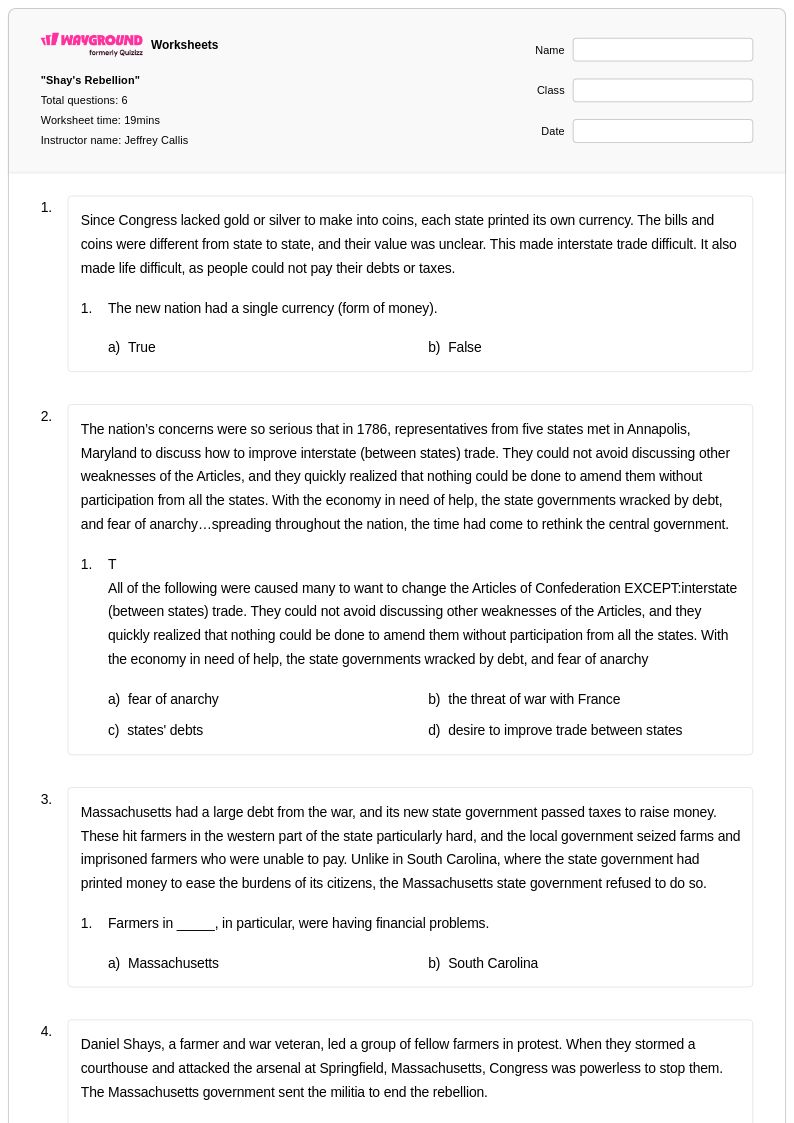
Teaching early rebellions effectively means grounding each uprising in its economic, social, and political context before asking students to draw comparisons across events. Start with primary source analysis — petitions, pamphlets, or government responses — to help students understand why ordinary people chose resistance. Connecting rebellions like Shays' Rebellion or the Whiskey Rebellion to the broader tensions around taxation, representation, and federal authority gives students a through-line that makes each event meaningful rather than isolated.
What exercises help students practice analyzing early rebellions?
Cause-and-effect organizers work well for early rebellions because each uprising has identifiable economic grievances, triggering events, and political consequences. Document analysis tasks — where students interpret a government proclamation or rebel manifesto — push beyond memorization into historical reasoning. Practice problems that ask students to connect a rebellion's outcome to changes in law or governance are especially effective at reinforcing lasting impact.
What mistakes do students commonly make when studying early rebellions?
A frequent misconception is that early rebellions were simply lawless uprisings rather than organized responses to specific political and economic failures. Students also tend to treat each rebellion as a standalone event rather than recognizing recurring patterns around taxation, land rights, and representation. Another common error is conflating the causes of one rebellion with another — for example, assuming Bacon's Rebellion and Shays' Rebellion shared the same grievances when their root causes and social compositions were quite different.
How do I use early rebellions worksheets to assess student understanding?
Early rebellions worksheets that incorporate document analysis and cause-and-effect reasoning make strong formative assessment tools because they require students to demonstrate understanding rather than just recall. Look for tasks that ask students to evaluate the significance of a rebellion's outcome or compare two uprisings — these reveal whether students can apply historical thinking skills. Reviewing common errors in student responses, such as misidentifying key figures or confusing timelines, helps pinpoint gaps before summative assessments.
How can I use Wayground's early rebellions worksheets in my classroom?
Wayground's early rebellions worksheets are available as printable PDFs for traditional classroom use and in digital formats for technology-integrated environments, giving teachers flexibility across in-person, hybrid, and remote settings. Teachers can also host worksheets directly as a quiz on Wayground, making it easy to assign interactive practice and collect student responses in one place. Each worksheet includes a detailed answer key, reducing prep time and supporting independent study as well as guided instruction.
How do I differentiate early rebellions instruction for students at different levels?
For students who need additional support, scaffolded graphic organizers that break down causes, key figures, and consequences into structured categories reduce cognitive load while keeping the historical content intact. Advanced learners benefit from comparative tasks that ask them to evaluate whether early rebellions succeeded or failed based on their political outcomes. On Wayground, teachers can apply individual accommodations such as reduced answer choices or read-aloud support to specific students, ensuring every learner can access the same core content without singling anyone out.

![TX24-25 - Early Statehood [and exam review] - Printable Early-rebellions Worksheets - Wayground](https://quizizz-static.s3.amazonaws.com/_media/worksheets-new/673380fae0dc7c828df7a248-tx24-25-early-statehood-and-exam-review)