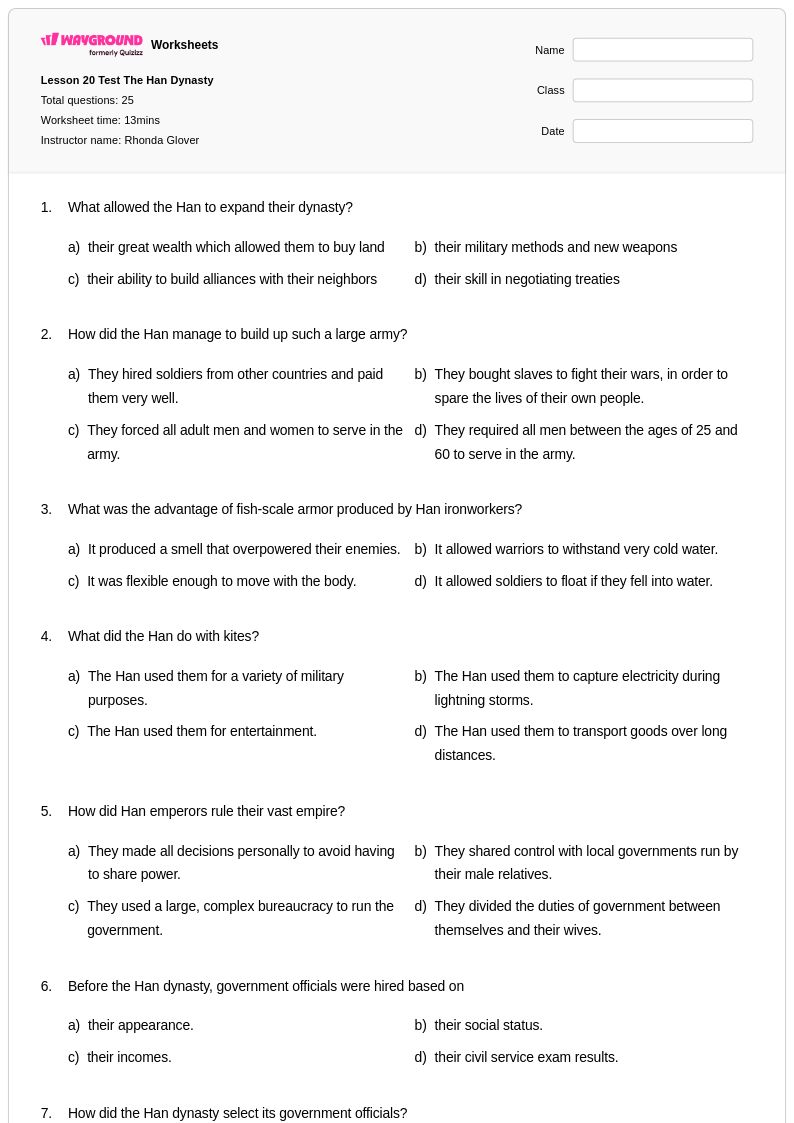
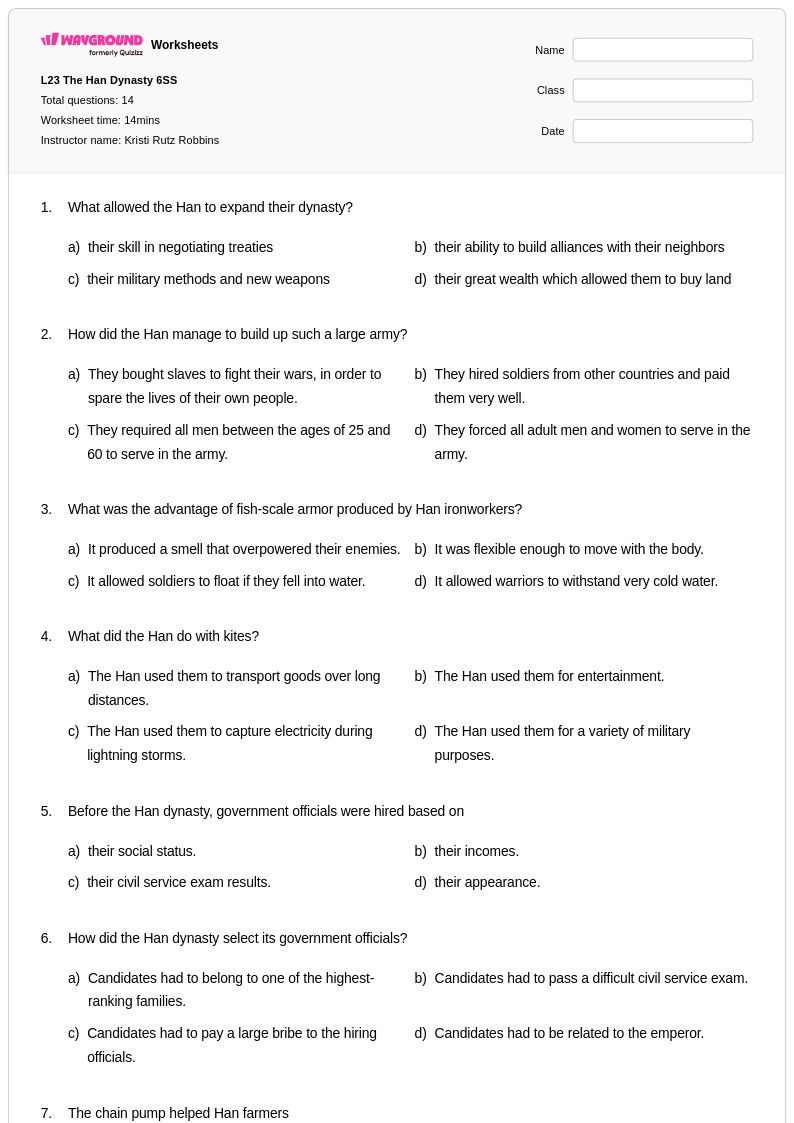
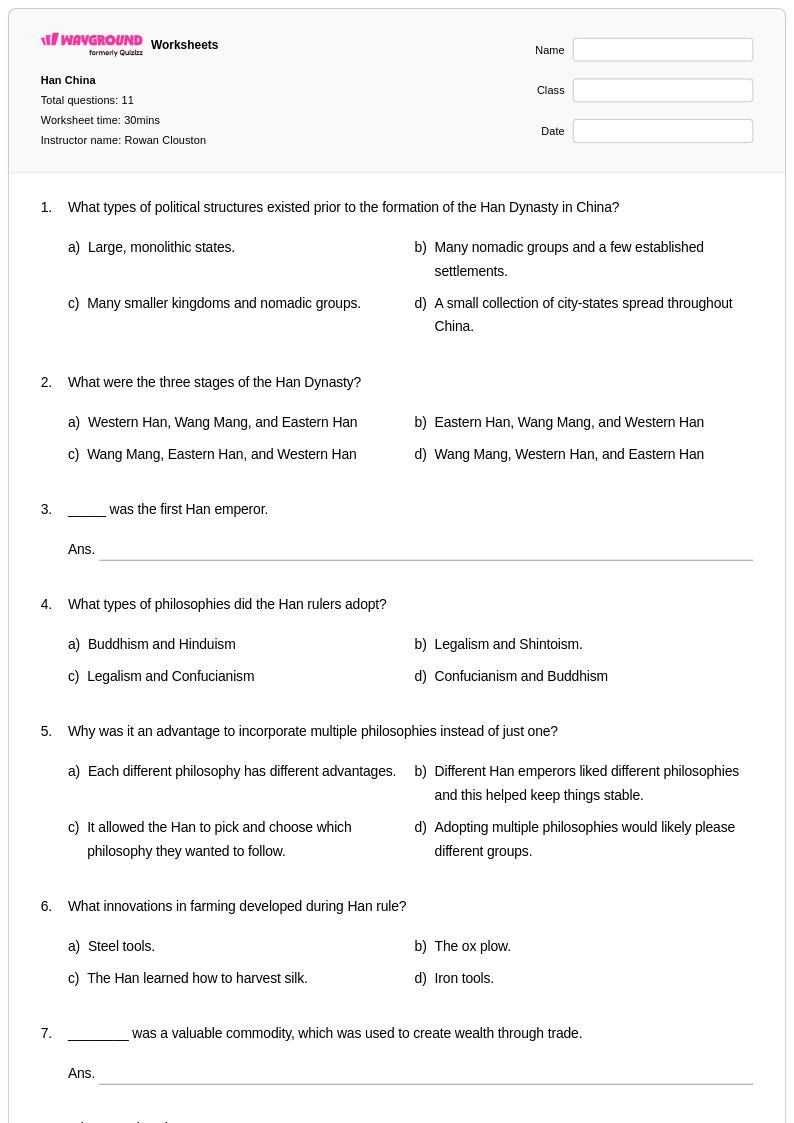
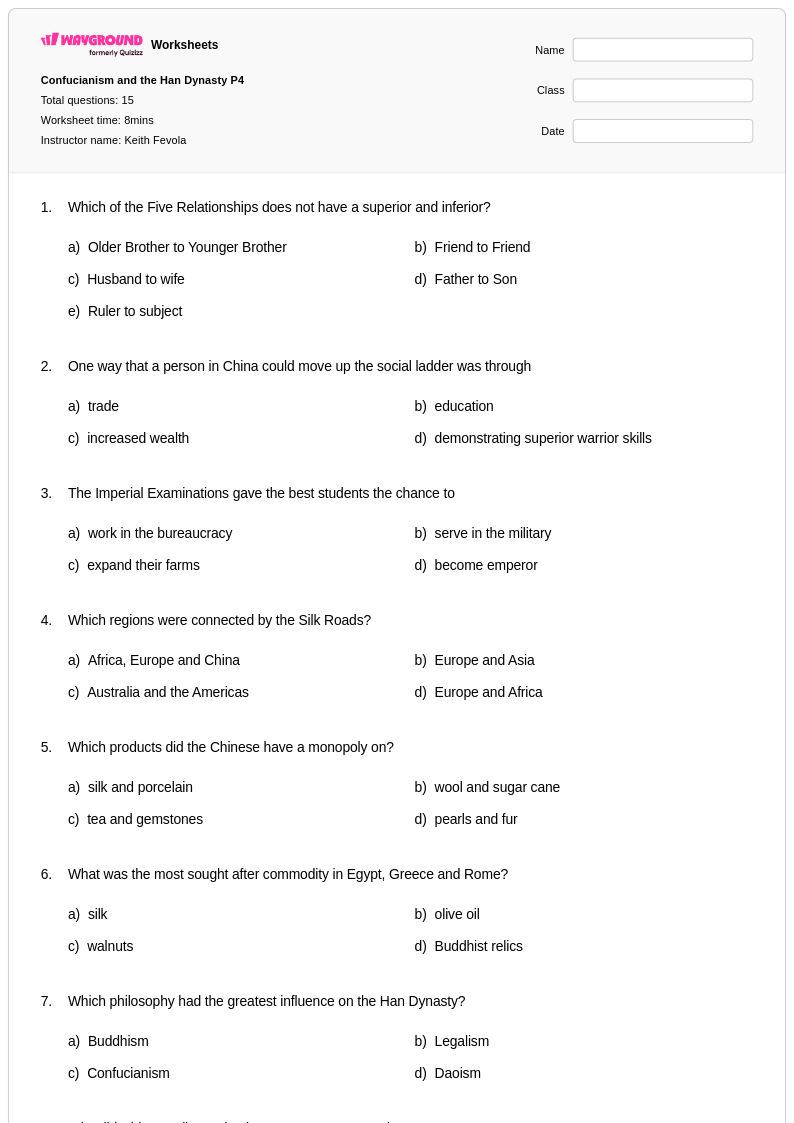
Explore Wayground's comprehensive collection of free Han Dynasty worksheets and printables that help students master ancient Chinese history through engaging practice problems and detailed answer keys.
The Han Dynasty worksheets available through Wayground (formerly Quizizz) provide comprehensive educational resources that immerse students in one of China's most influential historical periods, spanning from 206 BCE to 220 CE. These expertly crafted materials strengthen critical thinking skills by engaging students with the dynasty's governmental innovations, technological advancements, and cultural achievements that shaped Chinese civilization for centuries. Students explore the Silk Road's economic impact, examine the development of Confucian ideology in governance, and analyze the Han's administrative systems that became the foundation for future Chinese dynasties. Each worksheet includes detailed answer keys and is available as free printables in pdf format, featuring practice problems that challenge students to connect historical events with their lasting consequences on East Asian development.
Wayground (formerly Quizizz) supports educators with millions of teacher-created resources specifically designed for Han Dynasty instruction, offering robust search and filtering capabilities that allow teachers to locate materials perfectly suited to their classroom needs. The platform's standards alignment ensures worksheets meet curriculum requirements while differentiation tools enable teachers to customize content for diverse learning levels and abilities. These flexible resources are available in both printable and digital formats, including downloadable pdf versions that facilitate seamless integration into lesson planning. Teachers utilize these comprehensive worksheet collections for targeted skill practice, remediation support for struggling students, and enrichment activities for advanced learners, creating dynamic learning experiences that bring ancient Chinese history to life in modern classrooms.
FAQs
How do I teach the Han Dynasty to students?
Teaching the Han Dynasty effectively means anchoring instruction around three pillars: government, technology, and culture. Start with the dynasty's founding under Liu Bang and move through its administrative innovations, including the civil service exam system and Confucian-based governance. From there, connect political stability to economic expansion via the Silk Road, and close with an analysis of how Han achievements set the template for later Chinese dynasties. Primary source excerpts, timeline activities, and cause-and-effect organizers help students build a coherent narrative across the dynasty's 400-year span.
What are the most important topics to cover when teaching the Han Dynasty?
Core topics include the centralization of imperial government, the adoption of Confucianism as state ideology, the expansion and economic significance of the Silk Road, advances in technology such as papermaking and iron casting, and the Han's lasting influence on Chinese cultural identity. Teachers should also address the dynasty's eventual decline through internal corruption and regional fragmentation, which helps students understand dynastic cycles as a recurring historical pattern in Chinese history.
What exercises help students practice their knowledge of the Han Dynasty?
Effective practice exercises include document-based questions that ask students to analyze Han government edicts or Silk Road trade records, cause-and-effect charts linking specific policies to long-term outcomes, and comparison activities that contrast the Han with the preceding Qin Dynasty. Fill-in-the-blank and short-answer worksheets targeting key vocabulary — such as bureaucracy, Confucianism, and tributary states — reinforce content retention, while map-based activities tracing Silk Road trade routes build spatial and economic reasoning.
What mistakes do students commonly make when learning about the Han Dynasty?
Students frequently conflate the Han Dynasty with the Qin Dynasty, particularly around the topics of centralized government and the Great Wall, since both dynasties are taught in close sequence. Another common error is treating the Silk Road as a single road rather than a network of overland and maritime routes. Students also tend to overstate the role of trade goods like silk while underestimating the movement of ideas, religions, and technologies along the same routes. Clarifying these misconceptions early prevents confusion in later units on Tang and Song China.
How can I use Han Dynasty worksheets to support different skill levels in my classroom?
Han Dynasty worksheets can be tiered by task demand: struggling learners benefit from guided reading frames and vocabulary-support versions, while advanced students can engage with extended analysis prompts that ask them to evaluate the Silk Road's geopolitical consequences or compare Han Confucianism to earlier Zhou-era thought. On Wayground, teachers can apply accommodations such as read-aloud support, reduced answer choices, and extended time to individual students when assigning digital versions, ensuring the same content is accessible across learning levels without requiring separate lesson plans.
How do I use Han Dynasty worksheets from Wayground in my class?
Wayground's Han Dynasty worksheets are available as printable PDFs for traditional classroom use and in digital formats for technology-integrated environments, including the option to host them as a live quiz on the platform. Teachers can download and distribute print versions for independent practice, homework, or test prep, or assign the digital format for self-paced work or whole-class review sessions. Wayground also allows teachers to filter resources by skill focus, making it straightforward to locate worksheets targeting specific topics such as Silk Road economics, Han government structure, or cultural achievements.