Free Printable Fission and Fusion Worksheets for Grade 11
Explore Grade 11 fission and fusion worksheets from Wayground that help students master nuclear physics concepts through comprehensive printables, practice problems, and answer keys in convenient PDF format.
Explore printable Fission and Fusion worksheets for Grade 11
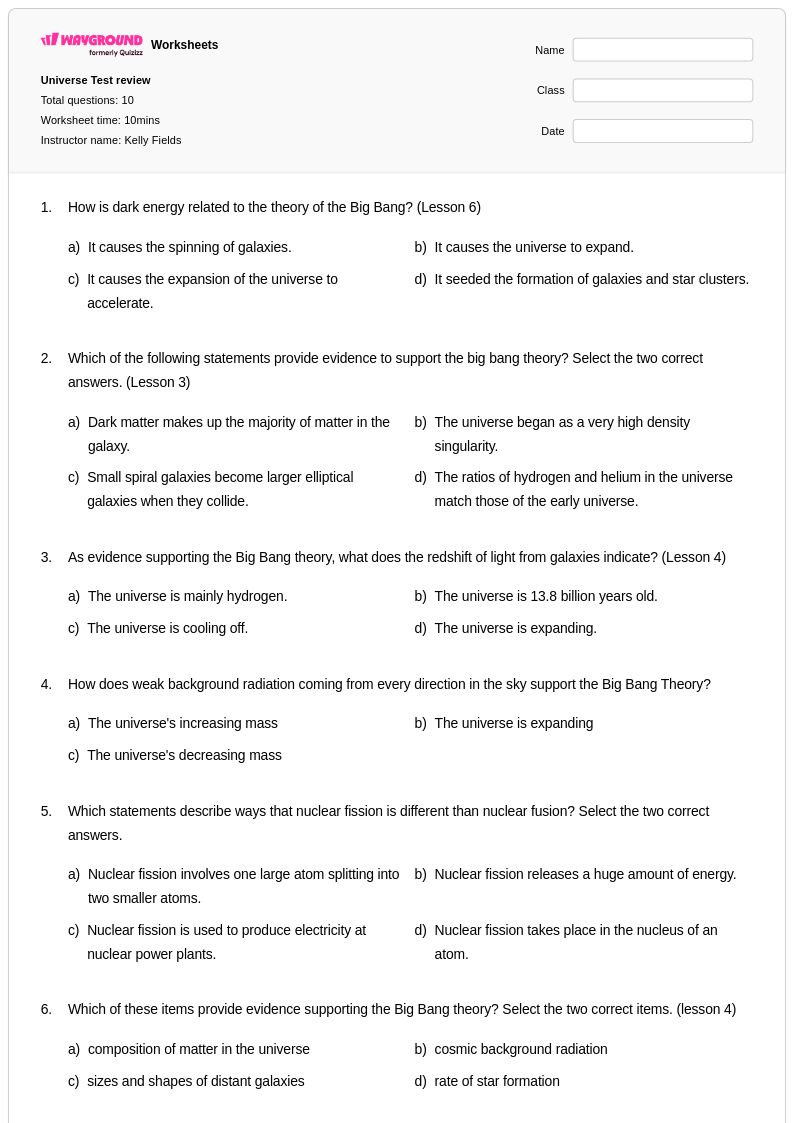
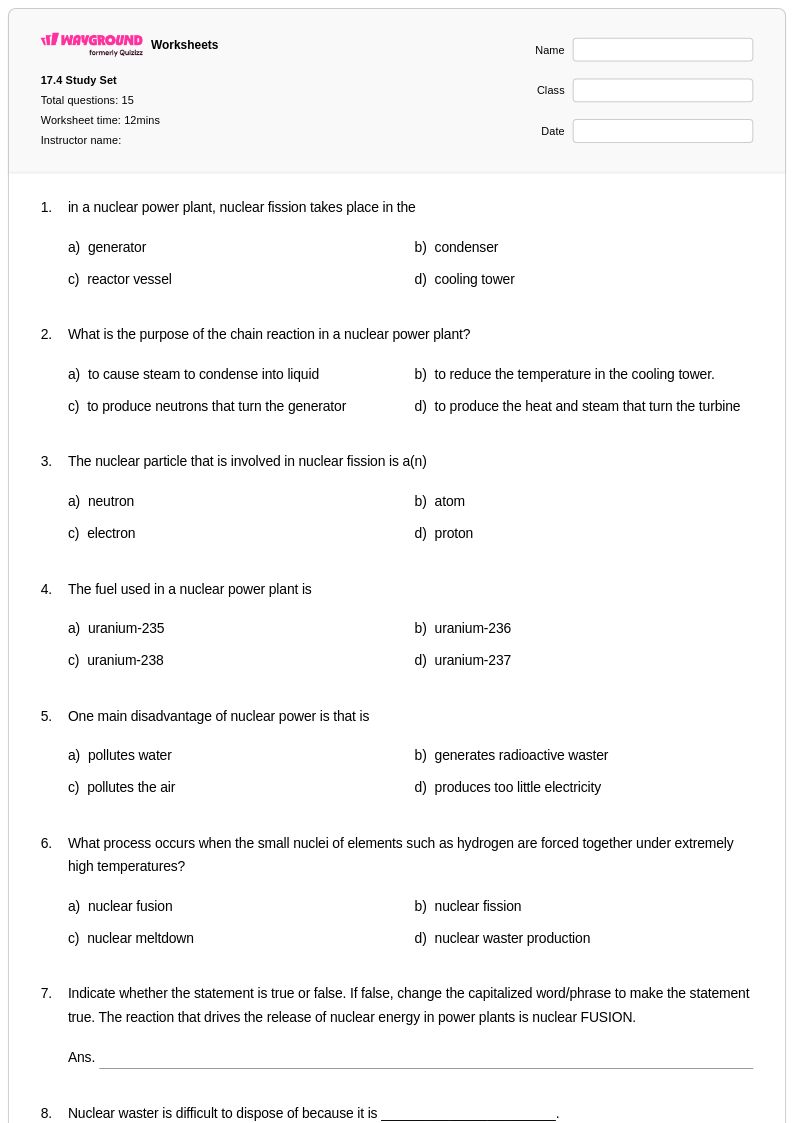
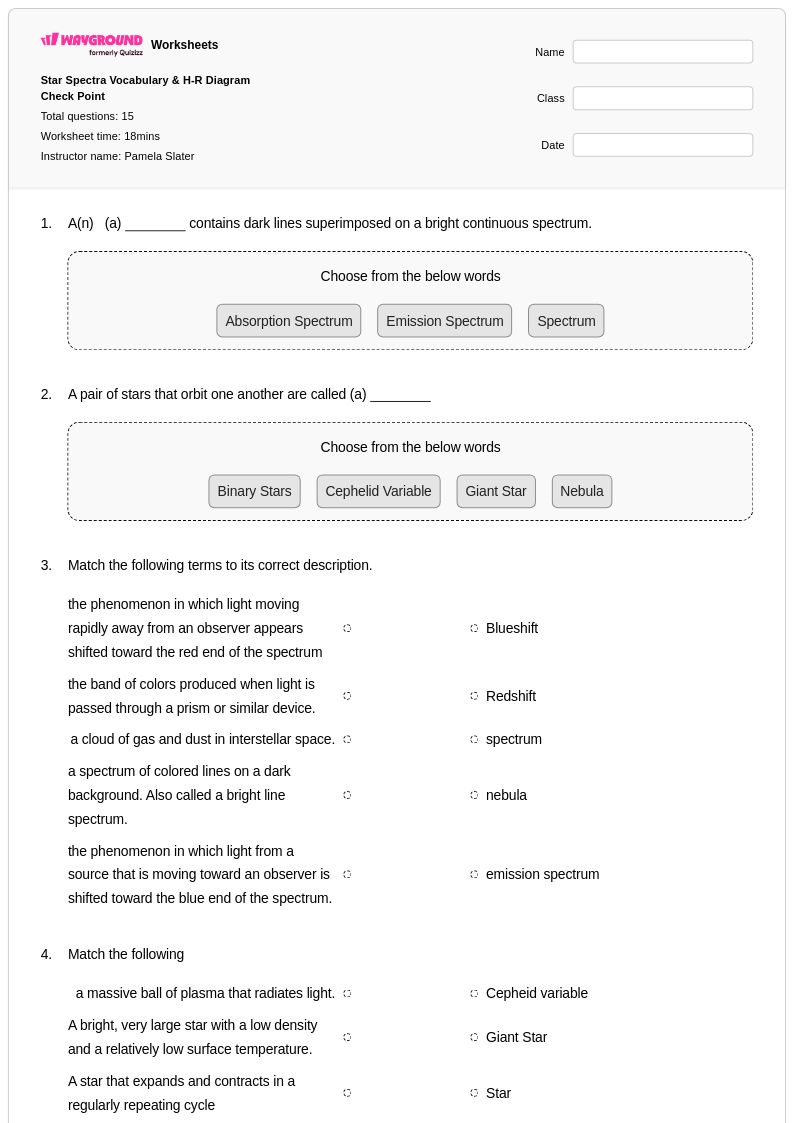
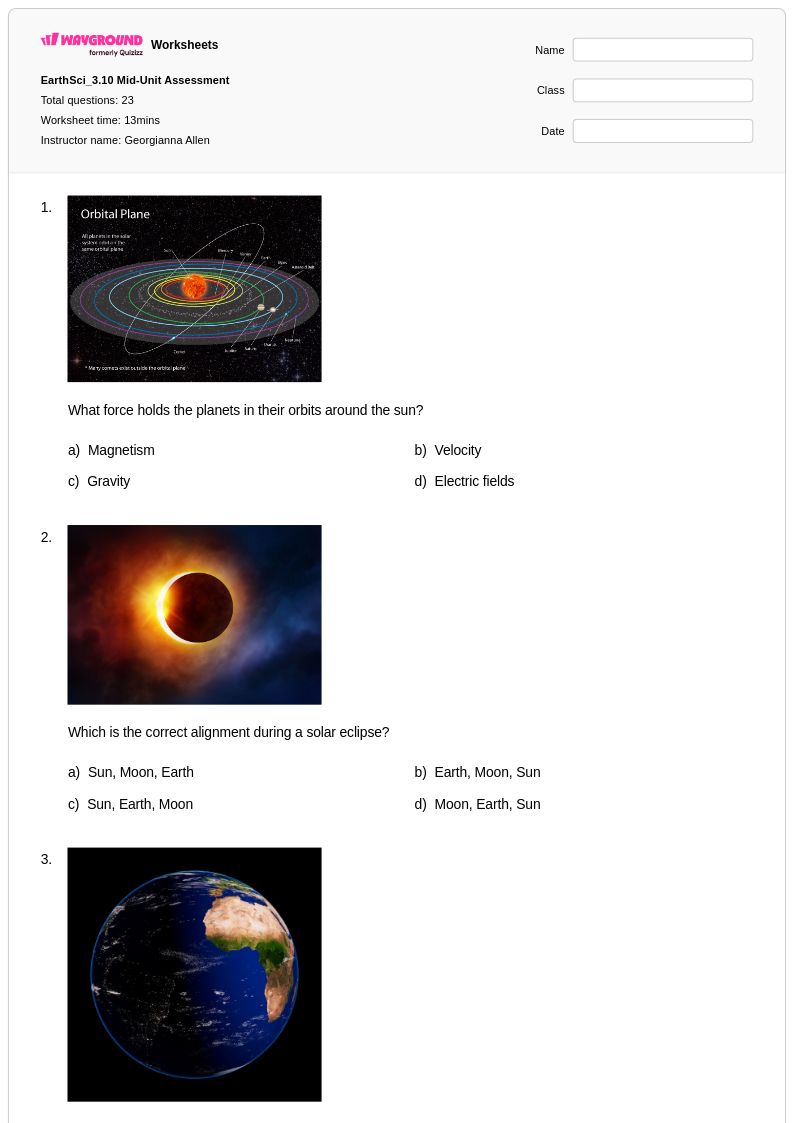
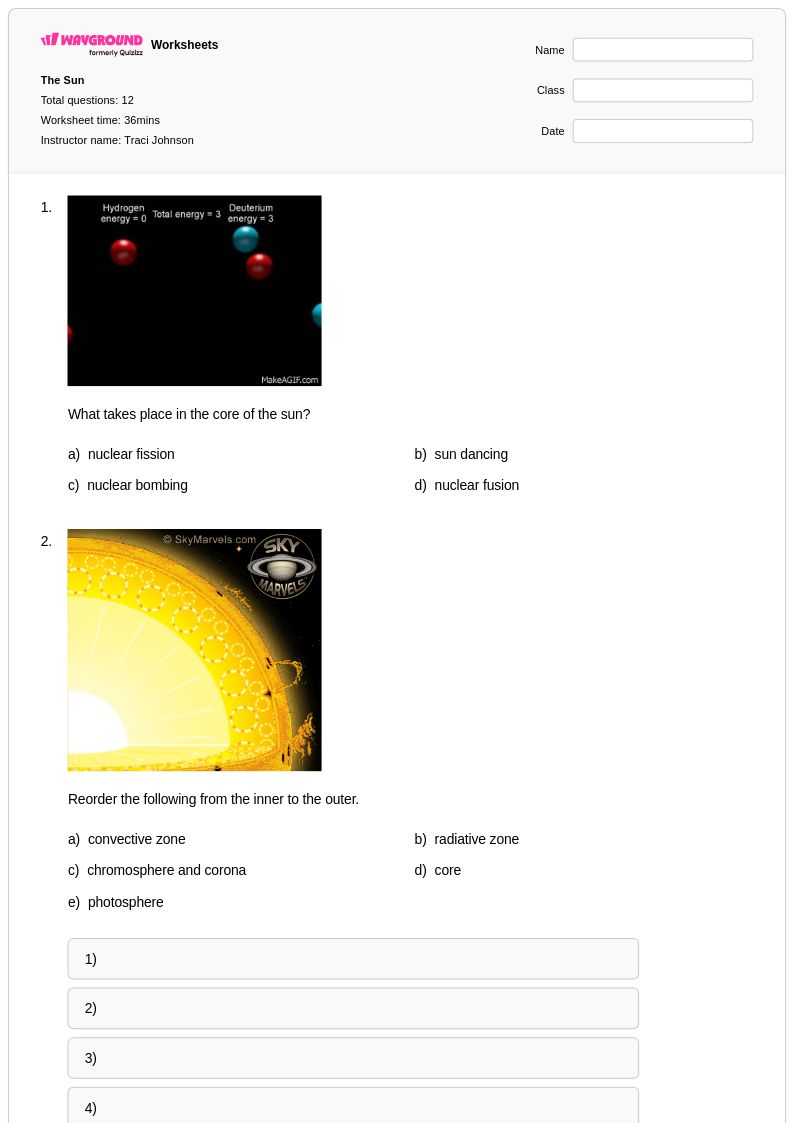
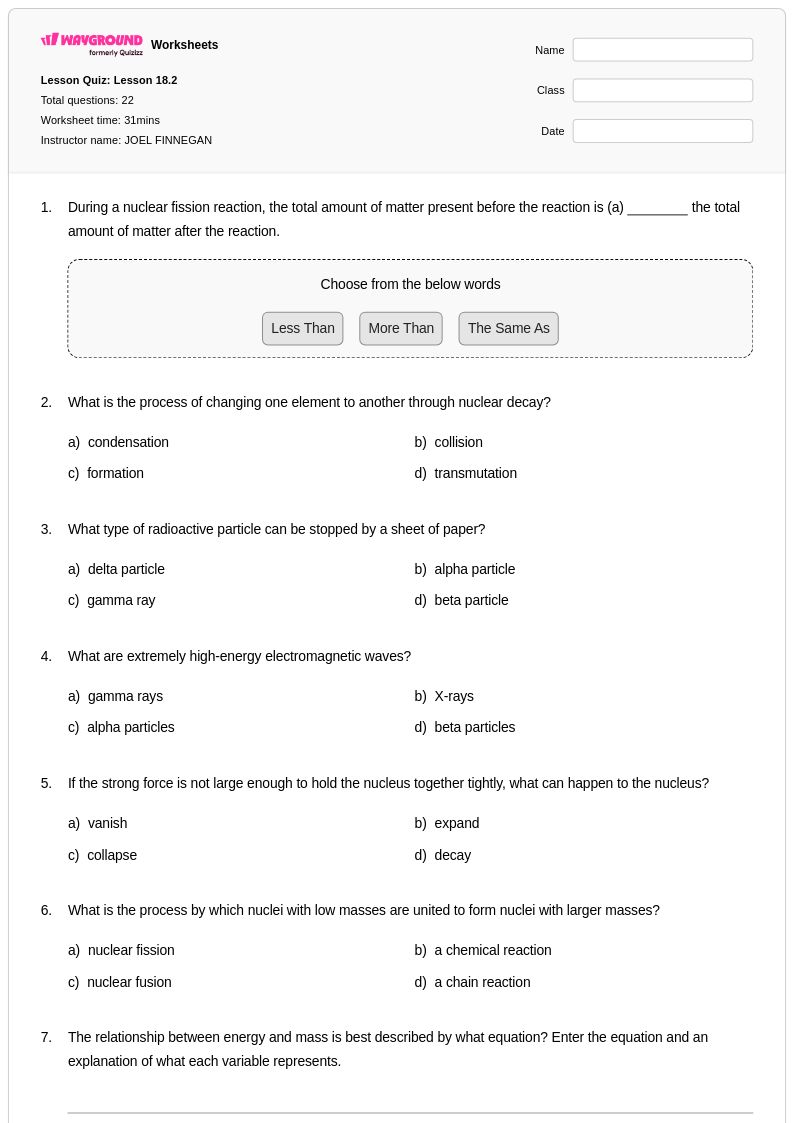
Fission and fusion worksheets for Grade 11 students available through Wayground (formerly Quizizz) provide comprehensive coverage of nuclear physics concepts essential for advanced high school science curricula. These expertly designed resources help students master the fundamental differences between nuclear fission and fusion processes, including energy calculations, nuclear equations, binding energy concepts, and real-world applications in power generation and stellar processes. Students engage with practice problems that reinforce critical thinking about nuclear stability, mass-energy equivalence, and the conditions required for each nuclear reaction type. The collection includes detailed answer keys and free printable materials that support both independent study and classroom instruction, ensuring students develop strong analytical skills in nuclear physics while building confidence with complex scientific calculations and theoretical applications.
Wayground (formerly Quizizz) empowers educators with millions of teacher-created fission and fusion worksheet resources that streamline lesson planning and enhance student learning outcomes. The platform's robust search and filtering capabilities allow teachers to quickly locate materials aligned with specific learning standards and curriculum requirements, while differentiation tools enable customization for diverse learning needs and ability levels. These comprehensive worksheet collections are available in both printable pdf formats and interactive digital versions, providing flexibility for various instructional approaches including traditional classroom settings, hybrid learning environments, and remote education scenarios. Teachers can efficiently implement targeted skill practice, remediation activities for struggling students, and enrichment opportunities for advanced learners, all while accessing professionally developed content that maintains academic rigor and pedagogical effectiveness in nuclear physics education.
FAQs
How do I teach fission and fusion in a high school physics class?
Start by grounding students in atomic structure and nuclear binding energy before introducing fission and fusion as separate processes. Teach fission first using the uranium-235 chain reaction as a concrete example, then contrast it with fusion by examining hydrogen nuclei combining in stellar cores. Connecting both processes to real-world contexts, such as nuclear power plants for fission and the Sun for fusion, helps students move from abstract equations to meaningful understanding.
What exercises help students practice fission and fusion concepts?
Effective practice includes mass-energy conversion problems using Einstein's E=mc² equation, nuclear equation balancing tasks where students track atomic and mass numbers, and comparison charts that require students to contrast the conditions, fuels, and energy outputs of fission versus fusion. Problems that ask students to calculate energy released during specific reactions reinforce quantitative reasoning alongside conceptual understanding.
What mistakes do students commonly make when learning about fission and fusion?
Students frequently confuse which process applies to which elements, mistakenly believing fusion splits atoms or that fission can occur in light nuclei. A persistent misconception is that both processes always release the same amount of energy regardless of the nucleus involved, when in fact energy release depends on the binding energy curve. Students also struggle with mass defect calculations, often forgetting to convert mass differences to energy using consistent units.
How do I help students understand the difference between nuclear fission and nuclear fusion?
Use the nuclear binding energy curve as a visual anchor: fission is energetically favorable for heavy nuclei like uranium, while fusion is favorable for light nuclei like hydrogen. A side-by-side comparison activity, where students map the inputs, outputs, conditions, and applications of each process, is more effective than treating them separately. Emphasizing that both processes release energy by moving nuclei toward the iron peak on the binding energy curve gives students a unifying framework.
How can I use fission and fusion worksheets in my classroom?
Fission and fusion worksheets on Wayground are available as printable PDFs for traditional classroom use and in digital formats for technology-integrated environments, including the option to host them as a quiz directly on Wayground. Printable versions work well for guided note-taking or lab follow-up activities, while digital formats allow teachers to assign practice asynchronously or use Wayground's accommodation tools, such as read aloud or extended time, for students who need additional support.
How do I address different skill levels when teaching nuclear fission and fusion?
Differentiate by varying the complexity of problems: beginning learners benefit from labeling diagrams of chain reactions and matching vocabulary, while advanced students can tackle multi-step mass-energy calculations and analyze engineering constraints on fusion reactors. On Wayground, teachers can apply student-level accommodations, including reduced answer choices, read aloud, and extended time, to individual students without alerting the rest of the class, making it practical to support diverse learners within a single assignment.