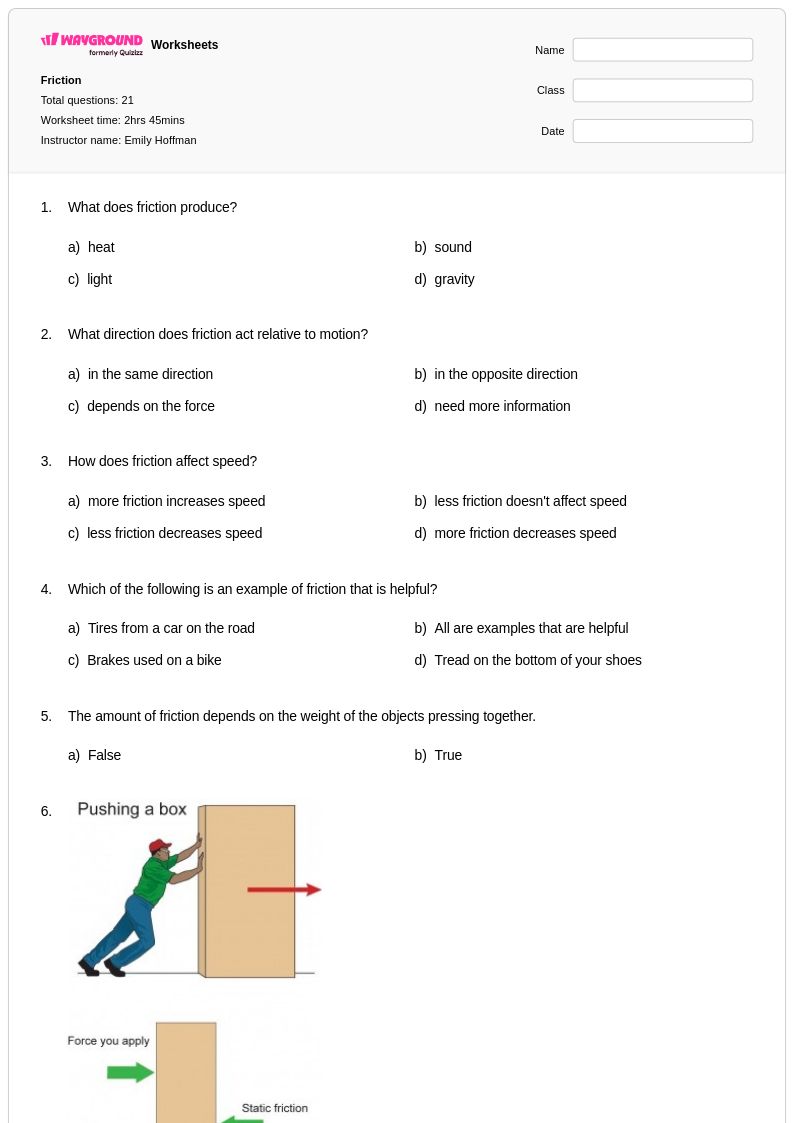
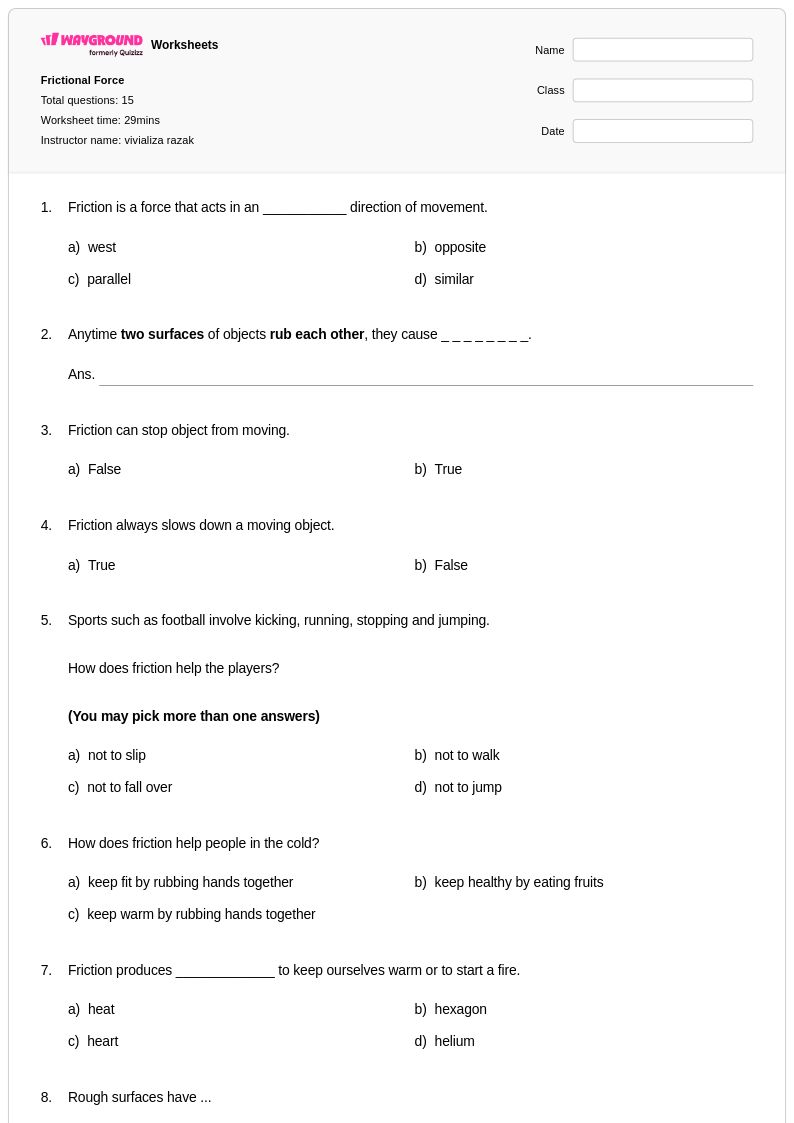
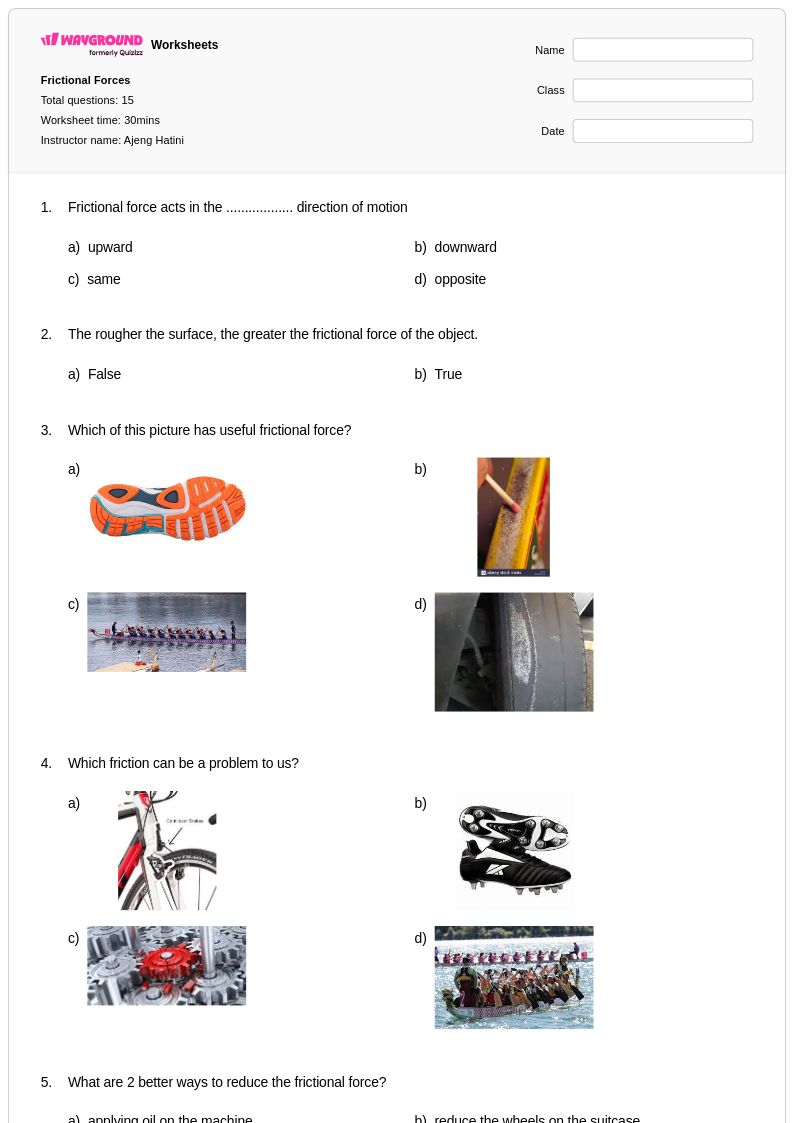
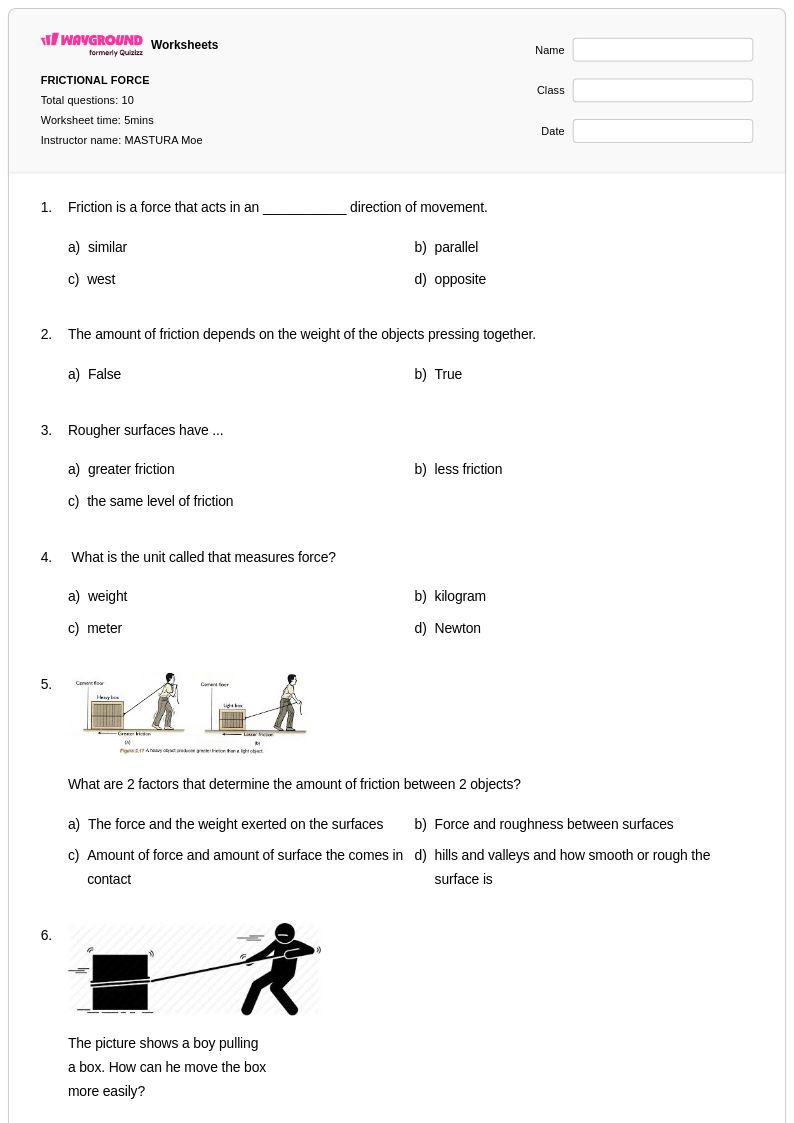
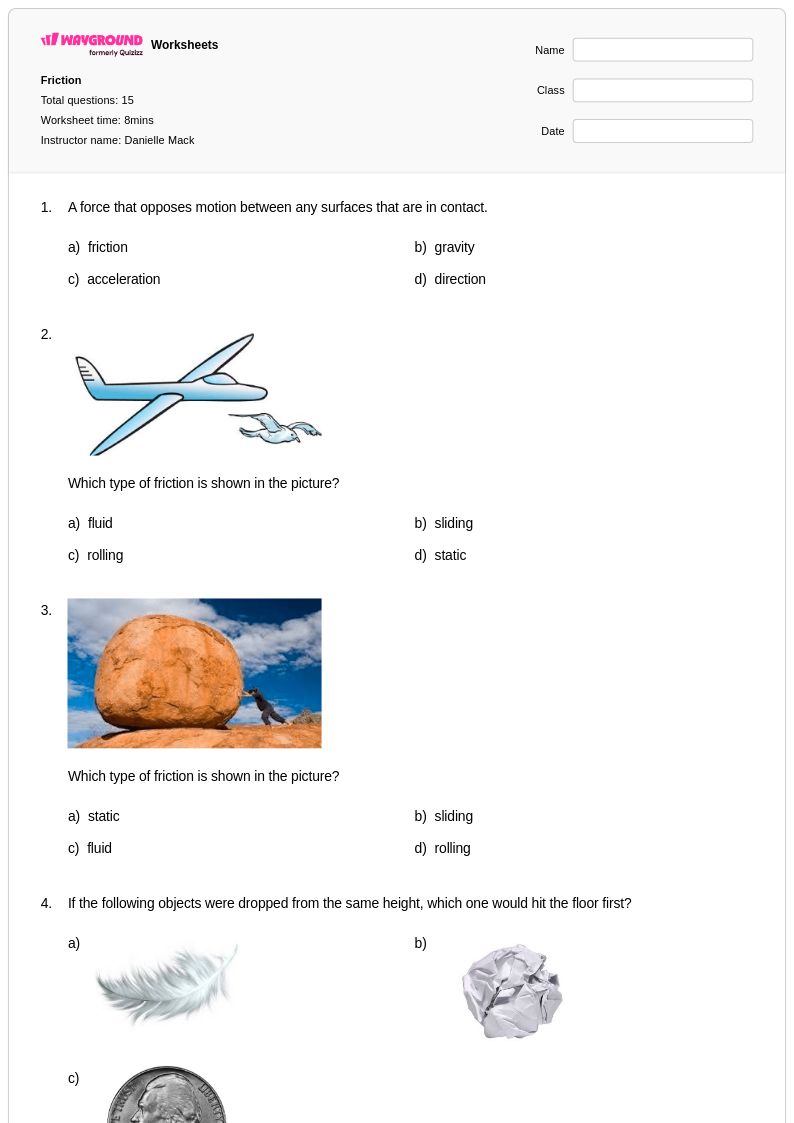
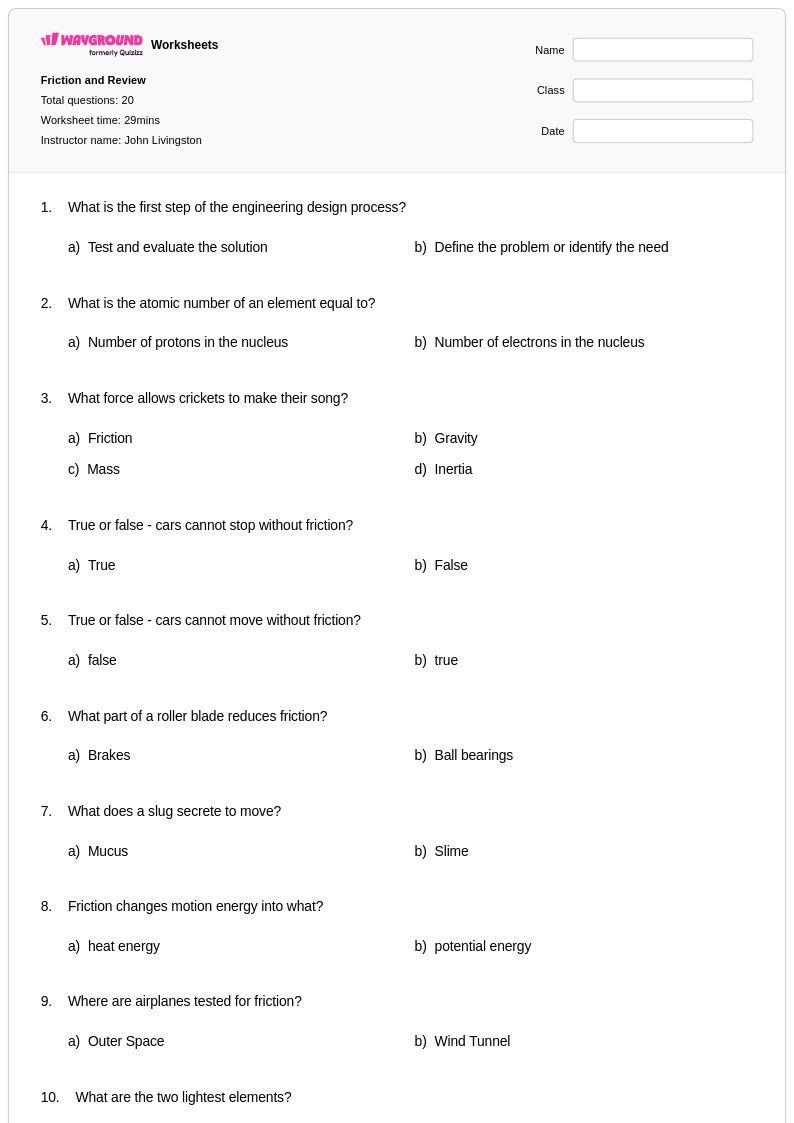
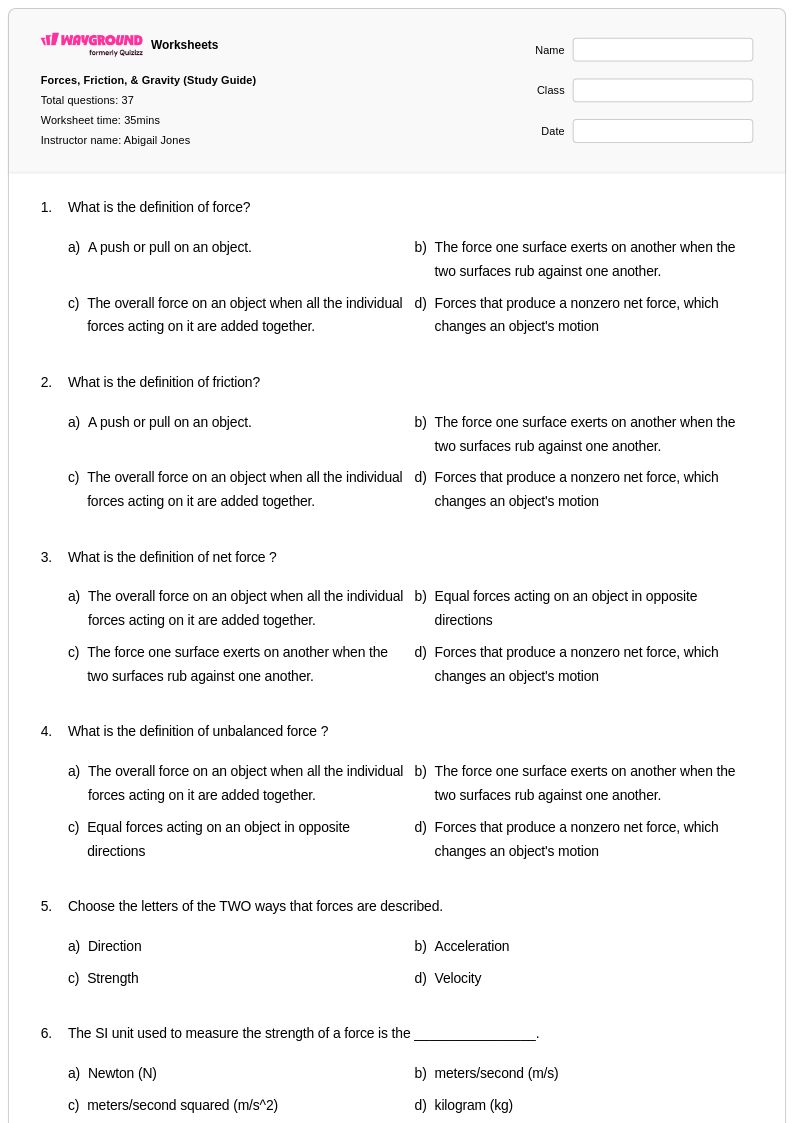
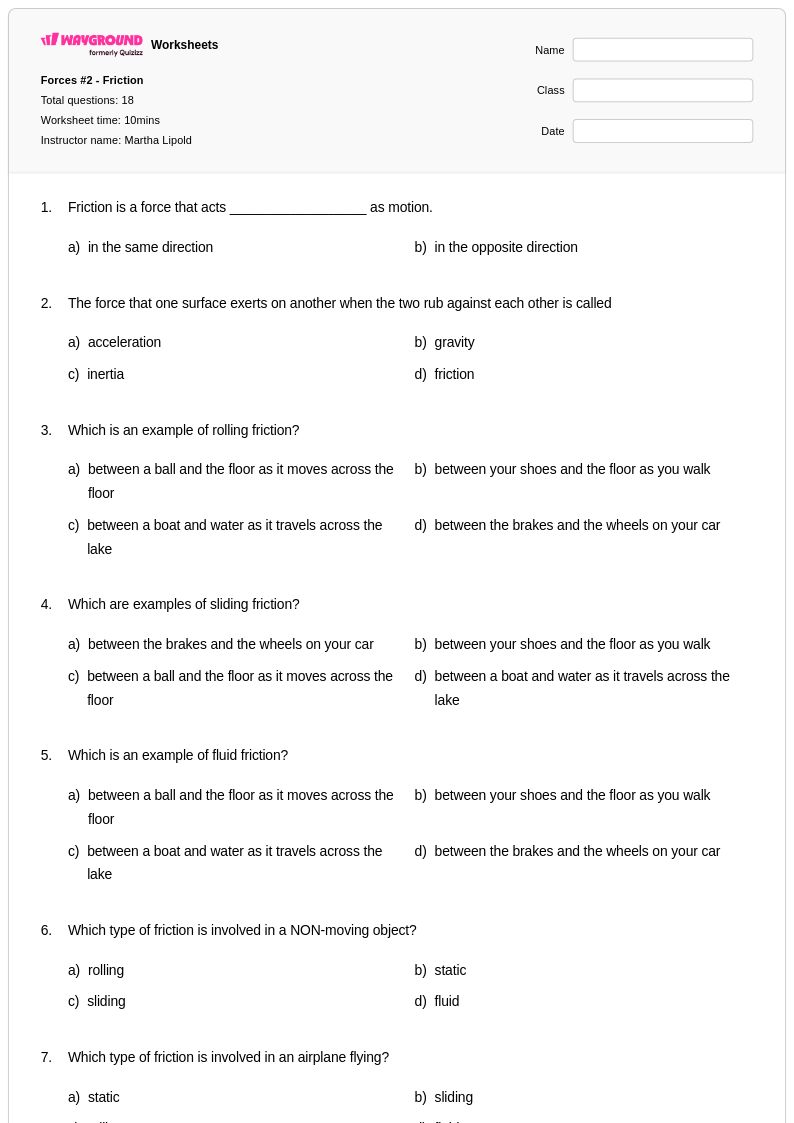
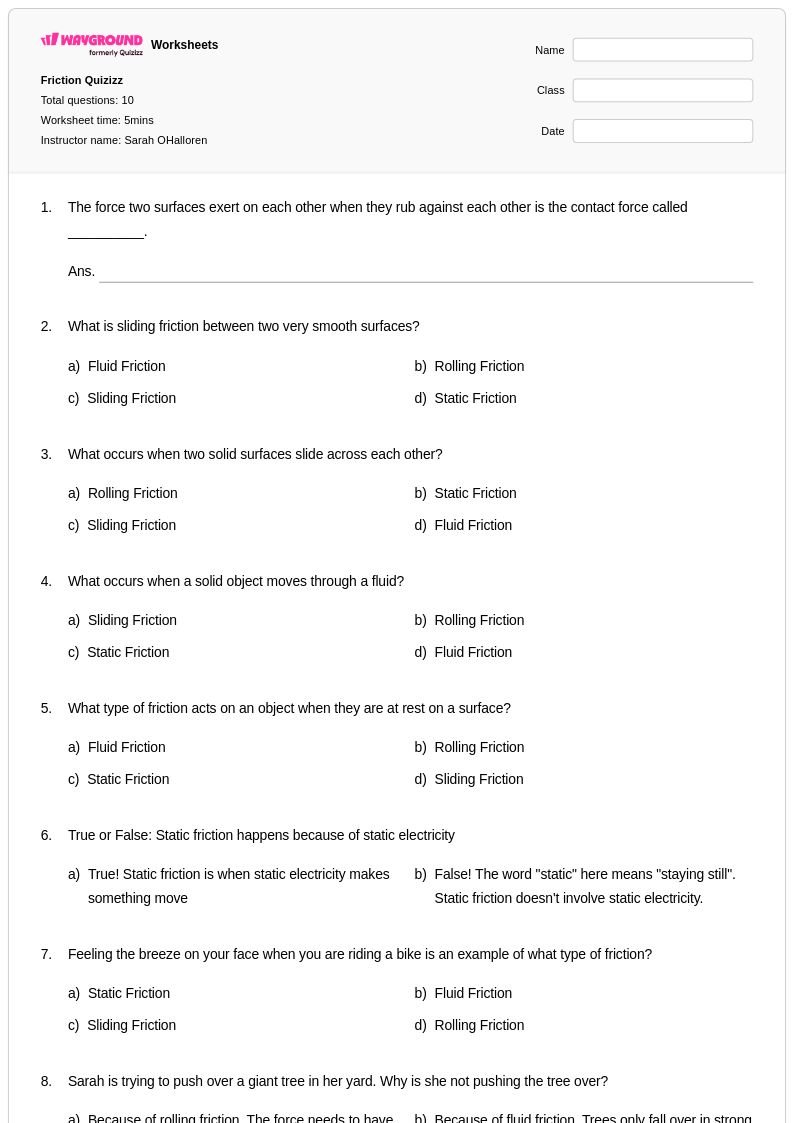
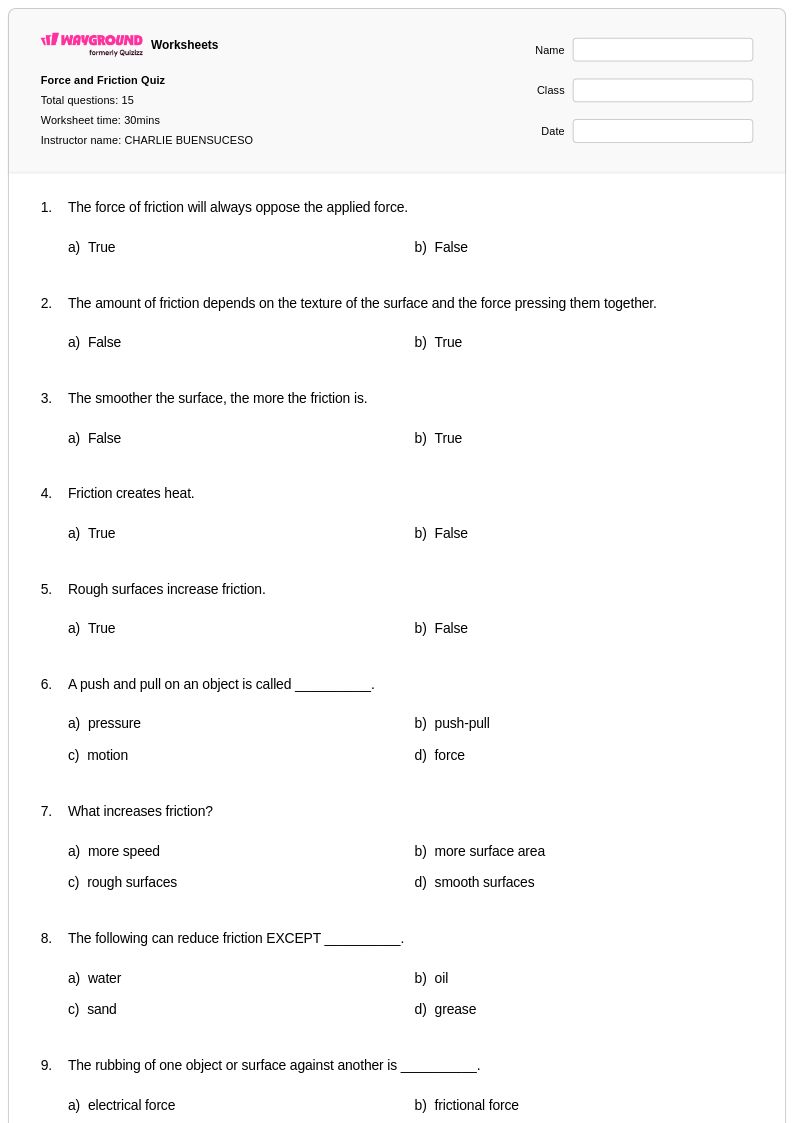
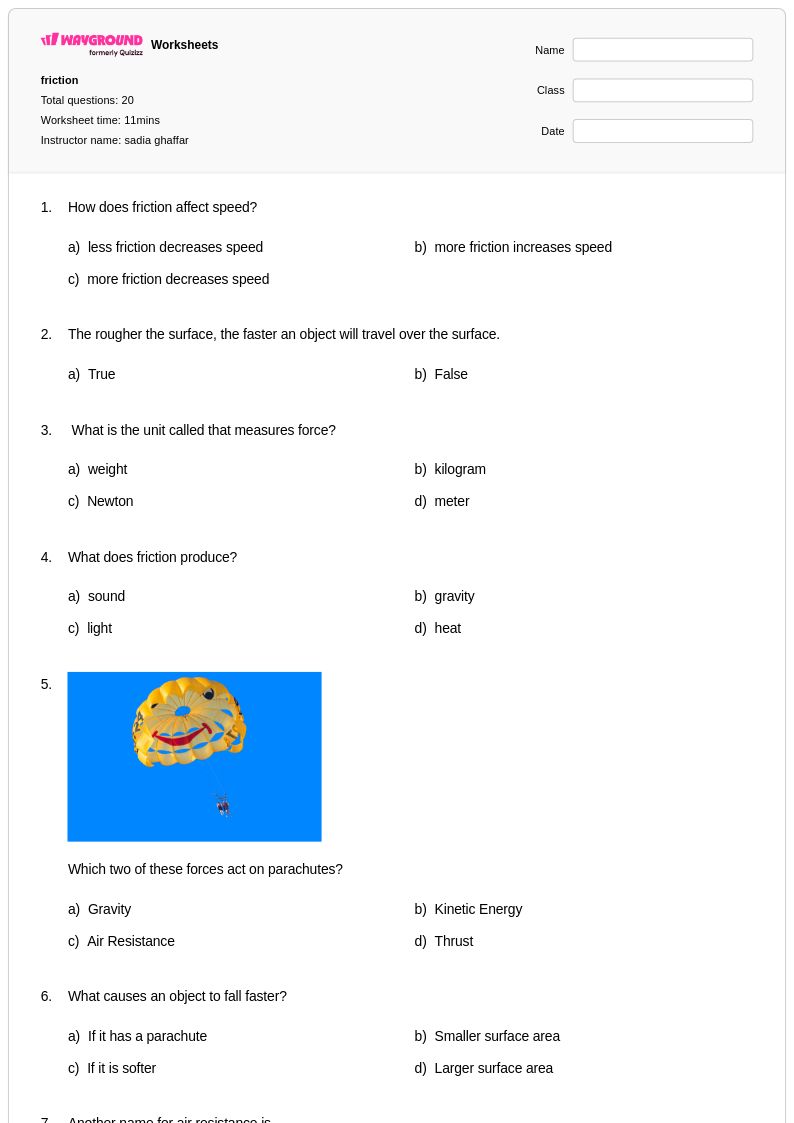
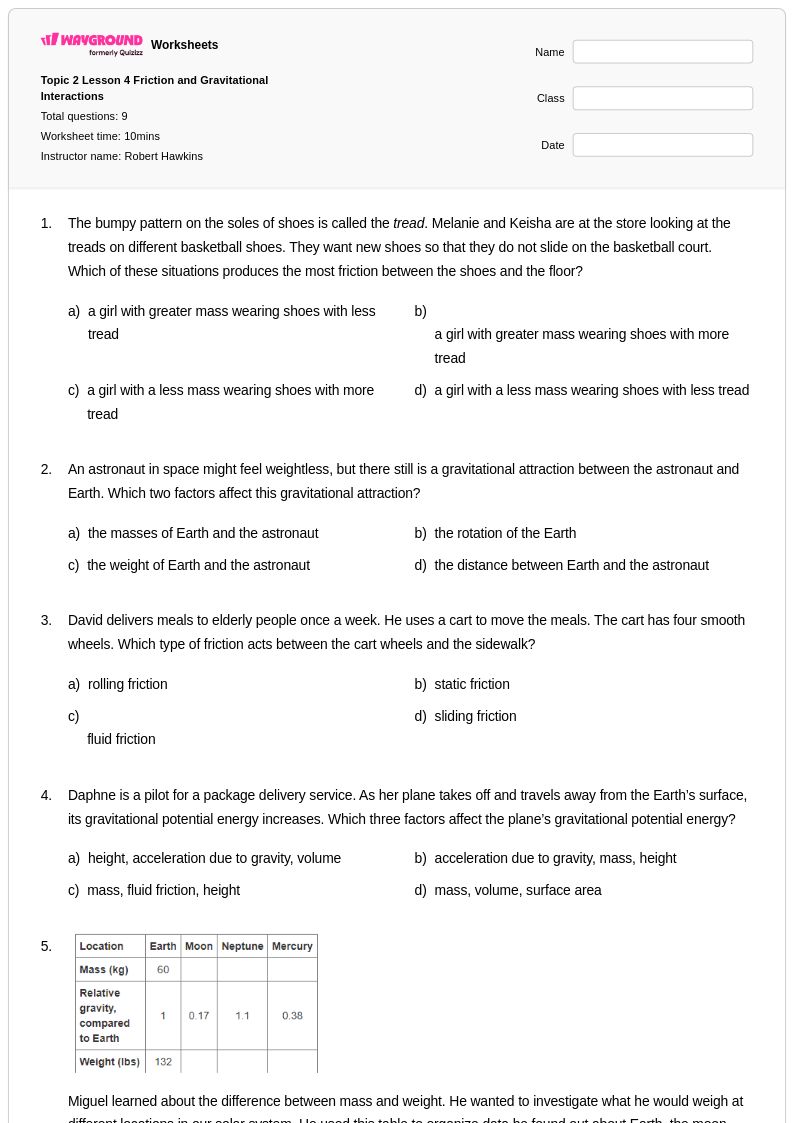
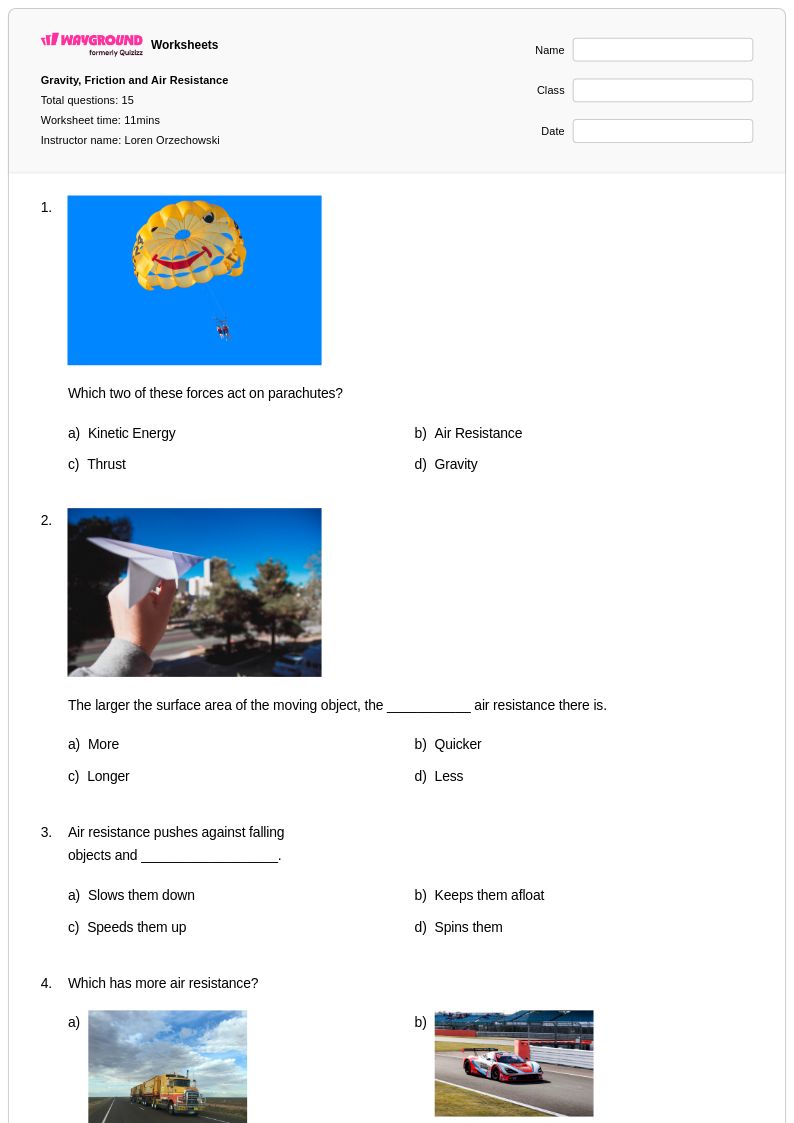
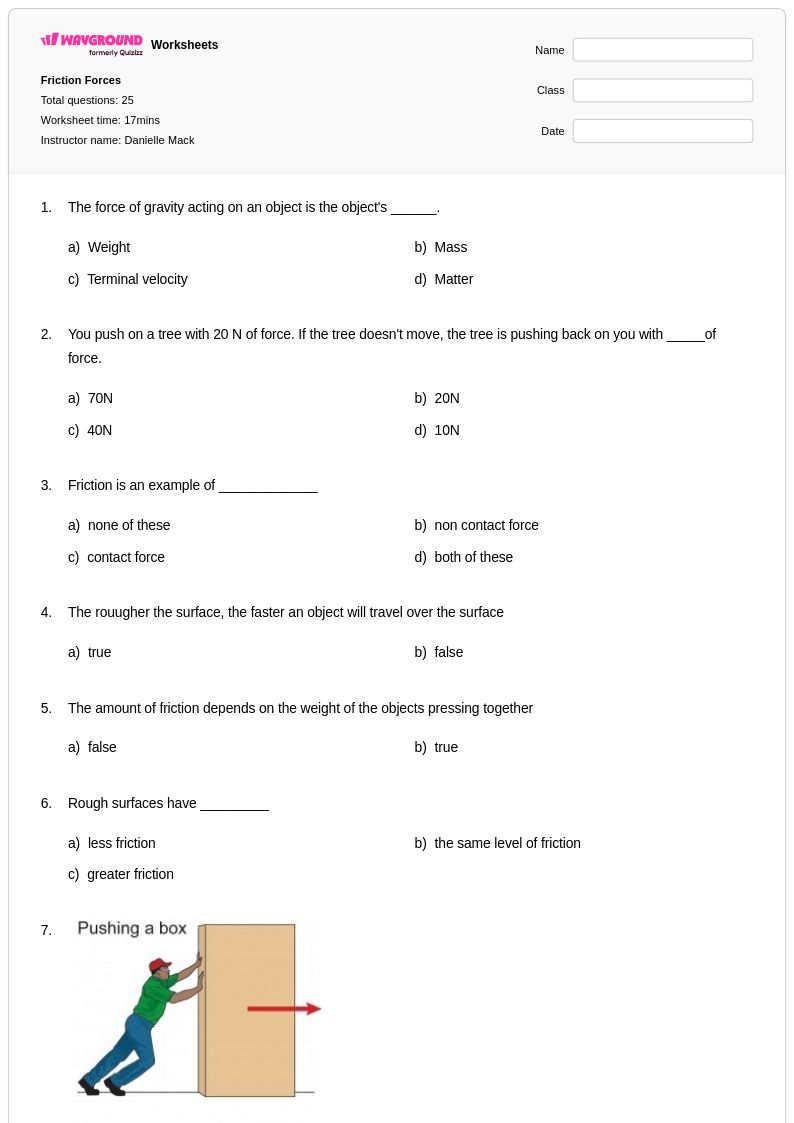
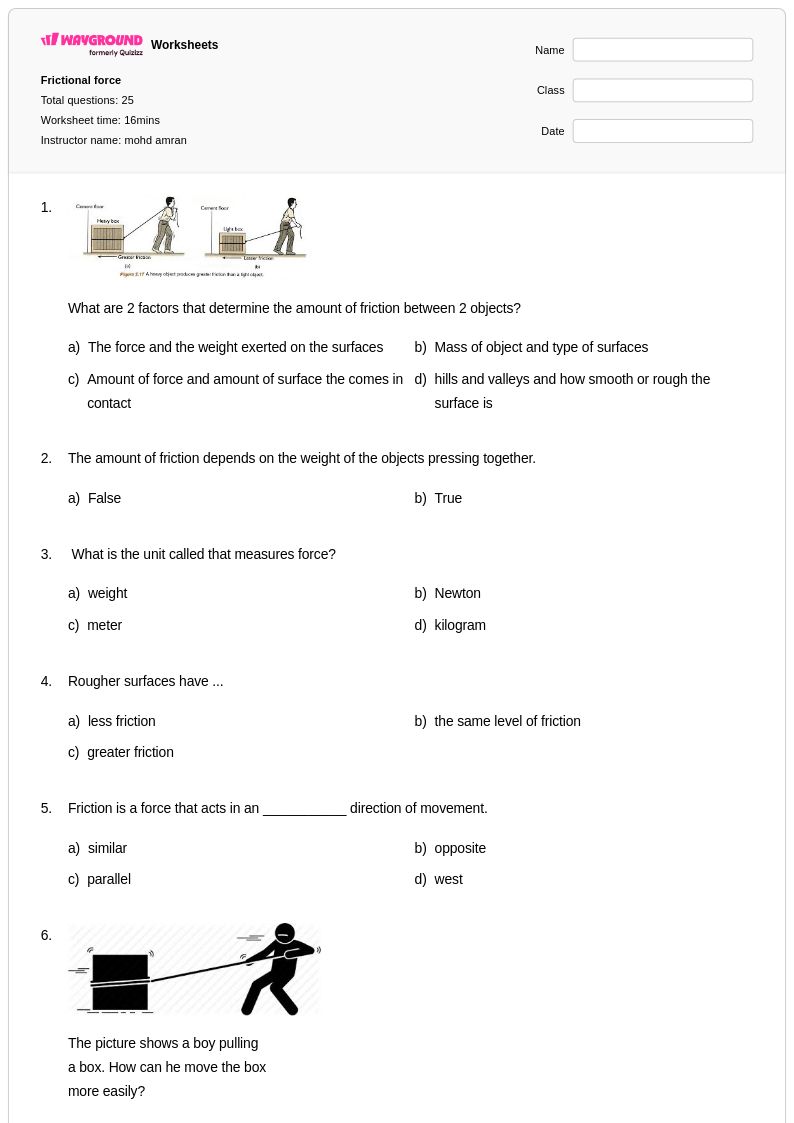
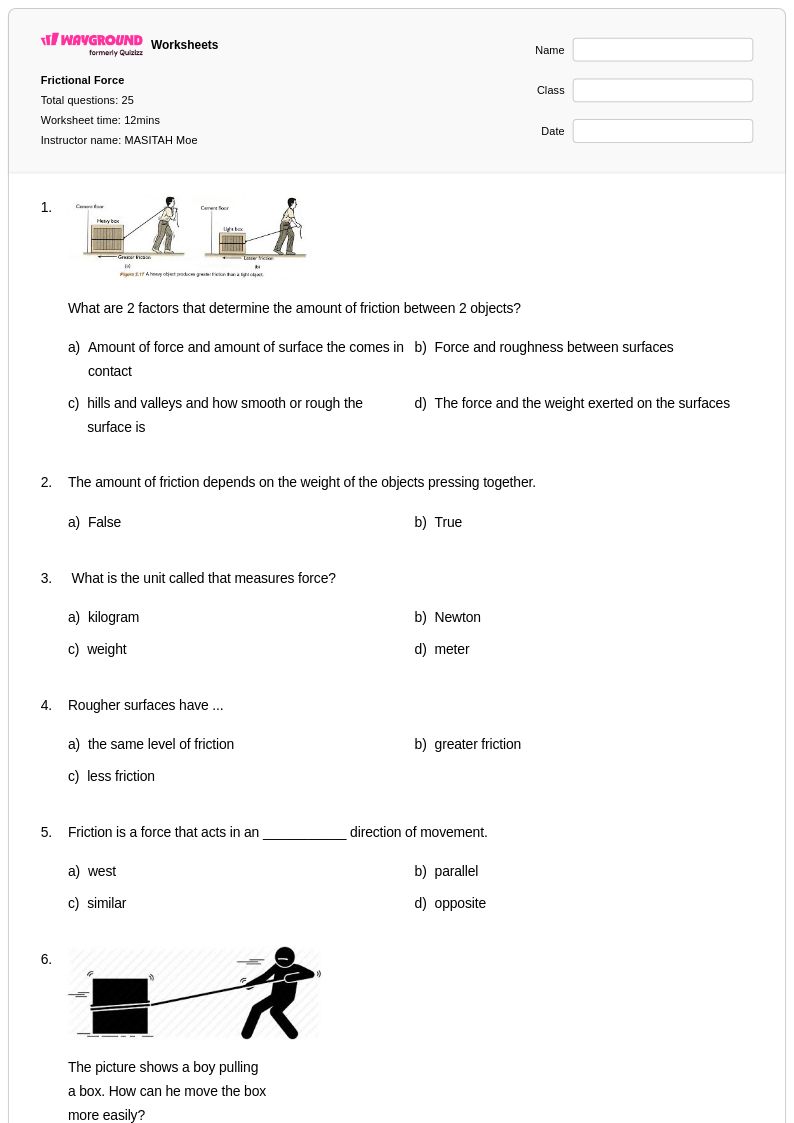
Grade 6 friction worksheets from Wayground help students explore how surfaces interact and affect motion through engaging printables, practice problems, and comprehensive answer keys for effective science learning.
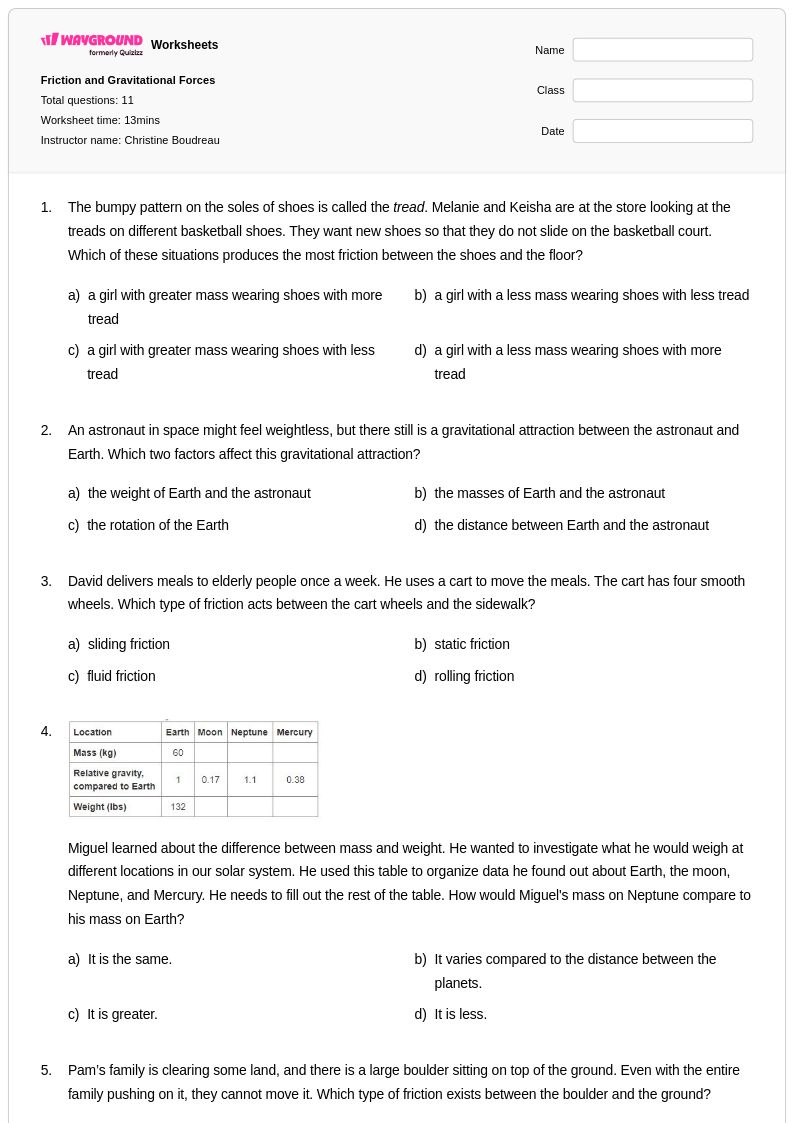
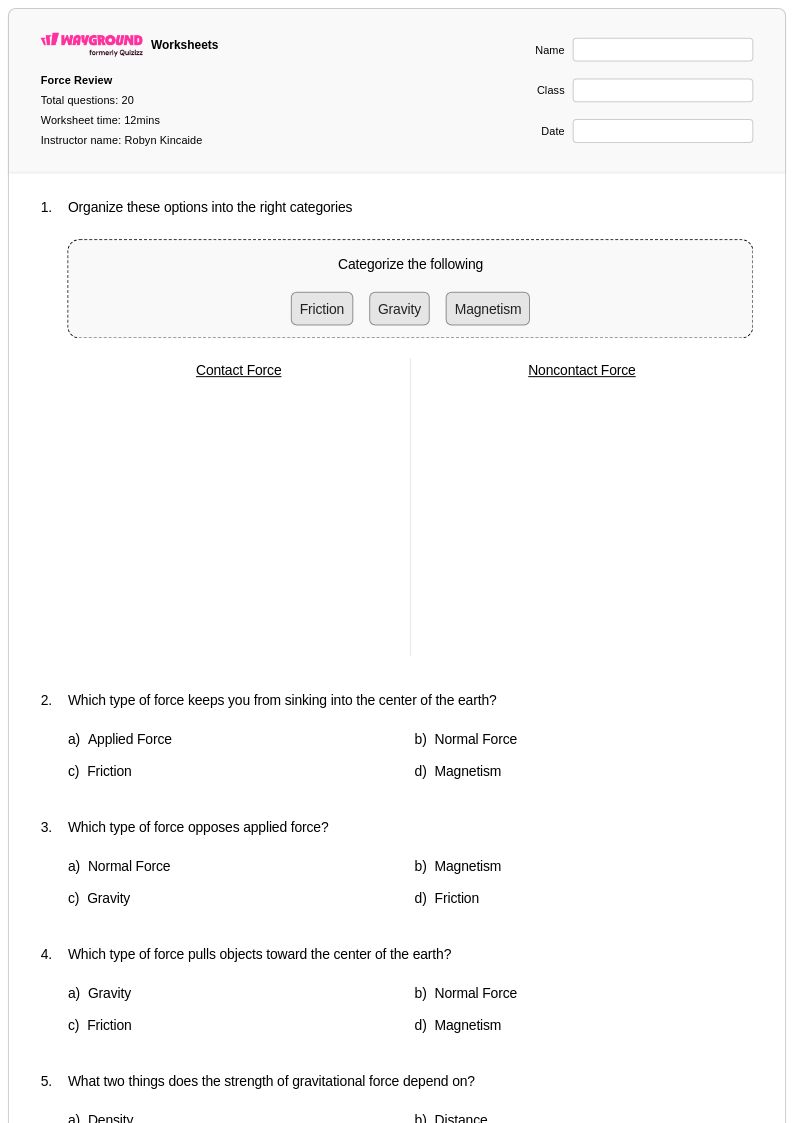
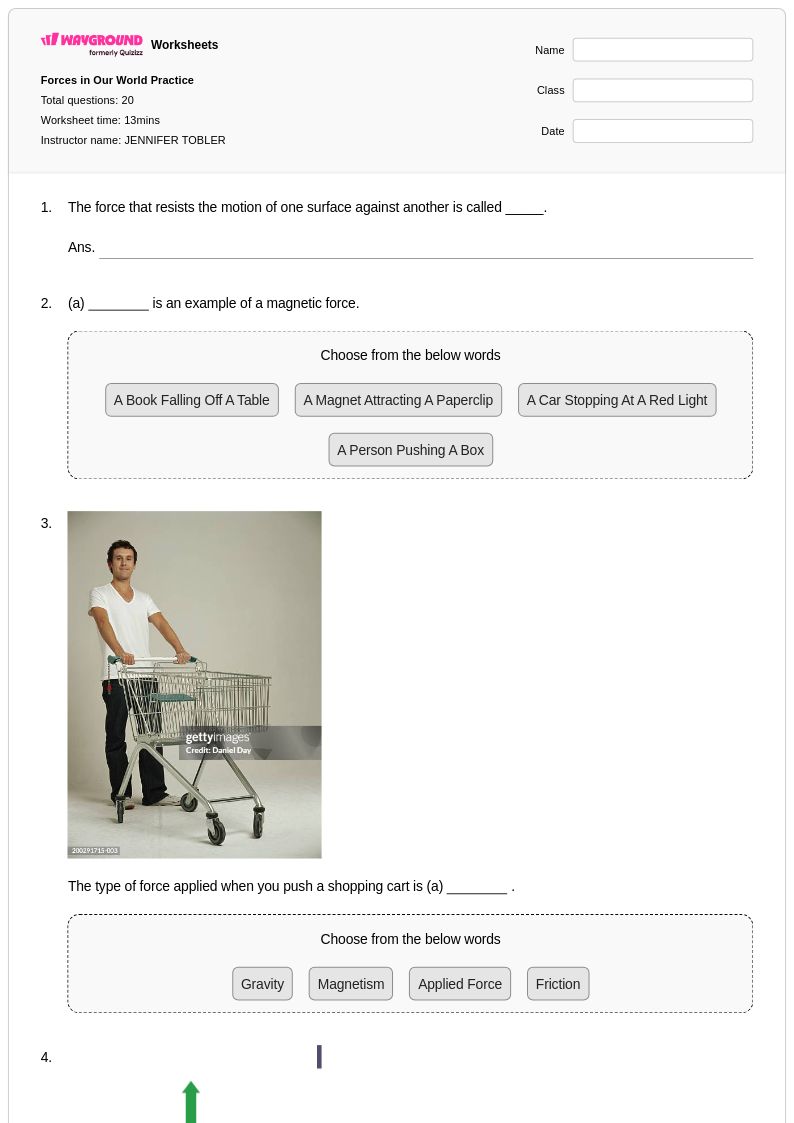
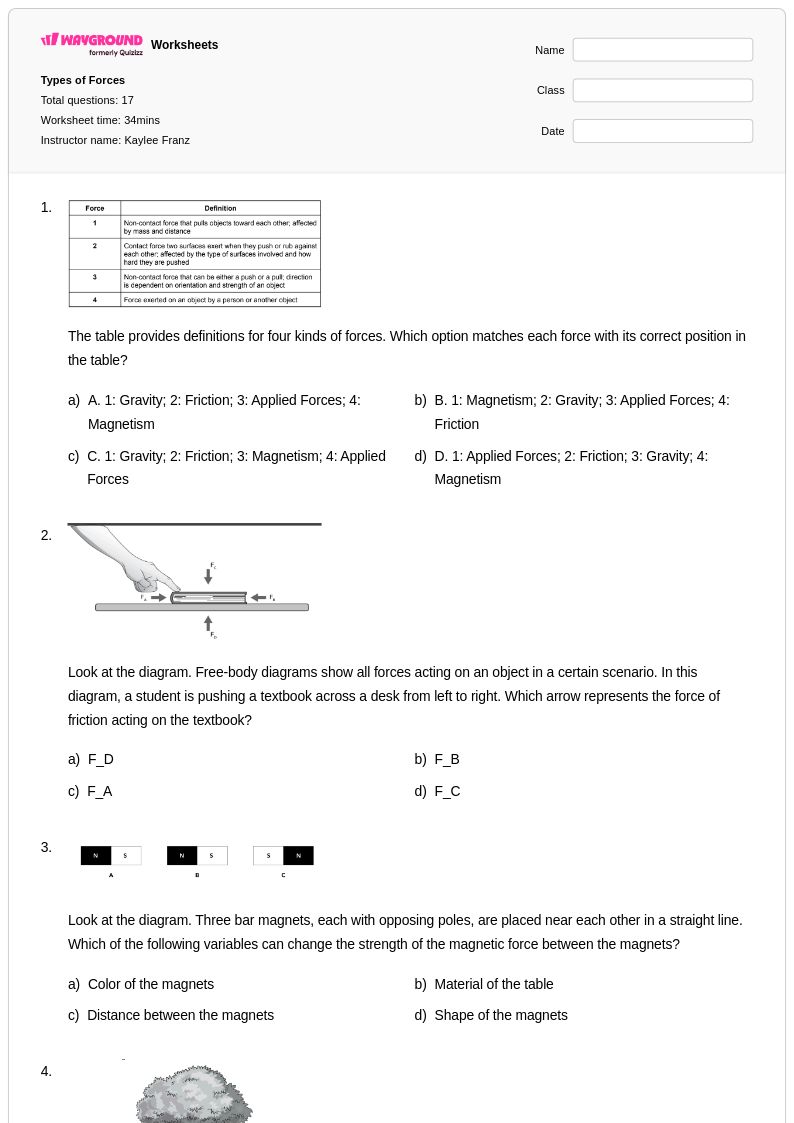
Friction worksheets for Grade 6 students available through Wayground (formerly Quizizz) provide comprehensive practice opportunities for understanding this fundamental force that affects motion in everyday life. These carefully designed educational resources help students develop critical thinking skills about how friction influences the movement of objects across different surfaces, from smooth ice to rough sandpaper. The worksheets strengthen essential scientific observation and analysis abilities through engaging practice problems that challenge students to predict, measure, and explain frictional forces in various scenarios. Each worksheet collection includes detailed answer keys and comprehensive explanations, making these free printables valuable tools for both guided instruction and independent study as students explore the relationship between surface texture, applied force, and resulting motion.
Wayground (formerly Quizizz) empowers educators with an extensive library of millions of teacher-created friction resources that can be easily searched and filtered to match specific Grade 6 learning objectives and curriculum standards. The platform's sophisticated differentiation tools allow teachers to customize worksheets for diverse learning needs, ensuring that struggling students receive appropriate scaffolding while advanced learners encounter enriching challenges that deepen their understanding of friction's role in physics. These versatile resources are available in both printable pdf formats for traditional classroom use and interactive digital versions that provide immediate feedback, making them ideal for lesson planning, targeted remediation sessions, and skill-building practice. Teachers can seamlessly integrate these comprehensive friction worksheets into their existing science curriculum to support standards-aligned instruction while providing students with multiple opportunities to master this crucial concept in forces and motion.
FAQs
How do I teach friction to students effectively?
Start by grounding friction in observable, everyday experiences — sliding a book across a desk, stopping a bicycle, or rubbing hands together to generate heat. From there, introduce the two main types (static and kinetic) and the factors that affect friction strength, including surface texture and the normal force. Hands-on demonstrations paired with structured practice problems help students connect the physical intuition to the mathematical relationships before moving into coefficient calculations and force diagrams.
What kinds of exercises help students practice friction concepts?
Effective friction practice should progress in complexity: begin with identification tasks where students classify friction types in real-world scenarios, then move to problems requiring students to compare friction across different surface pairs, and finally advance to quantitative problems involving the coefficient of friction and net force calculations. Worksheets that include force diagrams alongside calculation problems are especially useful because they reinforce both conceptual understanding and mathematical application simultaneously.
What mistakes do students commonly make when learning about friction?
One of the most frequent misconceptions is that heavier objects always experience more friction regardless of surface type — students often overlook that the coefficient of friction is a property of the surface interaction, not the object's mass alone. Another common error is confusing static and kinetic friction, particularly failing to recognize that static friction is generally greater than kinetic friction and that it acts before motion begins. Students also frequently misread force diagrams by omitting the friction force direction or placing it incorrectly relative to the direction of motion.
How can I differentiate friction instruction for students at different skill levels?
For students who are still building foundational understanding, focus on friction type identification and qualitative comparisons before introducing formulas. Advanced learners can be challenged with multi-step problems that involve calculating net force, acceleration, and coefficient values within the same scenario. On Wayground, teachers can apply individual accommodations such as reduced answer choices to lower cognitive load for struggling students, or enable Read Aloud for students who need audio support, while other students receive standard settings without interruption.
How do I use Wayground's friction worksheets in my classroom?
Wayground's friction worksheets are available as printable PDFs for traditional classroom use and in digital formats for technology-integrated environments, giving teachers flexibility regardless of their setup. Teachers can also host worksheets as a quiz directly on Wayground, making it straightforward to assign friction practice as an in-class activity or independent assessment. All worksheets include complete answer keys, which support both teacher grading and student self-checking during independent practice.
How do I help students who are struggling with friction force calculations?
Students who struggle with friction calculations often benefit from revisiting the relationship between the normal force and the friction force before tackling coefficient problems. Breaking multi-step problems into labeled stages — identifying forces, drawing a free-body diagram, then applying the formula — reduces the cognitive load of the calculation process. Targeted remediation worksheets that isolate one skill at a time, such as normal force identification or coefficient substitution, can rebuild confidence before students attempt integrated problems.