Free Printable Government Declarations Worksheets for Grade 12
Enhance Grade 12 students' understanding of government declarations through Wayground's comprehensive collection of free worksheets, featuring engaging printables, practice problems, and answer keys that develop critical analysis skills for foundational civic documents.
Explore printable Government Declarations worksheets for Grade 12
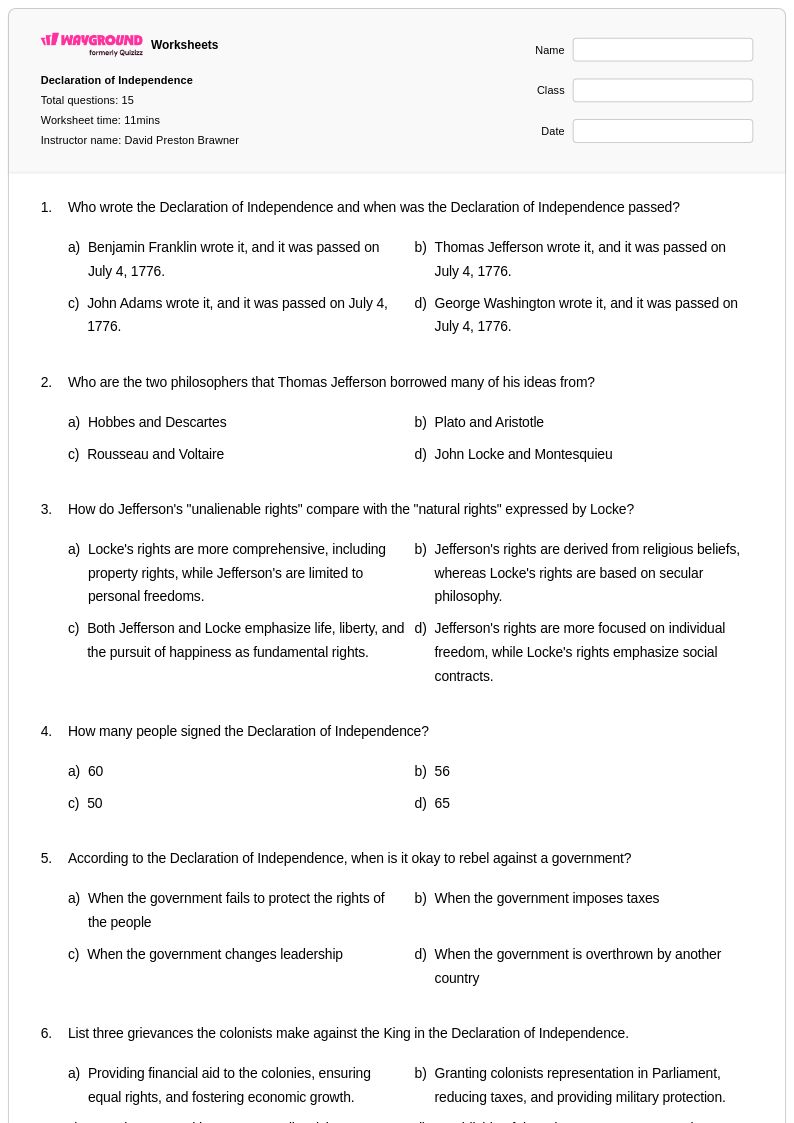
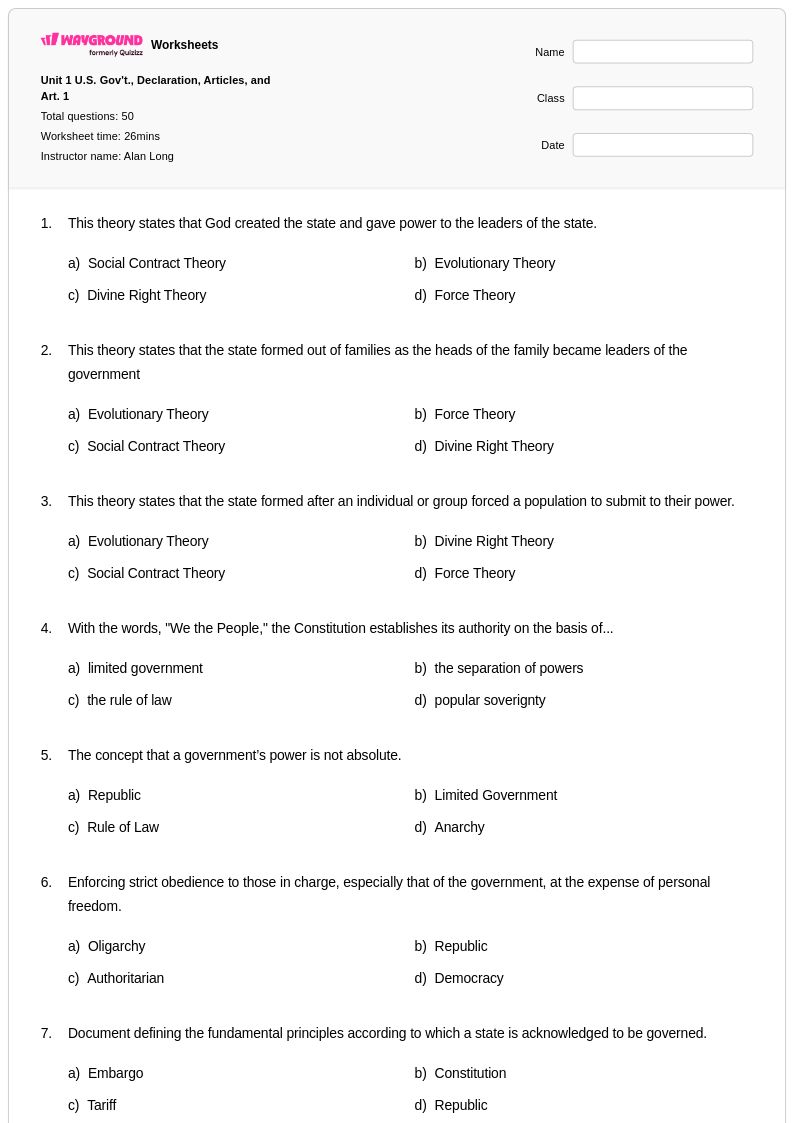
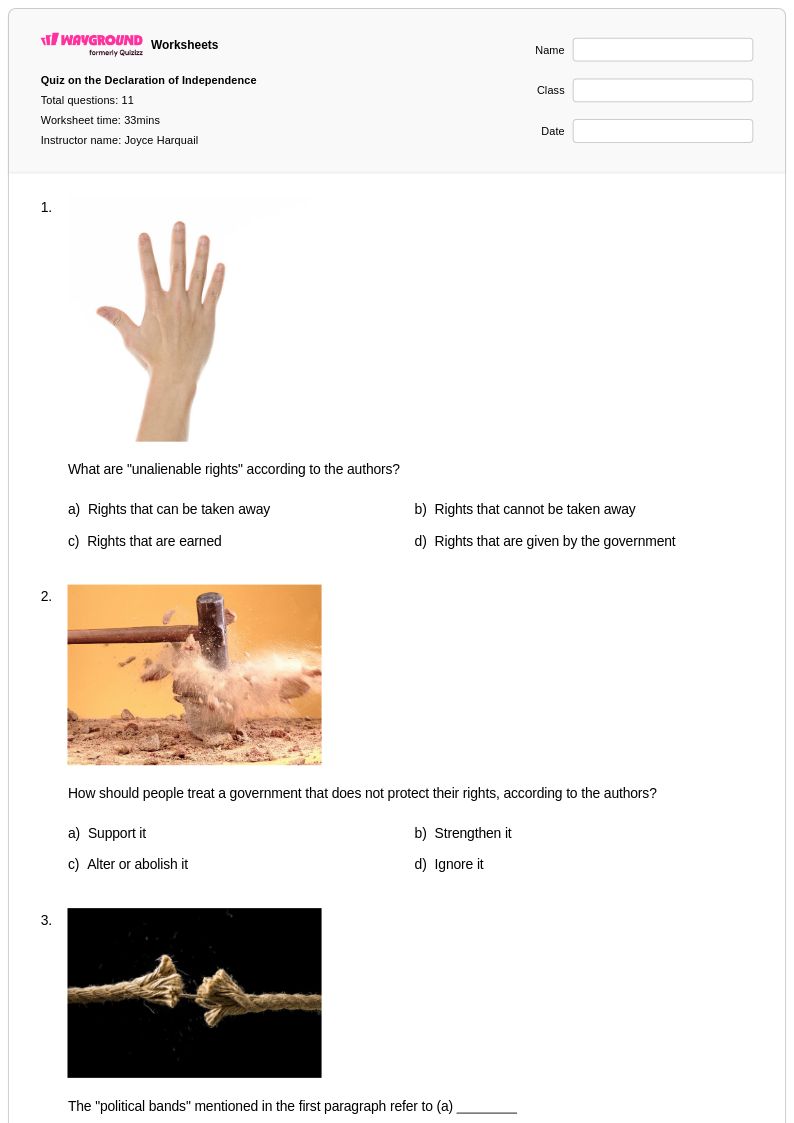
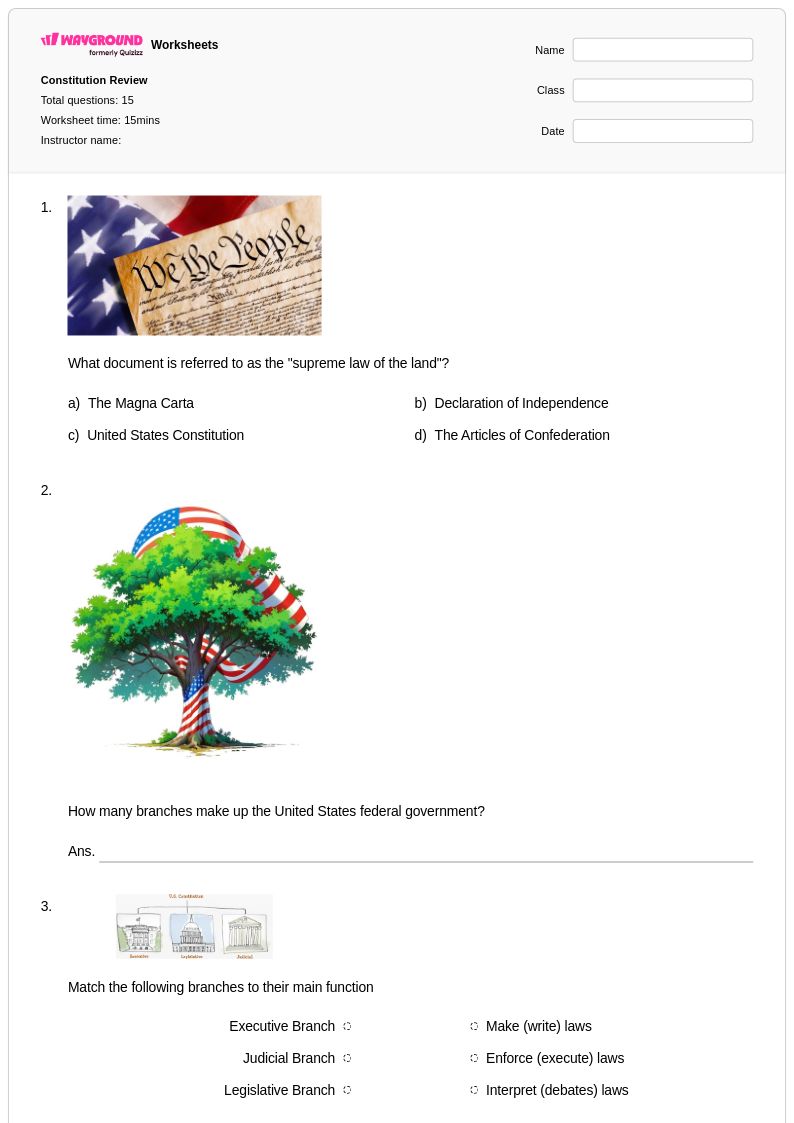
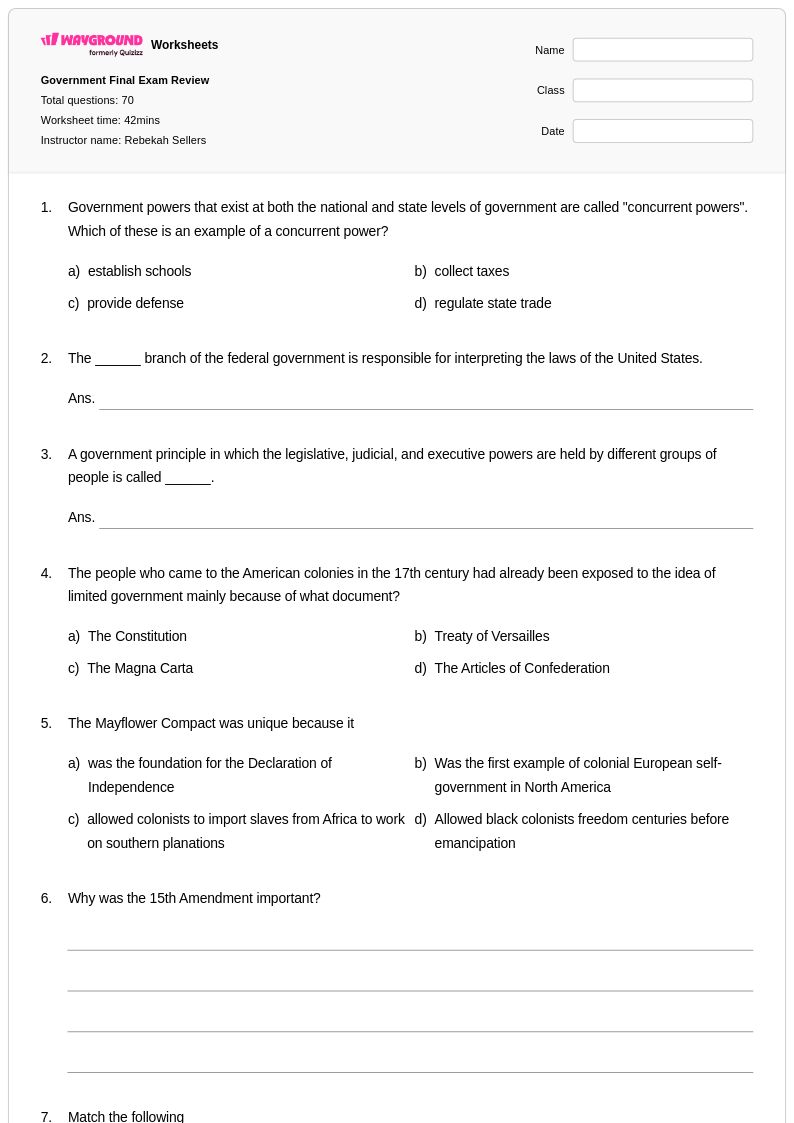
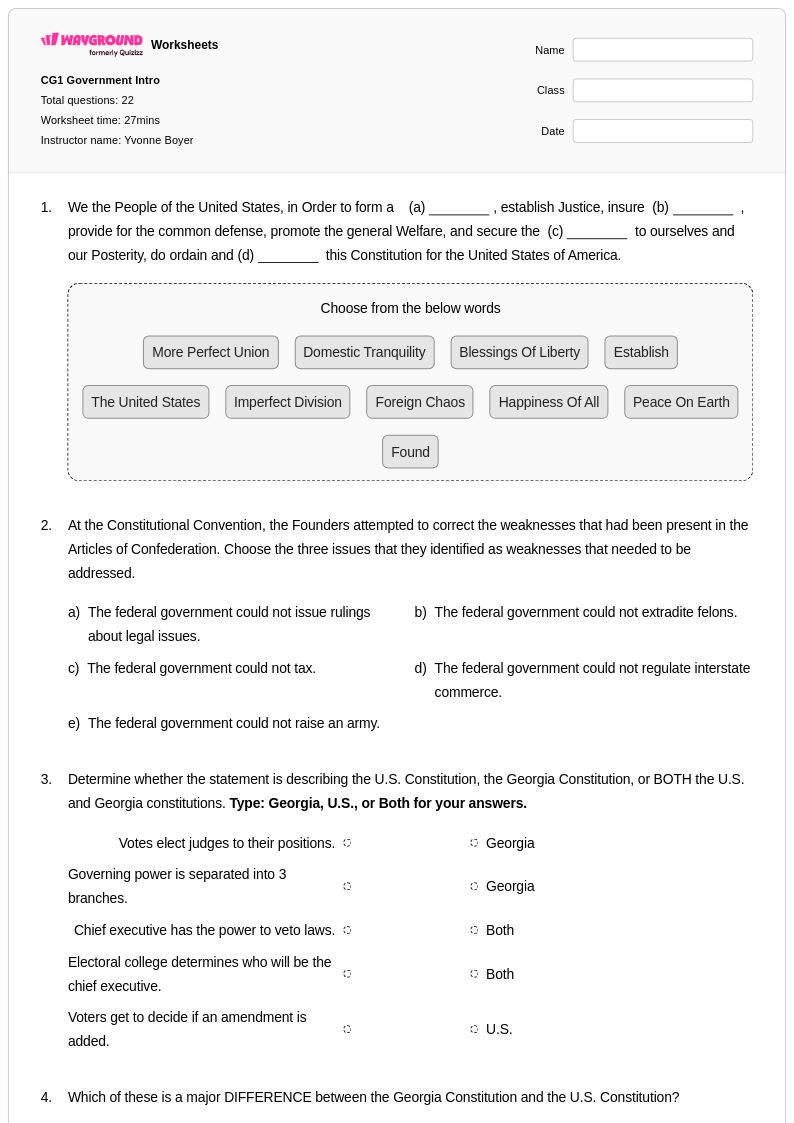
Government Declarations worksheets for Grade 12 students through Wayground (formerly Quizizz) provide comprehensive coverage of pivotal documents that have shaped democratic governance and political thought. These carefully crafted educational materials help students analyze founding documents such as the Declaration of Independence, Universal Declaration of Human Rights, and other significant governmental proclamations that establish principles of liberty, equality, and democratic governance. Students strengthen critical thinking skills by examining the historical context, philosophical foundations, and lasting impact of these declarations while developing their ability to interpret primary sources and understand constitutional principles. Each worksheet includes structured practice problems that guide students through document analysis, with accompanying answer keys that support both independent study and classroom instruction, available as free printables in convenient pdf format.
Wayground's extensive collection draws from millions of teacher-created resources specifically designed to support Grade 12 civics instruction on government declarations and foundational documents. The platform's robust search and filtering capabilities enable educators to quickly locate materials aligned with state standards and curriculum requirements, while differentiation tools allow teachers to customize worksheets for varying student ability levels and learning objectives. These versatile resources are available in both printable pdf formats for traditional classroom use and digital formats for interactive learning environments, making them ideal for lesson planning, targeted remediation of constitutional concepts, enrichment activities for advanced learners, and regular skill practice in document analysis. Teachers can seamlessly integrate these materials into comprehensive civics units while ensuring students develop the analytical skills necessary for understanding how government declarations continue to influence modern democratic institutions and civic participation.
FAQs
How do I teach government declarations in a social studies or civics class?
Teaching government declarations effectively starts with grounding students in the historical context behind each document before analyzing its language and legal significance. A useful sequence is to present the political conditions that prompted a declaration, then have students read primary source excerpts and identify the core claims, grievances, or rights being established. Comparing multiple declarations, such as the Declaration of Independence alongside a Bill of Rights or constitutional amendment, helps students recognize recurring civic principles and understand how foundational documents build on one another over time.
What exercises help students practice analyzing government declarations?
Effective practice exercises for government declarations include close reading tasks where students identify key claims and supporting evidence within primary source excerpts, as well as compare-and-contrast activities that ask students to evaluate how different declarations address similar civic principles. Document analysis graphic organizers, cause-and-effect charts tracing a declaration's impact on citizens' rights, and short-answer questions requiring constitutional interpretation all build the analytical skills students need. Worksheets that prompt students to connect historical declarations to modern civic life deepen understanding beyond memorization.
What mistakes do students commonly make when analyzing government declarations?
A frequent error is treating declarations as isolated texts rather than responses to specific historical conditions, which leads to shallow interpretation and missed meaning. Students also tend to conflate different document types, such as mixing up a constitutional amendment with a proclamation or a bill of rights, without recognizing their distinct legal functions. Another common mistake is paraphrasing in modern terms without accounting for the original legal or philosophical intent, which can distort meaning. Targeted practice with document-specific vocabulary and guided contextualization questions helps correct these patterns.
How can I differentiate government declarations worksheets for students at different reading levels?
Differentiation for government declarations can include providing scaffolded versions of primary source excerpts with annotated vocabulary for struggling readers, while advanced students work from unabridged texts with higher-order analysis prompts. On Wayground, teachers can apply individual accommodations such as Read Aloud, which delivers audio reading of questions and content, and Reduced Answer Choices, which lowers cognitive load for students who need it, without alerting the rest of the class. Adjustable font sizes and reading themes are also available through Wayground's Reading Mode setting, supporting accessibility across varied learning needs.
How do I use Wayground's Government Declarations worksheets in my classroom?
Wayground's Government Declarations worksheets are available as printable PDFs for traditional classroom use and in digital formats for technology-integrated or hybrid learning environments. Teachers can assign them as in-class practice, homework, or formative assessments, and can also host them as interactive quizzes directly on the Wayground platform. Each worksheet includes a complete answer key, which reduces prep time and makes them practical for both independent student study and teacher-led instruction.
How do government declarations connect to modern civic life, and how can I make that relevant for students?
Government declarations establish the legal and philosophical frameworks that continue to govern citizens' rights and responsibilities today, making them directly relevant to current events and policy discussions. Teachers can bridge historical documents to the present by having students identify which rights from a founding declaration appear in recent legislation or court decisions, or by analyzing a contemporary government proclamation using the same analytical lens applied to historical texts. This approach helps students see civic documents as living frameworks rather than historical artifacts.