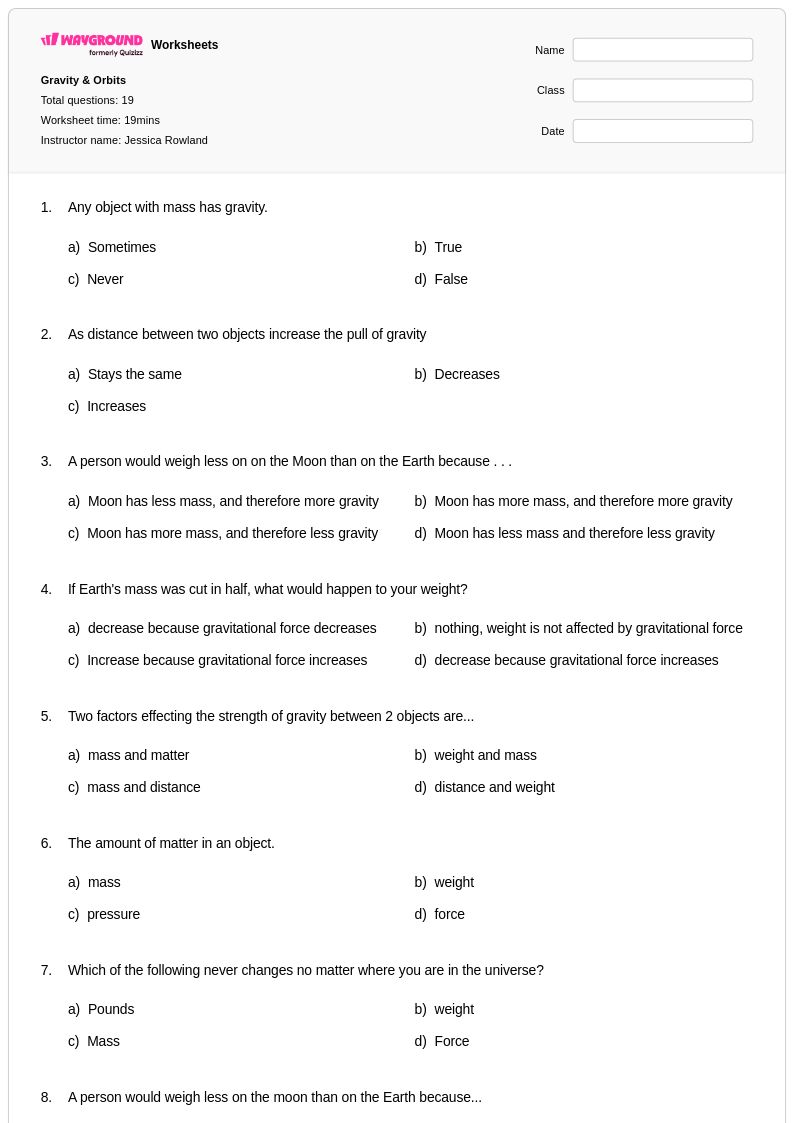
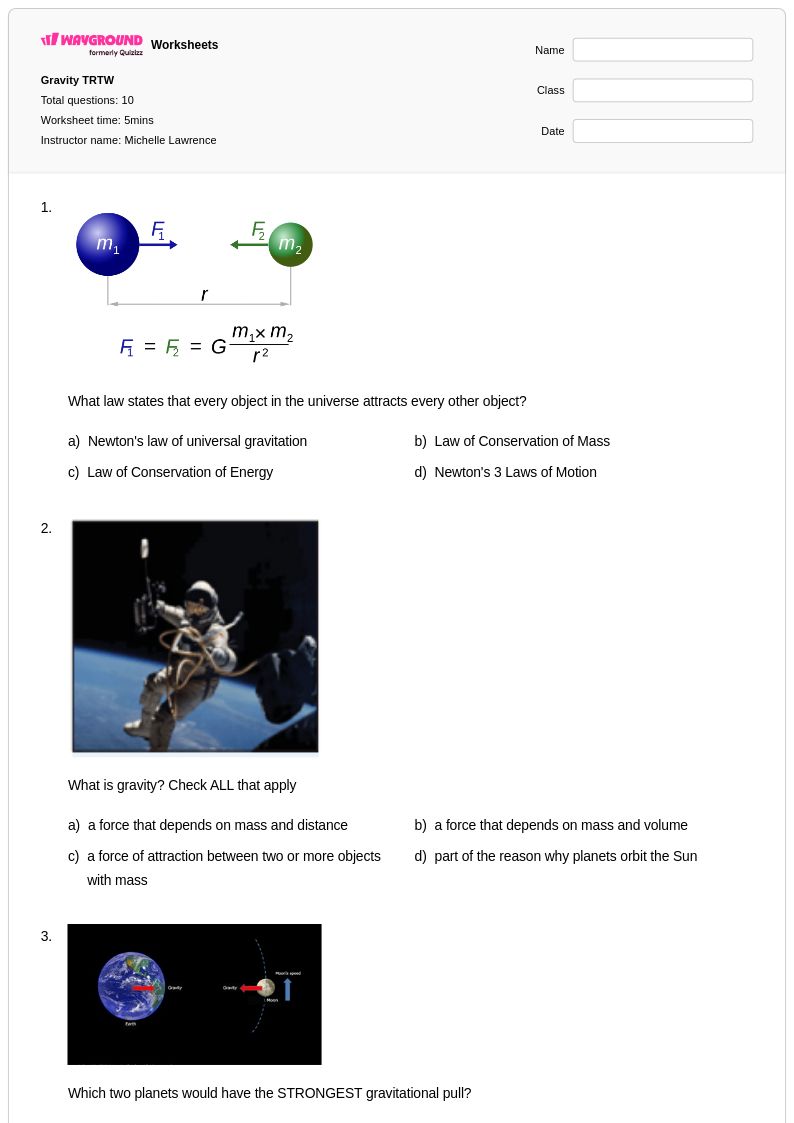
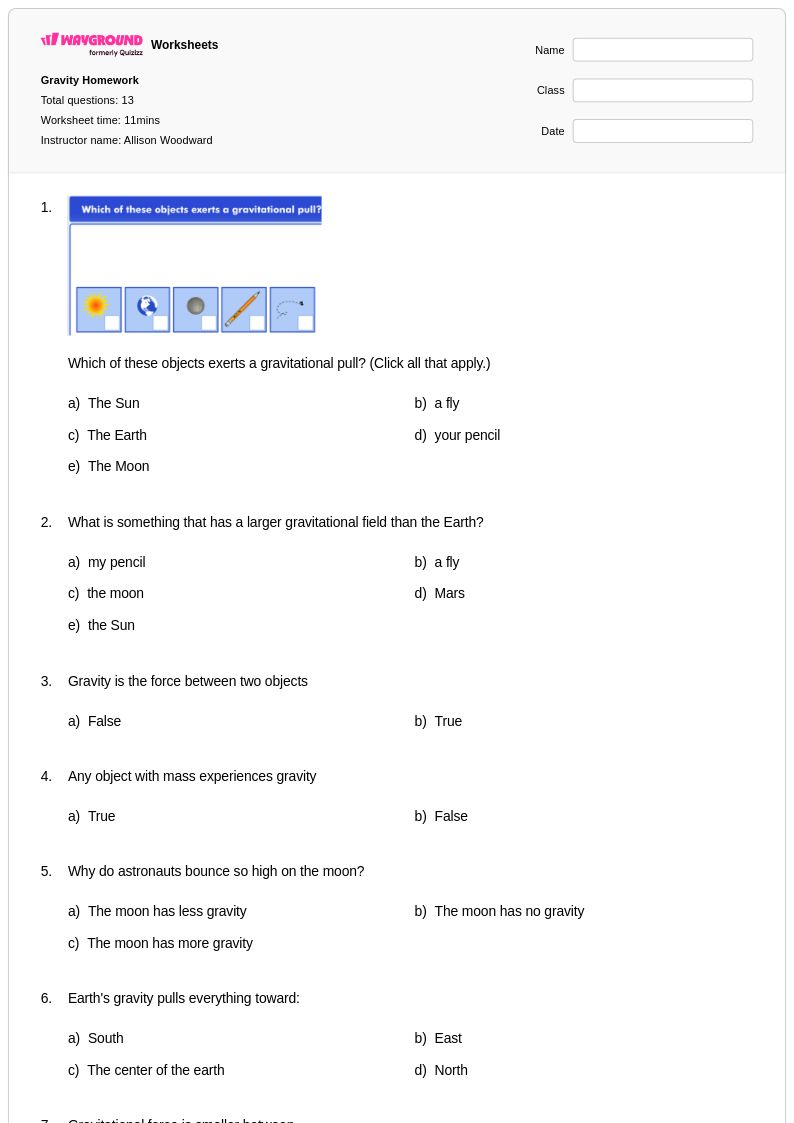
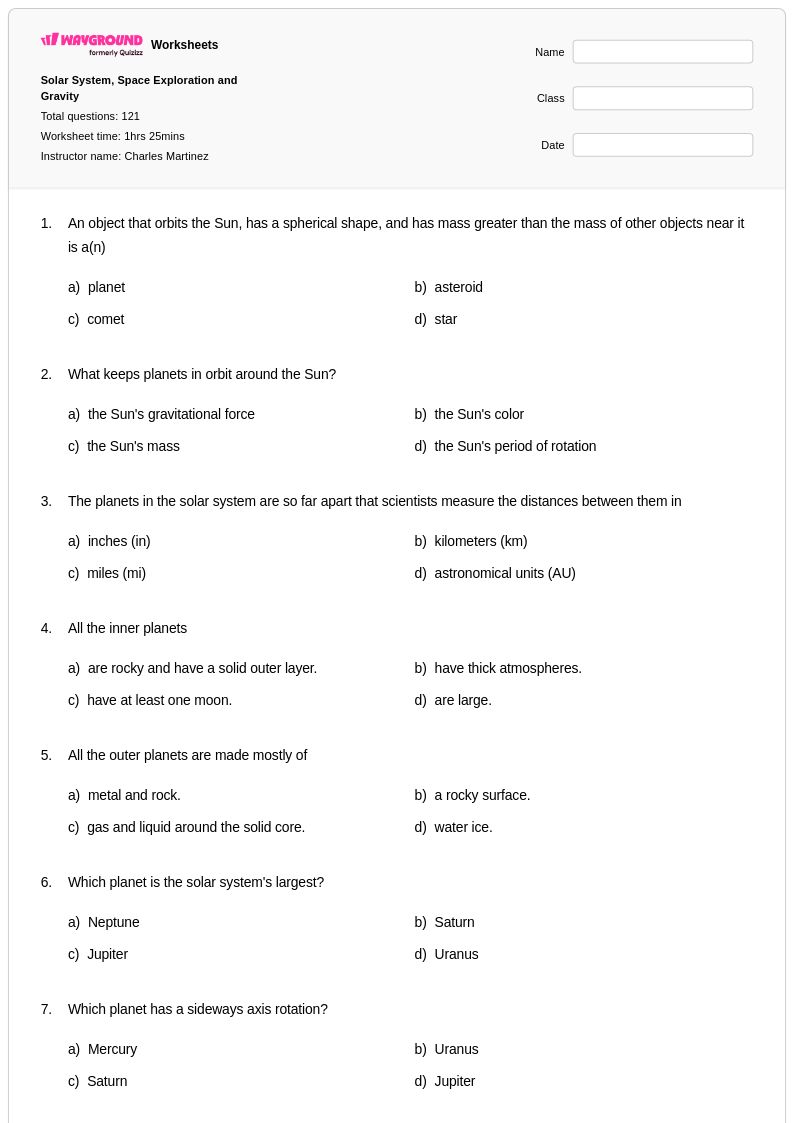
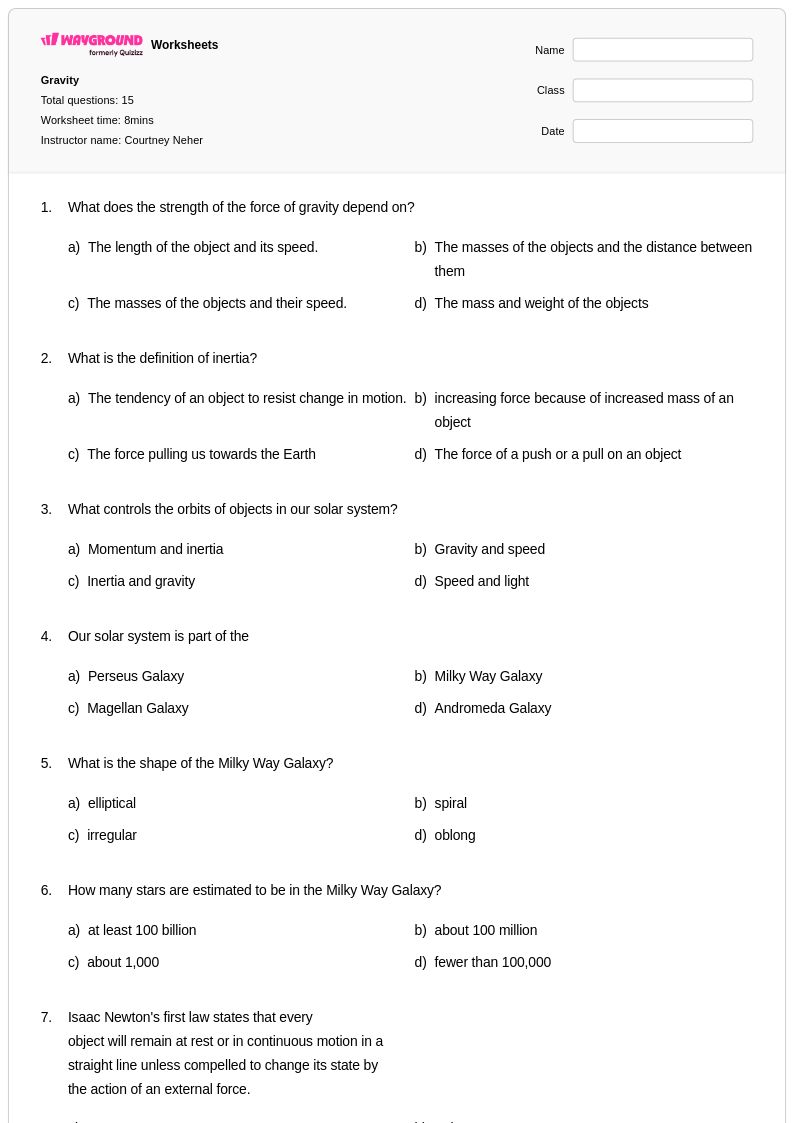
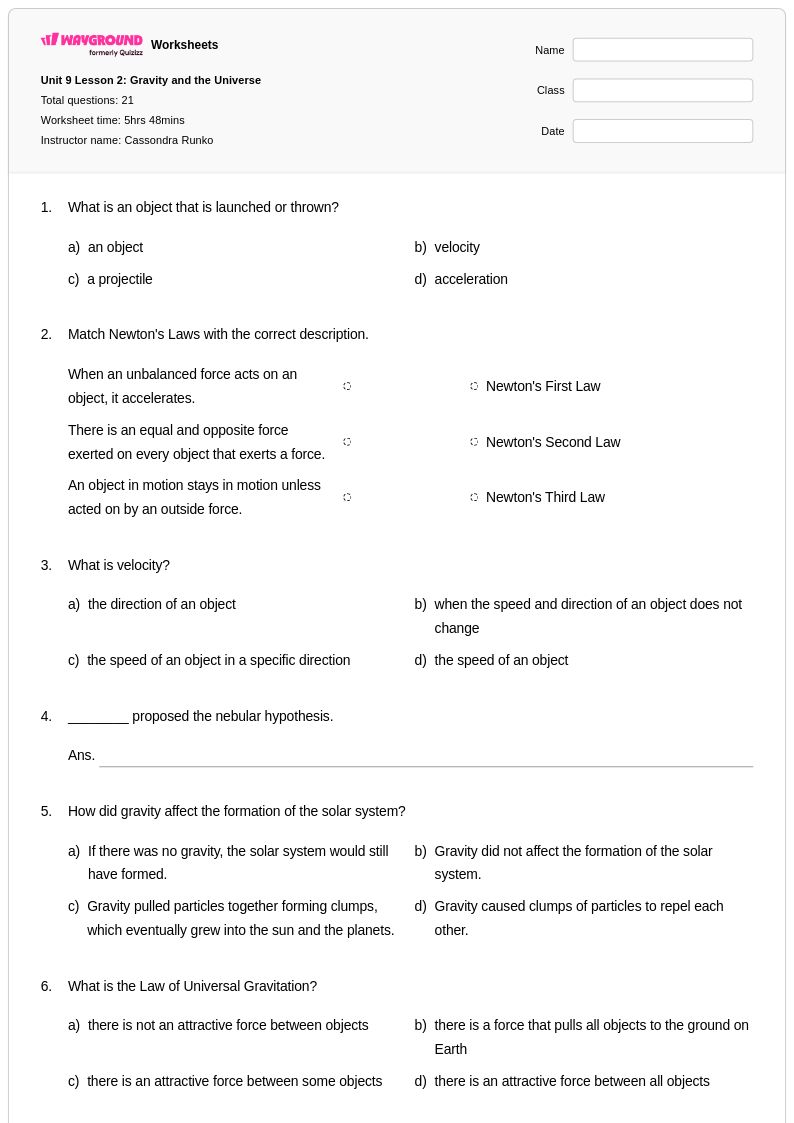
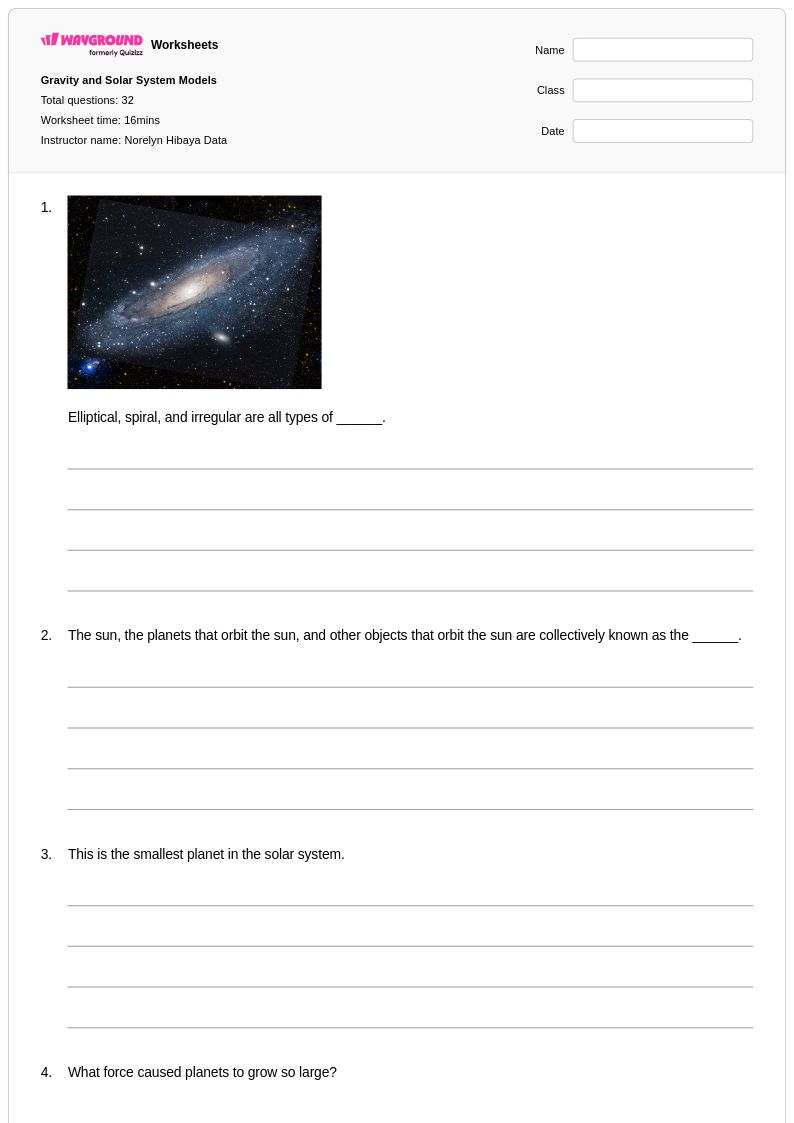
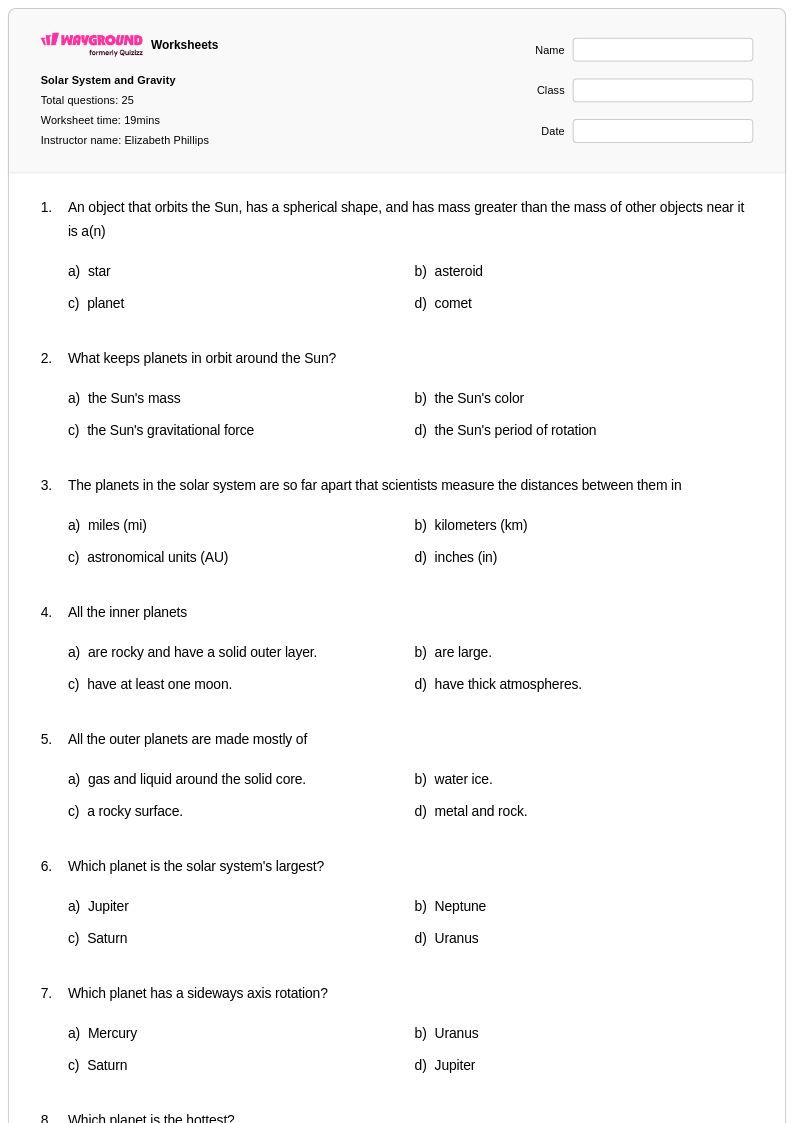
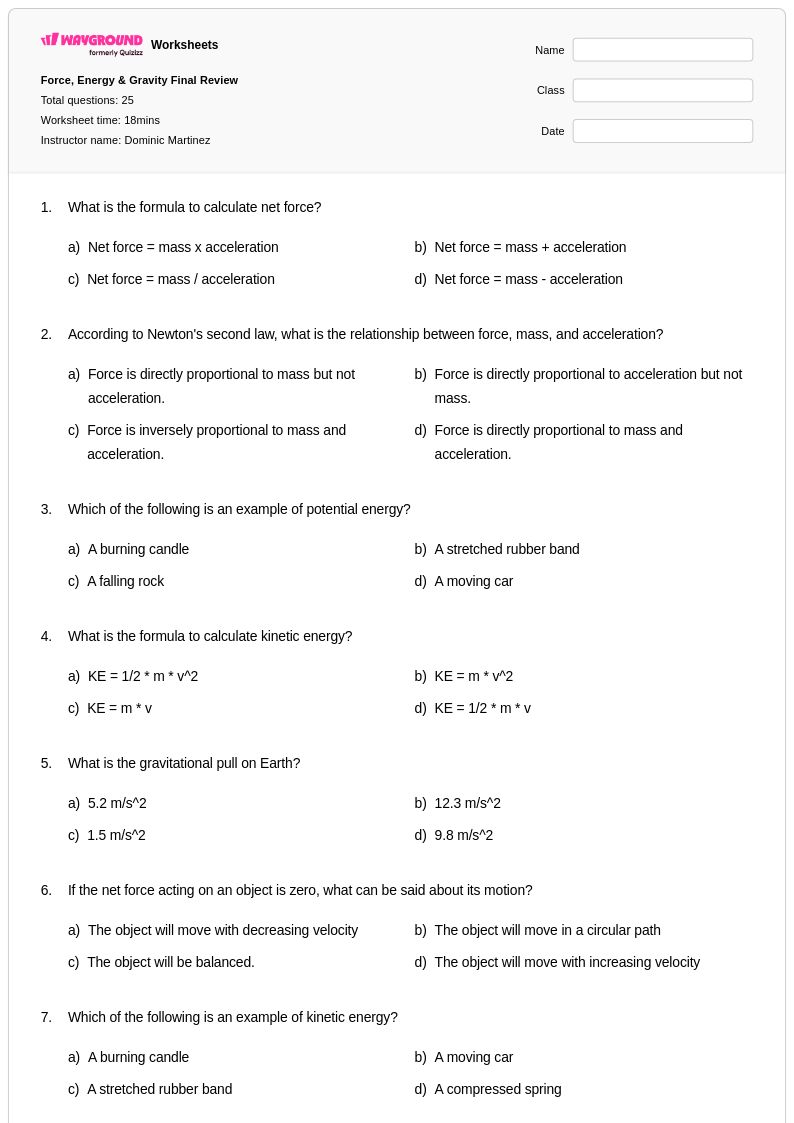
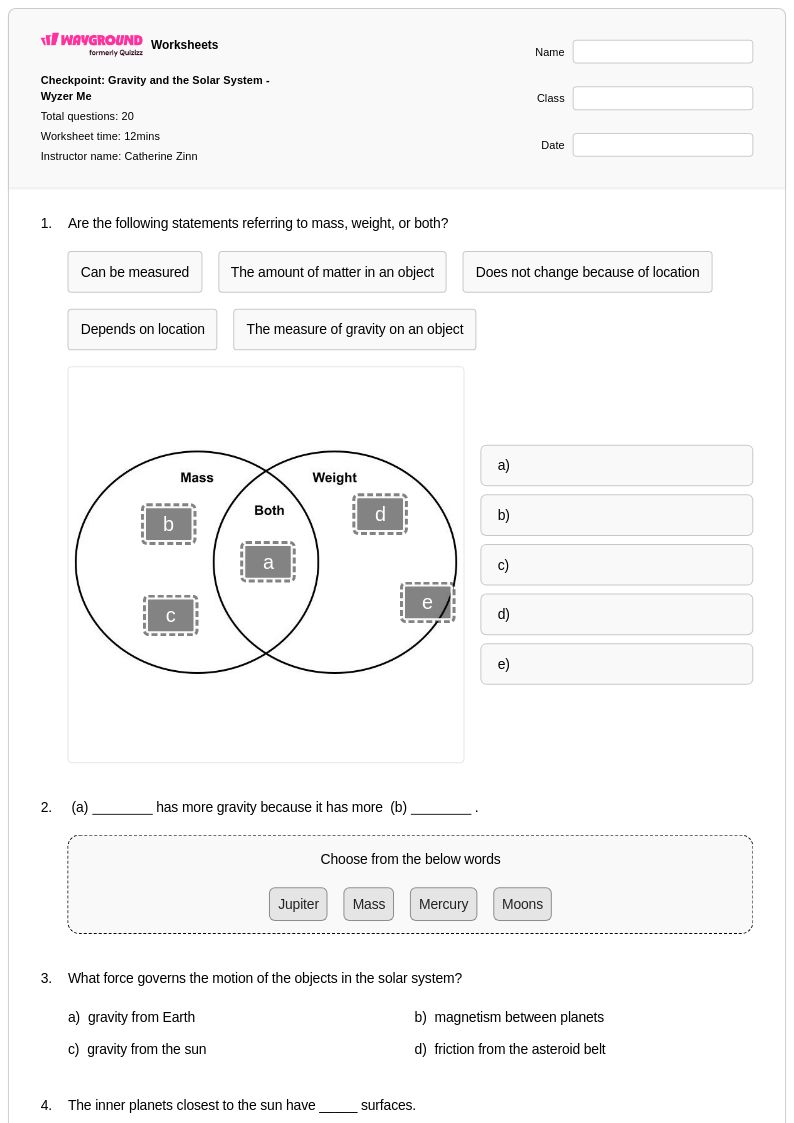
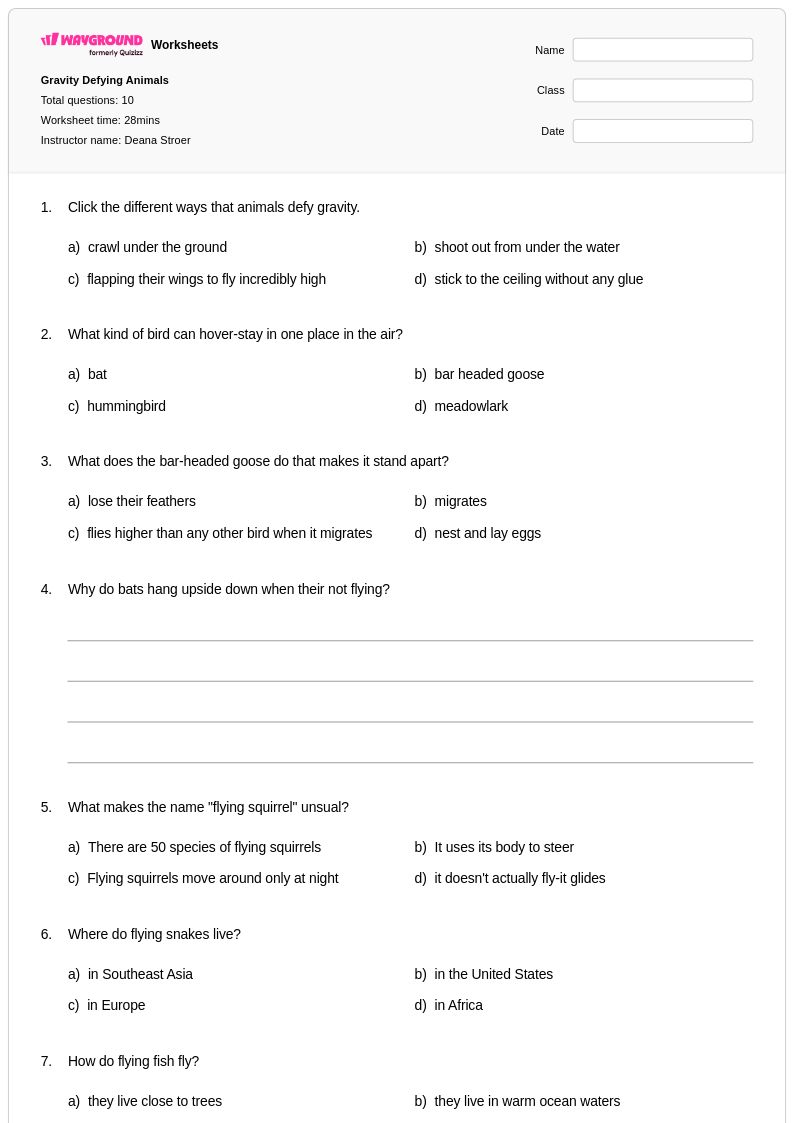
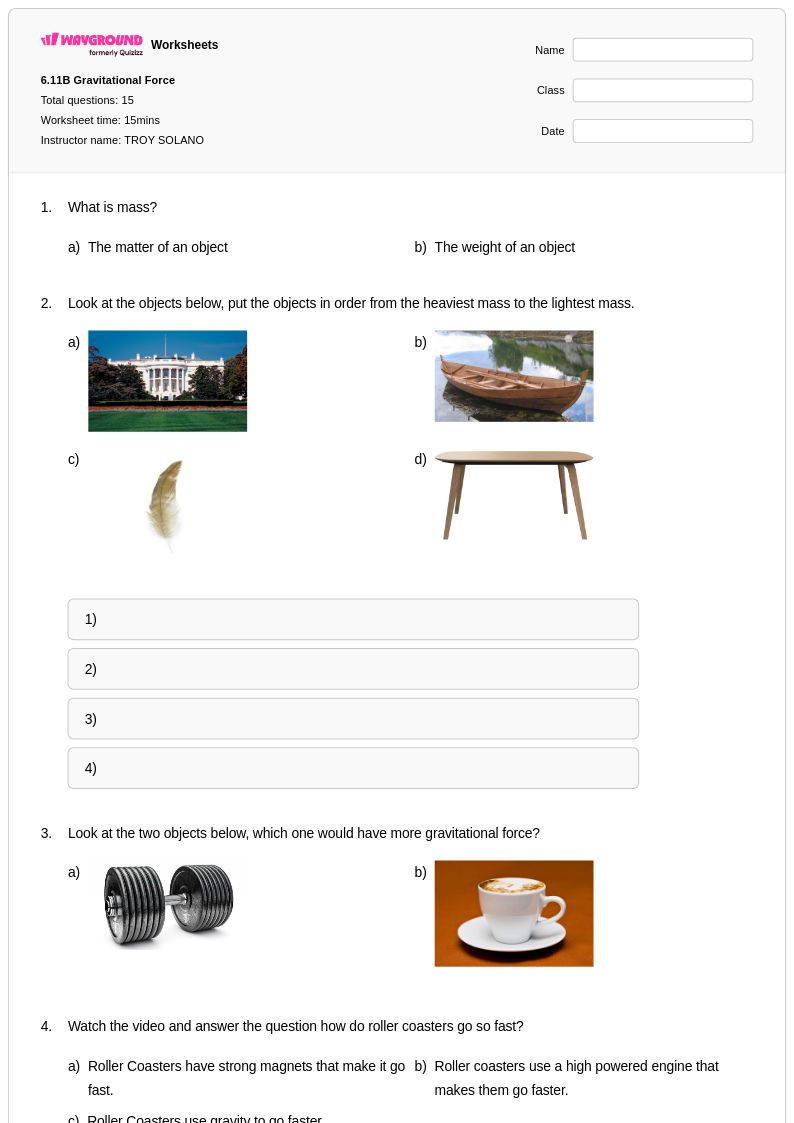
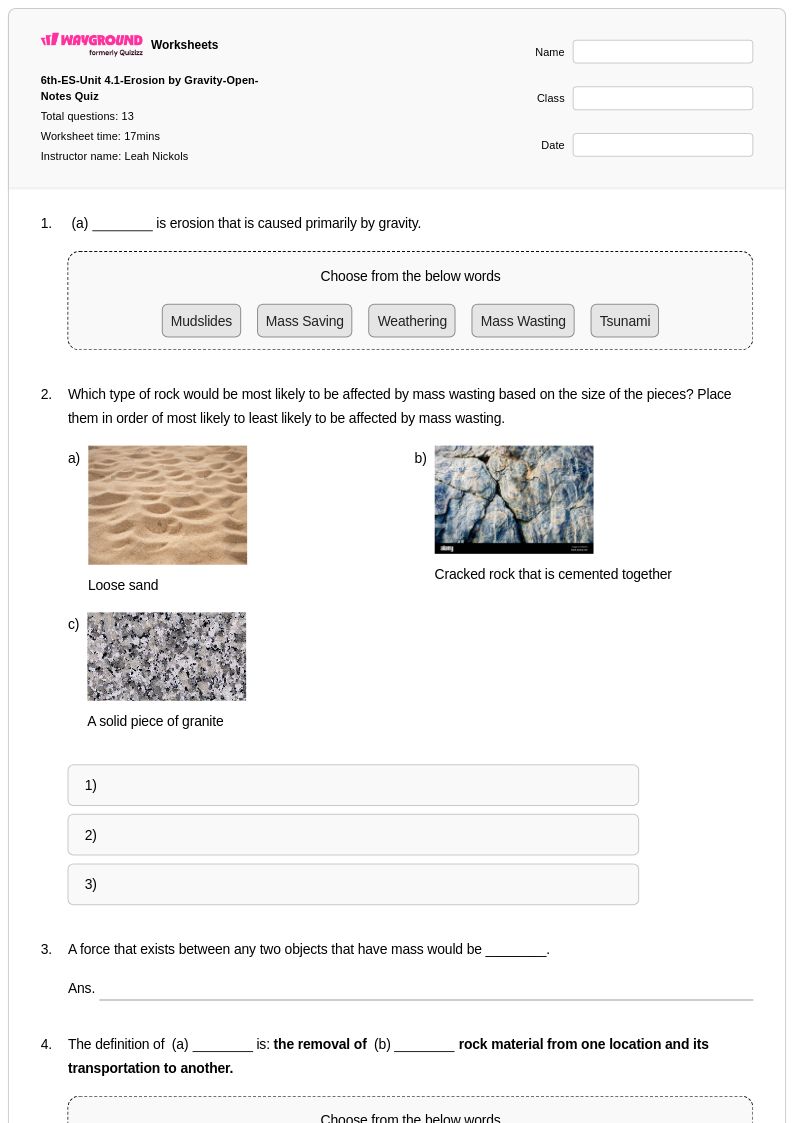
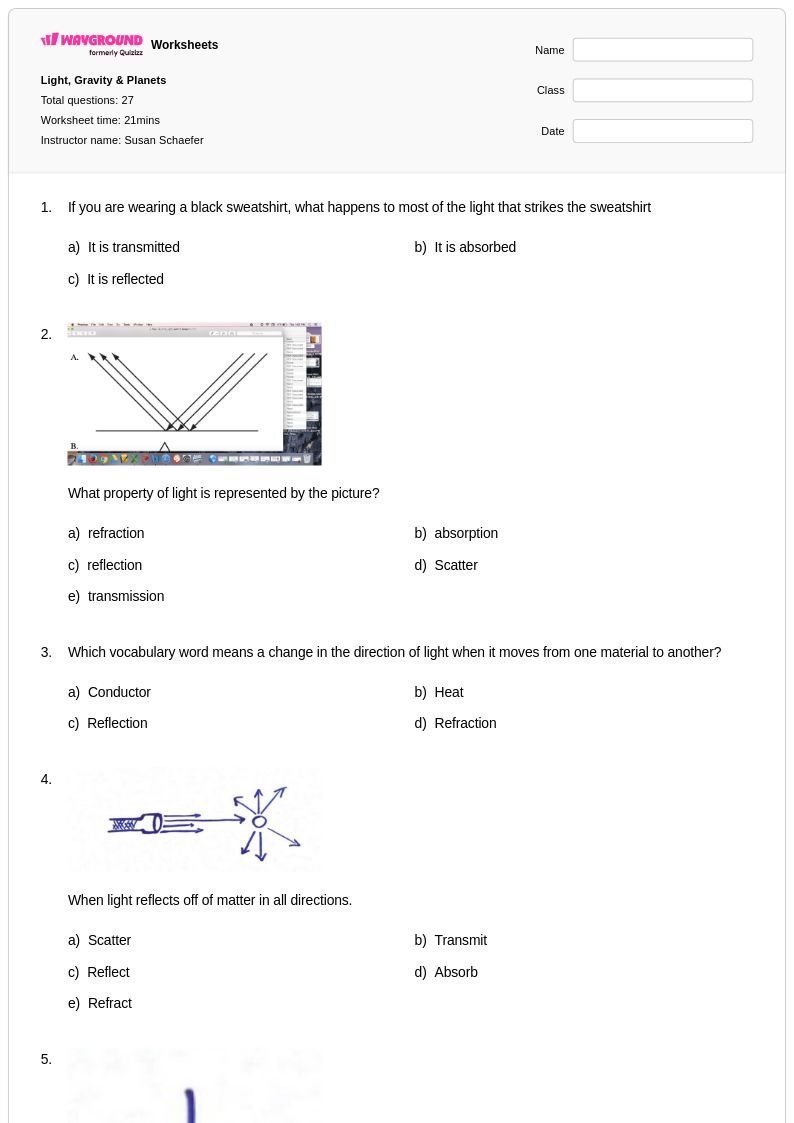
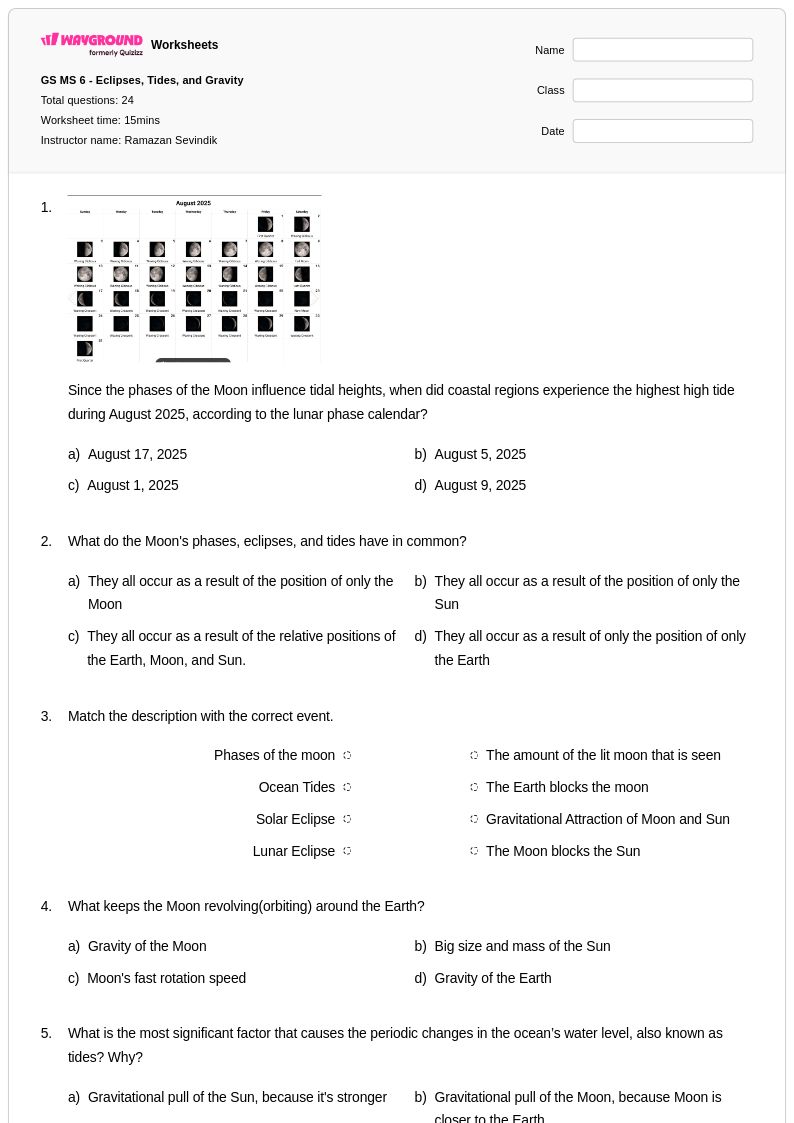
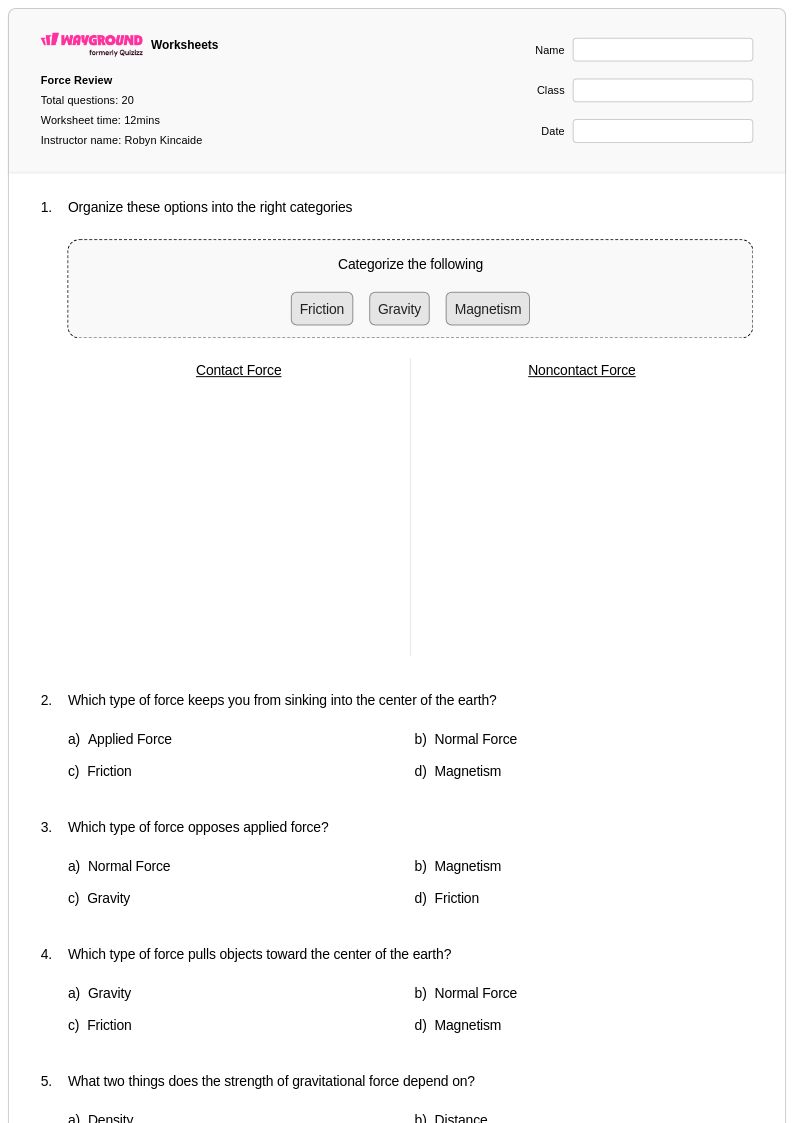
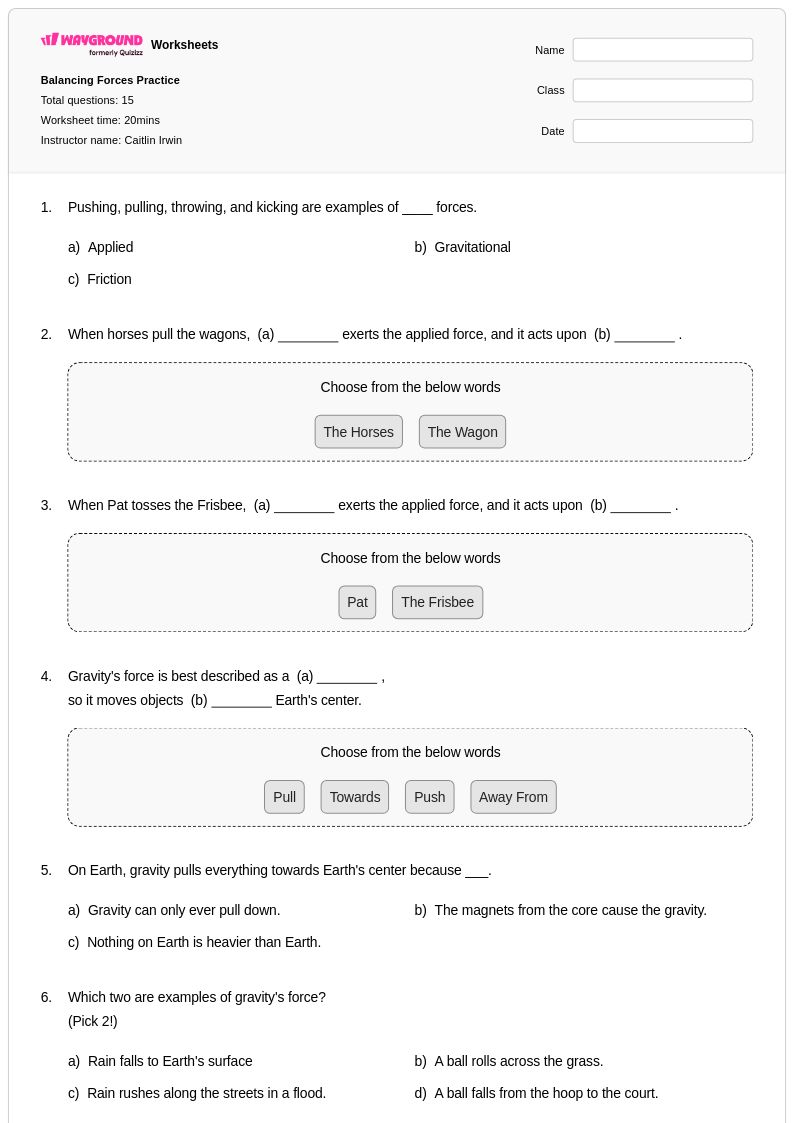
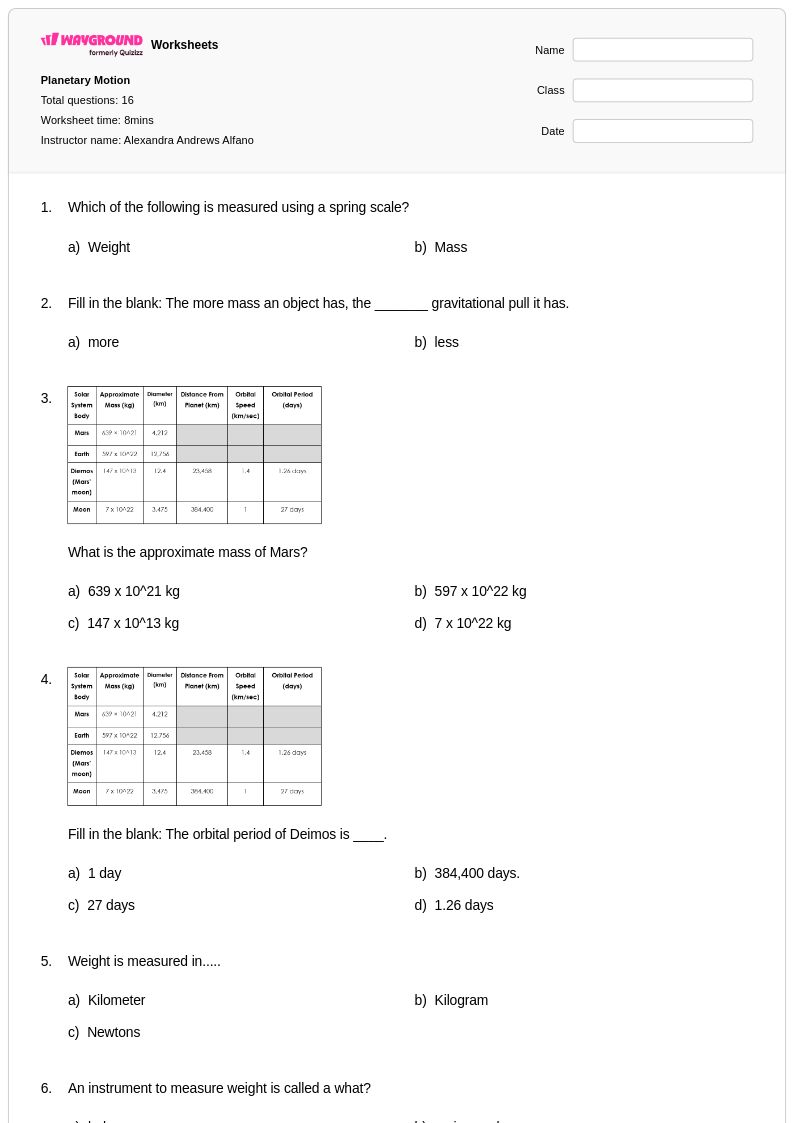
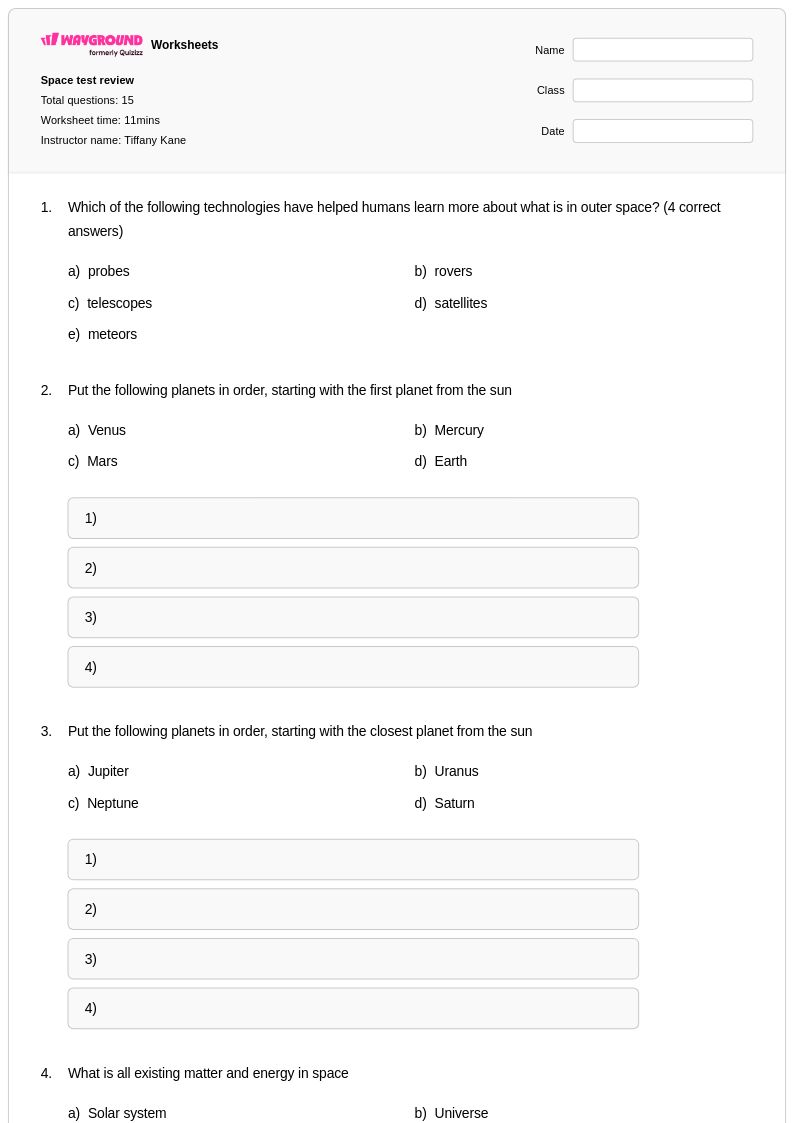
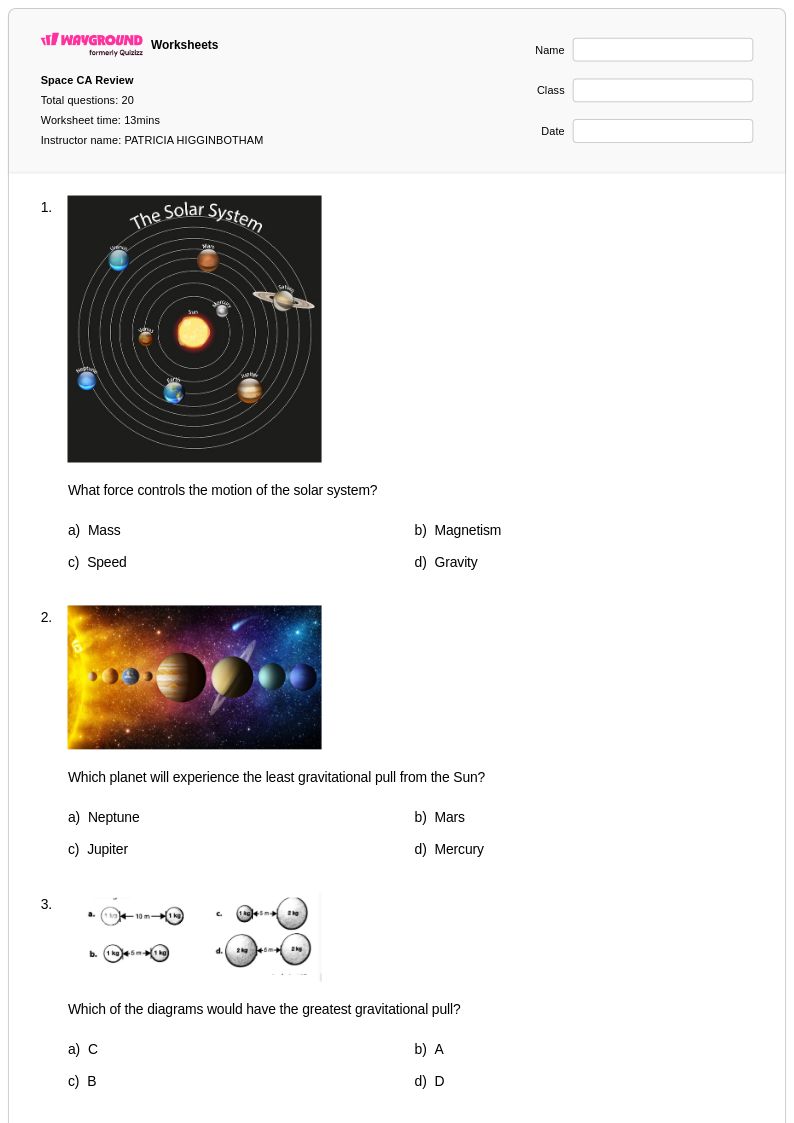
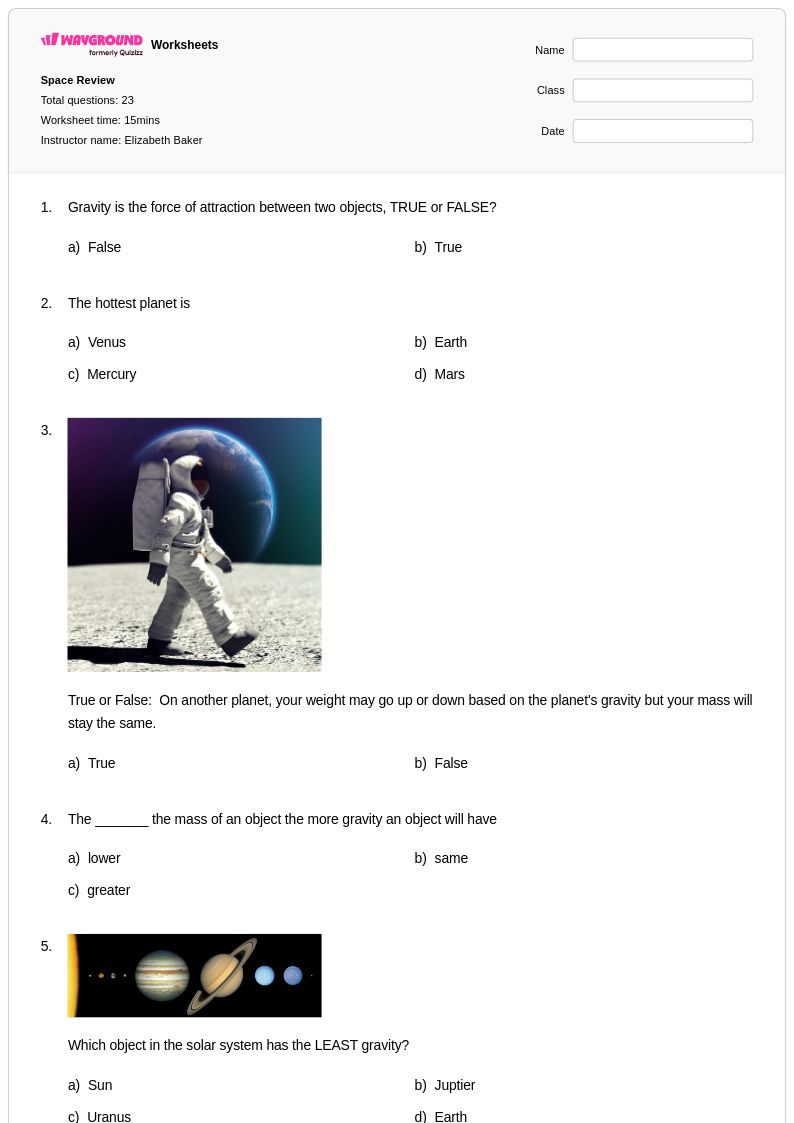
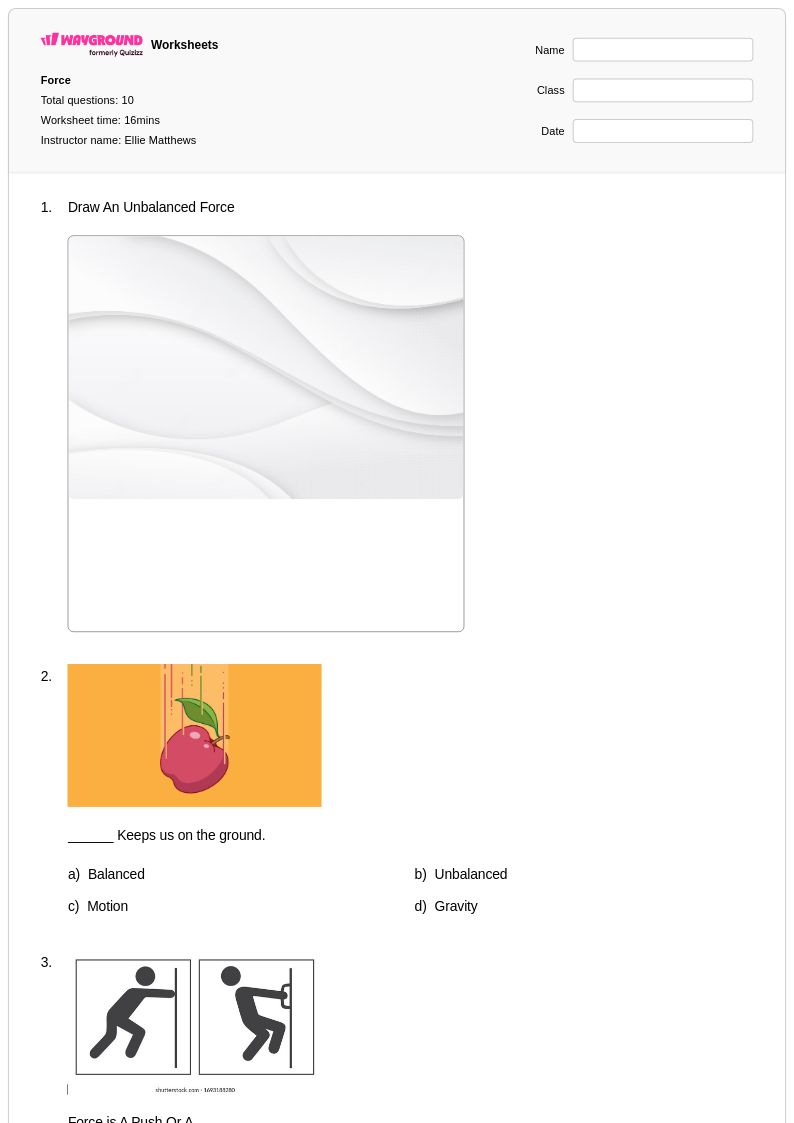
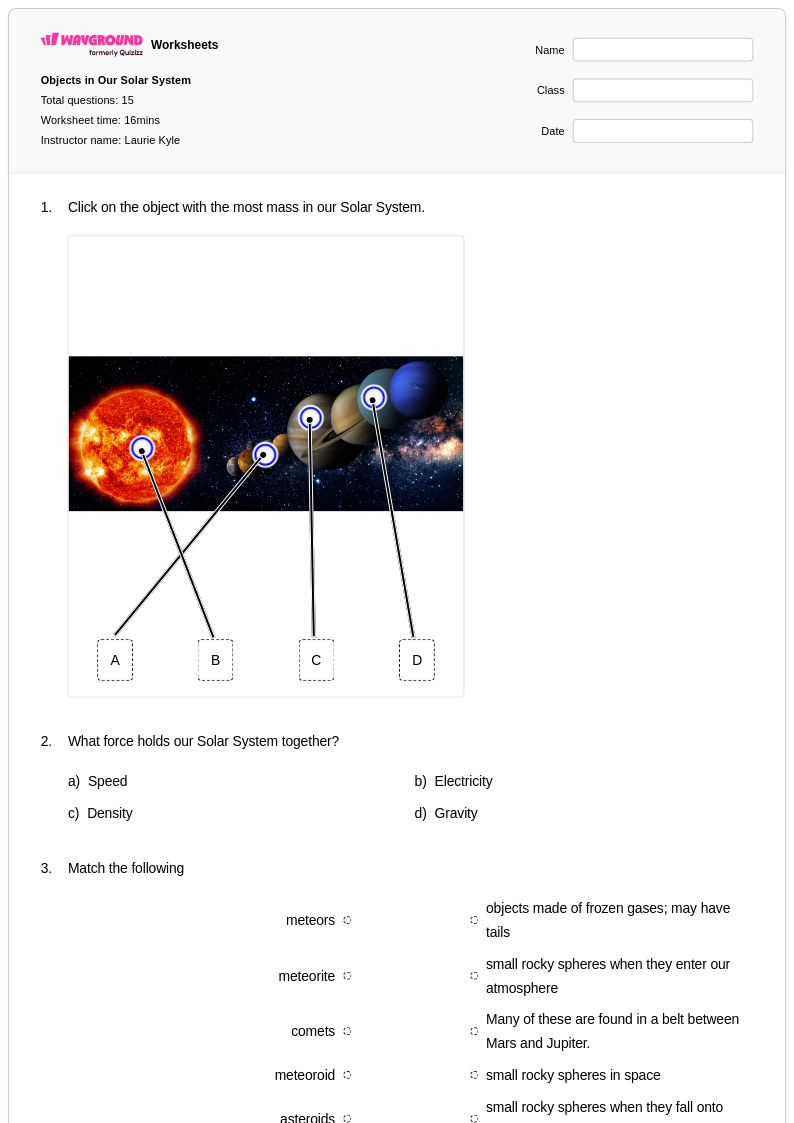
Master gravity concepts with Grade 6 physics worksheets from Wayground, featuring free printables, practice problems, and answer keys to help students understand gravitational force, weight, and motion through engaging PDF exercises.
Gravity worksheets for Grade 6 through Wayground (formerly Quizizz) provide comprehensive educational resources that help students understand one of the fundamental forces in physics. These carefully designed worksheets introduce young learners to essential concepts including gravitational pull, weight versus mass, and how gravity affects objects on Earth and in space. Students engage with practice problems that demonstrate gravity's role in everyday phenomena, from falling objects to planetary motion, while developing critical thinking skills through hands-on activities and real-world applications. Each worksheet comes complete with an answer key to support independent learning and includes free printables that make classroom implementation seamless for educators seeking quality physics resources.
Wayground (formerly Quizizz) empowers teachers with millions of educator-created gravity worksheets that can be easily searched, filtered, and customized to meet diverse classroom needs. The platform's robust collection includes materials aligned with educational standards, offering both printable pdf formats and interactive digital versions that accommodate different learning preferences and technological capabilities. Teachers can efficiently differentiate instruction by selecting worksheets that match individual student readiness levels, while the comprehensive search tools help locate specific gravity concepts for targeted skill practice, remediation, or enrichment activities. This extensive resource library streamlines lesson planning and provides educators with the flexibility to adapt materials for various teaching scenarios, ensuring that Grade 6 students receive consistent, high-quality physics instruction that builds foundational understanding of gravitational forces.
FAQs
How do I teach gravity to middle and high school students?
Teaching gravity effectively starts with grounding students in Newton's law of universal gravitation before moving into quantitative problem-solving. Begin with conceptual discussions about mass, weight, and the inverse-square relationship between distance and gravitational force, then layer in calculations involving gravitational field strength and free fall acceleration. Using real-world contexts like planetary motion, satellite orbits, and escape velocity helps students connect abstract equations to observable phenomena. Structured practice problems with scaffolded difficulty allow students to build fluency progressively.
What types of problems should students practice to master gravitational force concepts?
Students should practice a range of problem types including weight calculations using W = mg, free fall scenarios involving time and distance, gravitational field strength comparisons across planets, and universal gravitation calculations using F = Gm₁m₂/r². Problems that vary the unknown being solved, such as solving for mass rather than force, deepen conceptual flexibility. Including escape velocity and planetary motion problems ensures students can apply gravitational principles across multiple contexts.
What misconceptions do students commonly have about gravity?
One of the most persistent misconceptions is that gravity only acts near Earth's surface or that objects in orbit are weightless because gravity stops acting on them. Students also frequently confuse mass and weight, treating them as interchangeable rather than understanding that weight is a gravitational force dependent on the local field strength. Another common error is misapplying the inverse-square law, with students assuming that doubling the distance halves the gravitational force rather than reducing it to one-quarter. Targeted practice problems that directly confront these errors help students correct their mental models.
How do I use gravity worksheets to support students with different learning needs?
Gravity worksheets on Wayground can be assigned digitally, allowing teachers to apply individual accommodations directly to student accounts. Wayground supports extended time per question for students who need additional processing time, read-aloud functionality for students who benefit from audio support, and reduced answer choices to lower cognitive load for struggling learners. These accommodations can be set per student and apply automatically across future sessions without affecting the experience of other students. Available in both printable PDF and digital formats, the worksheets accommodate traditional classroom use as well as technology-integrated environments.
How can I use gravity worksheets to assess student understanding?
Gravity worksheets work well as formative assessment tools because they reveal whether students can apply equations correctly, not just recall them. Problems involving free fall, weight on different planets, and gravitational force between two masses each target distinct skills, making it straightforward to identify where a student's understanding breaks down. Answer keys included with Wayground worksheets allow for quick self-assessment during independent study or structured peer review in class. Teachers can also host worksheets as a digital quiz on Wayground to collect performance data across the whole class efficiently.
What is the difference between gravitational force and gravitational field strength, and how do I explain it to students?
Gravitational field strength (g) describes the force experienced per unit mass at a given location, measured in N/kg, while gravitational force (F) is the actual force acting on a specific object with a given mass at that location. The distinction matters because g varies by planet or altitude, while F depends on both g and the object's mass. A clear teaching approach is to present g as a property of the location in space and F as the result of placing a mass within that field. Practice problems that ask students to calculate weight on different planets using varying values of g are particularly effective for reinforcing this distinction.