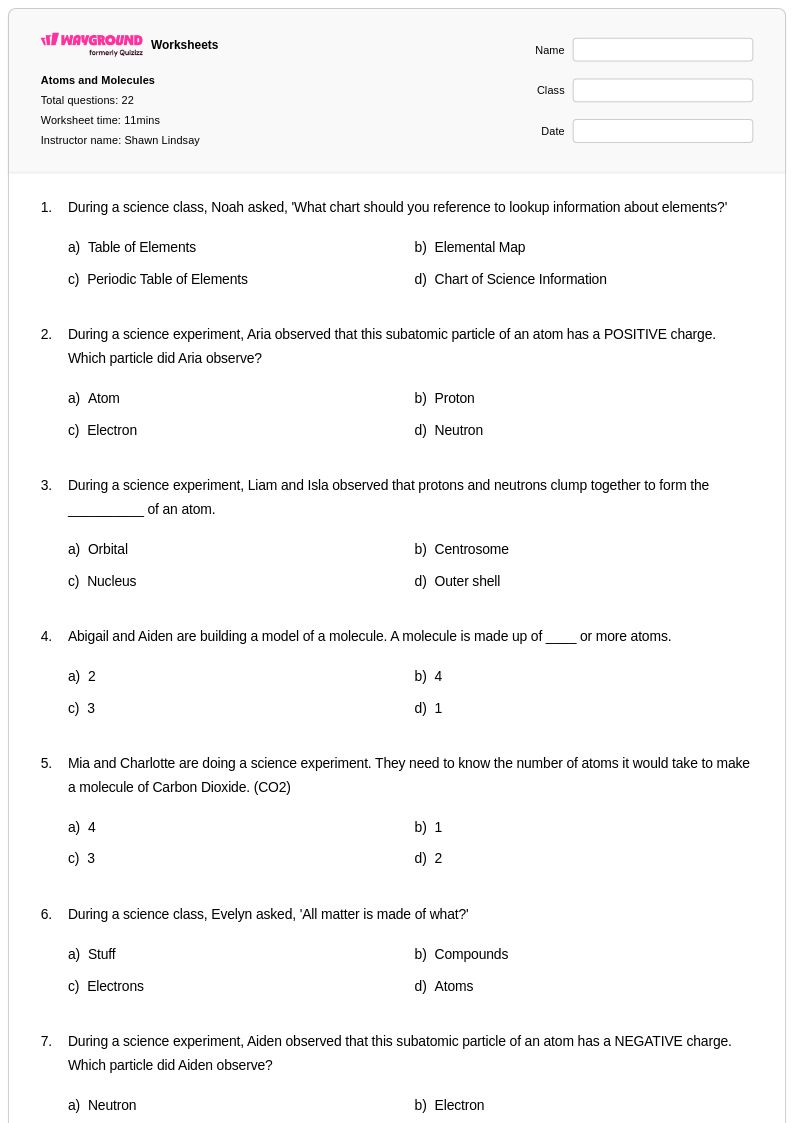
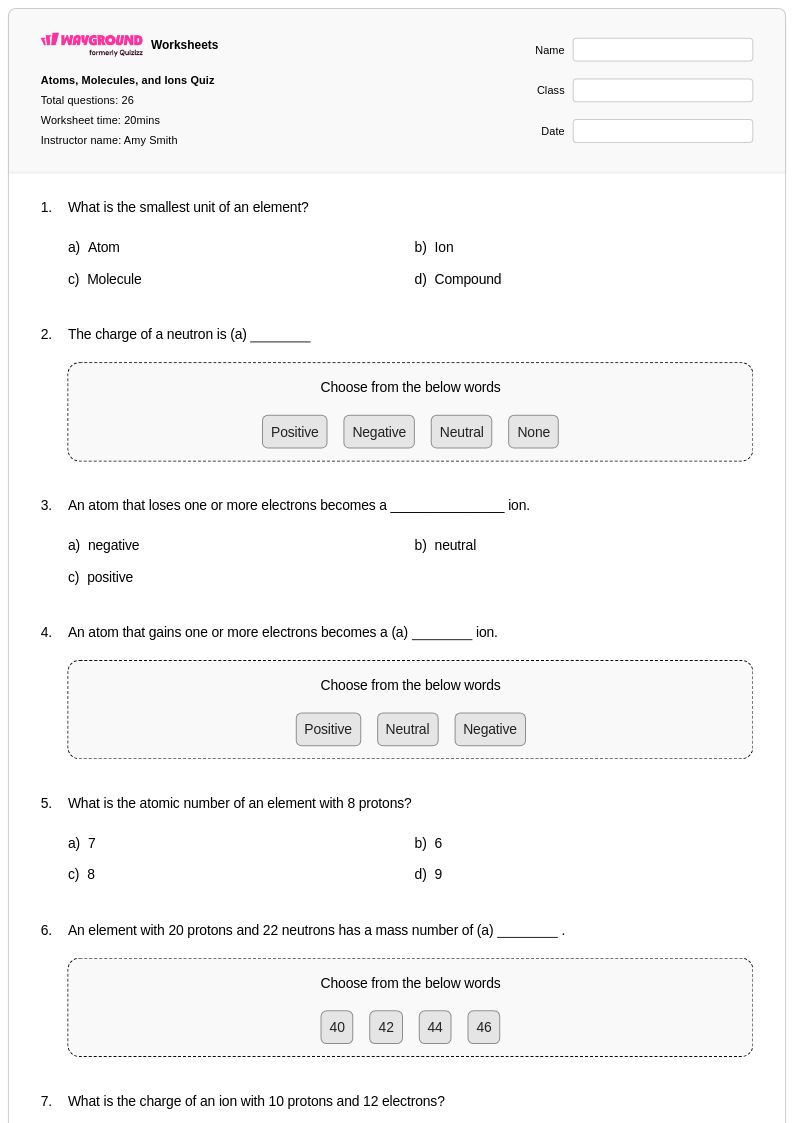
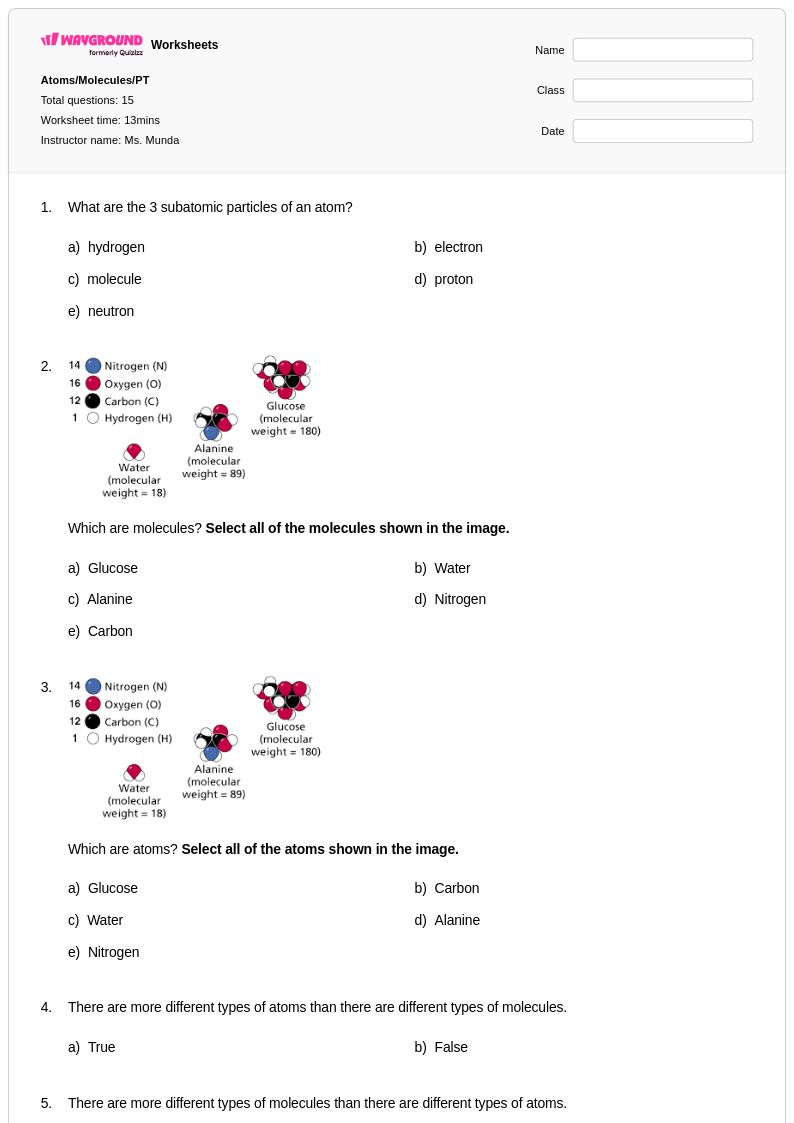
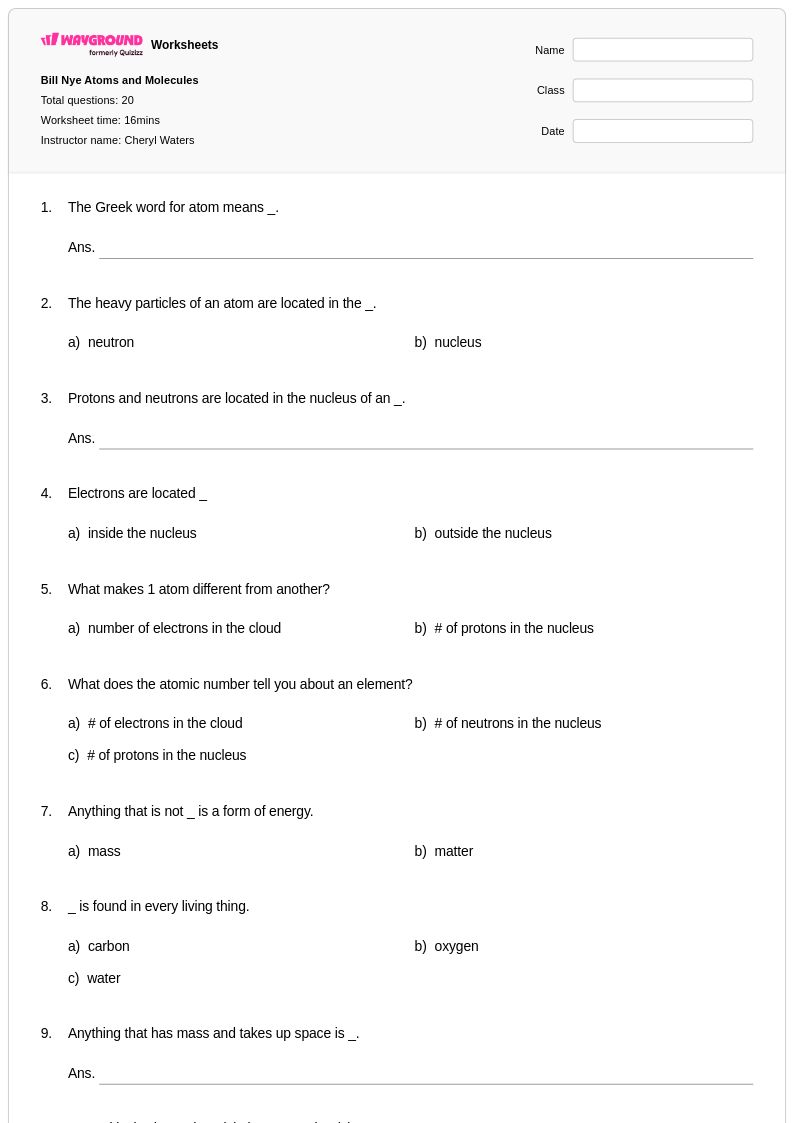
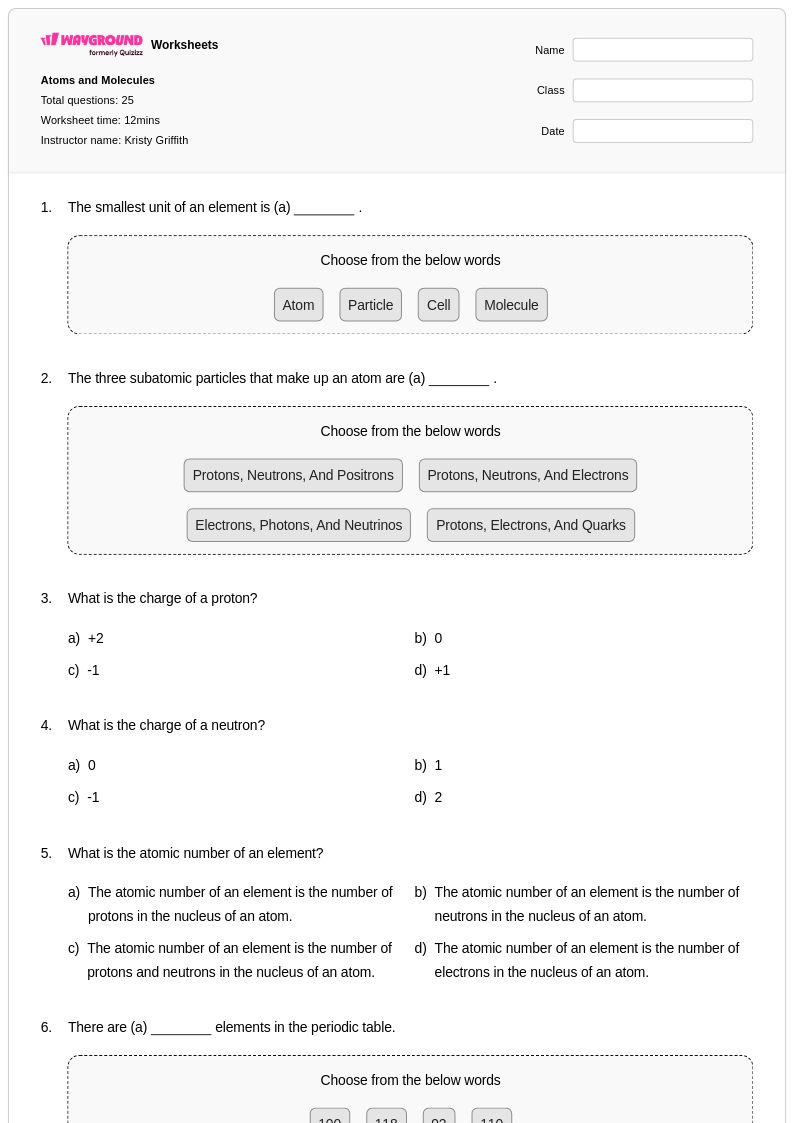
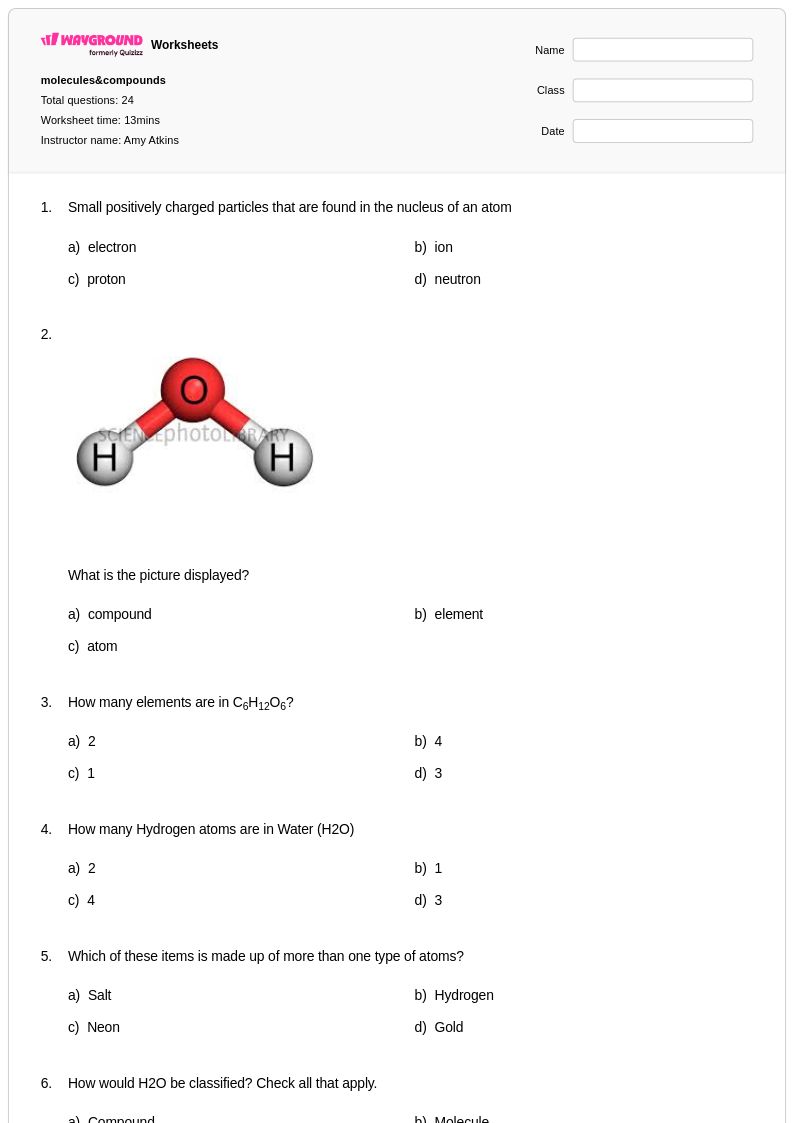
Explore Wayground's free Grade 8 molecule worksheets and printables that help students master chemical structures, molecular formulas, and bonding concepts through engaging practice problems with comprehensive answer keys.
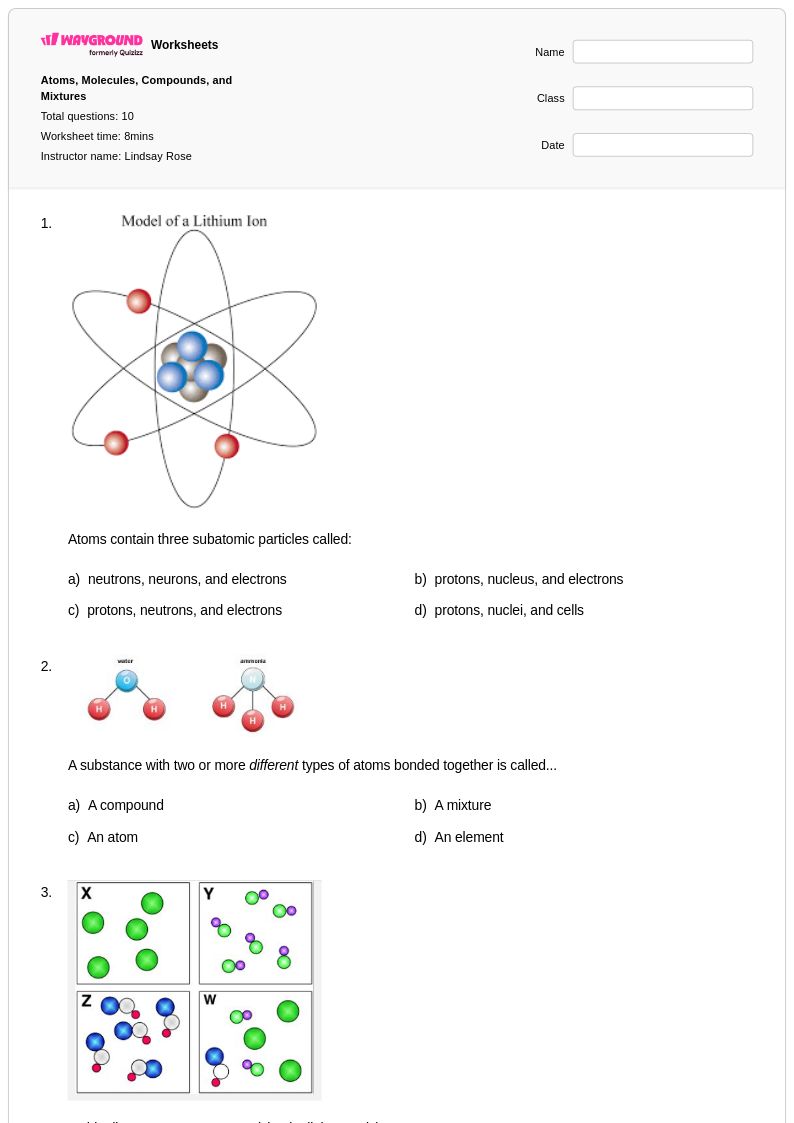
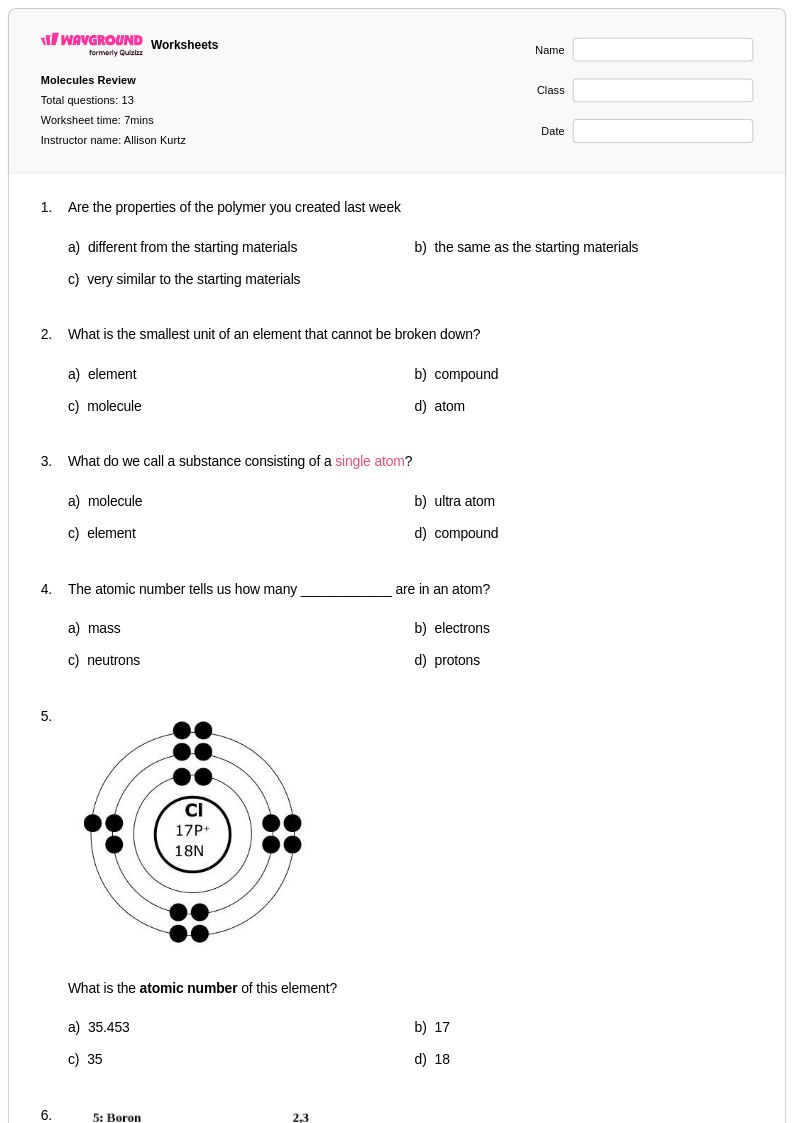
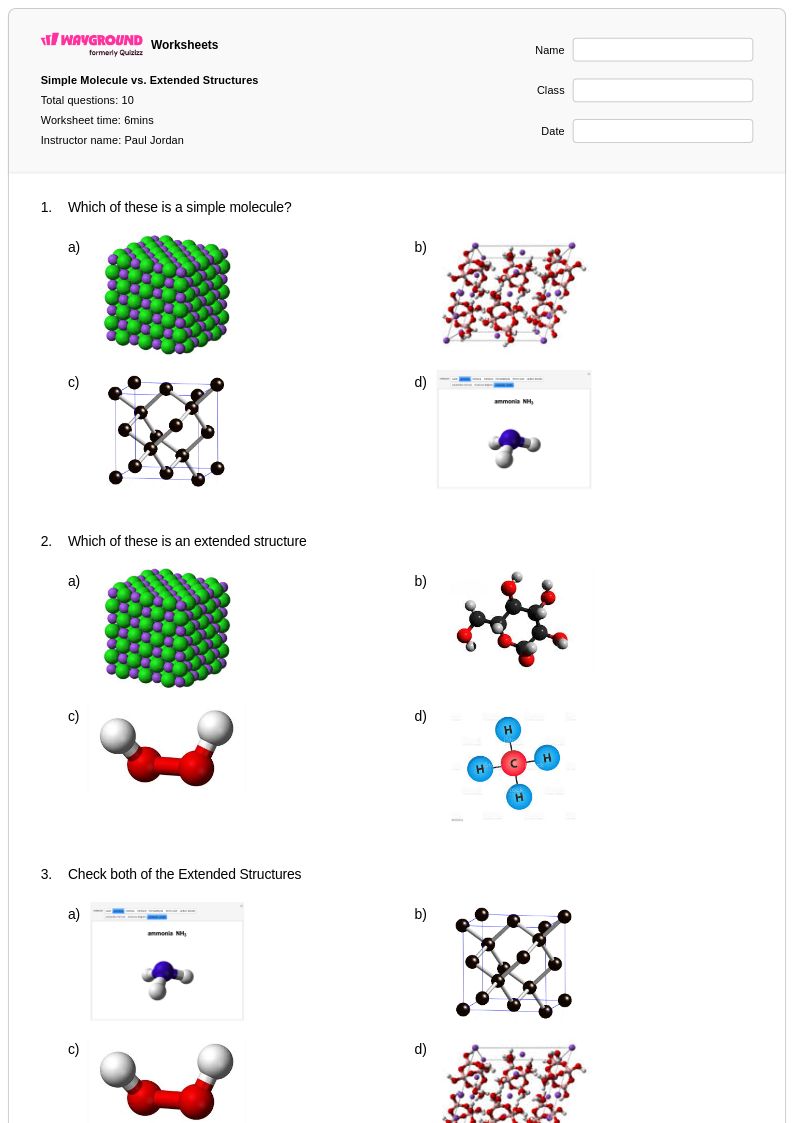
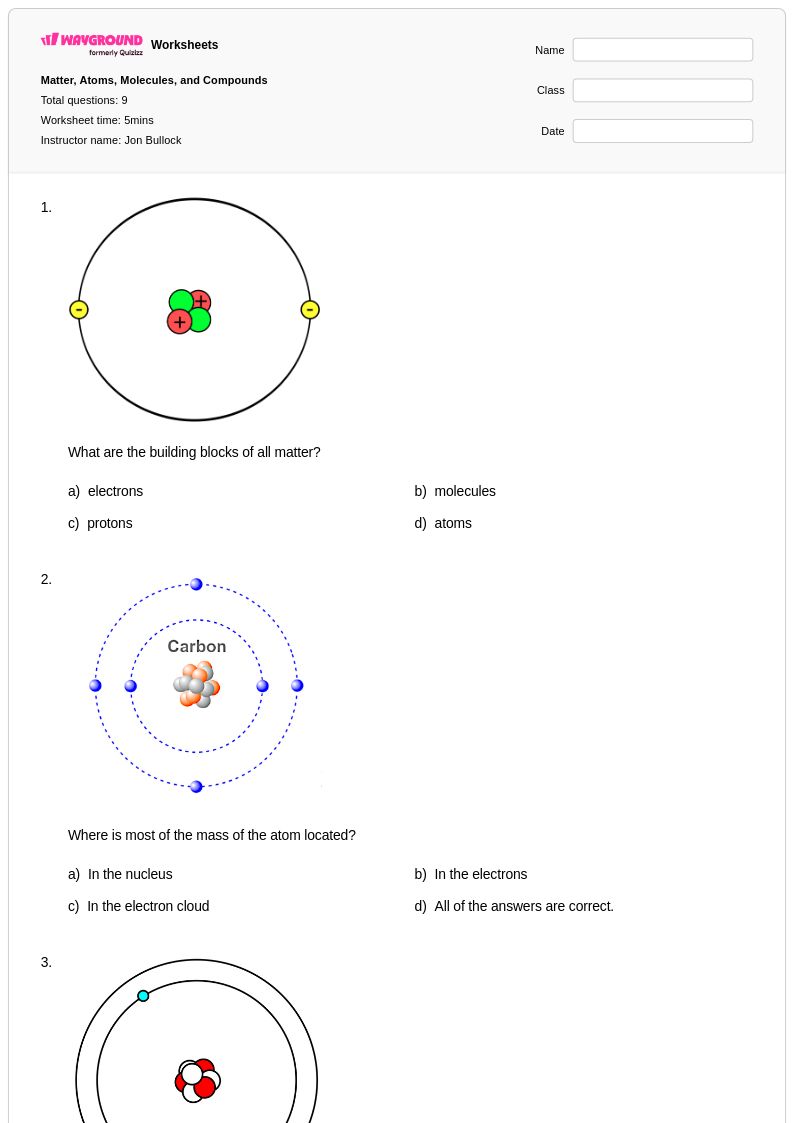
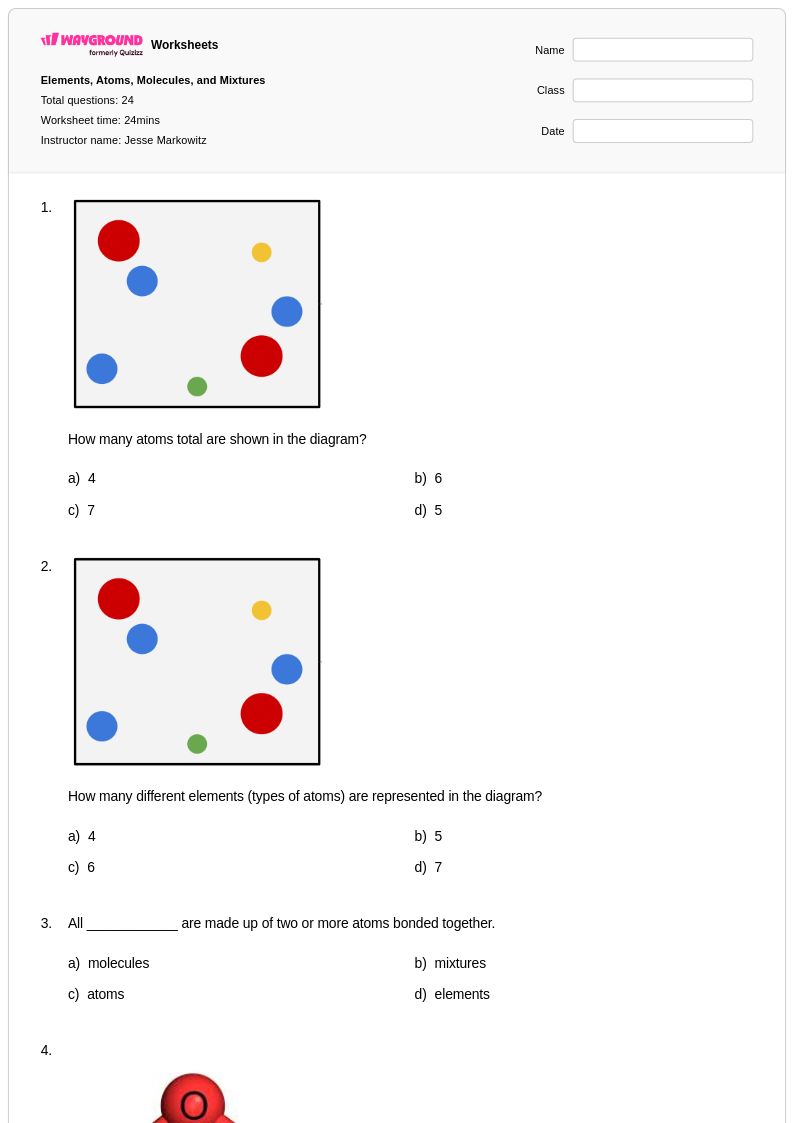
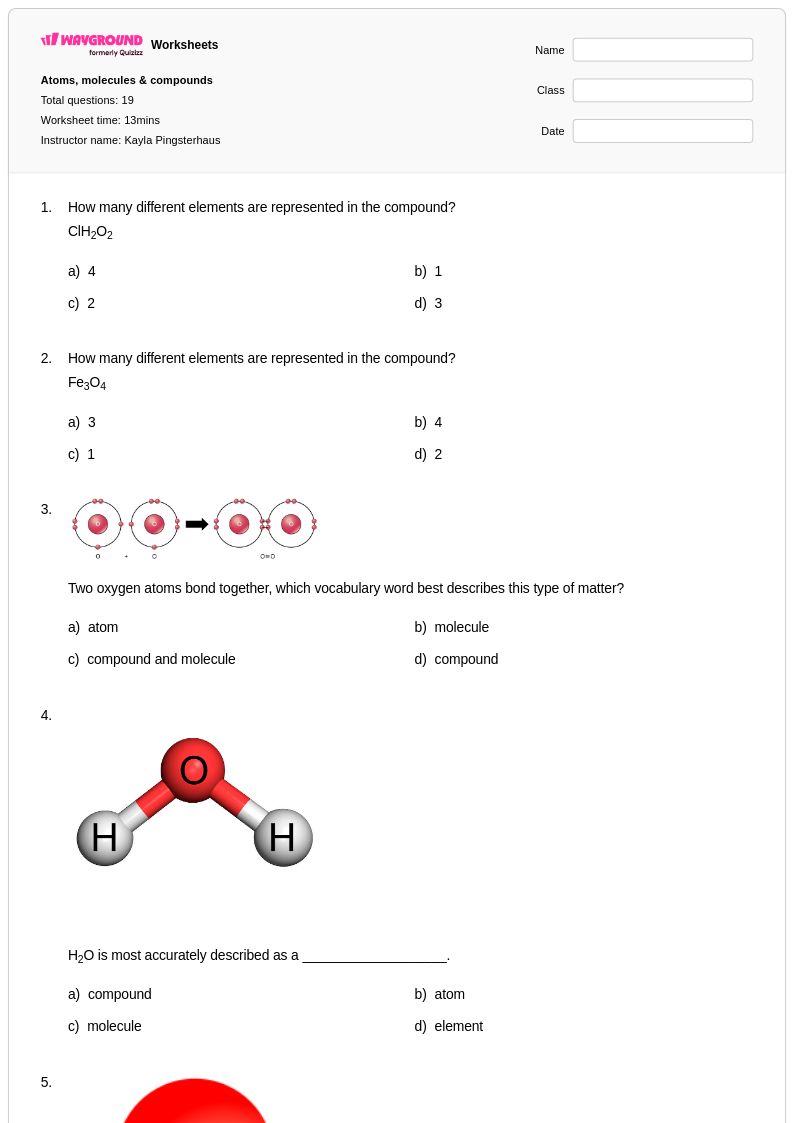
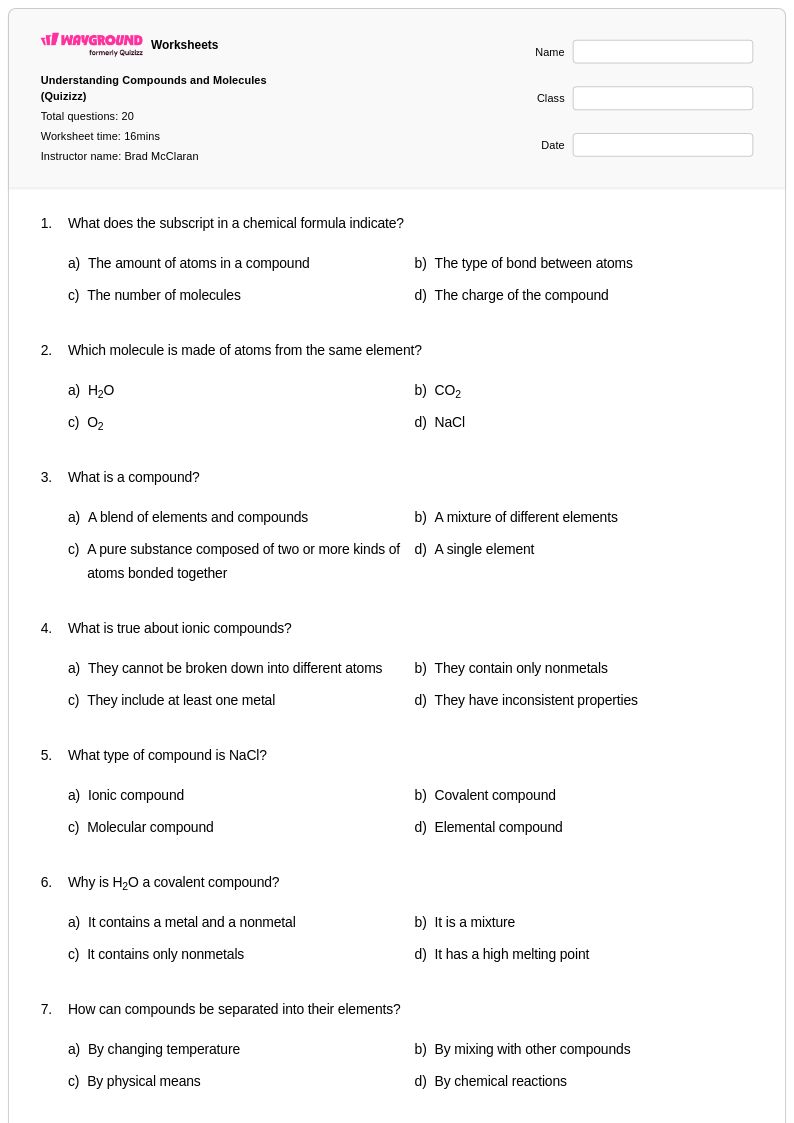
Grade 8 molecule worksheets available through Wayground (formerly Quizizz) provide comprehensive practice materials that help students master fundamental concepts of molecular structure, bonding, and behavior. These expertly designed worksheets strengthen critical chemistry skills including identifying molecular formulas, understanding covalent and ionic bonding patterns, recognizing three-dimensional molecular shapes, and applying knowledge of intermolecular forces. Students work through carefully scaffolded practice problems that progress from basic molecular identification to more complex applications involving molecular polarity and chemical reactions. Each worksheet collection includes detailed answer keys and is available as free printables in convenient pdf format, making it easy for educators to distribute materials and support independent learning both in classroom settings and for homework assignments.
Wayground (formerly Quizizz) empowers teachers with access to millions of teacher-created molecule worksheet resources that can be easily searched, filtered, and customized to meet diverse classroom needs. The platform's robust organizational tools allow educators to quickly locate materials aligned with specific chemistry standards and learning objectives, while built-in differentiation features enable teachers to modify worksheets for various skill levels within their Grade 8 classrooms. These flexible resources are available in both printable and digital formats, including downloadable pdf versions that maintain consistent formatting across devices. Teachers can efficiently plan comprehensive molecule units, provide targeted remediation for struggling students, offer enrichment opportunities for advanced learners, and create focused skill practice sessions that reinforce understanding of molecular concepts through varied problem-solving approaches and visual representations.
FAQs
How do I teach molecular geometry and VSEPR theory to high school chemistry students?
Start by ensuring students have a solid grasp of Lewis structures before introducing VSEPR theory, since molecular shape predictions depend on accurately counting bonding and lone electron pairs. Use physical models or 3D drawing activities to help students visualize geometries like tetrahedral, bent, and trigonal planar. Once students can predict shape, connect geometry to polarity so they understand how molecular structure influences real chemical behavior.
What exercises help students practice drawing Lewis structures correctly?
Effective practice begins with simple diatomic molecules and progresses to polyatomic ions and molecules with expanded octets. Exercises that require students to count valence electrons, place bonds, then distribute lone pairs in a structured sequence reduce systematic errors. Including resonance structure problems and formal charge calculations deepens understanding and prevents students from treating Lewis structures as a purely mechanical drawing task.
What mistakes do students commonly make when identifying molecular formulas and chemical structures?
One of the most frequent errors is confusing molecular formulas with empirical formulas, leading students to misrepresent the actual atom count in a compound. Students also commonly misplace lone pairs when drawing Lewis structures, which cascades into incorrect VSEPR geometry predictions and polarity assessments. Another persistent misconception is assuming that a symmetrical molecular shape always means the molecule is nonpolar, without accounting for electronegativity differences between bonded atoms.
How can I help struggling students understand the difference between ionic and covalent bonding?
Anchor instruction in electronegativity differences: when the difference between two atoms is large, electrons transfer and form an ionic bond; when it is small, electrons are shared and a covalent bond forms. Visual sorting activities where students categorize compound examples by bond type reinforce this distinction. Connecting the concept to observable physical properties, such as melting points and conductivity, gives students a concrete way to verify their reasoning.
How do I use Wayground's molecule worksheets in my chemistry class?
Wayground's molecule worksheets are available as printable PDFs, making them straightforward to distribute for in-class practice, lab preparation, or homework. They are also available in digital formats, so they integrate smoothly into technology-based instruction and remote learning environments. Teachers can host the worksheets as a quiz directly on Wayground, enabling automated grading and immediate student feedback. All worksheets include complete answer keys, which supports independent student review and reduces grading load for teachers.
How can I differentiate molecule worksheets for students with different proficiency levels?
For students who need additional support, Wayground offers built-in accommodation tools including read aloud, reduced answer choices, and extended time, all configurable at the individual student level without notifying the rest of the class. Advanced learners can be assigned problems involving hybridization, molecular orbital theory, or intermolecular forces to extend their understanding beyond foundational concepts. Because accommodation settings are saved per student, teachers do not need to reconfigure them each session, making differentiation practical to maintain over time.