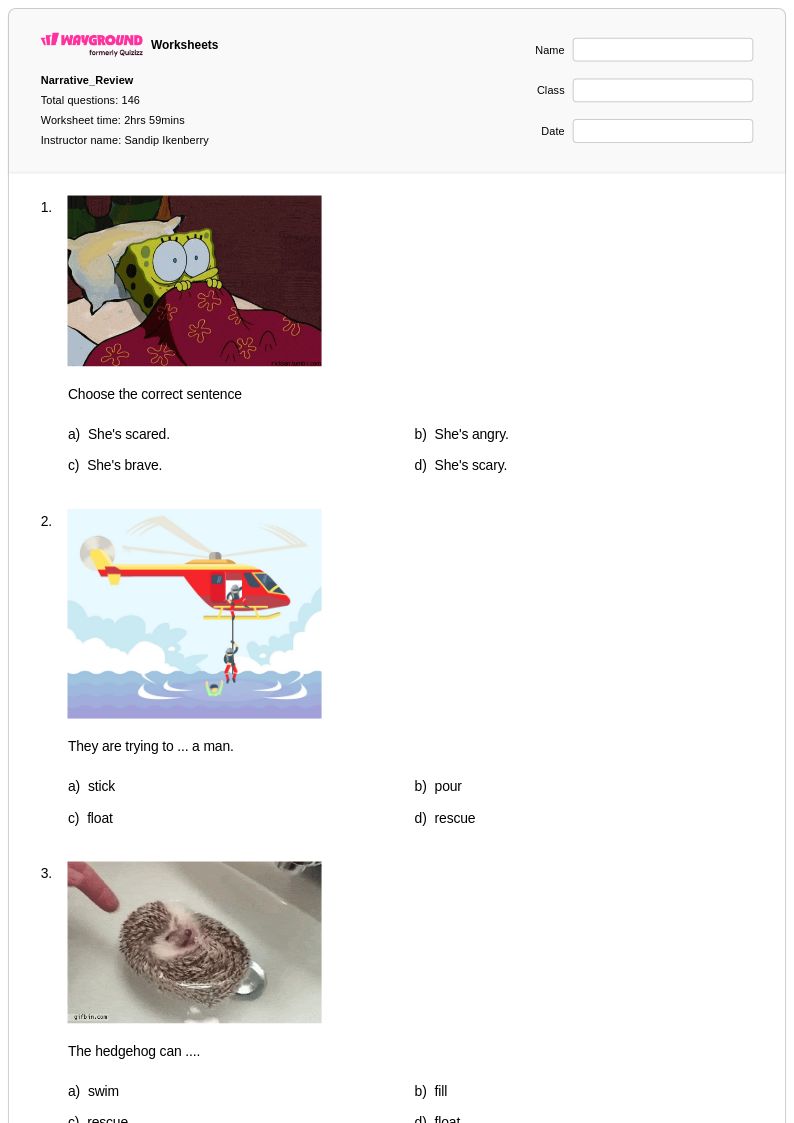
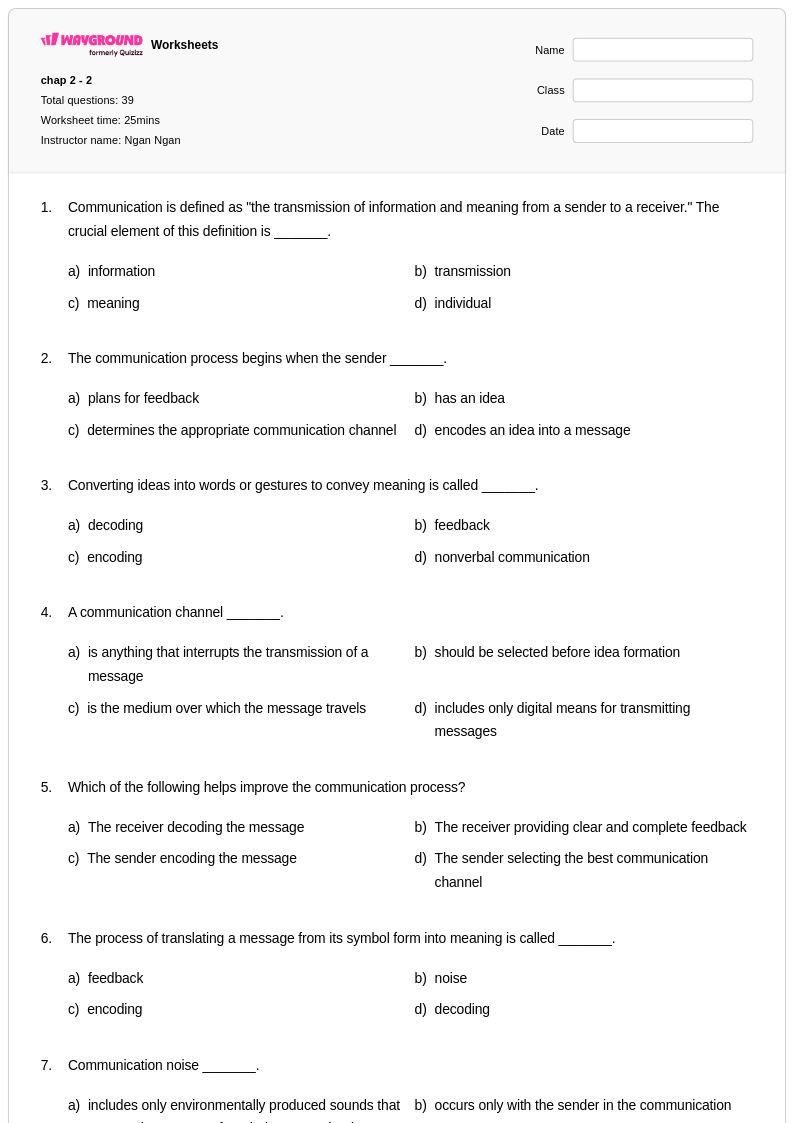
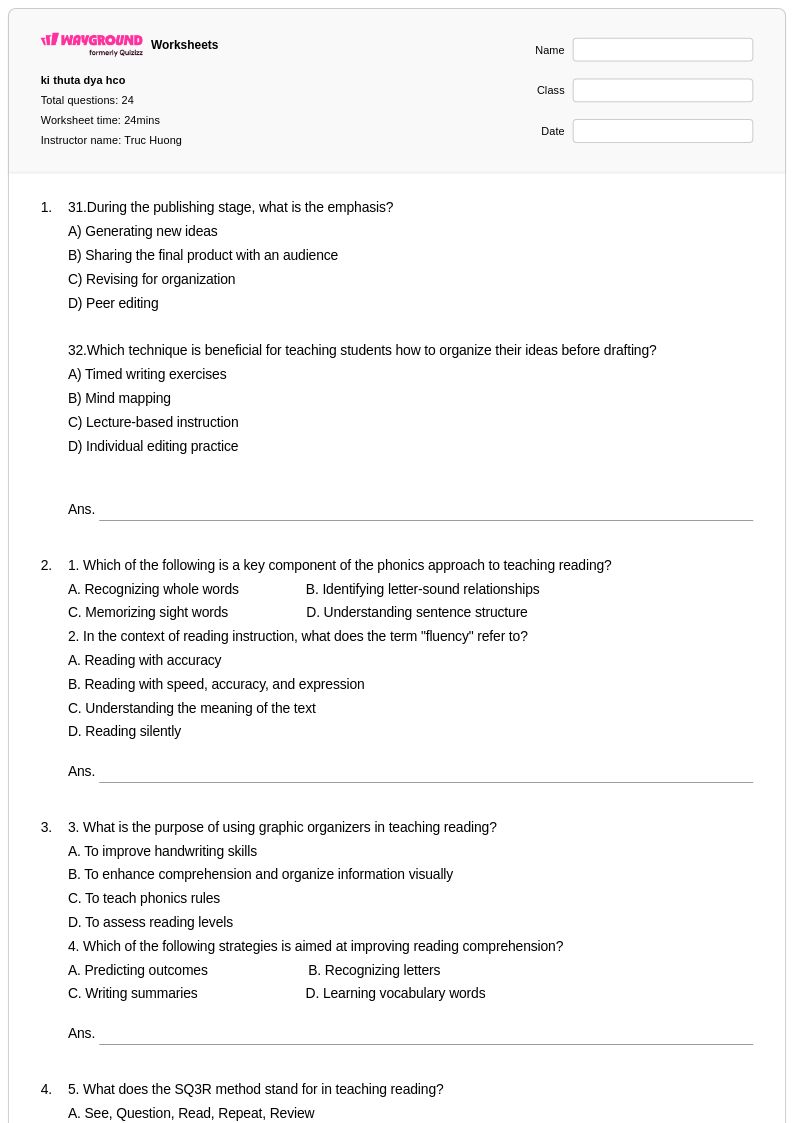
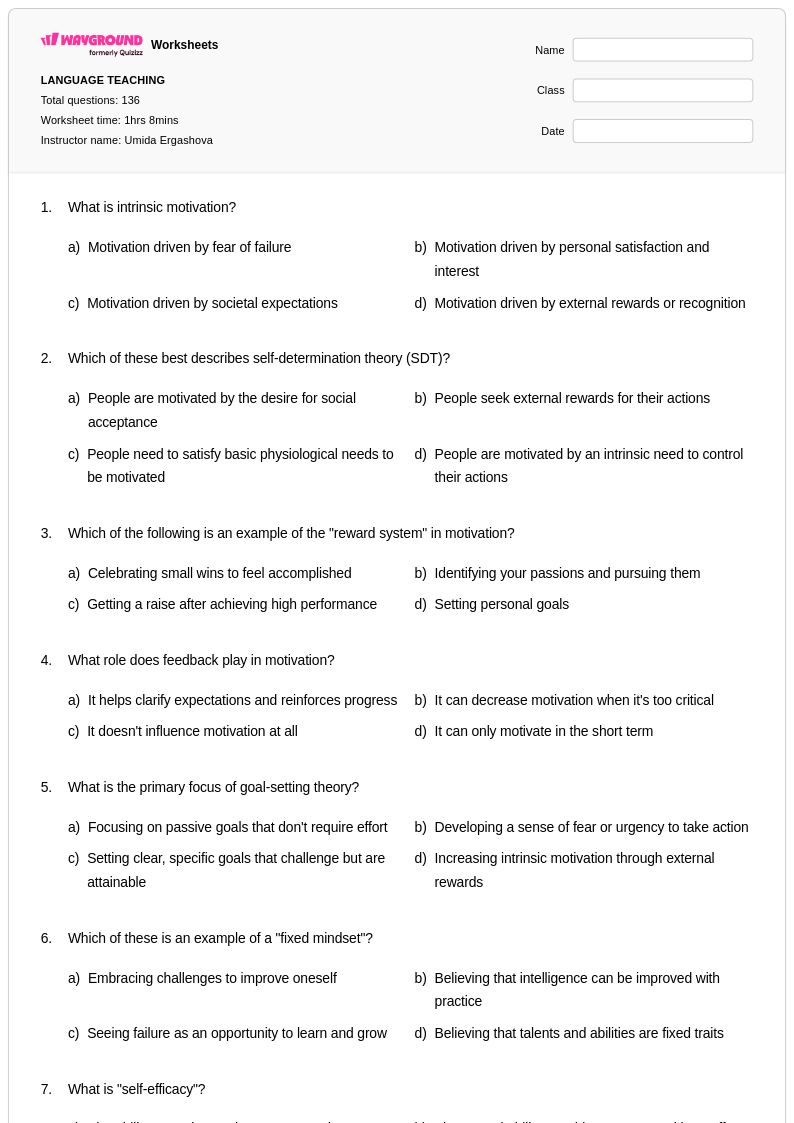
Enhance Grade 1 students' prewriting skills with Wayground's free printable worksheets and practice problems, complete with answer keys to develop essential foundational writing techniques.
Explore printable Prewriting worksheets for Grade 1
Prewriting worksheets for Grade 1 students available through Wayground provide essential foundation-building activities that help young learners develop the critical thinking and organizational skills necessary before they begin actual writing. These carefully designed practice problems guide first graders through the preliminary stages of the writing process, including brainstorming ideas, organizing thoughts, and planning their written work through age-appropriate exercises. The worksheets focus on strengthening pre-writing skills such as generating ideas through picture prompts, creating simple story maps, and practicing basic sequencing activities that prepare students for successful writing experiences. Teachers can access comprehensive answer keys and utilize these free printables to support classroom instruction while helping students build confidence in their ability to plan and organize their thoughts before writing.
Wayground's extensive collection of prewriting resources supports educators with millions of teacher-created materials that can be easily customized to meet diverse classroom needs and individual student requirements. The platform's robust search and filtering capabilities allow teachers to quickly locate grade-appropriate prewriting activities that align with curriculum standards and learning objectives. These versatile worksheets are available in both printable pdf format and digital versions, enabling seamless integration into various instructional settings and learning environments. Teachers can effectively differentiate instruction by selecting from multiple difficulty levels and activity types, making these resources invaluable for planning targeted skill practice, providing remediation for struggling learners, and offering enrichment opportunities for advanced students who need additional prewriting challenges to support their developing literacy skills.
FAQs
How do I teach prewriting strategies to students?
Effective prewriting instruction begins by teaching students that writing is a process, not a single event. Introduce one strategy at a time — starting with brainstorming techniques like mind mapping or free writing, then moving into structured tools like outlines and graphic organizers. Anchor each strategy to a real writing task so students see the direct connection between planning and a stronger final draft. Modeling each technique explicitly before students practice independently is essential, especially for students who struggle with generating or organizing ideas.
What prewriting exercises help students plan their writing more effectively?
The most effective prewriting exercises give students a structured way to externalize their thinking before they write. Graphic organizers, mind maps, and outlining worksheets help students sort ideas, identify supporting details, and establish a clear direction for their writing. Audience analysis exercises and questioning techniques (who, what, why, how) are particularly useful for teaching students to think beyond their own perspective. Repeated practice with varied formats builds the habit of planning, which significantly reduces writer's block and improves draft quality.
What mistakes do students commonly make during the prewriting stage?
The most common mistake students make is skipping prewriting entirely and jumping straight into drafting, which typically results in disorganized or underdeveloped writing. Students also frequently confuse brainstorming with planning — generating a list of ideas but not evaluating or organizing them. Another common error is prewriting too narrowly, selecting a topic without considering whether they have enough to say about it. Teachers should watch for students who fill out a graphic organizer mechanically without connecting it to their actual writing, as this suggests they don't yet understand the purpose of the planning stage.
How can I use prewriting worksheets in my classroom?
Prewriting worksheets on Wayground are available as printable PDFs and in digital formats, making them suitable for traditional classroom instruction, hybrid learning, or fully remote settings. Teachers can print them for guided in-class practice or assign the digital version for independent work, including as a hosted quiz on Wayground. Using these worksheets as a consistent pre-draft routine helps students internalize the planning process over time rather than treating it as a one-time exercise.
How do I differentiate prewriting instruction for students at different skill levels?
For struggling writers, provide heavily scaffolded graphic organizers with sentence starters or partially completed examples that reduce the cognitive load of generating ideas from scratch. Advanced students benefit from less structured formats that push them toward independent planning decisions, such as blank outlining templates or open-ended audience analysis prompts. On Wayground, teachers can apply individual accommodations such as read aloud, reduced answer choices, and extended time to support students with learning differences without disrupting the rest of the class.
At what grade level should prewriting strategies be introduced?
Prewriting strategies should be introduced as early as kindergarten and first grade through simple picture planning and oral storytelling before writing. By second and third grade, students can begin using basic graphic organizers and brainstorming lists. More sophisticated techniques such as outlining, topic selection frameworks, and audience analysis are typically introduced in upper elementary and middle school, where writing assignments become more complex and structured. Because prewriting supports writing development across all content areas, it remains a relevant instructional focus through high school.