Free Printable Properties of Materials Worksheets for Grade 11
Explore Grade 11 Properties of Materials worksheets and printables from Wayground that help students master material characteristics through engaging practice problems, free PDF downloads, and comprehensive answer keys.
Explore printable Properties of Materials worksheets for Grade 11
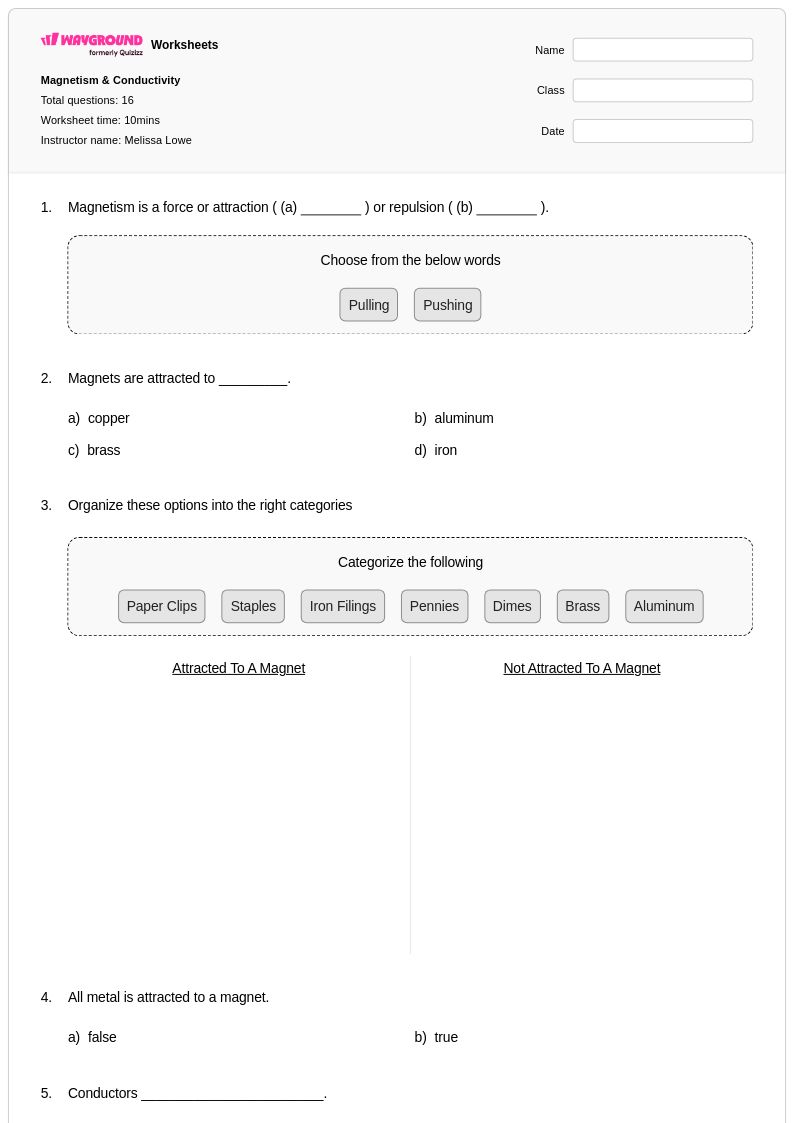
Properties of Materials worksheets for Grade 11 students available through Wayground (formerly Quizizz) provide comprehensive coverage of fundamental concepts in materials science that bridge chemistry and physics principles. These expertly designed resources help students master critical skills including analyzing mechanical properties like tensile strength and elasticity, understanding thermal and electrical conductivity patterns, and exploring the relationship between atomic structure and macroscopic material behavior. Each worksheet collection includes detailed answer keys and practice problems that guide students through complex topics such as stress-strain relationships, crystal lattice structures, and the classification of materials as metals, ceramics, polymers, and composites. The free printable pdf formats ensure accessibility while maintaining the academic rigor necessary for advanced high school physics coursework.
Wayground (formerly Quizizz) empowers educators with millions of teacher-created resources specifically designed for Grade 11 Properties of Materials instruction, featuring robust search and filtering capabilities that align with national and state physics standards. Teachers can easily differentiate instruction through customizable worksheets that accommodate varying skill levels, from foundational concept reinforcement to advanced problem-solving challenges involving material selection for engineering applications. The platform's flexible digital and printable pdf formats streamline lesson planning while supporting diverse classroom needs, whether for initial skill practice, targeted remediation of misconceptions about material properties, or enrichment activities that connect theoretical knowledge to real-world applications in construction, electronics, and manufacturing industries. These comprehensive tools enable educators to effectively assess student understanding of how atomic bonding influences material characteristics and mechanical behavior.
FAQs
How do I teach properties of materials to my students?
Start by grounding instruction in observable, hands-on comparisons — have students physically test materials for hardness, flexibility, and conductivity before introducing formal vocabulary. From there, connect molecular structure to macroscopic behavior so students understand why materials behave as they do. Organizing instruction around classification tasks (natural vs. synthetic, conductor vs. insulator) helps students build a transferable framework they can apply to unfamiliar materials.
What practice exercises help students understand properties of materials?
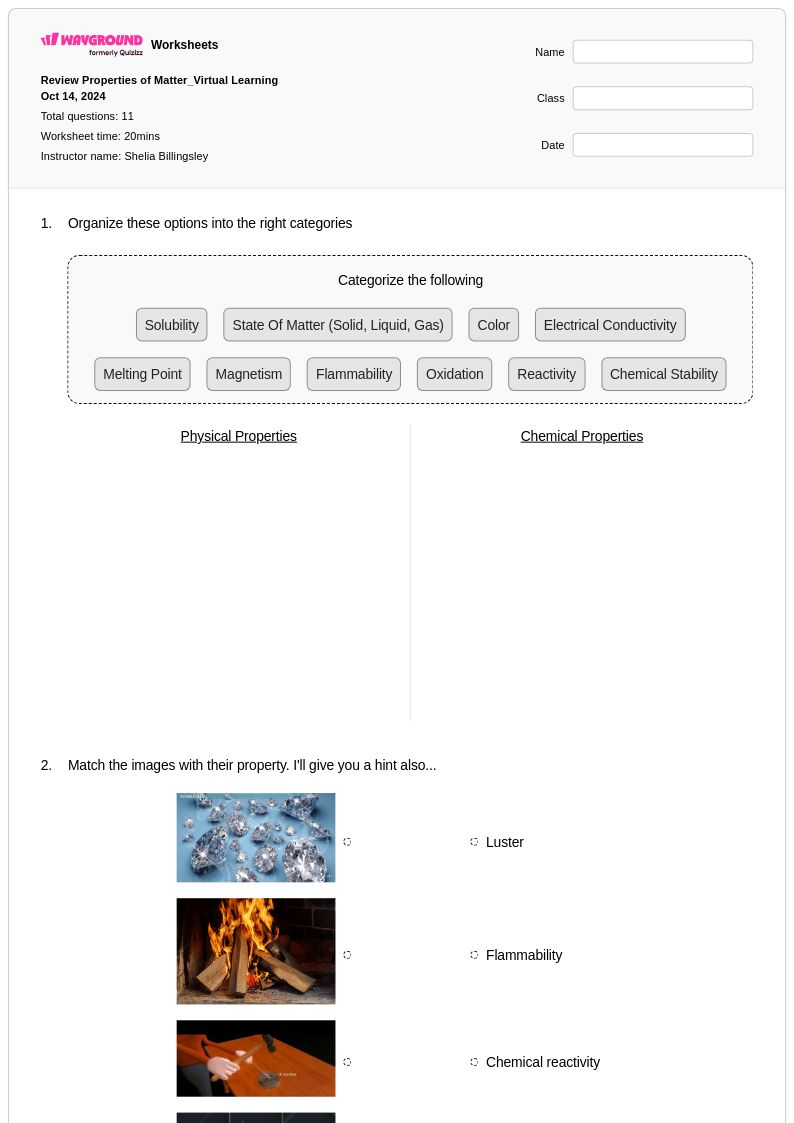
Effective practice includes classification tasks where students sort materials by observable properties such as density, magnetism, and thermal conductivity, as well as comparative analysis exercises that ask students to evaluate trade-offs between natural and synthetic substances. Problems that link molecular structure to macroscopic properties deepen conceptual understanding beyond simple memorization. Repeated exposure to varied material types across different practice formats helps students internalize the criteria used to distinguish materials scientifically.
What mistakes do students commonly make when learning about properties of materials?
A frequent misconception is conflating weight and density — students often assume heavier objects are always denser, regardless of volume. Students also tend to treat properties like conductivity as binary rather than as a spectrum, which leads to oversimplified conclusions. Another common error is confusing physical properties (observable without changing the substance) with chemical properties (revealed only through reactions), which creates persistent confusion in later chemistry and materials science contexts.
How can I differentiate properties of materials instruction for students with different learning needs?
For students who need additional support, reduce the number of material categories they are asked to compare at one time and build in scaffolded vocabulary before introducing classification tasks. On Wayground, teachers can assign accommodations such as Read Aloud for students who need questions read to them, reduced answer choices to lower cognitive load, and extended time — all configurable per student without affecting the rest of the class. Advanced learners can be extended into phase transitions, material engineering trade-offs, or the relationship between molecular structure and macroscopic performance.
How do I use Wayground's properties of materials worksheets in my classroom?
Wayground's properties of materials worksheets are available as printable PDFs, making them easy to distribute for in-class activities, lab investigations, or homework. They are also available in digital formats, allowing teachers to assign them online and collect responses automatically. Teachers can host any worksheet as a live quiz on Wayground, enabling real-time monitoring of student progress. Each worksheet includes a complete answer key, so grading and review require minimal preparation time.
How do I assess student understanding of properties of materials?
Look for whether students can accurately classify an unfamiliar material using measurable criteria rather than guessing based on appearance alone — this reveals whether they have internalized the concept or simply memorized examples. Formative tasks that ask students to predict how a material will behave under a new condition (e.g., increased temperature or applied force) are particularly diagnostic. Comparative analysis problems, where students must justify their classifications with evidence, are effective for identifying gaps in reasoning.