Free Printable Reading Syringes Worksheets for Grade 7
Enhance Grade 7 students' measurement skills with our free reading syringes worksheets, featuring printable PDF practice problems and comprehensive answer keys to master accurate liquid volume measurements in scientific experiments.
Explore printable Reading Syringes worksheets for Grade 7
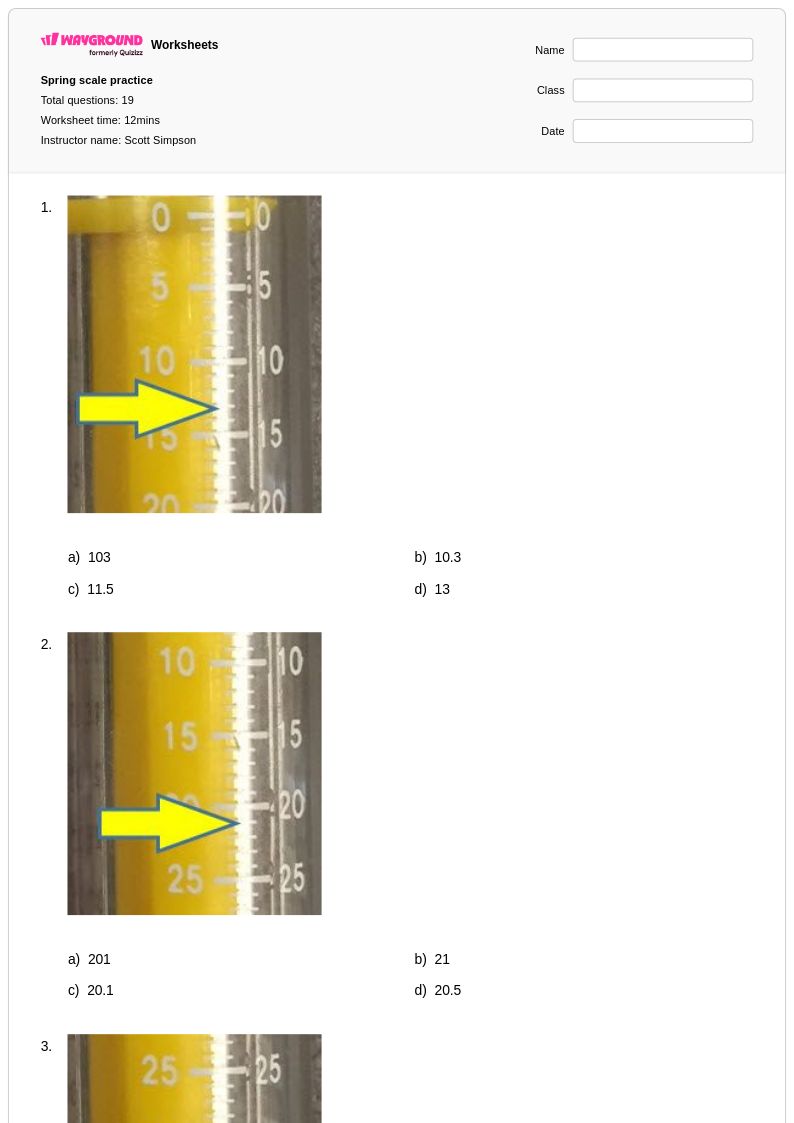
Reading syringes worksheets for Grade 7 students available through Wayground (formerly Quizizz) provide essential practice in measurement precision and scientific instrumentation skills. These comprehensive resources focus on developing students' ability to accurately interpret graduated markings, determine appropriate measurement intervals, and read liquid volumes to the correct number of significant figures using various syringe types and scales. The worksheets strengthen critical laboratory skills including proper meniscus reading, understanding measurement uncertainty, and applying appropriate rounding rules when recording syringe measurements. Students engage with practice problems that range from basic volume readings to more complex scenarios involving different syringe capacities and graduation increments, with answer keys provided to support independent learning and self-assessment. These free printable resources serve as valuable pdf downloads that reinforce the foundational measurement concepts essential for scientific experimentation and data collection.
Wayground (formerly Quizizz) empowers educators with access to millions of teacher-created resources specifically designed for reading syringes instruction, featuring robust search and filtering capabilities that allow teachers to quickly locate materials aligned with their curriculum standards and student needs. The platform's differentiation tools enable instructors to customize worksheets based on individual student proficiency levels, while flexible formatting options provide both printable pdf versions for traditional classroom use and digital formats for online learning environments. These comprehensive collections support diverse instructional approaches including guided practice sessions, independent skill remediation, and enrichment activities for advanced learners. Teachers can efficiently plan targeted instruction by selecting from worksheets that progress systematically from basic syringe reading to advanced measurement scenarios, ensuring students develop the precision and confidence necessary for successful laboratory work and scientific measurement tasks.
FAQs
How do I teach students to read a syringe accurately?
Start by ensuring students understand how graduated markings work on a syringe, emphasizing that the scale reads from the tip toward the plunger. Teach students to identify the unit of each graduation mark before attempting any reading, then practice locating the meniscus and reading at eye level. Progressing from whole-number increments to decimal readings builds confidence and precision over time.
What exercises help students practice reading syringes?
Worksheet problems that show labeled syringe diagrams at varying volumes are highly effective, especially when they require students to record readings in both milliliters and cubic centimeters. Practice sets should range from basic whole-number readings to values that fall between graduation marks, requiring estimation and decimal reasoning. Mixing syringe sizes within a single worksheet also helps students adapt to different measurement scales.
What mistakes do students commonly make when reading syringes?
The most frequent error is misidentifying the value of each graduation mark, particularly on syringes where one division represents 0.2 mL rather than 0.1 mL or 0.5 mL. Students also commonly read from the wrong end of the scale or fail to account for the meniscus, reading the top of the curve instead of the bottom. Reinforcing the habit of first determining the increment between marks before recording any reading reduces these errors significantly.
How do I differentiate syringe reading practice for students with different skill levels?
Begin lower-level students on large syringes with wide, clearly spaced graduation marks and whole-number readings before introducing smaller syringes with finer decimal increments. For students who need additional support, Wayground allows teachers to enable Read Aloud for question text and reduce the number of answer choices displayed, lowering cognitive load without singling those students out. Advanced students can be challenged with problems requiring multi-step volume calculations or conversions between mL and cc.
How do I use Reading Syringes worksheets from Wayground in my classroom?
Wayground's Reading Syringes worksheets are available as printable PDFs for traditional classroom use and in digital formats for technology-integrated environments, giving teachers flexibility for lab prep sessions, homework, or assessment. Teachers can also host the worksheet as a live quiz on Wayground, enabling real-time tracking of student responses and instant feedback. Answer keys are included with every worksheet, making self-correction and guided review straightforward.
Are reading syringes worksheets appropriate for both science and healthcare courses?
Yes, syringe reading is a foundational skill in both laboratory science and allied health education, making these worksheets cross-disciplinary. In science contexts, the focus tends to be on volume measurement, precision, and scientific notation, while healthcare courses emphasize dosage accuracy and unit conversions between mL and cc. Worksheets that cover a range of syringe sizes and measurement scenarios serve both audiences effectively.