Free Printable Reciprocal Teaching Worksheets for Grade 6
Enhance Grade 6 students' reciprocal teaching skills with Wayground's free printable worksheets and practice problems, complete with PDF downloads and answer keys for comprehensive reading comprehension development.
Explore printable Reciprocal Teaching worksheets for Grade 6
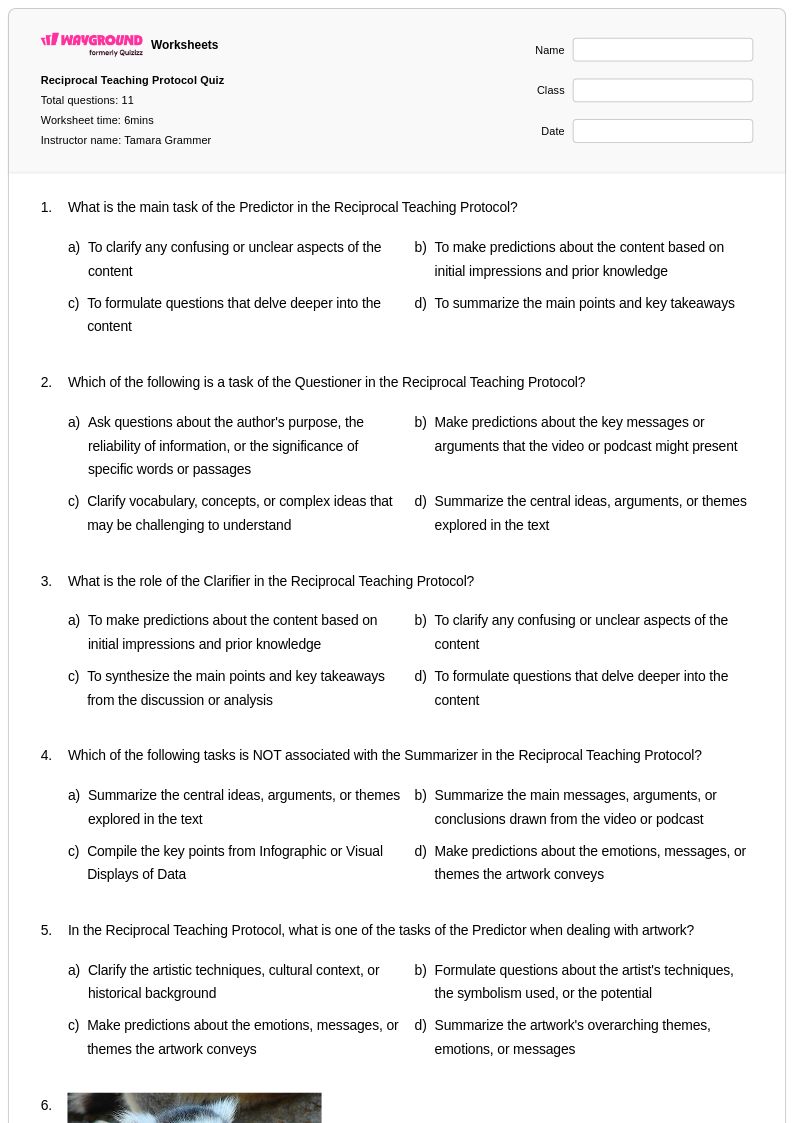
Reciprocal Teaching for Grade 6 students transforms reading comprehension through structured peer collaboration and strategic dialogue. Wayground's comprehensive collection of reciprocal teaching worksheets empowers sixth-grade learners to master the four essential strategies: predicting, questioning, clarifying, and summarizing. These carefully crafted practice problems guide students through interactive reading sessions where they take turns leading discussions and teaching each other, building both comprehension skills and confidence. Each worksheet includes detailed answer keys and step-by-step guidance, making implementation seamless for educators. Available as free printables and downloadable pdf resources, these materials strengthen critical thinking abilities while fostering collaborative learning environments where students actively engage with complex texts and develop metacognitive awareness of their reading processes.
Wayground's extensive library, featuring millions of teacher-created resources, provides educators with unparalleled access to high-quality reciprocal teaching materials specifically designed for Grade 6 reading comprehension development. The platform's advanced search and filtering capabilities allow teachers to quickly locate worksheets aligned with specific reading standards and learning objectives, while built-in differentiation tools enable customization for diverse learning needs and reading levels. Whether accessed in printable format for classroom activities or utilized digitally for remote learning, these resources support comprehensive lesson planning and targeted skill practice. Teachers can seamlessly integrate these materials into their instruction for initial concept introduction, focused remediation sessions, or enrichment activities, ensuring every sixth-grade student develops the collaborative discussion skills and strategic reading approaches essential for academic success across all subject areas.
FAQs
How do I teach reciprocal teaching in my classroom?
Reciprocal teaching is introduced by explicitly modeling each of the four roles: questioning, summarizing, clarifying, and predicting. Begin with whole-class practice where you demonstrate each role using a shared text, then gradually release responsibility to student-led small groups. Scaffolded worksheets that prompt students through each role help bridge the gap between teacher modeling and independent peer-led discussion.
What are the four components of reciprocal teaching and why do they matter?
The four components are predicting, questioning, clarifying, and summarizing. Predicting activates prior knowledge before reading; questioning pushes students to engage critically with the text; clarifying targets confusing vocabulary or concepts; and summarizing consolidates understanding after reading. Together, these strategies build metacognitive awareness, which research consistently links to stronger reading comprehension outcomes.
What activities help students practice the reciprocal teaching strategy?
Structured worksheet activities that assign each student a specific role within a small group are highly effective for practicing reciprocal teaching. Practice problems that require students to generate questions, write summaries, identify unclear passages, and make text-based predictions give them repeated exposure to each skill in isolation before integrating all four roles. Rotating roles across sessions ensures every student develops proficiency in each strategy.
What mistakes do students commonly make when learning reciprocal teaching?
The most common error is surface-level engagement: students generate yes/no questions instead of inferential ones, or write retells rather than true summaries. In the clarifying role, students often skip over genuinely confusing text rather than flagging it honestly. Worksheets that explicitly model the difference between a retell and a summary, or between a recall question and a higher-order question, help students self-correct these patterns before they become habits.
How do I differentiate reciprocal teaching for struggling readers?
For struggling readers, reducing the complexity of the assigned text while keeping the four-role structure intact preserves the strategy's integrity without overwhelming students. Sentence starters and graphic organizers on worksheets can scaffold each role so students focus on the thinking process rather than the writing demand. On Wayground, teachers can also enable Read Aloud and adjust font sizes through reading mode, supporting students who need additional accessibility accommodations during digital practice.
How do I use Wayground's reciprocal teaching worksheets in my classroom?
Wayground's reciprocal teaching worksheets are available as printable PDFs, making them easy to distribute for small-group or whole-class instruction, and in digital formats that support technology-integrated classrooms. Teachers can also host them as a quiz directly on Wayground, enabling real-time tracking of student responses. The included answer keys allow teachers to facilitate discussion efficiently and provide immediate feedback on student reasoning across all four reciprocal teaching roles.