Explore Wayground's free printable worksheets and practice problems designed to help students master recognizing triggers in social situations, complete with answer keys and downloadable PDFs for effective social skills development.
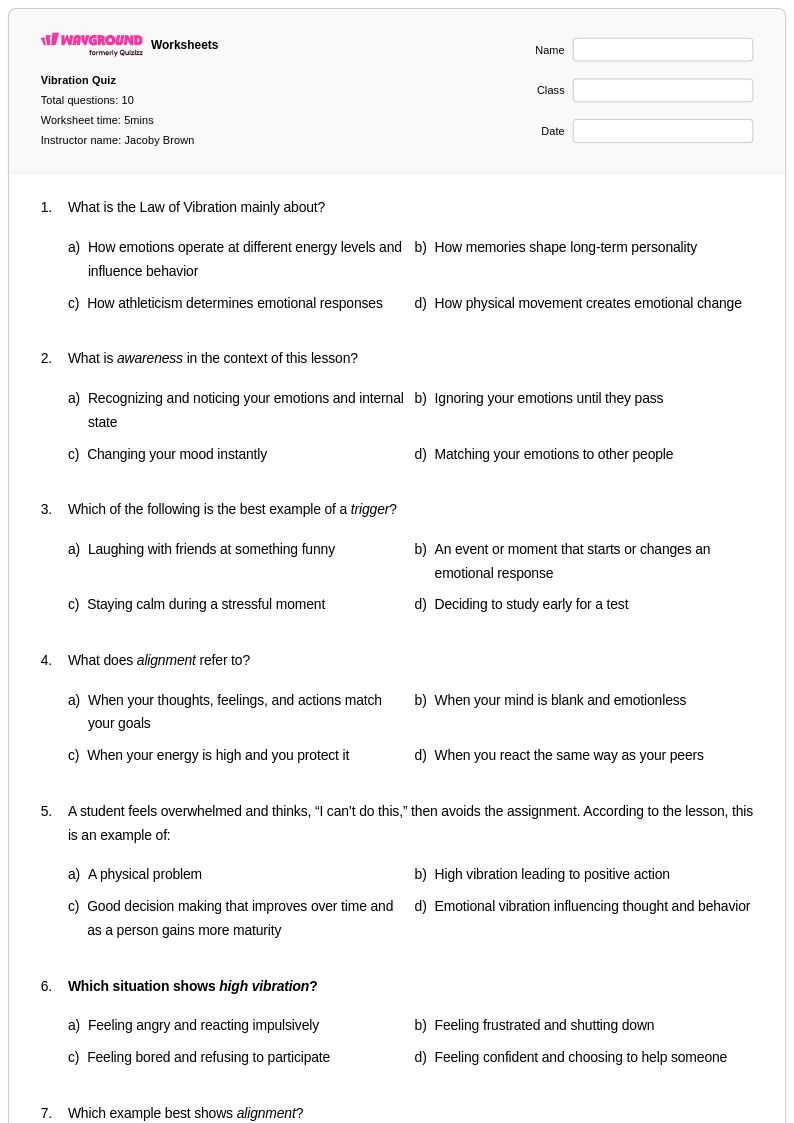
Recognizing triggers worksheets available through Wayground (formerly Quizizz) provide students with essential practice in identifying emotional and behavioral catalysts that can lead to challenging social situations. These comprehensive resources strengthen critical self-awareness skills by helping learners recognize personal warning signs, environmental factors, and interpersonal dynamics that may provoke strong emotional responses. The worksheets feature scenario-based practice problems that guide students through real-world situations, teaching them to pause and reflect before reacting. Each printable resource includes detailed answer keys that support both independent learning and guided instruction, while the free pdf format ensures accessibility for diverse classroom needs and home practice sessions.
Wayground (formerly Quizizz) empowers educators with millions of teacher-created resources specifically designed to support social skills development and emotional regulation instruction. The platform's robust search and filtering capabilities allow teachers to quickly locate age-appropriate materials that align with social-emotional learning standards and individual student needs. Differentiation tools enable instructors to customize worksheets for varying ability levels, while the availability of both printable and digital formats, including downloadable pdfs, provides flexibility for diverse learning environments. These features streamline lesson planning by offering ready-to-use materials for skill practice, targeted remediation for students who struggle with emotional regulation, and enrichment opportunities for learners ready to explore more complex trigger recognition scenarios.
FAQs
How do I teach students to recognize their emotional triggers?
Teaching students to recognize emotional triggers begins with building self-awareness through structured reflection. Introduce common trigger categories such as personal sensitivities, environmental cues, and interpersonal dynamics, then use scenario-based activities to help students identify warning signs before a strong emotional response occurs. Consistent practice with real-world situations helps students internalize the pause-and-reflect habit that is central to emotional regulation.
What exercises help students practice identifying triggers in social situations?
Scenario-based practice problems are among the most effective tools for helping students identify triggers in context. These exercises present realistic social situations and prompt students to pinpoint the specific emotional or behavioral catalyst at play, then consider how they might respond. Repeated exposure to varied scenarios builds pattern recognition and transfers more readily to real-life interactions than abstract instruction alone.
What mistakes do students commonly make when learning to identify their triggers?
A common error is that students conflate the trigger itself with their emotional reaction to it, making it difficult to intervene before escalation occurs. Students also frequently overlook environmental and interpersonal factors, focusing only on obvious personal sensitivities while missing subtler cues. Helping students slow down and systematically examine each layer of a situation, including setting, relationship dynamics, and internal state, corrects this tendency over time.
How can I differentiate trigger recognition activities for students at different skill levels?
For students who are newer to social-emotional learning, start with simple, single-factor scenarios where one clear trigger is present before introducing more complex situations with overlapping dynamics. More advanced learners can be challenged with scenarios requiring them to analyze interpersonal dynamics and anticipate how different responses might escalate or de-escalate a situation. On Wayground, teachers can apply accommodations such as read aloud support and reduced answer choices for students who need additional scaffolding, and these settings carry over across future sessions without disrupting the rest of the class.
How do I use Wayground's recognizing triggers worksheets in my classroom?
Wayground's recognizing triggers worksheets are available as printable PDFs for traditional classroom use and in digital formats for technology-integrated settings, including the option to host them as a quiz directly on Wayground. Each worksheet includes a complete answer key, making them suitable for independent practice, small group instruction, or guided whole-class discussion. The flexibility of both formats means the same resource can be assigned as an in-class activity, homework, or a targeted remediation exercise depending on student need.
At what age or grade level should students begin learning to recognize triggers?
Trigger recognition is a foundational social-emotional skill that can be introduced as early as elementary school using age-appropriate, concrete scenarios and simple language. As students mature, instruction can incorporate more nuanced interpersonal dynamics and abstract emotional vocabulary. Because the skill builds progressively, revisiting trigger recognition at multiple grade levels with increasing complexity reinforces self-awareness as a lifelong habit rather than a one-time lesson.